Sandra Finley

Oct 272016


‘They couldn’t have chosen a worse place for an industrial facility’

by Nika Knight, staff writer

(NOTE:  Search this blog on “Skeena”.  We joined others as long ago as 2007 to protect this River.)

The Skeena River, in British Columbia

The Skeena River, where Canada’s second largest salmon run occurs each year, is to be the site of a liquefied natural gas project worth $11 billion. (Photo: Frank Carter/Getty Images)


In an effort to block a massive liquefied natural gas (LNG) facility that threatens one of Canada’s most critical salmon habitats and the livelihood of local First Nations, several Aboriginal and conservation groups in British Columbia filed multiple lawsuits against the Canadian government in a Vancouver court Thursday.

“We feel like this is the absolutely right thing to do for today and and for future generations. If we lose these salmon runs, we’d lose a critical part of who we are.”

—Greg Knox, SkeenaWild


The Gitwilgyoots tribe of the Lax Kw’alaams, the Gitanyow First Nation, and SkeenaWild Conservation Trust are hoping the last-ditch effort will prevent the project, valued at $11.4 billion CAD, from ever being built.

The facility is to be built near Saint Rupert, B.C., at the mouth of the Skeena River, which hosts Canada’s second largest salmon run. It also falls within Lax Kw’alaams traditional territory on Lelu Island and the adjacent Flora Bank, as Common Dreams reported.


“They couldn’t have chosen a worse place for an industrial facility,” Greg Knox, director of SkeenaWild, told Common Dreams in an interview.

The lawsuits allege that the government’s environmental assessments of the project were deeply flawed, and that the impacted First Nations were not adequately consulted.

The Lax Kw’alaams famously turned down a $1 billion payout to approve the project last year and refused to grant approval for the project to move forward. Yet despite such opposition, the federal government went ahead and approved it last month.


“We had a couple meetings in June and July, but the material and research we put forward with respect to this project was minimized or denied,” Chief Malii, chief negotiator for the Gitanyow Hereditary Chiefs, told the Vancouver Metro. “It wasn’t meaningful consultation.”

The suits will name Petronas, the company with a majority stake in the project, as an associated party, the groups told Reuters.

A ceremony was held outside of the courthouse to celebrate the filing:    (short video at the URL)


The plaintiffs were encouraged by the success of a similar legal challenge that defeated Enbridge’s proposed Northern Gateway pipeline, another massive fossil fuel project, earlier this year. The Petronas LNG terminal poses no less a threat to the environment and Aboriginal rights, the groups say.

“The place where they’re proposing the plant is where the young salmon, the juveniles, come,” Knox explained, explaining that the young salmon stay in the area for an extended period in order to adjust to salt water before swimming out to sea. “Anywhere from 300 million to 1 billion juvenile salmon live here for several months of the year,” he said.

Knox noted that because “all of the salmon from a huge watershed” come and live at the river’s mouth for months, the proposed project will significantly impact even those Aboriginal communities hundreds of miles upstream of it, who rely on the fish for sustenance.

Moreover, the conservationist alleged that “the federal Canadian government knew that this was a terrible place for an industrial facility dating back 40 years.”

A government-sponsored study carried out in the 1970s found that “this was the most important salmon habitat on the coast,” he said, and the government concluded that “if a major industrial facility was built, the salmon would be seriously impacted.”

Yet the current government’s environmental assessments for the LNG project concluded that the massive facility would cause “no significant impacts” to fish.

Of the Liberal cabinet’s approval for the project, Knox observed that “so far what we’ve seen is massive lobbying from the oil and gas industry, and the government seems to be caving to their pressure. They’re not following through on their elections promises that they made.”

However, Knox added, “it feels good [to be a part of this fight]. We have a lot of support from these local communities and from the Aboriginal groups that we’re working with. We feel like this is the absolutely right thing to do for today and for future generations. If we lose these salmon runs, we’d lose a critical part of who we are.”

– – –

This work is licensed under a Creative Commons Attribution-Share Alike 3.0 License

Oct 272016
 
Media Blackout as Militarized Police Begin Clearing DAPL Protest Camp

by Deirdre Fulton

‘We will be peaceful, we will be prayerful, we will not retreat’


There are a number of videos for viewing at the above link (Media Blackout).   The text of the article appears below.

There are 2,000 people in solidarity, now at the protest camp  (Oct 27, 2016).


I don’t get it why anyone would criticize these people for standing up to protect their water supply.

Through the years, on this blog we’ve documented stories of other people whose water supply has been poisoned by the petro-chemical industry.

  • At some point the people have to leave,  unless you are willing to sacrifice your children and your livelihood.   The health outcomes are terrible – – recorded in other postings.  (Search this blog on any of Sarnia, ON  (Aamjiwnaang),  Niger Delta (Ogoni),  Ft Chipewyan (Denesuline (Chipewyan).   Jessica Ernst, Rosebud AB.   How many examples are required?  


Law enforcement lined up at the reclaimed frontline camp. (Screenshot: Atsa E'sha Hoferer/Facebook)

Law enforcement lined up at the reclaimed frontline camp. (Screenshot: Atsa E’sha Hoferer/Facebook)

Update, 2:30pm EDT:

Arrests have begun at the recently erected frontline camp in the path of the Dakota Access Pipeline (DAPL), as police and military move in on Indigenous water protectors and their allies in North Dakota.

With law enforcement seemingly interfering with cell signal, it is difficult to get a live feed from the ground. Some social media users were able to post video and updates from the scene:

Earlier:

Indigenous water protectors and their allies are prepared for a crackdown by law enforcement on Thursday, vowing to hold ground they reclaimed through eminent domain last weekend despite threats by Dakota Access Pipeline (DAPL) developer Energy Transfer Partners and local officials.


Texas-based Energy Transfer Partners warned on Tuesday that demonstrators occupying land in the pipeline’s path—land to which both the corporation and local tribes lay claim—must leave or face prosecution. The new frontline camp sits just north of the main protest camp on federal land near Cannon Ball, a town about 50 miles south of Bismarck.

The Associated Press reported:

Law enforcement officials demanded that the protesters leave the private land on Wednesday, but the protesters refused. It appeared only thick fog and cloudy skies kept a large contingent of law enforcement officers from moving in. Officials have frequently monitored protesters by air.

According to a separate AP report:

Cass County Sheriff Paul Laney told reporters that authorities don’t want a confrontation but that the protesters “are not willing to bend.”

“We have the resources. We could go down there at any time,” he said. “We’re trying not to.”

Morton County Sheriff Kyle Kirchmeier said authorities would continue to try for a peaceful resolution but that “we are here to enforce the law as needed.”

But the activists have refused to bend. The Bismarck Tribune quoted protest organizer Mekasi Camp-Horinek, of Oklahoma, as calling out, “No surrender, no retreat!” as he walked away from the negotiations with top law enforcement officials on Wednesday afternoon.

The Tribune reported:

Camp-Horinek said he told police the group did not intend to relocate, then warned protesters to expect 300 officers to remove everyone from the camp and take them to jail.

“We will be peaceful, we will be prayerful, we will not retreat,” he said.

“We’ve got to make our bodies a living sacrifice,” John Perko, a demonstrator from South Dakota, told the newspaper. “This is the most honorable thing I could be doing right now.”

Another member of the movement, Didi Banerji, who lives in Toronto but is originally from the Spirit Lake Sioux reservation in North Dakota, told the AP: “I’m here to die if I have to. I don’t want to die but I will.”

Meanwhile, also on Wednesday, the Morton County sheriff’s office—which the Guardian notes “has been leading the police response to the demonstration and conducted mass arrests over the weekend”—announced that the use of dogs by private security guards against protesters last month was potentially illegal. 

The sheriff’s office reportedly determined that “dog handlers were not properly licensed to do security work in the state of North Dakota” and passed the results of its investigation along to to the Morton County States Attorney’s Office and the North Dakota Private Investigators and Security Board for possible charges.

Private security workers were continuing to monitor water protectors on Wednesday afternoon, Leota Eastman Iron Cloud, a Native American activist from South Dakota who has been at the protests for months, told the Guardian by phone. “We’re watching them watching us.”

– – – – – – – – –  — – – – –

This work is licensed under a Creative Commons Attribution-Share Alike 3.0 License


Oct 202016
 

It did not really matter what we expected from life, but rather what life expected from us.  We needed to stop asking about the meaning of life, and instead to think of ourselves as those who were being questioned by life—daily and hourly. Our answer must consist, not in talk and meditation, but in right action and in right conduct. Life ultimately means taking the responsibility to find the right answer to its problems and to fulfill the tasks which it constantly sets for each individual.”

Man’s Search for Meaning by Viktor Frankl  (short and cheap!).   His most famous book.

– – – – – – – – – – – – –

Or, try The Meaningful Man,  a CBC podcast about Frankl’s work, the Sunday Edition, Michael Enright, Oct 9, 2016.     I highly recommend it.  http://www.cbc.ca/radio/thesundayedition/news-from-the-red-desert-dead-mom-talking-man-s-search-for-meaning-1.3794516/the-meaningful-man-1.3794527 

– – – – – –

Or, this 3.5 minute video:

“Happiness cannot be pursued; it must ensue.”

– – – – – –

he gives the example of two suicidal inmates he encountered there. Like many others in the camps, these two men were hopeless and thought that there was nothing more to expect from life, nothing to live for. “In both cases,” Frankl writes, “it was a question of getting them to realize that life was still expecting something from them; something in the future was expected of them.” For one man, it was his young child, who was then living in a foreign country. For the other, a scientist, it was a series of books that he needed to finish. Frankl writes:

This uniqueness and singleness which distinguishes each individual and gives a meaning to his existence has a bearing on creative work as much as it does on human love. When the impossibility of replacing a person is realized, it allows the responsibility which a man has for his existence and its continuance to appear in all its magnitude. A man who becomes conscious of the responsibility he bears toward a human being who affectionately waits for him, or to an unfinished work, will never be able to throw away his life. He knows the “why” for his existence, and will be able to bear almost any “how.”

– – – – – – – –

“By declaring that man is responsible and must actualize the potential meaning of his life, I wish to stress that the true meaning of life is to be discovered in the world rather than within man or his own psyche, as though it were a closed system. I have termed this constitutive characteristic “the self-transcendence of human existence.” It denotes the fact that being human always points, and is directed, to something or someone, other than oneself–be it a meaning to fulfill or another human being to encounter. The more one forgets himself–by giving himself to a cause to serve or another person to love–the more human he is and the more he actualizes himself. What is called self-actualization is not an attainable aim at all, for the simple reason that the more one would strive for it, the more he would miss it. In other words, self-actualization is possible only as a side-effect of self-transcendence.”
Viktor E. Frankl, Man’s Search for Meaning


“A man who becomes conscious of the responsibility he bears toward a human being who affectionately waits for him, or to an unfinished work, will never be able to throw away his life. He knows the “why” for his existence, and will be able to bear almost any “how”.”
Viktor E. Frankl, Man’s Search for Meaning
“Love goes very far beyond the physical person of the beloved. It finds its deepest meaning in his spiritual being, his inner self. Whether or not he is actually present, whether or not he is still alive at all, ceases somehow to be of importance.”
Viktor E. Frankl, Man’s Search for Meaning

– – – – – – – – –

http://www.theatlantic.com/health/archive/2013/01/theres-more-to-life-than-being-happy/266805/

Oct 202016
 

The Police Officer will do a good job.  But at the root?   it’s not actually his job.


The growth of gangs is a symptom that tells us we are failing.  So how do we get a passing grade?

A fundamental responsibility of our communities is to provide the stew to nourish our individual toddlers into adulthood, to empower them to develop their gifts.

Simply so they may experience comfortable pleasure in greeting others and know the joy of giving.

A lot of work is required to improve our communities.   The souls who can do it are with us.

Our job is to remove the shackles that place them in a situation where their needs are met in the community of a gang, on a path of self-destruction.

My contribution is to pass along what I learned from a community in South Africa, in a way that will hopefully be helpful for reaching a passing grade.   I don’t have any more answers than you have.  I know less than the Police Officer;  but I do know that his job is impossible without our attention (discussion), at minimum.

There was a time when we didn’t have the large problem we have today with gangs (and the concomitant drugs).

The gangs are the result of a need that kids have;  our communities aren’t delivering.

The evolution of gangs as an answer for the kids is probably a natural evolution under the conditions.

The lesson taught to me by an unknown South African points in a direction I would not have thought of for some of the answers. 


– – – – – – – – – – – – – – – – – – – –

PREFACE

The Canadian ideal is  peace, order and good governance.  

The American ideal is  life, liberty and the pursuit of happiness.

Viktor Frankl :   I recommend that the Statue of Liberty on the East Coast be supplemented by a Statue of Responsibility on the West Coast.

Viktor Frankl:    Happiness cannot be pursued; it must ensue.   

 – – – – – – – – – – – – – – – – – – – –

Oct 19th  CBC Radio,  On the Island,  Gregor Craigie interviewing.


The Police Officer (whose name I didn’t catch, sorry)  commented on the motivation that leads some young men, boys, to join gangs.


If we can get the answer and response to that right,  more young men will have the opportunity to contribute.  They will help to build better communities instead of contributing to the deterioration towards violence.


At a basic level the things that erode the  peace, order and good governance  of a community will have commonality with other communities of human beings.    In the 1990’s  we went to a community-constructed Museum housed in a little church in Capetown, South Africa.   Someone had written down their understanding of why the gangs developed.


Later, back home in Dartmouth Nova Scotia, boys who were around grade 10 level, from “good” homes, terrorized and trashed;  two of their targets were the children of friends.  The behavior of these kids was almost impossible to make sense of   . . .   until that piece of paper tacked on the wall of the little museum in South Africa floated back into my consciousness.

Memories, observations, reflections had been written and brought to the Museum to form a collective memory and testament to a community that had once existed and obviously been loved.   One of those writings lodged in my brain, the one that recorded the experience with gangs.   I conjecture that the person knew and loved some of the children when they were “good kids” in District 6 and sought to understand how it was that they changed.  Many parents, relatives and friends of our gang members will know that same search for answers.


A thriving mixture of people had lived not far from the docks in Capetown – – “District 6”.   Men walked to work, loading and unloading cargo at the docks.   At home, shopkeepers, repairmen, women buying fresh vegetables and meat moved about the streets.  Kids attended school.  In the evenings someone strummed a guitar, there was rhythm, laughter and chatter.  On Saturday night the music-makers coalesced in the school hall.  From the very young to the very old, the members of the community came together to talk, to dance and have fun.  Nobody wanted to miss the weekly happening. It was a vibrant community with solid values.


I think you will come to see that although their material circumstances were very different from ours, the roots of their gangs are not altogether different from the roots of our gangs.


The Police Officer told your listeners that gang members in B.C. are from many backgrounds.   He singled out the fact that some are from well-to-do families.    And named a couple of the kids as examples of those who – – you struggle to understand – –  and conclude they are motivated by greed alone.  (Read on.  That conclusion might appear to be the case but it’s not at the root.)


The people whose lesson I remember were Poor, as categorized by others.  Prior to the evolution of gangs, their photos and stories  tell of a community rich in things not measured:  self-sufficiency; looking out for each other;  integrity; a healthy, diverse, supporting community.   Some of our Canadian  gang members come from poor backgrounds, too.


I will return to the influence of the stew we feed our kids – – But keep in mind:  you can be measured if your transactions go through the cash register.  Otherwise you can’t be.  Our economic system categorizes you as “poor” if you grow your own food, make your own music, and build your own home – –  no matter how finely crafted, the aesthetics and the value.  No matter how meaningful it is for you to make a home for your family, and to prepare good food for them.   What has meaning is not counted.  You move up the ladder, you contribute to economic growth through the “more” you buy – – it can be measured and reported through the cash register.   If YOU create – – – oops and damn!   Added insult:  because of advertising we assign value and “must have” status to – – – I am laughing now – – – you will have your own crazy examples.  The fad passes and the doll is in the dumpster.

Some part of a child can be moulded.   Another part is highly intuitive.   Viktor Frankl writing about unemployment and depression at one point draws in “the young”:

depression  . . .  insofar as the feeling of meaningless is concerned, however, we should not overlook and forget that, per se, it is not a matter of pathology;  rather than being the sign and symptom of a neurosis, it is, I would say, the proof of one’s humanness.  But although it is not caused by anything pathological, it may well cause a pathological reaction; in other words,  it is potentially pathogenic.  Just consider the mass neurotic syndrome so pervasive in the young generation:  there is ample empirical evidence that the three facets of this syndrome — depression, aggression, addiction – – are due to what is called . .  the “existential vacuum”, a feeling of emptiness and meaninglessness.

It goes without saying that not each and every case of depression is to be traced back to a feeling of meaninglessness, nor does suicide   ….  


Returning to South Africa:

The development of gangs for those who were removed from District 6  in Capetown can be dated back to 1966.   The Museum records  (Caution:  “The Cause”  comes later – – to my understanding, THIS IS NOT IT!):    

On 11 February 1966 it (District 6) was declared a white area under the Group Areas Act of 1950, and by 1982, the life of the community was over.  More than 60 000 people were forcibly removed to barren outlying areas.

(Black people had been removed decades earlier.  Whites coveted the area;  “the “coloreds” were removed in 1966.  Most of the homes and buildings were bull-dozed.  The church was not.).


The memory of the “used-to-be” and loved community did not die.   Even though its inhabitants were dispersed and impoverished, post-apartheid they created this moving Museum.   They brought their old pictures.   There are ragtag pieces of paper with hand-writing and words to match the diversity of the recorders who tacked their memories to the walls and other surfaces in the church.

As mentioned,  one of those recorders helped me and my friends make sense of the gang behavior of a small group of boys from Dartmouth; that story follows.  First:

The story of the District 6 children and the rise of gangs goes like this, fleshed out and in my words:


The forced removal meant that the men could no longer walk to work.   Which meant the addition of relatively large transportation costs.  Work plus commute time meant the removal of the male influence and role in the family, the weakening of connection with him.


On break-even budgets as dock-hands, the new need to buy transportation meant that the women had to find jobs that generated cash.  One paycheque was no longer enough.  Consequence:  the women were now effectively removed and disconnected in the same way the men were removed and disconnected from the family.


The lack of local shops with fresh food, the all-consuming time demands of work and commute – – long days  – –  meant that the nutritional needs of everyone suffered significantly.

The changed structure of the economy meant there were now few caretakers, how could there be?


There was no community – – the removal from District 6 was to large settlements with many strangers.


The recorder understood the deterioration in behavior of the kids,  the roots of gang culture and its companion violence in this context:

Children pretty much had to fend for themselves.   And they did – –  in the way that was available to them.


Younger and vulnerable kids had to find protection.  The family was no longer able to provide that to them – – but gangs of kids with older ones in charge, could.   (Compare this with – – next story – –  the intervention of a mother in the Dartmouth situation.)

“Younger kids” become “older kids” and move up while new young kids come in below.   The system serves a need; it perpetuates.


The Dartmouth experience goes like this:


My friend’s son was small for his age.  His home was within walking distance of the school.   A group of three boys “from good homes in the suburbs” singled him out to be one of them, a friend.   They came home with him one lunch-time.   His Mother was happy to see him with friends and invited them to have lunch.   She is health-conscious;  they ate well.    And they came back.  This woman worked part-time;  on a noon-hour when she was not there they emptied the fridge.    The Mother sat down with her son when it became obvious that these were free-loaders, not friends.


The son’s response:  do you think I don’t know that?   Do you think I invited them?   He reluctantly told her what was happening.  They followed him out of the school and attached themselves to him.  He was forced into the spikes of a hawthorn hedge if he resisted them.  From the first day, they ran him by terrorizing him.   When she knew all this, the Mother put an end to it.


But “the gang” just moved on to another kid who lived near the school.   Both parents worked outside the home;  there were no adults in the house at lunch-time.  “The gang” ate;  they shook up pop bottles and sprayed the sticky liquid over the walls and ceiling.  Ketchup was used to make designs on the walls.  They found the assignment that their new-found “friend” had just completed in time for the teacher’s deadline.  They tore it up.   Each of these boys had material abundance at home and specifically received money to buy their lunches.


Of course,  there was discussion about going to the parents of the gang members.   Someone offered that it had been tried.  Another offered that both parents had demanding jobs;  their participation in the school community, if it happened, came in the form of a cheque.   Less important people than they had time to do the volunteer work that makes the community tick.  Another offered that anything that might be considered as criticism of one of the kids would definitely be interpreted by the parent as criticism.  No matter how tactful,  the parent would become angry and defensive of the kid, no matter what he had done.   It would be someone else’s fault.   The parents had some influence – – you don’t talk about them or their children.   There was fear of retaliation on my friends’ kids,  by the bullying boys if the parents or the school was approached.


I think the boys in Dartmouth told us something.  And the something has only worsened in the time since.  There is complexity, of course.   But we are overlooking or denying significant roots of the problem.   It is often easier to see things in the microcosm (Dartmouth and a 3-member gang) than it is to observe in the macro.   The  gang in Dartmouth  had a number of factors in common with the gang members in the re-settlement of District 6.   An economic structure that achieves “growth” on the backs of the children.


William Golding’s Lord of the Flies – – even boys from English private schools don’t retain the veneer of civilization in which they’ve been steeped, when left to their own devices.

The wisdom recorded in the District 6 Museum is that children need the protection and guidance of a community of adults.  If they don’t receive that, they must find ways to protect themselves, and they do, simple as that.   The gang, the tribe, extracts a heavy price for its protection.


 The problem is not the kids.   It is the adults.  

Viktor Frankl:   I recommend that the Statue of Liberty on the East Coast be supplemented by a Statue of Responsibility on the West Coast.

As I read it, the American dream of “Life, Liberty and the Pursuit of happiness” has created what is more accurately described as a nightmare.

Frankl:   Happiness cannot be pursued; it must ensue.   

Chinua Achebe (now deceased) was interviewed by the BBC in 2008.   He clarifies:

1.    The culture that children are immersed in will be reflected in the children of that culture.   

It is not the kids, the gang members, who created our culture.  The adults did – – whether through inaction, or through participation.

In Achebe’s words:

. . .  actually the story of Okonkwo (his book, “Things Fall Apart”) is almost like a parallel story to the story of his community.    His community is not very gentle in its behavior.  The cruelty that we see in Okonkwo is actually a reflection of cruelty in the society itself.    The crimes Okonkwo commits, in the sort of cosmic sense, the crime against women – –  in a way his community is also guilty of this.  It’s not  a question of which one was it that caused the falling apart.  It’s this complex of events.  And then you add onto it the invasion of the community by Europe (and later American imperialism).  So it’s when you put all this together that you say, this is why things fall apart   


2.    There is a failure in Leadership:

QUESTION:   . . .   And I just wanted to know what you attribute as the reason for things falling apart in present-day Nigeria? 

ANSWER:   My analysis is that it’s bad leadership.    By leadership I don’t mean just one person, the president or the prime-minister, but I mean a whole class of leaders,  leaders in different spheres who have fallen short of their responsibility.   If you look at what is going on now in Nigeria I sometimes wonder   Where are the people?  I mean educated people.  Nigeria has the resources, human and material,  to a degree that would make many, many countries envious  and yet   why are they allowing themselves to be bullied,  to be  bullied by one dictator or a bunch of dictators?   I don’t know   I think we have not got it right.

Our “leaders” and “influential people” by-and-large come from the Universities – – the “educated people” who Achebe refers to.

Have a look at this failure in leadership, if you can stomach it:   2016-10-20 University of Ottawa won’t commit to investigating sexualized pub crawl


Returning  to the stew we feed our children and the reminder that our economy is based on “rich or poor” measured by what goes through the cash register:

The absence of a connected and effective  community of adults, the caretakers of the kids, means a severance in transmission of knowledge from one generation to the next.   The knowledge of what’s important in life.

The question has been thought about by people for literally thousands of years.  Some of the thinkers were and are pretty smart people.   But even without them,  we know.   The ponderings that have been accepted and that have endured, that have been passed down generation-to-generation for literally centuries – –   as far as I can see,  all have arrived at what is basically the same conclusions when answering “what’s important in life”?   The invention of cash registers did not change the conclusions.

If we break the inter-generational transmission and enactment of that knowledge,  if we instead feed our kids the stew of violent sexualized western pop culture,  that is what kids will reflect back to us – – our culture.

Canadian culture, for as long as I’ve known, has been summarized as “Peace, Order and Good Governance“.    Our kids probably think it’s “Life, Liberty and the Pursuit of Happiness”.  A hedonistic failing state having its last orgy judging by the U of Ottawa video.   I remind myself of all the wonderful young people I know who will be as disturbed as I am by the U of Ottawa.   They, too, are our culture being reflected back to us.   If we don’t engage alongside them in a renewal process,  the descent swamps the boat.

To attain the passing grade, maybe we should all start by reading    Man’s Search for Meaning by Viktor Frankl  (short and cheap!).      Or, try The Meaningful Man, a CBC podcast about Frankl’s work, I highly recommend it.   See  Viktor Frankl   – – I will continue to add items.   At the top of the page:

It did not really matter what we expected from life, but rather what life expected from us.  We needed to stop asking about the meaning of life, and instead to think of ourselves as those who were being questioned by life—daily and hourly. Our answer must consist, not in talk and meditation, but in right action and in right conduct. Life ultimately means taking the responsibility to find the right answer to its problems and to fulfill the tasks which it constantly sets for each individual.”


The children of District 6 absorb imported western pop culture through ubiquitous television and electronic devices, their “baby-sitters” by necessity.   “Poor” homes almost all have TV’s.   Our culture has been swamped by the material and meaningless, normalized in North America, inescapably violent.   The documentary film “Bowling for Columbine” by Michael Moore which followed the first of the murderous attacks on school children in the U.S.  masterfully portrayed, if you wanted to see it, the systemic but veiled violence in “American” culture.  The film identifies root causes.   Judging by the results – –  the thought and resources that went into the film were a wasted effort by Moore.


The evolution of gangs is a symptom of our failures – – the adults.  The situation at the U of Ottawa reflects the failures of adults.   We are the ones responsible for rearing our children.

Rachel Carson observed:   Those who dwell…among the beauties and mysteries of the earth are never alone or weary of life.

The Africans provide insight.   But do we want to acknowledge or to learn?    Denial is an obstacle to addressing the growth of violence that comes with gangs in our communities.


I recently read  Midnight in Mexico: A Reporter’s Journey Through a Country’s Descent into Darkness,  2014,  by Mexican-American  Alfredo Corchado.

Mexico is our partner, along with the U.S., in NAFTA.  This book does an excellent job of presenting the Mexican experience of gangs grown so large that they go by a different name:  cartels.  We know of the violence in the U.S..  Canadians are skating on very thin ice if we think we can “leave it to police to deal with”.

The lessons make clear that the Police are unfairly tasked with solving the gang problem.   It is a societal problem.   The “economy” was created by us.  We are creatures molded by our economy.  It can be changed by us.   It SHOULD be changed if it is not serving us well.  The wisdom of the ages is that “things” are not the answer.   Yet that is the stew we feed our kids.


From the interview with the Police Officer:  the kids from the well-to-do homes seemed to participate in gangs because they are motivated “solely by greed”.   That is an imperfect answer.  What experience do they have with anything else but consumption of things?   They are rated;  they are evaluated by their “things”.  The same applies to the other kids without reference to rich or poor   As with language, they learn culture by absorbing it and then one day they emerge onto a higher plateau with an amazingly well-developed ability to spew it forth.   But what if “the who” of their being has never been a factor in their lives?   What if “the who” of their being, that has never been acknowledged or respected or even sought,  finds no meaning in our culture?   Why would they not gravitate to another culture?

It has to be a “community” of supportive adults.  The presence of adults in the home is not sufficient.   I recall a friend whose father and older brother sexually abused her when she was young   (as an adult she knew she hated her father, but she didn’t know why until the curtain lifted).  The family was European, 6 kids.  Could the Mother have found help to protect this daughter, whether or not she knew what was happening? . . .   The daughter tells the poignant memory of her Mother trying to change the family circumstances.   She packed some things in a small suitcase and was at the short picket fence before the sidewalk.  She didn’t speak English.  She had been isolated in the home looking after the children.  May not have known where to go to find help.  Her kids were crying, pleading with her not to leave.  Her shoulders stooped, her head hung down,  she waited . . .  then turned around and came back.

Today the immigrant adult in the home that speaks little English might have natural brown or dark skin, not “tanned” brown skin.  The mother has friends in her community, is living with a sister-in-law to help make ends meet, but has been struggling for a long time unsuccessfully to help her son who is addicted and in a gang, discovers that her husband is living with another woman when he goes back to China.  Seeing herself as a failure as a mother, a failure as a wife – – what does she do?

Thank-you to the Police Officer for “going public” on his work to reduce the need that kids have for gang families.   It will be to our benefit to prioritize and fulfill our responsibility to our children, which will help him find success and satisfaction, too.   So might we together achieve a passing grade.

Oct 202016
 
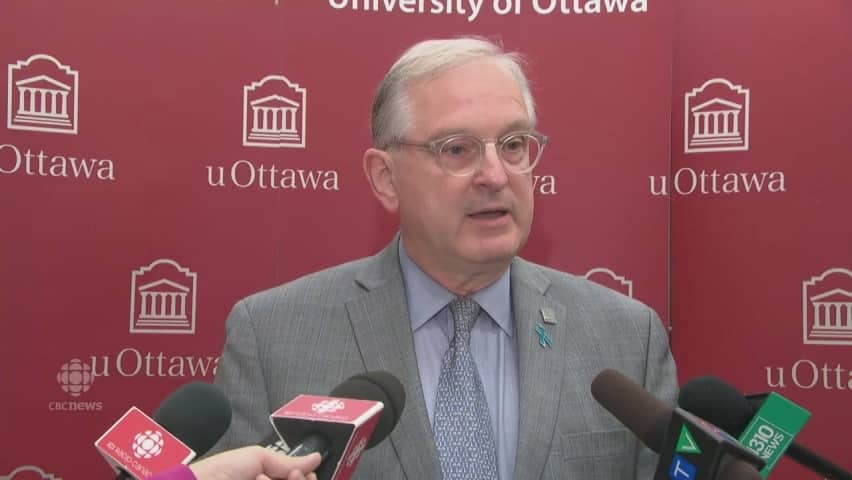
Jacques Frémont, president of the University of Ottawa, says the university's student federation is investigating the pub crawl.

Jacques Frémont, president of the University of Ottawa, says the university’s student federation is investigating the pub crawl. (Giacomo Panico/CBC)

University of Ottawa administrators will not commit to investigating the organizers of a now cancelled annual pub crawl, during which students were reportedly encouraged to engage in sexual acts in exchange for team points.

The student federation is investigating instead, said university president Jacques Frémont on Thursday morning.

“We will get in touch with them [the federation] today to see what can be done,” he said.

“The federation and the student association, if they want to conduct an inquiry, I think it’s probably the proper thing to do and we will support them.”

‘A lot of work to do’

Asked if there will be sanctions, Frémont said the university would wait to see how the investigation unfolds, but added that’s not the important issue.

“The main issue is not so much the sanctions — it’s to take stock that we’ve worked very hard for this coming back to school in September. There’s been sessions, we’ve invested money and time, the whole campus came around the new sexual harassment policy,” he said.

“But still, this event happened. I think it shows how deeply entrenched that culture remains on the campus and elsewhere in society, and it shows we have a lot of work to do.”

Yasmine Mehdi

Yasmine Mehdi, a news editor of the University of Ottawa student paper La Rotonde, infiltrated a Vet’s Tour pub crawl on Oct. 7. She has received violent messages and threats since revealing details about the event. (Radio-Canada)

Student journalist infiltrated event

The most recent edition of the pub crawl, known as the Vet’s Tour, happened Oct. 7 and was infiltrated by Yasmine Mehdi, a news editor at the French-language student newspaper La Rotonde, who said she intended to write an article on it.

According to Mehdi, close to 150 participants were handed a list of dares to be performed during the tour of private rooms in bars in Ottawa’s ByWard Market. Those who completed the acts to a judge’s satisfaction received points.

Included on the list of acts was being naked in the bar, performing oral sex on one of the judges, having sex in a bar bathroom and eating a doughnut off a judge’s penis, she said.

Once the details came to light the pub crawl was quickly condemned by the university and the school’s Science Students’ Association, which ran it. Future events have been cancelled, the association said.

Media placeholder

uOttawa president says student federation is investigating 0:19

Receiving threats

Mehdi, meanwhile, has been receiving threats of sexual violence and racial slurs on social media since the story broke.

“So a Muslim now tells CBC that having fun at College & University is against her ethics & morals. According to Sharia Law university students can’t have a good time or party. She wasn’t invited (for obvious reasons) and now has a hate-on for some white kids who drink,” one post Mehdi shared on Twitter reads.

“Sorry Yasmine, in this country your parents immigrated to we drink, we f— & we eat pork. Take your Nazi social control back wherever u came from,” it continues.

University of Ottawa

The University of Ottawa spent a lot of time educating students about sexual harassment and violence this year, according to the university’s president. ‘But still, this event happened.’ (Danny Globerman/CBC)

Backlash ‘absolutely unacceptable,’ university president says

Frémont condemned the backlash against Mehdi on Thursday.

“The comments that were made … against the reporter from the student journal La Rotonde are absolutely unacceptable. Cyberbullying and hate speech have no place on our campus or in our society,” he said.

“I reached out to the reporter to express my deep concern.”

For her part, Mehdi said she expected some backlash but not to this degree.

She’s considering filing a complaint with police, she said.

Event cancelled in 2014-15 but brought back

Elsa Mirzaei, a former president of the Science Students’ Association, brought forward concerns about the event in 2013, then cancelled it while serving as head of the association in the 2014-15 academic year.

In 2013, Mirzaei’s attempts to make the event safer weren’t fully successful.

“Many students who had been around and who had done it before and who were on the executive told me that because the event was happening between consenting adults, that I shouldn’t be worried and that I shouldn’t really impede on the event,” Mirzaei said in an interview.

“In my year, 2013, that’s when the slogan was, ‘It’s not peer pressure, it’s just your turn.’ So I did argue that coercion was involved in this event, but I was shot down by some older male students.”

In 2014-15, other members supported the decision to cancel the pub crawl.

“People were fully supportive of me in that year, which I guess is kind of interesting now, to see certain members who had actually returned from my year, who seemed to continue this event [in 2016]. It was just a shock to me,” Mirzaei said.

Elsa Mirzaei former SSA president Vet's Tour Oct 20 2016

Elsa Mirzaei, a former president of the Science Students’ Association, is ‘shocked’ the pub crawl was brought back after being cancelled in 2014-15. (CBC)

‘Need to be held accountable’

“I have a really hard time believing that the executive didn’t understand the high risk associated with the event. I really have a difficult time believing that it was really worth it for the fun just to put people in those situations of coercion. And I really think that they do need to be held accountable for putting these students [at] risk.”

While it’s unfortunate some students who enjoyed the event are feeling shamed for their sexuality, Mirzaei said the reports of sexual harassment, coercion and assault stemming from the pub crawl over the years made continuing the event “a really irresponsible choice.”

Mirzaei said: “Now that this has happened, I hope it doesn’t come back in future years under a more secretive way, and I hope that the members who were responsible for putting it on really are able to sit down and humble themselves and have some serious reflection about the kind of risk that they were putting people [in].”

Oct 162016
 

I’ve followed developments in North Dakota starting back when oil spills did a number on the water that these people are dependent upon.   They came together to try and stop events that make their homes uninhabitable.   Excellent and dedicated people doing what you or I might do under similar circumstances.

The story is a repeated one.  The oil and gas companies – – “petro-chemical industry” – – with impunity poison water supplies, destroying the health of local people and the environment they are dependent upon for living.  The result is impoverished, diseased people (and creatures).  Do a “search” on this blog for (among other stories)

All the same story.  With thousands of repeats globally.

At some point, unthinking people are going to wake up and realize that THEIR disease and developmental problems are the consequence of poisons that are going into THEIR environments, slowly, stealthily over decades.   Makes me think we can expect more, not fewer, confrontations and violence – – really, it’s people fighting for their lives.   There is no human life where there is no water;  there is no healthy life where there is polluted, poisoned water (and air, land, and food).

Bless the North Dakotans and those who have come to aid them in their battle.

And bless those who filmed (more than one event)  – – I can’t help but think that the overwhelming presence of riot police, the overhead surveillance by helicopters. and the armoured personnel carriers amassed at the most recent scene would have deteriorated had it not been for the filming.  Especially with the authorities themselves so willing to completely disregard the rule of law.


Huffington Post initiated this reporting.  Common Dreams picked it up.  Copies of both articles are below.

I am  shocked that the Police and Attorney General of North Dakota not only think they CAN, but actually DO IT – – charge people  (Amy Goodman, Deia Schlosberg – – journalists – -, Shailene Woodle and others) for filming the protests.   It backfired:  there have been more than 14 million views of one of the videos alone.


A documentarian arrested while filming an oil pipeline protest on Tuesday has been charged with three felony conspiracy charges ― and could face decades in prison if convicted.


Deia Schlosberg accepting an Emmy in 2014.

Deia Schlosberg accepting an Emmy in 2014. (Photo: Danny Moloshok/AP)


Deia Schlosberg, the producer of the upcoming documentary “How to Let Go of the World and Love All Things Climate Can’t Change,” was detained while filming a protest against TransCanada’s Keystone Pipeline in Walhalla, North Dakota. Activists at the event, associated with the group Climate Direct Action, shut down the pipeline, which carries oil from Canadian tar sands to the U.S, for about seven hours.

Two of the protestors, Michael Foster and Samuel Jessup, were also charged and Schlosberg’s equipment and footage from the event was confiscated. Schlosberg said shortly after being released on bond that she couldn’t comment on her arrest until she spoke to a lawyer.

She has been charged with three felonies: conspiracy to theft of property, conspiracy to theft of services and conspiracy to tampering with or damaging a public service. Together, the charges carry 45 years in maximum prison sentences.

Josh Fox, the director of the film and two others related to fossil fuels, including the Academy Award-nominated “Gasland,” said Schlosberg wasn’t participating in the protest herself but acting as filmmaker to document the event. Her arrest appears to reflect a “deliberate” targeting of reporters, he said.

“They have in my view violated the First Amendment,” Fox said, referring to the state’s Pembina County Sheriff’s Department. “It’s fucking scary, it knocks the wind of your sails, it throws you for a loop. They threw the book at Deia for being a journalist.”

Ryan Bialas, state’s attorney for Pembina County, told The Huffington Post there was no such targeting and said the event at the pipeline was “not a protest” but “a criminal action.”

“People are free to come and protest as much as they want in my county, I just ask they don’t damage any property in doing so,” Bialas said in an email. He also noted his office has offered to return Schlosberg’s equipment and footage and he has “no interest” in keeping it.

Credit: Robyn Beck/Getty Images
Thousands marched against the Dakota Access Pipeline in early September. They were met with guards carrying pepper spray and using attack dogs.


The arrest is the latest in a series of high-profile criminal charges filed in North Dakota. Police arrested actress Shailene Woodley and 27 others this week for trespassing while protesting the proposed Dakota Access Pipeline.

And authorities issued an arrest warrant for criminal trespassing for Amy Goodman of Democracy Now! last month, who filmed a thousands-strong Native American-led protest in September, which was met with guards wielding pepper spray and attack dogs.

Goodman announced this week she will surrender to authorities on Monday “to fight this charge … a clear violation of the First Amendment.”

Fox said the actions in North Dakota were “mind boggling” and he hasn’t seen “any other state behave this way.”

“Normally you get a warning,” he said, referencing other direct-action protests. “In North Dakota, you don’t. If you were trespassing, you leave and they arrest you anyway.”

He has been circulating a letter calling for the charges against Schlosberg to be dropped. Signatories include actress Daryl Hannah, musician Neil Young, activist Bill McKibben and actor Mark Ruffalo.

Bialas said he was unaware of the criminal action against both Woodley and Goodman and that his office does “not “target activists, journalists or media.”

COMMON DREAMS
Filmmaker Faces 45 Years in Prison for Reporting on Dakota Access Protests

“They threw the book at Deia for being a journalist.”

by  Nika Knight, staff writer

In an ominous sign for press freedom, documentary filmmaker and journalist Deia Schlosberg was arrested and charged with felonies carrying a whopping maximum sentence of up to 45 years in prison—simply for reporting on the ongoing Indigenous protests against fossil fuel infrastructure.

Schlosberg was arrested in Walhalla, North Dakota on Tuesday for filming activists shutting down a tar sands pipeline, part of a nationwide solidarity action organized on behalf of those battling the Dakota Access Pipeline.

“The actions of the North Dakota Police force are not just a violation of the climate, but a violation of the constitution.”
—Josh Fox, Gasland filmmaker

The filmmaker was held without access to a lawyer for 48 hours, her colleague Josh Fox wrote in the Nation, and her footage was confiscated by the police.

Schlosberg was then charged Friday with three felonies, the Huffington Post reported: “conspiracy to theft of property, conspiracy to theft of services and conspiracy to tampering with or damaging a public service. Together, the charges carry 45 years in maximum prison sentences.”

“They have in my view violated the First Amendment,” Fox told the Huffington Post, referring to the state’s Pembina County Sheriff’s Department. “It’s fucking scary, it knocks the wind of your sails, it throws you for a loop. They threw the book at Deia for being a journalist.”

NSA whistleblower Edward Snowden observed that Schlosberg faces more years in prison than he does for leaking secret documents about the NSA’s mass surveillance program in 2013:

“Deia isn’t alone,” observed Fox in an op-ed in the Nation. “The arrest of journalists, filmmakers, and others witnessing and reporting on citizen protests against fossil-fuel infrastructure amid climate change is part of a worrisome and growing pattern.”

Indeed, the news of Schlosberg’s arrest followed Democracy Now‘s Amy Goodman announcement earlier this week that she will return to North Dakota to combat charges she faces as a result of reporting on the Dakota Access Pipeline protest last month.

“Goodman, whose camera crew filmed a private security team attacking peaceful Native American protesters with dogs and pepper spray, faces charges of criminal trespassing—which many have said amounts to an assault on press freedom,” as Common Dreams reported.

It also emerged late Saturday that a North Dakota state prosecutor has dropped the trespassing charge and is seeking instead to charge Goodman with participating in a “riot,” Democracy Now reported.

“I came back to North Dakota to fight a trespass charge. They saw that they could never make that charge stick, so now they want to charge me with rioting,” said Goodman. “I wasn’t trespassing, I wasn’t engaging in a riot, I was doing my job as a journalist by covering a violent attack on Native American protesters.”

A warrant for Goodman’s arrest was issued September 8.

Meanwhile, actor Shailene Woodley was arrested Monday while live-streaming a prayer action at a Dakota Access construction site. “She was singled out, the police told her, because she was well-known and had 40,000 people watching live on her Facebook page,” Fox wrote. “Other filmmakers shooting protest actions along the pipeline have also been arrested.”

“Journalism is not a crime; it is a responsibility,” Fox said in a press statement about this pattern of arrests. “The actions of the North Dakota Police force are not just a violation of the climate, but a violation of the constitution.” 

Supporters have created a petition calling on the authorities in North Dakota to drop charges against Schlosberg, Goodman, and other journalists arrested for doing their work and reporting on the protests against Dakota Access.

Neil Young, Mark Ruffalo, Daryl Hannah, and other celebrities have also signed an open letter to President Barack Obama and North Dakota Governor Jack Dalrymple, calling on the leaders to intervene and for Schlosberg’s charges to be dropped. The charges were “unfair, unjust, and illegal,” the letter said, according to Reuters.

“This is not only about reporting on the climate-change movement,” Fox argued in the Nation. “Journalists have also been arrested reporting on Black Lives Matter, the movement for Native rights, and many other important movements the corporate media fails to cover. The First Amendment and the Constitution are at stake in this case. If we lose it, we lose America too.”

Oct 102016
 

RELATED:   A worthwhile PBS documentary, The Choice for American voters in the upcoming presidential election is found at #4 (the Clinton-Trump duo) in  Surveying the landscape of the empire.   

A deficit in the documentary:  it assumes there are only 2 choices.


NADER ARTICULATES ANOTHER OPTION:

  (From  http://www.cbc.ca/radio/thesundayedition/email-madness-ralph-nader-farewell-to-the-upright-piano-gopnik-on-being-a-parent-1.3782876/ralph-nader-on-the-ethics-of-voting-for-a-third-party-candidate-if-polls-show-donald-trump-might-win-1.3782887

Green Party presidential candidate Ralph Nader gives the thumbs up to supporters, November 7, 2000 at the National Press Club in Washington.

Green Party presidential candidate Ralph Nader gives the thumbs up to supporters, November 7, 2000 at the National Press Club in Washington. (Michael Smith/Newsmakers)

 Listen 28:17

This week, the Democrats embarked on a full-court press to convince those tempted to vote for a third party candidate in the presidential election, not to do it.

In about five weeks, either Hillary Rodham Clinton or Donald John Trump will win that race. The outcome, however, may well depend on how many votes are cast for neither of them.

Jill Stein and Gary Johnson composite

Green Party presidential nominee, Dr. Jill Stein, and Libertarian Party presidential candidate, Gary Johnson, did not meet the qualification criteria to participate in the first presidential debate. (Alex Brandon/AP, Lucas Jackson/Reuters)

According to the most recent polls, support for the leader of the Libertarian Party, Gary Johnson, is hovering at around eight per cent of the popular vote. Green Party leader, Dr. Jill Stein, who has been a guest on The Sunday Edition, has about four per cent.

Those may seem like insignificant numbers, but in a tight two-way race, they could make a difference.

If the Democratic Party cannot save the country from the worst Republican Party in history with the worst candidate in history…then they should look in the mirror.– Ralph Nader

More than one political analyst is reminding voters of the outcome in the 2000 election. Republican candidate George W. Bush was declared the winner; the Democrats’ Al Gore was the loser; and Green Party candidate Ralph Nader was dubbed “the spoiler.”

Many believe that had Nader not been on the ballot, Al Gore would have become president, saving the world from the war in Iraq, and even the creation of ISIS.

Nader not only dismisses the notion that he’s responsible for the election of George Bush, he argues that third and fourth party candidates are essential for a healthy democracy. He continues to call on voters to disrupt the current political system.

Ralph Nader is an activist, a lawyer and the author of several books. The most recent is called Breaking Through Power: It’s Easier Than We Think.

Click  Listen 28:17   to hear Michael’s interview with Ralph Nader. 

Oct 102016
 

Written in 1898:

I thought, on the contrary, that a revolutionary paper must be, above all, a record of those symptoms which everywhere announce the coming of a new era, the germination of new forms of social life, the growing revolt against antiquated institutions.  These symptoms should be watched, brought together in their intimate connection, and so grouped as to show to the hesitating minds of the greater number the invisible and often unconscious support which advanced ideas find everywhere, when a revival of thought takes place in society.  To make one feel sympathy with the throbbing of the human heart all over the world, with its revolt against age-long injustice, with its attempts at working out new forms of life,– this should be the chief duty of a revolutionary paper. It is hope, not despair, which makes successful revolutions.” 

            from MEMOIRS OF A REVOLUTIONIST by Peter Kropotkin  (Russia)     From the posting:    2005  . . .  Successful Revolutions


As I survey the landscape of the empire, I see symptoms that should be watched and brought together in their intimate connection to the work by people around the world, for the rescue of just society.

Their intimate connection?   in this time of a revival of thought?

Their stories help shed the propaganda that has shaped our nations,  the myths of the clans or tribes to which we “belong”.   We open ourselves to discovering the path forward. 


I express my gratitude by passing along the work of  3  players in the drama, concluding with the Trump-Clinton duo, their unwitting contribution to the Successful  Revolution.   5 players altogether.


 1.     Viet Thanh Nguyen

(Do a web search.   You will be blown away by what Viet Thanh Nguyen has accomplished  – – a major contributor to the Good of the World.)

2016-10-02 Excerpt from interview with winner of 2016 Pulitzer Prize,  Vietnamese-American author  Viet Thanh Nguyen. his book “The Sympathizer”.

The following is excerpted from the preceding link.   If you have time,  listen to the interview.  Viet Thanh Nguyen’s family became refugees when Saigon fell.   From a young age he lived in the U.S.   He is not without memories of the carnage which in the interview is condensed to   all the stories and  emotions and subjectivities that I was witness to as a kid among the Vietnamese people . . . 

. . .    I also took from it that there was no place in this American imagination, this American memory and history for Vietnamese people like me.  Or that our place was a very problematic place.   It was to be killed or silenced or victimized but in any role we were there simply as a backdrop for an American drama.  This was a very difficult thing to deal with because obviously growing up in a Vietnamese community we were not the backdrop of our own lives.   The war was central to us.

I always knew that this was actually also a crucially important war for us and that all the stories and  emotions and subjectivities that I was witness to as a kid among the Vietnamese people were not being heard or seen or understood by the larger American community.   And how Americans saw this war was also in many ways how the world was seeing it because of the power of American culture and the way that American stories were disseminated because of that power.

Wachtel (interviewer):   Yes because unusually as you point out, here history was written by the losers.

Viet Thanh Nguyen:    Yeah, this is one of the ironies.  I think it has to do with the unique nature of the United States and the wars that it has been fighting since WW2 or the Korean War.

Basically the U.S. is a global power after WW2 and it’s fighting all these wars.   It hasn’t won a war since WW2.

Korean War was a stalemate.

Vietnam war was a defeat.

Every major war since then can hardly be declared as a victory.

What this means is that even if the U.S. doesn’t win wars  its global power, its military power, combined with its economic power and its soft power through Hollywood and the public culture industry means that it can tell its own stories in its own ways and spread them all over the world and everybody all over the world has to confront them because that’s how pervasive American culture is.

Wachtel:  even the naming of the war.   To North Americans it’s called the Vietnam war but in Vietnam it’s often referred to as the American war and you say that both are in fact misnomers.   . . .  (more at  interview, winner of 2016 Pulitzer Prize, Viet Thanh Nguyen.)


Viet Thanh Nguyen tells us important truths about the wars and landscape of the empire.  We cannot stop the mindless death and destruction if our minds are clouded by pervasive myths and propaganda. 

From Walden Bello,  Revisiting the Battle of Seattle (Item #2 below), 

Seattle was what Hegel called a “world-historic event.”   Its enduring lesson is that truth is not just out there, existing objectively and eternally.  Truth is completed, made real, and ratified by action.

Thank-you,  Viet Thanh Nguyen, for helping to complete the truth, make it real and publish it.

I will use your work in the actions to reclaim Mother’s Day, as it was originally intended,  before it was appropriated by commercial interests  – –  a movement to stop the killing of our children.     (2007-05-14 Origin of Mother’s Day, 1870  &   Jezile, Son of Man)

2.   Walden Bello

See   2016-08-25 Revisiting the lessons of the Battle of Seattle and its aftermath, by Walden Bello.   

As mentioned under #1,  Bello tells us that truth is created – – ratified by action.   It seems evident to me that more and more people are truth-telling, whether it be about the absurdities of our economic system, failing regulatory systems, corruption in many quarters,  our role in war (we aren’t saintly peace-keepers or deliverers of democracy)  . . . invisible and often unconscious support  for the successful revolution.  

3.    Chinua Achebe

Things Fall Apart, author Chinua Achebe. Insights re violence in our communities.  

From the Continent of Africa.   Here’s the thing:  Chinua Achebe  (deceased in 2013)  may be invisible to many of us because he’s African.  But he is widely known internationally.   Africa struggles, but there are large numbers of empowered people because of his work.  We are strongly bonded through Chinua Achebe who offers us the same gifts.

 I selected two points made by him in a 2008 BBC interview.   If memory serves correctly, he talks about denial at one point.   I wonder about our denial, whether about what Viet Thanh Nguyen offers us, or about this from Chinua Achebe:

. . .  actually the story of Okonkwo (Things Fall Apart) is almost like a parallel story to the story of his community.    His community is not very gentle in its behaviour.  The cruelty that we see in Okonkwo is actually a reflection of cruelty in the society itself.    The crimes Okonkwo commits, in the sort of cosmic sense, the crime against women – –  in a way his community is also guilty of this.  It’s not  a question of which one was it that caused the falling apart.  It’s this complex of events.  And then you add onto it the invasion of the community by Europe.  So it’s when you put all this together that you say, this is why things fall apart   . . .

(Viet Thanh Nguyen of a later generation might have said “add onto it the invasion of the community by Europe and then by violent U.S. culture”.

From the Q & A:

QUESTION:   In the final chapter – –  lamenting the plight of the people,  said that things were falling apart because people were turning away from the old ways and were readily accepting the ways of the missionaries.  You recently mentioned that you couldn’t return to Nigeria  because things were getting worse and worse.  And I just wanted to know what you attribute as the reason for things falling apart in present-day Nigeria?

ANSWER:   My analysis is that it’s bad leadership.    By leadership I don’t mean just one person, the president or the prime-minister, but I mean a whole class of leaders,  leaders in different spheres who have fallen short of their responsibility.   If you look at what is going on now in Nigeria I sometimes wonder   Where are the people?  I mean educated people.  Nigeria has the resources, human and material,  to a degree that would make many, many countries envious  and yet   why are they allowing themselves to be bullied,  to be  bullied by one dictator or a bunch of dictators?   I don’t know   I think we have not got it right.

More at   Things Fall Apart.  

4.  Donald Trump and Hillary Clinton

EXPOSING THE LANDSCAPE OF THE EMPIRE   

In the context of unconscious support for successful revolution, who better than presidential hopefuls Hillary Clinton and Donald Trump?   In last night’s debate (2016-10-09)  Trump called out the truth on Clinton and in some instances on himself.  (Example:  loopholes that allow the wealthy, including himself, to not pay income tax.  The laws aren’t changed because the wealthy fund Hillary.  He is an indirect beneficiary.) 

The PBS programme Frontline aired the documentary film  The Choice 2016. 

FRONTLINE goes behind the headlines to investigate what has shaped Hillary Clinton and Donald Trump — where they came from, how they lead . . .

Clinton and Trump emerge as powerful Metaphors for what America has become (violent – the dropping of bombs on Libya is Hillary’s doing; a system of political economy in shambles; the subversion of values and the duping by false “celebrity” status).   I thank them for their contributions to the truth-telling work of Viet Thanh Nguyen, Chinua Achebe, Walden Bello and others.

I think  The Choice 2016  is well-done, worth your time to watch.  It discloses information about Trump that is additional disturbance to what I knew (not a lot!  I don’t watch much TV).

To me, Hillary Rodham Clinton has become one of those tragic figures in history.   She started from a place of good intent.  In the end she has been devoured by the events along her path, by her ambition, and by the system.  Most awful is her gleeful reaction, on camera, to the dropping of the bombs on Libya which she orchestrated.   It is clear that Obama bowed to her advice (in her role of Secretary of State) to carry out the bombing.  Power run amok.   Things Fall Apart.

The particular duo slugging it out for the presidency, Trump and Clinton,  are airing the truth about the empire.   People won’t put up with it.  Or, at least they should not.

For the record of those symptoms which everywhere announce the coming of a new era.   /Sandra

– – – – – – – – – – – –

P.S.   As pointed out in the Comments below (thank-you!),  The Choice is not limited to Clinton or Trump.    See  Ralph Nader CBC interview. On ethics of voting for third-party candidate, if polls show Donald Trump might win. Well done!

Oct 062016
 

“Things Fall Apart”, a novel by Nigerian author Chinua Achebe given to me 35 years ago.

Chinua Achebe died in 2013, in Boston.

I hate to offer only two insights from his impressive legacy.   Maybe the links will compensate.

On the subject of violence in our communities,  wherever in the world they may be:

from   Chinua Achebe talking about Things Fall Apart  to the BBC World Service, World Book Club in 2008:

http://www.bbc.co.uk/programmes/p01lhl6g

 . . .  actually the story of Okonkwo (Things Fall Apart) is almost like a parallel story to the story of his community.    His community is not very gentle in its behaviour.  The cruelty that we see in Okonkwo is actually a reflection of cruelty in the society itself.    The crimes Okonkwo commits, in the sort of cosmic sense, the crime against women – –  in a way his community is also guilty of this.  It’s not  a question of which one was it that caused the falling apart.  It’s this complex of events.  And then you add onto it the invasion of the community by Europe.  So it’s when you put all this together that you say, this is why things fall apart   . . .

From the Q & A:

QUESTION:   In the final chapter – –  lamenting the plight of the people,  said that things were falling apart because people were turning away from the old ways and were readily accepting the ways of the missionaries.  You recently mentioned that you couldn’t return to Nigeria  because things were getting worse and worse.  And I just wanted to know what you attribute as the reason for things falling apart in present-day Nigeria?

ANSWER:   My analysis is that it’s bad leadership.    By leadership I don’t mean just one person, the president or the prime-minister, but I mean a whole class of leaders,  leaders in different spheres who have fallen short of their responsibility.   If you look at what is going on now in Nigeria I sometimes wonder   Where are the people?  I mean educated people.  Nigeria has the resources, human and material,  to a degree that would make many, many countries envious  and yet   why are they allowing themselves to be bullied,  to be  bullied by one dictator or a bunch of dictators?   I don’t know   I think we have not got it right.

(To listen to the full interview:   http://www.bbc.co.uk/programmes/p01lhl6g)

 – – – – – – – – – – – – – – – – – – – – – – – – – – – – – –

The New Yorker

After Empire
Chinua Achebe and the great African novel.

http://www.newyorker.com/magazine/2008/05/26/after-empire

 This is lengthy.  It has more depth than many of the articles written about Achebe.    I hope the link remains good!

 – – – – – – – – – – – – – – – – – – – – – – – – – – – – – –


May 27, 2013

Chinua Achebe: A literary legend

http://www.developmenteducation.ie/blog/2013/05/chinua-achebe-a-literary-legend/ 

Chinua Achebe (pronounced Chee-noo-ah Ah-chay-bay) is considered by many critics and teachers to be the most influential African writer of his generation. His writings, including the novel Things Fall Apart, have introduced readers throughout the world to creative uses of language and form, as well as to factual inside accounts of modern African life and history. Not only through his literary contributions but also through his championing of bold objectives for Nigeria and Africa, Achebe has helped reshape the perception of African history, culture, and place in world affairs.

 – – – – – – – – – – – – – – – – – – – – – – – – – – – – – –

WIKIPEDIA

https://en.wikipedia.org/wiki/Chinua_Achebe

Things Fall Apart is a milestone in African literature. …. has sold more than 8 million copies worldwide.[3] .,, Time Magazine included the novel in its TIME 100 Best English-language Novels from 1923 to 2005.[9] The novel has been translated into more than fifty languages, and is often used in literature, world history, and African studies courses across the world.

. . .   Much of the critical discussion about Things Fall Apart concentrates on the socio-political aspects of the novel, including the friction between the members of Igbo society as they confront the intrusive and overpowering presence of Western government and beliefs.  Ernest N. Emenyonu commented that “Things Fall Apart is indeed a classic study of cross-cultural misunderstanding and the consequences to the rest of humanity, when a belligerent culture or civilization, out of sheer arrogance and ethnocentrism, takes it upon itself to invade another culture, another civilization.”[10]

. . . Before Things Fall Apart was published, Europeans had written most novels about Africa, and they largely portrayed Africans as savages who needed to be enlightened by Europeans. Achebe broke apart this view by portraying Igbo society in a sympathetic light, which allows the reader to examine the effects of European colonialism from a different perspective.[6] He commented, “The popularity of Things Fall Apart in my own society can be explained simply… this was the first time we were seeing ourselves, as autonomous individuals, rather than half-people, or as Conrad would say, ‘rudimentary souls’.”[7]

Oct 062016
 

It is my pleasure to alert you to this interview and to Harold’s book, “Firewater”.  I am looking forward to reading it.

Harold is an unassuming intelligence.  We haven’t talked much, I don’t know him well,  but here once again I find myself wishing there were more Harold Johnsons in our midst.  He makes good sense; we would be more sane.

Indigenous people need a new story around alcohol, says Firewater author Harold R. Johnson.

Indigenous people need a new story around alcohol, says Firewater author Harold R. Johnson. (Courtesy of Harold R. Johnson)

Listen 23:50

Read story transcript    (the transcript is copied below, in case the link becomes invalid.)

There’s a difficult conversation Harold R. Johnson wants to start — a new narrative about alcohol and Indigenous people, and the hardships drinking causes for many in Johnson’s Cree community.

Johnson is setting out to combat the centuries-old stereotype of the “drunken Indian.” He says it’s an image with colonialist roots — but one which many Indigenous people have internalized.

“I had a kid on one of the reserves tell me…that to be a real Indian you have to drink,” Johnson tells The Current’s Anna Maria Tremonti.

Firewater bookcover

Johnson approaches this subject with experience — as a crown prosecutor in northern Saskatchewan’s Treaty 6 territory — and he says the first step forward is to acknowledge hard truths.

“If we don’t talk about it, it’s just going to continue,” says Johnson. He has written his book, Firewater: How Alcohol Is Killing My People (And Yours), hoping to start a conversation that he considers long overdue.

“In my community, we don’t want to talk about  it publicly because we’re afraid people are going to point their fingers at us and call us ‘lazy, dirty, drunken Indians’.”

But he says he can no longer stay silent. Two of Johnson’s own brothers have been killed by drunk drivers.

“I’ve buried two brothers. I’ve buried many relatives. I’m not speaking figuratively — I’ve dug graves.”

Johnson estimates that one out of every two deaths in the Treaty 6 Territory is alcohol-related — and from talking to leaders in the communities, he’s afraid that estimate is low.

He tells Tremonti that the people who need to be part of this discussion publicly are the 35 per cent of Indigenous people in Canada who don’t drink at all — who are silently sober.

“I am trying to encourage those silently sober to speak up.”

Johnson says he isn’t bringing all the solutions to the table — he thinks Indigenous communities have the answers, if only the conversation gets rolling.

“I firmly believe the solution is talking about it.”

Listen to the full conversation at the top of this web post.

This segment was produced by The Current’s Karin Marley.

TRANSCRIPT
Indigenous people need to tell their stories of sobriety, says lawyer

Guests: Harold R. Johnson

AMT: Still to come there are some disruptive technologies Uber, AirBnB, that leave entire industries forever changed. And then there’s the disruptive medical technology that could forever change your own idea of who we are. We’ll hear about some breakthroughs in the meeting of mind and machine in about half an hour. But first, the bottle and the damage done.

SOUNDCLIP

To see a house full of drunken Indians consisting of men, women and children is a most unpleasant sight. For in that condition, they often wrangle, pull each other by the hair and fight. That sometimes 10 or 12 of both sexes may be seen fighting each other promiscuously, until at last they all fall on the floor one upon another, some spilling rum out of a small kettle or dish which they hold in their hands, while others are throwing up what they’ve just drunk.

AMT: That historic journal entry from the fur trader Daniel Williams Harmon dates back to the early 19th century. Yet here in the 21st century, the author and lawyer Harold R. Johnson includes it in his new book about Indigenous people and alcohol. The anecdote shows just how long the pernicious stereotype of the so-called quote, drunken Indian has been with us. But Harold R. Johnson includes that uncomfortable anecdote for another reason, precisely because it’s hard to hear. It’s difficult to talk about alcohol and the hardships it still causes many Indigenous communities today, and yet it’s a subject Harold R. Johnson approaches with experience as a Crown Prosecutor in Treaty 6 territory. And with the conviction that the first step forward must meet to acknowledge hard truth. He’s a graduate of the Harvard Law School. He’s a member of the Montreal Lake Cree Nation. His book is entitled Firewater: How Alcohol is Killing My People and Yours. Harold R. Johnson joins us from Saskatoon. Hello.

HAROLD R. JOHNSON: Good morning Anna-Maria.

AMT: Why does this story, as you call it the quote, dirty lazy drunken Indian story, have so much power even today?

HAROLD R. JOHNSON: It’s never gone away. It has been a constant, since first contact through the residential school era, all through colonialism. It is still being repeated. We’ve internalized it, made the story our own. Our own people believe the story. I had a kid on one of the reserves tell me just a couple of years ago that to be a real Indian you have to drink.

AMT: Hmm. Well, I want to talk about the people in your community and your community is Treaty 6 area in northern Saskatchewan, right?

HAROLD R. JOHNSON: That’s correct. The Woodland Cree signed an adhesion to Treaty 6 in 1889.

AMT: And how many people in the Treaty 6 community roughly?

HAROLD R. JOHNSON: I’m estimating about 20, 25,000 people.

AMT: OK, because you write specifically about people in your community. What do you hear from people in that community, the Treaty 6 community, about how they view their relationship to alcohol?

HAROLD R. JOHNSON: I had an elder give me a call when he heard that I was starting to work on this and he wanted me to know about drinking in the La Ronge area. He told me that back in the forties and fifties there was some drinking, sometimes an Indian would sell their treaty rights so they could legally go in the bar. And sometimes other Indians would ask them to buy beer for them. But it was a sometimes thing. I checked with other elders and that seems consistent. This first elder told me that real drinking didn’t start until 1966 with the opening of the Anglo-Rouyn mine north of town. And the miners came to town and had a party on the reserve 24 hours a day, seven days a week. And the entire purpose was to get Indian women drunk. There was another party going on at the same time, the smoke jumpers, and again they only invited women to their parties. And the elder told me that if any man showed up at those parties, there was usually a fight so they just quit going. There was a third group of people preying on Aboriginal women at that time, the American tourists were flying in on private planes. They didn’t bring their families with them but they brought the hard liquor. That’s where people remember seeing rum and whiskey and vodka for the first time. If you want to destroy a people, you destroy the women first.

AMT: You have calculated the rate of alcohol related deaths in your community. What have you found?

HAROLD R. JOHNSON: My estimate is one in two. And it’s based on the leading cause of death in my territory right now is injury. So that’s car accidents, ski doo accidents, drownings, stabbings, shootings, beatings, house fires, suicide, freezing to death. And we know that that’s all alcohol. The second leading cause of death is heart disease and we know that binge drinking causes heart disease. And all those guys my age who didn’t shut it down or continue to binge drink are now falling over dead of heart attacks. And the third leading cause of death is cancer. And we know that alcohol causes all sorts of cancers. Add to that children who don’t get proper nutrition because their parents are drinking. Add to that alcohol and FASD, and add to that alcohol attacks the immune system and people who drink too much have what is referred to as failure to thrive. Put all of those together, and my estimate is one in two. And I’m afraid that that estimate is low. I was in a community last winter, it’s a community of 880 people. A minister stood up at the meeting and said we had 66 funerals here in 2015 and 60 of them were because of alcohol.

AMT: Hmm. But those are your calculations, are there numbers available like that? Has anyone looked at this, like, the way you did?

HAROLD R. JOHNSON: I can’t get the numbers. I’m trying to get the numbers. We know in justice, where I spent a lot of time that 95 per cent of the people who come to court were intoxicated at the time of their offense. But when you look at the numbers, alcohol is so natural, normal and necessary in our society that people don’t write it down. It’s not recorded. You look at the police records and you can’t find that number there because the police don’t write it down because it’s so normal. The same thing in health care.

AMT: And you make the point in your book that it’s just assumed that at an arrest or at an emergency health–

HAROLD R. JOHNSON: Yes.

AMT: How has alcohol affected you and your family?

HAROLD R. JOHNSON: I’ve buried two brothers. I’ve buried many relatives. I’m not speaking figuratively, I’ve dug graves. My father died when I was eight years old. He died of a heart attack. I have two childhoods. My father and mother didn’t drink in the first eight years of my life. There was rarely any alcohol in our home. My father died, circumstances changed. Alcohol became much more prevalent in the second half of my childhood.

AMT: You’ve outlined theories about how Indigenous people can move forward and away from alcohol that is killing so many people. You talk about victim, grief, and trauma models and you have a problem with them. Take me through. You’ve got a couple of models, let’s start there. The victim, grief, and trauma models. What have you observed and what are you thinking?

HAROLD R. JOHNSON: So this victim’s story, to tell us that the reason that Aboriginal people are in the situation that they’re in is because of a history of colonization, that it’s because of residential school, that it’s because of government policy, that it’s all of these things that are outside of our control are killing us. Placebo and nocebo. We know placebo, if I give you a sugar pill and tell you that this is medicine and it’s going to make you feel better if you take it, 35 to 50 per cent of people experience a reduction in symptoms. The same thing occurs with nocebo. And in this case I give you a sugar pill and tell you that it’s poison and it’s going to make you sick. And if you take it, you’re probably going to get sick. That’s the power of story. So a nocebo story, and that’s what it is, is the story that heals you or kills you. I’m not saying that residential school wasn’t real. That was real, that happened, but we can’t fix it. We can’t go back and change residential school and to be told these stories over and over again is just making it worse.

AMT: Well there’s another example to use. The widely held understanding that alcoholism is a disease. What problems do you see with that?

HAROLD R. JOHNSON: We keep being told that alcoholism is a disease. When you check into it, disease is a metaphor for what they’re seeing, it’s not like smallpox. Smallpox killed many of us, alcohol is killing just about as many now. But alcohol doesn’t work the same as smallpox or TB. I see alcohol more like a repetitive strain injury. You use it too often, too much and you injure yourself. It changes the way that you look at it. If addiction is a disease, then there’s nothing I can do about it. It’s God’s will that I got it. If alcoholism is an injury that I did to myself, then I can change it. If I tell myself, if I do this too often and too much I can hurt myself, I might change the way that I drink. It’s in the story that we tell ourselves.

AMT: Is the key problem you see in Indigenous communities actually alcoholism or is it binge drinking?

HAROLD R. JOHNSON: It’s binge drinking. What I saw in the courts was 15 to 20 per cent of the people who came to court were obsessive compulsive drinkers. 80 to 85 per cent of people who came to court just drank too much that one time and did something really stupid, up to and including committing an atrocity. If we’re looking just at addictions, we’re looking at just a small portion of it.

AMT: Well, and I want to take a little further look into the justice system, because that’s the other model. You talk about the law enforcement model of how drunkenness or alcoholism is treated by the system. Talk to me about what you see?

HAROLD R. JOHNSON: If we go back in the common law, we find a statement that says He who killeth while drunk, sober shall hang. So we’ve got lots of experience with alcohol and crime, and I am still prosecuting people who got drunk and killed each other. The justice system is a complete failure. It is not going to solve our problems with alcohol. And that is our major problem.

AMT: And you see those cases where people get drunk and kill each other, but you see other cases where people misbehave because of drunkenness and then have the book thrown at them, am I correct?

HAROLD R. JOHNSON: That happens. I was talking with a defense lawyer a little while ago and we were talking about murders and alcohol and I asked them how many murders have you defended where alcohol wasn’t involved? And he remembered one. And as a prosecutor I could remember doing one that didn’t involve alcohol. And we were walking away and he said, but with regard to sex assault, I don’t remember any, and I don’t remember any either. With sex assault, it was always alcohol was involved.

AMT: And so how do you think the justice system needs to change to deal with that?

HAROLD R. JOHNSON: There is a model out of South Dakota called 24/7 that needs to be looked at a lot more closely. That 24/7 program out of South Dakota, if you are on an order for driving under the influence or domestic violence involving alcohol, you are required to attend at a police station twice a day, once in the morning and once in the evening, and blow into a breathalyzer. If you fail to show up or you have alcohol in your system, you go to jail automatically for up to two days. So immediate detection, immediate consequences. The breach rate for both failing to attend and for having alcohol in the system is less than 1 per cent. I would love to see a breach rate of less than 1 per cent. So it works. And what’s really amazing about the 24/7 program is the Rand Institute went and studied it and they found that there were positive health results. The death rate from alcohol in South Dakota is down because of the 24/7 program. And they were able to show that because each county went into the program at different times, so they’re able to trace it across the state. If we could do that in Canada, where it probably going to require legislative change.

AMT: And you’re speaking, of course, as both a crown prosecutor and a member of the Indigenous community, thinking this could actually move something forward.

HAROLD R. JOHNSON: Maybe we could do something positive with law.

AMT: Well, let me ask you. Has there been enough discussion in your community about the problems caused by alcohol?

HAROLD R. JOHNSON: No, we’re trying to open up the conversation. Let’s talk about it. Let’s bring it out into the light and talk about it. It’s really hard for white people to talk about Indians and alcohol, because the fear that someone is going to point a finger at them and call them racist. The opposite occurs in my community, where we don’t want to talk about it publicly, because we’re afraid people are going to point their fingers at us and call us lazy, dirty, drunken Indians. I firmly believe that the solution is in bringing it out and talking about it. And the people will find the answers. I’m not offering a whole bunch of solutions. I’m not going to go and tell my people you have to do a, b, c, and things will get better. We’ve had people come into our communities forever telling us how to do things and having solutions for us. And then they leave and the solutions don’t work. The solutions will come from the people, but we have to have a conversation first.

AMT: Well, so how can we talk about the problems caused by alcohol in Indigenous communities without falling into the trap of racist remarks, or the again, the quote, the drunken Indian stereotype. By being honest, just courageously going forward and talking about it. We don’t have to use race as part of it. What I’m seeing in northern Saskatchewan is that the severe problems started in 1966. So this happened on my watch, this is in my lifetime that it’s changed. There’s a history of alcohol in white culture that goes back thousands of years, the same problems exist in white culture. I’ve seen statistics that say that 25 per cent of deaths worldwide are because of alcohol. So this isn’t an Indian problem. It’s amplified in my communities, but it’s not our problem.

AMT: And why are you speaking out?

HAROLD R. JOHNSON: Because nobody else is. I don’t want to talk about this. I’ve got a whole bunch of things I’d love to do. I’d love to be writing fiction. I’d love to be trapping and fishing and doing all of the things that I really enjoy doing, but nobody else is talking about it. And if we don’t talk about it, it’s just going to continue and I’m just tired of digging graves.

AMT: In your book you include a letter from an author and an Indigenous law professor by the name of Tracey Lindberg, talking about sobriety and her own sobriety. Let’s listen to her reading parts of that letter.

SOUNDCLIP

TRACEY LINDBERG: I stopped drinking about 25 years ago. Until then I engaged in what was quite likely binge drinking. My relationship with booze began in grade eight. Boys with licenses picked up girls without and gave us alcohol. My first drink was vodka. By the time I went to graduate school, I was drinking or bingeing two days a week. By the time I was practicing law, three days a week, at least. In the practice of law and as the only Indigenous person in the firm that I worked for, alcohol became the lubricant through which I could unpeel my layer of Other and become one with the firm. It was me and I made a choice and the choice was to make friends through boozing with them. I made a decision because I love to drink. I made a decision because I needed to drink. This I knew was going to get harder and harder to do as time went by. This I also knew was a choice at that time, a luxury, the choice to stop. But in the future it might not be something I could stop. So I stopped. I continued going to ceremonies, I felt good. I quit drinking entirely. I felt better. And I had to learn how to socialize. I’m still not good at it without alcohol. Had to learn to hug without alcohol. Had to define and parse my spare time without alcohol. I do miss the denizens of the bars I haunted. Do miss that easy drunky friendship amongst drunken strangers. I miss the excitement of music in small rooms, yelled conversations and weird semi-hallucinatory observations. The nation that I work with never required that I quit. I quit because they don’t drink. Because I wanted no one to have to pay my way in ceremony but me. Because I wanted to be a sober advocate for them, because I wanted to be free. Freedom is walking away and doing better. I’m free.

AMT: That is Tracey Lindberg reading her own words. Harold R. Johnson, why is it important to hear her story?

HAROLD R. JOHNSON: We need all of the artists to tell sober stories. We need to bring back all of the Wisakedjak and [unintelligible] stories, all of those traditions, in a way that helps people to change the story that we tell ourselves.

AMT: So in other words when you have so many people who are not drinking, they need to share that so others can know that?

HAROLD R. JOHNSON: There’s a statistic that’s rarely mentioned, 35 per cent of Aboriginal people in Canada don’t drink at all. We are completely abstinent, but we are silently sober. I am trying to encourage those silently sober to speak up. Show what it’s like to walk a sober life.

AMT: And you also suggest the idea of sober houses. How would that work?

HAROLD R. JOHNSON: This is something that came out of our discussions last winter. What we learned when we’re asking questions, what was the hardest part about sobering up? We were told, I lost all my friends or I found out who my real friends were. And we take people out of our communities and we send them off to detox centres and rehab centres, and they come back into the communities and they come back to the same house, the same families, the same situation. And we have a success rate of about 2 per cent. If we had a sober house and you put a sign on your door, people walking by would see the sign and it be similar to the block parent idea. It would be a safe place to go. Someplace where there was no drinking, no pressure to drink. You could just play cards and visit and watch television and be amongst sober people.

AMT: And then give each other strength.

HAROLD R. JOHNSON: We turn our communities into treatment centres, we didn’t have to send people away.

AMT: You tell the story of a man who begged you to put him in jail, because he wanted to stay sober. He couldn’t find any other way. I’ve known him for a long time and I’ve frequently asked the judge to send him to jail, because it was pointless to put him on a probation order or any order that required him to not drink. And if he wasn’t drinking he wouldn’t cause any trouble. I’d see him around the communities, I’m the crown prosecutor, but he’d come up and shake my hand and talk to me. Once he told me, he was really proud he says I’m scheduled to go in for rehab. And I didn’t see him for a while and then I saw him one day in front of the post office and he came up and asked me to send him to jail. Because he’d been to rehab and he came back to the communities and he fell in with his friends again. And he was drunk, and he knew that if he didn’t stop drinking he was going to die.

AMT: So if there was a sober house for him to go to, he would have been OK.

HAROLD R. JOHNSON: He’s doing better now.

AMT: Mm.

HAROLD R. JOHNSON: He’s found sober friends to be around.

AMT: You have put your job as a crown prosecutor on hold temporarily for a project in two northern Saskatchewan Indigenous communities. Tell us what you’re working on.

HAROLD R. JOHNSON: I’m on a special project with the deputy ministers of Saskatchewan to create community alcohol management plans and to socialize a concept of sobriety. I have three women behind me. My wife Joan, Carla Frohaug and Sue Carriere, and with three strong women behind me I can’t fail. I am the voice and they do all of the work and all of the research. And we’ve created a community alcohol management plan for those communities. It belongs to them. It’s not ours, it’s not the government’s. We talk to people, we talked to as many people as we could in creating the plan. We tried to hold community meetings, but it didn’t work. Every time we scheduled a community meeting, the building we were using would be required for a funeral or a wake and quite often those funerals and wakes were for people who died from drinking. So we had to change our strategy, we created surveys, and we knocked on doors. We talked to churches, we talked to sweat lodge keepers, and pipe carriers and anybody who would talk to us.

AMT: And what were you asking them? What should we do about alcohol?

AMT: And what would they tell you?

HAROLD R. JOHNSON: 100 per cent of people said that alcohol was a problem in our communities. About 95 per cent said that it was getting worse. They would like to see changes to government policy. They’re telling us that we need to restrict supply. That there’s too many liquor stores and they’re open too long. There was support for increased taxation on alcohol. A lot of lives could be saved by just increasing the tax by 2 per cent. There’s no single answer.

AMT: You have written this book as a conversation among Indigenous people and you say that non-Indigenous people are welcome to listen. What do you want those of us who are not Indigenous to think about or do when we listen to you talking about this?

HAROLD R. JOHNSON: Mm. That’s hard. You are not responsible. Don’t feel guilty about it. Speak honestly about it. Talk about your own issues with alcohol. Be part of the conversation.

AMT: Where do you want this conversation in your own community to go then?

HAROLD R. JOHNSON: I don’t know where it’s going to go. All I know is that it’s not going anywhere if we keep silent about it. I have no way of seeing the future. I just want my people to have hope and that we change our story and that our story becomes one of hope. It’s the hopelessness that I see killing everybody.

AMT: So again, if the narrative changes and more people talk about it, there’s more hope than everyone being silent.

HAROLD R. JOHNSON: That is my dream.

AMT: Harold R. Johnson thanks, thanks for your ideas and for sharing them with us today.

HAROLD R. JOHNSON: And thank you for having me on Anna-Maria. It has been an honour.

AMT: Harold R. Johnson, Crown Prosecutor and the author of Firewater: How Alcohol Is Killing My People and Yours. He joined us from Saskatoon. If you want to share your thoughts on the conversation about alcohol and Indigenous people visit our cbc.ca/thecurrent. Click on the Contact link and send us an email. You can find us on Facebook or tweet us @TheCurrentCBC. And if you’re joining us partway through, download the podcast cbc.ca/thecurrent, find our podcast there. Coming up next, putting our minds together to solve some big problems. We’ll hear about the neurotechnology that is linking different people’s brains together. I’m Anna-Maria Tremonti, this is The Current on CBC Radio One.