Sandra Finley

Aug 012016
 

RELATED POSTINGS:

= = = = = = = = = = = = = = = = = = = =

‘What law am I breaking?’ How a Facebook troll came undone


Of the millions of perpetrators of online harassment, Zane Alchin of Sydney is among the few to have been prosecuted – and his victim says it took a media campaign

Sexual Violence Won't Be Silenced image
A promotional image for the advocacy group Sexual Violence Won’t Be Silenced, formed by Paloma Brierley Newton (second from right)

It began with a rap lyric.

“Type of girl that will suck you dry and then eat some lunch with you,” read Olivia Melville’s bio on Tinder – a Drake quote, from the Canadian rapper’s song with Nicki Minaj.

Melville, then 23, was on the other side of Sydney from Chris Hall when he came across her profile. He posted a screenshot publicly to his Facebook page.

“Stay classy ladies,” he wrote, adding the tears-of-joy emoji. “I’m surprised she’d still be hungry for lunch.”

It was the kind of blanket, banal sexism that weighs down the internet in steady streams: arguably too common, too tired to be truly offensive to any woman online.

Melville was alerted to Hall’s post by a friend. She chose to respond.

“I wasn’t aware I had to put my CV in my Tinder bio,” she wrote on 25 August last year, sharing Hall’s post to her own profile. “Shame on you, Chris Hall, for your ignorance of Drake and a good taste.”

Her friends rallied in the comments thread in support. So did his.

The back-and-forth between the two groups was antagonistic, at times aggressive – but, even so, the comments by Zane Alchin were an immediate escalation.

“Please you cunts deserve to be taken back to the 50s were [sic] you wil learn to know your role and shut your damn mouth.

“Do me a favour go home and slap your mother obviously your father never did it enough.

“I’d rape you if you were better looking but I wouldn’t fuck you.”

Over a period of about two hours, Alchin – now 25, a labourer who lives with his parents in Caringbah in southern Sydney – left 55 posts, many of them referring to violence and rape.

That last comment was addressed not to Melville but her friend, Paloma Brierley Newton, now 24, who had come to Melville’s defence. Their interaction came to dominate the thread; at one point Brierley Newton told Alchin she would report him to police “if you keep threatening me with rape”.

“What law am I breaking?” he responded. “I’m not the one out of the fucking kitchen.”

Eventually Brierley Newton blocked Alchin, meaning his comments were no longer visible to her. He kept posting.

Brierley Newton shared screenshots of their back-and-forth on her own Facebook page.

“This kind of behaviour is what we call ‘normalisation of violence against women’ and it is really, really scary and damaging,” she wrote. “… Every time you ‘playfully’ tell a woman to get back in the kitchen, every time you smack a girl on the bum because it’s funny, every time you make a joke about rape, YOU are contributing to a society where unfortunately women are not safe.”

She concluded with a vow to report Alchin’s comments to police.

“Be warned men, the internet is no longer your invisibility cloak. I am coming after you and I will not be stopped.”

Nearly one year on, Brierley Newton’s post has had more than 700 shares and 1,200 reactions – and Alchin has been convicted of a crime.

On Friday, he was sentenced to a 12-month good behaviour bond for using a carriage service to menace, harass or offend at the Downing Centre court in Sydney, although the judge found his conduct did not amount to threatening to rape. It has been described as a test of police and legal responses to online abuse, an area that appears to be nearing crisis point.

A United Nations report released in January 2015 suggests 73% of women worldwide have been exposed to or the target of some form of cyber violence. In the 18 months since then, online abuse – particularly of women, and, in the wake of the murder of the British MP Jo Cox, particularly female politicians – has come under greater scrutiny.

But if it seems a tipping point is nearing, it is only of awareness, not action. Of the millions, maybe billions of victims around the world, Brierley Newton is among a tiny minority to have successfully pursued her case through the criminal justice system.

It wasn’t easy, she said. The officers at her local police station to whom she reported Alchin’s comments, with screenshots saved to a USB drive, were unfamiliar with the medium.

“The cop I spoke to didn’t even have Facebook – explaining to her the post, the reposting, the screenshotting, the comments, was harder than it needed to be,” she told Guardian Australia in January. “It’s ridiculous. It’s 2016. Literally everyone uses the internet.”

The case progressed only after it received media attention, she said – echoing a common complaint about social media abuse, that only high-profile users get a response to their reports.

Her interactions with Alchin and then with the police inspired her to start an advocacy group, Sexual Violence Won’t Be Silenced.

First came a Change.org petition, then local media coverage – often alongside the striking press shots of Brierley Newton and her friends wearing homemade T-shirts reading “SHAMELESS SLUT”.

Her campaign eventually drew the attention of Clementine Ford, an Australian feminist commentator who frequently veers into activism, who shared the screenshots of Alchin’s comments with her tens of thousands of Facebook followers.

In late October, Alchin was charged.

Brierley Newton told Guardian Australia the officer who called to tell her said Alchin was apologetic and had no prior convictions in what she took to be an attempt to convince her to abandon the charge. (New South Wales police said they were unable to comment until after the appeals period had lapsed.)

Brierley Newton was better placed than many – maybe most – victims of abuse, online or offline, to pursue her case with the necessary tenacity to get results.

She is self-possessed, articulate, media savvy and a natural campaigner (disclosure: the reporter has known Brierley Newton socially for two years). Her mother, De, is lead organiser and a former candidate for the NSW Greens. Her personal Facebook profile lists her job title as a “force to be reckoned with” (and former “professional good timer”).

Alchin was charged with using a carriage service to menace, harass or cause offence, which carries a maximum penalty of three years’ imprisonment.


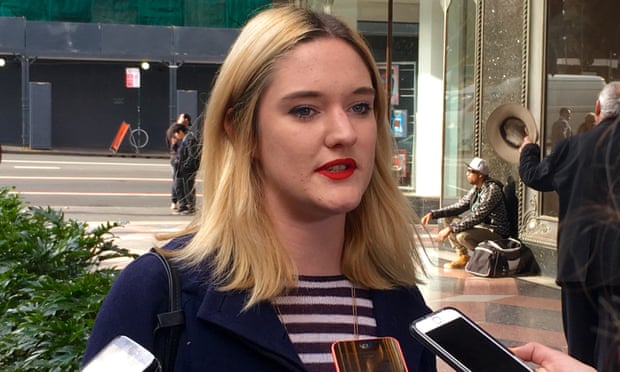
 Paloma Brierley Newton, 24, speaking to reporters outside court in Sydney on the day Zane Alchin entered his guilty plea

Paloma Brierley Newton, 24, speaking to reporters outside court in Sydney on the day Zane Alchin entered his guilty plea. Photograph: Elle Hunt for the Guardian

After his arrest, Alchin admitted he had written the comments but told police he was drunk at the time and that they did not reflect “what he is about”.

“He was internet trolling and was unaware it was a crime,” the police facts sheet stated.

Police put to him a specific comment he’d made, including that feminists “don’t get any action, so when you rape them it feels 100 times tighter”. Alchin said he had found it on an “anti-feminist website, to offend a group of feminists that were harassing me and my friends”.

In her victim statement, Brierley Newton said she was made to feel ambushed, harassed, intimidated, defenceless and anxious by Alchin’s comments.

But did she feel afraid?

I think I was just angered by it, to be honest,” she told Guardian Australia on Thursday, after a long pause. “I don’t think there was ever a point where I turned around and said, ‘I think this guy is going to rape me.’”

It seems Alchin’s motive was to cause offence, not to signal intention. But equally apparent is that he did not expect there could be consequences for his “trolling”.

He told police he was remorseful. But at an early court appearance, he was photographed outside extending his middle finger.

In January, his counsel pleaded not guilty on his behalf, though Alchin had admitted writing the comments and had earlier indicated he would plead guilty.

In March, a different representative indicated that his defence would rest on a legal argument as to whether the internet was a carriage service.

In late June, Alchin changed his plea to guilty. At sentencing on Friday, the court heard he had drunk half a bottle of bourbon when he made the comments, and woke up the next morning remorseful.

His lawyer, Louise Walsh, said Alchin had been threatened, “shamed and humiliated” after the case received media attention and he was held up as the “face of trolling”.

The sentencing judge, William Pierce, agreed with Walsh that Alchin’s comments did not threaten rape and said it was clear that he had been “harassed and threatened”.

He handed him 12 months’ good behaviour bond, likening dialogue online to a game of football. “There is a whirling maelstrom of hate and all sorts of unpleasantness which circulates on the net and institutions like Facebook,” he said.

“My view is that the closest analogy is a game of football. If you’re on the football field, you consent to a few bumps, so a few mildly explicit comments in the anaology … You don’t consent to be king hit with a savage right hook that knocks you out for 10 minutes.”

Pierce told Alchin: “You overdid it.”

A conviction was necessary, he said, more to deter others than Alchin – “because obviously you’ve learned your lesson, big time”.

Walsh said Alchin had been made the international “poster boy for the most vile trolling”.

But in other corners of the internet, Alchin has also been held up as a victim of the feminist movement.

“This witch-hunt against Zane Alchin has gone far enough,” stated an online petition that called for the state government to “stop the charges”. It raised eight supporters.

The Daily Stormer, “the world’s most visited alt-right web site”, proposed a different course of redress for the “hero and TOTAL BRO” Alchin. There is no suggestion that Alchin supports the broader views of the Daily Stormer or its campaign on his behalf.

A post in late June singled out Alchin’s “100 times tighter” rejoinder as “the perfectly natural response to being brutally oppressed by unhinged women your entire life”.

Its editor, Andrew Anglin, urged readers to seek “#JusticeForZane”, linking to the Facebook and (“more importantly”) Twitter presences of Sexual Violence Won’t Be Silenced and singling out individual supporters, including Brierley Newton.

“All of these women should be informed that they are ugly sluts who should not have any rights.”

So the cycle of online abuse continues but, with this sentence, one perpetrator has learned there are consequences.

And others were watching.

Jul 262016
 

In July,  StatsCan sketched out the new powers it wants (below).   With legislation expected in the fall.

What happened in the fall?:    2016-09-26  Statistics Canada eyes end to short-form census, CBC

Many thanks to Karen for sending in:

http://www.cbc.ca/news/politics/statistics-canada-powers-force-mandatory-1.3695969 

Liberals have promised to give Statistics Canada more freedom from government influence

By Jordan Press, The Canadian Press

Innovation Minister Navdeep Bains says the government is committed to "strengthening the independence of Statistics Canada."

Innovation Minister Navdeep Bains says the government is committed to “strengthening the independence of Statistics Canada.” (Sean Kilpatrick/Canadian Press)


Statistics Canada is privately floating the idea of new powers that would make all of its surveys mandatory by default and force certain companies to hand over requested data, such as credit card transactions and Internet search records.

Currently, the agency can ask for any information held by governments and businesses, but officials have long found it hard to get information like point-of-sale transactions that could give a more detailed and accurate picture of household spending.

The agency’s proposal would compel governments and companies to hand over information, and levy fines to discourage “unreasonable impositions” that “restrict or prevent the flow of information for statistical purposes.”

Corporate fines would depend on a company’s size and the length of any delays. The changes would also do away with the threat of jail time for anyone who refuses to fill out a mandatory survey, such as the long-form census.

The recommendations, contained in a discussion paper Statistics Canada provided to The Canadian Press, would enshrine in law the agency’s independence in deciding what data it needs and how to collect it.

New legislation to update the Statistics Act is expected to be tabled this fall, and the Liberals have promised to give Statistics Canada more freedom from government influence.

The current law permits the federal government to make unilateral changes — eliminating longitudinal studies about the Canadian population, for instance, or making the long-form census a voluntary survey, a Statcan spokesperson said.

Should the federal Liberals agree to the agency’s proposals, it would build a political wall between the government and Statistics Canada and ensure statistical decisions by the chief statistician take priority over political considerations.

StatsCan needs independence says Bains

Innovation Minister Navdeep Bains, who is responsible for Statistics Canada, said the government is still reviewing the Statistics Act. He said the government is committed to “strengthening the independence of Statistics Canada.”

“For a national statistical office to be credible, there must be a high degree of professional independence,” Bains said in a written statement.

“Canadians need to trust that their data are produced according to strict professional standards, ethics and scientific principles.”

The agency delivered the paper earlier this year to the National Statistics Council, a body of outside experts that acts as an advisory board for the chief statistician.

In the paper, Statistics Canada argues for a new, modern framework that would better mesh with the Liberal government’s priority on evidence-based decision making, while counteracting mounting concern about declining response rates and diminished data quality.

“I don’t see any negative in it,” said Susan McDaniel, a long-time statistics council member.

“What Statcan does is they provide the best data you can get that are nationally representative, that you can depend on, and researchers can build on that. We can use those data.”

Agency wants freedom from Shared Services Canada

There is also increasing demand from governments, businesses and researchers for micro-level data that Statistics Canada says it can’t publish in some cases because of outdated confidentiality rules. The paper also says the agency isn’t legally able to analyze “increasingly pressing” environmental issues.

The paper also makes the case for Statistics Canada to have control over its computer systems instead of relying on the government’s central IT department, known as Shared Services Canada.

Shared Services “impedes the agency’s ability to deliver its program,” the paper says, because “for all intents and purposes” the central IT department “has an effective veto” on IT spending needed for any program or initiative.

The agency argues that it should not be under the Shared Services umbrella, and should instead receive one-time funding to pay for data centre updates that Shared Services opted not to invest in.


Jul 252016
 

Click on this link to hear the interview, Democracy Now, Julian Assange.  I think Assange is right.  The only way to rein in the corruption is by exposing it.  Bless the people who are leaking the information.

I don’t know about pinning the leaks on the Russians?   (as the young man at the Democratic National Convention says)

http://www.democracynow.org/2016/7/25/exclusive_wikileaks_julian_assange_on_releasing

 
WikiLeaks founder and editor-in-chief Julian Assange joins us from London about their release of nearly 20,000 emails revealing how the Democratic Party favored Hillary Clinton and worked behind the scenes to discredit and defeat Bernie Sanders. This comes as the Democratic National Convention is opening today in Philadelphia, Pennsylvania, amid massive party turmoil. The DNC chair, Florida Congressmember Debbie Wasserman Schultz, has resigned following the leak. The emails also reveal a close relationship between mainstream media outlets and the DNC.
TRANSCRIPT


This is a rush transcript. Copy may not be in its final form.

JUAN GONZÁLEZ: The Democratic National Convention is opening today in Philadelphia, Pennsylvania, amid massive party turmoil. Democratic National Committee chairwoman and Florida Congresswoman Debbie Wasserman Schultz has resigned following the release of nearly 20,000 emails revealing how the Democratic Party favored Hillary Clinton and worked behind the scenes to discredit and defeat Bernie Sanders. The emails were released Friday by WikiLeaks.

In one email, DNC Chief Financial Officer Brad Marshall suggested someone ask Sanders about his religion ahead of the Kentucky and West Virginia contests. Brad Marshall wrote, quote, “It might may no difference, but for KY and WVA can we get someone to ask his belief. Does he believe in a God. He had skated on saying he has a Jewish heritage. I think I read he is an atheist. This could make several points difference with my peeps. My Southern Baptist peeps would draw a big difference between a Jew and an atheist,” unquote. In another email, Debbie Wasserman Schultz calls Sanders’ campaign manager Jeff Weaver a, quote, “Damn liar.”

AMY GOODMAN: A third email shows National Press Secretary Mark Paustenbach writing, quote, “Wondering if there’s a good Bernie narrative for a story, which is that Bernie never ever had his act together, that his campaign was a mess,” unquote. Multiple emails show the DNC complaining about MSNBC coverage of the party and of Communications Director Luis Miranda once writing, quote, “F***ing Joe claiming the system is rigged, party against him, we need to complain to their producer,” unquote, referring to Joe Scarborough. Other emails suggest the DNC was gathering information on Sanders’ events and that a super PAC was paying people to counter Sanders supporters online.

On Sunday, Bernie Sanders reacted to the emails during an interview with ABC’s George Stephanopoulos.

SEN. BERNIE SANDERS: I told you a long time ago that the—that the DNC was not running a fair operation, that they were supporting Secretary Clinton. So what I suggested to be true six months ago turns out, in fact, to be true. I’m not shocked, but I am disappointed. … What I also said many months ago is that, for a variety of reasons, Debbie Wasserman Schultz should not be chair of the DNC. And I think these emails reiterate that reason why she should not be chair. I think she should resign, period. And I think we need a new chair who is going to lead us in a very different direction.

AMY GOODMAN: WikiLeaks has not revealed the source of the leaked emails, although in June a hacker using the name Guccifer 2.0 claimed responsibility for the hacking into the DNC’s computer network. On Sunday, however, Clinton’s campaign manager claimed the emails were leaked, quote, “by the Russians for the purpose of helping Donald Trump,” unquote.

We go now to London for an exclusive interview with WikiLeaks founder Julian Assange, who has been holed up in the Ecuadorean Embassy for more than four years. He was granted political asylum by Ecuador, but he fears if he attempts to go to Ecuador, if he attempts to step foot outside the Ecuadorean Embassy, that he will be arrested by British police and ultimately extradited to the United States to face, well, it’s believed, possibly treason charges for the documents WikiLeaks has released.

Julian Assange, editor-in-chief of WikiLeaks, welcome to Democracy Now! Can you talk about this email—these emails, these 20,000 emails you have released?

JULIAN ASSANGE: Yeah, it’s quite remarkable what has happened the last few days. I think this is a quite a classical release, showing the benefit of producing pristine data sets, presenting them before the public, where there’s equal access to all journalists and to interested members of the public to mine through them and have them in a citable form where they can then be used to prop up certain criticisms or political arguments. Often it’s the case that we have to do a lot of exploration and marketing of the material we publish ourselves to get a big political impact for it. But in this case, we knew, because of the pending DNC, because of the degree of interest in the U.S. election, we didn’t need to establish partnerships with The New York Times or The Washington Post. In fact, that might be counterproductive, because they are partisans of one group or another. Rather, we took the data set, analyzed it, verified it, made it in a presentable, searchable form, presented it for all journalists and the public to mine. And that’s exactly what has happened.

JUAN GONZÁLEZ: And, Julian, your reaction to the announced resignation of Debbie Wasserman Schultz shortly after the release of these emails?

JULIAN ASSANGE: Well, I mean, that’s interesting. We have seen that with a lot of other publications. I guess there’s a question: What does that mean for the U.S. Democratic Party? It is important for there to be examples of accountability. The resignation was an example of that. Now, of course, Hillary Clinton has tried to immediately produce a counter-example by putting out a statement, within hours, saying that Debbie Wasserman Schultz is a great friend, and she’s incorporating her into her campaign, she’s going to be pushing for her re-election to the Congress.

So that’s a very interesting signaling by Hillary Clinton that if you act in a corrupt way that benefits Hillary Clinton, you will be taken care of. Why does she need to put that out? Certainly, it’s not a signal that helps with the public at all. It’s not a signal that helps with unity at the DNC, at the convention. It’s a signal to Hillary Clinton partisans to keep on going on, you’ll be taken care of. But it’s a very destructive signal for a future presidency, because it’s—effectively, it’s expanding the Overton window of corruption. It doesn’t really matter what you do, how you behave; as long as that is going to benefit Hillary Clinton, you’ll be protected.

AMY GOODMAN: I mean, it’s very interesting, because Hillary Clinton and Tim Kaine appeared together, as Mike Pence and Donald Trump did the week before, on 60 Minutes. And Hillary Clinton distanced herself from all these emails and the DNC, saying, “These people didn’t work for me.” And yet immediately upon the forced resignation of Deborah Wasserman Schultz, she said she’s a good friend, and immediately hired her. But, Julian, I was wondering if you can say, from your point of view, what do you think are the most significant emails that have been released, that you have released?

JULIAN ASSANGE: Well, actually, I think the most significant ones haven’t been reported on, although The Washington Post late last night and McClatchy did a first initial stab at it. And this is the spreadsheets that we released covering the financial affairs of the DNC. Those are very rich documents. There’s one spreadsheet called “Spreadsheet of All Things,” and it includes all the major U.S.—all the major DNC donors, where the donations were brought in, who they are, identifiers, the total amounts they’ve donated, how much at a noted or particular event, whether that event was being pushed by the president or by someone else. That effectively maps out the influence structure in the United States for the Democratic Party, but more broadly, because the—with few exceptions, billionaires in the United States make sure they donate to both parties. That’s going to provide a scaffold for future investigative journalism about influence within the United States, in general.

JUAN GONZÁLEZ: Julian, on that issue, clearly, a lot of the emails talk about the actual amounts of money that were being offered to donors for the opportunity to—I mean, asked of donors for the opportunity to sit at different events next to President Obama, especially, the use of President Obama as a fundraiser. Now, most people in the political world will consider this business as usual, but the actual mechanics of how this operates and the degree to which the DNC coordinates with the president, his marketability, is—I don’t think has ever been revealed in this detail. Would you agree?

JULIAN ASSANGE: That’s right. And it’s not just that the president holds fundraisers. That’s nothing new. But rather, what you get for each donation of a particular sort. There’s even a phrase used in one of the emails of, quote, “pay to play.” So, yeah, I think it’s extremely interesting. There’s emails back and forth also between the Hillary Clinton campaign and the DNC. So, you see quite elaborate structures of money being funneled to state Democratic Party officers and then teleported back, seemingly to get up certain stats, maybe to evade certain campaign funding restrictions.

In relation to what has become the most significant political discussion as a result of the publication, which is that the DNC higher-ups, including Debbie Wasserman Schultz, were clearly against Bernie Sanders and trying to subvert his campaign in a whole raft of ways, that’s true. That’s the—the atmosphere that is revealed by hundreds of emails is that it’s perfectly acceptable to produce trenchant internal criticisms of Bernie Sanders and discuss ways to undermine his campaign. So, whether that’s calling up the president of MSNBC—Debbie Wasserman Schultz called the president of MSNBC to haul Morning Joe into line, which it subsequently has done. I noticed this morning, Morning Joe actually discussed it themselves, trying to shore up their own presentation of, you know, a TV program that can’t be pushed around. But, in fact, they did not mention the call to the president. That was something that is still unspeakable. And it was a 180-degree flip in that coverage.

And you see other, you know, quite naked conspiracies against Bernie Sanders. While there’s been some discussion, for example, about—that there was a plan to use—to expose Bernie Sanders as an atheist, as opposed to being a religious Jew, and to use that against him in the South to undermine his support there. There was an instruction by the head of communications, Luis Miranda, to take an anti-Bernie Sanders story, that had appeared in the press, and spread that around without attribution, not leaving their fingerprints on it. And that was an instruction made to staff. So, it wasn’t just, you know, a plan that may or may not have been carried out. This was an instruction that was pushed to DNC staff to covertly get out into the media anti-Bernie Sanders stories. Another thing that—

AMY GOODMAN: On Sunday, Hillary—

JULIAN ASSANGE: Another aspect that is—

AMY GOODMAN: On Sunday, Hillary Clinton’s campaign manager, Robby Mook, cited experts saying that the DNC emails were leaked by the Russians in an attempt to help Republican presidential nominee Donald Trump. Mook was speaking to CNN. This is what he said.

ROBBY MOOK: What’s disturbing to us is that we—experts are telling us that Russian state actors broke into the DNC, stole these emails, and other experts are now saying that they are—the Russians are releasing these emails for the purpose of actually helping Donald Trump. I don’t think it’s coincidental that these emails were released on the eve our convention here. We also saw last week at the Republican convention that Trump and his allies made changes to the Republican platform to make it more pro-Russian. And we saw him talking about how NATO shouldn’t intervene to defend—necessarily should intervene to defend our Eastern European allies if they’re attacked by Russia. So, I think when you put all this together, it’s a disturbing picture.

AMY GOODMAN: So, that was Robby Mook citing experts saying the DNC emails were leaked by the Russians. You were the one who released these 20,000 emails, Julian Assange. Where did you get them?

JULIAN ASSANGE: Well, what’s not in that clip there by Robby is that, just afterwards, he was asked by Jake Tapper, “Who are these experts? Can you name them?” The answer was no, a refusal to name the experts. But we have seen one of the experts, so-called experts, that the Democratic Party is trying to base its incredible conspiracy theory on about WikiLeaks. And that is this—what we jokingly refer to as the NSA dick pic guy. He’s a former National Security Agency agent who started to produce conspiracy theories about us in 2013, when we were involved in the Edward Snowden rescue, as a means to try and undermine the Snowden publications, subsequently embroiled in some amateur pornography scandal. That’s why they don’t want to name their experts, because they are people like this.

In relation to sourcing, I can say some things. A, we never reveal our sources, obviously. That’s what we pride ourselves on. And we won’t in this case, either. But no one knows who our source is. It’s simply speculation. It’s, I think, interesting and acceptable to speculate who our sources are. But if we’re talking about the DNC, there’s lots of consultants that have access, lots of programmers. And the DNC has been hacked dozens and dozens of times. Even according to its own reports, it had been hacked extensively over the last few years. And the dates of the emails that we published are significantly after all, or all but one—it’s not clear—of the hacking allegations that the DNC says have occurred.


The original content of this program is licensed under a Creative Commons Attribution-Noncommercial-No Derivative Works 3.0 United States License. Please attribute legal copies of this work to democracynow.org. Some of the work(s) that this program incorporates, however, may be separately licensed. For further information or additional permissions, contact us.
Jul 242016
 

Many thanks to Lyle for the article below, “Turmoil in Saudi water . . . “.

Earlier, related postings  appear at bottom.

First, a bit of background on The Great Land Grab  is helpful to understanding the full impact of Lyle’s comment.

Note:  The Land Grabs usually take place in the Global South.   Welcome, Canada!   The sale of the Canadian Wheat Board took place under Prime Minister Stephen Harper and his Minister of Agriculture, Gerry Ritz.

  1. Wikipedia:   Land grabbing  is the contentious issue of large-scale land acquisitions: the buying or leasing of large pieces of land in developing countries, by domestic and transnational companies, governments, and individuals. While used broadly throughout history, land grabbing as used in the 21st century primarily refers to large-scale land acquisitions following the 2007-2008 world food price crisis.[1]

Obtaining water resources is usually critical to the land acquisitions, so it has also led to an associated trend of water grabbing.[2]

By prompting food security fears within the developed world and new found economic opportunities for agricultural investors, the food price crisis caused a dramatic spike in large-scale agricultural investments, primarily foreign, in the Global South for the purpose of industrial food and biofuels production.

Although hailed by investors, economists and some developing countries as a new pathway towards agricultural development, investment in land in the 21st century has been criticized by some non-governmental organizations and commentators as having a negative impact on local communities. International law is implicated when attempting to regulate these transactions.[3]

2. Oxfam:

What’s a land grab?

Imagine waking up one day to be told you’re about to be evicted from your home—being told that you no longer have the right to remain on land that you’ve lived on for years. And then, if you refuse to leave, being forcibly removed. For many communities in developing countries, this is a familiar story.

In the past decade, more than 81 million acres of land worldwide—an area the size of Portugal—has been sold off to foreign investors. Some of these deals are what’s known as land grabs: land deals that happen without the free, prior, and informed consent of communities that often result in farmers being forced from their homes and families left hungry. The term “land grabs” was defined in the Tirana Declaration (2011) by the International Land Coalition, consisting of 116 organizations from community groups to the World Bank.

The global rush for land is leaving people hungry

The 2008 spike in food prices triggered a rush in land deals. While these large-scale land deals are supposedly being struck to grow food, the crops grown on the land rarely feed local people. Instead, the land is used to grow profitable crops—like sugarcane, palm oil, and soy—often for export. In fact, more than 60 percent of crops grown on land bought by foreign investors in developing countries are intended for export, instead of for feeding local communities. Worse still, two-thirds of these agricultural land deals are in countries with serious hunger problems.

3.    THE GREAT LAND GRAB  

Paper published by the Oakland Institute

http://www.oaklandinstitute.org/sites/oaklandinstitute.org/files/LandGrab_final_web.pdf

– – – – – – – – – – – – – – – – – – – – – – – – – – –

LYLE WRITES: 

This sheds some light on the Harper/Ritz gift of the CWB (Canadian Wheat Board) assets to the Saudi gov’t.  (G3 is a Saudi/Bungi joint venture).

If your people are on the way to water deprivation and starvation,   isn’t a grain collection system in Canada a real gift?   It would be nice to know what we, farmers and taxpayers, got in return!

http://www.middleeasteye.net/columns/turmoil-saudi-water-sector-country-runs-dry-465571093

From the Middle East Eye

Kieran Cooke's picture
Kieran Cooke

Photo: Two men sit on wall overlooking the Red Sea at a popular cafe in the northwestern Saudi town of al-Wajh on April 25, 2016. (AFP)


Saudi Arabia could run out of water in the next 20 years after decades of mismanagement of domestic resources

Middle East watchers are familiar with the considerable financial problems facing Saudi Arabia as oil prices continue to drag along the bottom and the country’s budget deficit balloons.

Less well scrutinised is a potentially far bigger crisis unfolding in the desert kingdom’s vital water sector.

Government policy aimed at removing large subsidies on water use in order to tackle the serious state of public finances has met with a storm of protest on social media.

There have been widespread complaints over the implementation of a new water metering scheme brought in at the beginning of the year, in particular serious billing errors. Some residents complain their water charges have risen from a few dollars to several thousand.

In April the country’s long-serving water and electricity minister, Abdullah Al-Hussayen, was sacked by the royal family and, as part of one of the biggest shake-ups in the labyrinthine Saudi bureaucracy in recent years, his ministry was dissolved.

Everyone, including the Saudi government, is agreed that the country and its population of 32 million – including an estimated nine million non-nationals – are facing immense water-shortage challenges. With demand rising at five per cent per annum, the country is in danger of running dry within the next 20 years.

Predicted lower rainfall in future and increased temperatures caused by climate change are likely to exacerbate the problem.

Saudi Arabia is part of one of the hottest and driest regions on the planet, receiving on average about 100mm of rain per year.

Due to generous government subsidies, Saudis – living in a land dominated by desert with no natural rivers or lakes – have become used to paying virtually nothing for their water. As a result, they are among the world’s most prolific consumers, using on average up to 350 litres of water per person per day. In Europe the equivalent figure is about 130 litres per day.

In the more affluent areas of cites such as Riyadh and Jeddah, the figure climbs to more than 500 litres per person per day.

There has been chronic mismanagement of water resources. Half a century ago, Saudi Arabia sat on one of the world’s biggest and oldest aquifers, containing an estimated 500 cubic kilometres of water.

Scientists say that in one generation most of that massive amount of water has been exhausted, mainly through a seriously flawed agricultural policy.

Agriculture accounts for more than 80 percent of Saudi Arabia’s water usage. In the late 1970s and ’80s, a programme of food self-sufficiency was pursued. The government subsidised pumps and energy so farmers could suck out underground water. Irrigation methods were primitive, with vast tracts of desert flooded for crops.

The country became one of the world’s biggest wheat producers. On average it takes 1,000 tons of water to produce one ton of wheat. Large herds of cattle were kept in air-conditioned pens.

In recent years the self-sufficiency programme has been abandoned: the government says it will stop subsidising and buying domestically produced wheat and many other crops this year.

Instead, Saudis have been urged to invest in land and water resources overseas as part of the King Abdullah Initiative for Saudi Agriculture Investment Abroad.

The activities of Saudis abroad and accusations of a “land grab” in countries such as Ethiopia and Sudan have come in for growing criticism.

As part of the recent restructuring of the government bureaucracy, Abdul Rahman Al-Fahdli, the former agriculture minister, has been appointed to head a new environment, water and agriculture ministry.

Ironically, Al-Fahdli – who for many years has been CEO of Almaria, Saudi Arabia’s giant food conglomerate – is seen as one of the main architects of the country’s food self-sufficiency policy, presiding over the exploitation and near exhaustion of freshwater sources.

To cope with an ever more parlous water problem, the desert kingdom has become increasingly reliant on production from desalination plants. Saudi Arabia is by far the world’s biggest user of desalination technology, with its more than 30 plants on the coast processing millions of gallons of water each day, then piping it hundreds of kilometres to Riyadh and other population centres.

Over-dependence on desalination creates its own set of problems. Saudi officials are trying to curtail state spending but desalination is an expensive business. Estimates are that to keep up with water demand, as much as $29bn needs to be invested in desalination over the next 15 years.

The desalination process requires large amounts of energy. To fuel its desalination plants, Saudi Arabia uses up to 1.5 million barrels of oil per day – more than the entire daily oil consumption of the UK.

There is also a wider environmental issue: not only does the burning of oil during desalination result in more climate-changing carbon dioxide being emitted into the atmosphere, but the process also discharges large amounts of salt brine into sea water. This has resulted in increased salinity in Gulf waters, threatening fish stocks.

The Saudi authorities have tried to lower water use, mounting big publicity campaigns and giving away water-saving devices such as more efficient showerheads.

In some areas the campaigns have been successful, but the government is realising mistakes arising from its overly generous subsidy regime.

Once people have grown used to paying virtually nothing for services, they deeply resent any charges – even if the taps are running dry.

– Kieran Cooke is a former foreign correspondent for both the BBC and the Financial Times, and continues to contribute to the BBC and a wide range of international newspapers and radio networks.


 – – – – – – – – – – – – – – – – – – – – – – – – – – –

 RELATED POSTINGS

Excerpt:

(5)     THANKS TO WIKILEAKS:  U.S. EMBASSY RECOMMENDS A LIST OF COUNTRIES FOR ‘RETALIATION’ OVER THEIR OPPOSITION TO GENETIC MODIFICATION 

This latest cable further confirms that globally promoting genetically modified foods is a high priority for the US State Department.  As discussed in a prior piece, numerous leaked cables reveal a strong focus by embassy officials on cataloging how nations perceive GMOs, boosting GM acceptance in Africa, and even going so far as to discuss spiking food prices to spur GM acceptance in Europe. The latest cable is no different: 

“Post will continue to lobby the Vatican to speak up in favor of GMOs, in the hope that a louder voice in Rome will encourage individual Church leaders elsewhere to reconsider their critical views.” 

Strong opposition within the church cites the monopoly control over food held by multinational corporations: 


Corporate ownership of farmland   

The information is about Canada (Agcapita). 

. . .   More than 50 front groups, working on behalf of food and biotechnology trade groups―Monsanto being the most prominent―have formed a new coalition called Alliance to Feed the Future.

  . . .  this alliance and many other industry-sponsored front groups masquerading as non-profits and consumer protection organizations are becoming increasingly exposed for what they really are

…  how the food and agricultural industry hide behind friendly-sounding organizations aimed at fooling the public, policymakers and media alike.


The views expressed in this article belong to the author and do not necessarily reflect the editorial policy of Middle East Eye.


Jul 232016
 
Talk of the week

Suzanne Simard: How trees talk to each other

18:19 minutes · Filmed Jun 2016 · Posted Jul 2016 · TEDSummit

“A forest is much more than what you see,” says ecologist Suzanne Simard. Her 30 years of research in Canadian forests have led to an astounding discovery — trees communicate with each other, often and over vast distances. Learn about the harmonious, complex social lives of trees and prepare to see the natural world with new eyes.

Watch now »

Jul 212016
 

Newly released files show PM’s press chief suggested releasing footage of royal baby to keep CND protests out of the news

 Princess Diana with Prince William in New Zealand, 1983 Princess Diana with Prince William in 1983, a time of growing opposition to the deployment of US cruise missiles in UK. Photograph: Anwar Hussein/WireImage

Margaret Thatcher was privately warned by foreign secretary Francis Pym in 1983 that the anti-nuclear movement could become so “widespread and powerful” that it might halt the deployment of US cruise missiles in Britain.

Newly released Downing Street files also show that Thatcher’s press secretary, Bernard Ingham, recommended the release of official footage of royal baby Prince William over the 1983 Easter bank holiday weekend, in order to knock Campaign for Nuclear Disarmament protests out of the news headlines.


(INSERT, Sandra:   Too bad that the people fighting against Nuclear weapons didn’t know their effectiveness at the time.   The story is important now,  to empower us.

There are links to related articles,  Guardian URL:

http://www.theguardian.com/politics/2016/jul/21/margaret-thatcher-officials-plan-cnd-protests-prince-william?utm_source=esp&utm_medium=Email&utm_campaign=GU+Today+main+NEW+H+categories&utm_term=182606&subid=8093198&CMP=EMCNEWEML6619I2)


Ingham recommended using footage of the prince with his parents, Charles and Diana, to bury coverage of the anti-nuclear protests after admitting that alternatives such as an “assassination attempt on the Pope” or a “North Sea blow out” were in the “lap of the gods”.

The latest batch of files released by the National Archives in Kew show that concern over the deployment of US nuclear cruise missiles in Britain went far beyond the ranks of CND and the Greenham Common women to include at least one of Thatcher’s closest advisers.

Sir Anthony Parsons, a former ambassador who advised Thatcher after his retirement, told her that he was “astonished” at the “wide spectrum of personal friends” who were “actual or potential supporters of the government” and were preoccupied with the nuclear debate. He said one reason for their concern was the presence in the White House of Ronald Reagan, a president “of lower intellectual calibre and less grasp of international issues than any incumbent since the second world war”.

The Downing Street files also include a later MI5 report on a claim by John Major, Thatcher’s successor at No 10, that CND was trying to buy up properties on the edge of one of the bases where the cruise missiles had been deployed.

But Pym’s official assessment of the impact of the anti-nuclear movement in the 1980s shows that the mass protests came closer to halting the deployment of US missiles than many assumed at the time.

In a “personal and confidential” note in January 1983, Pym told Thatcher that it would prove a crucial year in the nuclear weapons debate, with 144 US cruise missiles to be deployed in November at bases at Greenham Common, Berkshire, and Molesworth, Cambridgeshire.

 Francis Pym and Margaret Thatcher

 Francis Pym and Margaret Thatcher. Photograph: PA

Pym warned that an “energetic and outright attack on the peace movement”, which had been attracting hundreds of thousands of people to its demonstrations, might “hearten the faithful, but it does little to persuade the doubters”. He said that thousands of people were entering active politics for the first time through the peace movement.

Pym wrote:

“The risk is two-fold: a. the development of a mass movement of demonstrations and civil disobedience against Cruise in 1983 so widespread and powerful that deployment would actually become difficult or even impossible. I still would not rate this possibility very highly, but it is less inconceivable than it was six months ago.

“b. an intensification of public opinion against nuclear weapons so strong that large numbers determine their vote on this issue in favour of the Labour or Liberal parties at the general election.”

Pym urged Thatcher to launch a sustained publicity campaign. She agreed and asked her new defence secretary, Michael Heseltine, to undertake the role. But she rejected one Pym suggestion that she chair a roundtable conference of senior members of the clergy including the archbishops, the cardinal and the moderator. “Fatal – I would have thought,” she noted in response to the idea.

However, Heseltine took to his task with gusto. He made plans to be filmed at the Berlin Wall over the 1983 Easter bank holiday weekend, when CND was planning a 14-mile (23km) human chain linking the nuclear warhead factories at Aldermaston and Burghfield to Greenham Common.

Ingham was not overjoyed by Heseltine’s plan, saying he had “serious doubts about ministers being seen to be competing with CND on Good Friday, the day of Christ’s crucifixion”.

The press secretary said they needed to consider “whether there was anything useful we can do to neutralise the television appeal of these demonstrations. They will secure less airtime and have less impact if something more newsworthy in television terms occurs – eg (to be brutal) a North Sea blow out; an assassination attempt on the Pope, etc; some awful tragedy.”

On 17 March 1983, Ingham told a Downing Street meeting: “I think that Good Friday is a lost cause. This is the day when the CND chain will (or will not) be formed between Aldermaston and Greenham Common. It is also a day when there is not much sport. However, what would take the trick would be press and TV pictures, for the release on the evening of Good Friday and/or Saturday newspapers of Prince William in Australia.”

His proposal was recorded in the minutes as an official recommendation. But although the media did report that 70,000 people took part in CND’s “human chain” protest, no pictures of Prince William on tour in Australia with his parents seem to have appeared that Easter weekend.

Jul 182016
 

A strategic lawsuit against public participation (SLAPP) is a lawsuit that is

intended to censor, intimidate, and silence critics by burdening them with the cost of a legal defense until they abandon their criticism or opposition.

I hope that the Law Reform Commission will help to establish legislation that is effective in thwarting the use of the threat of the legal system to coerce, intimidate and silence criticism.

SLAPP is the original, commonly-used term.  However, the use of SLAPP has evolved beyond the “Public Participation” aspect.  SLAPP is not the name under which Law Reform would be done.

As submitted to the Law Reform Commission of Saskatchewan, a Word document, August 23, 2016:

SLAPP, CyberViolence, Law Reform Commission Aug 2016    

THE NEED FOR ANTI-SLAPP TYPE LEGISLATION IN SASKATCHEWAN

There are other provinces that need the same legislation.  But one step at a time.

= = = = == = = = = = = = = = =

THE LAW REFORM COMMISSION WILL CONSIDER THE SUBMISSION:

From: Leah Howie  Sent: August 23, 2016 1:31 PM To: Sandra Finley Subject: Re: Anti-SLAPP Legislation


The Commission will consider your proposal at its September meeting, and will send you a letter after their meeting informing of you whether they have decided to go ahead with your proposal.

Thank you for taking the time to prepare a submission.


Kind regards,

Leah

= = = = = = = = = = = = = = =

THE FOLLOWING IS A FIRST DRAFT,  NOT THE SUBMISSION AS IT WAS ACTUALLY MADE, BUT CLOSE TO.  HAS SOME LINKS I WANT TO RECORD BEFORE DELETING/


  1. EXAMPLES OF SLAPP SUITS   Large corporations use the threat of a lawsuit to silence critics.

Which leads to

  1. ANTI-SLAPP LEGISLATION   (Ontario, Quebec, USA)

Which transitions into today’s world of social media (cyber-bullying and SLAPP):

costly lawsuits are being used to silence people who are posting negative reviews. We need to make it cheaper, easier and quicker to get rid of these lawsuits so that people are talking about matters of interest to the public and are expressing their opinion or are saying something that’s true, which is what the anti-SLAPP legislation does.

Which leads to “But this is Saskatchewan.  It’s not an issue here.”  . . . ?

  1. SASKATCHEWAN – FEDERAL GOVERNMENT SCIENTIST USE OF SLAPP
  2. UNIVERSITY OF SASKATCHEWAN USE OF SLAPP
  3. SASKATCHEWAN – INDIVIDUAL’S USE OF SLAPP (ARISING OUT OF CYBER-BULLYING OF YOUNG WOMEN)
  4. ISSUE: FREE SPEECH
  5. ISSUE: THE TRAGEDY OF THE COMMONS
  6. RELATIONSHIP BETWEEN SLAPP AND CYBER-BULLYING. SHOULD THEY BE ADDRESSED TOGETHER?
    1. A.  THE SIZE OF THE PROBLEM WITH CYBER-VIOLENCE, then to
    2. B.  CYBER-VIOLENCE WITH IMPUNITY, THE POLICE AND COURT SYSTEM WON’T OR CAN’T DO ANYTHING, AS THINGS STAND.  There are currently no avenues for redress.
  7. WHO HAS AN INTEREST IN ANTI-SLAPP LEGISLATION?   (coming later)
  8. REMEDY:   ANTI-SLAPP TYPE LEGISLATION   (coming later)

Now, the details.

= = = = = = = = = = = = = = = = = = = =


  1. EXAMPLES OF SLAPP SUITS   Large corporations use the threat of a lawsuit to silence critics.

Libel Suits are Meant to Slapp Free Speech   is an early documentation (1998) of the problem.

 . . .   Canada’s two huge logging companies, MacMillan Bloedel and Fletcher Challenge have sued hundreds of citizens, communities and environmental groups for saying bad things about clearcutting.  Monsanto, maker of genetically engineered bovine growth hormone (BGH), sued several small Midwest dairies for advertising that their milk is BGH-free.  . . .     (BGH = bovine growth hormone)

People in Saskatchewan may have forgotten that bovine growth hormone was rejected for registration in Canada.   The science did not support its use – there were very serious problems with it. Monsanto’s response was attempted bribery of Health Canada scientists to get it registered.   The scientists blew the whistle.   There was a Senate hearing; BGH was stopped in Canada. The lawsuits brought by Monsanto in the US were against dairy farmers who labelled their milk as being BGH-free.

Saskatchewanians may remember Monsanto’s lawsuit against Percy Schmeiser, or the dispatch of the RCMP to the homes of organic farmers at the behest of Monsanto for the same purpose of intimidation.   Percy could not have defended himself, except through community-based benefits and fund-raising on his behalf.  Monsanto’s use of the legal system to send a warning message to farmers about its roundup-resistant, genetically-altered, patented seed was thwarted, but only because people rallied to pay the costs.   The corporations have millions to pay lawyers.   Huge amounts of citizen’s donated time and money go into defending the public interest against the SLAPP.

More information?   You might want to look at:

Monsanto rBGH: video, Fox news reporters fired. (Health Canada whistleblower scientists were also fired eventually.)

2013-03-11 Vermont’s Governor Peter Shumlin still bullied by Monsanto

2007-08-09 Monsanto: two more strikes against  


  1. ANTI-SLAPP LEGISLATION   (Ontario, Quebec, USA)

https://en.wikipedia.org/wiki/Strategic_lawsuit_against_public_participation

Ontario

In Ontario, the decision in Daishowa v. Friends of the Lubicon (see [1996] O.J. No. 3855 Ont. Ct. Gen. Div.) (QL) was also instructive on SLAPPs.  A motion brought by the corporate plaintiff Daishowa to impose conditions on the defendant Friends of the Lubicon Indian Band that they would not represent Daishowa’s action as a SLAPP was dismissed.

By 2010, the Ontario Attorney-General issued a major report which identified SLAPP as a major problem[11] but initially little or nothing was done.[12]

. . . In October 2015, Ontario passed the Protection of Public Participation Act, 2015.[15]

. . . The Ontario Civil Liberties Association has called upon the Attorney General to go further, as Bill 83 does not correct fundamental flaws with Ontario’s defamation law which impose a one-sided burden of proof to force defendants to disprove falsity, malice, and damage within a very limited framework where “truth”, “privilege”, “fair comment”, and “responsible reporting” are their only recognised defences.[22]

Quebec

Québec’s then Justice Minister, Jacques Dupuis, proposed an anti-SLAPP bill on June 13, 2008. [23] The bill was adopted by the National Assembly of Quebec on June 3, 2009.

. . . .   The Quebec law is substantially different in structure than that of California[26] or other jurisdictions, however as Quebec’s Constitution generally subordinates itself to international law, the International Covenant on Civil and Political Rights applies.

(Aside: the Wikipedia information on SLAPP does not mention Monsanto, a Godfather of SLAPP suits. An edit should be sent to Wikipedia.)

USA

From   Public Participation Project, Fighting for Free Speech   http://www.anti-slapp.org/slappdash-faqs-about-slapps/ 

It Might Get Harder for Someone to Silence You with a Lawsuit

By Michael Arria / AlterNet

May 18, 2016

Currently 28 states have some kind of anti-SLAPP statutory protection. SLAPP stands for Strategic Lawsuits Against Public Participation, which refers to litigation intended to silence critics by sticking them with the need for an exorbitant legal defense. Think of the Church of Scientology’s attempts to intimidate whistleblowers with threats of legal action. It’s also used by corporations, like McDonald’s suing environmental activists for distributing pamphlets that were critical of the company’s policies.

Lawmakers have been pushing for federal SLAPP legislation for years, but it finally looks as if a substantial bipartisan effort is underway. The ideal model for federal rules is California, the state with the most expansive anti-SLAPP protections. A recent Los Angeles Times editorial explains the existing system:

When someone is hit with a lawsuit that feels like a SLAPP, he or she can quickly file a motion to strike. The court then puts the original lawsuit on hold while determining whether the person was, in fact, being sued for exercising free-speech rights, petitioning the government or speaking in a public forum on ‘an issue of public interest.’ If so, the court will toss out the lawsuit unless the plaintiff can show that the claims are legitimate and likely to succeed at trial. To guard against abusive anti-SLAPP motions, the side that loses such a case has to pay the other side’s legal fees.

The federal proposal, H.R. 2304, is sponsored by Rep. Blake Farenthold, a Texas Republican. Farenthold’s political affiliation may confuse those who only associate anti-SLAPP efforts with corporate critics, but there’s potentially a libertarian, even conservative, appeal to such legislation. When asked about the importance of the bill, Farenthold explained:

If someone posts something negative, whether it’s true or their opinion, both of which are protected speech under the First Amendment, costly lawsuits are being used to silence people who are posting negative reviews. We need to make it cheaper, easier and quicker to get rid of these lawsuits so that people are talking about matters of interest to the public and are expressing their opinion or are saying something that’s true, which is what the anti-SLAPP legislation does.

More:  http://www.alternet.org/civil-liberties/it-might-get-harder-someone-silence-you-lawsuit 


  1. SASKATCHEWAN – FEDERAL GOVERNMENT SCIENTIST USE OF SLAPP

2004-04-10    Tom Wolf, Health Canada scientist threatens to sue me.   Response – the mafia uses threat of broken bones.

(Note: CropLife Canada is the lobby machine for the chemical industry.   And it’s actually Dr. Wolf, not Mr. Wolf as I refer to him.)

EXCERPT:

MY RESPONSE TO LAWYER   (Woloshyn & Company, LLP)

Dear Stephen Nicholson:

I am in receipt of your registered letter, October 4th and email copy of same.

The email I sent to City Council contains information provided verbally by Mr. Wolf himself at the September 23rd meeting of the Saskatoon Environmental Advisory Committee (SEAC), in response to the written question handed to him (approximate wording), “Is this the same Tom Wolf as whose work appears in the communications of CropLife? If so, he is in a serious conflict-of-interest”.

In his response, Mr. Wolf said that he was seconded from Agricultrue Canada to work at the Pest Management Regulatory Agency (PMRA).  Mr. Wolf  specifically stated that he has been paid by CropLife and that he seeks funding from them. He specifically stated that he has written a manual for CropLife.  I gather that he provided the amount of one payment ($10,000.00) to the reporter from the Star Phoenix, as I interpret the newspaper article regarding the conflict-of-interest.

INSERT:   Copies of all the related documents are at   Tom Wolf, Health Canada scientist threatens to sue me. Response – the mafia uses threat of broken bones.    The newspaper article (Wolf told the reporter that he had been doing work for the industry for 8 years and that for one project, as an example, he received $10,000. He declined to say how much in total he had been paid by the industry.  I only came to know of his involvement with the industry (that the PMRA is supposed to regulate) because he jumped on me at an open meeting, said what I was saying was wrong when I knew I was right and supplied the info to prove it.   I didn’t know him; it seemed a funny reaction by him – – until a friend nosed around and found him in the industry publication. There’s also a copy of the letter from the lawyer threatening to sue me, notes re my trip to Ottawa, meeting with the head-haunchos of the PMRA to find out what in hell they’re doing, the written reply from them, and so on.)

Continuing with my letter to the lawyer:

If “Mr. Wolf does not personally receive payments from the chemical industry”, as stated in your letter, (INSERT: the letter that threatens to sue me) then he should not state that such is the case. Whether one calls the payor CropLife or the chemical industry is a matter of semantics.

I question the intent of your statement “We further understand that you may be speaking to City Council this evening (etc.)”. Presumably you, in your experience as a lawyer would know better than I, that sensitive matters involving individuals will be dealt with in camera. That would be routine.

If intended for me, the statement “Any dissemination, distribution or copying of this message is strictly prohibited.”, I respond that you sent the communication to me. I am free to do with it as I wish, except to alter it.

In light of the preceding points and other statements in your letter, I view your letter to me as an intimidation tactic. Gangsters bully people through threat of broken bones. The chemical industry has an established history (I will be happy to provide specific examples should you desire them) of attempting to intimidate through the threat of harm to the person’s finances and well-being, utilizing the legal system as the weapon.

For the record:

I did not send my complaint to “various media outlets”. I did send it to the other affected parties you named – the City, SEAC and the Auditor General (who issued an extremely critical report on the PMRA in October 2003 and who therefore has an interest). I also sent it to my personal email network.

The matter reached the Star Phoenix because a City reporter saw the vaporooter item on the Sept 23rd meeting agenda for SEAC. He knew of my interest in the subject from an earlier meeting of SEAC which he had attended. It was quite natural for him to phone me.

Yours truly,

Sandra Finley

(INSERT:   in 2006 I was in Ottawa and met with the then-Head of the PMRA, Karen Dodds,  to challenge the conflict-of-interest.  (And I wanted to see what kind of people these Government employees are – they must know the disease outcomes associated with pesticide poisoning.  Certainly, they have received lots of documentation.  How can they side with the industry and ignore the consequences, especially for children?  Incredibly cold-hearted.

The reply from Karen Dodds (an email) explaining that it is okay for a full-time Govt scientist to be simultaneously working for the industry because  the PMRA signed a “memorandum of  understanding” with Tom Wolf is item #1 in the posting.  Note that Tom Wolf was working on the mandated buffer zone for sprayed crops,  something that the industry wanted reduced.  The buffer zones were reduced very significantly.

Tom Wolf attended a presentation by David Suzuki at a National Farmers Union Convention.  He (whiningly)  asked Suzuki what University employees were supposed to do, they need to raise money.  Suzuki didn’t bite.   In his inimitable forthright form, he said simply, “The University has sold its soul to the devil.”)


  1. UNIVERSITY OF SASKATCHEWAN USE OF SLAPP

2011-10-15   My response to Letter from Lawyer, University threatens legal action.

The threat of legal action was also sent to Jordan Miller.

EXCERPT:

RE:  Your file reference 30000.455    USSWORD Infringing Use of Registered Marks   (USSWORD = University of Saskatchewan Senators WOrking to Revive Democracy)

A copy of your letter is posted at  2011-10-06   Letter from University’s Lawyer threatens legal action

“  . . .  cease and desist  . . . If you do not comply, we have instructions to pursue all available legal remedies.”

. . . .  Let me say, regarding your letter and prior to addressing the legal issue you raise:

the justice system is a well-known tool of intimidation and coercion used by large corporate interests and the Government with seemingly unlimited financial resources, compared to the ordinary, well-intentioned private citizen.

I am acquainted with the practice.   It is a disturbing trend, along with the use of the police (RCMP) to protect unregulated corporate interests (Encana pipeline incidents bring out the RCMP anti-terrorist squad when unregulated, very poisonous sour gas is causing still-births and miscarriages in women and in livestock.  People are trying to defend the health and lives of their family and environment.  They exhaust legal remedies, are left to their wits and then characterized as terrorists.)

It is my job as an elected Senator of the University of Saskatchewan to represent the voice of the owners of the University, the citizens of Saskatchewan.   The role of “the loyal opposition” in democratic institutions is to ask the hard questions, to hold officials accountable to citizens.

The University of Saskatchewan has been, and continues, using the legal system to silence and intimidate:

a.  The research project spreadsheet of approximately FIFTY cases of harassment at the University, shows

–              twenty cases going to the Court of Queen’s Bench

–              at least seven going to the Court of Appeal, and

–              others going to quasi-judicial bodies.

–              at least three of the cases are “exit with a confidentiality agreement”, commonly known as a gag order bought with a pay-out.  The pay-outs are known to be large, some VERY large.

As a Senator representing the community interest, I see reflected in the spreadsheet literally millions of dollars in lawyers’ fees,  financial settlements to aggrieved victims, and salaries paid to administrators who are dealing with the disputes.  There are serious questions to be answered concerning conflict resolution at the U of S.

b.  An issue raised by USSWORD is the unacceptable conflicts-of-interest at the University.   Nancy Hopkins is the Chair of the Board of Governors.  She has been on the Cameco Board since 1992 and as at the end of December 2009 had $1.8 million in Cameco shares.    She chairs the Search Committee for the next President of the University;  persons with connections to the industry are in contention for the position.

The President, Peter MacKinnon responds in Senate by proclaiming that there IS no conflict-of-interest.   We all know what a wonderful person Ms Hopkins is.

A reading of the minutes of the Board of Governors indicates that Ms Hopkins does not recuse herself from deliberations related to the nuclear industry on campus.

When the Government of Saskatchewan channels $30 million (or is it $45M) to the University ear-marked for research and development to benefit the nuclear industry, is Ms. Hopkins going to uphold University autonomy in its ability to allocate funds without political interference?  And is she concerned about the long-term sustainability of that program should that government funding be cut in future because they (and the nuclear industry) believe they are not getting the anticipated return on their “investment”?    No.

Does she benefit from the advancement of the nuclear research at U of S?   After Fukishima the world is exiting nuclear and Ms. Hopkins’ Cameco shares have taken a nose-dive.   Government (public) funding, through the University, of Cameco’s interests will be extremely beneficial to the investments of Nancy Hopkins – – but (repeat) the Administration of the University contends there is no conflict-of-interest.

USSWORD raises the issues;  the University seems unable to deal with them through respectful exchange.   They deny and then threaten “the full force of the law”.

The question is “WHY”?  

Link back to the spreadsheet of harassment cases.   You may or may not know:   Academic Women for Justice (INSERT: not based in Sask.) has lodged a complaint with the Minister responsible for Post-Secondary Education, Rob Norris.   They recommend that the University of Saskatchewan no longer be eligible for Canada Research Chair Funding because of the cases.   This is a matter of serious concern for the owners of the University and me as a representative.

But still the “WHY?”.  . . . Connect the dots.

(Name removed)  became a renowned researcher in water.   She was awarded a Canada Research Chair at the University of Saskatchewan, bringing $16 million with her.  I came to know of (Name removed) because she was the ONE scientist at the University who engaged with the community around Outlook over the question of adding high-volume water users and polluters of the South Sask River, in the form of intensive cattle operations.   (The South Sask River supplies 40% of the people in the province with the water that comes out of their taps. There are enormous demands on the River already.   The size of the promoted livestock operations is like adding the demands of another entire city.)

Then  big surprise:  (Name removed) recently and abruptly left, a great loss to the University.   . .  WHY did she leave?  I know that in early summer she was extremely worried that the University was going to fire her which was incomprehensible given her publication and work record.  The University has celebrated and profiled her virtues.

Hmmm . . .  I recall a social conversation with (Name removed).   I had been up to Wollaston Lake at a Keepers of the Water Conference.  Keepers of the Water (attendees of the Conference) are First Nations people from northern  Alaska, Alberta, Saskatchewan and Manitoba.  The elders are very concerned by the levels of cancer in their communities, unknown in the past.   Because of the disease levels (poisons going into the environment) they have joined hands across the North to protect their children.

(Name removed) told me her experience by which she was obviously disturbed:  she had been taking water samples in the North.  They had a Geiger counter with them  as they went along the shore.  The counter was going crazy.   What bothered her most was that children were innocently playing on the shore when even adults should not have been in the area without protection, given the readings on the Geiger counter.

Wollaston Lake = Cameco.   The University of Saskatchewan = Cameco University.   The connections are well documented.  Please ask if you would like them.

I received a brown envelope.   The Administration of the University can confirm the content. . . . (Name removed) asserted the need for laboratories at the University to be brought up to Canadian standards.  As I understand, she is a professional and has worked under the world’s best.   In order for her work to be scientifically reliable she must be working in laboratories that meet standards.

Whose interests are served by sub-standard laboratories?   Whose interests are served if the scientist with the Geiger counter is forced out of the University?

This was a SLAPP suit, the University attempting to silence the legitimate exercise of calling to account.

“  . . .  cease and desist  . . . If you do not comply, we have instructions to pursue all available legal remedies.”   

(Jordan Miller and I were cited for TradeMark infringement.  We, University Senators,  worked with a group of Senators.  We called ourselves  “University of Saskatchewan Senators WOrking to Revive Democracy”, or USSWORD for short).   “University of Saskatchewan” is trade-marked.  But as I say,  the set of related documents are at the posting,  2011-10-15   My response to Letter from Lawyer, University threatens legal action.)


  1.  SASKATCHEWAN – INDIVIDUAL’S USE OF SLAPP (ARISING OUT OF CYBER-BULLYING OF YOUNG WOMEN)

Anti-SLAPP legislation in some jurisdictions has been effective in reducing the use of SLAPP as a tool of coercion, insofar as it applies to Corporate entities versus the Public Interest.

But the world evolves and unfortunately, the SLAPP practice developed by large corporate interests has now been learned by individuals.   The last paragraph under 2. ANTI-SLAPP LEGISLATION alludes to it:   costly lawsuits are being used to silence people who are posting negative reviews.

The specific example I provide (Saskatchewan) is currently in the Justice system.   For a year, a 26 year-old woman had been mercilessly harassed by a 42 year-old man through social media, after she stood up at a public meeting and offered a viewpoint different from his.  I received a complaint from the distressed young woman through a facebook group for which I could be said to have some responsibility, in a volunteer capacity. I forwarded her complaint to the office in Ottawa for independent, 3rd party resolution.

Because I forwarded the complaint, the man then set his sights on me and has not stopped in the almost-three years since.   He attacked others. Eventually he threatened me with, and then brought a lawsuit.   I think he expects that the costs and inadequacies of the Justice system will force me to abandon a defence.  As of August 2016,  lawyer bills for me and a co-defendant are $22,000.   That is to get through preliminaries;  Mandatory Mediation has not commenced;  there is the likelihood of a trial.

More details under   8. RELATIONSHIP BETWEEN SLAPP AND CYBER-BULLYING.   Look under B.  CYBER-VIOLENCE WITH IMPUNITY, THE POLICE AND COURT SYSTEM WON’T OR CAN’T DO ANYTHING, AS THINGS STAND. There are currently no avenues for redress.

It is almost inconceivable that I, one person in one small province of Saskatchewan, can serve up from personal experience the preceding 3 examples of egregious uses of the threat of a lawsuit (SLAPP) for intimidation and silencing purposes.

I grew up in rural Saskatchewan which is conservative.  but community-minded in spirit.  I graduated from the College of Commerce in 1971 with honours.

The fault seems to be that I know right from wrong.

The larger issues . . .


6.  ISSUE: FREE SPEECH

Civil litigation is for the wealthy and a few people like myself who believe that Charter Rights have to be defended at all costs.  We must stand in solidarity with others who have defended the right to free speech at huge personal cost. Sometimes it is with their lives and the lives of their family members on the line.

Reference publication of the “Satanic Verses” in 1989 by Salman Rushdie.  The Ayatollah Khomeini of Iran issued a fatwa ordering Muslims to kill Rushdie.   “Joseph Anton: A Memoir” by Rushdie documents the refusal of himself, a handful of publishers and a few others to bow.

Their sole motivation: they understood that free speech must be an inviolable right.   With responsibilities, yes, but not to be abandoned out of fear.

It takes a deeper understanding, the ability to see that if we individually bow to violence, we collectively condemn our children to a more violent future.   You don’t save them by avoiding or failing to deal with the issue.  Quite the opposite.

My resolve to stay the course against a cyberbully was cemented by the realization that it is an issue of free speech.


7.  ISSUE: THE TRAGEDY OF THE COMMONS

As explained in letter to lawyer:

. . .   However,  in my opinion an agreement to settle with him (even if it was possible) would be a short-term fix, and it would be a larger betrayal.

The betrayal can be understood in the framework of “The Tragedy of the Commons”.   (The internet – – the air waves – – are part of “The Commons”.)   No one of us individually is responsible, and therefore no one is responsible.

A short read may be helpful:    Battles to protect the Commons.

When there are incursions onto the Commons, people have to come together to defend it.  If not, the Commons is lost and the whole community suffers  – – a lot.

OTHER people work hard, all the time, in defence of the Commons.  Without them, one tiny example,  the quality of the water coming out of your tap would be less than it is.   Many more people would side-step the issue through the purchase of bottled water, if they can afford it.

There have been monumental efforts by people in Canada and the U.S. to stop things like tiered (preferential) access to the Internet that large corporate interests seek.

In the context of this court case:

Some of you have daughters, sisters, nieces, or are young women yourselves.   The case against me exists because I forwarded a complaint – – this older man was using the internet against a young woman, in ways you would not tolerate.

Click on:    2016-07-29   ‘What law am I breaking?’  How a Facebook troll came undone 

This recent story is of young women who had the courage to fight against such cyber-bullies, and win.  It’s a win for everyone who has a presence on the internet.   AND for everyone who has a daughter, sister or niece.

One woman, Brierley Newton, stood in defence of the Commons.  She is not asking us for our gratitude.  But she should expect that we will at least stand in solidarity when the ball lands in our court.

Standing down from this man would be a betrayal by me.   We need to ADD to the success of these young women, not subtract from it.

You might think of the case of Amanda Todd (a teen who committed suicide as a consequence of on-line predation).  This is not as extreme, but it is related.

To what extremes will/would the man go?   So far, he knows that the Police and the Justice system will not touch him.

If I capitulate, not only would his belief be reinforced, but he will potentially make money (a “global settlement”) doing what he does.   He would flaunt a win, which would empower him AND others.   The above article, How a Troll came Undone,  describes the extent of the problem, as does the UN Report on CyberViolence.

We leave a more violent world behind us, if we do not accept our responsibility.

The tragedy and comedy of human existence:   we are often unwitting participants in our own demise  (a settlement with the cyberbully, pay him to stop, abandon the Charter Right to free speech, accept tyranny.)

 
8.   RELATIONSHIP BETWEEN SLAPP AND CYBER-BULLYING. SHOULD THEY BE ADDRESSED TOGETHER?
A.  THE SIZE OF THE PROBLEM WITH CYBER-VIOLENCE,     then to

B.  CYBER-VIOLENCE WITH IMPUNITY, THE POLICE AND COURT SYSTEM WON’T OR CAN’T DO ANYTHING, AS THINGS STAND. There are currently no avenues for redress.

= = = = = = = = = == = = = = =

A.    THE SIZE OF THE PROBLEM WITH CYBER-VIOLENCE

i.   UN report on cyberviolence highlights rampant issue online. The UN Report was discussed on CBC Radio, The Current, which is addressed in Cyberbullying, an issue of free speech. Salman Rushdie, a guiding light. 

You may remember Amanda Todd, a teenager who committed suicide as a consequence of on-line predation.

A recent case from Alberta: white racists (supremacists) vicious online attacks on First Nations female professor.

Canadian lawyer, journalist and author Paula Todd (not related to Amanda Todd) published “Extreme Mean, Trolls, Bullies and Predators Online” in 2014. Described as a “meticulous and dramatic investigation …… serves as a demand for action”.

In the search for help to deal with a cyberbully I found the last chapter of Paula Todd’s book Extreme Mean to be a good statement of the challenge that society has to address, with the rapidly-developed internet technology and its empowerment of destructive forces.

ii.  CYBER-VIOLENCE WITH IMPUNITY, THE POLICE AND COURT SYSTEM WON’T OR CAN’T DO ANYTHING, AS THINGS STAND.

There are currently no avenues for redress. 

There is plentiful documentation of the problem (A).

Why not just go to the Police and the Court system?

Experience in Saskatoon: 

A number of people have taken serious complaints against the same person to the Police, as early as January 2014.

As of August 2016 – Police could not or have not taken action.

Some examples, all against the same person, but not an exhaustive list of the complainants:

a.   January 7, 2014   From Tonia Zimmerman to Sandra Finley

I learned the hard way that harassment through social media is not taken seriously by local police . . ..  I went to the police with all of the harassment that ( – – ) has thrown at me, and they said there’s no way to prove it was really (him) who said and did these things. . . . 

Lastly, I’m not looking to endanger (him), despite how hard he has come after me–that would just lower me to his level.  I won’t spread his last name around–I’ve known it for months now, and the only action I’ve taken with it was to implore (his) father to talk some sense into (him), and get him to remove the websites harassing me.  I haven’t put it on my website, nor do I plan to.  It didn’t work to reach out to his father, so as I see it, I’m out of ammo. 

b.   7 Jan 2014 To Tonia Zimmerman from Sandra Finley

Re the conversation with John Gormley’s producer, Bryn.   

We discussed the matter of the Police.  Bryn felt the same as what you articulated.  In the end, the Police will not deal with the complaint. 

c.   17 July 2014   From V.S. to Sandra Finley

Subject: Bullying/cyberbullying by ( – – )

Here is the email I sent to Sgt. Gulka yesterday.  You can see that (- – ) has not stopped and now is beginning to harass me through work.  I have yet to receive any phonecall or email from Sgt. Gulka although I have given him my work and home phone numbers.  I hope he is taking this seriously as I don’t know how much further ( – -) is willing to go.

d.   26 July 2014 From V.S. to a number of people

I have filed my complaint with the City Police and if anyone receives any defamatory or threatening emails against me and would like to forward them on to the police, you are free to do so (any ones that I have been cc’d on or sent directly to me I will be forwarding on myself).  The case number I was given is:  14-64476.

e.   26 Jul 2014 From Sandra to Debra Eindiguer, Ottawa

Subject: Update ( – – ): Saskatoon Health Region re V.S.

With the Saskatoon Health Region now behind the Police complaint procedure, I think ( – – ) will be brought to his senses.

Excerpts:  (V.S.)

This morning I had my meeting with the Health Region.  There was a union representative available for me as well.  All is well, but they advised me to file a complaint with the City Police which I will do tomorrow. . . .

After I file my complaint and have a file number, I am going to give it to my manager as ( – – ) has sent emails, cc’ing almost every executive in the health region, regarding his complaint and giving out his blog information.  The people I talked with today told me that if those emails continue (basically it is additional harassment as he is crossing employee privacy lines), that they could add this to my harassment complaint.

The only thing I worry about going to the police is what is ( – – ) going to do to retaliate?  My union representative said that it sounds like (- – ) would escalate things anyway and having a complaint on file speeds up any actions the police can take.  

That is a sampling.


There is, in addition, the APPENDED   CYBERBULLY INTERFERENCE WITH BUSINESS CONTRACTS, BLOG HOSTING SERVICE AND DOMAIN NAME REGISTRAR

It is documentation or evidence.  ( – – The cyberbully ) followed through on the threat of the justice system and brought charges against me. He has threatened others and not followed through.  Now, in his continuing harassment of others he frequently refers to the fact that he will take them to Court, as he has done to me; and that they will have $20,000 or $30,000 in lawyer’s bills to pay.

I have paid $22,000 (by 2022, the amount is almost $36,000)   in legal bills to-date (mine and the co-defendant blog-hosting service with whom I have a contractural agreement).  We have not yet entered the Mandatory Mediation phase, which precedes an appearance in Court of Queen’s Bench.   The cyber-bully knows that the contract with the blog hosting service requires me to cover legal expenses they might incur as a consequence of this type of attack.

He knows that if he makes charges of DEFAMATION against me and the hosting service as co-defendants,  legal counsel will advise to settle (pay up, don’t defend against the tyranny. Simply because the legal bills will run to $30,000, as high as $50,000.   If you win, you don’t win because Courts typically make miniscule awards in cases of defamation.   And there is the question of the ability of the plaintiff to pay a Court-ordered amount.

The plaintiff offered to settle with the co-defendant, my blog hosting service.   Their lawyer said, “Do it” which certainly made financial sense.   I was able to convince them not to settle (I would ultimately pay their cost, and it would be used by the plaintiff to pay his own legal bills.)  Ideally, from his perspective, I will not be able to defend against defamation charges because of the limited defences that can be used.  And he might make some money.

I did not design this system.


The reason I give to myself for staying the course in the lawsuit that originated over the cyberbullying (Zimmerman): 

The cost is ridiculous,  The cause is not.

It is important to find ways to deal with cyberbullying.   Alternatively, people will find their own means.  Those means will be outside the Justice System for obvious reasons;  they will involve violence.  Civil litigation is completely ineffective in this realm, given the cost, the state of the system and the legislation.

From   Cyberbullying, an issue of free speech. Salman Rushdie, a guiding light.

The cost of shutting down the perpetrator is horrendous.  It involves a court case; our system of justice is not evolved to handle cyberbullying.  It argues against even trying.   You will be bankrupted which is what the perpetrator knows.   It enables him to continue with almost impunity.


  1. WHO HAS AN INTEREST IN ANTI-SLAPP LEGISLATION?    (coming later)
  2. REMEDY:   ANTI-SLAPP TYPE LEGISLATION   (coming later)

= = = = = = = = = = = = = = = = = = =

  1.  Note to Self: CRTC’S ROLE IN CYBER-BULLYING.   http://www.crtc.gc.ca/eng/home-accueil.htm
  2.  APPENDED   CYBERBULLY INTERFERENCE WITH BUSINESS CONTRACTS, BLOG HOSTING SERVICE AND DOMAIN NAME REGISTRAR

From: Samantha Mak (Lawyer for Domain Name Registrar) Sent: January 9, 2015 4:39 PM To: ‘Sandra Finley’; legal@domainpeople.com Subject: RE: re charges by ( – – ) against Sandra Finley

Dear Ms. Finley,

. . . we ask you to understand that we cannot allow a complainant to bring a lawsuit against DomainPeople for any particular registrant’s actions or inactions and we reserve the right to take any action to avoid such liability including the suspension of your domain name.  Furthermore, please be aware that CIRA, the registry for .ca domains, expressly states that .ca domains may not be used to defame or to contribute in any way to the defamation of a person or entity.  As such, we, as the registrar for your .ca domain name, may be obligated to suspend your domain based on our accreditation agreement with CIRA.

If you or your legal counsel would like to discuss this matter, I am available Monday to Friday at 604-688-8946 ext. 226.

Thank you for your understanding in this matter.

Best Regards,

Samantha Mak

Corporate Counsel

DOMAINPEOPLE, INC.

550 Burrard Street, Suite 200 | Vancouver, BC | V6C 2B5

T: 604.688.8946

F: 773.442.0563

E: samantha@domainpeople.com

NOTICE:  This email and any files transmitted are confidential and/or legally privileged and intended only for the person(s) directly addressed.  If you are not the intended recipient, any use, copying, transmission, distribution, or other forms of dissemination is strictly prohibited.  If you have received this email in error, please notify the sender immediately and permanently delete the email and files, if any.

– – – – – – – – – – – – – – –

From: Sandra Finley Sent: Friday, January 09, 2015 1:39 PM To: legal@domainpeople.com Subject: re charges by  ( – – )  against Sandra Finley

Hello Domain People, Legal Dept and/or Abuse Dept.

In response to your appended email to me,

I spoke at length with Adrian in your Tech Support Dept yesterday.   Please consider talking with Adrian.  Or phoning me (250-594-9898. . .

( – – ) is a cyber bully, well documented.   He is narcissistic and craves attention of any kind.   If his on-line bullying is unsuccessful,  he uses the THREAT of legal action to try to intimidate and coerce people.   He has been making threats against me for more than a year now.   He is 43 years old and unemployed.

The Police have been involved.

  • Saskatoon City Police, Sgt Gulka is the main contact
  • ( – – ) went also to the Duncan BC RCMP
  • Parksville BC RCMPI have been interviewed by all three Police Departments; they all found that there was no basis for the charges by ( – – ) against me.
  • The Prosecutor in Saskatoon, Melody Kujawa, has reviewed ( – –  ’s)  complaints against me and advised the Police that there is no basis for charges against me.

Inaccuracies (to which ( – – ) is prone) in his communication to you:

  • As a result of this legal demand letter, Loose Foot Computing Limited very recently discontinued Sandra Finleys service and Sandra Finley immediately switched to using your company, DomainPeople, Inc., as her domain name registrar for sandrafinley.ca.

No,  DomainPeople has always been my registrar, and for 8 years now.

RE LFC:  After four months of harassment by ( – – ), and in reply to this “demand letter” from law firm Cuelenaere (Saskatoon),  LFC transferred the hosting of my blog to Russia.   They transferred the blog at their suggestion, as the easiest way to deal with the situation and at no cost to me.   (They no longer host the blog which neutralizes (- – ‘s) coercive capacity.)

– – – – – – – – – – – – – – – –

From: Andrew G. MacCorquodale [mailto:a.mac@lfchosting.com] Sent: January-07-15 6:23 AM Subject: Re: ( – – ), update and path forward

Good morning Sandra,

At this time, ( – – ) seems to be satisfied with the action LFC took and I don’t have an interest in pursuing it any further from our end. If ( – – ) contacts us again (that means any employee, director, shareholder, or relative thereof) then my tune will dramatically change.

Please let me know if I can be of any assistance to you. It looks like you’ve done your homework.

All the best,

Andrew G. MacCorquodale Vice President LFC Hosting http://www.lfchosting.com 1-866-LFC-HOST (532-4678)

– – – – – – – – – – – – – – – –

If you (DomainPeople)  give ( – – ) attention, I expect he will do to you what he has done to others.   He has wasted a huge amount of my time, and other’s I know, for more than a year.    Prior to that he cyber-bullied a young woman for more than a year – entirely unacceptable.    He, 42 years old and she, 26.   He caused there to be a disciplinary hearing against a woman who has worked for years for the Saskatoon Health District.  The outcome:  she was exonerated and advised by her Union Rep to lay a complaint against (him) with Saskatoon Police, which she did.

(He) incorrectly characterizes this as a dispute between him and me.   It is not.

(He) started using Green Party social media against the young woman.   She complained to me;  I forwarded her complaint  for 3rd party, independent resolution.

I forwarded her complaint a year ago to the Ethics Committee of the Green Party of Canada in Ottawa.   Which was the trigger for him to launch an assault on me.   I have never once responded to him.   He phoned people in Saskatoon with my same surname at 5:00 in the morning.   Got my Mother, 85 years old, out of bed in rural Saskatchewan at 5:30AM and came to the Airport at 6:00am.  That is the only time I have conversed or communicated in any way with him since this began.   A gentleman in the line-up standing next to me offered to show (him) out the door.   I said no, I needed to call the Police or Security.   A Westjet attendant happened to have been observing, stepped in and took control of the situation.  She said, “No”  SHE was going to call Security, which she started to do but (he) left.   ((He) went to the parents of Andrew (LFC) who are in their seventies, to obtain Andrew’s home phone number – – the calls to LFC’s office were not enough.)

I posted material (he) generated when I realized there was a good chance I would need it to defend myself against false allegations by him.  The material would otherwise have become lost in my inbox.   It was posted under password protection; 6 months later when he brought ten complaints against me to the Green Party to have my membership revoked, I temporarily removed the password protection so the Ethics Committee and he could access the evidence I have to defend myself against his manipulations and lies.   Password protection was re-instated and has remained until he is dealt with.

I am only one of the people (he) has launched a campaign against.

The Green Parties, federally and provincially in both Saskatchewan and B.C.  have come under attack.   Provincially it was relatively easy;  I did not take out a membership.  GP BC just responded to (him) that they couldn’t do anything because I am not a member.   I am a member of the Federal Party.  The Federal Party has stood by me, but it meant going through the Ethics Committee and an Ombuds Committee process.   A HUGE cost in an organization that is largely volunteer.  He develops a list of people in the organization and then sends hundreds of emails to them, with false accusations about me.   He creates the idea that there is a personal dispute between him and me.   No.   All of my work is in the interests of strengthening democracy.

Especially in a democracy, you cannot bow to would-be tyrants like (him).   He has to know that there are consequences for his actions.   He cannot do what he does to other people, with impunity.   In a very small way, it is the Salman Rushdie story.

Canadian law has not kept pace with internet technology.

I believe that Adrian understands the situation.   I hope you will, too.    Please get back to me, if I can be of further assistance.

I request that you first talk with me, if you consider taking any steps to disable my blog, at the request of ( – – ).

Thank-you and Best wishes,

Sandra Finley

(phone)

– – – – – – – – – — –

From: Sandra Finley   Sent: January-08-15 4:30 PM To: a number of people Subject: Update, ( – – )

Hello Everyone,

Thank-you so much for hanging in, above and beyond the call of duty.  I think (once again!) we are near end-of-line with ( – – ).

I’ve done another round of conversation with the Police, following more actions directed at my blog hosting service and domain name registrar.

Based on current status with OTHERS, have decided to stay the year-long course, depriving ( – – ) of any attention.  I continue to make No responses to any of his actions.  Based on belief that he is a narcissist and craves attention, regardless of whether negative or positive.

Status:

  • Andrew Weaver’s office (Green Party MLA BC).  They are not being bothered by ( – – ) now.  He has been stopped.
  • V., who he tried to get fired.    He has been stopped there.
  • Elizabeth May’s office, Debra Endiguer  Jan 8/15:  He has not telephoned me personally in ages and have seen no emails for a couple of weeks. I am not sure if he is calling the GPC office.

My blog hosting service (LFC) moved my blog to a server in Russia so they could respond to lawyer ( – – ) is using to make threats of legal action,  that they no longer host the blog – i.e. nothing can be done about my blog by them (this after several months of harassment by ( – – ), including phone call to parents (in their 70s) of co-owner, Andrew).   Andrew was incensed.

I am fortunate;  LFC continues to stand by and proposed the Russia remedy,  with no cost or work required on my part.  They looked after it entirely and continue to offer support, technical and moral.

In response to my concerns whether ( – – ) might go after the Russian server, LFC replied:    I wouldn’t worry about it too much — Russia was chosen for a reason 🙂

Yesterday ( – – ) started on the registrar for my domain name.   They are remaining firm, advising him that they have no authority to do anything about my blog, after consulting with their lawyer.  In addition, I am an 8-year client – we had a good conversation.   I believe ( – – ) will find himself at a dead end there.   (UPDATE: NO, Samantha Mak, Doman Legal Counsel took a different position.)

He is inventive, but there can’t be too many others that he can turn his sights on now!

Once again,  thank-you so much for your forbearance through this rough saga.  I hope we will never see a similar case!

Happy campaigning!

Sandra

Jul 172016
 

 Sequence:

Appended:   Exchange with Professor Barnhizer,  “please feel free to post”.


by David Barnhizer


Cleveland-Marshall College of Law, Cleveland State University

November 20, 2013

Cleveland-Marshall Legal Studies Paper No. 13-260
Number of Pages in PDF File: 7

Keywords: Framing, propaganda, stereotypes, argument, argument culture, discourse, fanatics, fanaticism, Reason, Jacques Ellul, language as weapon, ideology, power, abuse of power, memes, “The Other”, unreflectiveness, identity, identity group, politics, polarization, thematic frames, Tea Party, new normal


An Essay on “Framing” and Fanaticism: Propaganda Strategies for Linguistic Manipulation


Language as a Weapon for Acquiring and Preserving Power

Language is a weapon to gain power, defend power, and undermine opponents’ claims to power. When deployed effectively, the “linguistic weapon” bypasses rational thought and penetrates us directly on the levels where we experience emotion, fear and bias. A sophisticated industry has arisen that employs strategies anchored in propaganda, “framing”, fanaticism and discord. The experts in this industry teach us how to “frame” everything into thematic propaganda “missiles” that we launch to “sell” our positions or sabotage those of our opponents.

Linguist Ruth Anshen once observed that humans do not only use language but actually are language. In The Undiscovered Self Jung warned that once the emotionality of a situation rises above a certain level of intensity, reason no longer works “and its place is taken by slogans and chimerical wish-fantasies.” One disturbing result of the pervasive propaganda and thematic framing is to convert us into angry “golem” who become inextricably tied to an “in” group and deeply opposed to anyone our identity group sees as “The Other”. This troubling phenomenon extends across the full range of social and political movements.

Once a culture reaches a sufficient intensity of anger and propaganda there is no longer any hope of engaging in honest and reasoned discourse because the “language” we have become, in Anshen’s sense of the term, acts as a “lens” that limits our understanding and defines not only how we see what we consider reality but even how we are able to see the world in which we are living. Our group’s “socially constructed language” no longer translates into the “socially constructed language” that comprises our opponents, our enemies or even those who simply do not support our agenda. As we see daily throughout a wide range of our political institutions and social movements, reasoned discourse and compromise are no longer possible. Our vision of reality becomes a collection of stereotypes rather than fact and evidence-based interpretations.

Propaganda and Argument

In his brilliant classic, Propaganda, French philosopher Jacques Ellul explains that the stereotype—a key tool of propagandists–“helps [humans] to avoid thinking, to take a personal position, to form [their] own opinion.” The problem for a political system is that stereotypes do not require thought. They are “acquired by belonging to a group, without any intellectual labor.” A prescient Albert Schweitzer argued a generation ago that: “the fettering of the collective spirit … by modern organizations, [by] modern unreflectiveness, and [by] modern popular passions, is a phenomenon without precedent in history.” As our communications and message shaping skills have grown exponentially during the “Internet Era” so has the ability to engage in framing and propaganda. At this point the ability to manipulate our beliefs, values and awareness has reached a level that allows emotive messages using powerfully “framed” stereotypes to be embedded deeply within our psyches without ever coming into contact with our rational minds.

We have devolved further than Schweitzer could have imagined, creating what Deborah Tannen describes as the “Argument Culture”. In the “argument culture” we are fanatics, unable and unwilling to engage in the kinds of fact-based reasoned discourse that we always were told was at the core of the democratic system. Tannen observed that: “when you’re having an argument with someone, your goal is not to listen and understand.

Instead, you use every tactic you can think of—including distorting what your opponent just said—in order to win the argument.” She concludes: “In the argument culture, criticism, attack, or opposition are the predominant if not the only ways of responding to people or ideas.”

The Disappearance of Honesty and True Understanding


A disturbing result of all this is that members of groups committed to a specific agenda or ideology can’t be honest during the “argument”. This is because opponents will immediately convert your honesty to uncertainty and attempt to use any effort to explore a range of rationally legitimate options as a weapon against your identity group. But it gets even worse. Others within your group will consider the attempt at reasonableness as an act of disloyalty or unforgiveable weakness.

The recent experience of Guns & Ammo editor Jim Bequette starkly reveals the intensity of our degraded social interactions. Bequette attempted to generate a “healthy exchange of ideas on gun rights” by publishing a column that broke only slightly from the anti-gun control rhetoric that normally appeared in the magazine. A few days after the column appeared Bequette resigned his position due to “a swift and vocal backlash from readers and other Second Amendment enthusiasts.” Guns & Ammo also terminated its relation with the contributing editor who authored the column. “I made a mistake by publishing the column,” Bequette wrote in an apologetic letter to readers. “I thought it would generate a healthy exchange of ideas on gun rights. I miscalculated, pure and simple. I was wrong, and I ask your forgiveness.”


We Have All Become Fanatics


Regardless whether we are Liberal or Conservative, Leftist or Tea Partier, Business actor or Environmentalist, Black Muslim or Klan member, a pervasive and disturbing pattern of behavior has emerged throughout American society in which we have become bigoted, angry and often ignorant fanatics. Nor are we able to admit what we have become. A result of this pervasive societal malaise is that we can only shout at each other and have lost the ability to communicate with each other. In Man Against Mass Society Gabriel Marcel warned of the improbability of having effective discourse in a politically polarized environment, adding: “The … fanatic never sees himself as a fanatic; it is only the non-fanatic who can recognize him as a fanatic; so that when this judgment, or this accusation, is made the fanatic can always say that he is misunderstood and slandered.”

As Jim Bequette of Guns & Ammo must now understand we cannot even be honest with ourselves about what we are doing because that would require that we admit our complicity. Instead we engage in rationalization and denial. Surely Barack Obama must sometimes suffer a degree of bewilderment and identity crisis when he hears Morgan Freeman say Obama is not “black enough” to be considered America’s first black president, or Harvard and Princeton professor Cornel West’s accusation that Obama isn’t “black enough” because he has spent most of his life around white people and Ivy Leaguers. West’s record demonstrates clear fanaticism and there is little doubt that he is completely unaware of the depths to which it possesses him.

Rather than condemn ourselves for our hypocrisy we project our “cognitive dissonance” onto “The Other”. The inability to engage in anything resembling what might be thought rational and fact-based discussion in a search for shared solutions to critical issues is then not “our” fault because we have conveniently transferred the responsibility and accountability to others. Problems and “failures to be reasonable” are due to the irrationality, inhumanity, immorality, callousness, ignorance, malice, and stupidity of those who do not agree with our logic, values or agenda. Little wonder that all we can do at this point is throw “verbal bombs” at each other. The “bombers” include our illustrious members of Congress and the Executive Branch who along with the added consideration of a lust for power and status that governs their behavior simply mirror the values of those who put them in office.


A Sampling of Thematic “Frames”


I want to share an abbreviated list of terms that I consider to be core parts of the propaganda and “framing” strategies in America. There are many others but these “top of my head” terms provide a sense of how debased our supposed social and political discourse has become. My argument is that each term has a potent emotional rather than intellectual meaning that produces a specific effect depending on the audience. My point is simple. These terms are thematic “frames”, propaganda weapons that not only lack any real content but exchange content for emotional impact. No one knows what such words actually mean once they are taken beyond a limited set of factual situations to which they were intended to apply and possibly inform. But they evoke strong positive and negative feelings in the hearts and souls of those subjected to their power in much the same way that Pavlov’s dogs were trained to salivate at the sound of a bell. The endless recitation of these “incantations” is the “magic” of the manipulators. These words and phrases cast spells over us that, when employed effectively transform us into creatures controlled by “puppet masters” pulling invisible strings. Here is my initial, and quite incomplete, sampling.

“New Normal”, “War Against Women”, Feminist and Feminism, Macho and Machismo, Profiling, Stereotype, Stereotyping, Phobia and Phobic (as in Homophobia, Islamophobia, Lesbophobia), “Hate Speech”, “Hate Crimes”, “Undocumented”, Illegal Alien, Alien, Gay Rights, Gay Marriage, Traditional Marriage, Darwinism, Creationism, Elitism or Elitist, Elite, Merit, Quota or Affirmative Action, Respect and Disrepect, LBGT, Reparations, “White Privilege”, Sensitivity and Insensitivity, Apology, Victim, Tolerance and Intolerance, Diversity, Multicultural and Multiculturalism, Racist and Racism, Sexist and Sexism, Capitalism, Free Market, Sustainable and Sustainability, Middle Class, Entitlements, Job Creation, Income Inequality and Income Gap, Globalization, Wall Street, “The 99”, “The One Percent”, “Big Government”, Fair Share, Community, War on Terror, Pro-Life, Pro-Choice, Pro-Gun, Gun Control, Pro-Tax, Anti-Tax, Pro-War, Anti-War, Pro-Amnesty, Anti-Amnesty, Republican, Democrat, Liberal, Conservative, Socialist, Tea Party, Leftist or Left, Right Wing or Right, Terror, Islamist, Arab Spring, Free Speech, First Amendment, Second Amendment, Separation of Church and State, Freedom of Religion, Democracy, Rule of Law, Justice, Equality, Equal, Egalitarianism, Equal Protection, Hero, National Security, NSA, Surveillance, Welfare State, Nanny State, Reason, Rational, Truth, Facts, Evidence, Proof, Science, Empirical.


How the “Frames” Create and Shape Our Perception


An interesting aspect of many of the terms is that superficially identical words possess radically different stereotypical content depending on the user and recipient. “Tea Party” or “Tea Partier”, for example, when heard or voiced by a Liberal Democrat most likely evokes images of people who are ignorant, greedy, Conservative Christian, White, racist, bigoted, homophobic, women with “Big Hair”, anti-immigrant, gun-toting and selfish. To a “Tea Partier”, however, the identity is one in which he or she is a patriot, resisting attempts by “Big Government” to take over everything, strong individualism, against the spread of the Welfare State, protecting the nation through the Second Amendment, preserving the Constitution in the face of Leftists who want to destroy it, protecting religious values and the Christian heart of America, and so forth. There is no chance that these interpretations, beliefs, agendas and values can be brought into alignment or important compromises reached.

The same situation exists in relation to many of the terms. The “War on Terror” is intriguing in the sense that “terror” is only a tactic. You don’t conduct a war on a tactic as opposed to a conflict directed against the users of that tactic. But the word “terror” produces an emotional state of continual apprehension that, when coupled with “National Security” and the need for “intelligence gathering” on an “invisible” and “ruthless” enemy, justifies the continual expansion of intrusive governmental power. After all, the most important function of government is to provide security against threats. What is occurring through the application of such powerful emotional “cultural memes”, “frames” and stereotypes is the creation of a national psychology of subjugation due to the need to be “protected” from any outside threat.

Other “frames” used by what we commonly think of as the Democratic Left, Progressives, or Liberals include the need to be “fair”, “just”, “tolerant”, “diverse”, “progressive”, “reasonable”, and “open to difference”. Barack Obama’s use of the moral responsibility to “pay your fair share” in taxes offers an example where the idea of what is “fair” contains a moral imperative but there is no way of determining specific content other than through government using its power to pass laws that impose “fair” taxation obligations on people whether or not they agree with the concept or its application. It is governmentally dictated morality that paradoxically is a kind of “official state religion”.

The use of the poorly defined term “Middle Class” operates in the same way because no one really knows who is included or what the criteria happen to be. I know many people earning $125,000 to $150,000 per year who consider themselves members of the “middle class”. My Blue Collar family members who spent their lives in steel mills would consider a claim by what they would see as “rich” people to be laughable. But the symbolism appeals to those who want to consider themselves to be “Middle Class” while signaling to them that they are conveniently set off from the “One Percent” who are either greedy or should be required to pay more simply because they can. The use of the term has several effects. One is the signal it sends to what can charitably be called “High Upper Middle Class” Democrats that they will not be taxed at an increased rate. Another is the creation of a divisive “us versus them” mentality that further ensures social hostility while seeking to capture a specific bloc of voters.

The labeling goes on and on and it is vicious. Of late, we “know” that Republicans are all bigoted racists who hate blacks, Hispanics and gays. We also know that although many women are Republicans those who identify themselves in that way are engaged in a “War against Women”. But those who think of themselves as Republican, Conservative, Capitalist, or even Tea Party-like, there are important matters to be defended such as “acting responsibly”, “preserving traditional values”, “protecting the traditional family”, recognizing “American Exceptionalism”, not “spending beyond the nation’s means”, protecting “hard working Americans against those who just want a free ride and to be on the dole”, the “Free Market”, Christianity, and so on. On either side of the political equation the strings of stereotypes are pulled together into a mythos or set of cultural memes that prevents agreement and compromise between the conflicted interests.


The Fragmentation into Clusters of Non-accountable Power

With these types of “frames” being used throughout the political universe it is irrational to think that we are capable of engaging in legitimate discourse. What was described as a “Culture War” in the 1990s may have changed its focus and techniques but rather than ending it is intensifying in ways that are undermining the American democracy. We can’t fix it. We can’t change it. We are speaking different languages with competing agendas representing distinct interest and identity groups.

Justice Rehnquist, dissenting in Furman v. Georgia, quoted from John Stuart Mill’s, On Liberty: “The disposition of mankind, whether as rulers or as fellow-citizens, to impose their own opinions and inclinations as a rule of conduct on others, is so energetically supported by some of the best and by some of the worst feelings incident to human nature, that it is hardly ever kept under restraint by anything but want of power.” Furman v. Georgia, 408 U.S. 238, 467 (172) (Rehnquist, J., dissenting) See, J.S. Mill, On Liberty 28 (1885).

The problem is that the seizure of language has bestowed significant amounts of power on competing identity groups whose members see only their interests as legitimate. This shift, coupled with the great increase in the knowledge and technologies of communication and manipulation means that nearly everyone possesses a fragment of power lying outside traditional mechanisms of social control and responsibility. As such, the conflicts between competing groups continually operate according to the “sin” described by Mill in seeking to impose a specific group’s “opinions and inclinations” on all others. Since we have no legal way to keep these behaviors under restraint in a society based on freedom of speech and association there is no way of stopping the fanaticism that has substituted propaganda for political discourse.


= = = = = = = = = = = = = = = = = = = = = = = = = =

From: David R Barnhizer   Sent: July 17, 2016   To: Sandra Finley

Subject: Re: Your 2013 “An Essay on ‘Framing’ and Fanaticism: Propaganda Strategies for Linguistic Manipulation”

Sandra.  Nice job on the layout.  Please feel free to post it.

David

– – – – – – – – – – – – – – – – –

From: Sandra Finley  Sent: Sunday, July 17, 2016  To: David Barnhizer   Subject: Your 2013 “An Essay on ‘Framing’ and Fanaticism: Propaganda Strategies for Linguistic Manipulation”


Dear Professor Barnhizer,

Is it okay to use your article on my blog?    I found it extremely helpful in understanding the relationship between propaganda and linguistics.


Please see    http://sandrafinley.ca/?p=17096.  . . .

I can remove, or change the posting, at your request.

Sorry to post it without prior approval, but  I think you would want a veto in case I am too crazy or weird.  You need to see it in context.


I have run an activist email network for more than 15 years.   Mainly Canadian-based.    Blog:  www.sandrafinley.ca

Your article would follow in this thread:

  1. Immediate
  •  David Barnhizer explains the relationship between linguistics and propaganda


Many of us have concluded that big business is running the show.   We have  corporatocracy, not democracy.


If that is the case,  by definition there has been a coup d’état by stealth in Canada (and in the U.S.). 

“Military historian Edward Luttwak says, “A coup consists of the infiltration of a small, but critical, segment of the state apparatus, which is then used to displace the government from its control of the remainder”, thus, armed force (either military or paramilitary) is not a defining feature of a coup d’état.”


(From  http://sandrafinley.ca/?p=16943   which goes on to the linguistics of conquerors.

Citizens fight to regain democracy = Revolution (insurgency).   Corporatocracy fights to hold on = counter insurgency.)


Canadian researchers who commit scientific fraud are protected by privacy law. Toronto Star. AND response.  Provides pretty egregious examples to address missing context:  In Whose Interests?   (Corporatocracy)


Thank-you in advance for giving consideration to my request to use your article.

But more importantly,  thank-you so much for your work.   I am happy I asked Mr Google about the relationship between linguistics and propaganda, both of which have received attention on my blog, but as separate discussions, which of course they are not.


Best wishes,

Sandra Finley

Aside:   My first lesson in Linguistics:  in the 1970’s I was a young manager transferred into a work environment with terminology not found in a dictionary;  nor was there a procedures manual.   I was dependent upon the development of relationships with the employees I managed (or who managed me!) and learning by observation.   It turned out that the procedures behind the multi-syllable, incomprehensible words were actually quite simple.   I had a good belly laugh at myself when I understood I had been intimidated by mere words, but bigger than any I had come across in my university days.   Those delightful women I supervised, mostly older than me, knew very well, all along, what the words meant.   The power differential in the beginning, afforded solely by words, was so obvious.  (I didn’t need power, but I needed their trust in order to experiment  – – there were better ways of doing things that drew on their skills and made the work-place more dynamic and fun.)