Sandra Finley

Jul 082015
 

EARLIER POSTINGS, RODRIGUE TREMBLAY:

(2011-01-04)   BIG BROTHER: The Police State Mentality in the Electronic Age + The Code for Global Ethics, Rodrigue Tremblay   

(2010-01-21)   U.S. Supreme Court gives corporations free spending on political campaigns.    (Item #4, by Rodrigue Tremblay)


Dear Reader,

In this time of crisis, we thought it could be useful to be able to read an enlarged version of our 2011 article about why the Eurozone is deficient in its structures, why austerity programs create a downward economic spiral, and why Greece should elect to opt out the euro monetary union and regain its monetary sovereignty.

The new article can be read below or accessed at this address:

http://www.thenewamericanempire.com/tremblay=1170.htm

Greetings,    Carole Jean

______________________

By Prof Rodrigue Tremblay

Greece and the Euro: Towards Financial Implosion (a new look)   July 7, 2015


If you can’t explain it simply, you don’t understand it well enough.“       Albert Einstein (1879-1955), German-born theoretical physicist and professor, Nobel Price 1921

It is incumbent on every generation to pay its own debts as it goes. A principle which if acted on would save one-half the wars of the world.”    Thomas Jefferson (1743-1826), 3rd President of the United States (1801-09)

Having seen the people of all other nations bowed down to the earth under the wars and prodigalities of their rulers, I have cherished their opposites, peace, economy, and riddance of public debt, believing that these were the high road to public as well as private prosperity and happiness.”     Thomas Jefferson (1743-1826), 3rd President of the United States (1801-09)


(2011 article followed by Update)

Recently, the credit agency Standard & Poor called Greece what it is, i.e. a country in de facto financial bankruptcy. No slight of hand, no obfuscation, no debt reorganization and no “innovative” bailouts can hide the fact that the defective rules of the 17-member Eurozone have allowed some of its members to succumb to the siren calls of excessive and unproductive indebtedness, to be followed by a default on debt payments accompanied by crushingly higher borrowing costs.


Greece (11 million inhabitants), in fact, has abused the credibility that came with its membership in the Eurozone. In 2004, for instance, the Greek Government embarked upon a massive spending spree to host the 2004 Summer Olympic Games, which cost 7 billion Euros ($12.08 billion). Then, from 2005 to 2008, the same government decided to go on a spending spree, this time purchasing all types of armaments that it hardly needed from foreign suppliers. —Piling up a gross foreign debt to the tune of $533 billion (2010) seemed the easy way out. But sooner or later, the piper has to be paid and the debt burden cannot be hidden anymore.


Greece’s current financial predicaments (and those of other European countries such as Spain, Portugal, Ireland and even Italy) are not dissimilar to the ones Argentina had to go through some ten years ago. In each case, an unhealthy membership in a monetary union of some sort led to excessive foreign indebtedness, followed by a capital flight and a crushing and ruinous debt deflation.


In the case of Argentina, the country had decided to adopt the U.S. dollar as its currency, even though productivity levels in Argentina were one third those in the United States. An artificially pegged exchange rate of one peso=one U.S. dollar held for close to ten years, before the inevitable collapse.


Indeed, membership in a monetary union and the adoption of a common currency for a group of countries can be a powerful instrument to stimulate economic and productivity growth, with low inflation, when such monetary unions are well designed structurally, but they can also turn into an economic nightmare when they are not.


Unfortunately for many poorer European members of the euro monetary union, the rules for a viable monetary union were not followed, and its unraveling in the coming years, although deplorable, should be of no great surprise to anyone knowledgeable in international finance.


What are these rules for a viable and stable monetary union with a common currency?


– First and foremost, member countries should have economic structures and labor productivity levels that are comparable, in order for the common currency not to appear persistently overvalued or persistently undervalued depending on any particular member economy. An alternative is to have a high degree of labor mobility between regional economies so that unemployment levels do not remain unduly high in the least competitive regions.


– Secondly, if either one of the two above conditions is not met (as is usually the case, since real life monetary unions are rarely “Optimum Currency Areas”), the monetary union must be headed by a strong political entity, possibly a federal system of government, that is capable of smoothly transferring fiscal funds from surplus economies to deficit economies through some form of centrally managed fiscal equalization payments.


This is to avoid the political strains and uncertainty when the standards of living rise in surplus regional economies and drop in regional deficit economies. Indeed, since the regional exchange rates cannot be adjusted upward or downward to redress each member country’s balance of payments, and since the law of one price applies all over the monetary zone, this leaves fluctuations in income levels and employment levels as the main mechanism of adjustment to external imbalances. —This can turn out to be a harsh remedy.


Indeed, such a system of income or quantity adjustment rather than price adjustment is somewhat reminiscent of the way the 19th century gold standard used to work, albeit with a deflationary bias, except that it was expected to have price and income inflation in surplus countries and price and income deflation in deficit countries, caused by money supply expansions in surplus economies and money supply contractions in deficit economies. In a more or less formal monetary union, we are left with income inflation and deflation while the central bank holds the rein on the overall price level.


– A third condition for a smoothly functioning monetary union is to have free movements of financial and banking capital within the zone. This is to insure that interest rates are coherent within the monetary zone, adjusted for a risk factor, and that productive projects have access to finance wherever they take place.


In the U.S., for instance, the highly liquid federal funds market allows banks in temporary deficit in check clearing to borrow short-term funds from banks in a temporary surplus position. In Canada, large national banks have branches in all provinces and can easily transfer funds from surplus branches to deficit branches without affecting their credit or lending operations.


– A fourth condition is to have a common central bank that can take account not only of inflation levels but also of real economic growth and employment levels in its monetary policy decisions. Such a central bank should be able to act as lender of last resort, not only to banks, but also to the governments of the zone.


Unfortunately for the Eurozone, it currently fails to meet some of the most fundamental conditions for a smoothly functioning monetary union.


Let’s look at them one by one.


-First, labor productivity levels (production per hour worked) vary substantially between the member states. For example, in 2009, if the index of productivity level in Germany was 100, it was only 64.4 in Greece, nearly one third lower. In Portugal and Estonia, for instance, it was even lower at 58 and 47 respectively. What this means is that the euro, as a common currency, may appear undervalued for Germany but overvalued for many other members of the Eurozone, stimulating net exports in the first case but hurting badly the competitiveness of other member countries.


-Secondly, and possibly an even more important requirement, the Eurozone lacks the backing of a strong and stable political and fiscal union. This leaves fiscal transfers between member states to be left to ad hoc political decisions, and this creates uncertainty. In fact, there are no permanent mechanisms of equalization payments between strong and weak economies within the Eurozone. —For this reason, we can say that there is no permanent economic solidarity within the Eurozone.


-Thirdly, the designers of the Eurozone elected to limit the European Central Bank to a narrowly defined monetary role, its central obligation being to maintain price stability, while denying it any direct responsibility in stabilizing the overall macroeconomy of the zone and preventing it from lending directly to governments through money creation, if needs be. —For this reason, we can say that there is no statutory financial solidarity within the Eurozone.


-Finally, even though capital and labor mobility within the Eurozone is fairly high, historically speaking, it is far less secured, for instance, than it is the case with the American monetary union.


In retrospect, it seems that the creation of the Eurozone in 1999 was more a political gamble than a well-thought-out economic and monetary project. This is most unfortunate, because once the most estranged members of the zone begin defaulting on their debts and possibly revert to their own national currencies, the financial shock will have real economic consequences, not only in Europe, but around the world.


Many economists think that the best option for Greece and the rest of the EU should be to engineer an “orderly default” on Greece’s public debt which would allow Athens to withdraw simultaneously from the Eurozone and to reintroduce its national currency, the drachma, at a debased rate. This would avoid a prolonged economic depression in Greece.

Refusing to accept the obvious, i.e. an orderly default, would please Greece’s banking creditors but will badly hurt its economy, its workers and its citizens. That’s what bankruptcy laws are for, i.e. to liberate debtors from impossible-to-repay debts.

______________________________________________________________

ADDENDUM to the 2011 article

July 7, 2015


In sowing the seeds of the Greek crisis, European politicians have made the same mistakes as American politicians before the financial and banking crisis of 2008-09, that is to say encourage excessive indebtedness of some economically weak countries with loan guarantees.


What really created the conditions for a major financial and banking crisis in the U.S., starting in 1999 when the so-called Glass-Steagall Act of 1933 was abolished by the administration of Bill Clinton, was the innovation of insurance given to risky loans.


In the U.S., the regulatory agencies that are the U.S. Treasury (controlled by mega banks) and the central bank (the Fed) (controlled by mega banks) closed their eyes when risky banking products were created, not the least being th e famous derivative products such as the mortgage-backed CDOs (collateralized debt obligations) whose risk of default was artificially reduced with insurance contracts (the famous Credit Default Swaps or CDS) against payment default and issued by large insurance companies such as AIG (American International Group). In doing so, borrowing was greatly encouraged and bank lending became more risky. It resulted in a mountain of mortgage debt, which led to the creation of a speculative housing bubble that began collapsing in 2005, and which turned into a general global financial crisis in 2008-09.


However, European politicians seem to have made the same mistake as American politicians. In their case, they encouraged a rise in the public debt of the poorest countries in the Eurozone by giving guarantees against default to large banks if they continued lending to them despite growing risks. This is what enabled a government like the Greece government, for example, to continue piling on debt upon debt even though lenders would have by themselves stopped lending, if they had not received guarantees against default. Today, the Greek debt represents an unsustainable 177 percent of its annual GDP (yearly total domestic production). Indeed, when a country’s debt exceeds 100 percent of its gross domestic product (GDP), creditors begin to get nervous. They react normally by raising interest rates and by reducing the volume of their loans.


But in Europe, politicians wished to keep interest rates as low as possible on loans to the most economically weak countries of the Eurozone. In doing so, they created, in 2010, the European Financial Stability Facility (EFSF), with guarantees from member States, in proportion to their participation in the European Central Bank (ECB). At a minimum, the EFSF has secured 131 billion Euros of Greek debt. Thus German taxpayers, for example, are on the hook for 41.3 billion Euros of guaranteed Greek debt, while French taxpayers, through their government, are responsible for 31 billion Euros of that debt, and so on for the other 17 member countries of the Eurozone. In so doing, an economic debt problem has been transformed into a major political issue.


Now, European politicians who gave a public guarantee to a large part of the Greek debt fear the political consequences if they were to pass the buck of the Greek government’s default on its debt to their own taxpayers. On the other hand, large banks and other lenders, confident in the guarantees they obtained from other European governments, feel no inclination to ‘restructure’ down the Greek government’s debt. In other words, everything is frozen. In a normal situation, creditors would bear alone the risks undertaken in lending to a government already deeply in debt, and they would have to write off some of the bad debt on the books.


This is reminiscent of the American situation before the 2008-09 financial crisis when mortgage lenders would not accept to reduce the mortgage debts of borrowers because their claims had been secured against default by insurance contracts to that effect. We know how it was resolved. American taxpayers were called to the rescue of mega banks and mega insurance companies, either directly through the U.S. Treasury or indirectly through the central bank (Fed), the latter acquiring from the banks toxic assets at full price. The same scenario is likely to occur in the Eurozone, whether Greece remains or not in the monetary union. In that sense, last Sunday’s Greek referendum on July 5 did not change anything.


In the Greek case, it has to be remembered that international investment banks, especially Goldman Sachs, used derivatives and dubious accounting tricks to camouflage the extent of the Greek government‘s debt in order to meet the strict requirements to join the Eurozone and allow Greece to join the monetary union. The main criteria to join the Eurozone are a public deficit below 3% of GDP and a public debt level lower than 60 % of GDP.


It is on these last two criteria that Goldman Sachs assisted the Greek government, in 2001, in presenting a rosy and false financial picture of its real deficit and its real debt level. Why European banking authorities allowed themselves to be lured by these tricks is another matter that should one day be clarified.


________________________________________________________

Dr. Rodrigue Tremblay is a professor of economics (emeritus) at the University of Montreal and a former Minister of Trade and Industry in the Quebec government. He is the author of “The Code for Global Ethics, Ten Humanist Principles”, Please visit the book site at: TheCodeForGlobalEthics.com/ Please visit his international blog in many languages at:

http://www.thenewamericanempire.com/blog.htm


Jun 282015
 

http://www.theguardian.com/world/2015/jun/28/pope-climate-change-naomi-klein


Social activist ‘surprised but delighted’ to join top cardinal in high-level environment conference at the Vatican

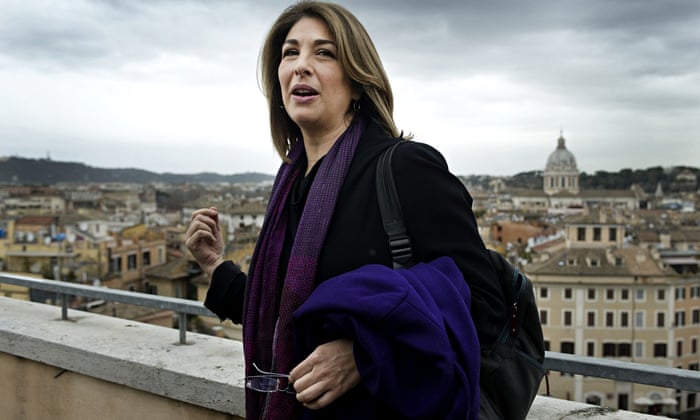
Naomi Klein visit Rome


PHOTO: Naomi Klein on an earlier visit to Rome Photograph: REX Shutterstock


Rosie Scammell


She is one of the world’s most high-profile social activists and a ferocious critic of 21st-century capitalism. He is one of the pope’s most senior aides and a professor of climate change economics. But this week the secular radical will join forces with the Catholic cardinal in the latest move by Pope Francis to shift the debate on global warming.


Naomi Klein and Cardinal Peter Turkson are to lead a high-level conference on the environment, bringing together churchmen, scientists and activists to debate climate change action. Klein, who campaigns for an overhaul of the global financial system to tackle climate change, told the Observer she was surprised but delighted to receive the invitation from Turkson’s office.


“The fact that they invited me indicates they’re not backing down from the fight. A lot of people have patted the pope on the head, but said he’s wrong on the economics. I think he’s right on the economics,” she said, referring to Pope Francis’s recent publication of an encyclical on the environment.


Release of the document earlier this month thrust the pontiff to the centre of the global debate on climate change, as he berated politicians for creating a system that serves wealthy countries at the expense of the poorest.


Activists and religious leaders will gather in Rome on Sunday, marching through the Eternal City before the Vatican welcomes campaigners to the conference, which will focus on the UN’s impending climate change summit.


Protesters have chosen the French embassy as their starting point – a Renaissance palace famed for its beautiful frescoes, but more significantly a symbol of the United Nations climate change conference, which will be hosted by Paris this December.


Nearly 500 years since Galileo was found guilty of heresy, the Holy See is leading the rallying cry for the world to wake up and listen to scientists on climate change. Multi-faith leaders will walk alongside scientists and campaigners, hailing from organisations including Greenpeace and Oxfam Italy, marching to the Vatican to celebrate the pope’s tough stance on environmental issues.


The imminent arrival of Klein within the Vatican walls has raised some eyebrows, but the involvement of lay people in church discussions is not without precedent.


Ban Ki-moon, the UN secretary-general, delivered the keynote address at a Vatican summit in April on climate change and poverty. Anticipating the encyclical, he said he was depending on the pope’s “moral voice and moral leadership” to speed up action.


When it came to the presentation of the document itself, the pontiff picked a five-strong panel, including a Rome school teacher and a leading scientist. Hans Joachim Schellnhuber, who heads the Potsdam Institute for Climate Impact Research, used the time to give churchmen a lesson in climate science.


The pope has upset some conservatives for drawing people from outside the clergy into the heart of the debate, while critics have also argued the Catholic church should not be involved in an issue that should be left to presidents and policy-makers.


But Klein said the pope’s position as a “moral voice” in the world – and leader of 1.2 billion Catholics – gives him the unique ability to unite campaigners fighting for a common goal. “The holistic view of the encyclical should be a catalyst to bring together the twin economic and climate crises, instead of treating them separately,” she said.


Much of the pope’s discourse focuses on the need to give developing countries a greater voice in climate change negotiations, a view that sits uncomfortably among some in developed nations. “There are a lot of people who are having a lot of trouble in realising there is a voice with such global authority from the global south. That’s why we’re getting this condescending view, of ‘leave the economics to us’,” said Klein.


She views the rise of Francis as an environmental campaigner as marking a welcome shift not only in the international sphere but also at the Holy See: “We’re seeing the power base within the Vatican shift, with a Ghanaian cardinal [Turkson] and an Argentine pope. They’re doing something very brave.”


While the upcoming conference is centred on the pope’s encyclical, delegates will also be looking ahead to decisive international meetings this year. Before the Paris talks comes a UN summit, where states are due to commit to sustainable development goals, which will inevitably affect the environment.


The pope will fly into New York on the first day of the meeting and address the UN general assembly, reinforcing his message and emboldening countries worst affected by climate change.


For Klein, the papal visit will mark a much-needed change in the way negotiators discuss the environment. “There’s a way in which UN discourse sanitises the extent to which this is a moral crisis,” she said. “It cries out for a moral voice.”

Jun 252015
 

The way in which Climate change and Water issues are approached by people in different places has an impact on all of us.

B.C. seems to have a pretty good system already in place for water management.  Four stages of restrictions on water use, depending on conditions.   You don’t just wait for disaster and then scramble to deal with it.


Salt Spring Island, B.C. today is at Stage 3, most likely going to stage 4 (the highest level of restriction) in the near future.  Two lakes are their source of water.  The lakes are the lowest they have been, EVER.  The water needs to be managed for today, but also for eventualities.  If the drought is short-lived the lakes will re-fill.  If drought continues,  the water levels will continue to decline.  The Island is not issuing development (new building) permits;  they are not extending water lines.     (Source, CBC Radio, On the Island, interview June 25.)


Our network started because of an ill-advised plan for water.  We have been actively involved in fighting for protection and against commodification. Through the years we have followed developments in the U.S. over water.  They, not unlike us, have been profligate users with no sense of limits or responsibility.   There are those who plan to make money through export of water from Canada to the U.S., a source of nervousness.


CALIFORNIA

This interview of California Governor Jerry Brown is very helpful to understanding the difficulties and the thinking in California.  It’s an hour long, the issue of commodification comes up:    watch the video »


View in browser


Join the Conversation On June 9 we began The California Conversation, a new way to discuss some of the complex issues we face in California. Governor Jerry Brown and Publisher Austin Beutner had an hour-long talk on water in the West. Stay tuned for more of The California Conversation. •   Read coverage, watch the video » •   Stay informed on the topic of water, subscribe to the newsletter » •   Follow us on social media #TalkCA


Sign up for newsletters | Unsubscribe | Privacy Policy | Copyright © 2015
Los Angeles Times | 202 West First Street, Los Angeles, CA, 90012 | 1-800-LA-TIMES
Jun 252015
 
(I don’t try to report on all the things Julian Assange is doing, from the Ecuadorean Embassy in London where he has been confined since June 2012 – 3 years.)
INTERESTING NEW DEVELOPMENT,  France mulls offering asylum to Assange and Snowden.     link at bottom,  in the Google Alerts for June 26
– – – – – – – – – – – – – – – –  – – – – – – — –
Julian Assange Says Time Has Come for Action After US Spying Revelations
Paris:  WikiLeaks founder Julian Assange told French television Wednesday that the time had come for legal action over US snooping after leaked documents revealing Washington had spied on three French presidents sparked fresh outrage.Speaking on TF1, the anti-secrecy campaigner urged France to go further than Germany: by launching a “parliamentary inquiry” into the foreign surveillance activities and referring “the matter to the prosecutor-general for prosecution”.German prosecutors had carried out a probe into alleged tapping on Chancellor Angela Merkel’s phone, but later dropped the investigation due to a lack of hard evidence.

Assange also said other important revelations were coming.

“I think from a policy perspective what is to come is much more significant than what we have published so far,” he said.

“But now the question really for (President Francois) Hollande and the French leadership is what are the opportunities in their response to address this situation.”

France expressed anger earlier Wednesday after leaked documents labelled “top secret” appeared to reveal US spying on Hollande and his two predecessors, Nicolas Sarkozy and Jacques Chirac, between 2006 and 2012. The disclosures were published by WikiLeaks along with French newspaper Liberation and the Mediapart website.

France’s foreign minister summoned the US ambassador for a formal explanation in response, while Hollande spoke by phone by with US President Barack Obama, who gave fresh assurances that spying on European leaders had ended.

But Assange accused the US of playing “word games”, as it did after revelations of US eavedropping on Merkel.

“What does it matter if they say that they’re not going to spy on Hollande personally if they’re spying on everyone he talks to?” Assange asked.

“Every single one of these intercepted phone calls that we have published is Hollande talking to someone else, Sarkozy talking to someone else, one of the members of the French government. What does it matter if they say that they’re not going to spy on Hollande personally if they’re spying on everyone he talks to?”

= = = = = = = = = =  = = = = = = = = = =


APPENDED,  Google Alerts, Julian Assange, June 26, 2015:

julian assangeDaily update ⋅ June 26, 2015
NEWS
Huffington Post

Julian Assange: Mainstream Media Rife With Censorship

Huffington Post

Seung-yoon Lee, CEO and co-founder of Byline, recently conducted a rare exclusive three-hour interview with Julian Assange in Embassy of Ecuador, …

Daily News & Analysis

Is Lalit Modi India’s Julian Assange?

Daily News & Analysis

A grandson of Rai Bahadur Gujarmal Modi, pushed to the wall, he has taken up the cudgels to expose corruption. He has put up a photograph of …

Flag as irrelevant
Sydney Morning Herald

France mulls offering asylum to Julian Assange and Edward Snowden

Sydney Morning Herald

France’s Justice Minister has canvassed possible asylum for WikiLeaks founder Julian Assange and former US intelligence contractor Edward …

French minister: It’s possible asylum will be offered to Snowden, Assange – CNN

Assange, Snowden Asylum in France Doubtful – Wikileaks Spokesman – Sputnik International

French Minister: Paris May Offer Asylum to Whistleblowers Snowden, Assange – Sputnik International

Full Coverage

Flag as irrelevant
The Malaysian Insider

US seeks to reassure France on spying, Assange urges action – The Malaysian Insider

The Malaysian Insider

WikiLeaks founder Julian Assange is calling for legal action over Washington’s snooping and promised more disclosures to come.– Reuters pic, June …

US seeks to reassure France on spying, Assange urges action | French News | Expatica France – Expatica France

Time has come for action after US spying revelations: Assange – Peninsula On-line

Full Coverage

Flag as irrelevant
The Cryptosphere

Operation Global Media Domination: The WikiLeaks Situation

The Cryptosphere

… we should write about WikiLeaks and Julian Assange just before heading offline, because it appears that we’ve been on the front page of Google …

Flag as irrelevant
Press digest Times of Malta… Taubira has told CNN affiliate BFMTV she “wouldn’t be surprised” if France decided to offer asylum to Edward Snowden and Julian Assange.

t
The North Africa Post

US reassures France to end spying on French presidents

동아일보

… WikiLeaks founder Julian Assange urged France to take legal action over … Assange called for launching a prliamentary inquiry into the foreign …

 
See more results|Edit this alert


You have received this email because you have subscribed to Google Alerts.
Jun 242015
 

Epigenetics, is it the same as, or different from, cellular memory passed inter-generationally?    (Residential Schools)

Through  “epigenetics” it is understood that trauma affects people inter-generationally.   We circulated info:


– – – – – – – – – – – – – – – – – – – – – –

Here we have:
“Day 6”, CBC Radio,  June 6, 2015.  Interview of Amy Bombay.http://www.cbc.ca/player/Radio/Day+6/ID/2668885811/

Can trauma have genetic effects across generations?

The Truth and Reconciliation committee has shed light on the horrors of residential schools in Canada. Dr. Amy Bombay explains the effects that trauma can have over multiple generations in relation to Canada’s First Nations people.

I contacted Amy Bombay and the Current.   Our exchange follows.

– – – – – – – – – – – – – – – – – – – – – –

From: Sandra Finley [Sent: June 6, 2015   To: amy.bombay   AT  dal.ca

Subject: Your interview on CBC Radio, Program ” Day Six”.   Epigenetics.

Dear Amy,

I left a voice message on your Dalhousie Office phone.

I sent the following message to The Current  to try and locate an interview done by Anna Maria Tremonti of an American psychiatrist a few years ago.

Just in case you are not aware of it,  I want to pass it along.    If my memory of what was said is accurate,  it has direct application to the generations affected by trauma suffered at Residential Schools.   I have a rudimentary understanding of epigenetics.   I think this is contributory but a little different – –

Best wishes,

Sandra Finley

= = = = = =  = = = = = =  =  = = = =

SUBMITTED TO “THE CURRENT”:

I have searched, can’t find.  An interview by Anna Maria.  Woman who had terrible nightmares from childhood, but was from an average middle-class American family.  No explanation for the nightmares.

The woman went into psychiatry, and over time developed a clientele for whom the solutions were in experiences of their parents.  They suffered from events that they had never experienced and knew nothing about.

The Psychiatrist and her Mother went as tourists to Poland, and visited Auschwitz.   Their guide was an elderly woman.   As would unfold (serendipity):  the Psychiatrist’s Mother’s Mother had been herded onto a train bound for Auschwich.  She was able to pass her infant (the Psychiatrist’s Mother) out the train window to a person on the platform.   The infant was spirited away and hidden in a dark basement, where the last thing that could happen was for the baby to cry and their hiding place be revealed.

The woman who cared for and loved the infant happened to be this elderly guide.   It was a tearful re-union.  The Psychiatrist’s Mother did not know of her own experience in infanthood, and had suffered not at all as a consequence of it.  It was her daughter who was impacted by the trauma of her Mother.   The nightmares of the daughter stopped when the source was stumbled upon.

That was the story told in the interview, as I recall these few years later.  I believe that the Psychiatrist wrote a book that documents not only her personal experience, but also some case studies from her practice.

Is it possible that someone at The Current might help find the information related to that interview?   I would like to pass it along to “Day Six” and to First Nations Amy Bombay re June 6/2015 interview.  Amy discussed the impact of trauma, conveyed inter-generationally through Epigenetics  (trauma “tags” attach to DNA and turn biological switches on and off ).

The stories told by the Psychiatrist suggest that cellular memory is also passed inter-generationally (which we know is the case – – for example cells have memory that lead to differentiation of function).

We have conscious and unconscious memory of events that affect us.   But we have not thought that we have within us, unconscious memory of events passed down inter-generationally.  (Some other cultures do have that belief.)   . . .   anyhow, I thought that Amy Bombay might be interested in that interview of the Psychiatrist by Anna Maria.    Thanks for your consideration.

/Sandra Finley

= = = = = = = = = = = = = =  = = = =

From: Lisa   On Behalf Of The Current   Sent: June 8, 2015   To:  Sandra Finley   Subject: Re: QUESTION: Interview, few years ago, American Psychiatrist

I am sorry. I don’t recall this at all.

If you want to pitch this to Day 6, they can ask archives to search for this segment. Maybe it was on another program? They have access to all show scripts so hopefully they can find it.

I’ll also flag this to our book’s producer to see if he might remember the book.

Take care,

Lisa Ayuso

= = = = = = = = = = = = =

From: Sandra Finley  Sent: June 24, 2015   To: ‘The Current’    Subject: RE:  Interview, few years ago, American Psychiatrist

Re Interview with Amy Bombay, research re inter-generational trauma (residential Schools)

Thank-you Lisa.

I will do as you suggest.

/Sandra

= = = = = = = = = = = = =

From: Amy Bombay [Amy.Bombay   AT  Dal.Ca]  Sent: June 8, 2015   To: Sandra Finley   Subject: Re: Your interview on Day Six. Epigenetics. A further consideration, cellular memory passed inter-generationally.

​Wow thanks so much for doing all of this leg-work for me Sandra! I have heard of it and will look into it more…. thanks so much for the email!   In case you are interested, I’ve attached a review article that we wrote….

All the best,

Amy

Amy Bombay

Assistant Professor

Department of Psychiatry/School of Nursing

Dalhousie University

(Tried standing on my head, to upload a copy of the attachment.  Need to get the error message resolved.  Did not formerly have this problem.)


Jun 222015
 
Derek left a Comment on the posting  Aware:

In My Opinion most people are “aware” that something is wrong with the way we live. The awareness is unfocused.
IMO again, I would say neoliberalism and the New World (aka American) Order- or unbridled capitalism 
I think that covers the gamut, but others will see destruction of the habitat without knowing the real cause.

 I think our problem is to focus the awareness. What do you think should be the focus?


Curious . . .  Derek’s question actually gave me an adrenalin rush!   What do you think should be the focus?

Derek – – if I understand correctly,  you are offering  the “something wrong”  as being, at root,  one of the first three items below  (Neoliberalism,  The New World (aka American) Order,  Unbridled capitalism).

You use the term “unbridled capitalism”;  I have used “late-stage capitalism”.   I have portrayed us as being in a battle to assert democracy over the corporatocracy that engulfs us.  A war, really.  But one in which we use weapons more powerful than the killing kind.  We use the weapons of non-violent resistance, much more effective, don’t destroy people and the environment,  and don’t generate the inter-generational hatred that goes with conventional or “stupid” weapons.

I do not use the terms Neoliberalism  or  New World (aka American) Order, except as they appear in articles written by others.

The Home page is a reclamation plan for democracy, from corporate takeover – it’s a statement of what this blog is about.   (A long time ago I circulated my understanding that corporate takeover is fascism, a word that would have been used in another day and place.   It is not current vernacular in North America, to describe what we are teetering on, so I don’t use it.)

I believe that “corporatocracy” is self-explanatory, and people easily relate to it,  they can see it in their daily experience,  more so than the word “fascism”.

Corporatocracy must necessarily grow a military presence.  It necessarily resorts to violence because it must appropriate resources that belong to others.  Eventually, people cabbage on to what is happening.  Power and control must then be exercised over them.  Hence we have, for example,  the growing presence of Lockheed Martin Corporation (American military) in Canada.  With collaborators in place.  Quislings, a word we should all re-learn.

Below, I went through options for “what to focus on”.   My personal preference is to focus on Corporatocracy  (or what I believe you would call “Unbridled capitalism”),   and within that, the militarization aspect to receive special emphasis.

Your feedback, also from others,  is valued!   Thanks Derek.   /Sandra

What do I think should be the focus?  

1.     Neoliberalism? 

2.    The New World (aka American) Order?

3.     Unbridled capitalism?     (corporatocracy, as I call it)

4.    Militarization, as a subset under corporatocray?

The majority of blog traffic, without diminishment, is to the postings about Statistics Canada and Lockheed Martin.   The single most-visited page is   Are StatsCan “surveys” mandatory?

(Note to Newcomers:  Lockheed Martin (American military and surveillance) has been involved at StatsCan.  “Surveys” are on-going, in between censuses.  StatsCan demands, under threat of prosecution, large amounts of personal information.  But under the law,  surveys are voluntary.  You can get a sense of things (guerilla warfare!! non-violent resistance!!) at  Are StatsCan “surveys” mandatory?)

Volume of traffic would recommend the militarization theme for focus.   The blog pages are USED,  which suggests we are meeting a need.   (Overall, we are approaching 75,000 hits,  a small number in the blogosphere.   Lots of our information goes through email networks.  I use facebook and ttwitter to a lesser extent.)

See my reply to Patricia at the bottom of  Radical idea about Leaders.  The next Census is upcoming in May 2016.   Lockheed Martin desperately needs to sell F-35 stealth bombers to Canadian tax-payers, after bankrupting American tax-payers.   If we demand that “leaders” sit down and find ways to resolve conflict,  if we refuse to pay the bills submitted to us by the weapons manufacturers,  the war machine would starve.  We should be clear that we are the enablers.   Without our money and big-time propaganda, they could not do the destruction – –  which will inevitably infect us, if it is not stopped, if we don’t get onto a better path.  People in other countries are doing what people here are doing  – – it is not that we are the only ones who see through the stupidity of allowing “leaders” to bomb each others’ countries.  We create the terrorists, both overseas and at home.

Our network has accumulated a lot of information on Lockheed Martin.   We are in a good position to keep growing awareness of the intrusion of American foreign policy into Canada, our loss of sovereignty, and the need to take back control of our military and surveillance functions.

The only way I can see to accomplish that is through non-violent resistance.  Standing firm behind our Constitutional Right to Privacy of Personal Information has been a tool in that effort.

We have an election in the offing (October).  In a few months following that, a Census  (NSA back-door entry to a comprehensive data base on Canadians – surveillance by the American military).

At some point the multi-multi-billion dollar contracts for the F-35 stealth bombers will be sprung upon us once again.   Doubtless, work is proceeding behind closed doors.  There is a report that the F-35’s are off the table until 2018.  It’s unwise to let the dog lie until then – – we need to continue building awareness and resistance.

If ever I falter, I re-visit  2011-01-1 WATCH: President Dwight D. Eisenhower’s 1961 farewell speech Plus Words of Wisdom from Eisenhower.

I think that, in general, Canadians are clueless about the threat of militarization.    There are anti-war groups, pro-peace groups, there’s ceasefire.ca  . . .  Maybe I haven’t developed the right “connections” – –  I don’t have a sense of momentum in this sphere like there is in climate change and the take-back of our food supply (March Against Monsanto).   Occupy and Idle No More are very important mobilizations,  along with AVAAZ, LeadNow, SumOfUs, Public Citizen, , and so on,  . . . but the militarization theme is not well represented.  There isn’t a mass movement, like there was to end the Viet Nam War,  to demand that “leaders” come to the table to talk, to work out solutions in the Middle East, and with Russia.   Media coverage very seldom makes the connection between the dropping of bombs in Iraq in 2003, the creation of refugees flowing out of Iraq into next-door Syria, the waves of refugees created by each successive wave of bombing  in country-after-country.  News casters report on the current situation in Yemen, but fail to point out that Yemen was either the first, or one of the first countries bombed by the U.S. through drone warfare.  . . .   War is still glorified.    Anyhow – – there are good groups countering the propaganda fed to the citizenry.

The leaks by Edward Snowden inform us of what is happening in the military/surveillance arena.  Every gain we make in thwarting corporate appropriation of water supplies, stopping pipelines, transitioning off fossil fuels, is a threat to the powers-that-be.  They have tools and agreements in place (documented on this blog) to call the American troops into Canada, in the event of civil emergency  . . .  in the event we become too unruly in our protection of what is necessary for survival.  Their reassurances that the Troop Exchange Agreement is just to assist us, hold little weight.

Both to strengthen any remaining sovereignty, and to remove ourselves from the clutches of the The New World (aka American) Order, as Derek would call it,  I suggest we focus on awareness of militarization – – where are the seeds of violence?

 5.   Should we focus on Expanding our reach? Better use of technology?   I am inefficient,  I don’t use technology’s capacity to reach more people.  I like small and personal.  (I am also deluded.  I know lots of you.  But in truth, I don’t know lots of you, too.)    If we are being taken to the cleaners (by Bill C-51, or corruption, the biotech corporations, Lockheed Martin, for example) and I want to turn anger into action, I add ten more people to my part of our email tree.   In truth I am not growing the tree, because I add people infrequently, while others are dropping off from time-to-time.  Some participants have spun off their own network from this one, and maybe they are better at “expansion”!   Maybe we can all add a few more people to our individual list?


NUMBER 6 IS THE WRONG ANSWER FOR ME.   IT IS THE RIGHT ANSWER FOR SOME OTHERS:

6.   hmmm . . .  Does OPPORTUNISM rule?   I see an opportunity right now.   Should that be our focus?    . . .   Life makes me laugh!   I could equally say that it’s opportunism, OR that I am simply following where I perceive the path leads, because Serendipity has brought a CONVERGENCE.    (I am a good rationalizer – – this might be serendipity but it’s not the right focus for me, right now.  There are other very capable hands at work on it.)

 An alternate interpretation:  laziness!   I like to push when there is less resistance.  It means  less work.  And we gain more ground.   . . .  aaah!  but wouldn’t it be nicer to say that I am a good strategist?!   Sounds better than “lazy”.

THE CURRENT OPPORTUNITY   is in electoral reform:

Please see

EXCERPT:

If we voted for what we want, we would vote for

  • Trudeau’s idea for change in the voting system
  • figure out what to do about the party system – it stinks, frankly speaking.  We need ideas,  . . .
  • If we designed our system of governance around IDEAS, might we be able to remedy another long-acknowledged flaw in the current system:   four-year election cycles lead to decisions by elected representatives that are VERY short-term in outlook.  

We have already moved in the direction of IDEAS  and away from the party system.   Videos and postings, ideas transformed into action,  petitions and pranks  shared by millions of people around the Planet.   Political Parties are becoming obsolete.

The work by Canadians to re-invent our system of governance is strong.

The Climate Change movement is making incredible advances.

I think our services can be most helpful if focused on an area of weakness:  Canadians need to reclaim control of our military.  They are operating under American control.


Jun 172015
 

2012-04-01  How the Big Energy Companies Plan to Turn the U.S. (and Canada) into a Third World Petro-State    http://sandrafinley.ca/?p=4894


2007-05-19  TARSANDS:  Backlash against a whistle-blower  Globe & Mail, Andrew Nikiforuk  http://sandrafinley.ca/?p=4917 


2007-06-06  VIDEO:  Help “Get the Shell Out” of the Sacred headwaters.  (Add to original: call on CPP to disinvest.)  http://sandrafinley.ca/?p=4897  


2009-09-26  Protect your turf.  “Small” reactors.  NUKE RALLY in Saskatoon, Update Sept 26.  http://sandrafinley.ca/?p=4921 


2010-04-05  Tar Sands Update:  Dr. Gina Solomon after May 03, 2010 Visit to Fort Chipewyan   http://sandrafinley.ca/?p=4903 


2010-04-12  Tar Sands:  Speech by Marcel Coutu.  Canada Stocks Rise on SinoPec Oil Sands Investment. Now the Clearwater River. http://sandrafinley.ca/?p=4928 


2010-09-13  Petro-state: there is no opposition.  Premier Brad Wall on “value added” for uranium.  NDP Opposition Leader Lingenfelter on nuke in Saskatchewan.  (The nuclear power is for tar sands development.)   http://sandrafinley.ca/?p=1200 


Lockheed Martin, Census, Trial, War Economy

Jun 172015
 

Related:

(2015-04-18)  Hundreds of Millions of Dollars already paid out to corporations because of trade deals. It’s about to multiply many times over (TPP, CETA, etc.).

(2013-11-09)   Contrast: Transatlantic Trade Deals (CETA & TTIP), also TPP vs “We Are Living in the World Occupy Made”

(2013-06-11)    CETA (also about GMO’s): Canada ready to raise threshold on foreign takeovers to $1.5B [and other give aways]

(2011-03-24)   CETA is NAFTA on Steroids – Cross Canada Tour

Regarding the TPP, but applies in general to the Trade Deals:

Thanks to Janet Eaton:

June 17,   Amanda Lang with Prof Gus van Harten on The Exchange

8:00 AST,   9:00 EST

Dear All:

Canada’s Trade Justice Network (TJN) just got wind that several people will be interviewed on “the Exchange” tonight,  about our TJN media release today on the TPP, TransPacific Partnership Agreement recent poll showing that only 1 in 4 Canadians had heard of the TPP. [See release below]

One of the interviewees will be Gus van Harten , York University, Osgoode Hall, Law Professor whose scholarly writings on Investor-State Dispute Settlement [ISDS] and the CETA, the Canada – US Comprehensive and Economic Trade Agreement, have been immensely helpful to the Trade Justice Network, European networks and all folks working to help the public, NGO’s and politicians understand Investor State Agreements, how they differ from our domestic courts, and the negative potential they have for our democracy, sovereignty, judicial system and our pocket books among other things.

Gus Van Harten’s recent book on the Canada China FIPA – Foreign Investment Protection Agreement is a must read for anyone wanting to see how unbalanced this deal is – basically leaving Canada out in the cold while giving China everything but the kitchen sink and to further understand how ISDS works since it is the dispute settlement in the FIPA. . His book is “Sold Down the Yangtze: Canada’s Lopsided Investment Deal” May 15, 2015.

The media release by TJN :  http://www.tradejustice.ca/en/

fyi-  janet

Janet M Eaton, Member of the Trade Justice Network

=====================================

75% of Canadians have never heard of major “TPP” trade deal being negotiated in secret June 17, 2015

OTTAWA (June 17, 2015) –

Three out of four Canadians have no idea that the federal government is negotiating a huge international trade deal known as the Trans-Pacific Partnership (TPP) that could have serious repercussions for the country, a new poll suggests.

The poll, conducted by Environics Research Group for Trade Justice Network, found that 75 per cent of respondents had not heard of the TPP, which is being negotiated with 11 other Pacific Rim countries and would cover more than a third of the world´s trade.

The survey also found: Seventy-five per cent of respondents were very or somewhat concerned that the deal is being negotiated in secret with no input from MPs, labour leaders, environmentalists or other experts.

Eighty-three per cent of respondents were very or somewhat concerned that the deal could include a provision allowing multinational corporations to sue Canadian governments under trade tribunals – rather than though the courts – if they feel our labour, environmental, health or other standards contravene the TPP and would lead to a loss of profits.

Forty-seven per cent of respondents said Canada is more likely to lose jobs under the TPP as Canadian companies move manufacturing and other jobs to low-wage countries, such as Vietnam where the average wage is 65 cents an hour.

Only five per cent said Canada is more likely to gain jobs. Forty-six per cent said they didn´t know enough to say.

The survey of 1,002 Canadians was commissioned by Trade Justice Network (TJN), a coalition of social, labour, environmental, student and other groups concerned about the secrecy and anti-democratic provisions of international trade negotiations.

TJN spokesman Martin O´Hanlon said the whole process surrounding the TPP negotiation is “deeply disturbing.” “Most Canadians have no idea that this deal is being negotiated in secret under the guidance of multinational corporations with no input from labour leaders, environmental experts or even MPs,” O´Hanlon said. “It´s frightening that this can happen in a democracy.”

One of the most troubling things about the TPP is the fact that multinational corporations would have the power to override Canadian sovereignty and sue our governments under secretive trade tribunals, O´Hanlon said. “Who else has the power to avoid the courts?” he asked. “This process effectively puts corporations above the law.”

O´Hanlon also stressed that the deal will result in the loss of thousands of Canadian jobs as manufacturers and others move work to low-wage Vietnam. “We support fair trade, but how can you have a fair trade deal with countries like Vietnam that pay workers 65 cents an hour and have no real health, safety, labour or environmental regulations?”

The poll, which was conducted by telephone June 3-12, is considered accurate to within 3.2 percentage points 19 times out of 20.

You can find the Trade Justice Network on Twitter (@TradeJusticeNet) and on Facebook.

For more information contact:

Martin O´Hanlon Trade Justice Network (613) 867-5090

Bill Gillespie Trade Justice Network (647) 786-4332

Share also on facebook Trade Justice Network

The Trade Justice Network is comprised of environmental, civil society, student, Indigenous, cultural, farming, labour and social justice organizations that have come together to challenge the scope and secret negotiating process of most free trade agreements. We seek to highlight the need for a more sustainable, equitable and socially just international trade regime.