Sandra Finley

Feb 252015
 

http://aptn.ca/news/2015/02/26/afn-fears-unjust-labelling-first-nations-activists-terrorists-proposed-anti-terror-bill-document/

Jorge Barrera
APTN National News
The Assembly of First Nations will be seeking to appear as a witness before the House of Commons committee currently studying the Harper government’s proposed anti-terror bill.

The AFN’s main concern is about its potential impact on First Nation dissent, according to a document from the national chiefs organization which analyzes Bill C-51.

To voice concerns about its potential impact on First Nation dissent, according to a document from the national chiefs organization which analyzes Bill C-51.

The AFN will also be seeking standing as a witness before the Senate committee taking over study of the anti-terror bill once it passes through the House of Commons, which is expected because the Harper government has a majority.

The AFN analysis document says the proposed bill could lead to the “unjust labelling of First Nations activists as ‘terrorists.’”

“Many of the provisions drafted in the proposed Act could potentially apply to activities of Indigenous peoples living in Canada and there are very few provisions proposed that would prevent the legislation from being interpreted against First Nations people,” said the analysis.

The AFN will also be seeking to meet with officials and MPs on both sides of the debate to have amendments considered in discussions on the proposed bill.

“Our office will seek to meet with government and opposition officials to seek amendments to the draft legislation,” according to the AFN’s analysis which was finalized Tuesday. “Our office will be working with First Nation leadership and interested organizations to assess the potential impacts of the legislation.”

The proposed anti-terror bill will give the Canadian Security Intelligence Agency police-like powers. It also gives police more leeway when it comes to arresting individuals suspected of committing acts of the terror. The bill also aims to crack-down on online speech that is perceived to promote terrorism.

The Harper government has rejected calls for more oversight to accompany the new powers the bill will give to law enforcement agencies.

The Liberals have stated they want amendments to the bill, but will support its passage even if their amendments are rejected.

The NDP has stated it intends to oppose the bill.

The AFN is among a list of 60 potential witnesses the NDP is planning to submit to the Commons Public Safety committee studying the bill. The NDP will also be including Indigenous activists on the list of potential witnesses.

It’s unclear at the moment when the committee will actually begin to hear from witnesses. On Tuesday, the Conservatives reportedly tried to limit the amount of days spent hearing witnesses while the NDP responded by filibustering, pushing the meeting to the four-hour mark.

The committee meets again in camera Thursday and NDP public safety critic Randall Garrison is expected to table a motion to have the committee sit during evenings and through break weeks to hear from as many witnesses as possible.

During question period Wednesday, NDP leader Thomas Mulcair accused the Harper government of trying to limit debate on the bill. He asked why Prime Minister Stephen Harper didn’t want to hear from First Nation leaders on their concerns about the bill. Mulcair quoted from a statement issued by the Union of B.C. Indian Chiefs last Friday which said the proposed anti-terror bill “directly violates the ability” of Indigenous people to assert and defend their constitutionally protected rights.

“First Nations are raising the alarm,” said Mulcair. “Again, Bill C-51 goes well beyond terrorism and will impact constitutionally-protected dissent and protest. Why is the prime minister afraid to hear from First Nations themselves?”

Harper wasn’t in the House of Commons for question period, but Public Safety Minister Steven Blaney fielded the question. Blaney said First Nations had nothing to fear from the bill.

“For greater certainty, it does not include lawful advocacy, protest, dissent and artistic expression,” said Blaney, quoting directly from the bill. “Please read the bill and then we can have a debate.”

The AFN analysis also references the same section Blaney used to argue First Nation dissent did not face a threat, but came to a different conclusion.

“Although most First Nations demonstrations could be considered as lawful advocacy, protest or dissent, it is likely that there would be disagreements between First Nations and the government as to what would constitute unlawful activity,” said the analysis. “The legislation does not account for disagreements or who would determine in the event of an ambiguous situation, such as if a demonstration was considered a lawful protest by a First Nation, but deemed an interference with critical infrastructure by the federal government or law enforcement agencies.”

The analysis also raises concerns about another section of the bill that covers activities that “undermines the security of Canada” including interfering with the government’s capabilities around defence, intelligence, border operations, public safety and the economic and financial stability of the country.

“This definition could be problematic for First Nations communities or citizens who may be engaged in various activities to: assert inherent or recognized rights and title; protect their land and water rights and interest; or oppose major development projects on their traditional lands that threaten the enjoyment of their Aboriginal or Treaty rights,” said the analysis. “The proposed legislation could result in the unjust labeling of First Nations activists as ‘terrorists,’ such activists who: seek to exercise their freedom of speech and freedom of assembly to assert First Nation’s collective rights, title and jurisdiction; march across or set up blockades at the border of the Unites States and Canada; set up a blockade along a major highway or railway; block access to a road or railway’ or publicly encourage such actions.”

The analysis also said the AFN was watching Bill C-639, An Act to Amend the Criminal Code, protection of critical infrastructure, which is a private member’s bill introduced by Conservative MP Wai Young last December. Bill C-639 aims to expand the Criminal Code definitions of critical infrastructure to also encompass everything from telecommunications, to transportation to finance, health care and food, said the analysis.

“The critical infrastructure provision in (the Bill C-51) closely resembles…Bill C-639,” said the analysis. “Unlike Bill C-639…Bill C-51 is very broad and will embody any activity that ‘undermines the security of Canada.’”

jbarrera@aptn.ca

@JorgeBarrera


Feb 242015
 

http://sputniknews.com/europe/20150223/1018648904.html 

© AP Photo/ Alik Keplicz

Poland is investing billions of dollars in game-changing military hardware, much of it supplied by Lockheed Martin, with ambitions to shift the balance of power in Eastern Europe.

Polish officials and experts have high hopes that a series of military programs aimed at beefing up Poland’s missile-related capabilities will dramatically strengthen the country’s projection power capability, even predicting that it will shift the balance of military power in Central Europe in Poland’s favor.

The Polish Defense Ministry made a deal this past December with the US’s Lockheed Martin to acquire at least 40 AGM-158 semi-stealth air-to-surface missiles with a range of 370 km for its F-16 fighter fleet. This, combined with plans to develop a 300 km range surface-to-surface rocket artillery system known as HOMAR with technology licensed from Lockheed Martin, plus plans to purchase a submarine-launched system of maneuverable rockets with a range of up to 800 km, will provide Poland with what political scientist Pawel Soroka calls a “Polish deterrent triad.”

Speaking with Poland’s Newseria news agency on Sunday, Soroka noted that the defense program would dramatically improve Poland’s independent military capability. “NATO has a system of deterrence, at the head of which is the US. I think that on the one hand, we must be included into NATO’s system of deterrence as an ally, but on the other hand, we must also have autonomous capabilities.” Soroka noted that the system would increase Poland’s options for independent action in times of crisis.

Moreover, in Soroka’s words, “along with the new hardware will come new opportunities, for example, the submarine-based landing of special forces.” The planned fleet of three new submarines, expected to cost over $2.03 billion, is expected to allow them to attack ground targets hundreds of kilometers from the Baltic coast using maneuverable ship-to-surface missiles, a capability Poland would be alone in possessing among its Central and Eastern European NATO partners.

The air, ground and ship-based conventional missile systems are part of a $42.4 billion military modernization program up to 2022 dubbed “Polish Claws” by Prime Minister Donald Tusk, which includes a $9 billion air and missile defense system known as “Polish Shield”.

Amidst rising tensions on its eastern European borders and ever-increasing NATO encroachment, Russia’s new military doctrine, adopted late last year, singles out NATO as a main strategic threat to the country’s security. The new doctrine has seen with it the speeding up of the country’s 2020 military modernization program, with new and modernized equipment entering service into all four branches of military. In 2014 alone, the army received two new brigades of Iskander M-based tactical rocket systems, while three new rocket forces regiments were outfitted with the RS-24 Yars ICBM.

Responding to the increasingly belligerent defense posture by NATO’s eastern outposts, former Deputy Defense Minister General Yuri Baluyevsky recently noted that the representatives of these countries’ political leaders seem to “have forgotten that while our strategic rockets would hypothetically ‘fly over’ their territory, medium and short range rockets would be aimed at their [territory].” Baluyevsky notes that he hopes that remembering this fact “will cool the heads of the leaders of these countries.”


Read more: http://sputniknews.com/europe/20150223/1018648904.html#ixzz3Sgm6icjJ

Feb 232015
 

| By Jim Bronskill, The Canadian Press

 
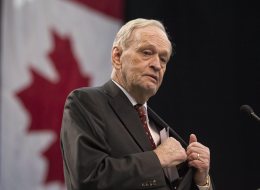
Former prime minister Jean Chretien addresses the audience during an event to celebrate the 50th Anniversary of the Canadian Flag, in Mississauga, Ont., on Sunday February 15 2015.THE CANADIAN PRESS/Chris Young

OTTAWA – Four former prime ministers and several retired Supreme Court members are among almost two dozen prominent Canadians calling for stronger security oversight.

Their statement, published Thursday in the Globe and Mail and La Presse newspapers, comes as the Conservative government proposes a new, expanded mandate for the Canadian Security Intelligence Service to counter terrorist threats.

“Protecting human rights and protecting public safety are complementary objectives, but experience has shown that serious human rights abuses can occur in the name of maintaining national security,” the statement says.

“Given the secrecy around national security activities, abuses can go undetected and without remedy.

“This results not only in devastating personal consequences for the individuals, but a profoundly negative impact on Canada’s reputation as a rights-respecting nation.”

The Security Intelligence Review Committee currently oversees CSIS, doing several studies each year and tabling a report in Parliament.

Critics argue the review committee is just that, a review body, not an oversight agency peering over the spy service’s shoulder in real time.

The joint statement published Thursday was signed by Jean Chretien, Paul Martin, Joe Clark, John Turner and 18 others involved in security matters over the years.

They include five former Supreme Court justices, seven former Liberal solicitors general and ministers of justice, three past members of the intelligence review committee, two former privacy commissioners and a retired RCMP watchdog.

They note that detailed recommendations for a new intelligence watchdog regime — put forward in 2006 by the federal inquiry into the Maher Arar torture affair — were not implemented.

Efforts to enhance parliamentary oversight of national security agencies have also been unsuccessful, they point out.

Several groups including Amnesty International, the Canadian Civil Liberties Association and the National Council of Canadian Muslims welcomed the statement.

The government’s recently tabled anti-terrorism bill, which would give CSIS the power to disrupt plots, was debated Thursday at second reading in the House of Commons.

Opposition MPs accused the government of rushing the bill through Parliament. They said the new powers would allow security agencies to go after the government’s enemies, such as environmentalists.

Justice Minister Peter MacKay dismissed the notion, telling the Commons that security forces would be better able to protect Canadians “in targeted and practical ways” with the review committee and the courts providing a check on their powers.

Speaking at an event in Surrey, B.C., Prime Minister Stephen Harper categorically rejected the idea of a security-cleared committee of parliamentarians monitoring spy agencies, like the ones in Britain and the United States.

“The model we have in Canada of independent, expert oversight — that’s the model we’re pursuing,” he said. “We’re going further in that direction, and we as a government are not interested in politicians doing the oversight.”

The New Democrats chided the government for not doing enough to prevent the radicalization of young people, saying community engagement plans have been left to languish on the drawing board for years.

At a defence forum Thursday, security analyst David Perry of the Conference of Defence Associations Institute said that since 2007, CSIS has handed back five per cent of its total appropriation, or $180 million.

The RCMP had returned eight per cent, or $1.7 billion, to government coffers, Perry said.

New Democrat MP Jack Harris said the government was under-funding key security agencies in order to balance the books.

“They’re bound and determined, come hell or high water, to have a budget surplus against all common sense and neglecting the security needs of the country.”

Feb 232015
 
Security

A Very Dark Place

In the panic after 9/11, Canada enacted anti-terrorism legislation that curtailed civil liberties in favour of national security. Faced with American pressure, is the Harper government poised to go even further?

From the July/August 2006 magazine
Photography by Jaret Belliveau

As the gates of Syria’s austere Far Falestin detention centre closed behind him, Abdullah Almalki remained calm. He was a Canadian citizen, in Damascus simply to visit his mother. Upon meeting with prison officials, he would be immediately released, he thought. At first, the questions were routine: Why had he come to Syria? What line of work was he in? Then suddenly and without warning, one of the inquisitors pulled a rubber blindfold tight across Almalki’s eyes. He was led to another room, seated in a chair, and presented with the names of three Arab men. Did he know them? When Almalki said he didn’t, the room went silent and he was viciously slapped across the face. The sound reverberated throughout the chamber, and at that moment, he later recalled, “they sacked my dignity, they crushed my personality.…[I was] transferred to another world.”

Beginning on May 4, 2002, and for the next 482 days, Abdullah Almalki’s world became a damp, cockroach-infested cell not much bigger than a grave. Cats urinated through a small opening in the ceiling and rats often squeezed under the door, but even still he hoped it wouldn’t swing open—an open door only meant more torture and interrogation, sometimes for eighteen hours straight. Stripped to his underwear, Almalki was repeatedly whipped with a thick cable (a guard once derisively told him that he had endured a thousand lashes during one seven-hour session). The worst torture occurred when his knees were forced to his chest and a large tire was placed around his bent body. He was then rolled onto his back, which allowed the guards to freely beat his head, body, genitals, and the soles of his feet.

Before his arrest, Almalki, then thirty-one, sold communications equipment across the Middle East and Pakistan. As such, the interrogations often centred on his work and on Osama bin Laden. Did he know the al Qaeda leader? Had he ever trained with the terrorist organization or sold equipment to it? But when he was back in his dark cell, Almalki became consumed by other questions. George Salloum, the prison’s chief interrogator, had told him that agents from the Royal Canadian Mounted Police (rcmp) and the Canadian Security Intelligence Service (csis) wanted information about a number of Canadian Muslim men—inconsequential people, it seemed to Almalki, whom the Syrians could not have known about or been remotely interested in. Almalki was also troubled by the fact that Salloum had information that could only have come from his personal business records, material that had been seized by the rcmp during a raid on his Ottawa home in January 2002. His interrogators were cryptic about this apparent collaboration, but several months into his incarceration, Almalki claims they produced a list of questions they said had been supplied by the rcmp and csis. “‘Canada sent these questions,’” he recalls an interrogator telling him. “‘We have to get answers on them so that we can send them back.’”

By that time, physically and emotionally shattered, Almalki had already cracked. “I told them, ‘Whatever you want, I’ll tell you what I know,’” he says. “‘If you want something else, I will sign a piece of paper, blank, and you fill it up with whatever you want.’ I got to the point where I felt I could not take one more lash.” Almalki maintains that on March 10, 2004, his interrogators finally told him that their findings had been sent to Ottawa and that he had been cleared of all allegations. He was set free that day. The question remained however: did csis, the rcmp, and top officials at Foreign Affairs conspire to have Almalki tortured in Syria, in a bid to unmask an al Qaeda sleeper cell operating in Canada?

This allegation is contained in a lawsuit that Almalki launched in March 2006. The case has obvious parallels with the more-publicized inquiry into the role of Canadian officials in the arrest of Maher Arar, the Ottawa computer engineer who was detained at John F. Kennedy Airport in New York in 2002 and, based on information allegedly supplied by the rcmp, flown in shackles to Syria, where he too was tortured at the Far Falestin detention centre. Partly at issue in both matters is whether Canadian officials will be obliged to disclose vital information about how and why Almalki and Arar ended up being tortured in Syria, and to what purpose the information derived from these interrogations was put. The cases may shed light on the depth of Canada’s involvement in what US Vice President Dick Cheney calls the “dark places” democracies must go to win the war against global terrorism.

The Canadian government, however, may be under no obligation to disclose just how dark its methods have become. Canada’s omnibus anti-terrorism package, Bill C-36, the Anti-Terrorism Act, which passed three months after the September 11, 2001, attacks on Washington, DC, and New York, restricts the legal rights of anyone suspected of terrorist involvement. Arar, Almalki, and others may yet be awarded compensation, but given what they went through, these victories might be pyrrhic.

In the aftermath of 9/11, when some in the US media suggested that the Canadian border was a sieve and that some of the terrorists had used Canada as a gateway to the US, Ottawa denied the specific charges, but agreed that the world had changed and that Canada must clamp down. And so our already overstretched military did its part in Afghanistan, and on the home front Bill C-36 was enacted after minimal parliamentary debate.

The 186-page bill rolled back civil liberties related to due process and privacy rights for terrorism suspects. But because its definition of terrorism is so broad—according to Kent Roach, a law professor at the University of Toronto and the author of September 11: Consequences for Canada, it amounts to a threat to life, property, or personal security made, as the legislation puts it, “for a political, religious, or ideological purpose, objective or cause”—many critics believe it is open to abuse. For example, Bill C-36 allows federal ministers to declare a group or organization to be a terrorist front, as recently happened to Sri Lanka’s Tamil Tigers. It also allows the Minister of Public Safety and Emergency Preparedness, together with the Minister of Citizenship and Immigration, to issue national security certificates resulting in the confinement of non-citizens suspected of terrorism (sometimes, as it has turned out, for indefinite periods).

At the time Bill C-36 was passed, civil-liberties lawyers insisted that such measures allowed the state to operate on the assumption of guilt, and that freedom of association and the right to hold and express views at odds with normative discourse and conventional culture were under siege. Bill C-36, they said, was little different than the usa Patriot Act. However, like the Patriot Act, Bill C-36 had an out clause: it implicitly recognized that such infringements on civil liberties are untenable in a free and democratic society by mandating a review of the bill three years after it took effect. Four and half years later, that review is still incomplete, and there are indications that when the assessment of Bill C-36 is finally complete, it will recommend enhancing state powers and further broadening the definition of terrorism.

Roach believes that Bill C-36 was inspired by genuine fears. “If a terrorist attack had originated in Canada the ramifications would have been profound,” he says. The Canadian government was deeply worried about losing control of the border and other matters pertaining to sovereignty. Of specific concern was the possibility that if the rcmp and csis didn’t do something to weed out terrorists based in Canada, the Central Intelligence Agency (cia) would take matters into its own hands. To help ensure “intelligence sovereignty,” the government agreed to spend almost $8 billion on security, including extra monies for policing, the military, and immigration, airport, and border control. csis and the rcmp saw their budgets increased, allowing both to step up domestic surveillance. While protecting Canadian sovereignty was the primary objective, there was considerable international brokering. Ties between csis, the rcmp, and the cia were strengthened, and Ottawa entered into information-sharing agreements with the intelligence services of more than one hundred countries, including, analysts say, those operating in rogue states such as Syria, where the use of torture to extract information is routine.

Given the “you’re either with us or against us” rhetoric of the time, fears about losing sovereignty were hardly irrational. With Canada equipped to play only a relatively minor military role in Afghanistan, Jean Chrétien’s Liberal government felt it necessary to provide assurances of increased domestic security, and to express a willingness to participate in international eavesdropping.

Bill C-36 was debated and passed as the US military campaign in Afghanistan was in full flight—a heady and distracting time that saw no real public outcry. But the fact that there has been no sustained demand to repeal the Anti-Terrorism Act or, at the very least, to insist that the review be concluded, reminds Wesley Wark, professor of international affairs at the University of Toronto, of the Cold War, another conflict in which the public quietly accepted that the secret service and police had to engage in unsavoury practices. Alluding to Stanley Kubrick’s film Dr. Strangelove, the dark satire about learning to “love” the bomb, Wark argues that “the bomb is back among us” in the form of Bill C-36 and that the general public has accepted a surveillance society and a constellation of strategies to wage a covert war on international terror without knowing much about what these entail.

Roach points out that the latest chapters in the evolving war-against-terrorism narrative—including the fbi’s mistaken view that some of the 9/11 terrorists had visited Canada; last summer’s bombings in London, England; and the ongoing provocations and calls to arms by Osama bin Laden—could result in the strengthening of the Anti-Terrorism Act when the review is finally complete. “There is a dynamic at work,” he says. “With each act of terrorism, there are calls for more anti-terrorism law. I think we’ll see calls to ramp it up even more coming out of the review.”

There is considerably more to this dynamic than recent terrorist incidents. Two reports released in the spring— one by the US State Department, the other by the Bi-National Planning Group (bpg), an influential fifty-member panel sanctioned by both governments that seeks closer ties between the US and Canadian militaries and intelligence services—suggest that despite the efforts it has already made, Canada is under increased pressure to co-operate on all matters related to continental security. Released in April and titled Country Reports on Terrorism 2005, the State Department’s long analysis claims that Canadian immigration policies are soft and that terrorists “enjoy safe haven, raise funds, arrange logistical support, and plan terrorist attacks” in Canada. The report names names, specifically targeting, among others, “the Khadr terrorist family” and Maher Arar; dredges up old chestnuts such as Canada’s failure to participate militarily in Iraq; and issues a specific warning: “The principal threat to the close US-Canadian co-operative relationship remains the fallout from the Arar case…that prompted the Canadian Government to review and restrict information-sharing arrangements with the United States.”

The report reflects the prevailing view in the US administration: that Canada’s anti-terrorism laws lack teeth, and that under the previous Liberal government, the sharing of vital intelligence about terrorist suspects suffered. Seemingly anticipating the US State Department criticism and in preparation for the May 2006 renewal of the North American Aerospace Defence Command (norad) agreement, on March 13 the bpg—established in 2002 with a two-year mandate that was extended to May 2006—issued its Final Report on Canada and the United States (canus) Enhanced Military Cooperation. The bpg recommends, at a minimum, turning norad into an “all-domain warning” system with a focus on air, land, sea, and cyberspace surveillance. At a maximum, according to Michael Byers, Canada Research Chair in Global Politics and International Law at the University of British Columbia, the bpg advocates continental integration of defence and security. As Byers wrote in the Toronto Star on April 28, the bpg report “reveals that expanding norad to include maritime surveillance sharing is intended to create momentum toward complete military, security and foreign policy integration.”

With the Canadian intelligence services already operating with increased resources, it is hard to imagine what this brave new world will amount to. csis, the Communications Security Establishment (cse), the rcmp’s Criminal Intelligence Directorate, and J2, the military’s intelligence division, have had their budgets increased, while a new agency, Public Safety and Emergency Preparedness Canada (psepc), was created in large part to coordinate the government’s response to and prevention of terrorist attacks. On top of all this, the mandate of the Financial Transactions and Reports Analysis Centre has been expanded to include terrorist financing.

The scope of activity is intense at the cse, which analyzes information that the military has gathered at bases outside Ottawa (near Leitrim), in Newfoundland, on Ellesmere Island, and on Vancouver Island. The Canadian military gathers information using satellite-based eavesdropping technology to monitor and intercept phone and computer communications, including emails. cse linguists, political scientists, and other experts then sift through the millions of conversations and computer messages looking for evidence of an emerging terror plot.

The pressure to prevent another terrorist attack in North America is taking its toll on the intelligence-gathering community. “In 9/11 we had a case history of failed intelligence,” says former senior csis official David Harris. “So we have people going back to files with the possibility that something might have sneaked through. But that kind of thing significantly increases workload and destabilizes the organization.”

A premium has been placed on ensuring that the mistakes of the past are not repeated, that people like Ahmed Ressam—the so-called “millennium bomber,” who planned to blow up the Los Angeles International Airport before he was caught crossing the Washington State border in 1999—are detected earlier. The rcmp and csis are trying to increase their intelligence contacts among Arab and Muslim Canadians (Ressam had moved freely within Montreal’s Muslim community). The difficulty, says Harris, is that it can take years to get an intelligence officer up to speed, while the problem is growing by the day. “We have 2,700 csis people, but every year we bring in 230,000 human beings through immigration. You can’t just slip into these communities the way you might have into a local Communist party during the Cold War. And that is troubling.”

Just outside cse headquarters in Ottawa is an antenna dish that some security observers believe links the cse directly to National Security Agency (nsa) headquarters in Fort Meade, Maryland. And there are suspicions that the cse has been illegally spying on Americans on behalf of the cia. Anxieties about questionable linkages do not end there. James Risen, author of State of War: The Secret History of the cia and the Bush Administration, says that basic international protocols would require the Canadian government to authorize, for instance, cia ghost flights carrying prisoners through Canadian airspace to “black sites” or secret foreign prisons where they are to be tortured, to say nothing of cia flights actually landing on Canadian soil en route.

Former cia assistant general counsel A. John Radsan, who was with the Agency from 2002 to 2004, sees other examples of Canada’s support for Washington’s interests. He points to the (very quiet) Canadian position on Guantánamo Bay, where hundreds of “enemy combatants” from Afghanistan, Iraq, and elsewhere are being held under a form of military justice rejected by nearly every other Western country and by the statutes of international law. Wesley Wark, for his part, is troubled by the lack of substantive debate on Canada’s escalating role in Afghanistan. Says Wark: “We really haven’t come to grips with the changing national security environment. And the lack of debate on Afghanistan is symbolic of that. I think the government believes that it would be worse to have a debate than to not have one, because Ottawa is anxious to avoid deepening the public’s perception that the international war on terror is an American endeavour that has little connection to Canada.”

Indeed, could official Canadian reticence on Guantánamo Bay be related to the possibility that Taliban fighters captured by our troops in Afghanistan could end up there? And has political pressure to co-operate with the cia compelled csis and the rcmp to hand over information about Canadians to American authorities, as is alleged in the cases of Maher Arar and Abdullah Almalki?

Ottawa and Washington have been co-operating closely on intelligence since the end of World War II, when Britain and the US entered into an alliance to share information captured by electronic eavesdropping. Then in the 1950s, with the Communist threat growing, bases containing sophisticated intercept capabilities were set up in Canada, New Zealand, and Australia. This expanded alliance became known as the “Five Eyes.” Martin Rudner, director of the Canadian Centre of Intelligence and Security Studies at Carleton University, points out that even before 9/11 drew the group’s members closer together, it had developed a “uniquely intimate international intelligence partnership”—one so effective it could often read the enemy’s coded messages as quickly as the intended recipients.

By the late 1980s, bases in the five countries had been linked into a secretive web, known as Echelon, run by powerful dictionary computers that can sort through vast flows of electronic data, including emails, to target almost anyone in the world. The Echelon system is now largely focused on Islamic terrorism, and according to Rudner was likely used in the arrest of Khalid Sheikh Mohammed, the alleged mastermind of the 9/11 attacks. In early 2003, Rudner says, the nsa asked the Five Eyes to intercept communications between diplomats on the United Nations Security Council during the debate over whether to invade Iraq. Canada, which opposed Washington’s plan to remove Saddam Hussein, refused to go along, but Rudner argues this marked “one of the rare singularities” in which Canada stood apart from its intelligence allies.

The US has demonstrated that to protect itself from attacks, it will reach beyond its borders, even into countries considered allies. Believing that Norway was incapable of dealing with Islamic terrorists, the White House sent cia agents into that country. Several alleged terrorists were handed over without trial by Swedish officials in December 2001, and one suspect was picked up on the streets of Milan in February 2003. Faced with this kind of pressure, Ottawa agreed to join the Bi-National Planning Group in December 2002.

“There has been a shift of resources radically in the direction of the Islamic world and a continued attempt to exploit liaison relationships with Canada,” says Richard Betts, a member of the US National Commission on Terrorism and the director of the Saltzman Institute of War and Peace Studies at Columbia University. Liaisons with other countries have become the norm for the US. According to Rudner, since 9/11, more than one hundred countries have signed information-sharing agreements with Washington. In 2002, the European Union granted American authorities access to personal data on terrorist suspects and set up joint teams to investigate and interrogate prisoners. And in 2003, the US and Britain formed a working group on international terrorism to track chemical, biological, and nuclear weapons development.

Against this backdrop, few are predicting that the wide definition of terrorism in Bill C-36 will be rescinded. At present, terrorist suspects can be detained for seventy-two hours and compelled to provide evidence that might be self-incriminating, and a judge can require the signing of a peace or recognizance bond lasting a year. Most vulnerable to the arbitrary application of the law, critics maintain, are members of Canada’s visible-minority communities. And given that laws are generalized precepts—affecting one community today but, if they stay on the books, another tomorrow—the results of the Bill C-36 review will tell Canadians much about what kind of society they are destined to live in.

In some arenas, change is already apparent. In order to advance peace negotiations in Sri Lanka, Paul Martin’s government tried to maintain relations with the Tamil Tigers. But in April, Stephen Harper’s Cabinet—perhaps reacting to reports that the Tigers were blackmailing Canadian Tamils into giving them financial support—classified the Tigers as a terrorist group. Strictly speaking, anyone who gave money to the Tigers or attended one of their meetings could be subject to csis surveillance or criminal charges and could, if he or she is not a Canadian citizen, be deported. Both Almalki and Arar were accused of being associated with fundamentalist Muslim groups. And the question remains: is their legal status much different from the “enemy combatants” incarcerated at Guantánamo Bay? Whether csis and the rcmp agree with the basic US position that suspected terrorists fall outside the norm of international law is open to question. Certainly, there is no formal agreement in place to keep prisoners captured by Canadian soldiers in Afghanistan from being shipped to Guantánamo. Canada has agreed to turn its prisoners over to the Afghan government; the Netherlands, by contrast, did not send troops until it had received assurances that its captives would not be sent on to Cuba.

Like Almalki, Maher Arar had been abroad vacationing with family. He was returning home from Tunisia when he was detained in New York. According to University of British Columbia president Stephen Toope, who interviewed him for the Arar inquiry, Arar was held for eleven days (beginning on September 27, 2002) at the Metropolitan Correctional Center in Manhattan. On the last night, he was awakened at 3 a.m. and told that he was being transported to Syria. “He told me,” says Toope, “that he began to cry and immediately said that he would be tortured. He felt ‘destroyed.’”

Arar was taken to New Jersey, put on a Gulfstream V jet registered to a series of dummy companies, and flown—via Washington, DC; Portland, Maine; and Rome—to Amman, Jordan. The next day, he was blindfolded and driven to Syria, where he was dumped, exhausted and hungry, at the gates of the Far Falestin detention centre. “He ventured to me,” says Toope, “that he was so frightened at that moment that if he could have figured out some way to kill himself, he would have done it.” That night, Arar was questioned by George Salloum, then led to the tiny cell where he would spend the next year as anonymous “prisoner number two.”

On the matter of information sharing across borders and US-Canada co-operation, with massive volumes of communications being downloaded from satellites, James Bamford, an expert on the nsa and the author of A Pretext to War, an examination of intelligence gathering in the post-9/11 era, says the cse may have been spying on Americans on behalf of the nsa. “One of the suggestions was having Canada do it,” says Bamford. “With all the co-operation after 9/11 we could have US intelligence working in Canada and your people down here doing work.” Agents are posted to the US embassy in Ottawa, but it’s impossible to determine how closely csis is working with the cia or whether the Agency has expanded its operations in Canada. The Canadian Press recently reported that declassified memos suggest that as many as twenty planes with cia ties have made seventy-four flights to Canada since September 11, 2001, and that in the last year eight different planes reputedly owned by cia shell corporations have landed at Canadian airports in Newfoundland, Nunavut, Ontario, and Quebec.

Although spokespeople for psepc in Ottawa say there is no evidence suggesting that cia flights broke Canadian aviation law, Risen believes senior government officials would almost certainly have approved the flights. “It stretches credulity to think the cia is doing this without local government approval,” he says. Wark adds that the fact that Arar was taken to Syria suggests that the rules governing the sharing of intelligence between the two countries are being bent, if not broken. “Something is going on,” he says, “that we don’t yet fully understand.”

In an attempt to shed light on expanded cia operations, the European Union and Britain’s Law Lords (the equivalent of Canada’s Supreme Court) have been investigating different aspects of the Agency’s covert activities. An ongoing EU inquiry found that one thousand undeclared cia flights have entered European airspace since 2001, some of which landed on the continent to pick up terrorist suspects who had been captured in Europe, then transported them to countries that use torture to extract information.

In December, the Law Lords ruled unanimously that evidence obtained by torture cannot be used in court proceedings. (This ruling overturned a Court of Appeal decision concluding that so long as there was no complicity on the part of British agents, evidence gained through torture was admissible.) There is no such prohibition in Canada, and the Supreme Court has never been asked to rule here on the admissibility of evidence extracted from tortured prisoners such as Almalki and Arar.

The only Canadian court findings on this issue have been peripheral, notably in the case of Mohamed Harkat. Harkat was arrested in December 2002 on a security certificate issued under the Immigration and Refugee Act and has been detained ever since. csis believes that he was an associate of Abu Zubaida, one of bin Laden’s top lieutenants, who was captured in Pakistan. According to government lawyers, Zubaida “co-operated” with US authorities and gave them evidence against Harkat. On the matter of whether to uphold the certificate, federal-court justice Eleanor Dawson did not rule on the question of torture, but concluded that the evidence “does raise significant concern about the methods used to interrogate Abu Zubaida.” Still, she ruled that there was enough evidence from other sources to allow the government to continue holding Harkat.

There are no provisions for appeal to the Supreme Court for suspects such as Harkat, who have been charged under the Immigration and Refugee Act and held on security certificates. And until Canadian courts formally ban evidence derived from torture in cases involving national security, critics say the intelligence community will remain free to follow US practices, which reflect the belief that if an interrogation (brutal or otherwise) can save lives, it is justified. Perhaps this is why csis refuses to comment on the torture experienced by Almalki and Arar. It also won’t admit that it has information-sharing agreements with regimes that use torture. The following exchange at the Arar inquiry, between former csis director Ward Elcock and Arar’s lawyer, Lorne Waldman, is telling:

Waldman: Do we have information-sharing agreements with any of the countries [that engage in torture]?

Elcock: The problem is that I don’t know what countries necessarily engage in torture. There are certainly allegations that certain countries do, but I have no independent knowledge in most cases that any country has engaged in torture.

Waldman: Is your position then that “I am going to close my eyes to torture until I see the person putting the electric cattle prods on the individual? ”

Elcock: I didn’t say that was my position at all…I can suspect that Syria may engage in torture. I have no confirmation of that one way or the other.

Four terrorism suspects, including Harkat, who were imprisoned on national security certificates have recently been moved to a specially built facility at the Millhaven Institution, near Kingston, Ontario. This June, Harkat’s lawyer, Paul Copeland, will argue before the Supreme Court that his client has been denied fundamental justice under Section 7 of the Charter of Rights and Freedoms, which guarantees the right to “life, liberty and security of the person.” Denied access to vital information, Copeland says, “The argument we’re making is that since your lawyer can’t be involved or know anything about the case, it doesn’t meet the idea of fundamental justice.” Copeland is hoping, however, that ultimately the court will rule that Section 1 of the Charter, which can limit the rights of individuals charged in national-security matters and deny them “fundamental justice,” does not apply in the Harkat case. If so, the court could strike down the law and order a review.

Copeland’s appeal to the principles of a free and open society faces stark challenges. Canadian officials are closely watching changes in British law on intelligence and security matters. Early in 2005, Britain adopted “control orders,” which can be used to place people under house arrest or force them to wear an electronic tracking device for a year if there is a reasonable suspicion that they pose a terrorist threat. A judge can now compel a person to turn over the names of associates to security services, and, based partly on last summer’s subway bombings, intelligence agencies are working overtime to ferret out suspects. Furthermore, Britain has adopted laws enabling the state to prosecute anyone who makes a speech that defends or promotes terrorism. But the fact remains that these issues are more political than judicial, more guided by a legislative agenda that, in Britain, Canada, the US, and elsewhere, appears to be reflecting the views of the people.

“We don’t know what’s going to happen after the review [of Bill C-36],” says Kent Roach. But he senses an opportunity for the government to expand the bill in the public furor over the acquittal of the two men charged in the Air India bombing. In that case, the court concluded that reasonable doubt had been established—a decision that outraged the victims’ families and Canadians in general. Over twenty years later, the Air India bombing—the worst terrorist incident in Canadian history—remains an open wound, and Prime Minister Harper has established an inquiry into the case and its ramifications.

Led by retired Supreme Court Justice John Major, the inquiry has a broad mandate to investigate both the criminal-justice system and current legislation related to the treatment of terrorist suspects. Among the issues under consideration are whether changes to the Criminal Code are necessary in order to improve information-sharing capabilities among intelligence services, and the implementation of a trial system in which a panel of three judges would adjudicate cases involving terrorist suspects. While this panel would involve civilian judges, for some critics the idea immediately conjured up the military tribunals established in the United States. (The US Supreme Court is expected to rule on the legitimacy of such tribunals by July.)

Legal experts fear that under a panel system, the burden of proof would be lowered and the likelihood of abuse increased. “To the extent that we give up some fair-trial rights in this quest for security,” says Roach, “we run the real danger of detaining innocent people.” The Air India inquiry will no doubt raise many thorny issues and may increase the likelihood that the public will accept a broadening of the anti-terrorism measures contained in Bill C-36 when the review is finally complete.

A charitable interpretation holds that the review could not be completed until after the Bi-National Planning Group had tabled its analysis on continental security and the threat of international terrorism. If this is the case, and if Parliament agrees with the bpg’s recommendations and its views on increased co-operation with the US, Canadians are unlikely to see a rollback of anti-terrorism legislation. It is the very real danger is that innocent people will be swept up in a climate of fear that has propelled a prominent group of Canadians, including former solicitor general Warren Allmand and former ndp leader Ed Broadbent, to demand that Prime Minister Harper investigate what happened to Abdullah Almalki and two other Muslim Canadians who were tortured in Syria. Only then might the questions Almalki pondered in the darkness of his cell be answered.

Curious about how Canada has used security certificates in the war against global terrorism? Secret Trial 5 examines the human impact of Canada’s “war on terror,” and is playing at Hot Docs Canadian International Documentary Film Festival in Toronto from April 24–May 4, 2014.


Feb 222015
 

1.    Glenn Greenwald In Canada Days After “Terrorists Attacks” In Their Country:

https://www.youtube.com/watch?v=iq2Hi_SD8pQ

Glenn Greenwald is a journalist, author and lawyer.  In my view, he is an important educator.   Ed Snowden selected “the best”  to work with!

(More on Greenwald – Wikipedia)


– – – – – – – – – – – – – – – –

2.    Edward Snowden interview with Harvard Law School  Oct. 20, 2014.   A practical but sophisticated understanding helpful to the current debate (Feb 2015) in Canada about Bill C-51 (secret police).

https://www.youtube.com/watch?v=o_Sr96TFQQE

Feb 202015
 

Canada: Bill C-51 – A Legal Primer

Canadian lawyers Clayton Ruby and Nader Hasan analyze Bill C-51 and conclude,

Bill C-51,the Anti-Terrorism Act, 2015, would

expand the powers of Canada’s spy agency,

allow Canadians to be arrested on mere suspicion of future criminal activity,

allow the Minister of Public Safety to add Canadians to a “no-fly list” with illusory rights of judicial review, and, perhaps most alarmingly, c

reate a new speech-related criminal offence of “promoting” or “advocating” terrorism.

These proposed laws are misguided and many of them are likely also unconstitutional.

The bill ought to be rejected as a whole. Repair is impossible.”

Bill C-51: A Legal Primer
Overly broad and unnecessary anti-terrorism reforms could criminalize free speech

By Clayton Ruby, C.M., and Nader R. Hasan

Six Muslim young adults stand in front of a mosque late at night in heated discussion in some foreign language. They may be debating the merits of a new Drake album. They may be talking about video games, or sports, or girls, or advocating the overthrow of the Harper government.

Who knows? There is no evidence one way or the other.  Just stereotypes. But the new standard for arrest and detention—reason to suspect that they may commit an act—is so low that an officer may be inclined to arrest and detain them in order to investigate further. And now, officers will no longer need to ask themselves whether the arrest is necessary. They could act on mere suspicion that an arrest is likely to prevent any terrorist activity. Yesterday, the Muslim men were freely exercising constitutional rights to freedom of expression and assembly. Today they are arrestable.


Overview: The Anti-Terrorism Act

Bill C-51, the Anti-Terrorism Act, 2015, would expand the powers of Canada’s spy agency, allow Canadians to be arrested on mere suspicion of future criminal activity, allow the Minister of Public Safety to add Canadians to a “no-fly list” with illusory rights of judicial review, and, perhaps most alarmingly, create a new speech-related criminal offence of “promoting” or “advocating” terrorism. These proposed laws are misguided and many of them are likely also unconstitutional. The bill ought to be rejected as a whole. Repair is impossible.

New offence of promoting terrorism

Bill C-51 creates a new criminal offence that likely violates s. 2(b) of the Charter. Newly proposed s. 83.221 of the Criminal Code provides as follows:

Every person who, by communicating statements, knowingly advocates or promotes the commission of terrorism offences in general—other than an offence under this section—

2

while knowing that any of those offences will be committed or being reckless as to whether any of those offences may be committed, as a result of such communication, is guilty of an indictable offence and is liable to imprisonment for a term of not more than five years.

The new offence will bring within its ambit all kinds of innocent speech, some of which no doubt lies at the core of freedom of expression values that the Charter was meant to protect. As Professors Kent Roach and Craig Forcese point out, the new offence would sweep within its net the following scenario:

Take just one hypothetical: An academic or foreign affairs columnists opines “we should provide resources to Ukrainian insurgencies who are targeting Russian oil infrastructure, in an effort to increase the political cost of Russian intervention in Ukraine.” The speaker says this knowing that her audience includes support groups who may be sending money to those opposing Russian intervention.1

Providing resources to a group, one of whose purposes is a “terrorist activity,” is a terrorism offence. And causing substantial property damage or serious interference with an essential service or system for a political reason and in a way that endangers life, to compel a government to do something, is a “terrorist activity.” This is so even if it takes place abroad. So a criminal prosecution of the columnist in the above-described hypothetical situation is a real possibility under the new law. It is constitutionally unacceptable and dangerous.

The new offence is broader than existing terrorism offences in the Criminal Code. Unlike these other offences, this new offence does not require an actual terrorist purpose. So someone can be guilty of this offence—like the columnist—despite completely innocent purposes, such as attempting to provoke democratic debate, or proposing a solution to an intractable international conflict. The speaker’s purpose does not matter; they are liable if they are reckless as to the risk that a listener “may” thereafter commit an unspecified terrorism offence.

Criminal culpability would extend beyond the speaker of the impugned words. Like all criminal offences, a person can be guilty if they aid or abet the individual who actually commits the offence. Not only the columnist, but also their editors, publishers, and research assistants become criminals.


3

It should be noted that there are other “promoting” and “advocating” offences in the Criminal Code. The Code contains a prohibition on willful promotion of hatred.2 It also contains a prohibition on advocating sexual activity with underage children.3 But hate propaganda and sexual activity with underage children are much narrower than the vague reference to “terrorism offences in general.” In addition, unlike willful promotion of hatred, which contains an express exception for communications made in private, the proposed new offence can be applied to statements made in private. This is all the more concerning given the Canadian Security Intelligence Service’s (CSIS) expansive anti-terror wiretap and surveillance powers.4

Another truly bizarre aspect of the new offence is the use of the term “terrorism offences in general—other than an offence under this section.” The Criminal Code already contains 14 broadly worded terrorism related offences. “Terrorism activity” is a defined term under s. 83.01 of the Criminal Code, but this is broader. It applies to more speech than speech advocating or promoting terrorist activity, or the 14 terrorism offences in the Criminal Code. The new offence is meant to include speech promoting and advocating “terrorism in general,” a deliberately opaque and unknowable term.

Even if the government exercises restraint in laying charges and arresting people, the result is an inevitable chill on speech. Students will think twice before posting an article on Facebook questioning military action against insurgents overseas. Journalists will be wary of questioning government decisions to add groups to Canada’s list of terrorist entities.

New CSIS powers

CSIS was created in 1984 by an Act of Parliament. Prior to 1984, security intelligence in Canada was the purview of the Royal Canadian Mounted Police (RCMP) Security Service.5 However, in the 1970s there were allegations that the RCMP Security Service had been involved in numerous illegal activities. In 1977, as a result of these allegations, Justice David McDonald was appointed to investigate. The McDonald Commission published its final report in 1981, with its main recommendation being that security intelligence work should be separated from policing, and that a civilian intelligence agency should be created to take over from the RCMP Security Service.6 CSIS was created to be that civilian intelligence agency. At the time of its creation, CSIS was subject to general oversight review by a new body, the Security Intelligence Review

4

Committee (SIRC), which has been starved of resources, as well as by the Office of the Inspector General, which was abolished and disbanded in 2012.

The idea behind CSIS was that abuses of power were less likely to occur if intelligence gathering was separated from law enforcement. Bill C-51 erodes the distinction between CSIS’s traditional intelligence gathering role by giving it broad new powers to engage in law enforcement–type activities. Under Bill C-51, CSIS would have broad powers to take “measures” to reduce threats to the security of Canada. For example, s. 12.1(1) of the proposed act states,

If there are reasonable grounds to believe that a particular activity constitutes a threat to the security of Canada, the Service may take measures, within or outside Canada, to reduce the threat.

The power under s. 12.1 is broadly defined, giving CSIS virtually unfettered authority to conduct any operation it thinks is in the interest of Canadian security. The definitions are so broad that they could apply to almost anything, including measures to disrupt or interfere with non-violent civil disobedience.

Only the following activities are explicitly excluded from these new powers, as per s. 12.2(1) of the act:

In taking measures to reduce a threat to the security of Canada, the Service shall not

(a) cause, intentionally or by criminal negligence, death or bodily harm to an individual;

(b) wilfully attempt in any manner to obstruct, pervert or defeat the course of justice; or

(c) violate the sexual integrity of an individual.

These limited exclusions leave CSIS with incredibly expansive powers, including water boarding, inflicting pain (torture) or causing psychological harm to an individual. The government has pointed out that in order for CSIS to take measures under s. 12.1, CSIS must first apply for a warrant. Under the warrant provision, a judge may issue a warrant if satisfied that there are reasonable grounds to justify the belief that the requested measures are required to enable CSIS “to reduce a threat to the security of Canada,” and are “reasonabl[e] and proportiona[te].”7

5

This is an odd standard, which judges will find difficult, if not impossible, to apply. The ordinary standard for issuance of a warrant is based on reasonable grounds to believe that a criminal offence has been committed (in the case of a warrant to arrest)8 or reasonable grounds to believe that the search of a place will afford evidence of an offence (in the case of a search pursuant to judicial warrant).9 These are determinations that can be made objectively, based on the evidence, by an impartial judicial officer. By contrast, whether a given measure would proportionately “reduce the threat to the security of Canada” is not like these other tests. It amounts to asking judges to look into a crystal ball to determine if Canada will be safer in the future if a CSIS officer takes some measure. This is not a determination that judges are equipped to make. The limits will vary with the judges chosen by CSIS, not with the evidence.

The expansion of CSIS’s powers is troubling given the RCMP’s notorious history of commingling intelligence gathering and law enforcement. It is also troubling for the additional reason that there is very little oversight of CSIS activities. At present, CSIS is accountable only to the SIRC. CSIS has a budget of over $500 million annually.10 SIRC has an annual budget of $3 million and is staffed by four part-time committee members.11 It no longer has a director general who watches the watchers. By contrast, spy agencies in other countries are supervised by powerful parliamentary or congressional committees. The sweeping new powers, coupled with the woeful lack of oversight, risks turning CSIS into a dangerous “secret police force.”

Preventive arrest powers

The current anti-terrorism sections of the Criminal Code already contain provisions for preventive arrest, preventive detention and preventive restraints on liberty. Preventive detention is at odds with our legal tradition of only prosecuting and punishing crimes that have been committed already, and only after those offences have been proven by the prosecution beyond a reasonable doubt. Preventive detention—i.e., detention on the suspicion that someone may or will commit a crime at some point in the future—is the opposite of that legal tradition and is inconsistent with the constitutionally protected right to be presumed innocent until proven guilty.12

Prior to the enactment of the 2001 anti-terrorism provisions, the only other preventive detention scheme in the Criminal Code was the dangerous offender regime.13 But to be found a dangerous

6

offender or a long-term offender under Part XXIV of the Criminal Code, an offender must have been already convicted of a serious personal injury offence, and there must be evidence that the individual constitutes a threat to the life, safety or physical and mental well-being of other persons based on evidence of repetitive or persistent serious criminal behaviour.14 By contrast, the anti-terrorism Criminal Code provisions permit the arrest and detention of individuals (who have not been convicted or even charged with any offence) based on what they might do.

The current preventive detention scheme is already constitutionally suspect. The proposed amendments in Bill C-51 will further lower the threshold for preventive arrest and detention, increasing the risk that entirely innocent people will be swept up on mere suspicion. Under the current s. 83.3(2) of the Criminal Code, a peace officer is empowered to lay an information and bring an individual before a provincial court judge if the officer:

(a) believes on reasonable grounds that a terrorist activity will be carried out; and

(b) suspects on reasonable grounds that the imposition of a recognizance with conditions

on a person, or the arrest of a person, is necessary to prevent the carrying out of the terrorist activity.15

Where exigent circumstances exist, or where laying the information would be impractical, the individual may be arrested without a warrant.16

The new measures would allow law enforcement agencies to arrest somebody if they suspect that a terrorist act “may be carried out,” instead of the current standard of “will be carried out.” Bill C-51 also substitutes “likely” for “necessary” such that s. 83.3(2) would now enable a peace officer to lay an information or effect a warrantless arrest if the officer:

(a) believes on reasonable grounds that a terrorist activity will may be carried out; and

(b) suspects on reasonable grounds that the imposition of a recognizance with conditions on a person, or the arrest of a person, is necessary likely to prevent the carrying out of the terrorist activity.17

Both changes result in a significant lowering of the standard for arrest and detention.

7

The changes to the law are significant in two respects. The substitution of “may” for “will” is a significant watering down of the standard. “Will,” when coupled with “reasonable grounds to believe”, denotes evidence-based probability,18 whereas “may” denotes mere possibility.

The shift from “necessary” to “likely” is equally important. “Necessity” in this context suggests that the police officer suspects that no measure other than arrest will prevent a terrorist act.

Likelihood is not necessity. Under the new provision, the police officer need only suspect that the arrest is more likely than not to prevent terrorist activity.

Canadians do not want government to arrest individuals based on religious and ethnic stereotypes. But under the new standard, it will be nearly impossible to challenge their decisions.

No-fly list powers

Bill C-51 codifies the Minister of Public Safety’s power to put Canadians on a so-called no-fly list, which prevents them from getting on an airplane. The minister can add anyone to the no-fly list on mere suspicion that he or she will engage in an act that would threaten transportation security or travel by air for the purpose of committing an act of terrorism.19

Putting someone on the no-fly list is a significant restraint on liberty. And once on the no-fly list, the procedure to have one’s name removed from the list is complex and difficult. Someone on the no-fly list has the right to appeal the minister’s decision to a judge of the Federal Court, but it is a very narrow and futile appeal. It is not nearly enough for the individual to show that the minister was wrong to put them on the no-fly list; they must also show that the minister has acted unreasonably.20

Moreover, Bill C-51’s review procedures for challenging the no-fly list designation incorporates the procedure from the Immigration and Refugee Protection Act’s byzantine security certificate regime. This means the minister can ask the Court to hold part of the hearing in secret—the individual challenging his or her no-fly list designation, their lawyer and the public are excluded from the courtroom when the government presents its case.21 The judge hearing the appeal can base his or her entire decision on evidence that was presented during the secret portion of the hearing.

8

In 2007, the Supreme Court held that this procedure was unconstitutional under s. 7 of the Charter when applied to the judicial review of the detention of a non-citizen detained pursuant to a security certificate.22 Although being put on the no-fly list is a less serious restraint on liberty than being subject to a security certificate, s. 7 of the Charter is still triggered, and thus the core protections of s. 7, such as the right to know the case to meet, should apply. The currently proposed procedure unequivocally violates that right.23


Clayton Ruby is one of Canada’s leading lawyers, an outspoken proponent of freedom of the press, a prominent member of the environmental community and a member of the Order of Canada.    Nader R. Hasan practises criminal and constitutional law at both the trial and appellate levels and is an adjunct professor at the University of Toronto, Faculty of Law. They are partners at Ruby Shiller Chan Hasan Barristers.


1 Roach, Kent and Forcese, Craig, “Bill C-51 Backgrounder #1: The New Advocating or Promoting Terrorism Offence” (February 3, 2015). Available at SSRN: <http://ssrn.com/abstract=2560006>.

2 Criminal Code, R.S.C., 1985, c. C-46, s. 319(2).

3 Criminal Code, s. 163.1(b).

4 Canadian Security Intelligence Service Act, R.S.C., 1985, c. C-23, s. 21.

5 Government of Canada, Canadian Security Intelligence Service, “History of CSIS”, online: <https://www.csis.gc.ca/hstrrtfcts/hstr/index-en.php>.

6 Ibid.

7 ATA, s. 21.1(2).

8 Criminal Code, s. 504.

9 Criminal Code, s. 487.

10 Government of Canada, Canadian Security Intelligence Service, Public Report 2011-2013, online <https://www.csis.gc.ca/pblctns/nnlrprt/2011-2013/PublicReport_ENG_2011_2013.pdf>.

11 Government of Canada, Security Intelligence Review Committee, “SIRC at a Glance”, online:  <http://www.sirc-csars.gc.ca/anrran/2013-2014/sc4-eng.html#sc4-1>.

12 Charter of Rights and Freedoms, s. 7 and s. 11(d).

13 Criminal Code, Part XXIV.

14 Criminal Code, s. 753.

15 Criminal Code, section 83.3(2).

16 Criminal Code, S. 82.3(4).

17 ATA, s. 17.

18 See R. v. Brown (2012), 92 C.R. (6th) 375 (Ont. C.A.) (for discussion of “reasonable grounds”).

19 ATA, s. 8.

20 ATA, s. 16(5).

21 ATA, 16(6)(a).

22 Charkaoui v. Canada (Citizenship and Immigration), [2007] 1 S.C.R. 350 at paras. 53-64.

23 Ibid.

Feb 192015
 

With thanks to Lawyers Against the War:

Stop Bill C-51

A bill that endangers democratic rights to expression, association and dissent and introduces risks of arbitrary arrest, detention and surveillance. 

Spread the message that: 

  • Your MP must vigorously oppose and vote against Bill C-51: a 62-page bill that seeks to create two new, and amend seven existing statutes;


  • Bill C-51 threatens individuals with arbitrary arrest, prosecution and surveillance for exercising rights to expression, association and dissent;


  • Bill C-51 must be scrapped and can’t be repaired;


  • “The bill ought to be rejected as a whole. Repair is impossible,” say Canadian lawyers Clayton Ruby and Nader Hasan;


  • “…We cannot protect our freedoms by sacrificing them,” says Tom Mulcair;


Feb 182015
 

Bless Ralph Nader, his letter to Harper.

I have been aghast (and speechless!) at what Harper is doing, the most recent example being the bill on secret police.

(Serendipitously,  last night I watched the DVD

An Unreasonable Man (Ralph Nader, How do you define a legacy?”)

Nader is a brilliant altruist who works tirelessly to make things better for the average joe.  I highly recommend the video. )

– – – – – – – –  – – – –


Subject: In The Public Interest–What’s Happening to Canada? Open letter to P.M.

Date sent: Wed, 18 Feb 2015

In the Public Interest by Ralph Nader
————————————————————
 
** What’s Happening to Canada? Open letter to P.M.
Ralph Nader
————————————————————
February 18, 2015
 
 
The Right Honourable Stephen Harper, P.C., M.P.
80 Wellington Street
Ottawa, ON K1A 0A2
 
Dear Prime Minister:
 
Many Americans love Canada and the specific benefits that have come to our country from our northern neighbor’s many achievements (see Canada Firsts by Nader, Conacher and Milleron). Unfortunately, your latest proposed legislation—the new anti-terrorism act—is being described by leading Canadian civil liberties scholars as hazardous to Canadian democracy.
 
A central criticism was ably summarized in a February 2015 Globe and Mail editorial titled “Parliament Must Reject Harper’s Secret Policeman Bill,” to wit:
 
“Prime Minister Stephen Harper never tires of telling Canadians that we are at war with the Islamic State. Under the cloud of fear produced by his repeated hyperbole about the scope and nature of the threat, he now wants to turn our domestic spy agency into something that looks disturbingly like a secret police force.
Canadians should not be willing to accept such an obvious threat to their basic liberties. Our existing laws and our society are strong enough to stand up to the threat of terrorism without compromising our values.”
 
Particularly noticeable in your announcement were your exaggerated expressions that exceed the paranoia of Washington’s chief attack dog, former vice-president Dick Cheney. Mr. Cheney periodically surfaces to update his pathological war mongering oblivious to facts—past and present—including his criminal war of aggression which devastated Iraq”a country that never threatened the U.S.
 
You are quoted as saying that “jihadi terrorism is one of the most dangerous enemies our world has ever faced” as a predicate for your gross over-reaction that “violent jihadism seeks to destroy” Canadian “rights.” Really? Pray tell, which rights rooted in Canadian law are “jihadis” fighting in the Middle East to obliterate? You talk like George W. Bush.
 
How does “jihadism” match up with the lives of tens of millions of innocent civilians, destroyed since 1900 by state terrorism—west and east, north and south—or the continuing efforts seeking to seize or occupy territory?
 
Reading your apoplectic oratory reminds one of the prior history of your country as one of the world’s peacekeepers from the inspiration of Lester Pearson to the United Nations. That noble pursuit has been replaced by deploying Canadian soldiers in the belligerent service of the American Empire and its boomeranging wars, invasions and attacks that violate our Constitution, statutes and international treaties to which both our co῵ntries are signatories.
 
What has all this post-9/11 loss of American life plus injuries and sickness, in addition to trillions of American tax dollars, accomplished? Has it led to the stability of those nations invaded or attacked by the U.S. and its reluctant western “allies?” Just the opposite, the colossal blowback evidenced by the metastasis of al-Qaeda™s offshoots and similar new groups like the self-styled Islamic state are now proliferating in and threatening over a dozen countries.
 
Have you digested what is happening in Iraq and why Prime Minister Jean Chrétien said no to Washington? Or now chaotic Libya, which like Iraq never had any presence of Al-Qaeda before the U.S.’s destabilizing military attacks? (See the New York Times’ editorial on February 15, 2015 titled “What Libya’s Unraveling Means”.)
 
Perhaps you will find a former veteran CIA station chief in Islamabad, Pakistan, Robert L. Grenier more credible. Writing in his just released book: 88 Days to Kandahar: A CIA Diary (Simon & Schuster), he sums up U.S. government policy this way: “Our current abandonment of Afghanistan is the product of a…colossal overreach, from 2005 onwards. He writes, œin the process we overwhelmed a primitive country, with a largely illiterate population, a tiny agrarian economy, a tribal social structure and nascent national institutions. We triggered massive corruption through our profligacy; convinced a substantial number of Afghans that we were, in fact, occupiers and facilitated the resurgence of the Taliban (Alissa J. Rubin, Robert L. Grenier™s ˜88 Days to Kandahar,™ New York Times, February 15, 2015).
 
You may recall George W. Bush’s White House counterterrorism czar, Richard Clarke, who wrote in his 2004 book, Against All Enemies: Inside America’s War on Terror—What Really Happened, “It was as if Osama bin Laden, hidden in some high mountain redoubt, were engaging in long-range mind control of George Bush, chanting, ‘Invade Iraq, you must invade Iraq.™
 
Mr. Bush committed sociocide against that country’s twenty-seven million people. Over 1 million innocent Iraqi civilians lost their lives, in addition to millions sick and injured. Refugees have reached five million and growing. He destroyed critical public services and sparked sectarian massacres—massive war crimes, which in turn produce ever-expanding blowbacks.
 
Canadians might be most concerned about your increased dictatorial policies and practices, as well as this bill’s provision for secret law and courts in the name of fighting terrorism—too vaguely defined. Study what comparable practices have done to the United States – a course that you seem to be mimicking, including the militarization of police forces (see The Walrus, December 2014).
 
If passed, this act. piled on already stringent legal authority, will expand your national security bureaucracies and their jurisdictional disputes, further encourage dragnet snooping and roundups, fuel fear and suspicion among law-abiding Canadians, stifle free speech and civic action and drain billions of dollars from being used for the necessities of Canadian society. This is not hypothetical. Along with an already frayed social safety net, once the envy of the world, you almost got away with a $30 billion dollar purchase of unneeded costly F-35s (including maintenance) to bail out the failing budget-busting F-35 project in Washington.
 
You may think that Canadians will fall prey to a politics of fear before an election. But you may be misreading the extent to which Canadians will allow the attachment of their Maple Leaf to the aggressive talons of a hijacked American Eagle.
 
Canada could be a model for independence against the backdrop of bankrupt American military adventures steeped in big business profits…a model that might help both nations restore their better angels.
 
Sincerely,
Ralph Nader
 
==================================================** follow on Twitter (https://twitter.com/Ralph_Nader)
| ** friend on Facebook (http://www.facebook.com/ralphnader)
 
Copyright © 2015 Nader.Org, All rights reserved.
Our mailing address is:
Nader.Org
P.O. Box 19367
Washington, DC 20036
USA
Feb 162015
 

https://www.youtube.com/user/steviecutts

(Enlarge to full screen by clicking bottom right-hand corner icon.  More than 12 million views, another 1.5 million views on the facebook posting of it, and millions more in other places.)


My comment is related to the video, but not obviously:

One after another the problems with our institutions are exposed, efforts to find remedies bear little fruit.   Confidence wanes, the institutions go into decline.

And so our system of Government loses support.  The question arises:  What form of governance are we evolving to replace the nation state? (aware citizens understand that it is incapable of delivering us from the ills we have collectively created.)

Think of each of us as a single cell amoeba. Eons ago, single-celled creatures came together and grew themselves into multi-celled animals. Groups of cells specialized. The individual cell was freed from needing its own repiratory, digestive, excretory, etc function.

The parallel in today’s world:   like-minded people (single cells) are re-organizing themselves.   They are moving outside their old physical relationships of nation states, religions and political parties.   They are coming together in new ways, creating new animals. 

The connection to this video? . . . technology enables us to speak with each other outside our nationa states, even though our languages don’t even use the same characters in our alphabets!  You will have no trouble understanding the video;  not a word is spoken.  

Like-minded people forming a new million-celled animal irrespective of nation states; we are an animal that is growing, an animal that will figure out how to protect that which gives us Life. The video makes our destructive tendency clear – – but there are millions of us, the Earth’s immune system, working together in self-organizing networks to create solutions. Vive!

Feb 152015
 
http://www.telesurtv.net/english/opinion/Is-Swedens-Offensive-Against-Assange-Unraveling-20150214-0022.html
 WikiLeaks founder Julian Assange holds up a copy of the Guardian after thousands of US military documents were leaked and exposed.
In January, Sweden’s record was reviewed by UN Human Rights Council members. Ecuador asked it to justify long periods of pre-charge detention.

On the morning of 23 October 2010, WikiLeaks co-founder – Julian Assange – shared a London press conference stage with Iraq Body Count staff, and numerous other experts. Together, they defended WikiLeaks’ decision to release the Iraq War Logs, more than 400,000 secret U.S. army field reports.

Among the field reports was a video of a U.S. helicopter gunship involved in a notorious Baghdad incident, it showed U.S. combatants gleefully killing individuals after they tried to surrender. Assange highlighted that the disclosed logs documented 109,000 deaths in Iraq since the U.S. led invasion of the country in 2003. The total casualties of the illegal, oil hunger induced, war included 66,000 civilians, of which 15,000 were previously undocumented.

Following the release of the Iraq War Logs, the then UN Special Rapporteur on Torture, Manfred Nowak, said there was now a duty on the U.S. to investigate whether its officials were involved in or complicit in torture in Iraq.

Rather than respond to these calls for accountability, U.S. Vice President Joe Biden labelled Assange a “cyber-terrorist”.

Days later, the Iraq War Log revelations were overshadowed by news that Julian Assange was wanted in Sweden, to face questioning in relation to two allegations of “rape”. Despite the media frenzy, Assange has never been charged of anything. He is wanted for questioning by the Scandinavian country in relation to two sexual misconduct allegations.

In August 2010, Stockholm Chief Prosecutor, Eva Finne had cancelled an early arrest warrant saying there is “no suspicion” that Assange had committed “any crime whatsoever”. One of the women has since tweeted “I have not been raped” and alleged that the police have pushed through the investigation against Assange.

However, Prosecutor Marianna Ny re-opened the matter and issued a European Arrest Warrant and an Interpol “red alert” for Assange.

Since 2010, Assange has been waiting to hear whether he will be questioned, and charged in relation to the misconduct allegations. Prosecutor Ny refuses to travel to London to question Assange, even though Swedish law allows for it and the UK government has said it would actively facilitate it.

Swedish police have traveled to other countries to interview suspects in the past, including Germany, Serbia, the U.S., and even the UK. Assange has made at least four formal offers to the prosecution to interview him in person, in writing, via telephone, or via videoconferencing.

Swedish authorities have also never explained why they will not provide Assange a guarantee that they will not extradite him to the U.S.

There are real risks that Sweden may transfer Assange to the U.S. On 23 December 2014, Google finally informed WikiLeaks that it was cooperating with the U.S. Justice Department in a criminal investigation against WikiLeaks, which the department first launched in 2010.

Prosecutors are also withholding data in relation to the case from Assange’s lawyers.

Katrin Axelsson and Lisa Longstaff of Women Against Rape wrote: “The allegations against [Assange] are a smokescreen behind which a number of governments are trying to clamp down on WikiLeaks for having audaciously revealed to the public their secret planning of wars and occupations with their attendant rape, murder and destruction…”

For an example of how the U.S. treats whistle-blowers, one can look to U.S. soldier Chelsea Manning. Manning is currently serving 35 years in military prison for leaking information to WikiLeaks. Manning has been kept in “extreme” and “excessive” solitary confinement, violating her right not to be subject to torture and cruel inhuman or degrading treatment or punishment. If transferred to the U.S., Assange can expect similar treatment.

In light of these concerns, Assange took refuge in the Ecuadorean Embassy in London in June 2012. He sought asylum in Ecuador, and that country granted him refugee status. However, the UK refuses to grant him safe passage out of London, so he can travel to Ecuador. Instead it has spent more than £9 million to guard the Ecuadorean Embassy. This is more than what the UK has spent on investigating its own complicity in human rights abuses in Iraq.

On Monday 26 January 2015, Sweden’s human rights record was reviewed by UN Human Rights Council members. Ecuador asked Sweden to explain how it justifies long periods of pre-charge detention, and withholding potentially crucial evidence to individuals it is investigating. There are concerns that Assange’s health is deteriorating, while kept cooped up in a small room in the Ecuadorean Embassy.

There is no excuse for the Swedish authorities not to undertake their investigation – either by travelling to the UK, or by video-conferencing. Their failure to do so, has impeded Assange’s freedoms significantly. Ecuador’s questioning at the UN Human Rights Council, seeks to put pressure on States such as Sweden: States that contend to uphold the rule of law, while limiting the rights of those that dare shed light on what took place in the shadows of the war on terror.