Sandra Finley

Sep 222014
 

Neil writes:

If you’ve never read Gail Tverberg, she’s usually a good read and one smart cookie!

Her recent blog looks interesting:

http://ourfiniteworld.com/2014/09/21/low-oil-prices-sign-of-a-debt-bubble-collapse-leading-to-the-end-of-oil-supply/


(Sandra speaking:   I recommend you go to  Gail’s blog.   The “comments” are also worthwhile.  As usual,  a back-up copy appears below, “just in case”.)


– – – – – – – – – – – – – – – – – – – – – – – – – – – – – – – – –

BACK-UP COPY:

Low Oil Prices: Sign of a Debt Bubble Collapse, Leading to the End of Oil Supply?

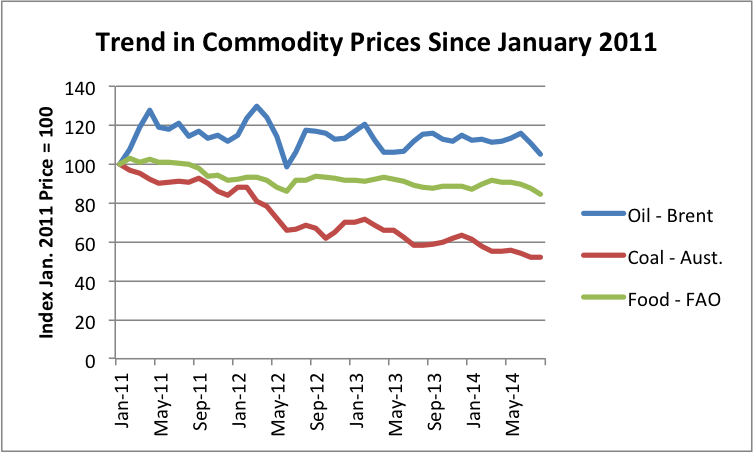
Oil and other commodity prices have recently been dropping. Is this good news, or bad?

trend-in-commodity-prices-sine-jan-2011-v2

I would argue that falling commodity prices are bad news. It likely means that the debt bubble which has been holding up the world economy for a very long–since World War II, at least–is failing to expand sufficiently. If the debt bubble collapses, we will be in huge difficulty.

Many people have the impression that falling oil prices mean that the cost of production is falling, and thus that the feared “peak oil” is far in the distance. This is not the correct interpretation, especially when many types of commodities are decreasing in price at the same time. When prices are set in a world market, the big issue is affordability. Even if food, oil and coal are close to necessities, consumers can’t pay more than they can afford.

A person can tell from Figure 1 that since the first part of 2011, the prices of Brent oil, Australian coal, and food have been trending downward. This drop in prices continues into September. For example, as I write this, Brent oil price is $97.70, while the average price for the latest month shown (August) is $105.27. It is this steeper, recent drop, which many are concerned about.

We are dealing with several confusing issues. Let me try to explain some of them.

Issue #1: Over the short term, commodity prices don’t reflect the cost of extraction; they reflect what buyers can afford.

Oil prices are set on a worldwide basis. The cost of extraction varies around the world. So it is clear that oil prices will not match the cost of extraction, or the cost of extraction plus a reasonable profit, for any particular producer.

If oil prices drop, there is a temptation to believe that this is because the cost of production has dropped. Over a long enough period, a drop in the cost of production might be expected to lead to lower oil prices. But we know that many oil producers are finding current oil prices too low. For example, the Wall Street Journal recently reported, “Royal Dutch Shell CEO: Can’t deny returns are too low. Ben van Beurden prepared to shrink company in order to boost returns, profitability.” I wrote about this issue in my post, Beginning of the End? Oil Companies Cut Back on Spending.

In the short term, low prices are likely to signal that less of the commodity can be sold on the world market. Commodities such as oil and food are very desirable products. Why would less be needed? The issue, unfortunately, is affordability. Affordability depends largely on (1) wages and (2) debt. Wages tend to be fairly stable. The likely culprit, if affordability is leading to lower demand for desirable products like oil and food, is less growth in debt.

Issue #2: Economic growth tends to produce a debt bubble. 

Many economists believe that technological innovation is the key to economic growth. In my view, economies need a combination of the following to have economic growth of the type experienced in the last 100 years:1

(Increase in debt) + (cheap-to-extract fossil fuels) + (cheap-to-use non-fossil fuel resources) +  (technological innovation)

In such a case, debt keeps increasing as an economy grows. Unfortunately, this economic growth is only temporary, because resources tend to become more expensive to use over time, making the “cheap” resources required for economic growth disappear.

The problem underlying the rising cost of resources (both for fossil fuels and others) is that we tend to use the cheapest-to-extract resources first. Technological innovation continues to occur, but as diminishing returns hit both fossil fuels and other resources, there are larger and larger demands on technology to keep costs in line with what workers can afford. Eventually, the cost of resources (net of technological improvements) rises too much, and economic growth is cut off. By this time, a huge mountain of debt has been built up.

Let me explain further how this happens. Without fossil fuels, the world is pretty much stuck with the goods that can be made with wood, or from other basic resources such as animal skins, cotton, flax, or clay. A small quantity of metal and glass goods can be made, but deforestation quickly becomes a problem if an attempt is made to “scale up” the quantity of goods that require heat in their production.2

Once inexpensive coal became available, its availability opened the door to technological innovation, because it provided heat in quantity that had not been available previously. While ideas such as the steam engine had been around for a long time, the availability of inexpensive coal made the production of metals needed for the steam engine, plus train tracks and railroad cars, available at reasonable cost.

With the ability to make steel and concrete in quantity (both requiring heat) came the ability to make hydroelectric dams and electrical transmission lines, thus enabling electricity for public consumption. Oil, as a liquid fuel, paved the way for widespread use of additional innovations, such as private passenger automobiles, mechanized farm equipment, and airplanes. Between coal and oil, many workers could leave farming and begin jobs in other sectors of the economy.

The transformation that took place was huge: from wooden tools and human or animal labor to a modern industrial society. How could such a big change take place? Before the change, the ability to generate a profit that might be used for future capital investment was very limited. Also, the would-be purchasers of products made in an industrial economy were very poor. I would argue that the only way of bridging this gap was debt. See my earlier posts, Why Malthus Got His Forecast Wrong and The United States’ 65-Year Debt Bubble.

The use of debt has several advantages:

  1. It allows the consumer to buy the end product made with the new resources, assuming the end product isn’t too expensive relative to the consumer’s earnings.
  2. It gives resource-extracting businesses the money they need to buy equipment and to hire workers, prior to the time they have earned profits from resource extraction.
  3. It gives the companies the ability to build factories, before they have accumulated profits to pay for the factories.
  4. It allows governments to fund needed infrastructure, such as roads and bridges, before having the tax revenue available to pay for such infrastructure.
  5. Most importantly, the “demand” generated by (1), (2), (3) and (4) raises the price of resources sufficiently that it makes it profitable for companies in the business to extract those resources. 

Because of these issues, debt and cheap fossil fuels have a symbiotic relationship.

(1) The combination of debt, inexpensive fossil fuels, and inexpensive resources of other kinds allows the production of affordable goods that raise the standard of living of those using them. The result is what we think of as “economic growth.”

(2) The economic growth provides the additional income needed to pay back the debt with interest. The way this happens is indirectly, through what is sometimes described as “greater productivity of workers.” This greater productivity is really human productivity enhanced with devices made possible by fossil fuels, such as sewing machines, electric milking machines, and computers that allow workers to become more productive. Indirectly, the higher productivity of workers benefits both businesses and governments, through higher sales of goods to consumers and through higher taxes. In this way, businesses and governments can also repay debt with interest.

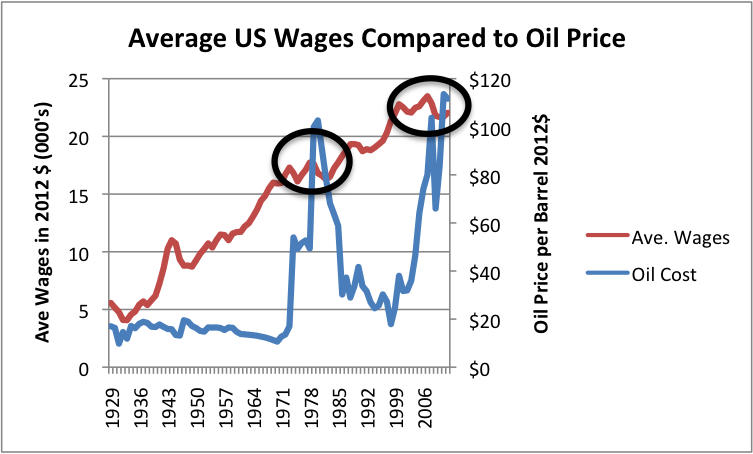
Higher-priced resources are a problem. Higher-priced resources of any kind tend to “gum up the works” of this payback cycle. Higher-priced oil in particular is a problem. In the United States, when oil prices rise above about $40 or $50 barrel, growth in wages stops.

ave-wages-compared-to-us-oil-price-thousands-dec-2013

With higher oil prices, the rise in the standard of living stops for most workers, and good-paying jobs become difficult to find. There are a couple of reasons we would expect wages to stagnate with higher oil prices:

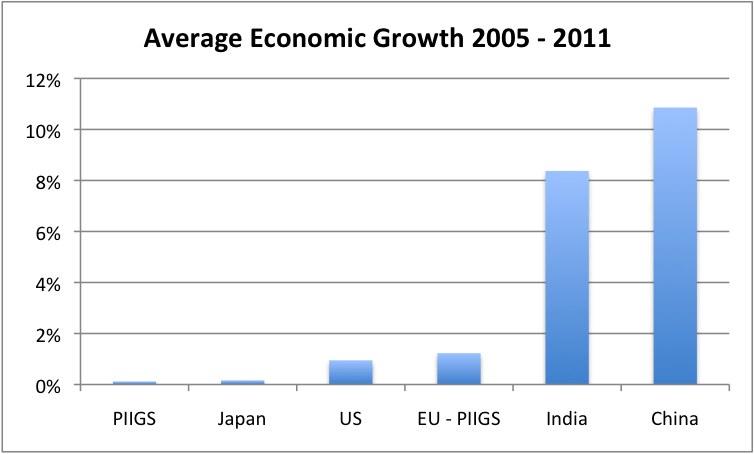
(1) Competition with cheaper energy sources. When oil prices rose, countries using a very high percentage of oil in their energy mix (such as the PIIGS in Europe, Japan, and United States) became less competitive in the world economy. They tended to fall behind China and India, countries that use much more coal (which is cheaper) in their energy mix.

average-economic-growth-2005-2011

(2) Need to keep the price of goods flat. Businesses need to keep the total price of their products close to “flat” despite rising oil prices, if they are to continue to sell as much of their product after the oil price increase as previously. Oil is one major cost of production; wages are another. An obvious way to offset rising oil prices is to reduce wages. This can be done in several ways: outsourcing work to a lower cost country, greater automation, or caps on wages. Any of these approaches will tend to produce the flattening in wages observed in Figure 2.

Based on Figure 2, an oil price above $40 or $50 per barrel seems to put a cap on wages, and indirectly leads to much less economic growth. Even if we didn’t hit this oil price limit–for example, if we had discovered a liquid fuel that could be produced in quantity for less than $40 barrel–we would eventually hit some kind of growth limit. For example, the limit might be climate change or too much population for food production capability. Even too much debt can be a limit, if citizens’ incomes don’t rise in a corresponding manner. At some point, it becomes impossible even to make interest payments if the debt level is too high. Indirectly, citizens wages even support business and government debt, because business revenues and tax revenues depend indirectly on wages.

Issue #3: Repaying debt is very difficult in a flat or declining economy.

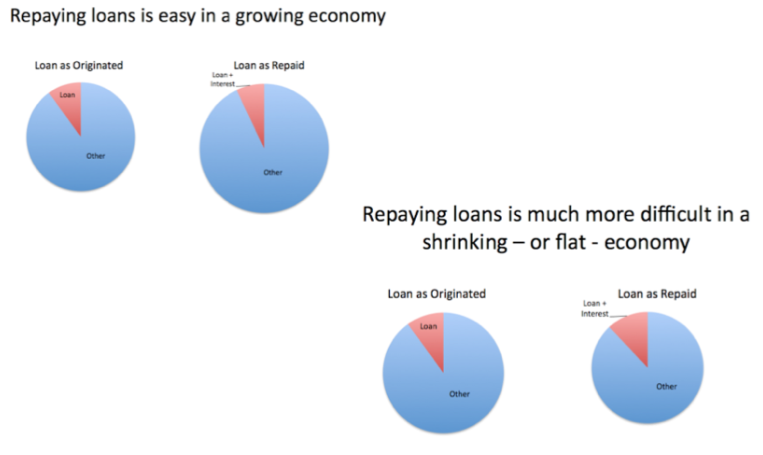
Once growth stops (or slows down too much), the debt bubble tends to crash, because it is much more difficult to repay debt with interest in a shrinking economy than in a growing one.

repaying-loans-growing-shrinking

The government can hide this issue for a very long time by rolling over old debt with new debt and by reducing interest rates to practically zero. At some point, however, the system seems certain to fail.

Not all debt is equivalent. Debt that simply blows bubbles in stock market prices has little impact on commodity prices. In order to keep commodity prices high enough for producers to want to continue to produce them, the debt really has to get back into the hands of the potential buyers of the commodities.

Also, any changes that tend to reduce world trade push the world economy toward contraction, and make it harder to repay debt with interest. Thus, sanctions against Russia, and Russia’s sanctions against the US and Europe, tend to push the world toward debt collapse more quickly.

Issue #4: Rising oil and other commodity prices are a problem, especially for countries that are importers of those commodities.

Most of us are already aware of this issue. If oil prices rise, or if food prices rise, our salaries do not rise by a corresponding amount. We end up cutting back on discretionary purchases. This cutback in discretionary purchases leads to layoffs in these sectors. We end up with the scenario we had in the 2007-2009 recession: falling home prices (since higher-priced homes are discretionary purchases), failing banks, and many without jobs. See my article Oil Supply Limits and the Continuing Financial Crisis.


The reason that low oil and other commodity prices are welcomed by many people now is because the opposite–high oil and other commodity prices–are so terrible.

Issue #5: Falling oil and other commodity prices are a problem, if the cost of production is not dropping correspondingly. 

If commodity prices drop for any reason–even if it is because a debt bubble is popping–it is going to affect how much companies are willing to produce. There is going to be a tendency to cut back in new production. If prices drop too far, it is even possible that some companies will leave the market altogether.

Even if it doesn’t look like a country “needs” the current high oil price, there may still be a problem. Oil exporters depend on the high taxes that they are able to obtain when oil prices are high. If they cannot collect these taxes, they may need to cut back on programs such as food subsidies and new desalination plants. Without these programs, civil disorder may lead to cutbacks in oil production.

Issue #6: The growth in oil sales to China and to other emerging markets has been fueled by debt growth. This debt growth now seems to be stalling.

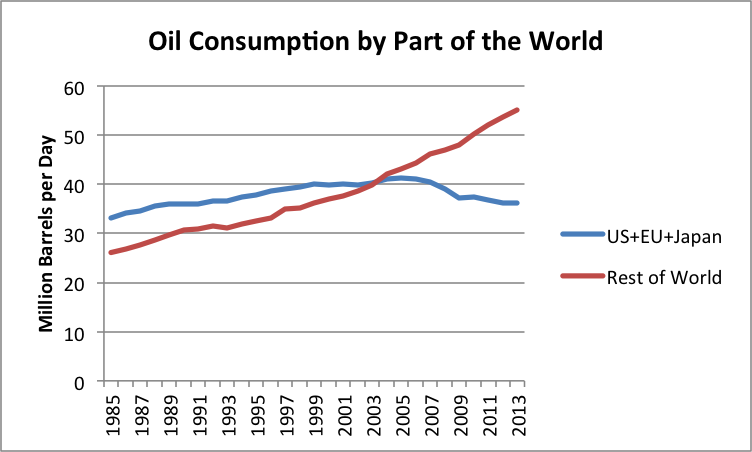
Growth in oil consumption has mostly been outside of the United States, the European Union, and Japan, in the recent past. China and other emerging market countries kept demand for oil high.

oil-consumption-by-part-of-the-world-2013

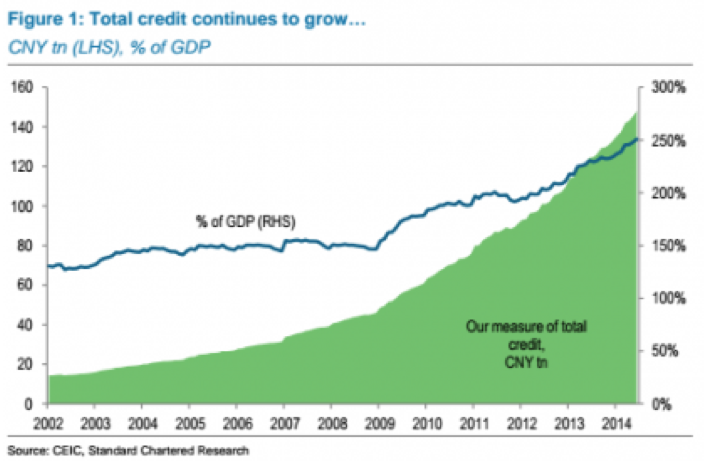
Ambrose Evans-Pritchard reports, China’s terrifying debt ratios poised to breeze past US levels. He shows the following chart of China’s growth in debt from all sources, including shadow banking:

china-total-debt

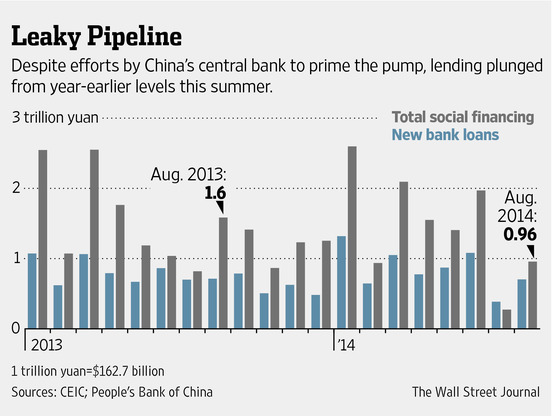
This rise in debt now seems to be slowing, based on a Wall Street Journal report. A person wonders whether this stalling debt growth is affecting world oil and other commodity prices.

wsj-plunge-in-chinese-lending

Other emerging markets also seem to be experiencing cutbacks. Since 2008, the United States, Europe, and Japan have had very easy money policies. Some of the money available at low interest rates was invested in emerging markets. Now the WSJ reports, Fed Dims Emerging Markets’ Allure. According to the article investors, investors are taking a more cautious stance on new investment because of fear of rising US interest rates.

Of course, other issues affect debt and world commodity demand as well. If interest rates rise, they many have a tendency to shrink new lending, in general, because loans become less affordable. Sanctions of one country against another, such as the US against Russia, and vice versa, also tend to reduce demand.

Issue #7: Debt bubbles have been a problem in past collapses.

According to Jesse Colombo, the Depression was to a significant result the result of debt bubbles that built up during the roaring twenties. Another, longer-term cause would seem to be the loss of farm jobs that occurred when coal allowed tasks that were previously done by farm workers to be done by either electricity or by horses pulling metal plows. The combination of a debt bubble and loss of jobs seems to have parallels to our current situation.

Many believe the subprime housing bubble crash contributed to the Great Recession. The oil price spike of 2007 and 2008 played a major role as well.

Issue #8: If we are facing the collapse of a debt bubble, it is quite possible that prices of many commodities will fall. This could possibly lead to a collapse in the supply of many types of energy products, more or less simultaneously.  

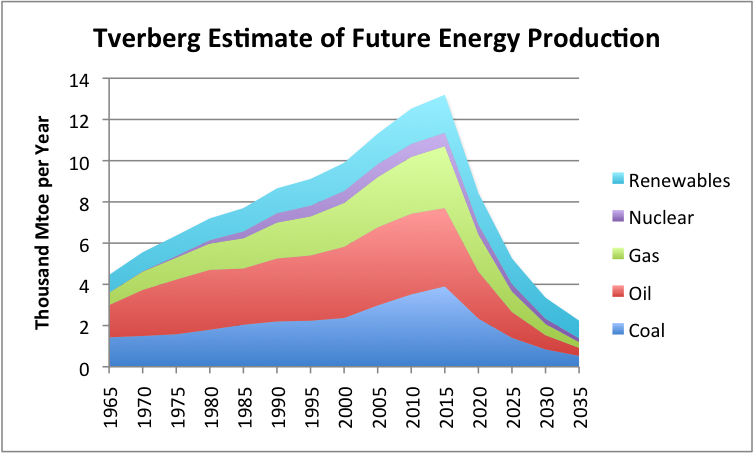
Figure 8, shown below, is a very rough estimate of the kind of decline in energy use we could be facing if a debt collapse leads to very low prices of many types of fuels simultaneously. Prices of many commodities crashed in 2008, and it was only with massive intervention that prices were propped up to 2011 levels. After the beginning of 2011, prices began sinking again, as shown in Figure 1.

tverberg-estimate-of-future-energy-production

Clearly governments will try to prevent another sharp crash in commodity prices. The question is whether they will be successful in propping up commodity prices, and for how long they will be successful. In a finite world, fossil fuel energy production eventually must decline, but we don’t know over precisely what timeframe.

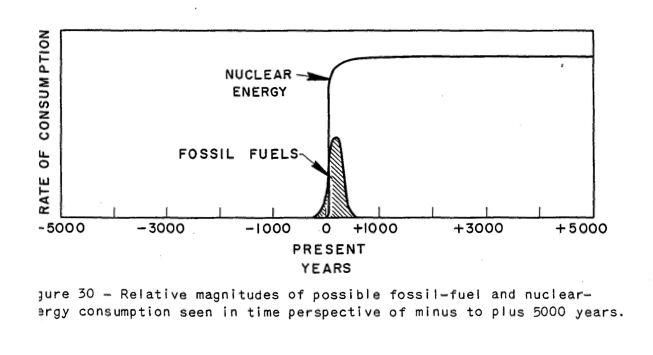
Issue #9: My steep decline contrasts with the “best case” forecast of future oil consumption given by M. King Hubbert. 

M. King Hubbert wrote about a scenario where another type of fuel completely takes over, before oil and other fossil fuels are phased out. He even discusses the possibility of making liquid fuels using very cheap nuclear energy. The way he represents the situation is the following:

hubbert-_nuclear_fossil-fuel-to-50001

In such a scenario, it is possible that oil supply will begin to decline when approximately 50% of resources are exhausted, and the down slope of the curve will follow a symmetric “Hubbert curve.” This situation seems to represent a best possible case; it doesn’t seem to represent the case we are facing today. If a debt collapse occurs, much of the remaining fuel is likely to stay in the ground.

Issue #10: Our economy is a networked system. Increasing debt is what keeps the economy inflated. If wages fail to keep pace with debt growth, the system seems likely to eventually crash.

In previous posts, I have represented the economy as a self-organized networked system, consisting of businesses, consumers, governments (with laws, regulations, and taxes), financial system, and international trade.

leonardo-sticks-dome-01-b


One reason the economy is represented as hollow is because the economy loses its capability to make goods that are no longer needed–such as buggy whips and rotary dial phones. Another reason why it might be represented as hollow is because debt is used to “puff it up” to its current size. Once the amount of debt starts shrinking, it makes it very difficult for the economy to maintain its stability.

Many “peak oilers” believe that if we have a problem with the financial system, all we have to do is start over with a new one–perhaps without debt. Everything I can see says that debt is an essential part of the current system. We could not extract fossil fuels in any significant quantity, without an ever-rising quantity of debt. The problem we are encountering now is that once resource costs get too high, the debt-based system no longer works. A new debt-based financial system likely won’t work any better than the old one.

If we try to build a new system without fossil fuels, we will be really starting over, because even today’s “renewables” are part of the fossil fuel system.3 We will have to go back to things that can be made directly from wood and other natural products without large amounts of heat, to have truly renewable resources.

Notes:

[1] This is really a simplification of the real issues. As world population grows, it is necessary to obtain an increasing amount of food from the same arable land. Thus, it is necessary to find new processes to increase food production, at the same time that soil is quite possibly degrading. Soil is in a sense a “resource other than fossil fuels,” but I have not mentioned this issue specifically.

Growing pollution problems are in some sense an indirect cost of extracting fossil fuels and other resources. These represent another growing cost that I have not specifically identified. Furthermore, there are indirect expenses that do not fit neatly into any category, such as required desalination plants to handle growing populations in areas where water is scarce. We may need to consider mitigation expenses of all types as part of the “cost of resource extraction.”

My point is that it becomes increasingly difficult to offset these many cost increases with technological innovations. Furthermore, if no changes are made, a larger and larger share of both the workforce and resources are required for maintaining the status quo, leaving fewer workers and a smaller quantity of resources to “grow” the economy.

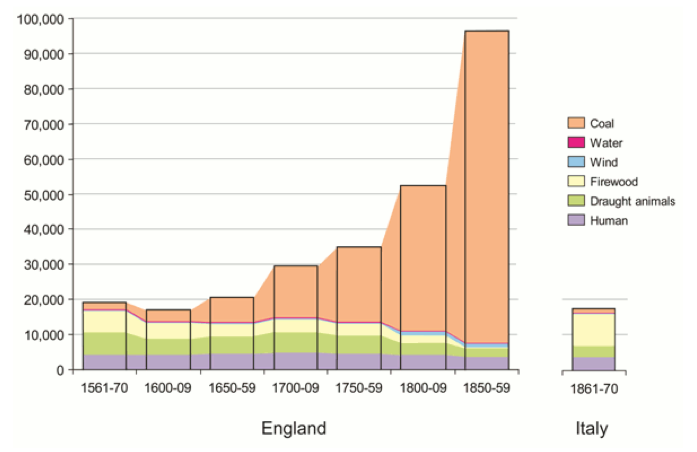
[2] Wind and water are additional sources of energy, but they are sources of mechanical energy, not heat energy, so are not helpful unless they can be converted first to electricity, and then to heat. In quantity, they never were very large in pre-fossil fuel days.

wrigley_annual-energy-consumption-per-head-1561-to-1870

[3] Of course, any existing “renewable” will continue to work until it needs repairs that are unavailable. Other parts of the system (such as electric transmission lines, batteries, inverters, and attached devices such as pumps) may fail more quickly than the renewables themselves.


Sep 162014
 

COMPLAINT, ASHU SOLO TO BC GREEN PARTY, SEPT 16, 2014  

“. . . Green Party of Saskatchewan member and Green Party of Canada member, but

both parties won’t allow her back due to her criminal and unethical conduct against me.”


From: Mayo McDonough [mailto:mayomcd@gmail.com] Sent: September 16, 2014 12:29 PM To: Sandra Finley

Subject: Fwd: Ethics Complaints against Sandra Finley


FYI –

Your thoughts would be helpful.

thanks

Mayo


———- Forwarded message ———-

From: Ashu M. G. Solo <amgsolo@mavericktechnologies.us>

Date: Tue, Sep 16, 2014 at 1:55 AM

Subject: Ethics Complaints against Sandra Finley

To: Green Party of B.C.   (Mayo @ )

Hi,

I understand you might have a B.C. Green Party member named Sandra Finley.  If so, I want to make ethics complaints against her for criminal and unethical conduct against me.  She was a Green Party of Saskatchewan member and Green Party of Canada member, but both parties won’t allow her back due to her criminal and unethical conduct against me.  Now she has moved to B.C.  Please let me know if she’s a member so I can make my ethics complaints against her.

Best regards,

Ashu M. G. Solo

Address:  Maverick Technologies Inc., P.O. Box 25038, Saskatoon, SK S7K 8B7 Canada

Phone:  (306) 242-0566

Email:  amgsolo@mavericktechnologies.us

– – – – – – – – – – – – – —


From: Mayo McDonough  Sent: September 16, 2014 12:29 PM   To: Sandra Finley  Subject: Re: strategy!

He has sent a complaint about you to me.

He sent it to my personal email address, not my GPBC address – which is curious.

I will send it to you for your thoughts.

thanks

Mayo

– – – – –  – – – – – – – —


On Tue, Sep 16, 2014 at 10:13 AM, Sandra Finley wrote:

You do not want to know Ashu Solo!  (Ashu Gupta – – he did name change 1999.  43-year old)

Sees himself as a civil rights activist.

Father is a retired Prof of Engineering at U of S.   Who did (does?) work for U.S. military.


He got into the Greens in Saskatoon –  spring 2013.

Eventually it came out:  he wanted to be a candidate.

Which prompted myself and another woman to do background research in August – – the vetting of candidate.

Having worked with him since spring, I already had concerns.

The background checking sent up large red flags.


I then learned all about cyber-bullying from him.

He set up a Saskatoon Green Party page.

Used it to promote himself.

And then to continue his year-long harassment of a 26-year old young woman, GP supporter.

He lies, manipulates, sets up bogus blogs to defame, bullies, provokes – – trying to curtail employment opportunities.

Her sin:  she disagreed with a position he took on religion (his civil rights work).


I received an effort from her to curb his use of GP media because it reflected badly on the Party.

I referred it as a complaint to the GPC Ethics Committee and to the GPS for resolution.

At which point Ashu began attacks on me.  That was early Dec 2013

He has a recognizable set of tactics and language, used on anyone he goes after.


When I was in Saskatoon at Christmas . . . details I won’t go into.  He came to the Airport at 6:00AM.  Kelly and I in line-up to check-in.  Ended up that Westjet attendant stepped in to call Security.  He left before Security could come.

In January I forwarded, this time my own complaint to the GPC – – to be activated if he tried to renew his membership.  To prevent him from getting back into the GP.

Which added fuel – – the attacks on me (and the young woman) ramped up.   (She is scared of him, afraid of what might happen if he finds out where she lives.)


He side-lined me from productive work for the next months.

Tried to get at me through every friend, my blog host, former husband, son, the Police, a lawyer, and the GPC in Ottawa.


By Christmastime I figured I needed to keep documentation, in case of future need.  I started posting his provocations on password-protected pages on my blog.   The password protection came off in June after he laid 10 complaints against me with the GPC, so he and the Ethics Committee could see the evidence I would use to defend myself.   The blog documentation is very comprehensive.   Which he doesn’t like and has tried to get me to take down.  I re-instated the password protection shortly after, as attempts were made to get him to stop.

He, of course, has his view of things.

It’s actually an interesting case study in the use of illusion.   His creation of the idea that I was harassing him.   All through repeated, high-volume messaging to a small group of people.  So inundated and with other demands on their time,  some of them saw it as an inter-personal duel between Ashu and myself.   When the reality was that I did not send one communication to him.   Not quite stupid enough to do that!

A Green Party friend in Saskatoon (CEO of EDA) and I finally went to the Police and laid complaints (June or July).  In her case he tried to get her fired from her decades- long position with the Health District.   She had to go through a disciplinary hearing.  It back-fired on Ashu.   Coming out of the Hearing, she was advised to go to the Police.   So her complaint has that weight behind it.   My fingers are crossed that he is finally shut down.

That’s Ashu Solo in a nutshell!

/Sandra

Sep 152014
 

“IDENTITY CORRECTION”  – – a fun way to get a point across.   To re-define.

What is it?

Andy Bichlbaum, Yes Men parodist:

(From  http://beautifultrouble.org/tactic/identity-correction/)

Key Principle at work

The real action is your target’s reaction

Often the most revealing moment in a successful identity correction is the reaction of the target. When you identity-correct a major corporation, you force them to react.

They can’t let the lie that tells the truth stand in the media.

GE had to tell the press it was NOT returning its questionable tax refund to stand in solidarity with struggling Americans.

Dow Chemical had to issue a statement indicating it had NOT apologized for the Bhopal disaster and would NOT be compensating the victims.


Identity correction potential, Lockheed Martin?   

Canadians have not been told:

Lockheed Martin has been forced out of Statistics Canada by citizen protest.    (Details are in other postings on this blog)

The Yes Men explain to citizens how to use the tool of identity correction.

Wouldn’t it be fun to develop a plan to apply the win against Lockheed Martin’s role at Statistics Canada for identity correction?!   http://beautifultrouble.org/principle/real-action-targets-reaction/  

A parody could certainly be made of Statistics Canada’s misrepresentation of the level of non-compliance with the Census.  They have claimed 98% compliance, always quoting the percentage.

But in the transcript from the trial of Audrey Tobias  the numbers used by StatsCan (mathematicians?) to arrive at 2% non-compliance are provided:

  • 1.6 million households out of
  • 14.6 million did not comply.
  • That’s non-compliance of roughly 11% , not 2% –  more than 1 in 10 households did not comply.

Further potential for parody:

they ended Lockheed Martin’s career at StatsCan because of protest (and rising non-compliance, I suspect) but then continued to threaten the protesters with prosecution, jail-time and a fine.  Not everyone succumbed to the threats:

  • 89-year-old Audrey Tobias went to Trial, October 2013
  • 79-year-old Janet Churnin, November 2013
  • (younger yoga instructor) Eve Stegenga, July 2014

All of these women protested the involvement of Lockheed Martin.

WHY the prosecutions?   What a colossal waste of everyone’s time and money, when the decision had already been made by the time of the Tobias trial  to end Lockheed Martin’s involvement.

Parody potential?


RELATED MORE DIRECTLY TO EVE’S TRIAL

For statistical purposes, Eve Stegenga lives below the poverty line. She cannot afford the cost of being on Trial, of defending herself against the charges.   Taking the time necessary to preparing for Trial is time robbed from her self-employment, the ability to generate money to pay for basic necessities.   (Eve is not “poor”.   She lives a healthy, vital, connected, rich and productive life.)

Therein lies the parody.   She is stacked up against the legalese and numerous senior lawyers within the Federal Department of Justice, also the resources of Statistics Canada.   You could say, Eve against the whole Federal Government.

Whose interests are being served by the continued prosecutions?   Where are the benefits for tax-payers and citizens?

– – – – – – – – – – – – – –

Note to self:  Lockheed Martin forced out by citizens

  • The International Community will be interested.
  • The news will go to the dozens of Peace Groups on Facebook, including Journalists for Peace.
  • It will go into the large North American networks of people working against corporate dominance, including Occupy and Idle No More.
  • The International Community working to get George Bush and Associates arrested and brought before the Courts in The Hague have a direct interest because of Lockheed Martin’s role in starting the illegal war of aggression on the people or Iraq.
  • People in Muslim communities will want to know of the victory against Lockheed Martin.  Muslim countries have been hit hard by the illegal war and the dropping of bombs from drones.
  • The international Marches Against Monsanto (many of the organizers are Moms) are now informed to the point of understanding that Corporate America is a huge problem. They will view the win against Lockheed Martin as fuel for “We can do it“.
  • The news of the win will spread and travel far, whether or not mainstream media engages with the story.


Sep 132014
 

(I marked the 6th last paragraph with >>>.   Remedies put forth by John McMurtry.)


The University Wars:

The Corporate Administration versus the Vocation of Learning


Address to Faculty and Students

Neatby-Timlin Lecture Theatre

University of Saskatchewan

April 7, 2009


by John McMurtry Ph.D, F.R.S.C.


My experience of the university extends over almost half a century. For the first 20-odd years, I was worried the place was disconnected from the real world in self-referential guild specialties. For the next 20-odd years, I have observed the cumulative subordination of the university to corporate-market methods and to rising financial-management appropriation of public educational funds by central administrations – all with no accountability to academic standards.


This invisible occupation of the academy by a corporate agenda forwarded by central administrations within universities has been analysed by University of Saskatchewan’s own Howard Woodhouse in his forthcoming book, Selling Out: Academic Freedom and the Corporate Market.1 Tracking of this corporate invasion of the academy ultimately leads back to what is not examined – the unaccountable right of central administrations to spend public money on their own growth, privileges and salaries instead of the constitutional objectives of the university – advancement of learning and dissemination of knowledge. University presidents who once received a faculty member’s salary with a modest stipend now arrange with their business-dominated boards to be paid more than the U.S. President while incurring steeper debts and raising tuition fees for debt-ridden students.


This is why I wrote the president of my own university on March 30 a week ago as follows.

Subject: Verification

Dear Alastair:

I am giving a faculty-invited lecture at the University of Saskatchewan in a few days entitled “Corporate Administration versus the Learning Vocation”. I read in the Guelph Tribune, March 27, 2009, that you “received a $47,000 increase in salary last year, making his salary near $450,000” and that “were paraphrased as saying students “might have to work more, take on more debt, or not return to the U of G next year so they can earn more money before returning”.

I intend to cite these disclosures as exemplifying the conflict referred to in the title of my public lecture; but I seek verification first that there is nothing substantively inaccurate in this account.

I frankly hope this CEO appropriation of education funds in a time of public outrage at grossly inflated incomes of revenue administrations in times of rising debts and cutbacks elsewhere is not true at the University of Guelph under your presidency. It shames the office and the institution, and undermines the university’s shared learning vocation by a culture of irresponsible pecuniary selfishness at the top.

Critical reason without deference to established opinion or power is the right of academic freedom. Yet which university faculties have stood up for it on their own campuses as the university has been invaded by anti-academic forces for over 20 years?

How did this corporatization of the academy begin? To make a long story short, university presidents planned with corporate executives to defund the universities – I quote from their own records – “to provide a greater incentive in the university community to seek out corporate partners”.2  This early strategy was planned by the Corporate Higher Education Forum (CHEF), originally founded in 1983 to join 25 university presidents to 25 senior executives of major corporations in setting the “new direction” for universities. The acronym C-H-E-F – CHEF – reveals the CEO agenda. Corporations were thereby empowered to redirect university researchers by leverage-funding to only that research from which they could privately profit. Most academics were and are so caught up in their career micro-worlds that they collaborated to get funds.

“Bring your knowledge to market” has been the master slogan throughout. In the words of one professor promoted to deputy minister of education, and then to head of a major national research granting council at the beginning of the corporate market takeover: “I contend that the one global object of education must be for the people of Ontario to develop new services which we can offer in trade in the world market”.3 This position is incoherent in principle, but has increasingly reigned across the educational system.


The Deciding Collaboration

Few faculty penetrate the underlying contradiction in purpose and method between the market’s private exchanges for money and the university’s community of advanced learning – even as low-paid sessional teachers carry more and more of university teaching loads, multiplying fees and debt-loads for students put university out of reach of the poor, and salaries for those in privileged and management positions escalate as cutbacks on courses and programs are imposed. Yet students have been conditioned to the same program of winning pecuniary self-advantage as all that counts. When I have asked my large first-year classes in philosophy, “Who thinks the goal of a university education is to make more money?” about 95% have raised their hands. Once Ronald Reagan became popular as the US president with a credo of “American freedom is the freedom to get rich”, the value rot seemed to set in.

The results are not pretty. University presidents now conceive themselves as corporate CEO’s of hundreds-of-millions of dollars. Research is increasingly only possible with outside money backing it. Campuses are ever more pervasively festooned with corporate ads and brands in every medium. Student market surveys are the administrative measures of quality of teaching as they are made into debt slaves. Sessionals with non-living wages multiply in the university in place of research faculty. Academic spaces morph into sites for big-business commodity sales. Science and humanities buildings are renamed after leaders of the university’s marketization. And multinational corporations control the academic journal and textbook system across borders in accordance with money-first values.

Few seem to observe that this financial marketization has led the rest of the world to ecological, social and economic collapse; nor the coincidence of this profile with the academy as its knowledge servant. Even less do corporate administrations notice the contradiction of values between the academy’s purpose of critical search for truth and the corporate market’s final goal of financial self-maximization which lies behind the university’s stripping down to a commercial venture. In direct value opposition, good reasoning and research require educators and researchers to pursue the truth wherever it leads independently of money payoffs to self. To devote long hours to research and rewriting if it adds time-costs without money payoffs is irrational in the market, but what all in-depth pursuit of the truth demands.

Unfortunately, senior academic administrations now may actually assist wealthy corporate interests in the silencing of truth. In the now famous case of University of Toronto, Dr. Nancy Olivieri was censured for disclosing life-and-death information about an Apotech product’s effects. University attacks on her position occurred just as the President, Robert Pritchard, was in the midst of negotiations to receive a multi-million dollar donation from the very same corporation seeking to silence Dr. Olivieri. Administrators who presided over false attacks were promoted to more lucrative positions, including the current President of University of Toronto.

As the eminent scientist and humanist, Ursula Franklin, has memorably said from her own experience of the 1930’s era of Nazi Germany in Europe and the corporatizing academy today: “They had their collaborators, and we have ours”. On the government plane, the sell-out of research with public dollars for private corporate exploitation is made a national command. “Tripling of the commercialization of university research”, Paul Martin proclaimed as he became Prime Minister in 2004, “is not nearly fast enough”.


Giving Away University’s Research to Transnational Corporations to Exploit Students

A second level of contradiction between market and academic models is between the methods of dissemination. The control of all knowledge that corporations can copyright or patent is an ultimately regulating principle of the global market. Indeed, this right to market monopoly of ideas is pursued and extended to the utmost by 20-year patents on life-saving remedies, control of seed varieties, and corporate copyrights on journal articles and texts – all typically discovered within universities themselves. I myself have been unsuccessfully blocked from putting relevant article and chapter publications on reserve for students for their copy use although I was the author of them.

This is the extent to which university administrations have gone in enforcing the corporate agenda against students’ learning interests. It is now a general fact that academic journals themselves have become copyright-controlled by private corporations’ buying up the journals, and then multiplying the prices for their purchase and use by university libraries whose own faculties have created the material for no cost to the corporations. Indeed there is a standard copyright form required to be signed by faculty authors whose work is produced and refereed free for corporately owned journals, and these forms demand exclusive copyright in perpetuity to the private corporate proprietor for no returns to the author, the university, or the public who support both. I always add a specific condition removing this exclusive world copyright, but typically risk or am threatened with non-publication. There has been no such resistance to signing these forms, I am told, by other academic authors.

Thus the public, the students and the universities pay for faculties to research and publish and for all the university resources to support them, while private corporations buy the vehicles of publication to sell them back to the university communities who have created them – and at staggering rising prices that beggar libraries themselves. The academy’s freedom of knowledge dissemination is thus reversed, but university administrators and funders increasingly press for still more commercialization of university knowledge creation while they give most of it away to their corporate senior partners. When such hijacking of publicly-funded academic resources for external private profit at the expense of libraries and students is enforced by university administrations themselves, one wonders as to their cognitive competence even at asset trading.

The abandonment of the academy’s vocation seems to have reached into the identity of researchers themselves. Faculty and grad students conceive of their worth in terms of their money and grant revenues, and mould their work to maximize their money returns. Yet development of abilities of critical and autonomous thought is what the academy stands for and is tax supported to provide. In direct opposition, easy consumption of ready-made commodities is what the corporate market provides to those who can pay. We know that if anyone tries to buy their way into or through university, s/he is liable to expulsion as a cheat. But if the academy follows market values, why shouldn’t students buy their papers from sellers of their choice? If all that is involved is an exchange to get what you want for the least price, the free market way, why is this wrong?

Rallying in support of academic freedom and Professor Denis Rancourt of the University of Ottawa who the grading system itself, Professors David Noble and Nancy Olivieri from York and Toronto have explained the purpose of Universities very well. I quote them now:

“Universities stand alone among our social institutions in their professed and acknowledged dedication to the pursuit and dissemination of the truth. They are the public’s only presumed repository of dependably disinterested expertise, drawn upon routinely by courts, government, and the media for the facts, authoritative assessments, and legitimacy. In a universe saturated by advertisers and public relations people with spin, deceit, fraud and fabrication the universities serve as a unique resource for citizens in need of the real story. This is one of the chief reasons why the public has so generously subsidized institutions of higher education and endowed its disciplined truth-seekers and truth-tellers with extraordinary protections from censorship – academic freedom -and job insecurity – tenure. These hallmarks of academia are not perks or privileges but obligations, calling upon academics to attend to their core responsibility of providing the public with the truth.”

Yet human reason and life coherent truth seeking are now incarcerated within a get-rich-quick program which corporate administrations imitate and impose on university communities at every level. In the global market as a whole, the ultimate drive-wheel of value is to turn money into more money for money managers and possessors in which the corporate rich at the top loot the world and the public treasury for ever more in cash, perquisites and command power for themselves.  Self-multiplying corporate university administrations have been an unidentified fifth column of imposing this meta-program on universities where they are at the front line of privatizing the knowledge commons for patent, proprietary and money-bearing accounts, and where their own corporate hierarchy of pay, privileges and servant positions is always growing.

Academically unaccountable to the learning purposes of the university, central administrations perpetually cut back on the teaching, learning and research front lines of the university to pay for this growth. This cancer-like pattern is then, in perhaps the greatest irony of our condition, defended against public critics under the public mask of “academic autonomy”.


Recognizing Corporate Administrations:


There are five properties by which we can recognize corporate administrations:

(1) They have exclusive hierarchical signing control of all financial expenditures, their ultimate lever of control and command which is mystified as their “leadership”;

(2) They do not perform the constitutional goals and primary functions of the academy – to advance learning and disseminate knowledge;

(3) They draw off ever more of the academy’s financial and physical resources to multiply their positions and incomes;

(4) They call themselves “the University” although they perform no function of advancing or disseminating learning;

(5) They selectively gang-attack faculty members for opposite to academic reasons  [as Professor of Sociology, Ken Westhues, superbly describes in his book, The Envy of Excellence : Administrative Mobbing of High-achieving Professors4].


Where administrators do not conform to this pattern, they may become genuine academic leaders – a possibility which has looked dim, but is worth robust support wherever it occurs.

At present, we may most deeply understand the university wars of corporate administrations versus the learning vocation by laying bare their opposite structures of rationality, method and purpose. Corporate administrators and their retinues follow the meta program of

(i) self-maximizing strategies in

(ii) conditions of scarcity or conflict over

(iii) desired payoffs at

(iv) minimum costs for the self to

(v) appropriate ever more for self with no productive contribution.


In direct opposition, those in the learning vocation follow an opposite inner value code:

(i) to maximize learning advancement and dissemination by

(ii) knowledge sharing without limit for

(iii) understanding and truth as ultimate value in itself at

(iv) any cost of difficulty to

(v) develop humanity’s more inclusive comprehension of natural and human phenomena.


We may see corporate administrations warring against the learning vocation by the following practices.

  • University patent hunting and corporate research displace science;
  • knowledge sharing is prohibited by contract and specialty lock-in;
  • research is made dependent on external money received by faculty and graduate students;
  • understanding and truth are not and ends in themselves, but are warped into what products pay more;
  • every decision is increasingly financialized with money gain the supreme value;
  • and those who follow the search for truth where it leads against the ruling value program are besieged by bureaucratic campaigns of anti-educative isolation and destruction of academic freedom – for example, inciting students to formal complaint, closing off academic resources, published personal attacks and – perhaps, as in the case of Professor Denis Rancourt – CEO banning from campus, handcuffing and firing of the heretic.

By these practices, the academy’s shared search for truth is suffocated and euthanized from within – that is, until faculties and students collectively stand for the learning vocation against its despoliation.


Financialization of the Academy: The Totalitarian Drift


To get a sense of the academy’s increasing submergence in corporate-market values, consider the words of the past Harvard President, Larry Summers, now chief economic adviser to the Obama administration. He was interviewed by the Globe and Mail in glowing admiration after a lecture to University of Toronto. (May 24, 2003). “The essential truth”, he declared, is that all “basic value” – including “literacy” – is “linked to market growth”.

We may formalize the equation of the paradigm corporate president as follows: More/less money-value sales = more/less market growth = more/less “basic values” for the world. No substantiation of the given equations is deemed necessary. No explanation of contra-indicative evidence is conceived. Yet mind-staggering implications follow that are not seen. Whatever is without a market price is, therefore, without any value – the world’s biodiversity of species, for example. Life itself is of no value except as it sells for a market price. So too research and knowledge. If they are not marketable, they do not exist. The truth is what sells.

An unseen onto-ethic rules here. As with soaps, so with universities. Sales pitches metamorphize reality into miracles of more value added in the market, and money sequences leave ever more money in the hands of money managers. This magical thinking is, of course, the very opposite of the search for truth. But the mind has become totalitarian. Recently, the New York Times gave much page and blog space to Stanley Fish, an academic servant to money and power as Allan Bloom and Leo Strauss before him. Fish’s tirade against academics following “the inner light” – his words – required, he concluded, the use of coercive force against them. Professors need to be reduced to a master-servant relationship with “their employer” as all other employees: that is, with university CEO’s and designates who hire and fire by unilateral control of purse-strings with no ultimate accountability to academic standards.5 Fish’s prancings for the boss in the New York Times are a sign of things to come.

The seductive kudo which keeps academics feeling on top, however, is that their work is the leading edge of the “global knowledge economy”. Yet who in the academy asks what the criterion of “knowledge” is here”? I have not heard the question raised, or the answer given. The reason is that what “knowledge” means here is symbolic sequences that reduce money costs or increase money revenues for money managers and possessors. That is what “accountability” means to them. Thus teaching comes to mean only what produces graduates to make more money in the global market than without their degree, with ever higher tuition fees as the costs for sale of their skills at a higher price. At the same time, selling campus grounds as marketing sites fits the same money-value program – corporate ads, junk foods and market franchises invading space and sightlines across university schools, buildings, lecture halls, and courses.

Perhaps the deepest level of violation of the higher learning vocation has been in corporate -partner research. At my own university, most of the agricultural and veterinarian research has been channeled into high-cost input products which distort animal bodies and adulterate foods (eg., bovine growth hormones and GMO’s). In general, the mission as elsewhere is to “bring research to market”, increasingly leveraging the academy into service to large private-profit enterprises. What was once unthinkable in the free academy – research and resources for private monied interests – has come to be the norm. Consider an official booklet on the research-market connection actively distributed by V-P- Research offices in the relevant universities. “Increasing competition for research funding”, it warned, “will demand that Canada identifies its research strengths and capabilities to focus on those areas with highest value and return on investment – – Priorities for applied research are set by the marketplace via partnerships eg. industry funds research that fits their priorities. – – Augmented private sector participation in research priority setting will – – ensure scientists have access to the appropriate market signals, are aware of the technology requirements of industry, and can focus their research appropriately”.6

Note how the university researcher is reduced to a reaction formation to market price-signals. Observe that government implicitly commands the conformity of university researchers to this market-servant role. The pattern is all too clear. Senior administrations propagate this imperative to faculty to abdicate research independence to compete for external funds so that administrations can take 25% off the top or off-load graduate education costs onto faculty grants. But who stands against the reversal of the academy’s vocation?  Which university’s faculty association takes up the cause of independent science and research?

In the standard “university-corporation partnerships”, university researchers must find projects which corporations are willing to co-fund for private profit. As a result, independent research in the public interest that is most urgently required is silently selected out – for example in the agricultural and food sciences, integrated pest management, organic farming for productive efficiency, management-intensive grazing, small-scale producer co-operatives, and alternatives to factory-processed livestock and to ecological contamination by genetically-engineered commodities. In fact, all of these domains of constructive research for sustainable agriculture and the public interest have been effectively defunded and attacked by conforming researchers – even as the public need for these researched alternatives becomes a matter of life-and-death significance for farmers and the world. Non-proprietary research for the public benefit does not attract corporate sponsors.

Thus at the general level, the most important scientific and rational innovations are pre-empted form the start – from unpatented low-cost pharmaceuticals to mandatory collective recycling systems, to non-profit alternatives to private-auto transit, to national public-water and energy programs, to any permitted critical reflection on values or depth research into the ruling economic system itself. What corporate or government funding agency will sponsor any in-depth research into any reigning social, political or economic practice and norm? Investigation of the causal mechanism of the ruling value system itself is out of bounds. A built-in gate-keeping against raising deep-structural problems is instituted at the money-management level.

In the humanities in many universities now, professors must bring in money from outside the university to defray the costs of their student’s graduate education, or they cannot have graduate students. Educational costs are thus downloaded onto faculty themselves who are forced to become fund entrepreneurs to stay alive in the game. Those not competing successfully at getting grants have no graduate students, a central demerit within administration’s annual rank and money reward process. Faculty are generally so wound up in getting the grant money they do not analyse what is going on, and even imagine this is what identifies original research. The entire higher learning process is thereby subjugated by financialization at another level.

Yet where is the structure of money rule resisted? Either faculty get money committed from private corporations who are structured to repel any finding against their interests, or they lose their lab space. Either they bring money into administrations’ revenues from a government or private funding body which will not fund system-critical research, or their research and graduate students are shut off. No financial mechanism for external control of postgraduate and faculty research could work better. Consider here what corporations find no profit in. It is not just preventative medicines for third-world malaria which kills over a million people a year, or diet-exercise routines to prevent epidemic diseases in our own society, or critical study of life-blind norms and social causal mechanisms. Nothing that does not pay off in more money to administrations is supported within the corporate university. This is why there may be no graduates or faculty now studying anything of what I have spoken today, or indeed any critical issue or thinker relating to the principles and reign of the total money-sequence order itself. Exceptions indicate the rule.

The ultimate assault on the university’s vocation is at the level of truth-seeking itself. The university is constitutionally committed to critically reasoned inquiry which goes wherever the quest for truth leads it. The truth is not an end state, but an open process in which partialities are continually exposed by thinking through deep assumptions, evidence and connections. This thinking through is the nature of learning and knowledge. Reason’s movement is always by a more inclusive taking into coherent account open to counter-evidence and argument. This inner logic governs all disciplines – from the problem of self and other in philosophy, to the nature of tropes in literature, to the hypotheses of subatomic waves and particles in physics. In one way or another, the critical search for more comprehensively coherent understanding leads the academy in every domain and the human condition itself. Deprived of the freedom to pursue truth independently of external money for administration to rake in, the academy’s learning vocation is blocked at the depths and at the leading edges across domains.

Yet surface images are what now rule as in Plato’s Cave where all are chained by their conditioning to see only projected illusions. In direct contradiction to the search for truth by life-coherent reason, the ruling global corporate order succeeds in all domains by one-sided conditioning of unconscious desires of buyers so as to maximize sales of products for money returns to money managers and possessors. This is today’s psychological law of motion to sell the system and its goods. This is why university managements now spin and lie as much as any other self-maximizing financial operation.  Excellence is what gets more money coming in. If sales increase by imaging and commercials that merely condition unconscious desires, then these are necessary to “grow business”. The corporate university thus joins in public relations reversal of reason as its own mode of thought and communication.


Forms of Faculty and Student Action to Reclaim the Academy


The known standard of research to guard against conflict of interest and cooked results is straighforward. Any research in which the funder has a financial stake in the outcome is a conflict of interest which must be ruled out. Yet this standard of research independence and validity has been usurped by the new order. For example, when a “research integrity” clause was explicitly specified on two occasions by decision of the Medical Research Council of Canada, it was annulled with no justification by the central administration.7 If universities are not to be so subordinated to outer control, such a research integrity condition must be re-instituted on campuses to protect higher research from conflicts of interest and cooked science – with all donations to a general pool of grants funds for independent research.

Just as research biased by conflict of interest must be stopped, so too the making of graduate student supervision dependent on external revenues captured by faculty. Faculty dependency on outside money determines the topics and direction of faculty research. One must usually spend countless hours in bureaucratic lock-steps to tailor research proposals ‘on spec’ to fit gatekeeper preconceptions so as to get funds. Solicitous grantmanship and dominant academic fads of the day thus supplant original and critical inquiry. This further level of financialization is, however, itself taboo to discuss for fear of offending the granting authorities.

Yet one has to wonder, why have the most self-evident defences of the academy’s research integrity been so easily overidden over by corporate administrations? Why have faculty and faculty organizations submitted to these pecuniary inversions of academic freedom and standards of research integrity? Collective academic presence has been lacking.

>>>   This why an independent Faculty Board of Academic Review (or Academic Freedom to fit current categories) – needs to bring active scholars across disciplines into one independent body on every university campus to review all administrative decisions so as to ensure against financially-led distortions and depredations of research and teaching – including by arbitrary administrative cuts of courses to claw back money to central administrations to spend on inflated executive bureacracies, self-display expenditures and corporate-management salaries. Cuts must begin at the top where they do not affect teaching, research and learning. Campus-based faculty associations and unions must in the end be willing to strike for protection of the university’s objectives against system-wide violations by corporate administrations. At the same time, such a faculty academic review body needs to institute formal evaluations of the performance of local central administrations by faculty questionnaires, just as faculty are evaluated by their students, with publication of the findings.

The faculty review committee needs also to press hard specifically for ceilings on academically wasteful balloon-salaries as an item of faculty negotiations – for starter norms, no salary higher than the provincial premier’s in public administration, and no faculty salary more than three times greater than the lowest-paid faculty. Once the facts on the systematic misallocation of public education funds are flushed into the open, corporate administration and overpaid faculty positions are made more accountable for expenditures on non-educative functions. Even right-wing politicians are shocked by the money and prerogatives unproductive administrations have increasingly showered on themselves and favorites with no teaching or research function. In fact, salary ceilings should be generalized across the campus and the saved costs applied to teaching and learning purposes. Those in the university for more money as their ruling goal would then be free to leave the academy where they do not belong.

The whip hand of financial cutback and self-serving in the hands of an unaccountable money management has terrorized long enough.  Bear in mind what has already happened and lies in store. In the last week before this lecture, I have observed a distinguished research professor in the U.S. being fired for questioning Israel state policies (Joel Kovel at Barnard), been informed that a long-term professor of physics is banned and then handcuffed for showing a documentary (Denis Rancourt at the University of Ottawa), and e-mailed by a professor colleague in Britain that the administration of a London University closed down classrooms to stop discussions of the G-20 summit. In the historical background, graduates of business programs have almost doubled, while social sciences and history have almost halved since the 1970’s in the United States. Overall, any research and learning space to stand back and ask ultimate questions of meaning, values and purpose or expose ruling assumptions has been systemically abridged.

Let me conclude. If the invading corporate-money forces are not pro-actively resisted at the level of collective contract – as distinguished from last-ditch defences of a few controversial victims – there will be no end to this usurpation of the academy’s independence and free inquiry. Consider that the courts have already ruled in the U.S. that “the state must have the ability to control the manner in which university employees (ie. Faculty) discharge their duties” and that “academic freedom cannot be invoked in a judicial proceeding” (as Stanley Fish seeks to be normalized).  Unless faculty stand up for accountability to academic standards of research and learning within the university, corporate administrations deploying unilateral financial levers and top-down restructuring will hollow out the academy like almost everything else on the planet – as the record already shows.

If it were not for the collapse of the wider global system of unregulated money-management, perhaps this slow-motion coup d’etat of Canada’s university system would just keep going under the radar. But it cannot go on if faculty and student bodies join in an institutional countervailing force in sustained commitment to the vocation of independent research and learning – where reasoning in the common interest, not unaccountable money control decides. In inherited daily practice, this right to seek and disseminate the truth is still alive, and no calling to account more effectively positions campus suits in their place.

Standing up for the university’s powers of reason, research and learning in everyday life and by independent faculty review is the long suppressed imperative. Collective academic monitoring, public exposing and strike where required can bring corporate financialization to ground in the academy better than elsewhere because the institutional vocation is the advance of learning, not more money control for corporate management. Reclaiming the university for higher learning is the one demand that cannot be publicly lied away.

1. Howard Woodhouse, Selling Out: Academic Freedom and the Corporate Market. Montreal and Kingston: McGill-Queen’s University Press, 2009.

2. Howard Buchbinder and Janice Newson, “Social Knowledge and Market Knowledge”, Gannet Centre Journal, 1991, 17-29.

3. Cited by William Graham, “From the President”, Ontario Confederation of University Faculty Associations Bulletin, 6:15, 1989.

4. Kenneth Westhues, The Envy of Excellence : Administrative Mobbing of High-achieving Professors. Lewiston N.Y.: Mellen Press, 2005.

5. Stanley Fish, “Are Academics Different?”, Stanley Fish Blog, New York Times,

6. The Canadian AgriFood Research Strategy 1997-2002, Agriculture Canada, Ottawa.

7. “On two occasions”, a senior member of the committee reports, “the MRC board moved and passed a motion that Pharma contributions of $60 million per year should be given with no strings attached i.e. added to the general pool of grant funds and not be adjudicated by committees with industry representatives. On both occasions, the motion died even though the standing committee on health also voted the same way.” “As to the assassin”, he adds, “it is not possible to say with certainty because it is done behind closed doors from the centre, likely the PMO .”(Correspondence with Dr. Robert McMurtry, May 10, 2008). It is worth noting that this testimony is given by a former Dean Of Medicine and Chief Medical Adviser to the Commission on the Future of Health Care in Canada (the Romanow Commission).


Sep 102014
 

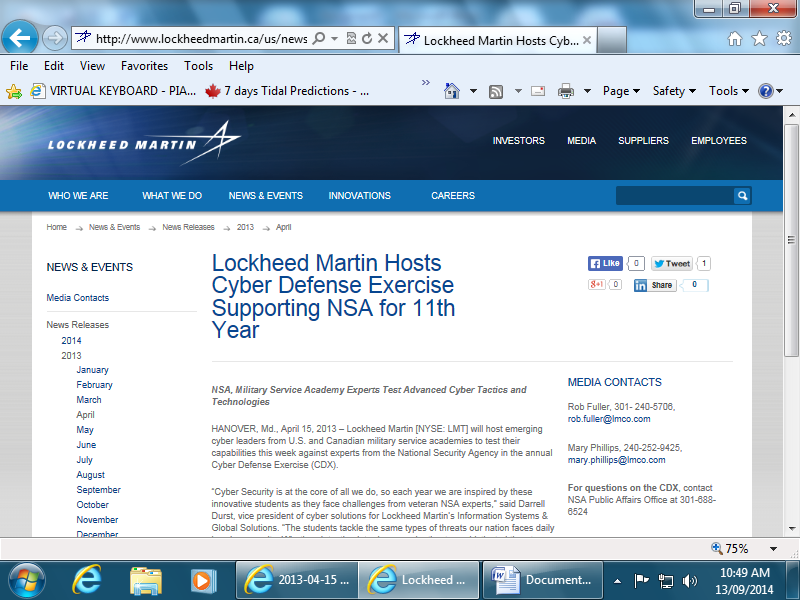
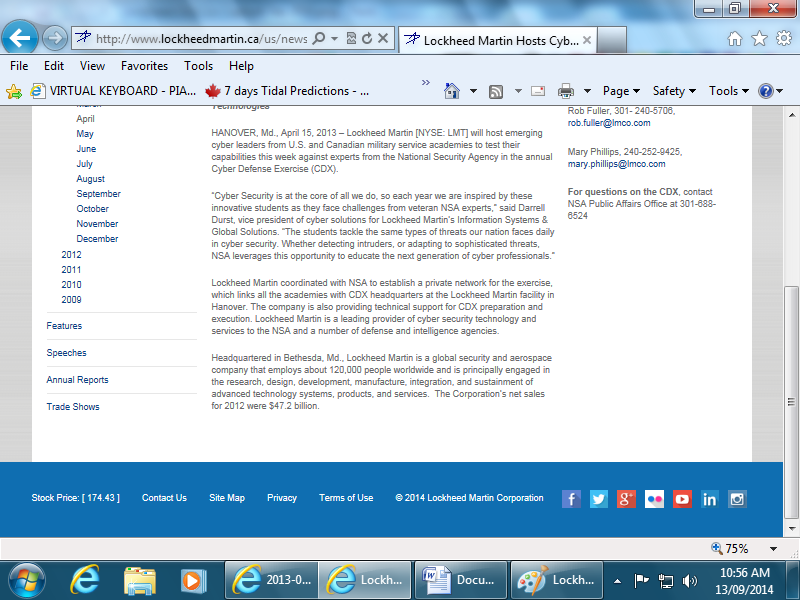
“Lockheed Martin is a leading provider of cyber security technology and services to the NSA” 

(last paragraph of Lockheed Martin’s webpage below.  A “screen capture” is appended.)

 http://www.lockheedmartin.ca/us/news/press-releases/2013/april/isgs-nsa-cdx-0415.html

Lockheed Martin Hosts Cyber Defense Exercise Supporting NSA for 11th Year

April 15, 2013 /PRNewswire/


Lockheed Martin (NYSE:LMT) will host emerging cyber leaders from U.S. and Canadian military service academies to test their capabilities this week against experts from the National Security Agency in the annual Cyber Defense Exercise (CDX).


(Logo: http://photos.prnewswire.com/prnh/20110419/PH85737LOGO-b  – – “Lockheed Martin We never forget who we’re working for”)


“Cyber Security is at the core of all we do, so each year we are inspired by these innovative students as they face challenges from veteran NSA experts,” said Darrell Durst, vice president of cyber solutions for Lockheed Martin’s Information Systems & Global Solutions. “The students tackle the same types of threats our nation faces daily in cyber security. Whether detecting intruders, or adapting to sophisticated threats, NSA leverages this opportunity to educate the next generation of cyber professionals.”


Lockheed Martin coordinated with NSA to establish a private network for the exercise, which links all the academies with CDX headquarters at the Lockheed Martin facility in Hanover. The company is also providing technical support for CDX preparation and execution. Lockheed Martin is a leading provider of cyber security technology and services to the NSA and a number of defense and intelligence agencies.

 “Screen Capture” of the Lockheed Martin – NSA Relationship

Lockheed NSA Scr Capture Sep 2014Lockheed NSA Scrn Capture (2) Sep 2014

Sep 052014
 

http://www.euronews.com/business-newswires/2673574-exclusive-canada-seen-buying-fighter-jets-from-us-not-europe-source/

By Randall Palmer, David Ljunggren and Andrea Shalal

Reuters, 04/09 22:42 CET

OTTAWA/WASHINGTON (Reuters) – Canada is likely to choose between two major U.S. firms when it buys a new fleet of jet fighters, excluding two European competitors, according to a source with direct knowledge of the matter.

The source, who spoke on the condition of anonymity, said Lockheed Martin Corp’s <LMT.N> F-35 stealth fighter and Boeing Co’s <BA.N> F-18 E/F Super Hornet were deemed more suitable for the variety of tasks the military has laid out.

That would mean the exclusion of Dassault Aviation SA’s <AVMD.PA> Rafale and the Eurofighter Typhoon, jointly made by BAE Systems PLC <BAES.L>, Finmeccanica SpA <SIFI.MI> and Airbus Group NV <AIR.PA>.

The fighter selection has proven enormously problematic for Canada’s Conservative government, which in 2012 scrapped a sole-sourced plan to buy 65 F-35s for C$9 billion (5.08 billion pound) after a parliamentary watchdog savaged the decision.

Ottawa then set up a special secretariat to compare the merits of the four contenders. It is deciding whether to hold a competition or go ahead with the initial plan to buy F-35s, which would likely prompt accusations that it was acting in bad faith.

Polls show the Conservatives of Prime Minister Stephen Harper could lose the next federal election, which is set for October 2015.

The source said that while the F-35 had scored well on the various tests laid out by the secretariat, the Super Hornet was almost as capable and had the advantage of being cheaper.

The secretariat was not asked to make a recommendation about which jet to buy.

A spokeswoman for Public Works Minister Diane Finley, who has day-to-day responsibility for military procurement, said ministers were reviewing a number of reports, including information on fighter capabilities, industrial benefits, costs and other factors.

“Until a decision is taken, all options remain on the table,” Alyson Queen said for the minister.

The $400 billion (244.91 billion pound) F-35 programme, the largest in Pentagon history, is already late and well over budget. U.S. officials said on Wednesday they were nearing a fix for the engine that powers the F-35. The failure of Pratt & Whitney’s F135 engine grounded the entire F-35 fleet for several weeks this summer. Flights have resumed but with certain restrictions on speed and other manoeuvres.

A potential attraction for Canada is that Lockheed’s bid offers Canadian industry some $11 billion in work building airplane components.

Three other sources familiar with the deliberations said Ottawa had been poised last month to announce it would buy the F-35s. That plan changed when Harper – concerned about the political fallout – suggested that Canada could wait since it did not need to replace its existing CF-18 jets until 2020.

One of the three sources, who was not authorized to speak publicly, said Harper could still announce in coming weeks Canada would buy the F-35 and skip a new competition but that “ultimately, it will be a political decision.”

Boeing’s bid would likely include more traditional offset agreements, giving contracts to Canadian firms. Dassault says it is prepared to eventually build the Rafale in Canada.

Analysts and opposition critics suspect the government will delay the decision until after the next election. If Canada puts off buying new planes for too long, it would likely have to upgrade its current fleet of ageing CF-18s, which date back to 1982, at a cost that some analysts estimate could top $1 billion.

Lockheed said on Thursday it was continuing to support the Canadian government and the special secretariat as Ottawa weighed its options. A Boeing spokesman said the company continued to support the Canadian process.

Harper is in Wales for a NATO summit, where he is under pressure to boost Canada’s defence spending in the face of instability in Ukraine and the Middle East.

(Editing by Jeffrey Hodgson and Tom Brown)

Aug 262014
 

You will know first part, nothing new there.  But there are worthwhile insights.

Knabe briefly mentions Edward Snowden;  at the end Knabe is asked re relationship to NSA.

https://www.ted.com/talks/hubertus_knabe_the_dark_secrets_of_a_surveillance_state


TEDSalon Berlin 2014·19:34·  Filmed Jun 2014

470,619  Total views as at August 26, 2014
TRANSCRIPT
0:11  This year, Germany is celebratingthe 25th anniversary of the peaceful revolutionin East Germany.In 1989, the Communist regime was moved away,the Berlin Wall came down, and one year later,the German Democratic Republic, the GDR,in the East was unifiedwith the Federal Republic of Germany in the Westto found today’s Germany.Among many other things, Germany inheritedthe archives of the East German secret police,known as the Stasi.Only two years after its dissolution,its documents were opened to the public,and historians such as me startedto study these documentsto learn more about how the GDR surveillance statefunctioned.

1:06  Perhaps you have watched the movie“The Lives of Others.”This movie made the Stasi known worldwide,and as we live in an age where wordssuch as “surveillance” or “wiretapping”are on the front pages of newspapers,I would like to speak about how the Stasireally worked.

1:30  At the beginning, let’s have a short lookat the history of the Stasi,because it’s really important for understandingits self-conception.Its origins are located in Russia.In 1917, the Russian Communists foundedthe Emergency Commission for CombatingCounter-Revolution and Sabotage,shortly Cheka.It was led by Felix Dzerzhinsky.The Cheka was an instrument of the Communiststo establish their regime by terrorizing the populationand executing their enemies.It evolved later into the well-known KGB.The Cheka was the idol of the Stasi officers.They called themselves Chekists,and even the emblem was very similar,as you can see here.In fact, the secret police of Russiawas the creator and instructor of the Stasi.When the Red Army occupied East Germany in 1945,it immediately expanded there,and soon it started to train the German Communiststo build up their own secret police.By the way, in this hall where we are now,the ruling party of the GDR was founded in 1946.

2:52  Five years later, the Stasi was established,and step by step, the dirty job of oppressionwas handed over to it.For instance, the central jailfor political prisoners,which was established by the Russians,was taken over by the Stasiand used until the end of Communism.You see it here.At the beginning, every important steptook place under the attendance of the Russians.But the Germans are known to be very effective,so the Stasi grew very quickly,and already in 1953, it had more employeesthan the Gestapo had,the secret police of Nazi Germany.The number doubled in each decade.In 1989, more than 90,000 employeesworked for the Stasi.This meant that one employeewas responsible for 180 inhabitants,which was really unique in the world.

3:53  At the top of this tremendous apparatus,there was one man, Erich Mielke.He ruled the Ministry of State Securityfor more than 30 years.He was a scrupulous functionary —in his past, he killed two policemennot far away from here —who in fact personalized the Stasi.

4:16  But what was so exceptional about the Stasi?Foremost, it was its enormous power,because it united different functionsin one organization.First of all, the Stasiwas an intelligence service.It used all the imaginable instrumentsfor getting information secretly,such as informers, or tapping phones,as you can see it on the picture here.And it was not only active in East Germany,but all over the world.Secondly, the Stasi was a secret police.It could stop people on the streetand arrest them in its own prisons.Thirdly, the Stasi workedas a kind of public prosecutor.It had the right to open preliminary investigationsand to interrogate people officially.Last but not least,the Stasi had its own armed forces.More than 11,000 soldiers were servingin its so-called Guards Regiment.It was founded to crash down protests and uprisings.Due to this concentration of power,the Stasi was called a state in the state.

5:36  But let’s look in more and more detailat the tools of the Stasi.Please keep in mind that at that timethe web and smartphones were not yet invented.Of course, the Stasi used all kindsof technical instruments to survey people.Telephones were wiretapped,including the phone of the German chancellor in the West,and often also the apartments.Every day, 90,000 letters were being openedby these machines.The Stasi also shadowed tens of thousands of peopleusing specially trained agents and secret camerasto document every step one took.In this picture, you can see meas a young man just in front of this buildingwhere we are now, photographed by a Stasi agent.The Stasi even collected the smell of people.It stored samples of it in closed jarswhich were found after the peaceful revolution.For all these tasks, highly specialized departmentswere responsible.The one which was tapping phone callswas completely separatedfrom the one which controlled the letters,for good reasons,because if one agent quit the Stasi,his knowledge was very small.Contrast that with Snowden, for example.But the vertical specialization was also importantto prevent all kinds of empathywith the object of observation.The agent who shadowed medidn’t know who I wasor why I was surveyed.In fact, I smuggled forbidden booksfrom West to East Germany.

7:26  But what was even more typical for the Stasiwas the use of human intelligence,people who reported secretly to the Stasi.For the Minister of State Security,these so-called unofficial employeeswere the most important tools.From 1975 on, nearly 200,000 peoplecollaborated constantly with the Stasi,more than one percent of the population.And in a way, the minister was right,because technical instrumentscan only register what people are doing,but agents and spies can also reportwhat people are planning to doand what they are thinking.Therefore, the Stasi recruited so many informants.The system of how to get themand how to educate them, as it was called,was very sophisticated.The Stasi had its own university,not far away from here,where the methods were exploredand taught to the officers.This guideline gave a detailed descriptionof every step you have to takeif you want to convince human beingsto betray their fellow citizens.Sometimes it’s said that informants were pressured to becoming one,but that’s mostly not true,because a forced informant is a bad informant.Only someone who wants to give you the information you needis an effective whistleblower.The main reasons why people cooperated with the Stasiwere political conviction and material benefits.The officers also tried to create a personal bondbetween themselves and the informant,and to be honest, the example of the Stasi showsthat it’s not so difficult to win someonein order to betray others.Even some of the top dissidents in East Germanycollaborated with the Stasi,as for instance Ibrahim Böhme.  In 1989, he was the leader of the peaceful revolutionand he nearly became the first freely elected Prime Minister of the GDRuntil it came out that he was an informant.

9:55  The net of spies was really broad.In nearly every institution,even in the churches or in West Germany,there were many of them.I remember telling a leading Stasi officer,“If you had sent an informant to me,I would surely have recognized him.”His answer was,“We didn’t send anyone.We took those who were around you.”And in fact, two of my best friendsreported about me to the Stasi.Not only in my case, informers were very close.For example, Vera Lengsfeld, another leading dissident,in her case it was her husband who spied on her.A famous writer was betrayed by his brother.This reminds me of the novel “1984” by George Orwell,where the only apparently trustable personwas an informer.

10:53  But why did the Stasi collect all this informationin its archives?The main purpose was to control the society.In nearly every speech, the Stasi ministergave the order to find out who is who,which meant who thinks what.He didn’t want to wait until somebodytried to act against the regime.He wanted to know in advancewhat people were thinking and planning.The East Germans knew, of course,that they were surrounded by informers,in a totalitarian regime that created mistrustand a state of widespread fear,the most important tools to oppress peoplein any dictatorship.

11:38  That’s why not many East Germans triedto fight against the Communist regime.If yes, the Stasi often used a methodwhich was really diabolic.It was called Zersetzung,and it’s described in another guideline.The word is difficult to translate because it meansoriginally “biodegradation.”But actually, it’s a quite accurate description.The goal was to destroy secretlythe self-confidence of people,for example by damaging their reputation,by organizing failures in their work,and by destroying their personal relationships.Considering this, East Germany was a very modern dictatorship.The Stasi didn’t try to arrest every dissident.It preferred to paralyze them,and it could do so becauseit had access to so much personal informationand to so many institutions.Detaining someone was used onlyas a last resort.For this, the Stasi owned 17 remand prisons,one in every district.Here, the Stasi also developedquite modern methods of detention.Normally, the interrogation officerdidn’t torture the prisoner.Instead, he used a sophisticated systemof psychological pressurein which strict isolation was central.Nearly no prisoner resistedwithout giving a testimony.If you have the occasion,do visit the former Stasi prison in Berlinand attend a guided tour with a former political prisonerwho will explain to you how this worked.

13:38  One more question needs to be answered:If the Stasi were so well organized,why did the Communist regime collapse?First, in 1989, the leadership in East Germanywas uncertain what to do againstthe growing protest of people.It was especially confusedbecause in the mother country of socialism,the Soviet Union,a more liberal policy took place.In addition, the regime was dependenton the loans from the West.Therefore, no order to crash down the uprisingwas given to the Stasi.Secondly, in the Communist ideology,there’s no place for criticism.Instead, the leadership stuck to the beliefthat socialism is a perfect system,and the Stasi had to confirm that, of course.The consequence wasthat despite all the information,the regime couldn’t analyze its real problems,and therefore it couldn’t solve them.In the end, the Stasi diedbecause of the structuresthat it was charged with protecting.

14:54  The ending of the Stasiwas something tragic,because these officerswere kept busy during the peaceful revolutionwith only one thing:to destroy the documentsthey had produced during decades.Fortunately,they had been stopped by human rights activists.That’s why today we can use the filesto get a better understandingof how a surveillance state functions.

15:25  Thank you.

15:27  (Applause)

15:35  Bruno Giussani: Thank you. Thank you very much.So Hubertus, I want to ask you a couple of questionsbecause I have here Der Spiegel from last week.“Mein Nachbar NSA.” My neighbor, the NSA.And you just told us about my neighbor,the spies and the informant from East Germany.So there is a direct link between these two storiesor there isn’t?What’s your reaction as a historian when you see this?

16:04  Hubertus Knabe: I think there areseveral aspects to mention.At first, I think there’s a differenceof why you are collecting this data.Are you doing that for protecting your peopleagainst terrorist attacks,or are you doing that for oppressing your people?So that makes a fundamental difference.But on the other hand,also in a democracy, these instruments can be abused,and that is something where we really haveto be aware to stop that,and that also the intelligence servicesare respecting the rules we have.The third point, probably,we really can be happy that we live in a democracy,because you can be sure that Russia and Chinaare doing the same,but nobody speaks about thatbecause nobody could do that.

16:53      (Applause)

17:00  BG: When the story came out first,last July, last year,you filed a criminal complaintwith a German tribunal. Why?HK: Yeah, I did so because of the second point I mentioned,that I think especially in a democracy,the rules are for everybody.They are made for everybody, so it’s not allowedthat any institution doesn’t respect the rules.In the criminal code of Germany, it’s writtenthat it’s not allowed to tap somebodywithout the permission of the judge.Fortunately, it’s written in the criminal code of Germany,so if it’s not respected, then I thinkan investigation is necessary,and it took a very long time thatthe public prosecutor of Germany started this,and he started it only in the case of Angela Merkel,and not in the case of all the other people living in Germany.

17:52  BG: That doesn’t surprise me because —(Applause) —because of the story you told.Seen from the outside, I live outside of Germany,and I expected the Germans to reactmuch more strongly, immediately.And instead, the reaction really came onlywhen Chancellor Merkel was revealedas being wiretapped. Why so?

18:16  HK: I take it as a good sign,because people feel secure in this democracy.They aren’t afraid that they will be arrested,and if you leave this hall after the conference,nobody has to be afraid that the secret policeis standing out and is arresting you.So that’s a good sign, I think.People are not really scared, as they could be.But of course, I think, the institutionsare responsible to stop illegal actionsin Germany or wherever they happen.

18:47  BG: A personal question, and this is the last one.There has been a debate in Germany aboutgranting asylum to Edward Snowden.Would you be in favor or against?

18:57   HK: Oh, that’s a difficult question,but if you ask me,and if I answer honestly,I would give him the asylum,because I think it was really brave what he did,and he destroyed his whole lifeand his family and everything.So I think, for these people, we should do something,and especially if you see the German history,where so many people had to escapeand they asked for asylum in other countriesand they didn’t get it,so it would be a good sign to give him asylum.

19:26   (Applause)

19:28   BG: Hubertus, thank you very much.

Aug 192014
 

The covering letter from AVAAZ is very good – it’s at the bottom.  Actions in support!

http://www.haaretz.com/mobile/.premium-1.610687?v=66691173328C172D77ED27A198582751

Archbishop Emeritus Desmond Tutu, in an exclusive article for Haaretz, calls for a global boycott of Israel and urges Israelis and Palestinians to look beyond their leaders for a sustainable solution to the crisis in the Holy Land.

A child next to a picture of Nelson Mandela at a pro-Palestinian rally in Cape TownA child next to a picture of Nelson Mandela at a pro-Palestinian rally in Cape Town. August 9, 2014 / Photo by AP


By Desmond Tutu

Published 21:56 14.08.14
The past weeks have witnessed unprecedented action by members of civil society across the world against the injustice of Israel’s disproportionately brutal response to the firing of missiles from Palestine.If you add together all the people who gathered over the past weekend to demand justice in Israel and Palestine – in Cape Town, Washington, D.C., New York, New Delhi, London, Dublin and Sydney, and all the other cities – this was arguably the largest active outcry by citizens around a single cause ever in the history of the world.

A quarter of a century ago, I participated in some well-attended demonstrations against apartheid. I never imagined we’d see demonstrations of that size again, but last Saturday’s turnout in Cape Town was as big if not bigger. Participants included young and old, Muslims, Christians, Jews, Hindus, Buddhists, agnostics, atheists, blacks, whites, reds and greens … as one would expect from a vibrant, tolerant, multicultural nation.

I asked the crowd to chant with me: “We are opposed to the injustice of the illegal occupation of Palestine. We are opposed to the indiscriminate killing in Gaza. We are opposed to the indignity meted out to Palestinians at checkpoints and roadblocks. We are opposed to violence perpetrated by all parties. But we are not opposed to Jews.”

Earlier in the week, I called for the suspension of Israel from the International Union of Architects, which was meeting in South Africa.

Subscribe to Haaretz for the latest on Israel, the Mideast and the Jewish World

I appealed to Israeli sisters and brothers present at the conference to actively disassociate themselves and their profession from the design and construction of infrastructure related to perpetuating injustice, including the separation barrier, the security terminals and checkpoints, and the settlements built on occupied Palestinian land.

“I implore you to take this message home: Please turn the tide against violence and hatred by joining the nonviolent movement for justice for all people of the region,” I said.

Over the past few weeks, more than 1.6 million people across the world have signed onto this movement by joining an Avaaz campaign calling on corporations profiting from the Israeli occupation and/or implicated in the abuse and repression of Palestinians to pull out. The campaign specifically targets Dutch pension fund ABP; Barclays Bank; security systems supplier G4S; French transport company Veolia; computer company Hewlett-Packard; and bulldozer supplier Caterpillar.

Last month, 17 EU governments urged their citizens to avoid doing business in or investing in illegal Israeli settlements.

We have also recently witnessed the withdrawal by Dutch pension fund PGGM of tens of millions of euros from Israeli banks; the divestment from G4S by the Bill and Melinda Gates Foundation; and the U.S. Presbyterian Church divested an estimated $21 million from HP, Motorola Solutions and Caterpillar.

It is a movement that is gathering pace.

Violence begets violence and hatred, that only begets more violence and hatred.

We South Africans know about violence and hatred. We understand the pain of being the polecat of the world; when it seems nobody understands or is even willing to listen to our perspective. It is where we come from.

We also know the benefits that dialogue between our leaders eventually brought us; when organizations labeled “terrorist” were unbanned and their leaders, including Nelson Mandela, were released from imprisonment, banishment and exile.

We know that when our leaders began to speak to each other, the rationale for the violence that had wracked our society dissipated and disappeared. Acts of terrorism perpetrated after the talks began – such as attacks on a church and a pub – were almost universally condemned, and the party held responsible snubbed at the ballot box.

The exhilaration that followed our voting together for the first time was not the preserve of black South Africans alone. The real triumph of our peaceful settlement was that all felt included. And later, when we unveiled a constitution so tolerant, compassionate and inclusive that it would make God proud, we all felt liberated.

Of course, it helped that we had a cadre of extraordinary leaders.

But what ultimately forced these leaders together around the negotiating table was the cocktail of persuasive, nonviolent tools that had been developed to isolate South Africa, economically, academically, culturally and psychologically.

At a certain point – the tipping point – the then-government realized that the cost of attempting to preserve apartheid outweighed the benefits.

The withdrawal of trade with South Africa by multinational corporations with a conscience in the 1980s was ultimately one of the key levers that brought the apartheid state – bloodlessly – to its knees. Those corporations understood that by contributing to South Africa’s economy, they were contributing to the retention of an unjust status quo.

Those who continue to do business with Israel, who contribute to a sense of “normalcy” in Israeli society, are doing the people of Israel and Palestine a disservice. They are contributing to the perpetuation of a profoundly unjust status quo.

Those who contribute to Israel’s temporary isolation are saying that Israelis and Palestinians are equally entitled to dignity and peace.

Ultimately, events in Gaza over the past month or so are going to test who believes in the worth of human beings.

It is becoming more and more clear that politicians and diplomats are failing to come up with answers, and that responsibility for brokering a sustainable solution to the crisis in the Holy Land rests with civil society and the people of Israel and Palestine themselves.

Besides the recent devastation of Gaza, decent human beings everywhere – including many in Israel – are profoundly disturbed by the daily violations of human dignity and freedom of movement Palestinians are subjected to at checkpoints and roadblocks. And Israel’s policies of illegal occupation and the construction of buffer-zone settlements on occupied land compound the difficulty of achieving an agreementsettlement in the future that is acceptable for all.

The State of Israel is behaving as if there is no tomorrow. Its people will not live the peaceful and secure lives they crave – and are entitled to – as long as their leaders perpetuate conditions that sustain the conflict.

I have condemned those in Palestine responsible for firing missiles and rockets at Israel. They are fanning the flames of hatred. I am opposed to all manifestations of violence.

But we must be very clear that the people of Palestine have every right to struggle for their dignity and freedom. It is a struggle that has the support of many around the world.

No human-made problems are intractable when humans put their heads together with the earnest desire to overcome them. No peace is impossible when people are determined to achieve it.

Peace requires the people of Israel and Palestine to recognize the human being in themselves and each other; to understand their interdependence.

Missiles, bombs and crude invective are not part of the solution. There is no military solution.

The solution is more likely to come from that nonviolent toolbox we developed in South Africa in the 1980s, to persuade the government of the necessity of altering its policies.

The reason these tools – boycott, sanctions and divestment – ultimately proved effective was because they had a critical mass of support, both inside and outside the country. The kind of support we have witnessed across the world in recent weeks, in respect of Palestine.

My plea to the people of Israel is to see beyond the moment, to see beyond the anger at feeling perpetually under siege, to see a world in which Israel and Palestine can coexist – a world in which mutual dignity and respect reign.

It requires a mind-set shift. A mind-set shift that recognizes that attempting to perpetuate the current status quo is to damn future generations to violence and insecurity. A mind-set shift that stops regarding legitimate criticism of a state’s policies as an attack on Judaism. A mind-set shift that begins at home and ripples out across communities and nations and regions – to the Diaspora scattered across the world we share. The only world we share.

People united in pursuit of a righteous cause are unstoppable. God does not interfere in the affairs of people, hoping we will grow and learn through resolving our difficulties and differences ourselves. But God is not asleep. The Jewish scriptures tell us that God is biased on the side of the weak, the dispossessed, the widow, the orphan, the alien who set slaves free on an exodus to a Promised Land. It was the prophet Amos who said we should let righteousness flow like a river.

Goodness prevails in the end. The pursuit of freedom for the people of Palestine from humiliation and persecution by the policies of Israel is a righteous cause. It is a cause that the people of Israel should support.

Nelson Mandela famously said that South Africans would not feel free until Palestinians were free.

He might have added that the liberation of Palestine will liberate Israel, too.


= = = = = =  = = =

AVAAZ writes:

Dear friends,

This is the first time an opinion piece has gone out to our community, but this one’s historic.

Archbishop Desmond Tutu has just published a powerful call to conscience in an Israeli newspaper. In it, the Nobel Laureate and anti-apartheid legend stands with 1.7 million of us in calling on companies to boycott and divest from the Israeli occupation and repression of Palestine. His love shines through, as he urges Israelis (87% of whom supported the Gaza bombing) to liberate *themselves* from this terrible status quo.  It’s a must-read:

His Op-Ed is here (free registration may be needed, or try this other link).

The piece is exclusively published in an Israeli newspaper, but it’s a powerful legitimizer of what some governments still see as a controversial position, and the rest of the world needs to see it. The only way that will happen is through people sharing it.  Let’s share it with everyone!

This campaign is gathering real pace. Russell Brand has recorded this video backing our campaign, and the companies we’re targeting are starting to reach out to the Avaaz team and ask for meetings. Avaazers in the UK are campaigning to end arms sales to Israel as the government there initiates a review. And shockingly, even the US government cancelled a shipment of hellfire missiles to Israel!

The pressure is working – so let’s keep it up! If you haven’t yet, sign the petition here. Or click here to keep sending messages to our target companies. Let’s make sure they don’t think they can ride this out. And if you have a local campaign you could start to ensure that your town, or university, or community divests from the repression of Palestinians, start your own campaign here.

It’s a tremendous thing for us to once again stand alongside Archbishop Tutu – one of our truly great non-violent leaders. Because in a world torn apart by extremists who successfully demonise the ‘other’, non-violent strength is transformative – the strength to be firm, even tough, in standing up for justice, but out of a love for all people that refuses to fall victim to the fear and ignorance that is our universal enemy. A love that recognises that all our fates, and freedom, are intertwined. That’s the precious spirit that our greatest leaders, from Gandhi to Tutu, have taught us, and that our community strives to live up to with each and every campaign.

With hope, Ricken, Alex, Fadi, Jeremy, Ana Sofia, Ari and the rest of the Avaaz team

PS – This campaign is about creating the conditions for a lasting peace between Israel and Palestine, and safe homes for Jews and Palestinians alike. Both anti-semitism and racism against Palestinians, like all hatred, are grotesque and should be fought. At the end of day, it is extremists on both sides that work together to threaten a peaceful future, and our work is to bring reasonable people together from all sides to take the action needed to save both Israel and Palestine.


If anyone feels this campaign is one-sided, please check the Avaaz team’s response and explanation here.

Avaaz.org is a 38-million-person global campaign network that works to ensure that the views and values of the world’s people shape global decision-making. (“Avaaz” means “voice” or “song” in many languages.) Avaaz members live in every nation of the world; our team is spread across 18 countries on 6 continents and operates in 17 languages. Learn about some of Avaaz’s biggest campaigns here, or follow us on Facebook or Twitter.

Aug 152014
 

NOTE:  I will get in touch with people named in this article to let them know that we got Lockheed Martin Corp OUT of  Statistics Canada, and of related initiatives.  In spirit with them.  /Sandra

http://asiancorrespondent.com/125801/australia-anti-war-activists-raid-israeli-drone-factory/

By Rowena Dela Rosa Yoon

Anti-war activists stormed a factory in Port Melbourne this morning to protest against the Australian government’s support for Israeli’s war in Gaza. They raided the manufacturing compound which, they said, supplies arms and drones for Israel.

Named the Melbourne Palestine Action Coalition (MPAC), it consists of activists from Whistleblowers Australian Citizens Alliance (WACA) and renegade activists. The protesters occupied the roof of Elbit Systems and blockaded the front gate.

WAKA’s Spokesperson Sam Castro said, “We are here today to call on the Australian Government to end military trade deals with Israel and cancel all domestic contracts with Elbit Systems.”

Anti-war activists occupy the rooftop of Elbit Systems (Photo: WACA)

The activists blasted Elbit Systems as one of the world’s leading manufacturers of unmanned aerial drones used by the Israel Defense Forces (IDF) in their ongoing offensive in Gaza. It accused the company to have “profited over the month-long attack with their share prices rising by 6.1% in July.”

Elbit is Israel’s largest military company which sells its drones around the world as ‘field tested’. According to the group, they have been tested on the Palestinian population under Israel’s illegal military occupation. Elbit provides services and technology to the Israeli army including surveillance equipment and drones.

There is evidence documented by various human rights groups, that drones are used to kill innocent civilians in Gaza. Al Mezan Centre, a Palestinian human rights organization, attributes the killing of more than 1,000 Palestinian in Gaza between 2000-2010 by drones, the group claims.

MPAC also accused the Australian Federal Police of spending $145 million for a computer policing system supplied by Elbit Australia after being tried and tested in the Palestinian Occupied Territories in 2010.

With front gate locked up, the activists scaled the wall of the company, then dropped a nine meter banner, reading ‘Elbit Drones Kill Kids In Gaza #BDS’ – a replication of the Israeli Government’s apartheid wall.

They said Israel’s ability to launch devastating attacks with impunity largely stems from the vast international military cooperation and trade that it maintains with complicit governments across the world.

The group said it is shocking to know the fact that Melbourne is one of the most livable cities in the world, yet there is a company making drones near the city. Drones that kill women and children are manufactured in the leafy suburb of Port Melbourne, they said.

 By importing and exporting arms to Israel and facilitating the development of Israeli military technology, governments are effectively sending a clear message of approval for Israel’s military aggression, including its war crimes and possible crimes against humanity.

The WAKA Spokesperson Sam Castro further said, “This is just the beginning of a global campaign to stop the war profiteering of private corporations off the people of Palestine and others around the world.”


Smart Tactical Advanced Racket is one of the featured products of Elbit Systems

Israel’s military technology is marketed as “field-tested” and exported across the world. Military trade and joint military-related research relations with Israel embolden Israeli impunity in committing grave violations of international law and facilitate the entrenchment of Israel’s system of occupation, colonization and systematic denial of Palestinian rights.

Ms Castro concluded, “We, like many other groups around the world, call on the UN and all governments to take immediate steps to implement a comprehensive and legally binding military embargo on Israel, similar to that imposed on South Africa during apartheid.”

Jul 292014
 

The Draft Report is followed by my Reply which corrects the factual information.  The correction of the time-line significantly changes the cause-and-effect relationship claimed by Ashu.  I believe I was cleared!  My membership continued.  Ashu canceled his membership rather than have a hearing of his complaint.

From: Ombuds Chair [mailto:ombuds.chair  AT  greenparty.ca] Sent: July 29, 2014 9:04 AM To: Rob Rainer <rob.rainer   AT greenparty.ca>; sandra.finley <sandra.finleY  AT  greenparty.ca>; Aaron Padolsky <aaron.padolsky  AT gmail.com>; amgsolo@mavericktechnologies.us Cc: Victor Lau <votelau  AY  gmail.com>; Alex Almendrades <alex.almendrades  AY  greenparty.ca>; Larry Waldinger <lwaldinger  AAT gmail.com>

Subject: Ombuds Report   (INSERT:   DRAFT REPORT)

We have completed our report; please note that we have not included all of the facts that each of you will think were significant, but we have included (in general terms) a summary of the ones we thought most important.

IF anyone finds that we have made a statement in the “Factual Background” section which is wrong — which is erroneous — please let us know.  If we have made a factual mistake we are willing to revise, in which case we would send a revised report to each of you.  But we are not willing to expand the report by including excessive detail.

If anyone has questions, please feel free to ask us.

Best wishes to all —

Sara Golling

= = = = = = = = = = =  = = = = = = = = = =

Green Party of Canada

Ombuds and Appeals Committee
(INSERT:  DRAFT)  REPORT, July 2014
Complaints of Ashu Solo


NOTE: The complaints herein were not sent to the Ombuds and Appeals Committee in any one coherent document by the complainant, but were identified and deliberated upon by this Committee from a long series of emails (well over 200, plus many attachments) which included a request by Ashu Solo that the Ombuds Committee review his complaints.

The “Factual Background” section of this report does not contain all of the facts available to us, but it does summarize the facts this Committee deemed most relevant to the complaints.

The Complaints:

  1. Ashu Solo (referred to hereafter as “Solo”) complained that Federal Council (“FC”) had unfairly barred his application for renewed membership in the Green Party of Canada (“GPC” or “the Party”) on the basis of a complaint about him from GPC member Sandra Finley ( “Finley”), without hearing his side of the story.
  2. Solo complained (initially to the Ethics Committee, then to the Ombuds Committee) that Sandra Finley had been (inter alia) spreading lies about him, harassing him, and “cyber-bullying” him.
  3. Solo complained that the Ethics Committee had ignored his complaints about Finley and had not communicated with him even to let him know that they did not think they had any duty to follow up on his complaint in any way, because he was no longer a member of the GPC.

The Factual Background:  (“A”  to “Y” in the document)

  1. Solo is a former GPC member.
  2. Solo was originally recruited to the GPC in the spring of 2013, probably because of his civil rights activism, specifically around the separation of religion and municipal government in Saskatoon.
  3. Solo had been promoted within the local Electoral District Association (“EDA”) in Saskatchewan as a potential candidate because of his energy and media coverage, but not all Party members agreed that Solo should be a candidate.
  4. Solo began using GPC resources to promote his civil rights causes, but when he was asked to stop doing that, he complied.
  5. Finley, then an Electoral District CEO, received a complaint about Solo’s activities from an individual named Tonia Zimmerman.
  6. Solo was elected CEO of his EDA at an AGM which was not properly called; Finley remained as CEO until a new AGM was called with proper notice. Finley refused to send out a communication from Solo to the membership prior to the new AGM, saying it was not the practice of the EDA, and Solo protested this.   The AGM was held with proper notice this time, and another person was elected CEO, not Solo.
  7. Finley began looking into Solo’s qualifications for GPC candidacy and for holding office in the GPC, and sought out information about him and his background.
  8. Finley began expressing doubts about some of the claims Solo made about his qualifications and experience.
  9. Solo responded by sending a large number of emails to Finley and to many other GPC officers and members, accusing Finley of defaming, bullying and harassing him.
  10. Solo resigned from the Party because he had been advised by another member that leaving the Party would stop what he saw as attacks against him.
  11. In January of 2014, Solo applied to rejoin the Party, and was sent a receipt for his membership fee. His membership was cancelled the following month (February 2014), and his fee returned to him without explanation.   It is not clear who cancelled his membership or why.
  12. On or around April 8, 2014, Finley sent a complaint about Solo to FC, listing the reasons why she thought he should be denied membership or expelled from membership.
  13. FC did not tell Solo about the complaint from Finley or ask him for any input on its contents before deciding to bar him from membership.
  14. FC sent Solo a letter explaining that he was being barred from membership because of violations of the member Code of Conduct, without specifying how he had violated it.
  15. Solo sent a list of ten complaints against Finley to the GPC Ethics Committee.
  16. The Ethics Committee did not communicate with Solo because he was not a member, and the Committee thought it owed no duty to anyone who is not a member of the Party. (When this Committee enquired of the Ethics Committee, its Chair said he thought he had sent a message to Solo, but was unable to find any record of it. Solo says he never received any such message.)
  17. Included in the Ethics Committee Handbook is the mandate of the Committee, which includes the following:

“A. Mandate Statement:

“The Mandate of this Committee is to develop and implement an ethics program based on ethics best practices and the highest ethical standards, which will include ethical guidelines for the GPC leadership and membership relating to the ethical conduct and ethical risk management within the GPC and in our external relationships.”

18.  Finley writes a blog with opinions and materials on many different topics, and she posted the material she had collected on Solo on her blog, including the emails he had sent to her, and others that he had sent to other people which had been forwarded to her. She also posted her opinions and doubts about the truth of Solo’s claims.

19.  Solo protested about these blog posts, on the basis that they could be found by anyone doing a Google search on his name and that his activism has garnered him many enemies (one of whom physically assaulted him, and the assault was reported in mainstream news media)

20.  Finley put password protection on the blog posts, but the password did not block the titles of the posts.

21.  When the Ombuds Committee began investigating Solo’s complaints, we asked Finley to provide us with the ability to access the password-protected part of her blog (by giving us a password for it); Finley responded by removing the password protection.

22.  Solo became upset by the removal of the password protection and sent emails to a number of people to try to get Finley to reinstate the password protection. A number of these emails threatened legal proceedings against Finley, the GPC, and various individuals.

23.  During the course of this Committee’s investigation into Solo’s complaints, Solo sent a large number of emails to us and copied them to various other levels of the Party (or vice versa), including the Leader, in which he was highly critical of FC, the Ethics Committee, and the Leader (inter alia), alleging various instances of wrong-doing, incompetence, racism, sexism, and other major flaws, and using accusations, name-calling and threats.

24.  When this Committee asked Solo to substantiate his claims that Finley was “spreading lies” about him, and “harassing” him, Solo referred us to many specific expressions of doubt about him, or statements about him, in Finley’s blog and stated that the various things that Finley’s doubts imply are untrue, and that her statements about him on her blog endanger him and cause him distress and anxiety.

25.  This Committee, and other GPC members, suggested that Finley replace the password protection on her blog, but this Committee has no authority over her or what she publishes on her blog.


Findings: The Ombuds and Appeals Committee finds that:

  1. Federal Council did not follow proper procedure in barring Solo from membership without seeking his input on the complaint from Finley and her request that he be barred from membership in the Party. The rules of natural justice require that a person be made aware of accusations against him/her and be given an opportunity to respond to them.
  2. The cancellation of membership in February, 2014, without any due process, was improper.
  3. The Ethics Committee was mistaken in thinking that it was acceptable procedure to simply ignore complaints against a member of the Party because the complaints were received from a non-member of the Party about whom a member had complained earlier.  The mandate of the Ethics Committee states that the GPC should pay attention to ethical risk management within the GPC and also in our external relationships (emphasis added).
  4. It is in the best interests of the GPC for all units to respond with courtesy and in a timely fashion to both members and also non-members in all communications, even when receiving communications in violent language from disgruntled non-members who complain about the Party or about individuals in the Party, and even when those communications are exaggerated, threatening, or otherwise offensive.
  5. Solo, the complainant to the Ombuds Committee in this case, has protested what he thought was unjust treatment by Federal Council, the Ethics Committee, and Finley, by means of an excessive number of e-mails containing repetitive messages, accusing many people in the Party of many failings and much wrong-doing. The e-mails include name-calling, and many threats of lawsuits for various causes of action, and threats to communicate accusations to someone’s employer.   This response has caused other people distress and anxiety, and to think that he was being verbally abusive and harassing them. They lost patience with Solo, and they lost sympathy for him, even though some of them believed he had been wronged.
  6. Finley took her “vetting” research further than necessary for the purpose originally claimed, and took it upon herself to drive Solo out of the Party, in part by publicizing her doubts and speculations about him.
  7. Finley, by posting her thoughts, doubts and speculations about Solo (with supporting links) on her blog, and making them open to public view, has caused Solo great distress and has added fuel to the continuing barrage of e-mails from Solo to other people.
  8. This Committee does not have the resources to establish the degree of accuracy of the claims or allegations made by Solo and Finley.

Recommendations:  (a to h on original – in HTML shows as 1 to 8) 

    1. FC should always hear from all parties involved when anyone makes a complaint about a member of the Party or a potential member of the Party.
    2. The Ethics Committee should respond to complaints, no matter who has made the complaint, and must follow the rules of natural justice.
    3. All members of the Ethics Committee should take courses in Ethics immediately. There are free on-line courses and tutorials available.
    4. Finley should remove all material about Solo from her blog, and should not publish anything further anywhere about Solo. If she wishes to save the materials for her own reference, she can easily do so without using a forum accessible to the public.
    5. FC should suspend Finley from membership until she permanently removes all material about Solo from her blog, and if she publishes any further material anywhere about Solo.
    6. Solo should cease all communications with and about the GPC and its members, and should stop sending communications to the media about the GPC or any of its members, and should not publish (or cause to be published) anything anywhere about the GPC or any of its members.
    7. Solo should accept, for the time being, that he is barred from rejoining the GPC, and that he brought this barring upon himself by his practice of sending too many e-mails, imputing motives to others and using name-calling, accusations, and threats in those e-mails.
    8. Solo, Finley, FC, the Ethics Committee, and all members of the GPC everywhere, should study Non-Violent Communication and its benefits. We strongly recommend that Solo pursue this topic and absorb and follow its precepts, as we think it can improve matters for him in all areas of his life.  Respectfully submitted,

The Ombuds and Appeals Committee

Out beyond ideas of wrongdoing, and rightdoing, there is a field. I will meet you there. –Rumi        (from:   www.cnvc.org)

Recommended viewing:

http://www.upworthy.com/its-probably-one-of-the-best-reactions-you-can-give-to-someone-who-doesnt-like-you?g=3&c=upw1

And a little further food for thought for all parties:

I always cheer up immensely if an attack is particularly wounding because I think, well, if they attack one personally, it means they have not a single argument left.

Margaret Thatcher

Honest debate stops when the name calling starts.

Jeffrey Benjamin

End of document.

= = = = = = = =  = = = = = = ==  = = == =  == =

SANDRA – – REPLY TO DRAFT ETHICS COMMITTEE REPORT

From: Ombuds Chair  Sent: July 29, 2014 3:17 PM To: Sandra Finley  Subject: Re: Ashu SOlo, Ombuds Report

Thank you, Sandra, for helping to clarify the chain of events.  With only an enormous series of different but often repetitive emails, it was not always easy to pin-point time frames.   I will discuss your input with Kathleen and we will consider our next steps.

Regards — Sara

= = = = = = = = = = = = = = = = = = = = = =

On Tue, Jul 29, 2014 at 1:20 PM, Sandra Finley wrote:

Thank you Sara.

My input:

  1. RE:   Item E, Statement of Facts

Finley, then an Electoral District CEO, received a complaint about Solo’s activities from an individual named Tonia Zimmerman. 

I think it is relevant and should be added to Item E:

Finley forwarded the complaint to the GPC Ethics Committee and to the GPS for resolution. 

– – – – – – – – – – –

  1. A simple change to the Facts removes an erroneous cause-and-effect relationship.  Currently:

–          R.  …  she posted the material she had collected on Solo on her blog

–          S.  Solo protested about these blog posts,

–          T.         Finley put password protection on the blog posts

That is not at all the case.   Everything was under password protection until June 20, 2014.

Also, the titles of the postings are such as “listin”, “Documentation Dec 18”, “c ro” – nothing to lead anyone to Ashu Solo.

R, S and T could be stated thus – there is little change to your wording:

  1. Finley writes a blog with opinions and materials on many different topics.
  1.     Finley posted the material she had collected on Solo on her blog, including the emails he had sent to her, and others that he had sent to other people which had been forwarded to her.  She posted her opinions and doubts about the truth of Solo’s claims. The posts were under password protection, with titles that did not indicate content.
  1. Solo protested about these blog posts, on the basis that they could be found by anyone doing a Google search on his name and that his activism has garnered him many enemies (one of whom  physically assaulted him, and the assault was reported in mainstream news media).

– – – – – – – – – 

  1. RE:   Items  H & I, Statement of Facts

These are presented as cause and effect.  They are not. 

  1. Finley began expressing doubts about some of the claims Solo made about his qualifications and experience.
  2. Solo responded by sending a large number of emails to Finley and to many other GPC officers and members, accusing Finley  of defaming,  bullying and harassing him.

The cause-and-effect relationship, borne out by the dates of Ashu’s emails is:

  1. Finley forwarded the complaint of Tonia Zimmerman to the GPC Ethics Committee and to the GPS for resolution.
  2. Solo responded by sending a large number of emails to Finley and to many other GPC officers and members, accusing Finley  of defaming,  bullying and harassing him.

– – – – – – –  – – – – –

  1. From my perspective, the Statement of Facts is misleading in this respect

(The evidence is in the list of emails from Ashu):

–          Ashu began his attacks on me by December 10th

I didn’t post anything until shortly before Christmas, when it was beginning to look as though he might never stop and I might need proof in future.   The documentation began as a catalogue of his emails.

– – – – – – – – – – – –

  1. I don’t think I have ever received a copy of the complaints by Ashu Solo against me.

– – – – – – –  – – – – –

Best wishes,

Sandra Finley

ADDENDUM

This is not to be construed as my intentions regarding the postings about Ashu Solo.

It is FYI:

My involvement in the matter of Ashu Solo drew to a close yesterday with the laying of complaint with the RCMP, please see appended to Debra (EMay’s assistant).

The Saskatoon Health Region recommended to Vicki Strelioff that she lay a complaint against Ashu with Saskatoon Police which she did on Saturday past.  This was after Ashu tried to intimidate her with threats of going to her employer, she did not respond, Ashu did an email launch on Executives in the Health District, there was a disciplinary hearing for Vicki.  And as told,  Vicki was cleared of any wrong-doing and her Union Rep recommended that she go to the Police.

= = == = = = = = =  = ==  = = = = = = =

From: “Sandra Finley”

Date: Mon, 28 Jul 2014 12:17:31 -0700

To: <debra.eindiguer  AT  greenparty.ca

Subject: RE: Update Ashu: Saskatoon Health Region gave direction: go to Police

Hi Debra,

I understand that the laying of complaint with the Police has nothing to do with you or Elizabeth.

I doubt that charges will be laid against Ashu.    As a consequence of the complaints (from Vicki and myself), the Police will talk with him.  That should cause him to stop doing what he is doing.  If he does more, then he will know there is a possibility of charges.

I understand that Ashu was a problem for you;  it was the basis for intervention by the Exec Director, and later by Elizabeth.

But that is not relevant.

I went to the Parksville RCMP this morning.   They will be talking with S’toon Police and handling it.

The RCMP advice is that I should:

–          completely disengage from everything, including the discussions of what to do re Ashu.

I am going to take their advice.   I will entertain nothing further re Ashu.

RE:  Your question, What I need to know is if you will take down his address and tel number from your blog.

I have been through the negotiation of taking down that info with Larry Waldinger.  In the end, it does not satisfy Ashu.   There is no need to go through it again.

You may want to advise Ashu that I am taking the advice of the RCMP in this matter.   Handle it as you see fit.

Best wishes,

/Sandra