Sandra Finley

Jul 072014
 

https://www.youtube.com/watch?v=76uBmi5IAuk

Eve does a great job in this interview!

I will try to track down the professor who is interviewed to see if he is aware of Lockheed Martin’s role, their surveillance agenda, the leaks by Edward Snowden about back-door entry to data bases by the NSA, etc.   – – factors that might change his beliefs about citizen’s unquestioning participation.

Jul 042014
 

The Current, CBC Radio, interview re psychology of wealth.   Worth a listen.

(Add the URL)

I responded:

RE:  re-play of Tremonti interview on Wealth.  Add anecdotal to science:

A predicament:  I had to get from Medicine Hat to Saskatchewan Landing on the South Sask River where my car was waiting for the arrival of a small group of canoers.  ( I had to abandon the trip down river because of extremely high winds;  my canoe was too light, buffeted around like a leaf.)

There was only one way to get to Sask Landing:  hitch-hike along a rural highway that parallels the border between Alberta and Sask.  The sun beat down hot. the wind too hot to bring relief.  Traffic steady but not a large amount on a Sunday.

Without fail, the SUV’s and shiny half-ton trucks swerved out and past, not slowing even a little.  The ONLY people who stopped to pick me up drove clunker cars.  It took four rides to arrive at destination. 

I loved every one of the people who gave me a ride.  They were interesting and generous,  Multi-dimensional characters.  Great conversation.

I avoid people that I stereotype to be one-dimensional;  I wonder whether they take time to think and to question the culture that shapes us. 

This second, quick story draws out another characteristic:  I was door-ro-door knocking in a political campaign in Saskatoon.  The constituency was divided – an upscale area adjacent to the River and a poorer area back from the River. 

We had fun campaigning in the poorer area, often joking and joshing with the people who opened the door. 

There was a marked difference in the upscale homes.  It was the only time when  Scowls greeted us, and some outright rudeness.  There was No or little, curiosity.  Kill-joys literally. 

We kind of felt sorry for those people and hoped they didn’t have kids.  By-and-large, they seemed to be unhappy. 

Nothing scientific here, just experience that left an impression.

We learn from experience, but conditioning and the lack of time for reflection can colour the experience. 

Maybe the biggest factor is that people think they are “free” to make choices, but they are actually disempowered, caught in a trap they didn’t understand they were making.  Now too entangled to know how to exit.  A recipe for unhappiness.

Jul 022014
 

“On the Island” this morning, CBC Radio, an opportunity to make a point  about economic indicators:

RE:  Salmon fishery, increasing the take from 3% to 15%

My experience with DFO and fish quotas is from Nova Scotia where we lived for 15 years.


We arrived in the nineteen-seventies.  The Grand Banks cod fishery supported the economies of Newfoundland, N.S., N.B., St Pierre-Miquelon.  Other nations, including the U.S. fished the Banks. It was a healthy fishery.


We left N.S. in 1990, 15 years later.  The cod fishery, a renewable resource that had been harvested sustainably for five hundred years, no longer existed.   Dead.  People said, “Nature is resilient.  The cod population will recover.”   The truth is that there are tipping points beyond which recovery appears to be impossible.  The North Atlantic cod fishery and all that it meant socially and culturally exists only in memory.  Communities are gone.


A root difficulty for DFO was consistent pressure from Government and Political bosses in support of commercial interests.  Another was our practice of patting ourselves on the back when we are “doing” something about a problem.  It doesn’t matter that the “something” is unrelated to the actual CAUSE of the problem.


The response to distress in the North Atlantic cod fishery was “more money”.  More money to buy larger trawlers with instant- freeze capability that could go further and further offshore. (Which, of course, also made it impossible for local fisher-people to provide for their families.) The response only hastened the collapse.


Twenty-five years later, looking at the Pacific salmon fishery:  I arrived in B.C. from Saskatchewan last year.  I watched the documentary film “Salmon Confidential”.  It confirmed what I suspected: the reason every grocery store and restaurant in Saskatchewan has inexpensive salmon on the menu is that salmon farms are large.  Well,  they are HUGE!  They contribute an enormous amount to the economy of B.C.  I had no idea how much.


The salmon farms are not sustainable, they are not a “right” response to the problem of fish stocks.   But Government and Political bosses will protect the commercial interests, in this case the export market.


Politicians must have “Economic growth”.    But you can see how people who were once self-sufficient are robbed in the process.   If you feed yourself, you and your community will be healthy.   But it will have negative consequences for “Economic growth”.   Anything you do for yourself does not go through a cash register, it doesn’t get counted, it doesn’t get taxed.  And if you and your family are healthy, expenditures on medicare go down.


We measure our progress by economic indicators.  But they are not measurements of success.  They measure a return to serfdom.

Jul 012014
 

http://www.corpwatch.org/article.php?id=7853


US: Wages Of Sin – Why Lawbreakers Still Win Government Contracts

by Christopher H. Schmitt, U.S. News & World Report

May 13th, 2002


In the mid-1970s, Lockheed Aircraft Corp. was center stage in a scorching bribery scandal. Millions in secret payments were slipped to public officials and political parties around the globe, to curry favor and win government contracts.

Stung by the blowback, the company promised stringent reforms. Two decades later, Lockheed was again in the spotlight, pleading guilty to paying off an Egyptian official to win a deal for C-130 cargo planes. Once more, the company was contrite. Standing before a federal judge in 1995, a top executive pledged Lockheed’s “commitment to the highest ethical standards of conduct.”

In the years since, however, Lockheed’s troubles have only grown. The company has been named in at least 33 more cases covering overcharges on government contracts, improper technology transfer to China, falsifying results of nuclear safety tests, job discrimination, environmental pollution, and more.

These cases, some of which were in motion before the 1995 conviction, have produced at least $145.3 million in penalties, settlements, and restitution. And at least 13 more cases are pending.

Lockheed Martin, as the company is known today, says it has a vigorous ethics and compliance program. And, it turns out, says it has a vigorous ethics and compliance program. And, it turns out, that promise is good enough for the Pentagon. Last October, despite the company’s record, the federal government awarded Lockheed the richest military contract in history – a deal to build the nation’s next generation jet. The project, the F-35 Joint Strike Fighter, could be worth as much as $200 billion over several decades.

Lockheed Martin is not the only big federal contractor that continues to do business with Washington despite repeated contract difficulties and other legal and regulatory trouble. In the past dozen years, 30 of the 43 largest federal contractors have racked up more than 400 enforcement cases, resulting in at least 28 criminal convictions, 286 civil settlements, and 88 administrative settlements, mostly involving their government contracts, according to data from the Project on Government Oversight, a nonprofit Washington, D.C., group that investigates government activities, and additional research by U.S. News.

The companies have breached environmental, labor, and securities regulations as well, For their difficulties, the analysis shows, they have paid at least $3.4 billion in fines, penalties, and restitution.

Injuries

The cases cover a wide swath, including price fixing, bogus testing, polluting, overcharging, hiding product defects, violating export laws, and withholding financial data from the government.

They also represent more than accounting quibbles: Company workers have been killed and seriously injured and national security potentially put at risk. Yet, together, these firms have corralled more than 4 of every 10 federal procurement dollars. “If it was a food-stamp recipient, they’d go to jail,” says Rep Peter DeFazio, an Oregon Democrat, who complains about repeat offenders. “If it was a student-loan recipient who wasn’t paying, they’d have their wages garnished. It’s an extraordinary double standard.”

The government actually has a process for cutting off wayward contractors from future work, but in practice, purchasing officers focus on getting projects done, not holding firms accountable for past behavior. And other officials responsible for barring firms can’t legally use punishment as a motive, says Robert Meunier, head of a committee of those officials.

“We’re here to protect the government’s business interest,” he says. Even if a current contractor is prevented from doing future business, the company could continue to do billions of dollars’ worth of government work under existing agreements. As best as can be determined, the government has cut off only one of the 30 big contractors with problems – General Electric Co. – and, even then, suspended the company for just a few days.

If federal agencies wanted to crack down on offending contractors, they couldn’t.

The U.S. government is the biggest shopper on the planet, buying some $235 billion worth of goods and services last year – everything from military hardware to management of nuclear laboratories to food for school lunches. But the reasons of cost, bureaucracy, and plain indifference, it doesn’t keep tabs on the behavior of its vendors. Contracting officers don’t know, for instance, if a company has already agreed with other agencies to clean up its act, and several agencies – including the General Services Administration – can’t even produce a list of whom they have suspended or barred from further contracts.

In effect, contractors have no official history when they line up for government work.

Little guys

The military tops the government’s buying list – with contracts for $156.5 billion last year. Not surprisingly, some of the worst offenders are military contractors.

But while the government may be reluctant to move against its biggest suppliers, federal agencies don’t have the same qualms about cracking down on small firms. Officials maintain that federal rules are written evenhandedly, but they acknowledge that larger companies can naigate them more successfully.

Take James Verlander, a Houston-area researcher who in early 1990s got tangled up in Operation Lightning Strike, a federal sting operation targeting NASA suppliers. Federal agents drew Verlander and several others into a scheme revolving around a bogus medical device that supposedly could improve monitoring of space-station astronauts.

Threatened with a heavy prison sentence, he pleaded guilty to having accepted $2,000 as part of an effort to win approval and funding for the device, says his attorney, Charles Portz. Barred from government work ever since, Verlander suffered a nervous breakdown and has since become a medical technician.

By contrast, two big contractors that came under scrutiny in the affair – Martin Marietta and General Electric – settled their involvement by paying $1 million to defray the government’s expenses.

“They didn’t want to make arrests of the higher-up people because it would damage the space program,” says Portz, “so they busted a bunch of little people.””They’re pretty willing to settle it to stay in business,” says Jacques Ganaler, former undersecretary of defense for acquisition, technology, and logistics, who is now a professor of public affairs at the University of Maryland.

Oversight of military and other federal spending has been kneecapped in recent years – through budget cuts and under the banner of streamlining regulation – and new proposals would weaken it further. Reflecting those developments and changing priorities, federal prosecution of contract fraud has fallen sharply in recent years, as have attempts by federal agencies themselves to rein in abuse, according to government data obtained by the Transactional Records access Clearinghouse at Syracuse University.

Many expect enforcement efforts to suffer further still as homeland defense comes to the fore. U.S. Department of Justice officials did not respond to requests for comment.

Corporate crime

Even in extreme situations, the biggest firms don’t face contracting’s version of the death penalty.

Take behemoth General Electric. In the early 1990s, problems including bribery and mispricing became so pervasive that the Pentagon’s Defense Contract Manage

Small fry get nailed more often because it’s more likely that senior executives were involved in any wrongdoing, say those familiar with the issue. And large contractors have more financial juice to make a case go away – to hire pricey legal talent, create compliance programs, or pay settlements.

ment Agency took the unusual step of setting up a special investigations office just for GE. The office produced 22 criminal indictments of the company, its sub-contractors, and employees, and recovered $221.7 million.

Although individuals were booted from future government work, the company was not, despite recommendations from frustrated investigators. Not barring the firm “is clearly a disincentive to forcing a major contractor to institute [change],” they said at the time.

“Other remedial actions, including criminal prosecutions, did not seem to be effective.”

Since then, GE has been named in new cases, involving both its military and civilian businesses. GE spokesman Gary Sheffer says that the earlier cases involved a small number of people and that the company used the experience to tghten an already strong compliance program….

Big Contracts, Repeat Offenders

In the past dozen years, 30 of the federal government’s biggest contractors have accumulated more than 400 enforcement cases, resulting in at least $3.4 billion in penalties, settlements, and restitution.

The top 10 firms:

GENERAL ELECTRIC … $982.9 million for 63 cases

TRW … $389.5 million for 17 cases

BOEING … $358.0 million for 36 cases

LOCKHEED MARTIN … $231.9 million for 63 cases

UNITED TECHNOLOGIES … $214.8 million for 18 cases

ARCHER DANIELS MIDLAND … $208.2 million for 8 cases

UNISYS … $182.2 million for 12 cases

RAYTHEON … $128.7 million for 24 cases

LITTON * … $111.5 million for 8 cases

CARGILL … $102 million for 8 cases

* Acquired by Northrup Grumman

Jul 012014
 

(Return to Huge victory. Lockheed Martin (U.S. weapons, surveillance, war) is OUT of the Canadian Census! )


Related to the role of Lockheed Martin in Canada:


The production of land mines and cluster munitions is against International Treaties that Canada is party to.  (International Conventions, Cluster Munitions, Land Mines)

Yet Lockheed Martin, a producer of land mines illegal in 2003, was awarded Census contracts in 2003.   Cluster munitions were illegal well before 2011; Lockheed Martin produces cluster munitions.   They were rewarded for their illegal activities with contracts for the 2011 Census.

Personally I have had enough of Laws that Canada signs onto and then simply ignores, when it comes to enforcement against Corporations or purported “influential people”  like George Bush,  Dick Cheney and their buddies.

The average Joe Schmoe (Todd Stelmach, Darek Czernewcan, Sandra FInley, Audrey Tobias, Janet Churnin, Karen (Eve) Stegenga) have all been prosecuted at large expense because they said, “The contracting-out to Lockheed Martin Corporation is wrong”.  Many more have been forced into compliance by the threat of prosecution.

If evidence is needed to prove that Lockheed Martin produces these illegal weapons, it appears below.  They are responsible for the maiming and killing of thousands of people through their illegal weapons.

Canadian officials see fit not to prosecute, but the opposite:  reward them with lucrative Government contracts.

Ultimately it is my responsibility because the ONLY money that finances Lockheed Martin comes from the public purse in one country or another, through various means.

Hallelujah!  The Government won’t do what’s right, but Canadians have forced an end, at least, to census contracts for Lockheed Martin.


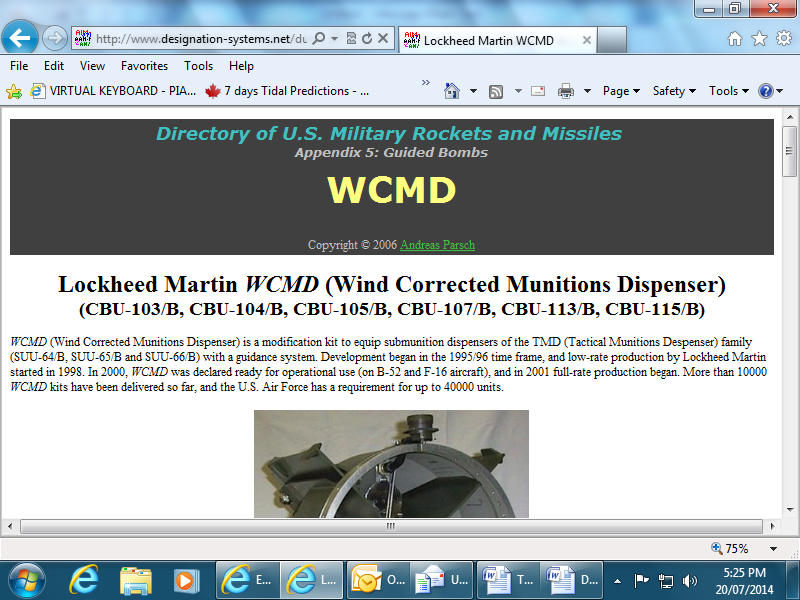
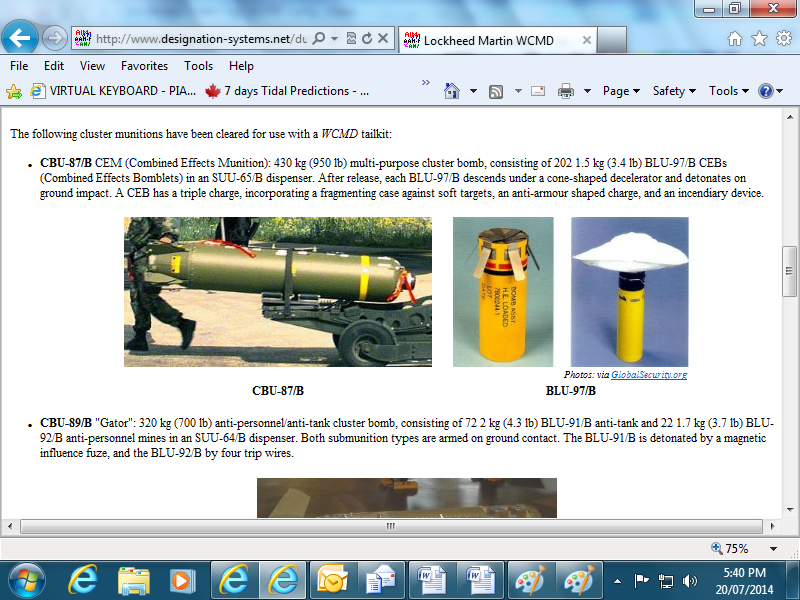
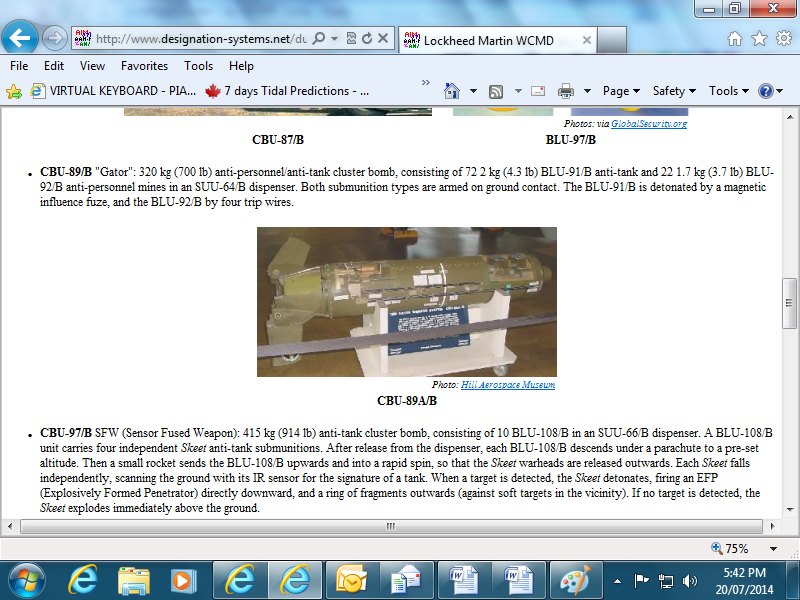
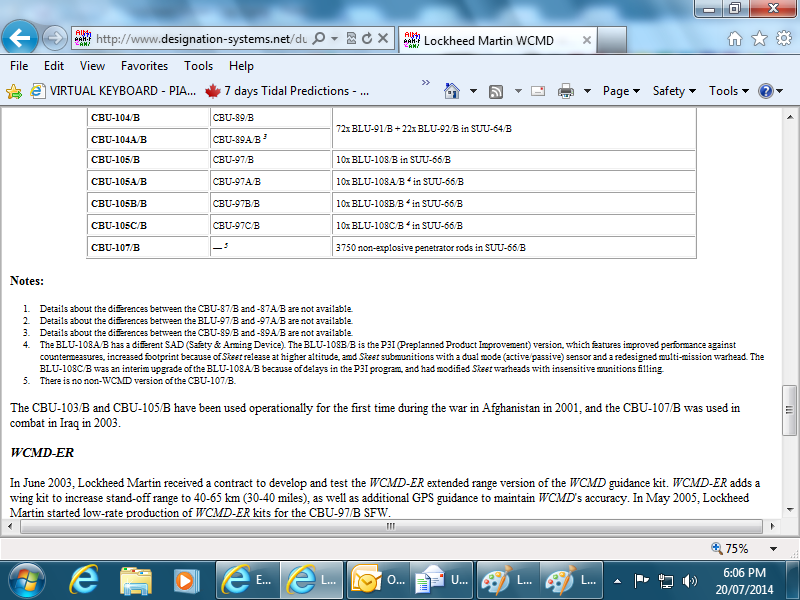
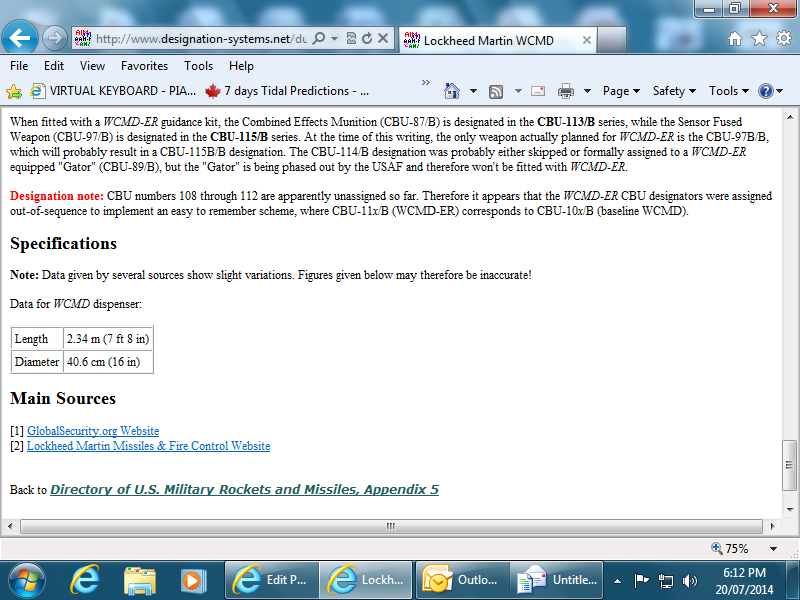
Screen captures of Lockheed Martin, cluster munitions, 4 pages.

CBU = Cluster Bomb Unit

Submitted to the Court, R v Karen (Eve) Stegenga, July 17, 2014, Powell River, BC but not entered as an “Exhibit”:

http://www.designation-systems.net/dusrm/app5/wcmd.html

Lockheed Screen Cap WCMD

Locvkheed Screen Cap WCMD 2

Lockheed Screen Cap WCMD 3


Lockheed Screen Cap WCMD 4


Lockheed Screen Cap 4


Lockheed Screen Cap 5

Lockheed Screen Cap 6


TWO MORE PAGES were submitted to the Court, Stegenga Trial.

http://www.lockheedmartin.com/products/LongShot/  

July 20, 2014.  Scan the pages.  The URL is no longer valid.


(Return to Huge victory. Lockheed Martin (U.S. weapons, surveillance, war) is OUT of the Canadian Census! )


Jul 012014
 

(Green text is a link)

International Treaties, Land Mines & Cluster Bombs

 (As submitted to the Court, R v  Karen (Eve) Stegenga, July 17, 2014, Powell RIver, BC)


See also: The evidence that Lockheed Martin Produces Cluster Munitions


(Return to  Huge victory. Lockheed Martin (U.S. weapons, surveillance, war) is OUT of the Canadian Census! )


Jul 012014
 

Related to the Trial of (Karen) Eve Stegenga over the involvement of Lockheed Martin at Statistics Canada. Eve refused to fill in her census form.

(To return to that posting, click on:  Huge victory. Lockheed Martin (U.S. weapons, surveillance, war) is OUT of the Canadian Census!)


PURPOSE OF THE POGO INFORMATION

You cannot defend yourself against something you don’t understand.

Understand the modus operandi of Lockheed Martin.They will have brought their ways and means with them to Canada.

The details in POGO’s The Politics of Contracting: Lockheed Martin tell the story.

Project on Government Oversight (POGO – U.S.) Reports (2009, 2007, 2003)

The Reports establish a clear pattern by Lockheed Martin. They reinforce the article, Wages of Sin.

The details in POGO’s The Politics of Contracting: Lockheed Martin tell the story.

As submitted to the Court, Lockhead Expenditures. The headings are:

  • Money Spent by Lockheed Martin to Influence Decisions and Secure Future Federal Contracts


  • Senior Government Officials Turned Current and Former Company Executives for Lockheed Martin


  • (Same, except) Turned Board Directors for Lockheed


  • (Same, except) Turned Registered Company Lobbyists for Lockheed

Source: http://www.pogo.org/our-work/reports/2004/politics-of-contracting-companies/gc-rd-20040629-1.html

The names and figures are as of 2004. POGO’s Reports 2007, 2009 show that nothing has changed:

April 2009, POGO’s Updated Federal Contractor Misconduct Database: Lockheed Martin Leads In Contracts and Penalties,

http://www.pogo.org/about/press-room/releases/2009/co-fcm-20090421.html

Excerpt:

Lockheed also has the most misconduct instances with 50 instances of civil, criminal, or administrative misconduct since 1995.

2007   The Project on Government Oversight Report,  . .  (information overload)

2003  The Project on Government Oversight Report, .

The detail is very good. See scanned copy submitted to the Court: Lockheed – Project on Government Oversight    (The URL is no longer valid. )

Jun 272014
 

Having Edward Snowden as a customer brought Ladar Levison into a battle with his own government.

Recommend:  go to the URL to listen to the podcast of the interview

http://www.cbc.ca/thecurrent/episode/2014/06/27/ladar-levison-the-american-who-shut-down-his-business-when-he-felt-his-government-wanted-too-much-1/

(Note:  the interview originally aired Oct 11, 2013.)

While you may not be familiar with Ladar Levison or his email service, Lavabit, you’ve certainly heard about one of its users. His e-mail address was edsnowden@lavabit.com. We hear from the man who got caught up in a legal battle with his own government for running an e-mail service, and his fight for privacy.

“They were able to map out the patterns of communications…with whom Brazilian officials were speaking, who was calling them, how long they were speaking for, and what their network of association was…”

Glenn Greenwald

Last October, journalist Glenn Greenwald dropped a bombshell when he told our colleagues at As It Happens that Canadian officials spy on members of Brazil’s government. Mr. Greenwald says it was information he received from Edward Snowden, the former contractor with the U.S. National Security Agency.

Last summer, Mr. Snowden went public with the details of a sprawling, NSA campaign to monitor phone calls, e-mails and web searches.

Snowden was a customer of a small secure e-mail provider called Lavabit, owned by entrepreneur Ladar Levison. Having Snowden as a customer brought Levison into a battle with the U.S. government, one that would test his resolve, as well as his principles.

“I feel there’s a sacred trust between a user and a service provider. “

Ladar Levison


Ladar Levison was summoned to a grand jury, held in contempt of court, fined thousands of dollars and threatened with arrest. In the end, he decided the best course of action was just to shut-down his business.

“Overnight, I went from being a small business owner to a political activist.”

Ladar Levison


Ladar Levinson was able to speak publicly about this because a U.S. court lifted the gag order on his case last October.

This interview originally aired on October 11th, 2013

Jun 272014
 

Recommend:  go to the URL and listen to the interview with Levison.   I captured the text of the news story below, for backup  purposes.

http://www.cbc.ca/news/business/lavabit-founder-fought-9-month-legal-battle-with-fbi-1.2658374

After refusing hand encryption codes to federal agents,
Ladar Levison had to shut down his company

CBC News  Posted: May 29, 2014

Last year Ladar Levison shut down Lavabit, the email company he’d built over 10 years, rather than obey a government order to compromise the privacy of his users.

Levison has been caught in a legal nightmare for the past nine months, since he refused to hand over the encryption codes used on his system, a small business built with a promise of a secure system for end users.

“Lavabit was established 10 years ago as an alternative to gmail with a focus on privacy,” Levison said in an interview with CBC’s The Lang & O’Leary Exchange.

“We set out with that goal and in the course of building the system that would go on to power the servers, there were a number of headlines discussing the Patriot Act and national security levels and that prompted me to build into the platform an encryption system that would prevent me from accessing the messages of some secure accounts that had enabled the secure storage feature,” he added.

The ordeal began with a knock on the door by federal agents who had a court order requiring the installation of surveillance equipment on Lavabit’s network .

“I had no choice but to consent to the installation of their device, which would hand the U.S. government access to all of the messages—to and from all of my customers—as they travelled between their email accounts other providers on the internet,” Levison wrote in The Guardian.

“But that wasn’t enough. The federal agents then claimed that their court order required me to surrender my company’s private encryption keys, and I balked. What they said they needed were customer passwords.”

‘I simply feel that the freedom to communicate privately, the freedom to associate without suspicion or being accused of criminal behaviour in secret reports is so important to a free and functioning democracy that I’m willing to invent new technology’- Ladar Levison, founder of Lavabit


Long legal battle

Levison told CBC he did not believe it was right to expose all his 410,000 users because the FBI wanted to investigate a handful of his customers.

“I thought if the government came knocking, I could give up the identity of the account holder and they could go directly to that person and collect the data, which is how I believe in a democracy the process should work. You should not be accused of a crime without ever finding out that you were accused,” he said.

Levison was held in contempt of a federal order and faced a court case in which neither he nor his attorneys were given access to background information and in which most of the information was under seal.

He shut down his company, rather than hand over the encryption code. Even today, he is not permitted to say who the FBI was investigating.

“I can’t confirm or deny they were targeting Snowden. The only thing I’m not allowed to speak about to this day is who and how many targets they were going after in my system,” he said.

Last week, a federal judge unsealed key parts of the record detailing the government’s requests from Lavabit, freeing Levison to talk more openly about what happened.

“With the decision last week, I feel empowered to speak out about the lack of justice that I received as a business and as an individual American,” Levison said.

Levison claimed he is worried his service could be used to hide criminal behaviour, but he believes the government should target its investigation against the individuals it is investigating, rather than all of his customers.

He intends to begin again in a new service with other developers in the coalition called the “Dark Mail Alliance.” Levison said he hopes to have a new encrypted email system in testing within a few months and widely available later this year.


Privacy issues paramount

Lavabit encryption was done on the server, using an SSO system to create a secure bridge to the client, but that won’t work if federal agents can demand the code for everyone at once.

“Moving the cryptography down to the client is a new technical challenge and one I’m in the process of solving,” he said.

Levison believes Snowden’s revelations have made people more conscious of the need for privacy and there will be a growing market for really secure email systems.

“I simply feel that the freedom to communicate privately, the freedom to associate without suspicion or being accused of criminal behaviour in secret reports is so important to a free and functioning democracy that I’m willing to invest (invent – I think this should be) new technology to ensure that future generations don’t succumb to biting from the forbidden apple like this one,” he said.