Sandra Finley

Nov 082012
 

Regarding Proposition 37, on the California ballot during the U.S. Federal Election, to require labeling of GMO food:

  1. from Forbes Magazine, Nov 13
  2. from the Huffington Post, Nov 8

= = = = = = = = = = = = = = = = = = = = =

1.    http://www.forbes.com/sites/amywestervelt/2012/11/13/with-california-prop-defeated-gmo-labeling-proponents-look-to-farm-bill/

California’s Proposition 37, which would have required labeling of all food products containing genetically modified organisms within two years, was narrowly defeated last week (53 to 47). The result has largely been credited to the $45 million spent by a coalition including Monsanto, Du Pont, and many others on No on 37 ads depicting farmers, Democrats, and scientists claiming GMO labeling would be detrimental to business, confusing and costly to consumers, and counterproductive to research. Despite the defeat of the bill, GMO labeling advocates are calling the California campaign a victory given that it was outspent 5 to 1 and still managed to get over 4 million votes.

Now the groups behind Prop 37–a coalition of nonprofits, farmers, and organic and natural foods companies–are keeping an eye on the Farm Bill. “Federal GE foods labeling must now be the focus,” said David Bancroft, campaign director of Just Label It, a coalition of 600 businesses and organizations that spearheaded the FDA petition drive for GE foods labeling, in a release about Prop 37′s defeat. The group is not just concerned with passing a Federal labeling mandate, but with language related to the USDA’s authority that was inserted into the House versions of the Farm Bill, which, if passed, would strip federal agencies of their authority to regulate GE crops.

“We believe that consumers have a right to know what’s in their food,” says Britt Lundgren, Director of Organic and Sustainable Agriculture for Stonyfield, a member of Just Label It and longtime supporter of GMO labeling  (more)  . . .

= = = = = = = = = = = = = = = = = = = = =

2.    http://www.huffingtonpost.com/michele-simon/prop-37-defeated_b_2087782.html

By

Public health lawyer

California’s Proposition 37, which would have required labeling of GMO foods, died a painful death Tuesday night. Despite polling in mid-September showing an overwhelming lead, the measure lost by 53 to 47 percent, which is relatively close considering the “No” side’s tactics.

As I’ve been writing about, the opposition has waged a deceptive and ugly campaign, fueled by more than $45 million, mostly from the leading biotech, pesticide, and junk food companies. Meanwhile, the “Yes” side raised almost $9 million, which is not bad, but being outspent by a factor of five is tough to overcome.

While we can always expect industry to spend more, the various groups fighting GMOs for years probably could have been better coordinated. I was dismayed and confused by all the fundraising emails I received from different nonprofits on Prop 37 and wondered why they weren’t pooling their resources.

But would more money and better strategy have made a difference? Given the opposition’s tactics, it seems unlikely. I am not easily shocked by corporate shenanigans, but the “No on 37” campaign is my new poster child for propaganda and dirty tricks. It’s worth recapping the most egregious examples.

Lying in the California voter guide: The “No” campaign listed four organizations in the official state document mailed to voters as concluding that “biotech foods are safe.” One of them, the American Council on Science and Health, is a notorious industry front group that only sounds legit. Another, the Academy of Nutrition and Dietetics, actually has no position and complained about being listed. (I was attending the group’s annual meeting when this came to light and promptly notified the “Yes” campaign, but the damage was already done.) The other two organizations, the National Academy of Sciences and the World Health Organization, in fact have more nuanced positions on GMOs than just “safe.”

Misuse of a federal seal and quoting the Food and Drug Administration: This one caused even my jaded draw to drop. In a mailer sent to California voters, the “No” campaign printed the following text along side the FDA logo: “The US Food and Drug Administration says a labeling policy like Prop 37 would be “inherently misleading.” That is exactly how they wrote it, with the incorrectly placed quotation marks. How can a $45 million campaign make a mistake like that? They can’t; it’s deliberately confusing. It also may even be a violation of criminal law to use a federal seal in this manner. I am told that some California voters were fooled into thinking FDA opposed the measure. Of course, that was the idea.

Misrepresenting academic affiliation: More than once, the “No” campaign gave the false impression that its go-to expert Henry Miller was a professor at Stanford University, in violation the school’s own policy. (In fact, he’s with the Hoover Institute, housed on the Stanford campus.) Only when Stanford complained did the “No” campaign edit the TV ad, but many already saw it, and then they repeated the lie in a mailer.

Deploying unfounded scare tactics: I fully expected the “No” side to use distracting arguments to scare voters while ignoring the merits of issue. But it took this common industry strategy to new heights, making wild claims about higher food prices, “shakedown lawsuits,” and “special interest exemptions.” While each of these claims is easily debunked, being outspent on ad dollars makes it hard to compete, especially when all you can really say is, “that’s not true.”

Additional lies and dirty tricks: 1) claiming the San Francisco Examiner recommended a “no” vote when in fact the paper endorsed “yes”; 2) putting up doctors and academic experts on the dole from Big Biotech as spokespeople without disclosing the conflict of interest; 3) securing a major science group’s endorsement just two weeks before Election Day; 4) somehow convincing every major California newspaper to endorse a “no” vote, often with the very same industry talking points; and 5) placing ads in deceptive mailers that looked like they came from the Democratic party, cops, and green groups.

Each of these tactics, combined with a $45 million megaphone to spread the lies and deceit, simply overwhelmed the “yes” side. Some on Twitter criticized Californians for voting no on 37, but do not under-estimate the effectiveness of scare tactics such as claims of higher food prices. Industry uses them because they work. And voters believe the arguments not because they are stupid or don’t care about the food they eat, but because they are pummeled with ads, getting only one side of the story. This is a problem inherent to the proposition process. (I live in California and have seen scare tactics work on everything from tobacco taxes to gay marriage.)

Indeed, the California experience may seem like déjà vu all over again to Oregonians who recall the ballot initiative there to label GMO foods in 2002. It lost miserably (70 percent voted no) and guess what the winning argument was then? And that measure also enjoyed an overwhelming lead in early polling, but a multi-million dollar ad blitz in the final weeks claiming higher food costs turned that right around.

While a lot has changed in 10 years for the food movement, the same industry tactics still work. (At least we came a lot closer here in California.) Advocates have also tried in 19 states to go through the legislature and failed there too, thanks to industry lobbying.

It’s a shame because we really need a win at the state level to boost the federal Just Label It campaign, which aims to get the FDA to require labeling. I disagree with Gary Hirshberg, chairman of Stonyfield Farms and leader of Just Label It, for putting all his eggs in the federal basket. While Hirshberg and his company endorsed 37, he donated relatively little to the campaign and was even quoted in the New York Times saying he doesn’t think this problem can be solved state by state. Obviously not, but how does Hirshberg ever expect to get anywhere at the federal level unless and until we can gain traction locally? This is exactly how most policy change is made, especially when we face massive industry opposition. Some are already predicting that the California loss will set back the effort nationally.

But the campaign is still an important step forward in the larger political fight against Big Food, one that raised a lot of awareness about GMOs, food production, and corporate tactics, both in California and nationally. As Twilight Greenaway noted at Grist, win or lose, the effort to pass Proposition 37 in California demonstrates a “bona fide movement gathering steam.”

Now we have to keep gathering more and smarter steam. It was never enough to just be right, or even to have the people on our side. Not when the food industry gets to lie, cheat, and steal its way to victory.

Nov 082012
 

Hi All,

On November 5th,  I entered the Appeal Court buoyed by your emails of support – – many thanks!

A panel of three Judges.  The hearing was longer than I expected, more than three hours with one ten-minute break.

The prosecutor was again brought in from Ottawa.

I am satisfied.  The questions were probing, whereas in the earlier hearing in Queen’s Bench there was not sufficient challenge to the legitimacy of some statements.

I still have wonder at my good fortune in connecting with lawyer Steve Seiferling.  He knows Privacy Law inside out.  He was able to answer and explain everything that came his way.

His strategy:  (this is the way I understand it, not his words)  there is one gateway.  Build an impenetrable barrier at that one gateway, everything on the other side is irrelevant, if you can’t pass through the gateway.  Keep the arguments clear and concise on that point.  Don’t get entangled in ideas and arguments that only exist if you can pass through the gateway (which you can’t).

The gateway: the case law that establishes the Charter Right to Privacy of personal information says that the COLLECTION of personal information is illegal unless the citizen provides it on a VOLUNTARY basis.  The Government cannot force citizens to provide personal information.

R. v. Plant, [1993] 3 S.C.R. 281

In fostering the underlying values of dignity, integrity and autonomy, it is fitting that s. 8 of the Charter should seek to protect a biographical core of personal information which individuals in a free and democratic society would wish to maintain and control from dissemination to the state.”

It does not matter to what use the information is put, or how secure or insecure is the data base, and so on  . . .  the citizen has a Charter Right to NOT provide personal information to the state.  To me, it is stated quite eloquently and simply in the R vs Plant judgment.


The opening debate was whether or not Section 8 of the Charter applies in this case.  Provincial Court Judge Whelan (first level of trial) said yes, unequivocally.  Court of Queen’s Bench Judge Konkin (second level of trial) said yes and then equivocated at another place in his judgment .

The lawyer and the prosecutor (Nov 5) provided case law examples to support their opposing positions:  Section 8 applies, Section 8 does not apply.

The State collects information from people:

  • suspected of criminal activity
  • in regulatory matters
  • in censuses and surveys

Differences arise because of the conditions that surround the collection of the personal information.  An abbreviated explanation:

  • In criminal matters, investigative powers are subject to (limited by) Section 8
  • In regulatory matters, there is a benefit to the person (e.g. they receive a driver’s license)
  • (Steve argues) In the case of collecting information for statistical purposes there is no benefit to the person, nor criminal activity involved.  The threshold for the protection of personal information should, if anything, be HIGHER in this case.


Whether there is a REASONABLE EXPECTATION of privacy was argued.   (This was discussed in our network, see the posting  Charter argument,  Privacy of personal information, REASONABLE   R. v. Edwards, [1996] 1 S.C.R. 128 )


Whether there was a “search”.  (Section 8 is protection against unwarranted “search and seizure”, in this case, of  personal information.)   The Crown Prosecutor argued that your breath is “something” but it cannot be captured.  Similarly, an idea is something that cannot be captured.  Personal information does not exist until you are asked to provide it, it is an idea that you have to bring to mind.  Section 8 does not apply because nothing was seized because I didn’t write anything down on the census form!  If I had filled out the census form, there would have been a seizure (Prosecutor’s argument).

The argument fared poorly under questioning.  (I would have liked to add “We would not be here if there was nothing that the State could seize.”)

That the Government, Minister Tony Clement, announced that the census long form is no longer mandatory was raised.  (I always want to add:  but they did not actually change the law.  They did something better (if you want to build detailed information files on individuals):  they changed the census long form (collection once every 5 years) to the “national household SURVEY”, enabling data collection to be carried out every week, every month, every year.)

American jurisprudence (Morales) was raised.  But their constitutional law is quite different from Canadian.  (a cautionary note from a Chief Justice on this topic is found in the legal argument in the posting  Charter argument,  Privacy of personal information, REASONABLE   R. v. Edwards, [1996] 1 S.C.R. 128 )


To my mind, the Judges carry the same misinformation (out-dated) as most people.  Fortunately a comment was made in passing by one of the Justices:  the census records are in aggregate.  There are no identifiable, individual records.  This misconception is critical and it is widely held.   By his enunciating it, it was possible to offer a correction:  as of the 2006 census the individual data files are complete with the name of the person a part of the record.  Reading body language, I think this caused an adjustment in thinking.


The prosecutor made much of the fact that I didn’t answer ANY of the questions.  I wanted to interject:  “I did not have the option of answering only SOME of the questions!”.  But aaah!  That is on the other side of the gateway.

Well!  I guess you do not want to hear all 3 hours of it!

Expect the Appeal Court decision . . . . (Steve suggests)  four or five months maybe.

Both of us are decidedly cautious in predicting the outcome, after twice having our confidence blown in the earlier court appearances!   How about 51% versus 49% chance of success?!

I believe that the battle to protect the Charter Right to privacy of personal information must be fought.  We are all at risk when our country starts the construction of detailed files on individuals.  History is clear on that point.

Nov 072012
 

Is the GOP stealing Ohio?
Uncertified, “experimental” software patches have been installed on machines in 39 counties of the key swing state

Is the GOP stealing Ohio?Jon Husted (R), Ohio Secretary of State. (Credit: AP/Jay Laprete)

Last week, Bob Fitrakis and Gerry Bello at FreePress.org reported an important story concerning what they described as “uncertified ‘experimental’ software patches” being installed at the last minute on electronic vote tabulation systems in 39 Ohio counties.

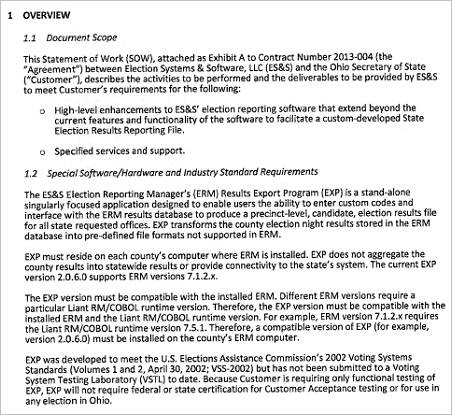
The story included a copy of the contract [PDF] between Republican Ohio Secretary of State Jon Husted’s office and ES&S, the nation’s largest e-voting system manufacturer, for a new, last-minute piece of software created to the custom specifications of the secretary of state. The contract itself describes the software as “High-level enhancements to ES&S’ election reporting software that extend beyond the current features and functionality of the software to facilitate a custom-developed State Election Results Reporting File.”

A subsequent story at the Free Press the following day included text said to be from a Nov. 1 memo sent from the Ohio secretary of state’s Election Counsel Brandi Laser Seske to a number of state election officials confirming the use of the new, uncertified software on Ohio’s tabulator systems. The memo claims that “its function is to aid in the reporting of results” by converting them “into a format that can be read by the Secretary of State’s election night reporting system.”

On Friday evening, at Huffington Post, journalist Art Levine followed up with a piece that, among other things, advanced the story by breaking the news that Fitrakis and his attorney Cliff Arnebeck were filing a lawsuit for an immediate injunction against Husted and ES&S to “halt the use of secretly installed, unauthorized ‘experimental’ software in 39 counties’ tabulators.” Levine also reported that Arnebeck had referred the matter to the Cincinnati FBI for criminal investigation of what the Ohio attorney describes as “a flagrant violation of the law.”

“Before you add new software, you need approval of a state board,” says Arnebeck. “They are installing an uncertified, suspect software patch that interfaces between the county’s vote tabulation equipment and state tabulators.” Arnebeck’s alarm is understandable.

Since the story initially broke, I’ve been trying to learn as much as I could about what is actually going on here. During that time, a few in the mainstream media have gotten wind of the story as well, including NBC News and CNN, and have been able to press Husted and other officials in his office into finally responding to the concerns publicly. The Ohio officials have attempted to downplay the concerns, though in doing so they appear to have given misleading information which, at times, seems to conflict even with the contract itself.

I’ve also spoken to computer scientists and election integrity experts, in trying to make sense of all of this, though many of them seem to be scratching their heads as well. My own queries to the Secretary of State’s office have gone unanswered, as had Fitrakis’ and Bello’s before they published their initial story, begging the question as to why, if this software is as benign as Ohio officials are suggesting, they didn’t respond immediately to say as much. Furthermore, why did they keep the contract a secret? Why did they wait until just before the election to have this work done? And why did they feel it was appropriate to circumvent both federal and state testing and certification programs for the software in the bargain?

I’d like to have been able to learn much more before running anything on this at all, frankly. But the lack of time between now and Tuesday’s election — in which Ohio’s results are universally believed to be key to determining the next president of the United States — preclude that.

So, based on the information I’ve been able to glean so far, allow me to try to explain, in as simple terms as I can, what we currently know and what we don’t, and what the serious concerns are all about.

And, just to pre-respond to those supposed journalists who have shown a proclivity for reading comprehension issues, let me be clear: No, this does not mean I am charging that there is a conspiracy to rig or steal the Ohio election. While there certainly could be, if there is, I don’t know about it, nor am I charging there is any such conspiracy at this time. The secretive, seemingly extra-legal way in which Secretary of State Husted’s office is going about whatever it is they are trying to do, however, at the very last minute before the election, along with the explanations they’ve given for it to date, and concerns about similar cases in the past, in both Ohio and elsewhere, are certainly cause for any reasonable skeptic or journalist to be suspicious and investigate what could be going on. And so I am …

The Contract

The first 13 pages of the 28-page contract [PDF] is largely boilerplate legal stuff. The actual “Statement of Work” in the contract, signed on Sept. 18, 2012, by ES&S and on Sept. 19 by Assistant Secretary of State Scott Borgemenke — less than two months before this year’s presidential election — describes the software that is to be created for the state by ES&S, beginning on Page 17.

Here’s the beginning of the “Overview” section, describing the scope of the work, which I’ll try to unpack just below it, for non-geeks…

In short, the contract is for an application called EXP, which exports voting results into a specific format after the data from the central tabulator has been organized by the ES&S Election Reporting Manager (ERM). The ERM program itself directly accesses the main tabulator database and the results are then exported, by EXP, to a text-based file.

The text-based file is then sent by the county, via some unspecified means, to the secretary of state for import into its Election Night Reporting System, which is subsequently made available on the Web, where it will be viewed by the media and the rest of the world as the “results” of that day’s election in Ohio.

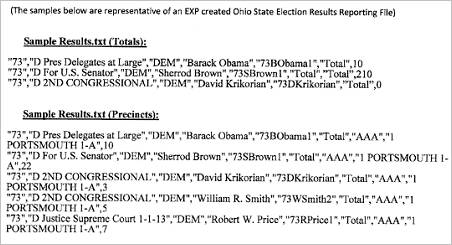
The unencrypted text-based file created by EXP is a simple CSV (Comma Separate Values) formatted file, which includes field names and values separated by commas, as culled from the tabulated results database. Pages 26 and 27 of the contract detail the specific format for the plain text files created by EXP. Here’s an example:

The Secretary of State’s Explanations

Last last week, a public response was finally offered to Ugonna Okpalaoka of theGrio, an African-American-centric website published in partnership with NBC News.

Okpalaoka write: “Matt McClellan, a spokesman for the Secretary of State’s office, told theGrio that no patches were installed, describing instead a reporting tool software meant to ‘assist counties and to help them simplify the process by which they report the results to our system.’”

McClellan’s reported claim that “no patches were installed,” but rather it was simply “a reporting tool software” to assist counties, seems to be in direct contradiction with the contract itself.

At the bottom of Page 17, the contract states that “the current ES&S ERM Results Export Program (EXP) product version 2.0.6.0″ will be “modified to meet the Customers request.” The contract goes on to say that it “shall be modified” into two different EXP versions, 2.0.7.0 and 3.0.1.0, to work with two different versions of the ERM software variously installed in different Ohio counties.

It’s not entirely clear how the new version of EXP will differ from the existing one, though the contract specifies the older version created XML-formatted files instead of plain-text CSV files. The new version of the EXP program is installed onto the tabulation computing systems of the Ohio counties, which use the ES&S system, so this updated version is a new version of the existing software. It is either a “patch” or an upgrade or a new installation. Distinguishing between those descriptions, in this case, seems to be a distinction without a difference made by McClellan. In either case, it’s new software being applied onto the existing central tabulation system computers, without either state or federal certification, just days before the 2012 presidential election.

By describing it as “experimental” software, it seems the state is attempting to skirt the legal requirements for state testing and certification by the Ohio Board of Voting Machine Examiners. But more on that in a moment.

According to Pam Smith, president of the nonpartisan watchdog group VerifiedVoting.org, her organization also sought explanations for the last-minute software changes from the secretary of state’s office.

She tells me that she was told that “the Secretary of State team installed the EXP tool” themselves in the counties that use the ES&S system. “It was not left to the counties to figure out the installation or the configuration.”

Moreover, she stressed, she was told the software “does not get installed on voting machines.”

But that makes little difference, since the software is installed directly onto the central tabulator machines, where it can affect — either accidentally, or by design — the main results of an entire county’s election. Software residing on the central tabulation systems is, in fact, far more dangerous than software on the voting systems, since it can have direct access to the entire set of county election results.

Jim March, a longtime Libertarian election integrity and software expert, as well as a member of the Pima County, Ariz., Election Integrity Commission (which serves as an official advisory body to the Pima County Board of Supervisors), and a founding and current board member of BlackBoxVoting.org, is highly suspicious of the last-minute installation of software.

In an affidavit [PDF] submitted to Fitrakis and Arnebeck for their legal case, March says he believes “that this custom software is not necessary for the conduct of elections and is in fact highly dangerous.”

March has been involved in numerous cases involving suspicious elections and election software. In 2005 he received part of a multimillion-dollar settlement from Diebold as the result of a qui tam case with the state of California, after it had been discovered that the company had secretly installed uncertified software on its voting systems in the state. The secretary of state decertified the systems as a result.

“What ES&S has chosen to do here is extremely dangerous and exactly what you’d want to do if you wanted to plant a ‘cheat’ onto the central tabulator,” March says in his affidavit.

On Saturday night, Secretary Husted himself attempted to downplay the matter during an interview with CNN’s Don Lemon, explaining that there was no danger in installing the software on the county’s tabulation systems. MSNBC’s “Ed Show” played that part of the exchange with the secretary, as well as a response to it from Democratic Ohio state Sen. Nina Turner.

As Husted explained to Lemon: “The reporting system and the counting system are not connected in any actual way. And the results that anybody can get at home on their computer are — they’re going to get them at the same time that I do on election night. So we have a very transparent system.”

The “transparency” of a system that counts votes in secret and features a secretly installed piece of software that skirted normal certification procedures aside, March’s affidavit disputes Husted’s explanation about the separation between the reporting and counting systems.

“Their custom application … would have full contact with the central tabulator database on both a read and write basis, while running on the same computer as where the ‘master vote records’ (the central tabulator database — the ‘crown jewels’ of the whole process) are stored,” he says.

“Under this structure a case of accidental damage to the ‘crown jewels’ of the election data is possible. A case of deliberate tampering of that data using uncertified, untested software would be child’s play.”

He describes the process as “criminally negligent just from a standpoint of data security.”

State Sen. Turner was similarly suspicious: “They should not be experimenting in a presidential election. You know the secretary of state had previous years to try to experiment.”

Indeed, one of the unanswered questions we sent to the secretary of state asked why they waited until Sept. 18 to begin this contract, since Husted’s been in office fore nearly two full years, and they’ve carried out many elections, of lesser import than a presidential election since that time during which this software could have had a trial run. Furthermore, we asked, how did they manage without it until now during both his tenure and that of his predecessors?

We received no reply to that and a number of other related questions.

When theGrio asked a similar question, as to why they waited until “so soon before the election” to commission the new software, they were told by McClellan: “I’m not sure the exact timeline of that, but I know we’ve been working with the counties for the past couple of months on getting these in place, testing them to make sure they work properly, and working with the vendors as well.”

There was another point reported by theGrio that seems to be in direct contradiction to the contract between ES&S and the secretary of state, and it’s a troubling one.

They report: “McClellan said the tool serves to cut down on the amount of information precinct workers would have to key in by hand by allowing the results to be output onto a thumbdrive and uploaded at once into the Secretary of State’s system.”

But the contract specifically notes at the top of Page 21 that “Automated uploading or sending of the State Election Results Reporting file” is “outside the scope” of the software called for in the agreement, and that “It is a manual process to upload or send the results file.”

That would seem to contradict McClellan’s claim that the converted file created by the EXP program is “output onto a thumbdrive and uploaded at once into the Secretary of State’s system.”

The way in which that file is sent to the secretary of state, as noted, remains unknown. Moreover, if a plain text file is sent via email, or other similar Internet transmission, it can easily be intercepted and changed before it ever even reaches the SoS Election Night Reporting System. Such an attack is sometimes described as a “Man-in-the-Middle” attack.

Verified Voting’s Smith explained that she had been told that results files from the state’s other e-voting systems made by Diebold and Hart-Intercivic already created files in the format that EXP was being modified to create. Thus, she said, all of the files would be in the same format for uniform import into the Election Night Reporting System.

Another question I’d asked of Husted’s office was, if all that EXP did was simply convert files from one simple format to another, wouldn’t it have been far less dangerous to install the software once at the secretary of state’s office and simply convert files there for the Reporting System, after they’d been sent to them by the counties, rather than install 39 uncertified pieces of software on 39 different central tabulators in 39 different Ohio counties just days before the 2012 presidential election?

I received no answer to that question either.

History and Reason for Concern

Writing in the Oct. 5, 2006, issue of Rolling Stone, Robert F. Kennedy Jr. in“Will the Next Election Be Hacked?” described a suspect election that took place in Georgia in 2002, just after Diebold’s electronic touch-screen voting systems had been deployed for the first time across the entire state.

“Six days before the vote,” Kennedy writes, “polls showed Sen. Max Cleland, a decorated war veteran and Democratic incumbent, leading his Republican opponent Saxby Chambliss … by five percentage points. In the governor’s race, Democrat Roy Barnes was running a decisive eleven points ahead of Republican Sonny Perdue. But on Election Day, Chambliss won with fifty-three percent of the vote, and Perdue won with fifty-one percent.”

To this day, Election Integrity advocates cite that 2002 election as suspect, along with the curious software “patch” they later learned was secretly applied to the state’s electronic voting system earlier that year.

In his article, Kennedy quotes Diebold contractor Chris Hood, who was directly involved in the installation of the systems across the state, as describing Diebold Election Systems Inc. president Bob Urosevich personally distributing the software “patch,” which was covertly installed on more than 1,200 Diebold touch-screen systems that year.

No one will likely ever be able to prove that the November 2002 election was rigged, but that infamous software “patch,” along with the anomalous election results from 100 percent unverifiable voting systems (which are still in use today across the state of Georgia and in many other states) has cast an everlasting cloud of suspicion over that election.

Similarly, there remains a dark cloud of suspicion over the 2004 presidential election in Ohio itself, the last one run under the administration of a Republican secretary of state, when blatant voter suppression tactics, ballot tampering, unprecedented counting room lockdowns due to phony Homeland Security “terror warnings,” criminal manipulation of the post-election recount, as well as concern about a possible “Man-in-the-Middle” hack of the state’s Election Night Reporting System have long cast a shadow of doubt over the reported results.

The BRAD BLOG was honored with an award from Sonoma State University’s 36-year old investigative reporting project Project Censored for some of our coverage of the mysterous death of Ohio-based GOP IT guru Michael Connell.

In 2004, Connell designed and created Ohio’s Election Night Reporting System for then Secretary of State J. Kenneth Blackwell. It was later discovered, ironically enough by Ohio’s investigative journalist Bob Fitrakis and the Free Press, that the results the world were watching on the Web that night, as it became clear that the winner of the Buckeye State would determine the presidency, had been diverted from Ohio down to the servers of a far right-wing company in Chattanooga, Tenn., called SmarTech in the middle of the night.

Computer analysts and security experts, including a Republican who worked with Connell, have speculated, with a fair amount of evidence to support their case, that there could have been a “Man-in-the-Middle” attack that night, in which someone changed the results of the election between the time they were tabulated at the county level and before they appeared on the secretary of state’s website later that evening, as it was then being run out of SmarTech’s servers in Tennessee.

We may never know if that actually occurred, though schematics unearthed during an election fraud case against Blackwell detailed how Connell’s system allowed for “Man-in-the-Middle” access to change the results before they were reported to the world. Despite a federal court order to retain all of the ballots from the election, some or all of them were destroyed in 56 out of 88 counties, so it became impossible to compare the reported results with the actual ballots cast during the 2004 election.

Connell can no longer discuss the matter. He was killed when he crashed near the Columbus airport in his single-engine Piper Saratoga on his way back from Washington, D.C., for his company’s Christmas party in December of 2008. One month earlier, on the Monday before the 2008 presidential election, a federal judge compelled Connell to sit for a deposition in the 2004 election fraud case in which the attorneys believed the man who created the George W. Bush and John McCain campaign websites, as well as the now-infamous secret email system for the George W. Bush administration, held the key to an alleged conspiracy to steal the 2004 election in Ohio for Bush.

Whether or not a similar scheme could be in the works in 2012 is certainly unknown. To be clear, once again, I am alleging no such thing. I am simply reporting the facts that I know, and those that I do not.

Nonetheless, questions about a last-minute secret software patch to be used across multiple counties in Ohio, one that now resides on vote tabulation systems and is said to produce easily modifiable text files to be uploaded to a very partisan secretary of state’s Election Night Reporting System, certainly have a familiar, and to some, a chilling ring just over 24 hours before the next presidential election could well be decided in the Buckeye State.

As the Free Press notes, “Government reports such as Ohio’s Everest study [PDF] [the landmark analysis of the state’s electronic voting systems by world class academic and corporate computer science and security experts, commissioned by Husted’s Democratic predecessor Secretary of State Jennifer Brunner] document that any single change to the system could corrupt the whole voting process.”

Late on Sunday, in a new update from Bello and Fitrakis at the Free Press, the pair describe that “The potential federal illegality of this software has been hidden from public scrutiny by the Secretary of State’s Election Counsel Brandi Seske.” They report that a Sept. 29 memo from Seske describes “de minimis changes” in the ES&S software that allowed for use of the software updates without state testing. “De minimis,” they explain, “is a legal term for minute.”

And yet, they go on to cite a memo from the U.S. Elections Assistance Commission, the body tasked with certifying electronic voting and tabulation systems at the federal level, dated February 8, 2012 entitled “Software and Firmware modifications are not de minimis changes.”

Ohio election law provides for experimental equipment only in a limited number of precincts per county,” they report. “Installing uncertified and untested software on central tabulation equipment essentially affects every single precinct in a given county.”

“The method of execution chosen,” for this effort, notes March in his affidavit for the Fitrakis/Arnebeck injunction lawsuit, “is unspeakably stupid, excessively complex and insanely risky. In medical terms it is the equivalent of doing open heart surgery as part of a method of removing somebody’s hemorrhoids. Whoever came up with this idea is either the dumbest Information Technology ‘professional’ in the US or has criminal intent against the Ohio election process.”

Ernest A. Canning contributed research to this report.

Nov 072012
 

A very important story:

http://www.youtube.com/watch?v=eYIezJyhGWY

(INSERT:  in the October 2012 municipal election in Saskatoon, the electronic voting system was the same as demonstrated in the documentary where a black marker is used to fill in the oval to mark the voter’s choice.  The page is then run through the reader/computer.)

“The mid-term elections are one week away–will your vote be counted? A new HBO documentary exposes the vulnerability of electronic voting machines. The film follows investigative journalist Bev Harris as she investigates the security and accuracy of electronic voting systems. Harris joins in our firehouse studio.

There is a week to go before millions of voters cast their vote in the mid- term elections. Many are calling this the most high-stakes election in recent years with the possibility of a Democratic takeover of Congress. But since the contested Presidential elections of 2000 and 2004, more people have been raising concern about the integrity of our voting system.

We start by looking at electronic voting machines. There have been widespread reports of malfunctions and security lapses even though these machines count 80 percent of the votes cast in America today. Last month, Maryland Governor Robert Ehrlich called for the state to scrap its electronic voting system and revert to paper ballots in the upcoming election. He cited technical glitches that occurred during the state’s primary election. In that election, electronic voting machines that were built by the Diebold corporation, repeatedly crashed. Ehrlich said that the voting situation is “approaching crisis proportions.” But the problem is not limited to Maryland–a report released earlier this year by the group Common Cause found that Maryland was only one of 17 states nationwide whose voting system is at “high risk” for a compromised election.

Well a new documentary airing on HBO on November 2nd exposes the vulnerability of computers that are counting our votes. The film follows Bev Harris, a Seattle grandmother and writer as she investigates the security and accuracy of electronic voting systems. Her investigation takes her from the trash cans of Texas to the secretary of state of California, and finally to Florida.

Bev Harris, publicist turned investigative reporter. She is author of the book “Black Box Voting.” More information at BlackBoxVoting.org ”

The official website for Hacking Democracy:  http://www.hackingdemocracy.com/

= = = = = = = = =

The Results are In: Online Voting Still Too Risky, by Michael Geist, April 2012 following the NDP leadership convention  http://www.michaelgeist.ca/content/view/6400/135/

= = = = = = = = = = =

http://en.wikipedia.org/wiki/Electronic_voting_in_Canada

“It is a common misconception that there is no electronic voting in Canada. While the federal elections still use paper ballots, electronic voting technology has been used since at least the 1990s at the municipal level in some cities, and there are increasing efforts in a few areas to introduce it at a provincial level. Some municipalities provide Internet voting as an option.

There are no Canadian electronic voting standards.”

Electronic voting has even been used in Ottawa municipal elections. It’s very popular in Alberta.

Nov 072012
 

http://www.thestar.com/article/657514

Published on Friday June 26, 2009

Joan Bryden
THE CANADIAN PRESS

OTTAWA–Allowing Canadians to vote electronically may be the remedy for the ever-dwindling percentage of voters who bother to exercise their democratic rights, Elections Canada suggests.

In a report released late Friday, the independent electoral watchdog says it will push this fall for legislative changes that would allow it to implement online registration of voters.

And it wants parliamentary approval to conduct an electronic voting test-run in a byelection by 2013.

The report notes that only 58.8 per cent of registered voters actually cast ballots during last October’s federal election – the worst-ever voter turnout in Canadian history.

“It would appear that voting competes with other daily priorities for a substantial number of electors,” says the report, summarizing the results of surveys, focus groups and other evaluations commissioned by Elections Canada in the wake of the Oct. 14 vote.

“In that sense, Elections Canada’s efforts to make registration and voting more accessible and convenient for electors (e.g., through initiatives such as e-registration and an eventual e-voting pilot) appear to be well positioned.

“By working at ‘bringing the ballot to the elector,’ we may contribute to mitigating some of the reasons for lower turnout.”

A survey conducted for the agency found that 57 per cent of those who didn’t vote in the last election blamed “everyday situations” – such as being on holiday, being too busy, family obligations or work schedules – for their failure to cast ballots.

Thirty-six per cent cited negative attitudes toward politics or political parties, including 14 per cent who said they were too apathetic and eight per cent who said they were too cynical to bother voting.

The survey also found considerable public interest in making it easier to vote. Fifty-eight per cent of electors said they’d be likely to use the Internet to register and 54 per cent said they’d be likely to use it to vote.

Among those who didn’t vote in the last election, the survey found 55 per cent said they’d be likely to use the Internet to vote if the service was available.

Sixty-four per cent of non-voting young people and 41 per cent of non-voting aboriginal electors – two of the groups with the lowest voter turnout – said the same.

The report suggests electronic voting may also benefit Canadian Forces members and other Canadians living temporarily outside the country. If they want to vote, their only option at the moment is to obtain a special mail-in ballot.

However, the report says many out-of-country voters have missed the deadline because of the relatively complicated special ballot procedure, combined with the short election time frame and limitations of the postal service.

Last October, 3,675 special ballots were received two weeks after election day, too late to be counted.

“This is an area where we believe electors would benefit from online services.”

While voters seem to like the idea, candidates are not quite so keen.

A survey of candidates in the last election found 75 per cent believe voters should be able to register online. But when it comes to actually casting ballots via the Internet, 48 per cent of candidates were opposed and 46 per cent were in favour.

“The survey indicates that most Canadians are interested in online registration and voting,” the report concludes.

“In view of the number of Canadians who are interested in accessing electoral services online, our efforts to put e-registration in place and to test e-voting are well aligned to their needs.”

Nov 062012
 

This is quite a woman!!  &  this is quite an essay……

***********************************

Wake Up! Our World Is Dying and We’re All in Denial

“George Orwell argued that pessimism is reactionary because it makes the very idea of improving the world impossible. I found that whether or not we believe we can change the world, even in a small way, acting as if we can is the healthiest emotional stance to take in the face of injustice and destruction.

“He who fights the future has a dangerous enemy,” said Soren Kierkegaard. Life is stressful. We think something is wrong with us, but the problems are endemic and systemic. As a people, we’ve lost our grounding in deep time and in our place. At root, our problems are relationship problems. We have a disordered relationship with the web of life.”

http://www.alternet.org/visions/wake-our-world-dying-and-were-all-denial?akid=9567.294733.puBAMh&rd=1&src=newsletter730596&t=3

Wake
Up! Our World Is Dying and We’re All in Denial

October 20, 2012 | By Mary Pipher

We live in a culture of denial, especially about the grim reality of
climate change. Sure, we want to savor the occasional shrimp cocktail without
having to brood about ruined mangroves, but we can’t solve a problem we can’t
face.

I don’t like to think about global environmental problems, and neither do
you. Yet we can’t deal with problems we can’t face. Isak Dinesen wrote,
“All sorrows can be borne if put into a story.” Here’s my story. In
the cataclysmic summer of 2010, I experienced what environmentalists call the
“‘Oh shit!’ moment.” At that time, the earth was experiencing its
warmest decade, its warmest year, and the warmest April, May, and June on
record. In 2010, Pakistan hit its record high (129 degrees), as did Russia (111
degrees). For the first time in memory, lightning ignited fires in the peat
bogs of Russia, and these fires spread to the wheat fields further south. As
doctors from Moscow rode to the rescue of heat and smoke victims, they fainted
in their non-air-conditioned ambulances. In July, the heat index in my town,
Lincoln, Nebraska, reached 115 degrees for several days in a row. Our planet
and all living beings seemed to be gasping for breath.

That same month, I read Bill McKibben’s Eaarth,
in which he argues that our familiar Earth has vanished and that we now live on
a new planet, Eaarth, with a rapidly changing ecology. He writes that without
immediate action, our accustomed ways of life will disappear, not in our
grandchildren’s adulthoods, but in the lifetimes of middle-aged people alive
today. We don’t have 50 years to save our environment; we have the next decade.

Nothing I’d previously read about the environment could quite prepare me for
the bleakness of Eaarth.
I couldn’t stop reading, and, when I finished it, I felt shell-shocked. For a
few days, all I could experience was despair. Everything felt so hopeless and
so finite.

During this time, my grandchildren came to visit. As we picked raspberries,
I thought about all the care we lavished on the children in our family. We made
sure they ate healthy foods and brushed their teeth with safe toothpastes. We
examined and treated every little bug bite or scratch. And yet, we–and I mean
all the grandparents in the world, including myself–hadn’t worked to secure
them a future with clean air and water and diverse, healthy ecosystems.

Had we been in a trance? That summer, when I listened to friends talking
about mundane details of life, I wanted to shout at them, “Wake up! Please
wake up! Our old future is gone. Matters are urgent. We have to do something now.”

After years of being a therapist and a mother, I’ve learned that shouting
“wake up” doesn’t work. One of my most dispiriting realizations was
that while I wanted desperately to preserve the world I loved, I didn’t even
know how to share this fact with my closest friends.

One night, my daughter and her family came for dinner during a
record-breaking rainfall. After the baby went to sleep, we watched the wind
whip through the pines and listened to the torrents of rain hammer our windows.
Sara asked if my husband and I thought the rain was related to global climate
change. Jim and I stared at each other, too confused to speak.

My wonderful daughter had the dreams all mothers have for their children.
She was already doing her best. I couldn’t bear to inflict any pain on her.
However, Sara was persistent in her curiosity. In the most positive, calm way
that I could, I told her what I’d recently learned.

Sara was devastated. She and John quickly bundled up the baby and said good
night. I could see her weeping as she tucked Coltrane into his car seat. I felt
anguished, and I wasn’t sure I’d done the right thing. Yet Sara was 33 years
old. Could I really shield her from what scientific experts were telling us?
Would I want to be “protected” from the truth? Wasn’t it better if we
faced these things together?

That next week, I couldn’t enjoy anything. My conversations with my husband
quickly fell into what we call “the dumper.” I was afraid to be
around friends for fear I’d infect them with my gloominess.

I knew I had to find a way out of my state of mind. I couldn’t survive with
all that awareness every minute of my day. I wanted to be happy again, to be
able to laugh, and to snuggle with my grandchildren without worrying about
their futures. But I couldn’t forget what I now understood.

What pulled me out of my despair was the desire to get to work. I didn’t
know what I was going to do. I felt unqualified for virtually everything
involving the environment, but I knew I had to do something to help. It was
unclear how much my action would benefit the world, but I knew it would help
me. I’ve never been able to tolerate stewing in my own anxiety. Action has
always been my healing tonic.

I invited a group of people to my house to discuss what we could do to stop
TransCanada from shipping tar-sand sludge through our state via the Keystone XL
pipeline. We called ourselves The Coalition. For more than a year now, we’ve
met for potluck dinners and planning sessions. We’ve made sure the meetings
have been parties. We’ve had wine, good food, and lots of laughter and hugs.
We’ve tried to end our meetings on a positive note, so everyone would want to
return. None of us has time for extra tedium or suffering, but we like working
together for a common cause.

If you want to discover how the world works, try to change it–especially if
the changes involve confronting the fossil-fuel industry. Our campaign has been
a complicated story about money, power, international corporations, and
politics. But it’s also a simple story, about my friends and me, working to
save our state from what we nicknamed the Xtra Leaky Pipeline.

Through the year, we held rallies, educational forums, and music benefits,
and set up booths at farmers’ markets and county fairs. In other words, we
“massified”–a term we used to signify momentum and getting
increasing numbers of people on board.

By the summer of 2011, our entire state had united around the idea of
stopping the XL Pipeline’s route through our Sandhills and over the Ogallala
Aquifer. Our campaign was the best thing to happen to our state since Big Red
football. Progressives and Western ranchers worked together, and Sierra Club
attorneys were given standing ovations in VFW halls in little towns with no
registered Democrats. We staged tractor brigades and poetry readings against
the pipeline. What all of us had in common was a desire to protect the place we
loved.

As Randy Thompson, a conservative farmer who fought the pipeline, said,
“This isn’t a political issue. There’s no red water or blue water; there’s
clean water or dirty water.”

I wanted to keep Nebraska healthy for my grandchildren. When my grandson
Aidan was 6, he had a growth spurt in his point of view. Our family had gone to
a lake to watch the Perseid meteor showers. Afterward, driving back home, we
crested a hill and Aidan saw the lights of his small town on the horizon. He
said, “Look at my beautiful city.” I responded, “It’s a pretty
town at night with all the twinkling lights.” Aidan was quiet for a moment
and then said, “Nonna, my town is big to me, but small to the rest of the
world.” I sighed. That’s a lesson we all have to learn sooner or later.

In a speech at a rally, I recalled that night. I told the crowd, “Aidan
may be small to TransCanada. He may be small to our governor and legislators,
but he’s big to me, and I’m going to take care of him.”

In January 2012, President Obama denied a permit to TransCanada because of
concerns about Nebraska. But the outcome is uncertain, and we may yet lose our
fight. We’re still working. John Hansen, head of the Nebraska Farmer’s Union,
said, “Working for a cause isn’t like planting corn. You don’t throw in
some seeds and walk away. It’s like milking cows, something you do over and
over, and can never ignore.”

Our coalition isn’t about odds. When we started, we didn’t think we had a
chance. We did it because it was the right thing to do, and we couldn’t let our
state be destroyed without a protest. Our reward for this work has been a sense
of empowerment and membership in what Martin Luther King, Jr., called a beloved
community.

From this work, I’ve learned that saving the world and savoring it aren’t
polarities, but turn out to be deeply related. As Thich Nhat Hanh writes,
“The best way to save the environment is to save the environmentalist.”

George Orwell argued that pessimism is reactionary because it makes the very
idea of improving the world impossible. I found that whether or not we believe
we can change the world, even in a small way, acting as if we can is the
healthiest emotional stance to take in the face of injustice and destruction.

——

“He who fights the future has a dangerous enemy,” said Søren
Kierkegaard. Life is stressful. We think something is wrong with us, but the
problems are endemic and systemic. As a people, we’ve lost our grounding in
deep time and in our place. At root, our problems are relationship problems. We
have a disordered relationship with the web of life.

Right now, the more we connect the dots between events, the more frightened
we become. This reminds me of a night I slept in a tent with three of my
grandchildren. Kate was 6, Aidan was 4, and Claire was 2. Claire and Aidan were
blissfully happy. They snuggled and listened to the sounds of the cicadas and
night birds. Meanwhile, Kate kept telling me she was scared and that she wanted
to sleep in the house. Stupidly, I chided her for her fears. I asked,
“Kate, you are the big sister and the oldest. Why can’t you be as brave as
your sister and brother?” She wailed, “Nonna, they’re little. They
don’t know enough to be scared!”

These days, I often feel like Kate did that night. I know too much about
deforestation, nuclear power plants, our tainted food supply, and our
collapsing fisheries. Sometimes I wish I didn’t know all these things. But if
we adults don’t face and come to grips with our current reality, who will?

Neither individuals nor cultures can keep up with the pace of change.
Recently I was telling my grandchildren about all the things that didn’t exist
when I was a girl. I mentioned televisions (in my rural area), cell phones, the
Internet, cruise control, texting, computerized toys, laptops, video recorders,
headphones for music, and microwaves. The list was so long that my grandson
Aidan asked me, “Nonna, did they have apples when you were a girl?”

We’re bombarded by too much information, too many choices, and too much
complexity. Our problem-solving abilities and our communication and coping
skills haven’t evolved quickly enough to sustain us. We find ourselves rushed,
stressed, fatigued, and upset.

On all levels–international, national, and personal–many situations now
seem too complicated to be workable. A friend of mine put it this way:
“There are no simple problems anymore.”

In addition to the problems that we can describe and label, we have new
problems that we can barely name. Writers are coining words to try to describe
a new set of emotions. For example, Glenn Albrecht coined the term solastalgia to describe “homesickness or
melancholia when your environment is changing all around you in ways that you
feel are profoundly negative.”

We experience our own pain, but also the pain of the earth and of people and
animals suffering all over the world. Environmentalist Joanna Macy calls this
pain “planetary anguish.” We want to help, but we all feel that we
have enough on our plates without taking on the melting polar ice caps or the
dying oceans.

One night before dinner, Jim asked me to sit and have glass of wine with
him. That day, he’d overseen the installation of a heating and air-conditioning
system after a tree had crushed our old one. That same week, our refrigerator
had needed replacing. And suddenly our dishwasher wasn’t working properly
either. I’d been writing about global climate change and working with the
Coalition to Stop the XL Pipeline. I said, “I’ll sit down with you as long
as we don’t have to discuss the fate of the earth.” Jim agreed readily and
added, “I don’t even want to discuss the fate of our appliances.”

The climate crisis is so enormous in its implications that it’s difficult
for us to grasp its reality. Its scope exceeds our human and cultural
resilience systems. Thinking about global climate collapse is like trying to
count two billion pinto beans. Oftentimes, because we don’t know how to
respond, we don’t respond. We develop “learned helplessness” and our
sense that we’re powerless becomes a self-fulfilling prophecy.

In States of Denial, Stanley Cohen writes about Germany and
the denial of the Holocaust. He talked about a state of knowing and not knowing
that arises in ongoing traumatic situations. This “willful ignorance”
occurs when information can’t be totally denied, but can’t be processed either.
That’s the state I think we’re in now when we try to deal with global climate
change.

We live in a culture of denial. A Pew Research Center poll in September 2011
revealed that, in spite of increasing evidence, belief in climate change was at
its lowest level since 1997. In fact, belief had decreased from 71 percent to
57 percent in the previous 18 months. Even the manner in which we discuss
climate change is odd. We don’t talk about “believing in” the laws of
aerodynamics, the DNA code, or faraway galaxies. By now the evidence for global
climate change is solid and the scientific community is united. So why do we
speak of believing in it as if we were speaking of belief in extraterrestrials?

Partly these poll numbers reflect a well-funded and orchestrated
misinformation campaign by the fossil-fuel industry. Robert Proctor at Stanford
University coined another new word, agnotology, for the study of ignorance or doubt
that’s deliberately manufactured or politically generated.

The poll results also can be explained by what Renee Lertzman called
“The Myth of Apathy.” She interviewed people about global climate
change and found that they actually care intensely about the environment, but
that their emotions are so tangled up and they’re so beset by internal
conflicts that they can’t act adaptively. They aren’t apathetic, but rather
shut down psychologically.

All cultures have rules about what can and can’t be acknowledged. This
reminds me of an old joke about the Soviet Union. Two KGB men were walking
together down the street. One of them said to the other, “What do you
think of this system?” “I don’t know,” said the other one.
“I probably think about the same as you do.” “In that
case,” said the first, “I’m going to have to arrest you.”

Social and environmental studies professor Kari Norgaard writes, “The
denial of global warming is socially constructed. In America it is almost as if
relevant information about our climate crisis is classified. Our national
policy towards the devastation we face is, ‘Don’t ask. Don’t tell.'”

We all have a healthy and understandable desire to avoid feeling pain. We
want to savor the occasional shrimp cocktail without thinking about the ruined
mangroves or read a book about lions to children without wondering how many are
left in the wild. Yet we cannot solve a problem we will not face.

Once we face the hard truths about our environmental collapse, we can begin
a process of transformation that I call the “alchemy of healing.”
Despair is often a crucible for growth. As we expand ourselves to deal with our
new normal, we can feel more vibrant and engaged with the world as it is.

We can be intentional when we’re shopping, planning a trip, or working in
our communities. We can be citizens of the world, rather than consumers, and we
can vote every time we hand over our debit card.

We’re all community educators whether we know it or not. Everything we say
and do is potentially a teachable moment for someone. So appoint yourself a
change agent, engage in participatory democracy, and help yourself, your
country, and your world. Belief often follows action. The harder we work, the
likelier we are to experience hope and to improve our situation.

Amazement is another antidote to despair. Author Hannah Tennant-Moore wrote,
“It took me a long time to learn that being miserable does not alleviate
the world’s misery.”

After a rough week, I felt compelled to drive to Spring Creek Prairie, about
30 minutes from my home. I joined a group of birders doing a winter bird count.
It was a grand experience, with long lines of snow geese overhead, woodpeckers
in the burr oaks, and a mink ice-skating in the little pond. However, at some point,
I wanted to be away from people, even the birders I normally enjoy.

I walked alone to a sunny patch of prairie, lay on the ground, and looked at
the sky through the waving big bluestem. I imbibed the prairie. I felt the warm
earth beneath me. I smelled the moisture, the dirt, and the cereal-like aroma
of the tall grasses. I looked up through the golden seed heads at the blue sky
and the geese. I heard their calls and the wind rustling in the grasses. As I
lay there, I thought, “I’m getting what I most needed today.”

I’m lucky to have a prairie nearby, but we all have green space available to
us. We all can look at the sky. As my friend Sherri said, “I’ve never seen
an ugly sky.”

Another day, Margie brought her dog over for a walk around the lake. When we
returned to my house, Leo began rolling around in the grass. First, he rolled
on his back; then he lolled about on his stomach, trying to have every possible
inch of skin touching the grass. Margie said, “If you want to know the
time, ask a dog. They always know, and they’ll tell you the correct time, which
is now, now, now.”

Transcendence can come from work, bliss, or an expanding moral imagination.
I define the moral imagination as the ability to understand how the world looks
and feels to another person. It involves motivation, heart, and imagination. My
respect for the moral imagination leads to a simple value system–good is that
which increases it and evil is that which decreases it.

I believe that the purpose of life is to expand our own moral imagination
and to help others expand theirs, so that our circle of caring, which begins
with our families, eventually includes all living beings.

One day, I played my grandchildren a song called “Hey Little Ant”
by Phillip and Hannah Hoose. This song is a conversation between an ant and a
boy on a playground with his friends watching. He wants to squish the ant just
for fun. But the ant sings that he has a home and a family, too. He sings to
show the boy that his life is as precious to his ant family as the boy’s life
is to his human family. The song ends with a question for the listener to
ponder: “Should the ant get squished? Should the ant go free? / It’s up to
the kid, not up to me. / We’ll leave that kid with the raised-up shoe. / Now
what do you think that boy should do?”

When 9-year-old Kate heard it, she said, “Nonna, I’ll never squish an
ant again.” Aidan, who was 7, also promised to let all ants run free. But
5-year-old Claire said, “Nonna, I still like to squish ants, but I won’t
kill any talking ants.” Sigh. She’ll have a growth spurt soon enough.

Poet Pablo Neruda wrote, “We are each one leaf on the great human
tree.” I hope we can extend that to include all living beings.

Dealing with our global crisis is essentially an ethics problem. If we don’t
expand our moral imaginations, we’ll destroy ourselves. Healing will involve
reweaving the most primal of connections to this sacred web.

Interconnection can be seen as a spiritual belief, especially in Buddhism.
As Thich Nhat Hanh says, “we inter-are.” But it’s also a scientific
fact. Economist Jeremy Rifkin writes, “We are learning that the earth
functions like an invisible organism. We are the various cells of one living
being. Those who work to save the earth are its antibodies.” At its core,
interconnection is a survival strategy. Gregory Bateson said it best, “The
unit of survival is the organism and his environment.”

The next great rights battle will be a fight to rescue our beleaguered
planet. It’ll be about air, plants, animals, water, energy, and dirt. We have a
right to a sustainable planet and a future for our grandchildren. And the
meadowlark, the fox, the bull snake, the mosquito, and the cottonwood also have
this right.

We’re in a race between human consciousness and the physics and chemistry of
the earth. We can equivocate, but the earth will brook no compromises.

In our great hominid journey, no one really knows what time it is. We could
be at its end, or we could be at the beginning of a great and glorious turning
toward reconnection and wholeness.

We who are alive today share what Martin Luther King, Jr., called “the
inescapable network of mutuality.” We aren’t without resources. We have
our intelligence, humor, and compassion, our families and friends, and our
ancestry of resilient hominid survivors. We can be restored.

Since the beginning of human time, how many people have loved and cared for
each other in order for us to be alive today? How many fathers have hunted and
fished, fought off predators, and planted grain so that we could breathe at
this moment? How many mothers have nursed babies and carried water so that we
could savor our small slice of time?

We can never know the significance of our individual actions, but we can act
as if our actions are significant. That will create only good on earth.
Besides, what’s our alternative?

As U.S. Poet Laureate W. S. Merwin said, “On my last day on Earth, I’dlike to plant a tree.”

So let’s save and savor the world together.

I wish you well on your journey

Nov 042012
 

1.     CONTINUATION OF MY TRIAL

I expect the hearing in the Appeal Court to be fairly short (Regina, 10:00am tomorrow).  My lawyer will present argument.  He is concise.   I don’t know how long the Court will take to write its decision.

The last update on the Trial was:  2012-02-01 Judgment. Court of Queen’s Bench, Sandra Finley v The Queen. Appeal dismissed.

Larger background information:  Lockheed Martin, War Economy (also info on Census, Trial)

– – – – – – – – – – – – – – – – – – – – – –

2.     PRIVACY COMMISSIONER

You may recall that I filed a complaint with the Privacy Commissioner (the blog and emails give me an idea of what is going on).

Recently a gentleman from Kitchener phoned with another disturbing report of unwarranted bullying by StatsCan, over “surveys” that are voluntary under the Statistics Act.

Initially Zladimir was inclined to answer the questions but they became too invasive and he declined to answer more.  StatsCan then phoned him two and sometimes three times a week.  At one point a supervisor came to his home, he was threatened.

In the end he advised StatsCan that he got out of his homeland, a communist country.  He has been 15 years in Canada.  He will be leaving Canada before he submits to the police-state tactics of StatsCan.

I phoned the Privacy Investigator assigned to my complaint and told of this most recent case.

Others continue to post their experience to the blog.  And to express appreciation for the information on the blog.

From the evidence, StatsCan is in a constant state of collecting more information on citizens.  By re-naming the “census (long form)” to become a “survey” (National Household Survey) they are no longer confined to “once every 5 years” data collection on citizens.

Follow-up, complaint submitted to Privacy Commissioner

– – – – – – – – – – – – – – – – – –

3.     LOCKHEED MARTIN AT THE UNIVERSITY

This is a continuing serious matter.   University Senate met on October 20th.   We went through the hoops we now expect, trying to get a motion regarding Lockheed Martin onto the agenda and failed.  The minutes of the last Senate meeting recorded that Lockheed Martin’s business is “renewables”.   . . .   I will write this up later.  Right now I have to catch the bus for Regina, for tomorrow’s hearing in the Court of Appeal.

Nov 042012
 

http://www.bostonglobe.com/ideas/2012/11/03/global-domination-whoa-canada/gJ37RiRzIg3zqe8T4ZibTO/story.html

Could we handle a muscular new version of our quiet northern neighbors? For that matter, could they?

By Leon Neyfakh |  Globe Staff

There is a place on earth that most Americans never think about—a vast, strange land where the days can be cold, but the people are friendly and the health care is free. We remember this place exists only occasionally: when we find out our favorite comedian was born there, or when someone we know decides to move there for college. For the most part, though, it hardly enters into our conception of the world. Canada is there, and it isn’t.

But there is a new and unfamiliar wind blowing in the North—one of national ambition and passionate, even aggressive, patriotism. Its proponents seek to transform Canada from the polite and accommodating country it’s been for most of its history into a major, muscular force on the world stage. The Canada they envision will be powerful, rich, and influential. It will never again be ignored, or dismissed sneeringly as “America’s hat.”

Adherents of the new Canadian nationalism point to their country’s range of advantages, starting with its massive size and abundance of natural resources like timber, water, gold, and oil. They note the stability of their government and the strength of the Canadian economy—the Canadian loonie is currently worth more than the American dollar, and according to the International Monetary Fund, its gross domestic product outpaced that of the United States by more than $2,000 per capita in 2011. Then there’s global warming, which promises, strangely enough, to benefit Canada by melting the ice in the Arctic Circle, thus opening it up for drilling and lucrative new trade routes to Asia.

“There is a growing consensus in a certain part of the Canadian population that we have been underachievers and boy scouts, internationally, for far too long,” said Matthew Fisher, an international affairs columnist for Postmedia, a Canadian publishing company based in Toronto. When Fisher started his column last January, he argued that Canada, for the first time, “intends to live up to what has until recently been largely a fantasy—that it is an important world player,” and pledged to use his position to trace “Canada’s growing reach and rising stature.”

Led by Conservative Prime Minister Stephen Harper, the Canadian government has fully embraced this vision, emphasizing the country’s military history and spending millions to promote its image as a nation of uncompromising fighters. Earlier this fall, the country’s foreign affairs minister, John Baird, delivered an unmistakably belligerent speech at theUnited Nations accusing the organization of “endless, fruitless inward-looking exercises.” And last spring, amid a national debate over the government’s plan to spend billions of dollars on a fleet of F-35 jets, an elaborate ceremony was staged on the Canadian equivalent of Capitol Hill to celebrate the country’s military and its contribution to unseating Libyan dictator Moammar Khadafy.

‘Every day brings a new development in what seems to be a very consistent and well thought out, almost ideological reeducation program. Once [Americans] wake up to this, they’ll be startled.’

This growly and pugnacious Canada bears little resemblance to the nation of unobtrusive peacekeepers that Americans have known. The change in tone has been nothing if not deliberate, and according to Canadian experts, it’s one that Americans ought to be paying attention to. “Every day brings a new development in what seems to be a very consistent and well thought out, almost ideological reeducation program,” said Ian McKay, a historian at Queen’s University and coauthor of the recent book “Warrior Nation: Rebranding Canada in an Age of Anxiety.” He added: “Once [Americans] wake up to this, they’ll be startled.”

Meanwhile, many Canadians are bristling at the top-down campaign to change their national identity. “I think we’re so embarrassed by it, to be honest,” said Adrienne Silnicki of The Council of Canadians, a progressive organization. “We’re watching this happen and it’s so out of touch with the Canadian reality….Who our government promotes us to be is not who we are.”  The question, then, is not just whether Canada can rebrand itself in the eyes of the world. It is whether the nationalists can successfully rile up a reluctant populace to aim for global domination—even if, to most, that goal is fundamentally at odds with what being Canadian is all about.

***

Almost uniquely, for a country its size, Canada has long defined itself in terms of what it isn’t, rather than what it is. It’s not part of Europe, though French is one of its official languages. It’s also not part of the British Empire, though it is still part of the Commonwealth and bows before the same queen. Most profoundly, Canada is not the United States, its swaggering neighbor to the south—and the country which, but for a few accidents of history, it most closely resembles.

For Irvin Studin, a public policy professor at the University of Toronto who penned a widely circulated article titled “Why Do Canadians Shun Greatness?” the modesty at the heart of Canada’s national identity is a direct result of its history. For one thing, Studin argues, the country’s independence did not involve an “emancipatory moment” like the one that gave the United States its origin story. But perhaps more importantly, he says, Canada has been done in by its own good luck: Because North America is so isolated, it has never really had to protect itself. “You defeated an empire, and so you became an empire,” he said in an interview. “But Canada never had that. We never had to fight for our existence or prove ourselves.”

During the second half of the 20th century, as the United States emerged as a superpower, Canada slipped into a very different role. Instead of building up a massive army, the country developed its foreign service and treated international peacekeeping as its central calling abroad. After World War II, Canadian peacekeepers were deployed to places like Cyprus, Lebanon, West New Guinea, and Yemen, where they stood guard over simmering conflicts and worked to prevent them from flaring up; in 1957, Canadian diplomat Lester Pearson was awarded the Nobel Peace Prize for helping to resolve the Suez Crisis. “The term in the postwar era that was used for Canada was ‘middle power,’ and we were very proud of this,” said Andrew Cohen, a professor of journalism and international affairs at Carleton University and author of the book, “While Canada Slept: How We Lost Our Place in the World.” “It was so us, to be a middle power. It reflected…the instinct to mediate, the idea of being the helpful fixer and the honest broker.”

It was a peculiar sort of pride, a moral authority derived from not being the kind of country that would start a war in Vietnam or face off with the Soviet Union. “It was kind of like a phantom nationalism—a negative nationalism,” said McGill University historian Gil Troy. “It was defined…by saying ‘We’re not patriotic; we’re not aggressive like the United States.’ But that in itself was a form of nationalism—they just didn’t name it nationalism because of some post-’60s, post-colonial assumption that nationalism is somehow bad.”

Troy doesn’t see it that way: In an essay published last spring in the Canadian magazine Policy Options, he argued that it’s no longer enough for Canada to be “the nice nation”—that to fulfill its potential, it must rise up and become a “leading player in the Western democratic West.” For Troy, that means passionately supporting Israel, denouncing Iran, and being willing to stand up, militarily, for its ideals. The emphasis on peacekeeping, Troy said in an interview, “curdled at a certain point—it turned, and became too concerned with appeasing others. And in a world filled with some seriously bad people and some seriously evil forces, that kind of approach has its limits, and it has to be paired with what people consider a more in-your-face confrontational style.”

Family members wave as the HMCS Iroquois heads out of Halifax to the Persian Gulf.

Associated Press

Family members wave as the HMCS Iroquois heads out of Halifax to the Persian Gulf.

This call to arms has been embraced and passionately promoted by the Harper government, whose approach to foreign policy has been marked by militaristic rhetoric and an emphasis on Canada’s martial history. Perhaps the most overt manifestation of this effort has been the $28 million promotional campaign to recast the War of 1812, when British forces in Canada fought off an invasion attempt by the United States, as a defining moment in Canadian history. “This kind of talk is just everywhere,” said Ian McKay. “They’re [also] redesigning the Canadian passport, and they’re going to put on the back…all kinds of ennobling, exciting things about Canadian history, one of which is a long salute to Canada’s role in war. There won’t be any word in these passport history lessons on peace. Not one. Not a peep.”

The new Canadian nationalism does not end with militaristic bluster. A 2010 report by former Globe and Mail editor Edward Greenspon, intended as a blueprint for making Canada “the centre of the networked world that is emerging in the 21st century,” focused on ways to make the country more economically powerful, and to avoid being left to “sit on the sidelines as the world moves on.” Among other things, the report called on policy makers to help expand Canadian trade with India and China, so that Vancouver might become “the Asian business capital of North America.” The report also called for the construction of a pipeline that would connect the Alberta oil sands to the country’s west coast, so that its oil can be exported more easily to countries other than the US.

Then there’s the matter of the rapidly melting Arctic ice, which stands to expand Canada’s already vast stores of natural resources.  The shrinking ice would also open up a new sea route from Asia to Europe, allowing ships to bypass the Panama Canal and cut some 4,300 miles off the trip from Tokyo and London. Suddenly Canada would go from the world’s quiet, tree-covered back forty to a crossroads of international trade.

Who will control the Arctic waters is in dispute—it will be somehow divided between Canada, the United States, Russia, Denmark, and others—and there’s reason to believe it will be the site of intense competition. “There has not been a major strait that has opened itself to maritime traffic and geopolitical competition that has not been the cause of…war,” said Studin. Even if outright conflict is avoided, he added, the mere threat of it will compel Canada to protect its interests in a way it has never had to before.

“This will be a much more difficult century for Canada,” said Studin. “And it will test our mettle and make us more relevant, if we’re up for the game.”

***
So far, the new Canadian nationalists have not been met with great affection by their countrymen: Matthew Fisher, the Postmedia columnist, said his first piece on Canada’s future as a big, strong power provoked an outpouring of condemnation. “Ninety percent of the respondents ridiculed me,” Fisher said, “and asked why I was trying to turn Canada, the most righteous country in the world, into America.”

Therein lies the rub: For many Canadians, being powerful on the world stage is associated with the arrogant, tub-thumping United States they’ve spent their lives trying not to resemble. Perhaps this is why the Harper government has so insistently invoked Canada’s historical alliance with the British Empire and ties with the British monarchy. On the surface, there’s something paradoxical about this—as McKay put it, “It’s risky to hitch your nationalism to something that so emphatically isn’t made in Canada”—but as a strategy for differentiating Canada from the United States, it makes a certain amount of sense.

Which isn’t to say Americans should worry that a “South Park”-style war with Canada is on the horizon. Though Harper and his team have made disparaging comments about the American economy—and bluntly told countries that are struggling economically to take the “Canadian approach” to fiscal policy—we are still each other’s largest trading partners, and our longstanding alliance is unlikely to falter. Besides, the patriotic fervor that the new nationalists are trying to whip up is still just a proposition—one that most Canadians have yet to buy into.

“It doesn’t seem like a grass-roots type of nationalism,” said Michel Bouchard, an anthropologist at the University of Northern British Columbia. “It seems like the Canadian state is promoting a certain type of nationalism and seeing if the rest of the populace will actually follow them.” He added: “It’ll be interesting to see 20 years from now how it will play itself out. It may end up being a complete flop.”

Nov 022012
 

In follow-up to: 2012-07-13  StatsCan Surveys, Complaint to the Privacy Commissioner

Mr. Prosper Beral,  Senior Privacy Investigator, took on my complaint.   I spoke with him, providing background details and answering questions.

August 22, 2012 I received  Reply 1 from Privacy CommissionerIMG

On October 31, a phone call from Zladimir (Kitchener) prompted me to get back in touch with Prosper to pass along this another story of attempted intimidation and bullying by StatsCan employees.  Zladimir has been in Canada for fifteen years; he came from Slovakia.   In the end he told the StatsCan supervisor who came to his property that he has lived in a communist regime and will leave Canada before he submits to a communist regime here.

–  Among other things, I said to Prosper that the abuses of power and acting outside the law are a basis for, and sufficiently disturbing that citizens should maybe come together and lay charges against StatsCan.  (There is too much to do when the Government operates outside the rule of law.)

–  The role of the Privacy Commissioner is to work with the offending agency of the Government to uphold the privacy rights of Canadians.  Prosper is dealing with StatsCan.  I will let you know when I hear back.

Nov 022012
 

I follow some of the undermining of democracy in the U.S. because the same strategies are sometimes used in Canada.  Hopefully this one is not possible under Canadian law.

The NY Times article is followed by an excerpt from a good commentary, (Nation of Change)  “Super PAC Shell Games Highlight Need for New Disclosure Rules”.

Note:  in the following article  PAC = Political Action Committee

http://www.nytimes.com/2012/11/03/us/politics/new-super-pacs-add-to-last-minute-rush-of-spending.html?_r=4&

By NICHOLAS CONFESSORE and DEREK WILLIS

In mid-October, a Republican lawyer in Washington sent paperwork overnight to the Federal Election Commission forming a new “super PAC” called Freedom Fund North America. The group did nothing for more than a week, until the last deadline passed for publicly disclosing donors before Election Day. Then it spent nearly $1 million on advertising against Democratic candidates for the Senate in North Dakota and Montana, races that could determine control of the chamber next year.

A last-minute burst of below-the-radar cash has begun flooding into the national elections, most of it financing advertising against Democrats, often in markets where television time is still cheap. But unlike the well-known outside groups that have dominated the airwaves until now, many of the new spenders did not formally exist a few weeks ago. They have generic-sounding names, rarely have Web sites and are exploiting a loophole that will keep their donors anonymous until long after the last votes are counted.

“You get used to the same old crew,” said Heidi Heitkamp, the Democratic candidate for Senate in North Dakota, referring to outside groups like the U.S. Chamber of Commerce that have already poured millions of dollars into the race on behalf of both candidates. “But then you see a group place an ad, and don’t know what their interest is, you wonder who they are. And when you do some research, you find nothing.”

One new super PAC, called the Hardworking Americans Committee, has spent a little more than $1 million since Oct. 23 on ads attacking Senator Debbie Stabenow of Michigan, a Democrat, accusing her of failing to pay property taxes. But the group reported raising no money at all through Oct. 17, the last date before Election Day by which super PACs were required to disclose contributors. Because all the group’s cash was provided afterward, none of the donors will be revealed until the next disclosure deadline — in December.

“None of our donors are ashamed about being part of the project,” said Stuart Sandler, the group’s treasurer, who served as executive director of the state Republican Party last year. It was just the way the calendar worked.”

On Wednesday, a new super PAC called Republicans for a Prosperous America purchased $1.7 million worth of advertising against President Obama. The group was formed in early September and did not file a disclosure report in October.

But on the same day it reported purchasing the ad time, the super PAC revealed that it was affiliated with an existing group called the Republican Jewish Coalition, a tax-exempt advocacy organization that has already run millions of dollars in “issue ads” against Mr. Obama. The change was reported on Wednesday by the Sunlight Foundation, a nonpartisan watchdog group that works for more transparency in campaign spending.

Matt Brooks, the Republican Jewish Coalition’s executive director, said the group — which has been heavily financed by the casino billionaire Sheldon Adelson — wanted to run more explicit campaign ads using a super PAC but set it up under a different name to avoid tipping off opponents.

“We just didn’t want to telegraph in advance our strategy and tactics,” Mr. Brooks said. The timing had nothing to do with disguising donors, he said, but was determined by the subject of the group’s new ads: Bryna Franklin, a former organizer for Democrats living in Israel, who announced in an op-ed this week that she planned to vote for a Republican presidential candidate for the first time in her life.

Mr. Brooks said of the op-ed, “We were presented with an opportunity.

“We hustled to film her in Israel and get this turned around,” he said. “The timing didn’t have anything to do with donor disclosure.”

The lawyer representing Freedom Fund North America, Michael G. Adams, also serves as treasurer to seven other super PACs that have run ads in recent weeks against Democrats running for the Senate.

Mr. Adams, who did not respond to an e-mail seeking comment, is a former deputy counsel for the Republican politician Ernie Fletcher, the former governor of Kentucky and an ally of Senator Mitch McConnell of Kentucky, the party’s leader in the Senate.

One of them, the Fund for Freedom, reported having $89,433 on hand in its final pre-election disclosure. Since then, the group has spent $670,000 on advertising to assist Linda Lingle, the Republican candidate for Senate in Hawaii.

Other super PACs are also using last-minute contributions to finance attack ads in states where they had not been active before.

A group called Patriot Majority reported having $20,045 in cash on hand on Oct. 17. Since then, it has spent more than $400,000 on ads attacking Mitt Romney. It is one of the few major late spenders to focus on Republicans.

Now or Never PAC, a group based in Missouri, reported it had $79,494 in cash when it filed its final pre-election disclosure with the F.E.C. in mid-October. In the two weeks since, the group has spent more than $5 million in five Senate races and one House race, all to benefit Republicans.

“Especially late in the game, it’s possible to game the timing of disclosures to drop a whole lot of money without having to disclose anything about its sources,” said Bill Allison, the editorial director of the Sunlight Foundation. “We’re seeing all kinds of groups popping out of the woodwork that we haven’t ever seen before, spending a lot of money, and voters have no opportunity to see who is behind those messages.”

All the super PACs will eventually be required to disclose their donors. But additional advertising has been purchased in recent weeks by tax-exempt groups making their first foray into campaign-season advertising. Such organizations are not required to disclose their donors even after the election because they claim to be engaged primarily in educational, not political, activities.

At least 37 such groups, known as 501(c) 4s after a section of the tax code that regulates them, reported political expenditures of close to $3 million since Oct. 17.
Jo Craven McGinty contributed reporting.

= = = = = = = = = = = = = = = = = = = =

http://www.nationofchange.org/super-pac-shell-games-highlight-need-new-disclosure-rules-1355398763

Super PAC Shell Games Highlight Need for New Disclosure Rules

By Stan Oklobdzija

2012-12-13

EXCERPT

. . .   Disclosure rules seek not to stifle political speech, but serve a crucial purpose in providing voters with information about candidates. As the U.S. Supreme Court wrote in its per curiam opinion during the seminal 1976 campaign finance case ofBuckley v. Valeo:

…disclosure requirements deter actual corruption and avoid the appearance of corruption by exposing large contributions and expenditures to the light of publicity. This exposure may discourage those who would use money for improper purposes either before or after the election. A public armed with information about a candidate’s most generous supporters is better able to detect any post-election special favors that may be given in return.”

The American Anti-Corruption Act, launched by United Republic’s Represent.us campaign, seeks to end the shell games played by special interest groups by mandating that anyone that spends $10,000 or more to campaign for or against any candidate file a disclosure report with the Federal Elections Commission within 24 hours. Free speech would be protected and encouraged, but the political sleight-of-hand that allows wealthy interest groups to obviate the law and subvert the democratic process would come to an end upon passage of the act. When ordinary citizens are required to sign their name and affix their address to donations of a few hundred dollars, it’s absurd to allow multi-million dollar donors to hide behind dummy corporations and innocuously named non-profits.

Sunlight is the best disinfectant for what ails our democracy. It’s time for ordinary citizens to reach out and pull back the curtains.