Sandra Finley

Jul 072012
 

and

Three huge agribusinesses dominate $1bn US food aid policy, Guardian study reveals, with lobby groups ensuring agricultural surpluses are exported despite cost to developing countries
Get the data
Interactive: The business of US food aid


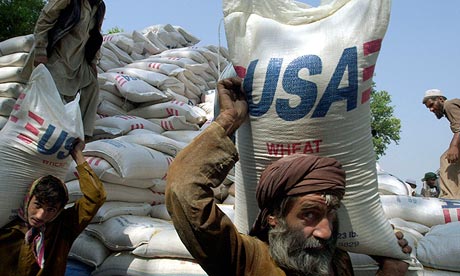
Sacks of American wheat destined for Afghanistan being unloaded in Peshawar, Pakistan.

Sacks of American wheat destined for Afghanistan being unloaded in Peshawar, Pakistan. Three firms – ADM, Cargill and Bunge – accounted for two-thirds of all US food aid last year. Photograph: Peter Dejong/AP


Two-thirds of food for the billion-dollar US food aid programme last year was bought from just three US-based multinationals.

The main beneficiaries of the programme, billed as aid to the world’s poorest countries, were the highly profitable and politically powerful companies that dominate the global grain trade: ADM, Cargill and Bunge.

The Guardian has analysed and collated for the first time details of hundreds of food aid contracts awarded by the US department of agriculture (USDA) in 2010-11 to show where the money goes.

ADM, incorporated in the tax haven state of Delaware, won nearly half by volume of all the contracts to supply food for aid and was paid nearly $300m (£190m) by the US government for it. Cargill, in most years the world’s largest private company and still majority owned by the Cargill family, was paid $96m for food aid and was the second-largest supplier, with 16% of the contracted volume. Bunge, the US-headquartered global grain trader incorporated in the tax haven of Bermuda, comes third in the list by volume, and was paid $75m to supply food aid.

Together, these three agribusinesses sold the US government 1.2m tonnes of food, or almost 70% of the total bought.

Critics of the US system of food aid have complained for years that the programme is as much about corporate welfare for American companies as helping the hungry overseas.

Eric Munoz, agriculture policy analyst for Oxfam America, said: “This new information makes it abundantly clear that it is massive multinational firms – not rural America and not farmers – that are the direct beneficiaries of the rigged rules governing the US food aid programme.

“The more the reality of who benefits from these deals is exposed to the light of transparency and open debate, the less defensible current policy becomes,” said Munoz.

A USDA spokesman defended the aid programme, however, saying it benefited 33 million people worldwide between 2009 and 2012 while supporting jobs in the US.

“Farming operations of all sizes often sell their grain or other goods to larger entities for storage and distribution (or processing in some cases), benefiting the entire value chain and US economy,” he said.

But aid experts questioned whether the programme represented value for money and was the best way of feeding hungry people in poor countries.

Rob Bailey, fellow of the UK thinktank Chatham House, said: “When you have got a process as concentrated and as uncompetitive as what the Guardian analysis reveals, you would expect taxpayers to be overpaying for the services of agribusiness.

“We know only 40 cents of every taxpayer dollar goes on food itself, the rest goes into the pockets of agribusiness and the cost of freighting.”

Legislation passed in the 1950s dictates how US food aid to foreign countries operates, with the vast majority of it tied so that it must be purchased, processed and shipped by American companies, even if there are cheaper alternatives. It is an approach to aid most other donor countries have abandoned, saying it raises prices, delays deliveries, damages developing countries’ markets, and does little to end dependence on foreign assistance.

The European Union changed its food aid policy in 1996, shifting to cash donations, while Canada fully “untied” its food aid budget in 2010 – a move that has been commended internationally, including by the OECD.

Some experts in the US would like to see a similar refocusing of American food aid. The US government’s top development official, Raj Shah, head of the US agency for international development (USAid), warned last year that his agency was “no longer satisfied with writing big checks to big contractors and calling it development”.

In January, USAid revised its purchasing rules to allow the agency to buy most goods and services from developing countries. But the bulk of US food aid, which falls under the agriculture rather than the aid budget, was not covered by these changes.

The Guardian analysis also reveals how food aid is still used to export US agricultural surpluses. The US government has said that it is no longer a surplus disposal programme and most of the commodities shipped as food aid are the major grains.

But also on the list is 80 tonnes of canned pink salmon shipped to Cambodia and Laos through a “food for education” programme, which provides food for school meals, and maternal and child nutrition projects. It was added to the list after a glut led industry groups and Alaska state officials to lobby in Washington for salmon to be added to the list of foods that were eligible.

The potato industry also hopes to raise its share of US food aid business. In 1999, the US Potato Board (USPB) launched a special initiative to get dehydrated American potatoes into the government’s overseas food aid programmes. Last year the government bought 550 metric tonnes of dehydrated Idaho potatoes for shipment to Guatemala and Guinea-Bissau.

But getting on the list of eligible commodities is just the first step. The main challenge, says the USPB, is persuading non-governmental organisations to request their products. Earlier this year, the industry body brought 11 organisations to Idaho Falls, Idaho, for a special demonstration of how “dehy” potato can be used in food aid packages.

Additional research by Nicola Hughes

Jul 072012
 

A large part of “mental illness” is depression (see article below).

Mercury is a neuro-toxin, it causes depression.   (Dentists have the highest suicide rate among the professions.)

Health insurers, employers and workers are alarmed by COSTS of mental illness. From June 28 article below:

  • The steady rise of disability claims related to mental illness in  Canada’s public service continued last year and accounted for a historic 48 per  cent of all claims filed.”
  • “. . the same problems with absenteeism exist in the private sector — where mental health claims are predicted to hit 50 per cent of all claims by  2014.”

Please see   2012-07-07 Mercury Fillings,  Letter sent to Health Insurance – – interest in reducing incidence of mental illness.

Feel free to copy, paste and make changes to the letter I sent to the companies named in the following article.  There are many more letters that could be sent!  Awareness is key to finding solutions.

= = = = = = = = = = = = = = = = = = = = = = = =

Mental illness claims continue to rise in federal public service

http://www.ottawacitizen.com/health/Mental+illness+claims+continue+rise+federal+public+service/6857321/story.html#ixzz1zyPC5cIU

By Kathryn May, Postmedia News

OTTAWA — The steady rise of disability claims related to mental illness in  Canada’s public service continued last year and accounted for a historic 48 per  cent of all claims filed.

The grim tally was to be presented to this week’s annual meeting of the  Disability Insurance Plan’s Board of Management, which was cancelled  unexpectedly.

The report comes at a time when the public service’s soaring absenteeism  rates and disability claims are under the spotlight as Treasury Board wraps up a  three-year disability management initiative and contemplates how to overhaul a  45-year-old sick leave and disability insurance plan to get sick and injured  workers back on the job faster and healthier.

On any given day, 19,000 public servants are booked off work on some kind of  sick leave. Federal employees were absent 12.5 days last year — twice the  average rate of employees in the private sector. In the core public service,  however, workers are off 18 days a year, when you include paid and unpaid sick  leave, workers’ compensation and disability.

Public servants get 15 days of sick leave a year, which they can accumulate  and carry over year to year. The value of all banked sick leave is pegged at  about $5 billion.

For the first time in years, the number of overall claims filed by public  servants in 2011 dipped slightly to 3,790. The reasons are unclear but the size  of the public service has shrunk with the government’s spending cuts and some  speculate that some workers, worried about losing their jobs in a looming  downsizing, were afraid to take time off for illness.

In the months leading up to the Conservatives’ March budget, departments also  were more aggressive in getting ill or injured employees back to work so they  knew what jobs they had vacant when it came to managing the $5.2 billion in  spending cuts and the 19,200 jobs that have to go.

The incidence of disability claims per 1,000 members also dipped slightly to  15.82 compared to more than 16 the year earlier. The incidence rate has risen  about 35 per cent since 2,000. At last count, about 11,000 public servants were  collecting disability benefits.

But the most worrisome statistic is that mental health conditions, led by  depression and anxiety, are now responsible for 48 per cent of all approved  claims. That is the highest percentage since the plan was created 45 years  ago.

Twenty years ago, mental health conditions accounted for 23.7 per cent of  approved claims and have been rising ever since. They have represented more than  40 per cent of all claims cent since 1997.

Here’s how those mental health claims broke down:

– 23 per cent of all claims are for depression;

– 6.4 per cent are for recurrent depressive disorder;

– 4.7 per cent are for adjustment disorder caused by grief or separation;

– 4.1 per cent are for anxiety;

– 2.1 per cent are for bipolar disorder;

– 1.8 per cent are for post-traumatic stress disorder.

– 5.9 per cent include acute stress reaction, chronic fatigue syndrome,  obsessive-compulsive disorder, panic disorder, schizophrenia, bulimia, anorexia,  dementia phobias and illness-related drug and alcohol use.

Nearly 70 per cent of the claims for mental health conditions have been filed  by women, a percentage that has been relatively steady since 2005. Experts offer  many reasons why women account for a higher percentage of the claims.

Bill Wilkerson, cofounder of the Global Business and Economic Roundtable on  Addiction and Mental Health, said women are diagnosed with depression four times  as often as men — but men are four times more likely to take their own lives due  to depression. Women are more liable to seek professional help than men and they  carry the burden and conflict of “role overload” in juggling demands of work,  home, child and elder care.

The disability plan, administered by Sun Life, has 241,785 members and paid  $256 million in benefits to the 11,100 public servants who are on disability.  The plan’s reserves now stand at $1.7 billion and annual premiums — mostly paid  by government — are $301 million.

The management board overseeing the disability insurance plan has long warned  the plan, close to 45 years old, is so archaic that the benefits aren’t helping  a growing number of sick and disabled public servants to get better and back to  work.

The board has raised red flags about the design of the plan, its rising  number of claims, and its governance; the plan hasn’t been updated or  re-tendered since it was awarded to Sun Life in 1970. The board is comprised of  union and government representatives and reports to Treasury Board.

It’s unclear how the government intends to revamp its sick leave and  disability plan but many said it wants to replace accumulated sick leave with a  short-term disability scheme. Treasury Board officials were supposed to brief  the board on its next steps at the meeting that was cancelled at the last  minute.

Wilkerson said the latest report is a “telltale sign” that the government’s  existing sick leave and disability management system isn’t working in today’s  epidemic of chronic and episodic illnesses. He’s a proponent of getting rid of  banked sick leave but he said the plan has to be overhauled to put more emphasis  on prevention, rehabilitation, wellness and disability case management to get  the ill and injured back to work faster.

He chastised the government for “stigmatizing” its own workforce by allowing  all the debate to focus on the large number of sick days public servants take  off rather than getting to the bottom of what’s wrong with the workplace that’s  making people sick.

Wilkerson said he worries the government is going to isolate sick leave as  the main issue and “stigmatize” its own workers to get rid of it.

He said the same problems with absenteeism exist in the private sector — where mental health claims are predicted to hit 50 per cent of all claims by  2014.

The government’s disability management initiative was supposed to get a  handle on some of these issues and lay the groundwork for a new system that  promoted prevention, rehabilitation and getting people back to work.

Until now, Treasury Board has kept the unions in the loop about reforms and  asked them to identify their biggest concerns about the way disability is  managed in government.

The unions are reluctant partners because they fear a backlash from members,  some of whom feel sick leave is an entitlement that they earn.

Public servants have few defenders these days. The government has tapped into  public sentiment that sees the public service as too big and too inefficient,  and its employees as overpaid and enjoying overly-generous benefits, as a way to  cut spending and eliminate perks.

Union leaders know there are problems. They boiled their concerns down to six  top priorities that were presented several weeks ago at a meeting of the  National Joint Council.

At the top of the list was the growing number of mental health claims and a  lack of services to get employees back to work.

Unions also reported that accumulated sick leave wasn’t working like it  should. Young or new employees can’t bank enough sick leave to cover recurring  or chronic illnesses. At same time, healthy, older workers who have backed  months of leave may be entitled to use it as leave or holidays as they head  toward retirement.

They also complained the long-term disability plan’s rehabilitation services  are inadequate and take too long to get.

Disabled employees are treated inconsistently when pressed to return to work  or resign from public service. They also don’t have a way to save for retirement  and those who try to return to work and go on the priority list are sidelined by  departments that don’t want to hire someone who has been sick.

The big question now is whether unions will continue to be part of any  overhaul the government is planning.

The government has three types of disability: Workers’ Compensation for  illness and injury related to the job; paid sick leave for non-work related  injury; and long term disability.

All told, the government has four separate plans covering nearly 352,500  employees — a long term disability plan managed by Sun Life for unionized public  servants and another run by Industrial Alliance for executives, judges, MPs,  Senators and order-in-council appointees. Great West Life manages the RCMP’s  disability plan and Manulife runs the military plan.

The government negotiates premiums with the insurers based on the expected  and current costs of claims. Public servants kick in about 15 per cent of the  premiums and the government pays the rest. The government pays 100 per cent of  the premium for executives.

© Copyright  (c) The Ottawa Citizen


Jul 062012
 

Crash just  ONE F-35  =  more than $600 million dollars down the toilet.  . . .

– – it passes for SANITY!!   . . I am laughing out loud!

” . . .  The program’s projected “life cycle cost” — including development since 1994, production of 2,443 jets and 55 years of support — increased to $1.51 trillion from $1.38 trillion in 2010, Pentagon officials told reporters March 30.  . . ” (full text below)

Do they still have 2,443 F-35’s for their $1.51 trillion?  Are some of those already crashed?  Giving the benefit of the doubt:

$ 1.51 trillion for 2,443 jets – – trillion means a million billions,  12 zeros.

SOooo . . .  each F-35 cost the American tax-payers over $600 million buckaroos  . . . $618,092,509.00 to be exact.

DO CRASHES HAPPEN?

F-35 Almost Back in Air; F-22 Still Grounded  (after crash in Alaska, pilot killed)

Published: August 10, 2011

Please click on the link:  http://defense.aol.com/2011/08/10/f-35-almost-back-in-air-f-22-still-grounded/

= = = = = = = = = = = = = = = = = = = = = = = =

Lockheed Gets Approval of Next F-35 Production Contract.

http://www.businessweek.com/news/2012-07-06/lockheed-gets-approval-of-next-f-35-production-contract

By  Tony Capaccio

Lockheed Martin Corp. (LMT) (LMT) received approval for a sixth production contract of F-35 aircraft, the Pentagon’s largest weapons program.

Undersecretary for AcquisitionFrank Kendall in a two-page Acquisition Decision Memo yesterday approved proceeding with the next contract for as many as 36 aircraft, including 23 Air Force versions, seven aircraft carrier models and six Marine Corps short-takeoff and vertical-landing models. The contract includes five for international customers.

Kendall approved a strategy that “bases aircraft procurement quantities upon development and test progress” as well as progress Lockheed Martin makes reducing the cost to retrofit aircraft to correct deficiencies uncovered in flight tests.

Shares of Lockheed Martin fell 14 cents for the day to $86.86 at the close of New York trading, after rising from $86.44 before Kendall’s approval was reported.

The steps are the latest efforts to control costs for the $395.7 billion acquisition program. The first four contracts for 63 jets are exceeding their combined target cost by $1 billion, according to congressional auditors.

“This strategy provides a means to have control on production that is informed by demonstrated performance”against this year’s program goals, Kendall wrote.

Control Strategy

Under the plan, the Pentagon F-35 program office could proceed with putting under contract 25 of the 31 U.S. planes Kendall authorized. Six wouldn’t be put on contract until the Bethesda, Maryland-based company meets at least five criteria.

“This strategy provides a means to have control — a dial– on production that is informed by demonstrated performance against the 2012 plan,” the F-35 program manager, Vice Admiral David Venlet, told the House Armed Services Committee in May, previewing the strategy Kendall approved.

It also seeks a reduction in the “concurrency,” or overlap between production and testing, that has forced retrofits when problems cropped up, he said.

Venlet said the program’s parallel development and production have resulted in aircraft retrofits that “are very real and affect schedule and cost in hardware, software, test and production.”

The overlap will decline as the program approaches the end of development in 2016, he said.

Controlling Costs

A fifth contract remains under negotiation. Kendall wrote that his decision for the sixth contract going forward was contingent on him receiving an update on a “recommended agreement” for the fifth contract.

The F-35’s total acquisition cost has increased 70 percent, to $395.7 billion in April from $233 billion in late 2001 when the development phase began. The costs are calculated in comparable, inflation-adjusted “then-year dollars.”

The program’s projected “life cycle cost” — including development since 1994, production of 2,443 jets and 55 years of support — increased to $1.51 trillion from $1.38 trillion in 2010, Pentagon officials told reporters March 30.

To contact the reporter on this story: Tony Capaccio in Washington at  acapaccio@bloomberg.net

To contact the editor responsible for this story: John Walcott at  jwalcott9@bloomberg.net

Jul 052012
 

(I am sorry, I don’t know why I didn’t record the URL’s from which the following was assembled.  Arendt’s ideas about the relationship between freedom and action appear nearer the bottom.)


Arendt’s essay  On Violence distinguishes between the concepts of violence and power. Arendt maintains that although theorists of both the left and right regard violence as an extreme manifestation of power, the two concepts are in fact antithetical. Power comes from the collective will and does not need violence to achieve any of its goals since voluntary compliance takes its place. As governments start losing their legitimacy, violence becomes an artificial means towards the same ends and is therefore found only in the absence of Power. Bureaucracies then become the ideal birthplaces of violence since they are defined as the “rule by no-one”, with whom to argue against and therefore re-create the missing link with the people it rules over.  . . .

Banality of evil is a phrase coined by Hannah Arendt and incorporated in the title of her 1963 work Eichmann in Jerusalem: A Report on the Banality of Evil.[1] It describes the thesis that the great evils in history generally, and the Holocaust in particular, were not executed by fanatics or sociopaths, but rather by ordinary people who accepted the premises of their state and therefore participated with the view that their actions were normal.

Explaining this phenomenon, Edward S. Herman has emphasized the importance of “normalizing the unthinkable.” According to him, “doing terrible things in an organized and systematic way rests on ‘normalization.’ This is the process whereby ugly, degrading, murderous, and unspeakable acts become routine and are accepted as ‘the way things are done.'”[2]

Criticism

Reicher and Haslam have challenged Arendt’s idea of the banality of evil. They agree that ordinary people can commit evil actions, but they assert that it is not simply a matter of “blind people following orders.” They point to historical and psychological evidence that suggest that ordinary people become evil when they identify with evil ideology.[3]

They cite Cesarani‘s Eichmann: His Life and Crimes, as “suggesting that Arendt’s analysis was, at best, naive.” In his work, Cesarani claims Arendt only attended the beginning of Eichmann’s trial and missed the defendant’s more revealing admissions. The author recalls that Eichmann spoke proudly of the creative measures with which he executed Hitler’s policy. To Cesarani, this was indicative of an active involvement in evil, not just a passive following of orders.[3]

Reicher and Haslam have also reinterpreted the findings of a number of landmark psychological cases, including Milgram‘s obedience studies and Zimbardo‘s Stanford prison experiment to conclude that people follow ideology, not just orders.[3] They have proposed a number of factors that can be used to explain how people become swayed by evil ideology. These factors include:

  • individual differences (not everyone will choose to commit evil)
  • crisis or group failures (people are most vulnerable under a crisis or when a social group they belong to falls apart)
  • leadership (people require a strong leader to encourage them to commit evil).[3]

Reicher and Haslam admit these are just some of the factors involved and that more research needs to be done. In part, they blame the popularity of Arendt’s banality of evil for handcuffing research for so long.[3]   .. . .

– – – – –  – – – – – – – – –

http://www.iep.utm.edu/arendt/For Arendt, the popular appeal of totalitarian ideologies with their capacity to mobilize populations to do their bidding, rested upon the devastation of ordered and stable contexts in which people once lived. The impact of the First World War, and the Great Depression, and the spread of revolutionary unrest, left people open to the promulgation of a single, clear and unambiguous idea that would allocate responsibility for woes, and indicate a clear path that would secure the future against insecurity and danger. Totalitarian ideologies offered just such answers, purporting discovered a “key to history” with which events of the past and present could be explained, and the future secured by doing history’s or nature’s bidding. Accordingly the amenability of European populations to totalitarian ideas was the consequence of a series of pathologies that had eroded the public or political realm as a space of liberty and freedom. These pathologies included the expansionism of imperialist capital with its administrative management of colonial suppression, and the usurpation of the state by the bourgeoisie as an instrument by which to further its own sectional interests. This in turn led to the delegitimation of political institutions, and the atrophy of the principles of citizenship and deliberative consensus that had been the heart of the democratic political enterprise. The rise of totalitarianism was thus to be understood in light of the accumulation of pathologies that had undermined the conditions of possibility for a viable public life that could unite citizens, while simultaneously preserving their liberty and uniqueness (a condition that Arendt referred to as “plurality”).

In this early work, it is possible to discern a number of the recurrent themes that would organize Arendt’s political writings throughout her life. For example, the inquiry into the conditions of possibility for a humane and democratic public life, the historical, social and economic forces that had come to threaten it, the conflictual relationship between private interests and the public good, the impact of intensified cycles of production and consumption that destabilized the common world context of human life, and so on.

. . .   The prioritization of the economic which has attended the rise of capitalism has for Arendt all but eclipsed the possibilities of meaningful political agency and the pursuit of higher ends which should be the proper concern of public life.

. . .   The activity of labor and the consumption of its fruits, which have come to dominate the public sphere, cannot furnish a common world within which humans might pursue their higher ends. Labor and its effects are inherently impermanent and perishable, exhausted as they are consumed, and so do not possess the qualities of quasi-permanence which are necessary for a shared environment and common heritage which endures between people and across time. In industrial modernity “all the values characteristic of the world of fabrication – permanence, stability, durability…are sacrificed in favor of the values of life, productivity and abundance.” The rise of animal laborans threatens the extinction of homo faber, and with it comes the passing of those worldly conditions which make a community’s collective and public life possible (what Arendt refers to as “world alienation”).

. . .

The fundamental defining quality of action is its ineliminable freedom, its status as an end in itself and so as subordinate to nothing outside itself. Arendt argues that it is a mistake to take freedom to be primarily an inner, contemplative or private phenomenon, for it is in fact active, worldly and public. Our sense of an inner freedom is derivative upon first having experienced “a condition of being free as a tangible worldly reality. We first become aware of freedom or its opposite in our intercourse with others, not in the intercourse with ourselves.” In defining action as freedom, and freedom as action, we can see the decisive influence of Augustine upon Arendt’s thought. From Augustine’s political philosophy she takes the theme of human action as beginning:

To act, in its most general sense, means to take initiative, to begin (as the Greek word archein, ‘to begin,’ ‘to lead,’ and eventually ‘to rule’ indicates), to set something in motion. Because they are initium, newcomers and beginners by virtue of birth, men take initiative, are prompted into action.

And further, that freedom is to be seen:

as a character of human existence in the world. Man does not so much possess freedom as he, or better his coming into the world, is equated with the appearance of freedom in the universe; man is free because he is a beginning…

In short, humanity represents/articulates/embodies the faculty of beginning. It follows from this equation of freedom, action and beginning that freedom is “an accessory of doing and acting;” “Men are free…as long as they act, neither before nor after; for to be free and to act are the same.” This capacity for initiation gives actions the character of singularity and uniqueness, as “it is in the nature of beginning that something new is started which cannot be expected from whatever happened before.” So, intrinsic to the human capacity for action is the introduction of genuine novelty, the unexpected, unanticipated and unpredictable into the world:

The new always happens against the overwhelming odds of statistical laws and their probability, which for all practical, everyday purposes amounts to certainty; the new therefore always appears in the guise of a miracle.

This “miraculous,” initiatory quality distinguishes genuine action from mere behavior i.e. from conduct which has an habituated, regulated, automated character; behavior falls under the determinations of process, is thoroughly conditioned by causal antecedents, and so is essentially unfree. The definition of human action in terms of freedom and novelty places it outside the realm of necessity or predictability. Herein lies the basis of Arendt’s quarrel with Hegel and Marx, for to define politics or the unfolding of history in terms of any teleology or immanent or objective process is to deny what is central to authentic human action, namely, its capacity to initiate the wholly new, unanticipated, unexpected, unconditioned by the laws of cause and effect.

. . . .

Arendt’s theory holds that actions cannot be justified for their own sake, but only in light of their public recognition and the shared rules of a political community. For Arendt, action is a public category, a worldly practice that is experienced in our intercourse with others, and so is a practice that “both presupposes and can be actualized only in a human polity.” As Arendt puts it:

Action, the only activity that goes on directly between men…corresponds to the human condition of plurality, to the fact that men, not Man, live on the earth and inhabit the world. While all aspects of the human condition are somehow related to politics, this plurality is specifically the condition – not only the conditio sine qua non, but the conditio per quam – of all political life .

Another way of understanding the importance of publicity and plurality for action is to appreciate that action would be meaningless unless there were others present to see it and so give meaning to it. The meaning of the action and the identity of the actor can only be established in the context of human plurality, the presence others sufficiently like ourselves both to understand us and recognize the uniqueness of ourselves and our acts. This communicative and disclosive quality of action is clear in the way that Arendt connects action most centrally to speech. It is through action as speech that individuals come to disclose their distinctive identity: “Action is the public disclosure of the agent in the speech deed.” Action of this character requires a public space in which it can be realized, a context in which individuals can encounter one another as members of a community. For this space, as for much else, Arendt turns to the ancients, holding up the Athenian polis as the model for such a space of communicative and disclosive speech deeds. Such action is for Arendt synonymous with the political; politics is the ongoing activity of citizens coming together so as to exercise their capacity for agency, to conduct their lives together by means of free speech and persuasion. Politics and the exercise of freedom-as-action are one and the same:

freedom…is actually the reason that men live together in political organisations at all. Without it, political life as such would be meaningless. The raison d’être of politics is freedom, and its field of experience is action.

. . . Arendt sees both the French and American revolutions as ultimately failing to establish a perduring political space in which the on-going activities of shared deliberation, decision and coordinated action could be exercised. In the case of the French Revolution, the subordination of political freedom to matters of managing welfare (the “social question”) reduces political institutions to administering the distribution of goods and resources (matters that belong properly in the oikos, dealing as they do with the production and reproduction of human existence). Meanwhile, the American Revolution evaded this fate, and by means of the Constitution managed to found a political society on the basis of comment assent. Yet she saw it only as a partial and limited success. America failed to create an institutional space in which citizens could participate in government, in which they could exercise in common those capacities of free expression, persuasion and judgement that defined political existence. The average citizen, while protected from arbitrary exercise of authority by constitutional checks and balances, was no longer a participant “in judgement and authority,” and so became denied the possibility of exercising his/her political capacities.

. . .

She controversially uses the phrase “the banality of evil” to characterize Eichmann’s actions as a member of the Nazi regime, in particular his role as chief architect and executioner of Hitler’s genocidal “final solution” (Endlosung) for the “Jewish problem.” Her characterization of these actions, so obscene in their nature and consequences, as “banal” is not meant to position them as workaday. Rather it is meant to contest the prevalent depictions of the Nazi’s inexplicable atrocities as having emanated from a malevolent will to do evil, a delight in murder. As far as Arendt could discern, Eichmann came to his willing involvement with the program of genocide through a failure or absence of the faculties of sound thinking and judgement. From Eichmann’s trial in Jerusalem (where he had been brought after Israeli agents found him in hiding in Argentina), Arendt concluded that far from exhibiting a malevolent hatred of Jews which could have accounted psychologically for his participation in the Holocaust, Eichmann was an utterly innocuous individual. He operated unthinkingly, following orders, efficiently carrying them out, with no consideration of their effects upon those he targeted. The human dimension of these activities were not entertained, so the extermination of the Jews became indistinguishable from any other bureaucratically assigned and discharged responsibility for Eichmann and his cohorts.

. . . .t concluded that Eichmann was constitutively incapable of exercising the kind of judgement that would have made his victims’ suffering real or apparent for him. It was not the presence of hatred that enabled Eichmann to perpetrate the genocide, but the absence of the imaginative capacities that would have made the human and moral dimensions of his activities tangible for him. Eichmann failed to exercise his capacity of thinking, of having an internal dialogue with himself, which would have permitted self-awareness of the evil nature of his deeds. This amounted to a failure to use self-reflection as a basis forjudgement, the faculty that would have required Eichmann to exercise his imagination so as to contemplate the nature of his deeds from the experiential standpoint of his victims. This connection between the complicity with political evil and the failure of thinking and judgement inspired the last phase of Arendt’s work, which sought to explicate the nature of these faculties and their constitutive role for politically and morally responsible choices.

. . .  Understanding yields positive knowledge – it is the quest for knowable truths. Reason or thinking, on the other hand, drives us beyond knowledge, persistently posing questions that cannot be answered from the standpoint of knowledge, but which we nonetheless cannot refrain from asking. For Arendt, thinking amounts to a quest to understand the meaning of our world, the ceaseless and restless activity of questioning that which we encounter. The value of thinking is not that it yields positive results that can be considered settled, but that it constantly returns to question again and again the meaning that we give to experiences, actions and circumstances. This, for Arendt, is intrinsic to the exercise of political responsibility – the engagement of this faculty that seeks meaning through a relentless questioning (including self-questioning). It was precisely the failure of this capacity that characterized the “banality” of Eichmann’s propensity to participate in political evil.

. . .

Her theory of judgement is widely considered as one of the most original parts of her oeuvre, and certainly one of the most influential in recent years.Arendt’s concern with political judgement, and its crisis in the modern era, is a recurrent theme in her work. As noted earlier, Arendt bemoans the “world alienation” that characterizes the modern era, the destruction of a stable institutional and experiential world that could provide a stable context in which humans could organize their collective existence. Moreover, it will be recalled that in human action Arendt recognizes (for good or ill) the capacity to bring the new, unexpected, and unanticipated into the world. This quality of action means that it constantly threatens to defy or exceed our existing categories of understanding or judgement; precedents and rules cannot help us judge properly what is unprecedented and new. So for Arendt, our categories and standards of thought are always beset by their potential inadequacy with respect to that which they are called upon to judge. However, this aporia of judgement reaches a crisis point in the 20th century under the repeated impact of its monstrous and unprecedented events. The mass destruction of two World Wars, the development of technologies which threaten global annihilation, the rise of totalitarianism, and the murder of millions in the Nazi death camps and Stalin’s purges have effectively exploded our existing standards for moral and political judgement. Tradition lies in shattered fragments around us and “the very framework within which understanding and judging could arise is gone.” The shared bases of understanding, handed down to us in our tradition, seem irretrievably lost. Arendt confronts the question: on what basis can one judge the unprecedented, the incredible, the monstrous which defies our established understandings and experiences? If we are to judge at all, it must now be “without preconceived categories and…without the set of customary rules which is morality;” it must be “thinking without a banister.” In order to secure the possibility of such judgement Arendt must establish that there in fact exists “an independent human faculty, unsupported by law and public opinion, that judges anew in full spontaneity every deed and intent whenever the occasion arises.” This for Arendt comes to represent “one of the central moral questions of all time, namely…the nature and function of human judgement.” It is with this goal and this question in mind that the work of Arendt’s final years converges on the “unwritten political philosophy” of Kant’s Critique of Judgement.

. . .  Kant requires us to judge from this common standpoint, on the basis of what we share with all others, by setting aside our own egocentric and private concerns or interests. The faculty of reflective judgement requires us to set aside considerations which are purely private (matters of personal liking and private interest) and instead judge from the perspective of what we share in common with others (i.e. must bedisinterested). Arendt places great weight upon this notion of a faculty of judgement that “thinks from the standpoint of everyone else.” This “broadened way of thinking” or “enlarged mentality” enables us to “compare our judgement not so much with the actual as rather with the merely possible judgement of others, and [thus] put ourselves in the position of everybody else…” For Arendt, this “representative thinking” is made possible by the exercise of the imagination – as Arendt beautifully puts it, “To think with an enlarged mentality means that one trains one’s imagination to go visiting.” “Going visiting” in this way enables us to make individual, particular acts of judgement which can nevertheless claim a public validity. In this faculty, Arendt find a basis upon which a disinterested and publicly-minded form of political judgement could subvene, yet be capable of tackling the unprecedented circumstances and choices that the modern era confronts us with.

. . .  Particularly important is the way in which Arendt comes to understand power, namely as “the capacity to agree in uncoerced communication on some community action.” Her model of action as public, communicative, persuasive and consensual reappears in Habermas’ thought in concepts such as that of “communicative power” which comes about whenever members of a life-world act in concert via the medium of language.

Jul 052012
 

This took place in 2009.  I didn’t get it posted earlier.  It is an important part of the historical record.  It is why Canadians should refuse to pay for Lockheed Martin and Stephen Harper’s F-35 stealth bombers.

http://www.youtube.com/watch?v=B6hp8HMstkE&feature=related

Powerful testimony

Number of views, July 5, 2012:  958,238

Jul 052012
 

http://www.parl.gc.ca/About/Parliament/LegislativeSummaries/bills_ls.asp?lang=E&ls=c60&Parl=40&Ses=2&source=library_prb

Contents

Background

Bill C-60, An Act to implement the Framework Agreement on Integrated Cross-Border Maritime Law Enforcement Operations between the Government of Canada and the Government of the United States of America (short title: Keeping Canadians Safe [Protecting Borders] Act), was introduced in the House of Commons on 27 November 2009. Public Safety Canada, the department responsible for the bill, in a statement released the day the bill received first reading, cites the Minister of Justice, the Honourable Rob Nicholson, as saying:

This proposed legislation is a new approach to border law enforcement. With its accompanying regulatory changes, the proposed legislation provides a proper legal framework and ensures effective integrated law enforcement operations can occur in boundary waters.(1)

A. “Shiprider” Agreement

Bill C-60 implements the Framework Agreement on Integrated Cross-Border Maritime Law Enforcement Operations between the Government of Canada and the Government of the United States of America, which was signed on 26 May 2009. The agreement was signed by the Canadian Minister of Public Safety, Peter Van Loan, and the US Department of Homeland Security Secretary, Janet Napolitano.

The agreement makes permanent a joint Canada–US pilot program – referred to as “Shiprider” – which was created in 2005 to address security concerns along the maritime border. Shiprider enabled armed officers from the United States Coast Guard and the Royal Canadian Mounted Police to jointly patrol shared waterways and to continue to easily pursue suspects from one country to the other. Furthermore, it allowed each government to confer upon the other country’s participating law enforcement officers the authority of peace officers in order to facilitate the enforcement of their respective laws across the international border.

Shiprider was initially based out of the Windsor/Detroit Integrated Border Enforcement Team (IBET) station. Although the IBET concept of cross-border law enforcement cooperation dates back to the mid-1990s, it was only after 2001 that Canada and the United States formally committed to setting up a series of IBETs as part of their joint management of the Canada–US border. The IBET program targets regions between the various ports of entry along the border and comprises the following core agencies: Royal Canadian Mounted Police, Canada Border Services Agency, the US Coast Guard, the US Customs and Border Protection/Office of the Border Patrol and the US Joint Task Force–North.(2)  Shiprider was therefore an extension of the IBET program.

In 2007 Shiprider was expanded to other areas along the Canada–US maritime border to include areas along the British Columbia and Washington state border. Finally, in 2008, based on the success of Shiprider, the governments of Canada and the United States announced their intention to negotiate a framework for a more permanent, joint maritime law enforcement program. This led to the signing of the Canada–US Framework Agreement on Integrated Cross-Border Maritime Law Enforcement Operations in May 2009.

The purpose of the agreement is to provide the parties with additional means in shared waterways to prevent, detect, suppress, investigate and prosecute criminal offences or violations of law, including, but not limited to, illicit drug trade, migrant smuggling, trafficking of firearms, the smuggling of counterfeit goods and money, and terrorism.(3)  The Integrated Cross-Border Maritime Law Enforcement operations under the agreement are to be intelligence-drive, based on joint Canada–US threat and risk assessment and coordinated with existing cooperative cross-border policing programs and activities.

In order for the agreement to be brought into force, both Canada and the United States must complete internal processes after signing the international agreement. In Canada, this requires that implementing legislation be introduced in the House of Commons and be passed by the House of Commons and the Senate. While the United States does not require similar implementing legislation, the US government is in the final stages of completing its own internal procedures to incorporate the agreement into national law and bring it into force.

Description and Analysis

A. Definitions, Purpose and General Provisions (Clauses 2 to 4)

Clause 2 of the bill sets out definitions for the key terms and concepts used in the proposed legislation. For the purposes of this summary, a few definitions are worth noting. First, the “Commission” referred to in the bill is the Royal Canadian Mounted Police Public Complaints Commission established by section 45.29 of the Royal Canadian Mounted Police Act.(4) The term “designated officer” refers to an individual who is appointed as a cross-border maritime law enforcement officer by Canada or by the United States. “Integrated cross-border operation” refers to the deployment of a vessel crewed jointly by designated officers from Canada and the United States for cross-border law enforcement purposes in undisputed areas of the sea or internal waters along the Canada–US border. Finally, references to the “Minister” are to the minister of Public Safety and Emergency Preparedness.

Clause 3 states the purposes of the Act, which are to implement the Canada–US Framework Agreement on Integrated Cross-Border Maritime Law Enforcement Operations and its objectives. These objectives, as described above, are to provide additional means to prevent, detect and suppress criminal offences and violations of the law in undisputed areas of the sea or internal waters along the border of Canada and the United States and to facilitate the investigation and prosecution of the offences.

Clause 4 of the bill establishes the underlying principles for the agreement and the proposed Act. It states that Canada and the United States recognize that they have a common interest in the security of the undisputed areas of the sea or internal waters on the border between the two countries. It recognizes that integrated cross-border operations must respect the sovereignty of each state and that operations must be intelligence-drive, based on threat and risk assessments, and conducted in accordance with the rule of law. It further stresses that in Canada, all integrated cross-border operations must be conducted in accordance with the Canadian Charter of Rights and Freedoms.

B. General Implementing Provisions (Clauses 5 to 15)

Clauses 5 to 7 of Bill C-60 deal with the creation of the Central Authority for Canada, the body in charge of coordinating the implementation of the agreement as mandated in Article 5 of the agreement. In Canada, the Central Authority has been designated as the Commissioner of the Royal Canadian Mounted Police, or his or her delegate. The Central Authority is responsible for the direction and management of integrated cross-border operations and can appoint cross-border maritime law enforcement officers.

Clauses 7 to 10 set out the requirements for the appointment of a designated officer, an individual appointed as a cross-border maritime law enforcement officer. An individual may be appointed by the Central Authority only if he or she has satisfactorily completed the required training program for appointment as a designated officer. Article 7 of the agreement requires that the Central Authorities of Canada and the United States coordinate the development of and approve a joint training program for designated officers that includes training in the applicable laws, regulations, constitutional considerations and policies of both parties, including the use of force and operational procedures.

Clause 11 provides that in the course of an integrated cross-border operation, every designated officer is considered to be a peace officer in Canada, and therefore has the same power to enforce laws as a member of the Royal Canadian Mounted Police.

Clauses 12 and 13 clarify that the laws of Canada apply to any person detained or taken into custody within Canada as well as to any vessel or other “thing” seized within Canada in the course of an integrated cross-border operation. Furthermore, no person detained or vessel or thing seized may be removed from Canada except in accordance with Canadian laws.

Clause 14 provides that where a vessel or other “thing” is seized in the United States but is brought into Canada out of operational or geographic necessity, the vessel or other thing remains in the custody and control of the American designated officer.

Clause 15 of the bill states that no Act of Parliament relating to the import or export of goods applies to the import or export of vessels or other “things” as set out in the bill.

C. Public Complaints Commission Provisions (Clauses 16 to 25)

Clauses 16 to 24 establish a public complaints commission, the Royal Canadian Mounted Police Complaints Commission, and sets out the procedures for any member of the public to make a complaint concerning the conduct of a designated officer in the performance of any duty or function in the course of an integrated cross-border operation. The creation of this commission is mandated under Article 11 of the agreement, which states that there shall be a mechanism to hold designated officers accountable for their conduct.

Under the complaint procedure, the Central Authority must be notified of all complaints received by the commission relating to activities of the designated officers. The Central Authority must consider whether a complaint can be disposed of through an informal process and may attempt to do so, with the consent of the parties involved. Although the Central Authority is obliged to consider the possibility of an informal resolution process, the use of the term “may” indicates that the Central Authority has a degree of discretion in its decision whether to proceed with an informal process. If the complaint cannot be disposed of informally, the Central Authority must refer the complaint to the commission for review.

The commission chairman must review every complaint referred to the commission and may subsequently submit a report with findings and recommendations to the minister and the Central Authority, investigate the complaint or institute a hearing to inquire into the complaint, if it is advisable in the public interest. The commission chairman may also initiate his or her own complaint into the conduct of a designated officer if the chairman is satisfied that there are reasonable grounds for an investigation. Furthermore, the commission has, in relation to the complaints before it, the powers conferred on a board of inquiry by sections 24.1(3)(a) to (c) of the Royal Canadian Mounted Police Act)(5)

Clause 25 of the bill provides that the Central Authority must maintain a record of all complaints it receives under the Act and make that record available to the commission upon request.

D. Consequential Amendments to Statutes (Clauses 26 to 32)

Bill C-60 contains amendments that, as a consequence of the proposed legislation, must be made to a number of existing pieces of legislation, namely the Criminal Code, the Customs Act, the Export and Import Permits Act, the Immigration and Refugee Protection Act and the Royal Canadian Mounted Police Act. In particular, clauses 26 to 32 make amendments to various statutes as a result of the creation of the designated officers and the enhanced powers of the Royal Canadian Mounted Police Commission to review the conduct of designated officers.

E. Coming into Force (Clause 33)

The provisions of Bill C-60 come into force on a day or days to be fixed by order of the Governor in Council.

Notes

*  Notice: For clarity of exposition, the legislative proposals set out in the bill described in this Legislative Summary are stated as if they had already been adopted or were in force. It is important to note, however, that bills may be amended during their consideration by the House of Commons and Senate, and have no force or effect unless and until they are passed by both houses of Parliament, receive Royal Assent, and come into force.

  1. Public Safety Canada, “Government of Canada introduces legislation to fight cross-border crime in shared waterways,”News release, Ottawa, 27 November 2009.
  2. Royal Canadian Mounted Police, “Canada-United States IBET Threat Assessment 2007,” 27 May 2008.
  3. Framework Agreement on Integrated Cross-Border Maritime Law Enforcement Operations between the Government of Canada and the Government of the United States of America, pdf (38 Kb, 17 pages) 26 May 2009, Article 1.
  4. Royal Canadian Mounted Police Act [RCMP Act], R.S.C., 1985, c. R-10.
  5. RCMP Act, ss. 24.1(3)(a)–(c), states:

    (3) A board of inquiry has, in relation to the matter before it, power

    (a) to summon any person before the board and to require that person to give oral or written evidence on oath and to produce such documents and things under that person’s control as the board deems requisite to the full investigation and consideration of that matter;

    (b) to administer oaths;

    (c) to receive and accept on oath or by affidavit such evidence and other information as the board sees fit, whether or not such evidence or information is or would be admissible in a court of law.

Jul 032012
 

Also the Yes Men, see:  http://sandrafinley.ca/?p=6218

CONTENTS

(1)    THE YES MEN FIX THE WORLD

(2)   A HUFFY CANADA SHUTS DOWN ‘YES MEN’

= = = = = = = = = = = = = = =

(1)    THE YES MEN FIX THE WORLD

In my estimation Andy Bichlbaum and Mike Bonnano are low-key brilliant and this is a brilliant movie.

Not only that, I couldn’t help myself from laughing out loud in some parts.

I left the theatre feeling happy inside because the people in this world are awesome.    /Sandra

(The web address is no good – – has been taken over.  It is not the Yes Men,   http://theyesmenfixtheworld.com/)

The movie is playing at the Broadway Theatre (Saskatoon):

THE YES MEN FIX THE WORLD

2009 * USA * Dir: Bichlbaum & Bonanno * 97 min * Rated PG

7 pm: Apr 9, 11, 15

9 pm: Apr 8, 10, 12, 14

Andy Bichlbaum and Mike Bonnano engage in a series of stunts to underscore the crimes and misdemeanors of contemporary corporations.

Even if the Yes Men don’t fix the world, they certainly give it something to think about.  (Mike Scott, Times-Picayune)

= = = = = == =  == = = = = = =

(2)    A HUFFY CANADA SHUTS DOWN ‘YES MEN’

http://blog.seattlepi.com/seattlepolitics/archives/189467.asp

A huffy Canada shuts down ‘Yes Men’

Stung by a satire at the Copenhagen climate conference, Canada’s government has shut down two parody Web sites criticizing the Great White North’s glacial policy on global warming.

In the process, however, it has taken down 4,500 other Web sites that had nothing to do with the prank played two weeks ago at the global climate summit.

The two “offending” sites, developed by “Yes Men” pranksters, announced that Canada would reduce greenhouse gas emissions in 2020 40 percent from 1990 levels, and 80 percent by the year 2050.

The “announcement” came as Prime Minister Stephen Harper’s government was privately circulating a plan to permit a 165 percent INCREASE in emissions from Alberta’s huge, dirty oil sands project.

The two Web sites, (Links no longer valid)  “enviro-canada.ca” and “ec-gc.ca” are “directly connected to a hoax which misleads people into believing that the Government of Canada will take certain actions in relation to environmental matters,” Mike Landreville from Environment Canada wrote in an e-mail to the German Internet Service Provider (ISP) Serveloft.

“We trust you appreciate the importance of avoiding confusion among the public concerning Canadian governmental affairs and that you will assist us in preventing this hoax from spreading further.”

Going further, Landreville asked the ISP to “make every effort to prevent any further attempts concerning other environment-related domains (enviro, ec-gc, etc.) originating from your servers.”

The Great White North carries weight with ISP.

Serverloft immediately turned off a wide block of provider addresses, knocking out 4,500 websites that had nothing to do with “Yes Men” or the parody that raises such hackles among Harper’s minions.

“We are sorry to see that the Canadian government will not ‘take certain actions’ that could help stave off catastrophic climate change,” said Mike Bonanno of “Yes Men,” “and we are sorry to see that they don’t care so much for free speech.”

The “Yes Men” made international headlines with the parody. The hoax emission target was announced on official-looking Environment Canada stationary. A replica of the United Nations conference center podium to show “delegate” from Uganda praising the plan.

It was the second successful parody this year for the loosely knit group. “Yes Men” had staged a fake news conference at the National Press Club in Washington, D.C. A “spokesman” for the U.S. Chamber of Commerce announced that the chamber was ending its years-long lobbying campaign against climate legislation.

The hoax was revealed when an official from the real U.S. Chamber of Commerce showed up and got into a shouting match with the imposter.

The Canadian government reacted to the parody in Copenhagen by throwing a public tantrum.

An aide to Harper sent Canadian newspapers a furious denunciation of what he called “a childish prank,” and was filmed furiously (and falsely) accusing a leading Quebec environmentalist of being behind it.

On the same night, however, CBC News revealed a paper circulating in Harper’s cabinet. It listed a much lower emissions reduction target, and plans to go easy on Canada’s oil and gas industry.

A trio of Canadian provincial premiers – most notably Quebec Premier Jean Charest – excoriated the federal government for its weak environmental politicies.

The Climate Action Network, a global coalition of “green” groups, awarded Canada its “Colossal Fossil” prize for worst behavior in the Copenhagen negotiations.

Jun 282012
 

Is there a bigger “David versus Goliath” story than

  • Julian Assange (Wikileaks)  versus
  • the American Military Empire?

What a cliff-hanger!  Will he be extradited to Sweden, or will Ecuador come through?

For Assange, it is the difference between death and life (the Swedes will turn him over to the Americans.  Ecuador, into whose custody he masterfully escaped, will hopefully grant him asylum.)

For democracy it is life or death.  Citizen in every would-be democracy, let’s celebrate his work!

The most recent developments:

History in the making.  For a complete listing of the Assange postings, click on Julian Assange, Wikileaks, and scroll down.

– – – – – – – – – – – – – – – – – – – – – – – – – – –

Amy GoodmanDemocracy Now, 2011 interview with Julian Assange (Wikileaks) and Slavoj Žižek:

“ Information is a matter of life and death. We’ve learned that through these remarkable trove of documents (INSERT: documents leaked through Wikileaks) that have been released in the last year. The Iraq War Logs, the Afghanistan War Logs, and what’s been called Cablegate, the U.S. State Department documents that are continuing to be released.   Why does it matter so much? . . .

Why DOES it matter so much?

Assange asserts that freedom of speech is not the jewel in democracy, so much as the freedom to communicate our ideas with each other.  (WikiLeaks’ Julian Assange & Philosopher Slavoj Žižek, interview by Amy Goodman, Democracy Now! .) He talks about the importance of an accurate societal record of what’s happening; that societal record (independent, accurate journalism) is a driving force for him.

Slavoj Žižek introduces the idea of “public reason”, the independent space of communication and debate.  I think of it in relation to our ability to make intelligent decisions for the society in which we live.  If public reason is not carried out in an independent space (free of undue influence), we will make lousy decisions, or lousy decisions will be made for us!

But again, Why does it matter? . . .

What if no one knew, about “what’s happening” to Julian Assange and why?  Are you hearing it in the media?  . . .  Try these additional two examples:

  1. 2012-05-11 Historic judgment: (Charge #2) Bush & Associates found Guilty of torture, Kuala Lumpur.

Would some people act differently if they didn’t know that even a former U.S. President will be held accountable for war crimes?

It’s not only the small players like Bosnian Serb general, Ratko Mladic, or al-Bashir from Sudan, or a general from Sierra Leone that will be put on trial.  It is also George Bush and his pals, eventually.  If we were in the dark, we would not be in a position to help.

And what if we didn’t know WHO is assuming responsibility?  Changing roles in the world, empowerment.

One of the major forces behind the efforts to bring Bush and Company to justice is “part of an initiative by former Malaysian premier Mahathir Mohamad” who stated simply:

Unlawful use of force threatens the world to return to a state of lawlessness.

The acts of the accused (Bush and Co.) were unlawful.”

It’s a group of international people, with leadership in Kuala Lumpur, who decided that they had to play their part to defend justice for all.  Their position is well documented:   Historic judgment: (Charge #2)  Bush & Associates found Guilty of torture, Kuala Lumpur.

For newcomers: there’s a long list of people working to ensure the arrest of Bush – see Arrest George Bush. Rule of Law essential to democracy.

Another point made in the Amy Goodman interview with Assange and Žižek:  the ordinariness of people who just decide to do something.

2.  Click on this short video:  Julia Bacha: Pay attention to nonviolence (from TED.com – Ideas worth spreading)

“. . I believe that what’s mostly missing for non-violence to grow is not for Palestinians to START adopting non-violence, but for us to start paying attention to those who already are . . “.

(I relate this to Julian Assange’s statement of society’s need to record and communicate what is happening in the real world.  . . .  If we don’t know . .?!)

Slavoj Žižek, in the interview with Goodman says:

(the “he” referred to is Sgt Bradley Manning who is alleged to have leaked the documents to Wikileaks),

“ . . There are many examples that I know of ordinary people who are not anything special, they are not saints. But all of a sudden, they see something, like probably he, if he is the one, saw all these documents, and something told him, “Sorry, I will not be pushed more. I have to do something here.”

This is so precious today, because it also goes against a note which is in a way true, but it’s exploited by our enemies, this idea ideology today is cynical, people are totally duped, and so on. No, they are not. I prefer her to play a little bit of simple moralism.

From time to time, there are ethical miracles. There are people who still care, and so on and so on. This is very important because, you know, like, let’s not leave this domain of a care for simple, dignified, ethical acts to agencies like Catholic Church and so on. Who are they to talk about it? We . . . should rehabilitate this-I know it doesn’t sound very postmodern or cynical-this idea that there are out there quite ordinary guys, nothing special, but who all of a sudden, as if in a miracle, do something wonderful. That’s almost, I would say, our only hope today.”

Julia Bacha is a quite ordinary person (maybe!) who did something wonderful!  What if the villagers’ story wasn’t told, in their communities?

= = = = = = = =  = = = = = = = = = = = = =

The examples

  • Julian Assange
  • Mahathir Mohamad
  • Julia Bacha
  • tonnes of other such people

find Canadians looking at actions of

  • the U.K.  (in relation to Assange)  (did their Supreme Court uphold the rule of law?)
  • Sweden  (how credible is their position on Assange, in whose interests, and with what intent?)
  • the U.S.A. (look at the actions of the American military in Iraq, Afghanistan, Pakistan, etc.  Sgt Bradley Manning is alleged to have leaked documents to Wikileaks, bringing light to the darkness.  If time permits sometime I would like to post what has happened to him at the hands of the military beasts.  Manning is an incredible hero.  I wonder how the historical record will read.)
  • Ecuador (how is it that Ecuador can stand up to the U.S. and Canada can’t?)
  • Malaysia  (Bush found guilty) and
  • Palestine  (Julia Bacha)

Maybe our stereotypes are challenged, because “what’s happening” hasn’t been communicated to us.

TURN THE TABLES:

What are Ecuadorans, Malayans and Palestinians being told about what’s going on in Canada?

Indeed, what are we being told about what’s going on in Canada?   . . .

There’s lots of really good things happening.  We just have to communicate it!  Democracy Now!

ROMEO DALLAIRE SOCKS IT TO THEM!  God bless Senator Romeo Dallaire – his speech against Bill S-10, cluster bombs

Or, how about this?  short  Animation:  Enbridge spills it out

And robo-call updates:

Is it:


Happy Canada Day!

Jun 282012
 

Julian Assange Julian Assange’s Wikileaks
published leaked diplomatic cables

Related Stories:

Wikileaks founder Julian Assange has been served with an extradition notice by the Metropolitan Police.

Officers from the extradition unit delivered a note to Mr Assange at Ecuador’s London embassy.

Mr Assange took refuge there last week and is seeking diplomatic asylum to  prevent being sent to Sweden where he is accused of rape and assault.

Scotland Yard said the notice required a 40-year-old man to attend a police station “at a time of our choosing”.

‘Standard procedure’

The Wikileaks website published a mass of leaked diplomatic cables that embarrassed several governments and international businesses.

Mr Assange fears that if he is sent to Sweden he could be sent on to the United States to face charges over Wikileaks and that he could face the death  penalty.

In a brief statement to the BBC, Scotland Yard said: “This is standard procedure in extradition cases and is the first step in the removal process.

“He remains in breach of his bail conditions and failure to surrender would be a further breach of those conditions and he is liable to arrest.”

Under international diplomatic arrangements, the Metropolitan Police cannot go into the embassy to arrest Mr Assange.

Mr Assange, whose bail conditions include staying at a named address between 22:00 and 08:00 BST, arrived at the embassy in Knightsbridge on Tuesday last week.

Ecuador is considering Mr Assange’s application for asylum.