Sandra Finley

May 092011
 

Please go to:  2008-12-20   Lockheed Martin changed its website to say that it does not manufacture cluster munitions

I copied evidence here as a back-up copy.  But the information didn’t copy very well.   Best to go to   2008-12-20.

Directory of U.S. Military Rockets and Missiles
Appendix 5: Guided Bombs
WCMD
 
Copyright © 2006 Andreas Parsch

Lockheed Martin WCMD (Wind Corrected Munitions Dispenser)
(CBU-103/B, CBU-104/B, CBU-105/B, CBU-107/B, CBU-113/B, CBU-115/B)

WCMD (Wind Corrected Munitions Dispenser) is a modification kit to equip submunition dispensers of the TMD (Tactical Munitions Despenser) family (SUU-64/B, SUU-65/B and SUU-66/B) with a guidance system. Development began in the 1995/96 time frame, and low-rate production by Lockheed Martin started in 1998. In 2000, WCMD was declared ready for operational use (on B-52 and F-16 aircraft), and in 2001 full-rate production began. More than 10000 WCMD kits have been delivered so far, and the U.S. Air Force has a requirement for up to 40000 units.

Photo: Lockheed Martin
WCMD tail kit

The WCMD guidance kit can replace the tail of any TMD-based cluster bomb. The baseline WCMD incorporates an inertial navigation system (INS), and has flip-out control fins to steer the bomb. Additional GPS guidance was considered unnecessary, because the delivery aircraft are equipped with a GPS system. The latter is used to update the WCMD‘s INS immediately before release, and the resulting accuracy of about 26 m (85 ft) CEP is good enough for cluster bombs. After release, the WCMD guidance corrects for launch errors and winds aloft, and computes the optimum flight path and submunition release point. When dropped from 12200 m (40000 ft), a WCMD guided cluster bomb has a stand-off range of about 16 km (10 miles).

Photo: Lockheed Martin
WCMD

The following cluster munitions have been cleared for use with a WCMD tailkit:

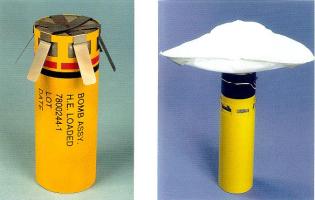
  • CBU-87/B CEM (Combined Effects Munition): 430 kg (950 lb) multi-purpose cluster bomb, consisting of 202 1.5 kg (3.4 lb) BLU-97/B CEBs (Combined Effects Bomblets) in an SUU-65/B dispenser. After release, each BLU-97/B descends under a cone-shaped decelerator and detonates on ground impact. A CEB has a triple charge, incorporating a fragmenting case against soft targets, an anti-armour shaped charge, and an incendiary device.
     
    Photos: via GlobalSecurity.org
    CBU-87/B   BLU-97/B
  • CBU-89/B “Gator”: 320 kg (700 lb) anti-personnel/anti-tank cluster bomb, consisting of 72 2 kg (4.3 lb) BLU-91/B anti-tank and 22 1.7 kg (3.7 lb) BLU-92/B anti-personnel mines in an SUU-64/B dispenser. Both submunition types are armed on ground contact. The BLU-91/B is detonated by a magnetic influence fuze, and the BLU-92/B by four trip wires.
    Photo: Hill Aerospace Museum
    CBU-89A/B
  • CBU-97/B SFW (Sensor Fused Weapon): 415 kg (914 lb) anti-tank cluster bomb, consisting of 10 BLU-108/B in an SUU-66/B dispenser. A BLU-108/B unit carries four independent Skeet anti-tank submunitions. After release from the dispenser, each BLU-108/B descends under a parachute to a pre-set altitude. Then a small rocket sends the BLU-108/B upwards and into a rapid spin, so that the Skeet warheads are released outwards. Each Skeet falls independently, scanning the ground with its IR sensor for the signature of a tank. When a target is detected, the Skeet detonates, firing an EFP (Explosively Formed Penetrator) directly downward, and a ring of fragments outwards (against soft targets in the vicinity). If no target is detected, the Skeet explodes immediately above the ground.
     
    Photos: Textron Systems
    CBU-97/B   BLU-108/B
  • PAW (Passive Attack Weapon): 1000 lb class cluster bomb with 3750 non-explosive penetrator rods in an SUU-66/B dispenser. This weapon was developed within three months in late 2002 to destroy soft area targets (like e.g. fuel storage depots) with a minimum of collateral damage.

When fitted with a WCMD guidance kit, these CBUs receive new designations. As guided cluster munitions, WCMD weapons qualify for both the GBU (guided bomb) and CBU (cluster bomb) categories, and the USAF decided to designate them in the latter. The following table lists all known WCMD-equipped cluster bombs:

Designation Base CBU Payload
CBU-103/B CBU-87/B 202x BLU-97/B in SUU-65/B
CBU-103A/B CBU-87A/B 1
CBU-103B/B CBU-87B/B 202x BLU-97A/B 2 in SUU-65/B
CBU-104/B CBU-89/B 72x BLU-91/B + 22x BLU-92/B in SUU-64/B
CBU-104A/B CBU-89A/B 3
CBU-105/B CBU-97/B 10x BLU-108/B in SUU-66/B
CBU-105A/B CBU-97A/B 10x BLU-108A/B 4 in SUU-66/B
CBU-105B/B CBU-97B/B 10x BLU-108B/B 4 in SUU-66/B
CBU-105C/B CBU-97C/B 10x BLU-108C/B 4 in SUU-66/B
CBU-107/B  5 3750 non-explosive penetrator rods in SUU-66/B

Notes:

  1. Details about the differences between the CBU-87/B and -87A/B are not available.
  2. Details about the differences between the BLU-97/B and -97A/B are not available.
  3. Details about the differences between the CBU-89/B and -89A/B are not available.
  4. The BLU-108A/B has a different SAD (Safety & Arming Device). The BLU-108B/B is the P3I (Preplanned Product Improvement) version, which features improved performance against countermeasures, increased footprint because of Skeet release at higher altitude, amd Skeet submunitions with a dual mode (active/passive) sensor and a redesigned multi-mission warhead. The BLU-108C/B was an interim upgrade of the BLU-108A/B because of delays in the P3I program, and had modified Skeet warheads with insensitive munitions filling.
  5. There is no non-WCMD version of the CBU-107/B.

The CBU-103/B and CBU-105/B have been used operationally for the first time during the war in Afghanistan in 2001, and the CBU-107/B was used in combat in Iraq in 2003.

WCMD-ER

In June 2003, Lockheed Martin received a contract to develop and test the WCMD-ER extended range version of the WCMD guidance kit. WCMD-ER adds a wing kit to increase stand-off range to 40-65 km (30-40 miles), as well as additional GPS guidance to maintain WCMD‘s accuracy. In May 2005, Lockheed Martin started low-rate production of WCMD-ER kits for the CBU-97/B SFW.

When fitted with a WCMD-ER guidance kit, the Combined Effects Munition (CBU-87/B) is designated in the CBU-113/B series, while the Sensor Fused Weapon (CBU-97/B) is designated in the CBU-115/B series. At the time of this writing, the only weapon actually planned for WCMD-ER is the CBU-97B/B, which will probably result in a CBU-115B/B designation. The CBU-114/B designation was probably either skipped or formally assigned to a WCMD-ER equipped “Gator” (CBU-89/B), but the “Gator” is being phased out by the USAF and therefore won’t be fitted with WCMD-ER.

Designation note: CBU numbers 108 through 112 are apparently unassigned so far. Therefore it appears that the WCMD-ER CBU designators were assigned out-of-sequence to implement an easy to remember scheme, where CBU-11x/B (WCMD-ER) corresponds to CBU-10x/B (baseline WCMD).

Specifications

Note: Data given by several sources show slight variations. Figures given below may therefore be inaccurate!

Data for WCMD dispenser:

Length 2.34 m (7 ft 8 in)
Diameter 40.6 cm (16 in)

Main Sources

[1] GlobalSecurity.org Website
[2] Lockheed Martin Missiles & Fire Control Website

Back to Directory of U.S. Military Rockets and Missiles, Appendix 5


Last Updated: 15 May 2006

May 092011
 

Ottawa Citizen

Count me out on (pointless) census day

Let me be clear: I’m not advocating civil disobedience. But I will not associate my name to the 2011 census fiasco. After senselessly disfiguring the mother of all data in Canada, our minister responsible for Statistics Canada is now reminding me to fill out a largely meaningless, yet mandatory, short-form questionnaire, while leaving it up to me to either complete the national household survey questionnaire or use it to get a nice camp fire going this summer. Apparently, it’s completely up to me and it’s all good, and it’s all cool. But I won’t do it.

Green Day said it best in its American Idiot hit song: “Welcome to a new kind of tension … where everything isn’t meant to be OK.” Nothing is OK with the 2011 census. It will be the most expensive process (more than $600 million or the equivalent of two federal elections) to produce numbers barely worth anything more than a poll conducted on how we felt about the 2010 Games in Vancouver. Remember those stats? Probably not. We’ve moved on.

The census is dead, evidencebased decision-making is ridiculed, and we may as well start teaching that Adam and Eve just popped up one day. The rule of law, a pillar of democracy, requires citizens to understand and respect the law of the land. I’m all for it. But it also requires governments to act responsibly, fairly, and transparently. On the census issue, the government has misled Canadians and, in fact, has lied about the nature of the data being gathered.

If the government can lie to me about the census, I have every right to exclude myself from this sad parody. And I will.

François Dumaine, Past-president of the Canadian Evaluation Society, Ottawa

© Copyright (c) The Ottawa Citizen

http://www.ottawacitizen.com/opinion/letters/Count+pointless+census/4748982/story.html

May 072011
 

I would like everyone to read  “Women Who Run with the Wolves”!  Google — there’s lots of information.  Here are the first two articles I tried, both excellent:   

http://www.radiancemagazine.com/issues/1994/wolves.html

Women Who Run with the Wolves
An interview with author and analyst
Clarissa Pinkola Estés
By Isabella Wylde

From the Radiance Winter 1994 Issue

“I am built close to the ground and of extravagant body.” So writes the Jungian analyst and cantadora storyteller Dr. Clarissa Pinkola Estés in her number 1 New York Times best-seller, Women Who Run with the Wolves (Ballantine Books, 1992). Remaining on the prized list for one year (as of August 1993), her book uses multicultural myths and folk and fairy tales to help women reconnect with their instinctual selves.

Having struggled with body size most of my life, I was especially curious about Dr. Estés, and fascinated by her book and audio tapes (available through Sounds True, Boulder, Colorado). In Denver bookstores, where brochures and fliers announce upcoming workshops, I found that several local women had begun to offer workshops and ongoing groups to facilitate “finding the creative Wild Woman.” Dr. Estés’s work was catching on. Further proof came when her name appeared as a clue in a New York Times crossword puzzle!

I was eager to attend a conference for women where Dr. Estés was scheduled to speak in Boulder. After the introductions, a large woman in a black dress with a blue yoke climbed the stage steps. Her dark hair was pulled back and adorned with a red bow at the nape. The audience began to applaud immediately. Suddenly, everyone stood up, clapping and yelling to honor this woman who had not, as yet, spoken one word. It was obvious that many women at the conference had been touched deeply by Dr. Estés’s work.

Though skeptical when I had first bought her tape, I found myself listening to “The Wild Woman Archetype” over and over again. I gained emotional strength from each hearing. I began to feel more alive, excited, empowered. I told friends about it, I bought her book, and I soon found women in all walks of life who were being strengthened by Estés’s words, by the stories that she calls soul vitamins.

They seemed to reach me at a subconscious level. The stories affirmed my inner core self and reminded me that I am valuable, creative, important. Her stories and interpretations strengthened my resolve to dig out more of my own inner feelings and desires, and to put time and energy into them; to value what my sometimes rigid family and community do not – creativity, vision, personal power; and to trust my own oft-trampled intuition, my wounded “inner child.”

Estés was raised in the rural midwest near the Great Lakes. She describes her childhood environment poetically in the introduction to her book. “There, thunder and lightning were my main nutrition. Cornfields creaked and spoke aloud at night. Far up in the north, wolves came to the clearings in moonlight, prancing and praying. We could all drink from the same streams without fear.”

This early exposure to nature and a later study of wildlife biology, focusing on wolves, led Estés to make a comparison of women to wolves. “Healthy wolves and healthy women share certain psychic characteristics,” she writes. “Wolves and women are relational by nature, inquiring, possessed of great endurance and strength. They are deeply intuitive, intensely concerned with their young, their mate, and their pack.”

Her analogy continues: “Yet both have been hounded, harassed, and falsely imputed to be devouring and devious, overly aggressive, of less value than those who are their detractors. Separation from the wildish nature causes women to become confused and lose their way.”

And when women hear the term wild woman, it is like “the fairy-tale knock at the door of the deep female psyche” and “an old, old memory is stirred and brought back to life. The memory is of our absolute, undeniable, and irrevocable kinship with the wild feminine, a relationship which may have become ghosty from neglect, buried by overdomestication, outlawed by the surrounding culture, or no longer understood anymore. We may have forgotten her names,” Estés writes, “but in our bones we know her, we yearn toward her; we know she belongs to us and we to her. A healthy woman is much like a wolf: robust, chock-full, strong life force, life-giving, territorially aware, inventive, loyal, and roving.”

In her book, Estés explains that she uses the word wild to mean living “a natural life, one in which the criatura, creature, has innate integrity and healthy boundaries.” She stresses that balance is necessary and good, and that women should beware of overdoing it in any area of their lives, even in creative work.

The wild and instinctual nature means “to establish territory, to find one’s pack, to be in one’s body with certainty and pride regardless of the body’s gifts and limitations, to speak and act in one’s behalf, to be aware, alert, to draw on the innate feminine powers of intuition and sensing, to come into one’s cycles, to find what one belongs to, to rise with dignity, to retain as much consciousness as we can.”

Estés put herself through college and then earned a Ph.D. in psychology after a divorce and a year spent on welfare with her young daughters. She next earned a postdoctoral diploma that certified her as a Jungian analyst. Working as a psychotherapist, Estés soon recognized that traditional psychology looked at women as men would have them be, missing the “deeper issues important to women: the archetypal, the intuitive, the sexual and cyclical, the ages of women, a woman’s way, a woman’s knowing, her creative fire.”

In 1976 Estés developed the first psychology course on women in Colorado and taught it at a local community college. She had seen women in her psychotherapy practice with a similar problem. They, like the larger patriarchal society surrounding them, did not value women’s creativity but rather their “niceness.” This effectively squashes, and drives deep within, women’s true nature and creative gifts. In her practice, Estés found that telling stories worked better than traditional psychology in helping both women and men find their strengths.

Each of her ethnic heritages – Mexican and Hungarian – has contributed to Estés’s love and immense knowledge of stories and myths. In her adult years she traveled and spent time with people of many cultures, including Native Americans from the north, throughout the west, and down to Central and South America. She writes in her book that she became a “gypsy scholar” traveling in a little trailer in which she would “drive down any dirt road [she] could find and see who was at the end of it.”

I’ve traded stories at kitchen tables and under grape arbors, in hen-houses and dairy barns, and while patting tortillas, tracking wildlife, and sewing the millionth cross-stitch. I’ve been lucky to share the last bowl of chili, to sing with gospel women so as to raise the dead, and sleep under stars in houses without roofs. I’ve sat down to the fire or dinner, or both, in Little Italy, Polish Town, the Hill Country, Los Barrios, and other ethnic communities throughout the urban Midwest and Far West, and most recently traded stories about sparats, bad ghosts, with storytellers in the Bahamas.

In Women Who Run with the Wolves, Estés uses nineteen folk tales to empower and enlighten women. She attempts to reconnect us with the Wild Woman hidden somewhere deep within each of us. From the tale of “La Loba – The Wolf Woman,” through “Bluebeard,” “Vasalisa The Wise,” “The Ugly Duckling,” and “The Red Shoes,” to “The Handless Maiden,” Estés offers solutions to the common pitfalls of women’s lives.

Originally Dr. Estés attempted to publish her work with the Jungian presses, but was rejected. She then made several audio tapes available by mail-order, which sold well by word of mouth. Luckily, one of her tapes reached a New York editor, and the publisher came to her.

Dr. Estés is now writing a second book, one of several in the works. It is called When This Tree Has Stood Winter: Myths and Stories of the Wise Woman Archetype. A former executive director of the C. G. Jung Institute in Denver, Estés currently spends time writing and keeping a small practice. In addition, she is a longtime human rights activist who has developed and heads the Guadalupe Foundation, which has as one of its missions broadcasting strengthening stories via radio to troubled areas throughout the world.

During the open microphone sessions at the conference I attended, many participants thanked Estés further for her book. One woman said that no book had helped her deal with the aftereffects of a rape as much as Women Who Run with the Wolves.

“That’s because it isn’t self-help!” Estés exclaimed.

Several days later, when I had the opportunity to interview Dr. Estés, she explained what she had meant.

“People are starved for poetry, starved for things that strengthen them,” she began. “There are any number of so-called self-help books and tapes on the market, but I don’t think that people are needing or wanting self-help as much as they want to be strengthened. It is useful, most definitely, but it leaves out the underworld, the deep inner life. Deep inner life,” she emphasized. “It also leaves out the spirit.”

Estés described for me her method of healing. “I come from the Curanderisma healing tradition from Mexico and Central America. In this tradition a story is ‘holy,’ and it is used as medicine. The story is not told to lift you up, to make you feel better, or to entertain you, although all those things, of course, can be true. The story is meant to take the spirit into a descent to find something that is lost or missing and to bring it back to consciousness again. For some people that may sound mystical . . . and it is!” she added, laughing.

I recalled the advice for her daughters that Estés had listed at the conference. 1) Be friendly but never tame. 2) Misbehave with integrity. 3) Don’t let the bastards grind you down! I asked if she thought her own daughters were Wild Women.

“I would say that they have a good start as pretty strong pups. They have a really good connection to their instinctual life,” she answered. “What I mean is not that they live within that bound all the time, but that they know immediately when they are out-of-bounds and make actions to correct it.

“The injunction in our culture is to ‘be perfect,’ which is ridiculous, impossible, and not only that – it is boring! Perfection means that you have to be totally still, that nothing can ever change. To live that way would be disastrous.”

Estés explained how our egos interfere with our instinctual nature by convincing us of false paths. “A gorgeous person walks into our lives and we drop everything and go off. Or we take a job we hate for the money we love, or think that if we just do something, that somehow life will be made miraculously better. That’s the kind of out-of-boundary that most people struggle with. If you don’t have a sense of the instinctual nature, then sometimes you are outside of your own cycles rather than in them.

“The cycles are birth, light, and energy, and then depletion, decline, and death. Then incubation and new life comes. Cycles, that is how we are supposed to meet everything,” she emphasized. “Our children, our work, our lovers – everything goes through that cycle. There is the time to say that is enough, to incubate, and then to come back with new energy and new life again.

“And when a woman is in that mystical and practical sensibility called the instinctual nature, then she knows when it is time to make things live and time to let things die.”

Estés told me two life circumstances that had contributed to her unusually strong self-esteem in relation to body size.

“I was born of Mexican heritage and adopted as an older child by Hungarian immigrants,” she began. “My adopted family had bought the culture lock, stock, and barrel. They did not want people to know that they could not speak English very well, that they could not read or write. They also bought into the cultural injunction against the natural female body, so my foster mother and her sisters all tried to starve themselves – to be thin, to wear to church the pointy high heels, and girdles – all the devices of torture.

“After the Second World War, when I was about eight or nine, my foster father searched throughout Europe for any living relatives who might have survived the war. He found four of his sisters who had lost their husbands and all of their children. He managed to bring them to the United States.

“Here they came off the train in Chicago.” Estés laughed as she went on. “These four big women. And I mean huge women. Their clothes were hanging on them, which means that they had been even bigger before they were starved. They were tall and broad. They came here with hair down to their ankles, braided and wrapped around their heads, and with only a few clothes.

“They treated me as though I were a ‘Child of God,’ because I was the only living child in the family. They could not hug me enough. I can remember them hugging me and hugging me and hugging me. They were always wanting to hold me. I was older, but they carried me around like I was a baby.” She laughed out loud at this memory. “I just loved them – they were so wonderful!

“They grew bigger and bigger as they were recovering, and they returned to their natural size, which was big. I was just so thrilled with them. They raked and hoed and spaded and seeded and watered and harvested. They spun and wove and chrocheted and tatted, and they made lace.

“I can remember sitting beside them at night as they told stories with their arms around me, and their large hips – how big and how comforting the aunts were. How safe I felt near them.

“You know the phrase thunder-thighs?” Estés asked. “‘She makes thunder when she walks’ – you are supposed to be able to hear a woman coming by her thighs brushing against each other – that is what my aunts taught me!”

The second event that influenced her life occurred when Estés was in her early thirties.

“I went back to the Isthmus of Tehuantepec in Mexico to meet some of my ancestral family members. I found this huge group of big women. They thought I was too thin and they were astounded at the idea of a ‘diet.’ Astounded. They kept trying to put dieting into a religious context – like purification, or strengthening oneself in a spiritual way.

“I said to them, ‘No, no, only so that you can attract men.’

Estés continued, “They are the Tehuana. They are a matriarchy, and they would put their hands on their hips and would say, ‘Que?’ (What?) And they were really not only puzzled but also outraged. ‘They do this to women far up north?’ they asked me.

“‘Yes, women do it to themselves far up north,’ I said to them.

“My blessing that I received from them I would call a rebirthing for my own body. They lived in a way that I found I could also live by seeing the body as a vehicle. Some people naturally have a small body, and that is their vehicle. But some women and men have very large bodies.”

After that visit, Estés stopped dieting. “I never, ever again went on a diet, because I felt that my body was meant to be large. I also saw that I came from a long line of women who were proud and stood tall. They were totally empowered, and they also had large bodies.”

Estés added, “I think that it is all right if people want to control their weight, as long as they don’t make themselves sick about it. But I also think that there is something to be said for not causing a woman to spend a huge amount of her entire life preparing food, shopping for food, fixing food, and eating food in order to maintain a weight that’s less than her body would like to be.

“Robbing women’s creative life from them – to set them after a foolish task – that happens in fairy tales and in mythology a lot. It shows the separation of the person form their own soul life. The person is set upon a foolish task, and finally in the midst of their life they wake up and say, ‘Oh, my, this is a foolish task.'” Estés laughed.

“I can’t even imagine that we were put on the face of this Earth in order to be thin. I think most of us are here on a mission different from a job or a career. I think we’re here to do helping and healing and discovery and creation.

“I think the idea of body size is a diversion and a distraction from the real work. The process of being here is the most important, and we must honor that with respect and love.”

I was reminded of an incident I had observed at the Boulder conference. Estés had been invited to join the panel of presenters on the stage after a lunch break. As she ascended the stairs, she noticed only one empty chair. She hesitated.

Glancing from the chair to the audience, she said, “One thing large people learn is to check out a chair with arms before sitting, or else when you get up you may be wearing it!” She walked bent over, demonstrating how she would look with a chair stuck to her backside.

The humorous way she handled what could have been an embarrassing moment was refreshing to me. Later, when I mentioned this to her, she said, “It’s like with shoes. I have a size 9 foot, and I wouldn’t try to put it into a size 7 shoe.” Simple, no excuses.

At the closing ceremony of the conference, when a Native American woman began performing a ritual with drums and chants, Estés had already gathered her things and left the stage. Hesitating at the foot of the stage, she looked as though she wanted to make a hasty exit, but still didn’t want to miss anything.

The drumming and chanting proceeded. Estés suddenly kicked off her shoes, put down her purse and glasses, and, with her arms raised high, swayed and danced to the drumbeat. As she continued to move around the large auditorium, other women left their seats to dance with her, and one of the women on the panel left the stage to join in.

Such life, such beauty in her movement! Estés’s glorious large body was dancing with abandon and grace. This image has stayed with me, this image of a woman who truly loves and cherishes her own body.

For information on the audio tapes available by Clarissa Pinkola Estés, write to Sounds True Audio, 735 Walnut Street, Boulder, CO 80302, or call 303-449-6229.

ISABELLA WYLDE is a free-lance writer and social worker who is trying to live up to her new last name. She is currently working on a book about women and alcoholism.

– – – – – – – –  – – – – – – – – – – – – – – –

http://www.homestar.org/bryannan/estes.html

Women Who Run with the Wolves
by Clarissa Pinkola Estes, Ph.D.

Ballantine Books, 1992

Reviewed by Laura Bryannan

Every once and a while a truly great book for women comes along. Sometimes the book calls us to arms, sometimes it provides us with important new information about ourselves or our bodies, and sometimes–like this book–it will nourish our souls.Clarissa Pinkola Estes is a Jungian analyst and cantadora, a collector and teller of stories. She has birthed a book about the archetype of the Wild Woman that has so much gut-level wisdom in it, you immediately sense that Estes is a woman who is really living her life (as opposed to simply existing in it). Estes has gotten past mentalized “good ideas,” and presents material that applies to the total being: body, heart, mind and soul. This book is for any woman who longs in her secret self for something more, who knows that her mind works better than her heart, who feels as if she’s stretched too thin, who has forgotten how to create, have fun, get dirty, laugh, cry or growl. Estes offers the “medicine” of folk and fairy tales to these wounds with insight and care. She shows how the archetype of the Wild Woman can be a model of wholeness for the modern woman.

Who is this Wild Woman? If you’re thinking this is a book about how to be wild and crazy, you would be a little bit right, but mostly wrong. The Wild Woman is not wild in the sense of being crazy, angry or out-of-control, she is wild because she has not lost her connection to life, death and rebirth–or, to put it more simply, nature.

“A healthy woman is much like a wolf: robust, chock-full, strong life force, life-giving, territorially aware, inventive, loyal, roving. Yet separation from the wildish nature causes a woman’s personality to become meager, thin, ghosty, spectral. We are not meant to be puny with frail hair and inability to leap up, inability to give chase, to birth, to create a life. When women’s lives are in stasis, ennui, it is always time for the wildish woman to emerge; it is time for the creating function of the psyche to flood the delta…It means to establish territory, to find one’s pack, to be in one’s body with certainty and pride regardless of the body’s gifts and limitations, to speak and act in one’s behalf, to be aware, alert, to draw on the innate feminine powers of intuition and sensing, to come into one’s cycles, to find what one belongs to, to rise with dignity, to retain as much consciousness as we can.”

Ms. Estes begins her book with a story that introduces us to La Loba, The Wolf Woman, one of the hundreds of Wild Woman’s names. (To you students of the Goddess: are your whiskers twitching yet? The ancient, female being of many names and places…yes, of course, who else could Wild Woman be but the Great Mother herself!) Estes then expertly leads us down the pathway to Her door; a pathway often so perilous with briars, bogs or other mysterious oogly-wooglies we would never even try it without someone like Estes’ help! The titles of the chapters are evocative in and of themselves: Stalking the Intruder: the Beginning Initiation. Nosing out the Facts: the Retrieval of Intuition as Initiation. The Mate: Union with the Other. Hunting: When the Heart is a Lonely Hunter. Finding One’s Pack: Belonging as Blessing. Joyous Body: the Wild Flesh. Self- Preservation: Identifying Leg Traps, Cages and Poisoned Bait. Homing: Returning to Oneself. Clear Water: Nourishing the Creative Life. Heat: Retrieving a Sacred Sexuality. Marking Territory: the Boundaries of Rage and Forgiveness. Battle Scars: Membership in the Scar Clan. La Selva Subterranea: Initiation in the Underground Forest. Shadowing: Canto Hondo, the Deep Song.

Estes writes in a casual, lively style, full of good humor. This is not a dry, analytical, passionless discussion, and you will not find one ounce of psychobabble anywhere. As one friend of mine exclaimed, “This woman talks like me!” As I read, I found myself laughing, crying, and nodding my head in agreement. It sparked such a sense of longing I felt my heart would burst at times–something deep in my bones woke up, stretched and sniffed the breeze. I remembered what it was like to be alive in this way, and I saw how “civilized” I had become. Just as pictures can tell a thousand words, I’d like to quote a little tale Estes learned from her late Uncle Vilmos which will clearly show what happens in this civilization process:

“A man came to a szabo, tailor, and tried on a suit. As he stood before the mirror, he noticed the vest was a little uneven at the bottom.
‘Oh,’ said the tailor, ‘don’t worry about that. Just hold the shorter end down with your left hand and no one will ever notice.’
While the customer proceeded to do this, he noticed that the lapel of the jacket curled up instead of lying flat.
‘Oh that?’ said the tailor. ‘That’s nothing. Just turn your head a little and hold it down with your chin.’
The customer complied, and as he did, he noticed that the inseam of the pants was a little short and he felt that the rise was a bit too tight.
‘Oh, don’t worry about that,’ said the tailor. ‘Just pull the inseam down with your right hand, and everything will be perfect.’ The customer agreed and purchased the suit.
The next day he wore his new suit with all the accompanying hand and chin ‘alterations.’ As he limped through the park with his chin holding down his lapel, one hand tugging at the vest, the other hand grasping his crotch, two old men stopped playing checkers to watch him stagger by.
M’Isten, oh, my God!’ said the first man. ‘Look at that poor crippled man!’

The second man reflected for a moment, then murmured, ‘Igen, yes, the crippling is too bad, but you know I wonder…where did he get such a nice suit?'”Just like the man with the new suit, we often develop personas that display to everyone how good, caring, nice, etc., we are. To the outside world everything is perfect, but inside our true natures are crippled. Women often get so much support for these pleasing personas, we lose touch with how much they narrow our choices, cut us off from life, and bring us unnecessary pain. Women Who Run with the Wolves helps us see that we have become like the tailor’s gullible customer. Perhaps we have been hobbling around in our fancy suits for so long we have forgotten we weren’t always a cripple. Estes’ book will show you where you have lost touch with your heart, your guts, your creativity, your wildness–your life! The stories she presents, and her insightful analysis of those stories, will gently lead you back to yourself. Even if you are unmoved by this review, I would ask you to run to the nearest bookstore and read the introduction. Let Estes’ own words touch you. This is one of those powerful books that, if you are ready for it, it will call you. If, at the next full moon, I hear howling at midnight, I’ll know someone out there heard the call.

May 072011
 

From an excellent website:

Marge Piercy: The Low Road

(from We Are Everywhere)

The Low Road

What can they do to you?
Whatever they want..

They can set you up, bust you,
they can break your fingers,
burn your brain with electricity,
blur you with drugs till you
can’t walk, can’t remember.
they can take away your children,
wall up your lover;
they can do anything you can’t stop them doing.

How can you stop them?
Alone you can fight, you can refuse.
You can take whatever revenge you can
But they roll right over you.
But two people fighting back to back
can cut through a mob
a snake-dancing fire
can break a cordon,
termites can bring down a mansion

Two people can keep each other sane
can give support, conviction,
love, massage, hope, sex.

Three people are a delegation
a cell, a wedge.
With four you can play games
and start a collective.
With six you can rent a whole house
have pie for dinner with no seconds
and make your own music.

Thirteen makes a circle,
a hundred fill a hall.
A thousand have solidarity
and your own newsletter;
ten thousand community
and your own papers;
a hundred thousand,
a network of communities;
a million our own world.

It goes one at a time.
It starts when you care to act.
It starts when you do it again
after they say no.
It starts when you say we
and know who you mean;
and each day you mean
one more.

– Marge Piercy

Thivai Abhor

2 comments:

Brett said…

I like this piece of work. I really enjoy the comparisons the author makes between two opposing lifestyles. At first I was unsure about the title but after consideration I feel that it aids in supporting the postitive lifestyle as being right. Everyone needs to be more aware of how we treat each other. The low road is the absolute lowest human mind set. We must be aware of what we are capable of and realize that we can all make this world a better place starting with how we treat each other as human beings.

11:10 PM

Thivai Abhor said…

. . .  Poercy’s poem moved me because it reminds me that through the bonds of fellowship/collaboration/community/activism we can move toward effective change. Oftentimes sensitive people who are hurt by the system end up lashing out mindlessly and destructively, acting alone with no plan… (I did for a long time)… what happens when we act together with focused intent?

May 052011
 

UPDATE, SELECTION OF NEXT PRESIDENT FOR THE UNIVERSITY,    no comment

DATE:  Tue 5/10/2011 4:56 PM

SUBJECT:  appointment of Dr. Vera Pezer as Senate member to the presidential search committee

Greetings to all,

 I am writing to inform all members of Senate that Dr. Vera Pezer will serve as the Senate member on the presidential search committee. The appointment occurred by unanimous motion at a duly constituted meeting of the Senate executive committee on May 5, 2011. 

I also wish to thank those members of Senate who submitted their name for consideration by the Senate executive committee.

Sincerely,

 Sandra Calver

Acting University Secretary

May 042011
 

Please consider forwarding this to fellow citizens.

For those who are not aware of Lockheed Martin’s (the American military’s) role in the Canadian census and in Canada, check out Lockheed Martin, Census, Trial, War Economy.   The large influence of Lockheed Martin, their intentions, and the seriousness, is apparent.

– – – – – – – – – – – – – – – – – – –

Did you recently receive your “2011 Census” in the mail?

Birgit did.  I did.

It’s a buff-coloured envelope that unfolds.  It is one page of directions for how to obtain your census form:

  1. Online using the “secure access code” provided.
  2. By phoning a 1-800 number and inputting your “secure access code” for them to send you a paper form.

My census information for the Government is 3 words  “No Lockheed Martin”.

The sub-title on the envelope is “Complete the census – it’s the law.”

IT’S THE LAW ?! 

  • Hmm . . . the Prime Minister is the “leader” for our country.
  • The Government of Stephen Harper was found guilty of contempt of Parliament.  That’s about the highest breaking-of-the-law there is for the Prime Minister of Canada.  Unprecedented.
  • If I follow my leader, Stephen Harper,  I will . . . break the law with impunity.  Everyone is equal under the law.  I guess the way Stephen Harper sees himself in relation to the law (it doesn’t apply) is the way that I should see myself in relation to the law.   HOWEVER!  … continue
  • However,  I value democracy.  I have put a lot of effort into supporting the rule-of-law.   Scroll down to  on-going warnings to the Government of Canada, starting as early as 2005.  They are undermining the rule-of-law.  Stephen Harper is just the pinnacle.
  • The awarding of lucrative Government contracts to corporations that are in contravention of  Canadian and International Law is

From my election brochure:  The leadership of Canada believes no one cares if they break the law. No rule of law means no Democracy.  Danger zone.

It turns out it’s up to citizens to enforce the rule of law in Canada.   If we do not, as is so clear in the case of the census,  the laws are used as instruments of intimidation and coercion against us.  In the census example, the threat of prosecution, jail time and a fine are used to take away our Charter Right to Privacy of Personal Information.

Note that although the Harper Government announced last year that the census long form is no longer mandatory,  they never did change the law.   They did ONE BETTER!  They made the census long form into the “National Household SURVEY” which enables the collection of data on an on-going basis, year-in and year-out.

REASSURANCE OFFERED BY CHIEF STATISTICIAN, WAYNE SMITH:  

Wayne Smith concludes his 2011 Census instructions saying:

  • “By law, your responses will be kept confidential”

That is an absurd statement:

  1. The Prime Minister of Canada does not believe in the rule-of-law.
  2. The stories about serious breaches of security around electronic data bases are on-going and too numerous to keep up with.  The most spectacular is the leaking of massive volumes of confidential U.S. Government files to Wikileaks.

Wayne Smith is relying on our wish to feel secure.  He just has to tell us that everything is fine, Big Daddy is looking after our best interests.

OUR ROLE, according to StatsCan:  PUT WHAT WE KNOW ASIDE, and fall into the ever-loving arms of Wayne Smith and the American military (Lockheed Martin).

Creatures who are naïve do not survive.

WHAT A RIOT!

People are doing wonderful, creative and funny things with the census!

NOTE:  I am hoping that a couple of people will re-send their input on the census – I lost it.  I was laughing out loud!  Good stuff to share with others.  But then I maxed out on Outlook capacity – again – and had to delete emails.

(UPDATE:  See the Comments below.  Also.   2011-07-13   Don’t know what to do about the census? What’s happening to other people? some actual questions and answers might be helpful. )

GREAT RESOURCES! 

GOVERNMENT UNDERMINING THE RULE OF LAW, WARNINGS THAT GO BACK TO 2005:  

I have been telling the Government through official channels (e.g. Privy Council Office) that they are undermining the rule of law.  Click on:

It turns out it’s up to citizens to enforce the rule of law in Canada.

– – – – –  – – —  – — –  – – – – – – – – –

My census information for the Government is  “No Lockheed Martin”.

– – – – – –  – – – – – – – – – – – –

May 022011
 

http://blog.ted.com/2011/05/02/beware-online-filter-bubbles-eli-pariser-on-ted-com/

Online “filter bubbles”: Eli Pariser on TED.com

As web companies strive to tailor their services (including news and search results) to our personal tastes, there’s a dangerous unintended consequence: We get trapped in a “filter bubble” and don’t get exposed to information that could challenge or broaden our worldview.

Eli Pariser argues powerfully that this will ultimately prove to be bad for us and bad for democracy.

(Recorded at TED2011, March 2011, in Long Beach, CA. Duration: 9:05)

May 022011
 

STEFANIA WRITES:

Hi everyone,

As your Senate representative at the University of Saskatchewan, I am forwarding a copy of the e-mail and letter I sent to the University Secretary, Vice-Chair of the Board of Governors, President and Senate members regarding the conflict of interest of Ms.Hopkins, Chair of the Board of Governors by virtue of her position as a Board Member of Cameco.

Stefania


From: Stefania    Sent: Thursday, April 28, 2011 5:46 PM
To: ‘university.secretary  AT  usask.ca’
Subject: Letter outlining Conflict of Interest on U of S Board of Governors

 Dear Ms. Calver, 

Further to the April 16, 2011 Senate meeting, I am forwarding a copy of my letter addressed to the Office of the University Secretary and Ms. Susan Milburn, Vice-Chair of the University of Saskatchewan Board of Governors for distribution to Ms. Milburn, President MacKinnon, the members of the University of Saskatchewan Senate, and Chair of the University Council, outlining the apparent conflict of interest involving Ms. Nancy Hopkins as Chair of the Board of Governors.    

 I would like to request that your office forward my e-mail and the attachments to Ms. Milburn, President MacKinnon, members of the Senate and Ms. Card, Chair of the University Council via your e-mail list.  

 I am attaching the letter as a word file and as a pdf file with the brochure attachment. 

Please advise me when the distribution has occurred.

 Thank you for your assistance in this regard. 

Yours truly,

 Stefania A. Fortugno, LL.B., LL.M. 

University Senate,   Member at Large

= = = = = = = = = = = = = = = = == = =  ==  =

Ms. Stefania A. Fortugno                                

Barrister & Solicitor

P.O. Box 137

Saskatoon, SK  S7K 3K4

April 28, 2011

 Ms. Sandra Calver (Acting University Secretary)

Office of the University Secretary

University of Saskatchewan
Room 212 – 107 Administration Place
Saskatoon, SK   S7N 5A2

Ms. Susan Milburn (Vice-Chair)

University of Saskatchewan Board of Governors

c/o Office of the University Secretary

 Re:     Conflict of Interest involving Ms. Nancy Hopkins

          Chair of the Board of Governors (2010);

          Appointed to Board 2005

Dear Ms. Calver and Ms. Milburn:

 I am writing to you in my capacity as a University of Saskatchewan Senate Member at Large.  I was elected to my position on the Senate and represent the views of my constituency drawn from the University of Saskatchewan alumni. 

 It has recently come to my attention that Ms. Nancy Hopkins, the current Chair of the University of Saskatchewan Board of Governors, is a Board member of Cameco Corporation, the uranium mining giant headquartered in Saskatoon.  This information is not posted in the biography of Ms. Hopkins found in the University of Saskatchewan Board of Governors website.  As a result of Ms. Hopkins’ membership on the Cameco Board, she is in an apparent conflict of interest with her position as a member and Chair of the Board of Governors.  

Pecuniary Interests

 Ms. Hopkins has been a Board member of Cameco since 1992 and according to the Cameco Board of Directors web pages, as of 2009, Ms. Hopkins has a total of $1,843,273.00 equity at risk including “Cameco shares, DSUs and options”.  In 2008 her total Cameco equity at risk was $1,001,871.00.  

Moreover, Ms. Hopkins earned $175,873.00 in compensation as a Cameco director for the year 2009.  This amount included $74,853.00 in stock awards.  In 2008 Ms. Hopkins earned $186,500.00 by virtue of her position as a director with Cameco, including $72,000.00 in stock awards.  This information is posted at Forbes.com (see http://people.forbes.com/profile/nancy-e-hopkins/14935). 

University of Saskatchewan Conflict of Interest Policy

The University of Saskatchewan conflict of interest policy for Operations and General Administration was approved on February 8, 2002 and was amended on December 12, 2008.  The conflict of interest policy is the responsibility of the Office of the University Secretary and was authorized by the Board of Governors. 

The conflict of interest policy applies to “everyone who is a member of the University of Saskatchewan” including any “person while acting on behalf of or at the request of the University including, but not limited to members of a University committee (including the Senate and Board of Governors), persons giving advice or providing services to the University at the request of the University, and anyone involved in a decision-making process.”  Thus, the conflict of interest policy applies to all members of the Board of Governors.

The Board of Governors Bylaws further outline under part IV, Responsibilities of a Board Member, item 10, that each Board member is required to “understand the ethical responsibilities incumbent upon a member of the Board, and to declare a conflict of interest whenever such conflict arises.” 

Power and Authority of the Board of Governors

 As you are aware the Board of Governors is the principal decision-making and governing body of the University of Saskatchewan.  Under The University of Saskatchewan Act, 1995, the Board of Governors is responsible for “overseeing and directing all matters respecting the management, administration and control of the university’s property, revenues and financial affairs, other than those matters that are specifically vested in the minister pursuant to this or any other Act.”  (s.48) 

Under the Act (section 49) the Board of Governors is empowered to:  

(1)  “construct any buildings and structures on the university’s property that, in its opinion, are necessary and proper”, subject to prior ministerial approval, and to maintain such university buildings and structures;

(2)  appoint the president, vice-presidents, secretaries, faculty members, and any other officers and employees that are required to be appointed by the Act or considered necessary for the purposes of the University; 

(3)  provide for the establishment or disestablishment of any college, department, chair, endowed chair or institute after consultation with the council; and,

(4)  fix student fees, among other duties. 

 As a result, the decision making power of the Board of Governors is broad and deep. 

 Conflict of Interest: Both in Appearance and Reality 

Any time that the University of Saskatchewan enlarges the role of the nuclear sciences on campus, through the appointment of faculty chairs, or establishing a new $30 million nuclear research centre, and allocates scarce educational resources to the same, the share prices of Cameco Corporation correspondingly increase.  As a result, Ms. Hopkins’ pecuniary interests as a Board member of Cameco gives rise to a conflict of interest in her role as principal decision-maker at the University, most particularly when decisions are taken that directly or indirectly benefit the nuclear industry or the nuclear sciences and allocate scarce resources to such endeavours at the expense of other programs and disciplines at the University of Saskatchewan. 

The conflict of interest policy states: “A conflict of interest occurs when there is a divergence between a University member’s private interests and professional work outside of the University and their obligations to the University such that an independent observer might reasonably question whether the University members’ professional actions or decisions are determined by considerations of personal gain, financial or otherwise.” 

 “Conflict of interest is a breach of an obligation to the University that has the effect of advancing one’s own interest or the interests of others in a way detrimental to the interests of, or potentially harmful to, the integrity of the University. Conflicts of interest and the appearance of conflicts of interest must be avoided.”  (emphasis added). 

Currently language programs are being defunded resulting in the loss of courses which language students require in order to convocate.   See attached brochure: “Speak Up! Save Languages at the U of S!” 

Similarly, the department of Sociology is unable to offer senior level courses that students require to complete their degrees.  Where is the funding going?  Are these funding decisions that result in gutting the Arts and Humanities faculties and programs intended to make the University of Saskatchewan an Ivy League type institution, a renowned international centre of learning excellence, as indicated in the University’s strategic plan?

 Is the decision to allocate scarce University resources to specialized science programs, in this case nuclear science, rather than to University courses and programs that provide the foundation for a University education (i.e., the Arts and Humanities), in the best interests of the University as a whole or in the best interests of the mining sector in the province or the nuclear industry in Canada? 

Whether or not the intent is to increase the share/stock value of the uranium mining giant, Cameco, the decisions by the Board of Governors that support or promote the nuclear sciences on campus result in an increase in the share/stock value of Cameco.  Even if share prices are not immediately impacted, such decisions serve to promote nuclear industry strategic interests.  Thus, the conflict of interest is both apparent and real. 

 As we have seen, the disastrous melt down of the reactors at the Fukushima nuclear complex in Japan, which is still on-going, has resulted in an approximately 20% drop in the stock value of Cameco (see Reuters Breaking News; Update 1 – Cameco shares tumble on Japanese nuclear crisis, 14 March 2011, at uk.reuters.com.)  A 20% drop in the stock value amounts to a $360,000 decrease in the 2009 value of Ms. Hopkins total “equity at risk” of $1.8 million.   More recent reports place the stock value drop at 37% for Cameco.  

Similarly, any glimmers of hope for the resurrection of the dying nuclear industry, through, for example, the establishment of a nuclear research centre at the University of Saskatchewan (funded by public taxpayer monies) and the development of new small reactor designs for deployment in the tarsands and other remote industrial uses, will correspondingly result in an increase in the value of Cameco stock.   Again the conflict of interest is apparent and real.  

Previous Decisions and Conflict of Interest

Has Ms. Hopkins recused herself from making the following decisions over the last six years? :  

(1)   Appointing nuclear physicist, Dr. Richard Florizone, to the position of Vice-President of Finance and Resources;

(2)   Naming the area in front of the administration building the Cameco Plaza;

(3)   Naming the pedestrian link at the Royal University Hospital the Cameco Skywalk in February 2010;

(4)   Appointing Dr. Howard Wheater as the Canada Excellence Research Chair (CERC) in Water Security, a researcher with extensive background in examining issues relating to geological disposal of nuclear waste.  See, e.g., DIAMOND’09 Conference, Decommissioning, Immobilisation and Management of Nuclear Waste for Disposal, 9-10 September 2009, York, UK, Initial results in the development of a near-surface component for use in a performance assessment model for the geological disposal of nuclear waste by J. Jardine, S. Mathias, A. Butler, H. Wheater.

(5)   Appointing the Canada Research Chair in Advanced Materials for Clean Energy, Dr. Jerzy Szpunar in July 2010.  According to one appointment announcement, “Szpunar’s research into advanced materials includes novel materials that better resist radiation damage and handle the high temperatures, corrosion and stress found in nuclear power reactors.”  

(6)   Appointing the Dean of Engineering Janusz Kozinski, P.Eng in 2007.  One of Dr. Kozinski’s principal areas of research includes the next generation of nuclear reactors. 

I would like to request a copy of all Board of Governors agenda and minutes between 2005 and 2011 to see if Ms. Hopkins recused herself from any decision making that involved the nuclear sciences, and/or any direct or indirect benefit to the nuclear and/or uranium mining industry in Canada. 

It is also problematic that the Board of Governors meetings are held in camera, rather than in public.  As a result there is no proper scrutiny of the decision-making occurring in the Board of Governors.  

New President for the University of Saskatchewan

 As indicated above, the Board of Governors is tasked with appointing a new President.  As Chair of the Board of Governors, Ms. Hopkins is also the Chair of the Search Committee for the President. 

Possible candidates for the next President may include such high-profile individuals as Dr. Richard Florizone (nuclear scientist and V-P Finance and Resources), Dr. Brett Fairbairn (Provost and V-P Academic), and Dr. Grant Isaac (former Dean of the Edwards School of Business; currently a vice-president of Cameco).

 Is Ms. Hopkins in a sufficiently conflict-free position to be scrutinizing and selecting the next President of the University given her ties to the nuclear industry in Canada? 

Undue Influence

 The Board of Governors has responsibility in all aspects of University administration and management including the allocation of scarce resources for hiring faculty, establishing or disestablishing programs and faculties, and making capital expenditures for any buildings or equipment.  The Board of Governors can affect every single aspect of the University’s existence.  By virtue of the presence of a Cameco Board member on the Board of Governors, the nuclear industry has undue influence over every aspect and key decision affecting the University of Saskatchewan. 

The University is a public institution with values and ideals that do not correspond to corporate interests.  The corporate community has its own sphere, it does not properly belong in the sphere of running/heading a publically funded educational institution.  

Appropriate Course of Action

 What is the appropriate course of conduct in this matter?

 The conflict of interest policy states:  “When a conflict of interest exists, the University member in question may be required to relinquish the responsibilities causing the conflict of interest.”  

In this case, it is respectfully submitted, a resignation by Ms. Hopkins from the Board of Cameco or the Board of Governors is required.  

Yours truly,

 Stefania A. Fortugno, LL.B., LL.M.

Senate Member at Large

 VIA POST & E-MAIL

 cc:      (1) President MacKinnon;

          (2) Members of the Senate;

          (3) University Council Chair;

          (4) Alumni Constituency;

          (5) Local Press.

cc: Via E-mail

May 012011
 

This is about WikiLeaks and Harper, not about residential schools.

Residential school apology rare ‘consensus’ moment during centralized, secretive Harper minority rule: U.S. diplomatic cable

National News | 01. May, 2011 by APTN National News

Residential school apology rare ‘consensus’ moment during centralized, secretive Harper minority rule: U.S. diplomatic cable By Jorge Barrera
APTN National News


OTTAWA–
When an “instinctively combative” Stephen Harper reached across party lines to deliver the historic apology to Indian residential school survivors, it marked a rare moment when he attempted “consensus” during a centralized and secretive minority rule, according to a blunt assessment contained in a “confidentialt” U.S. diplomatic cable obtained by APTN National News.

The Jan. 2, 2009 cable, titled, Never Apologize: PM Harper’s Governing Style, describes a prime minister who trusted only an “extremely small” circle of “like-minded” confidantes and kept caucus and cabinet members in the dark on major decisions.

The cable was written by former U.S. ambassador to Canada David Wilkins and was released to APTN by whistle-blower Web site WikiLeaks.

Parts of Wilkins’ assessment was based on conversations with Conservative caucus members.

APTN was one of two Canadian media organizations to receive the full batch of diplomatic cables, including secret and confidential dispatches, originating from the Ottawa embassy and U.S. consulates.

WikiLeaks released hundreds of unclassified cables on its Web site last week.

Wilkins notes that, up to the point of writing, the only times Harper reached out across partisan lines came when he delivered the apology to Indian residential school survivors and secured an extension to the Afghanistan mission.

“In office, Harper has rarely made the compromises typical of a minority (prime minister), nor built the bridges and informal channels that usually get things in a minority Parliament,” wrote Wilkins. “He reached across the floor only twice: in March 2008 to achieve bipartisan consensus on the extension of Canada’s military mission in Afghanistan through 2011; and in June 2008 to resolve the Indian Residential Schools issue.”

In the House of Commons, just before he began the June 2008 apology, Harper acknowledged the role NDP leader Jack Layton played leading to that moment.

“For the past year and a half, he has spoken to me with regularity and great conviction on the need for this apology,” said Harper, at the time. “His advice, given across party lines and in confidence, has been persuasive and has been greatly appreciated.”

The apology came after the government secured a multi-billion dollar settlement with residential school survivors.

Most of the diplomatic cable, however, deals with Harper’s centralized governing style where everyone but his small circle of advisors were kept out of the loop on major decisions. The cable also notes how fear kept his ministers and MPs in line.

“Harper’s inner circle appears extremely small. Notoriously hard on staff … (Harper burned through a series of communications directors as opposition leaders and once reportedly told an aide that he liked to see the ‘fear’ in the eyes of prospective employees) he has tended to surround himself with like-minded people,” wrote Wilkins. “As a result, some insiders say he lacks staff willing or able to act as an effective sounding-board or check his partisan instincts.”

Wilkins compares Harper to former Progressive Conservative prime minister Brian Mulroney, saying the he lacked his predecessors’ ability to connect personally with his caucus.

“Unlike former Conservative prime minister Brian Mulroney who famously called his MPs when their kids were sick and kept their loyalty even when his personal popularity plunged to historic lows, Harper lacks the personal touch,” wrote Wilkins.

The cable also describes how major decisions, like the controversial announcement to end public subsidies for political parties in November 2008, caught his cabinet and caucus by surprise.

“Discussions with Conservative caucus members over the past year have also made it clear that they are often out of the loop on the prime minister’s plans,” wrote Wilkins. “Many senior Conservatives admitted that they were stunned to hear about the ban on public financing of political parties…neither cabinet nor the caucus apparently had any clue this was even part of the long-range agenda, much less subject of an immediate confidence vote.”

The announcement triggered a crisis that forced Harper to shut Parliament down to avoid being toppled by opposition parties through a coalition.

Wilkins said former Governor General Michaelle Jean was also apparently considering rejecting Harper’s decision to prorogue Parliament and asking the opposition parties to form a coalition government.

“The opposition’s ability to turn the tables with a proposed coalition in turn apparently caught the PM by surprise, as was perhaps the rumoured unwillingness of the Governor General to rule out this option against his advice (sic),” wrote Wilkins.

Wilkins said Harper’s reputation as a master political chess player took a major blow as a result.

“He has played the game of high-stakes, partisan politics well, but his reputation for decisiveness and shrewdness has been tarnished by a sometimes vindictive pettiness,” wrote Wilkins, who was appointed by former U.S. president George W. Bush to the position and left the post in Jan. 20, 2009.

Wilkins also describes a conversation with a junior cabinet minister as an example of the “short-leash” around the necks of cabinet ministers.

“At a December conference, one Minister of State confessed privately that he did not ‘dare’ to deviate from his pre-approved text, even though fast-moving events had already overtaken his speech,” wrote Wilkins.

Wilkins’ assessment concludes that the Conservative leader needed a more conciliatory approach to deal with the country’s fiscal situation and global economic slowdown.

“However, this will go against the grain for such an instinctively combative prime minister,” wrote Wilkins.

jbarrera  AT   aptn.ca

The cable

Download (PDF, 34.27KB)

May 012011
 

Hi Kendra,

These are interesting questions and ideas.   I have responded to all but a couple. 

I do not wish to respond to questions I haven’t thought about, unless there is a principle that is easily apparent and therefore provides direction. 

My thinking on religion has gone through a number of different stages over the course of my life.  I view “religion” as an interpretation by a group of people of the spiritual side of existence.  Often it’s a way for some people to exercise power over others, which means dis-empowering those others. 

My work is related to  the empowerment of individuals so they can develop their potential. 

Related to religion, in today’s world I am particularly concerned about the need of the military-industrial complex to create “enemies”.  They use propaganda and the target is often Muslim people.  It is not different from the lead-up to World War Two when the targeted groups were Poles and Jews.  My thoughts on “religion” are cushioned by the need to protect people who may be vulnerable because of a choice they have made, or been conditioned to make, regarding the expression of their spirituality. 

These are simultaneously troubling and exciting times.  On the troubling side:  there is growing corporatocracy (corporate values, militarism, fascism).  In order to work our way to a new economy, one that is not based on destruction,  we need to work together.  Work that polarizes is not helpful.

You refer in one question to the Charter.

I have been on trial over my refusal to fill in the 2006 census which I would not do because of the involvement of Lockheed Martin (American military) in the Canadian census.   The legal argument available to me is the Charter Right to privacy of personal information. 

Many Canadians either never knew, or have forgotten that we have that Charter Right (mind you – – I was found guilty! in January,  but the verdict is under appeal;  I expect that the decision will be overturned.)  To me Orwell’s Animal Farm does a nice job of describing how we forget.  There are times when we need to fight to uphold the Rights and to teach younger generations WHY we have the rights.

I see part of your work as a contribution to reversing our slide down the slippery slope.   However, I have pointed out what I think are errors in logic in some of your questions. 

You may also be interested in John Ralston Saul’s work to balance the role of our “rational” faculty with other faculties we have such as values, memory, and so on.   There is a brief description on my blog, click on:  2010-03-10 Propaganda, Democracy: Imagining “the other”. Ralston Saul. The Cellist of Sarajevo.

Best wishes,

Sandra Finley

Secularism
1. Do you support the separation of religion and state, and government neutrality in all matters between believer and non-believer?   

Yes I do.  And you will find a number of statements on my blog www.sandrafinley.ca to that effect.   I use the separation of religion and state as an example of the need to separate the “powers” in a democracy.  From there I argue that the same logic applies to the separation of the commercial powers from the state.   Failure to separate the powers leads to corruption and the decline of democracy.   You may be interested in this posting:    2011-03-26 Xcorporatocracy: update – democracy fighting back in North America!

Freedom of Speech

2. Do you believe there should be any legal limits on the criticism of religious opinion in the public square? 


3. Would you support repealing the law against blasphemy in the Criminal Code of Canada?

I vaguely remember laughing when I stumbled across this law in the Criminal Code.  How could it ever be enforced?  Obviously it is not being enforced.  

Questions:

–        When was the law passed?

–        Have there ever been charges laid under the law? 

 There is a further point:   in my opinion, laws should not be allowed to stand, even if they are not being used.  By virtue of just being there, there is an option of using them.  Laws are often used as instruments of coercion and intimidation.   

It should be fairly simple to obtain agreement to repeal this law.  I support doing so.

Religious accommodations

4. “What is your position on granting people exemptions from neutral, generally applicable laws and policies based on their religious beliefs (e.g. religious accommodation)?

Charity status


5. Do you support granting an organization tax-exempt charitable status for the sole purpose of the “advancement of religion”, if such an organization undertakes no other charitable activity such as feeding the poor?

 I think we need to table and sort out all the grievances on the question of charitable status.   I am an activist.  Charitable status is denied to organizations that “advocate”.  It serves to curtail needed community-based action to address problems.  The arrangement weakens democracy.    

There are vested interests in maintaining charitable status.  I have wondered whether it would be better to get rid of it altogether and address funding needs in other ways?  I think discussion is needed.  Otherwise you polarize people with the vested interest,  and it becomes very difficult to move forward.

Anthem

6. Would you support an amendment to the National Anthem Act to remove the reference to “God” in the lyrics of O Canada?

Will you read this posting on my blog:?

2011-04-12 Lesson in democracy: Challenge to the notion that YES / NO responses are appropriate to democratic functioning. 

I think you have to work things out with people.   What is the actual wording that you would like to see?  I am uncomfortable with the use of “God”.  I personally would use something along the lines of “Life force” but I have no idea whether something like that could be worked in.  Someone else will probably have a better idea.   

Charter of Rights and Freedoms

7. Would you support an amendment to the preamble of the Canadian Charter of Rights and Freedoms to remove the reference to the “supremacy of God”?

Again,  I do not think that “yes/no” responses are appropriate in a democracy.  What wording do you propose?   I am not agreeable to the idea of the “supremacy of human beings”!!    Our record is too abysmal. 

Religious law


8. What position do you hold concerning the legally-binding use by religious communities of separate religious courts (e.g. in family law)?

Your question  assumes that courts are the only option in matters of family law (or other law).  I am not so sure that your premise is valid.  Many of our institutions are obsolete and in need of overhaul.    

Medicine and Health

9. Do you support the requirement that all products labeled “medicine”, including homeopathic or naturopathic remedies, be required to pass the same rigorous testing as pharmaceuticals?

You have stated a false premise:   rigorous testing (of) pharmaceuticals     My experience says your statement is propaganda.   If it was true, why are so many drugs pulled off the market because of the deaths and other extremely serious adverse health effects they have created?  (You will find a lot of documentation on my blog regarding the corrupt nature of the pharmaceutical corporations.)

10. Do you support vaccination as a good public health measure?  

I am curious regarding the relationship between this question and  the mission of your organization>  the Canadian Secular Alliance, a national non-profit organization seeking church-state separation and government neutrality with respect to religion?    

Notwithstanding, I will reply.

I preface my remarks:   yes/no responses shut down the inquiry to get closer to the truth of matters. 

 There may be “good vaccinations”.   But there are definitely very bad vaccinations that no one in their right mind should take.   Many contain mercury and/or aluminum (heavy metals are extremely toxic) and other foreign ingredients.

I refer you to my blog.  Please click on:  Heavy metals in vaccinations, Mercury in dental amalgams.   

Yours in good health!  You’d have a very difficult time forcing a vaccination on me!   The pharmaceutical corporations have undermined faith in the system.

Best wishes,

Sandra

———- Forwarded message ———-
From: Getty, Kendra    Date: Tue, Apr 26, 2011 at 9:31 PM
Subject: Policy Questions on Church-State Separation and Science from Educational Charity Centre for Inquiry
To: Kendra Getty    Cc: saskatoon.freethinkers   AT  gmail.com

Greetings,

The Centre for Inquiry is a registered educational charity that promotes reason, science, secularism, and freedom of inquiry.  We are also Canada’s most vocal organization representing atheists, agnostics, and secular humanists who constitute one of the fastest growing minorities in Canada. According to a 2008 Harris-Decima poll(1), roughly one quarter of Canadians are atheists or agnostics.

The Centre for Inquiry represents a membership of over 1,000 individuals, and is constituted of 10 branches in the cities of Vancouver, Kelowna, Calgary, Edmonton, Saskatoon, Regina, Toronto, Ottawa, Montreal and Halifax.  In Saskatchewan, we have members across the province with active branches in Saskatoon and Regina. 

In partnership with the Canadian Secular Alliance, a national non-profit organization seeking church-state separation and government neutrality with respect to religion, we have prepared the set of questions below. The responses we receive will be posted, without modification, to our website and circulated to our members.

We understand that some of the questions reference propositions that might be complicated to implement, but we are looking for your position on the principles they embody.

Given how busy you are, we trust you appreciate the unique opportunity this request grants of reaching a community that, until recently, had little organized presence.  We thank you in advance for your time and consideration.

QUESTIONS

Secularism
1. Do you support the separation of religion and state, and government neutrality in all matters between believer and non-believer?

Freedom of Speech

2. Do you believe there should be any legal limits on the criticism of religious opinion in the public square? 


3. Would you support repealing the law against blasphemy in the Criminal Code of Canada?

Religious accommodations

4. “What is your position on granting people exemptions from neutral, generally applicable laws and policies based on their religious beliefs (e.g. religious accommodation)?

 Charity status


5. Do you support granting an organization tax-exempt charitable status for the sole purpose of the “advancement of religion”, if such an organization undertakes no other charitable activity such as feeding the poor?

Anthem

6. Would you support an amendment to the National Anthem Act to remove the reference to “God” in the lyrics of O Canada?

Charter of Rights and Freedoms

7. Would you support an amendment to the preamble of the Canadian Charter of Rights and Freedoms to remove the reference to the “supremacy of God”?

Religious law


8. What position do you hold concerning the legally-binding use by religious communities of separate religious courts (e.g. in family law)?

Medicine and Health

9. Do you support the requirement that all products labeled “medicine”, including homeopathic or naturopathic remedies, be required to pass the same rigorous testing as pharmaceuticals?

10. Do you support vaccination as a good public health measure?

Best Regards,

Kendra Getty

Saskatchewan Chair

Centre for Inquiry Canada
Canadian Charity/Business No. 833642614RR0001

www.cficanada.ca

www.secularalliance.ca

Saskatchewan Address:

Box 31043 RPO Broadway & Taylor

Saskatoon, SK  S7H 5S8

(1) http://www.cbc.ca/news/canada/story/2008/06/03/f-religion-poll.html