Sandra Finley

Jun 062007
 

The situation in Nigeria (the Ogoni people, Ken Wiwa, the execution of his Father) has been discussed in this network.  It is now transported to Canada by Royal Dutch Shell.  There will be the destruction of the Kleppan area in the interior of B.C..  But it isn’t a done deed yet – –  it doesn’t have to be.  There are enough of us to stop it.

You’ll see in the information below about organized protest against Shell.  “We are approaching 75,000 views on YouTube”.   (April 4, 2012.  196, 089 views)

AFTER THE VIDEO (A suggestion I don’t see below)

Canada Pension Plan invests your money on your behalf.  I looked up CPP investments: I have investments in Royal Dutch Shell, the corporation behind all this.  This is unethical investing.  I don’t want my money in it.  I am protesting to the CPP Investment Board.  It’s easy to do.  (INSERT:  2012 – these directions are probably obsolete.)

HOW DO I KNOW THAT MY CPP MONEY IS INVESTED IN ROYAL DUTCH SHELL?

Go to the CPP Investment Board web site.  http://www.cppib.ca/ At centre left bottom, under “Investment Profile”, click on “Equities”.  On the Equities page, go to the right hand side and click on “Public Equity Holdings”.  On the Public Equity Holdings page, near the bottom, click on  Foreign Equities Complete list of Foreign equity holdings (PDF 87KB)   Scroll down to:   Royal Dutch Shell.

HOW MUCH MONEY DO WE HAVE INVESTED IN ROYAL DUTCH SHELL?   We are invested in 2 classes of their shares.  In total we hold:

  • 6,762 MILLION shares
  • Valued (March 31, 2007) at  $259 million dollars, more than a quarter of a billion dollars.

This company has destroyed the lands of the Ogoni and impoverished them. Their leader was killed.  Shell will destroy the important Kleppan area in the interior of B.C.  The profits will go to investors.

HOW TO CONTACT THE CPP Investment Board:   Under “Contact Us”, on their web site:   We welcome and value your questions and feedback about the CPP Investment Board.  If you’d like to contact the CPP Investment Board you can:   Email: csr@cppib.ca Call: 416-868-4075   Toll Free: 1-866-557-9510   TTY – 416-868-6035   Fax: 416-868-8689   Write: One Queen Street East,  Suite 2600, P.O. Box 101,  Toronto, Ontario M5C 2W5  Canada

=================================================

The Sacred Headwaters is the birthplace of three of BC’s great salmon rivers: the Nass, Skeena, and Stikine. The oil company Royal  Dutch Shell has been aggressively pursuing a program to extract coalbed methane from the area against the wishes of a majority of the local Tahltan people.  Dogwood Initiative, along with several other groups, has responded to a call for help from the Klabona Keepers, an organization of Tahltan elders, to keep Shell out. Dogwood Initiative has worked aggressively to that end, and on Saturday November 10th we need your help to send a different kind of message to Shell executives.

Dear friends,

YouTube Video, British Columbia – Nigeria North?    please take a look and find out what Shell is up to in Northern BC.  http://www.youtube.com/watch?v=V2RUhJGbjDM

The Video is really making Shell sit up and listen. We are approaching 75,000 views on YouTube  and would love to push that over 100,000. Please view the video and forward it on to your friends. The more people that see, comment on, rate and favourite this video the more likely we can get Shell to stay out of the Sacred Headwaters.

You can also take more direct action by joining Dogwood Initiative, the Wilderness Committee and the Skeena Watershed Conservation Coalition for “Shell Saturday.”

This Saturday, Nov 10, 2007, Shell Gas stations across the nation will be targeted by concerned people handing out information to draw attention to  Shell’s lack of respect for indigenous rights in the Sacred Headwaters.

Victoria (Dogwood Initiative)   (. . .locations, times and dates . . .)

For information about other “Shell Saturday” events, visit http://www.skeenawatershed.com/

Learn more on our website

All the best,

Charles

Word-warriors mailing list

======================================================

ELAINE WRITES

Shell Canada [along with many other huge corporations (tax write-offs/politically-correct!)]  is also a major sponsor of Nature Conservancy of Canada.

(Link no longer valid:  http://www.natureconservancy.ca/site/DocServer/Corporate_Ad__Final-2006.pdf?docID=1382)

See correspondence below.  no reply was ever received from Shell Canada.

—————————— Original Message   —-

From: Elaine Hughes

To:  “David Suzuki Foundation” solutions AT  davidsuzuki.org

Sent: Monday, September 13, 2004 8:41 AM

Subject:  Shell and Nature Conservancy of Canada

Dr. Suzuki, is it just me who has trouble with this?

Elaine Hughes

—– Original Message —–

From: “Jacqueline Waldorf”  @  natureconservancy.ca

To: Elaine Hughes

Cc: “Sharp, Linda SCAN–” Linda.Sharp@shell.com

Sent: Monday, September 13, 2004 8:49 AM

Subject: RE: Shell and Nature Conservancy of Canada

September 13, 2004

Elaine Hughes

Box 23  Archerwill, SK S0E 0B0

Dear Ms. Hughes:

I am writing in response to your email to the Nature Conservancy of Canada (NCC) regarding corporate support of our organization by Shell Canada. I would like to thank you for sharing your views with NCC. It is important to us to know what people are thinking, in order to help address public needs and concerns. I would like to take this opportunity to explain a little more about the way in which we do our business.

NCC accepts donations from any individual or organization that shares our passion for the land. We do not wish to deny anyone the opportunity to support our work and help preserve Canada’s essential biodiversity. We work hand in hand with corporations, community groups, conservation groups, government bodies and concerned individuals like you to devise win-win solutions that benefit the environment.

Our partnership with Shell Canada exists strictly in the context of NCC land conservation work – it is not a general endorsement of this corporation and its overall practices. We are grateful to all our supporters for allowing us to protect precious natural areas for the ultimate benefit of all Canadians, now and in years to come. For example, Shell Canada’s support to NCC has spanned more than 20 years. From coast to coast, Shell has provided NCC with resources to help conserve special properties and endangered ecosystems, including the globally rare alvar habitat on Pelee Island in Ontario, old-growth forests at the MacFarlane Woods Natural Area in Cape Breton, and wetlands such as those found on the St. Lawrence River Island in Québec.

Shell has also made an impressive contribution to the stewardship of NCC sites through the Shell Conservation Internship Program. Now in its third year, the program provides environmental studies students with practical field experience outside of classroom walls. This summer, 16 Shell Conservation Interns from all over Canada were engaged at NCC sites doing such activities as conducting flora and fauna surveys in Nova Scotia, taking photo reference points in Alberta and mapping threatened species in Ontario.

As a non-advocacy group, NCC focuses its energy and resources on preserving ecologically-sensitive areas rather than supporting or discouraging the specific activities or motives of other organizations. We maintain this simple, non-confrontational approach because it works – thanks to our spirit of collaboration, we have preserved more land than any other national conservation organization in the country, protecting over 7,300 square kilometres (1.8 million acres) since 1962.

Please don’t hesitate to contact us again if you have any other questions or concerns, or should you decide to continue supporting NCC projects.

Sincerely,

Jane Lawton

Director, Corporate Marketing and Communications

Nature Conservancy of Canada

—–Original Message—–

From: Elaine Hughes [mailto:tybach  AT  sasktel.net]

Sent: Saturday, September 11, 2004 8:37 PM

To: Jacqueline Waldorf

Cc: linda.sharp@shell.com

Subject: Shell and Nature Conservancy of Canada

Hello.  I was enjoying your beautiful website until I saw that ShellCanada is involved with your organization.  Is this the same Shell Oil companythat has  destroyed the lives of people and their environment in Nigeria (Ken Wiwa’s homeland) and goodness knows in how many other countries on this planet??

How do you reconcile these two images?

Elaine M. Hughes

(contact info)

Jun 012007
 

If you know of a web-site that deals with the frauds of the pharmaceutical companies, please forward this to it.  When I read today’s story (G & M) about the tuberculosis scare it seems concocted.

This TB superbug scare story comes on the same day as media coverage of  criminal charges against Pfizer brought by the Government of Nigeria.

I phoned the G & M and asked for the source of their information for the TB superbug article (2012 – still waiting for a call-back ).

==================

CONTENTS

(1)  MY LETTER TO JOHN LE CARRE, AUTHOR OF “THE CONSTANT GARDENER” RE PHARMACEUTICAL COMPANIES AND TUBERCULOSIS.

(2)  GLOBE & MAIL, TUBERCULOSIS SUPERBUG

(3)  THE INDEPENDENT, MAY 31, US PHARMACEUTICAL GIANT PFIZER SLAPPED WITH CRIMINAL CHARGES IN NIGERIA OVER NOTORIOUS CLINICAL TRIAL IT CONDUCTED ON CHILDREN  . . .  moved to  http://sandrafinley.ca/?p=4415,  $75 million.  Pfizer settles Nigerian drug case out of court  (criminal charges for death of children)

=========================

(1)  MY LETTER TO JOHN LE CARRE, AUTHOR OF “THE CONSTANT GARDENER” RE PHARMACEUTICAL COMPANIES AND TUBERCULOSIS.

Response received.
Mon 21/05/2007 5:03 AM

Dear Miss Finley

Your message has found its way to me, John le Carré’s agent.  I shall make sure that he sees it.

Yours sincerely

Bruce Hunter

David Higham Associates

Visit our website at www.davidhigham.co.uk

——————————-

(NOTE:  Cornwell is the real name, the pen name is le Carré.  I did not elaborate on relationships that le Carré knows because he wrote the book.   If you haven’t read the book it is possible that the letter will leave you wondering?!)

Dear Mr. Cornwell,  John le Carré,

I would like to pass information along to you, or through you.

It’s about tuberculosis.
I have first-hand experience with it.
Two years ago while in recovery I swung into a movie theatre, attracted by a title “The Constant Gardener”.

I’ve run an activist email network for seven years.  My nemesis is the transnational pharmaceutical corporations.  They own the chemical companies (as in Bayer owns Aventis) and together they are the biotech companies.  In bed with the Government of Canada and the Government of Saskatchewan and with the University. Especially pernicious here in Saskatchewan where now the Federal Government will help fund the development of biopharmaceuticals, after we fought them down on herbicide-tolerant bio-teched wheat.

You may have an uproarious laugh when you imagine the reaction I had while watching The Constant Gardener.  That there should be such a movie, that I should stumble into it, the timing with my own case of TB, the messages, the relationship to the work I do … it blew me out of normal.

I live in Saskatoon, Saskatchewan.  A few months ago I passed by a sidewalk table of used books for sale.  “The Constant Gardener”, there again, after two years.  And so I read the book.  Chapter 18.  Justin visits Lara who is living in Saskatchewan.  The university is the University of Saskatchewan (which I attended in my younger years), in Saskatoon where I currently live.

Perhaps you can understand:  I can’t NOT write to you!  There’s too much serendipity!

Bill Gates and other people are throwing millions of dollars into “the next cure” for the resistant strains of tuberculosis.

The path we tread is suicidal.  Drugs, organisms evolve to become resistant, . . .  more potent drugs, organisms evolve to become resistant.  The drugs become so potent that humans can’t withstand the toxic side effects.  We know it from anti-biotics and from World Watch Institute who keep track of the plants, etc that are now resistant to common chemicals (pesticide) applications.

Our heavy reliance on drugs is also poisoning the water supplies through urine.  We don’t have the means to remove all the chemicals and drugs from the water supply.

Here’s what needs to be passed along.  I figure you’ll have a better chance of getting it to people like Bill Gates who are funding TB research than I will!

Because of the conviction that we have to find non-drug responses to organisms like TB, I beat tuberculosis without the use of drugs.  I figured it could be done because I knew that in the 1940’s there were TB sanatoriums here in Saskatchewan that were very successful in the treatment of TB.   My Grandmother-in-law spent two years in a sanitorium as a young woman, recovered from TB and lived well into her eighties.

That is where the funding needs to go:  to non-drug therapies.  They do work.
The focus is on a determination of why the immune system succumbed to the organism.  Strengthen the immune system.  Deal with that and the body has the ability to self-heal.  I, too, am living proof that it works.

Because of the power of the drug companies, we aren’t developing alternatives to drugs.  Third world countries can’t afford the drugs.   The alternatives employ people.

We have to figure out how to get off the spiral we’re on.  It doesn’t stand up to the most elementary scrutiny by common sense.

Thanks for your book.
Knowing how vicious those companies are, I was and am amazed by the courage you displayed in writing the book.
We have to live without fear of the people in these corporations, if we are to overcome them.

Best wishes,

Sandra Finley

============================

(2)  GLOBE & MAIL, TUBERCULOSIS SUPERBUG

416-585-5000. I phoned the G & M and asked for the source of their information – am awaiting a call-back.  I just think the article sounds concocted.  And I know the corrupt history of the pharmaceutical companies.  It’s also documented in “The Constant Gardener”.    Is this a concocted story to divert attention from the real story – the Nigerian Government brings criminal charges against Pfizer?   The two news stories happen to be on the same day.  The TB superbug story went wild.  Who heard about the criminal charges against Pfizer over its drug trials for “Trovan” which, as documented at the bottom of http://sandrafinley.ca/?p=4415, was seen as a possibility for the “cure” of tuberculosis, not just meningitis?

SUPERBUG TRAVELLER: CASE TAKES IRONIC TWIST

Patient’s father-in-law studies TB

But expert says his work played no role in man’s infection    JOANNA SMITH

With reports from CP, AP

June 1, 2007

An American tuberculosis patient who flew to Europe and back despite a no-fly order did so to marry the daughter of a microbiologist who specializes in the disease.

“I wasn’t involved in any decisions my son-in-law made regarding his travel,” Robert Cooksey said in a statement issued by the U.S. Centers for Disease Control and Prevention.

He says he did not act as a CDC official in any aspect of this case and is certain his son-in-law, identified as personal-injury lawyer Andrew Speaker, 31, from Atlanta, did not contract the disease as a result of his own contact with it.

Mr. Speaker’s adventure has health and border authorities around the world wondering whether existing regulations are enough to handle the threat of superbugs.

A World Health Organization official, meanwhile, hopes Mr. Speaker’s journey will serve as a “wake-up call.”

“Let’s revisit international laws and see how we can improve things,” said Mario Raviglione, director of the WHO’s Stop TB department in Geneva.

Mr. Speaker knew he had tuberculosis when he and Dr. Cooksey’s daughter flew from Atlanta to Paris in mid-May for their wedding and
honeymoon, and did so even after local public health officials said they advised him not to travel.

It was not until the CDC contacted him in Rome a week-and-a-half later – after the couple had already taken four short flights from Paris to Athens, then to the island of Thira, from the island of Mykonos back to Athens and then to Rome – that he learned his form of TB was particularly resistant to antibiotics.

The CDC put him on a no-fly list and told him to go into isolation at an Italian hospital, but by the time the CDC checked back with him, the newlyweds had already flown to Prague to board a transatlantic flight to Montreal.

That transatlantic journey aboard Czech Air Flight 0104 had the Public Health Agency in Canada scrambling to locate 28 passengers who were sitting within two rows of Mr. Speaker.

The PHAC said yesterday it had identified all of those passengers and has given their contact information “to the appropriate public health authorities for follow-up.”

The PHAC said 19 were Canadian residents – 14 from Quebec and five from Ontario. The others are mainly from Europe.

Despite Mr. Speaker having been placed on a no-fly list by the CDC, the PHAC said it was not aware that he had landed in Canada until the day after it happened.

While Canada’s own no-fly list does not come into effect until June 18, Canadian officials have consulted the U.S. list in the past.

“We are obviously not in a position to confirm or deny any particular security measure that our carriers may or may not use,” said Fred Gaspar, vice-president of policy and planning with the Air Transport Association of Canada.

Czech Air found out about the no-fly order from the U.S. Transportation and Security Administration only two hours after the plane had landed in Montreal, spokeswoman Daniela Hupakova told The Canadian Press.

Mr. Speaker and his wife then drove across the border at Champlain, N.Y., a surprisingly simple feat now under scrutiny by the U.S. Department of Homeland Security.

Information put into the system on May 22 would have brought up a notice ordering border patrol agents to isolate and detain Mr. Speaker whenever his passport was swiped, DHS spokesman Russ Knocke said.

Instead, Mr. Speaker was waved through within about two minutes.

The U.S. House Committee on Homeland Security will hold a hearing on June 6, which Mr. Knocke said will “look at the possibility of human error” as well as Mr. Speaker’s “potential for deceitfulness.”

Another source close to the investigation said U.S. Customs and Border Protection Commissioner Ralph Basham will appear before the committee.

“People have to look into regulations and into the application of international agreements and international public health recommendations in such a way that these things are prevented,” Dr. Raviglione of the WHO said.

The WHO has begun circulating an internal memo questioning whether new rules, set to take effect next month to govern these types of situations, would have been enough to stop Mr. Speaker before he put his fellow passengers at risk, he said.

Dr. Raviglione also believes there are gaps in policy that make it difficult for officials to act quickly.

For example, what if the Italian health authorities had tried to detain Mr. Speaker but he insisted on leaving?

“What am I going to do if I don’t know exactly what the legal implications would be?” Dr. Raviglione asked.

—————–

FOR NEWCOMERS, BIT MORE BACKGROUND

From: Sandra Finley

Sent: September 12, 2005 12:47 PM

. . .    Who would think that John le Carré, British spy novelist, author of “Tinker Tailor Soldier Spy”, “The Spy who Came in from the Cold” and other espionage thrillers, would come to our rescue?!

Last evening I attended the movie, “The Constant Gardener”, not knowing its subject matter nor that it is based on le Carré’s 2001 novel — in spite of an email I received in April which is a review and recommendation of the book!  . .

“The Constant Gardener” is a life-and-death struggle and an indictment of the pharmaceutical industry with a neat connection to its chemical flip-side through the gardener’s use of pesticides.

We have circulated news reports of the industry’s infiltration of the Government of the U.S., of its unethical, immoral and corrupt ways, we’ve seen
them at work in Canada, and know of the outrage over their plans to test chemicals on immigrant agricultural workers and their children in Florida. In le Carré’s hands and set in an Africa of teeming life and colour, what we know becomes a story of suspense that is relentless in its message, down to the last scene.

(Note to newcomers: The pharmaceutical companies own the chemical companies. The example in Saskatchewan is the Aventis chemical manufacturing plant in Regina owned by Bayer (as in aspirin). When a pesticide bylaw was attempted in Regina, an Aventis employee made a presentation to City Council saying that Bayer would close down the plant if a pesticide bylaw went through. The pharmaceutical and chemical companies are one and the same.)

In the movie, the pharmaceutical company wants to cash in on the upcoming tuberculosis (TB) epidemic by getting its drug registered first. We are familiar with the ensuing story, a repeat of VIOXX, etc. etc.: if the trials show that the side effects of the drug can kill people, the response is to cover up, bribe and kill your way out of it.

We live in a strange and swirling world. I was temporarily knocked off my pivot when I realized that “The Constant Gardener” is based on a world-wide epidemic of TB: Newcomers in our network do not know that I was diagnosed with tuberculosis on April 1st.  I thought the diagnosis was a mistake; no one gets TB!    OLD-TIMERS do not know that the daughter-in-law of Evelyn from Medicine Hat, also has tuberculosis.

You can see where “The Constant Gardener” is eerily connected to me, because of my experience with TB and work on the pest/pharma/transgenic complex and its influence on Government in Canada.

We have circulated more than enough solid science to know that synthetic chemical pesticides are slowly and stealthily deranging human reproductive and development processes. They are known to be a factor in childhood and adult cancers, Parkinsons disease, asthma, … the list is long.   The companies KNOW what their products do. That, too, is well documented through the successful court cases brought against them and through the documentary “Trade Secrets”.

le Carré’s work and the monstrosity it portrays is fiction to some people.   It is not fiction at all.

The devastation in Louisiana (hurricane) was multiplied because the Government failed to respond to the information and admonitions of people who had studied and therefore could predict outcomes. Levees were ignored, natural defences were eroded, funding was withdrawn.

A failure to enact a phased-in pesticide bylaw, to BEGIN concrete remedial action, is to succumb to the same inertia that leads to the multiplied consequences of hurricanes like Katrina.

The inertia is the consequence of Governments that are the puppets of these transnational corporate interests. le Carré’s book and the movie are a powerful frontal blow to the pharmaceutical industry and by extension to the chemical and transgenic (GMO) complex.  We have high rates of childhood cancers, Parkinsons’ disease, MS, prostate cancer, etc. The Federal Government pulled the funding on the research that was collecting the data on where childhood cancer is occurring (research into the causes of childhood cancer).     . . .   enough said.

May 192007
 

“…….hope this does not happen to Sask… incredible irresponsible behaviour on the part of Health Canada…”

– Concerned Citizen, Saskatchewan Canada

==========================================================

With the Press Release of May 7, 2007, New Regulations for  Oil Sands and Oil Shale Resources at:

(Link no longer valid)  http://www.gov.sk.ca/news?newsId=1f85d947-e09b-4ad6-b775-43a006ff2831

we now realize the very real possibility that Saskatchewan will be taken down the same trail as northern Alberta.

. . . . . just what we need –  another environmental nightmare for our grandchildren’s grandchildren to learn to live with.

Manitobans should also be very concerned about Saskatchewan’s plans for this “moderate development”.

Elaine Hughes   Archerwill, SK

See also Letter to the Editor, published in Wadena news  May 16, 2007 at:  http://forum.stopthehogs.com/phpBB2/viewtopic.php?t=449

==========================================================

GLOBE & MAIL, MAY 19th by Andrew Nikiforuk

THE ENVIRONMENT: HEALTH AND SAFETY
Backlash against a whistle-blower

(link is no longer valid)

For years, Dr. John O’Connor has made headlines by continually asking why natives near the oil sands have so much cancer. But that’s not the only reason he’s in such hot water now. Andrew Nikiforuk reports ANDREW NIKIFORUK May 19, 2007.  The Globe and Mail.

FORT CHIPEWYAN, ALTA. — When John O’Connor, a diminutive and soft-spoken Irish-born family physician, began his weekly visits to Fort Chipewyan, a picturesque community on the shores of Lake Athabasca, he never expected that eight years later he would be fighting for his professional life.

Located near Wood Buffalo National Park and once Canada’s richest fur-trading post, Fort Chipewyan looks like an idyllic place. But the elders soon started to tell their new doctor stories of deformed fish and bleeding muskrats and how an unusually high number of local people had been “taken with cancer.”

Dr. O’Connor says he couldn’t help but wonder what was happening in the settlement of 1,000 that sits near the mouth of the Athabasca River about 300 kilometres downstream from the largest capital project in the world: the northern Alberta oil sands. In 2005 alone, half the community’s 14  deaths were due to various cancers.

“Is it genetics, lifestyle, the environment or just bad luck?” he recalls asking himself. “What’s going on? Where could the origin be?” He had practised medicine in Fort McMurray, at the heart of the oil sands, since 1993, and had never seen such problems in the city. “I can’t explain it.”

Since then, his concern for the health of his native patients has led to many sleepless nights as well as an open battle with the Alberta government over the lack of medical resources in the service-challenged Northern Lights Health Region, where 14 family doctors care for 80,000 people. Now, he finds himself the subject of an unusual investigation by the College of Physicians and Surgeons of Alberta that could compromise his future. A ruling could come down at any moment, and he feels that he’s in such dire straits that he has decided to pack up and leave the province altogether.

The hunters, trappers, fishermen and oil-sand workers of “Fort Chip” seem flummoxed by what’s happening to their doctor, who works 80 hours a week, but his colleagues feel the case is politically motivated. “This is not about shutting up John; this is about shutting him down,” charges Dr. Michel Sauvé, a respected Fort McMurray internist. “There should be whistle-blowing protection for doctors.”

And that seems to be the root of the problem. As well as asking pointed questions about cancer causes, Dr. O’Connor, the region’s chief of family medicine, has spent much of the past few years criticizing the shortage of medical resources as well as the carnage on the road to Fort McMurray, a stretch so deadly it has become known as Hell’s Highway.

Yet he didn’t start to speak up in earnest about his patients in Fort Chip until 2004, when he diagnosed a middle-aged patient with a very rare bile-duct cancer known as cholangiocarcinoma. He knew it well because his father had died of the same disease in Ireland. “It’s vicious and fast.”

It’s also strongly associated with chemical pollution, including arsenic and polycyclic aromatic hydrocarbons or PAHs, a group of carcinogens discharged by oil-sand mining, which now produces a million barrels of oil a day – half the nation’s gasoline supply – and gives Ottawa more than $6-billion a year in taxes.

Normally, this form of cancer occurs in one in 100,000 people. So, when Dr. O’Connor found another case the following year, as well as clusters of immune-system disorders, in a community of just 1,000 people, he called for an independent study. “Am I seeing a problem, or am I not?” he asked officials.

He wasn’t the first to ask for a study. The fact that uranium mines, now abandoned, pulp mills and the oil sands have flushed chemicals into Lake Athabasca for decades prompted scientists to seek a survey of health in the region in 1999. Three years later, two Fort McMurray doctors asked again for a comprehensive health study on behalf of several first nations.

Finally, in 2004, Alberta’s oil regulator, the Energy and Utility Board, recommended a study. But Alberta Health and Health Canada started working on one only after a CBC reporter asked Dr. O’Connor early last year why there were so many cases of cancer in Fort Chip. The story made The National, and five months later the agencies released a statistical analysis, albeit one that had not undergone a peer review, which kept it from being deemed first-rate research.

The report found that, from 1995 to 2005, the community’s cancer rates “were comparable to the provincial average,” although officials agreed the incidence of bile-duct cancers — by this point, five cases in the North Lights alone — was “provocative.”

Dr. O’Connor challenged the thoroughness of the analysis while people in Fort Chipewyan expressed deep skepticism. In response, Alberta Health accused him of having withheld cancer reports. “Either there is no evidence, or he has decided to ignore the law,” charged provincial spokesman Howard May.

Expressing disbelief at the charge, Dr. O’Connor said: “I haven’t received any requests for information. I don’t know what they are talking about.”

In an independent analysis, well-known Alberta ecologist and statistician Kevin Timoney also found the provincial study to be deeply flawed.

“It’s difficult to find a significant result in a small sample size,” he explained. Because missing just one case would skew the results, “statistics offer a blunt tool for detection of elevated cancer rates” in such a small community.

Mr. Timoney also found widespread evidence of chemical contamination in the Athabasca River. According to data collected by a government and industry group known as the Regional Aquatics Monitoring Program (RAMP), the levels of PAHs in the river’s sediment now resemble those found at highly contaminated sites in the United States.

A RAMP report last year also found that 7.4 per cent of fish from the river had growth abnormalities. “That’s high,” says Mr. Timoney, who is now conducting an extensive water-quality study for the community’s local health board.

Frustrated by government unwillingness to conduct a proper health study, Dr. O’Connor announced in December that he plans to leave Fort McMurray this summer and move to Nova Scotia. Then he caused an even bigger sensation by writing in an emotional letter to Halifax’s Chronicle Herald newspaper that life in Fort McMurray is “intolerable.” He also warned Atlantic Canada workers not to expect to come west and find a family doctor or affordable housing when they get here. “The quality of life,” he said, “is extremely low.”

Because of the letter, Dr. O’Connor admits, “a lot of people in administration thought I was the worst thing that had happened to the town.”

After all, the provincial government was in the middle of a campaign to recruit more health-care workers to a region that it says has “the most severe” gaps in care.

Within weeks, three employees of Health Canada, one from Alberta Health and another from Environment Canada had filed a complaint against Dr. O’Connor with the College of Physicians and Surgeons. According to one source, the bureaucrats have accused him of “irresponsible actions” and “raising undue alarm among the public.” His concerns about contamination, they said, have left the people of Fort Chipewyan “fearful of the places they live in and their traditional foods.”

Asked why government employees would take such a drastic step, a Health Canada spokesperson stated via an e-mail simply that health professionals of all sorts are obliged to report on “professional practice issues.”

However, the timing of the complaint has led Dr. Sauvé and other local doctors and nurses to conclude that the federal and provincial governments wanted to silence an outspoken critic of the area’s industrial growth. The college normally reviews complaints made by patients, Dr. Sauvé explains, and shouldn’t be used as “a state tool for censoring doctors.”

The “fearful” people of Fort Chipewyan, meanwhile, contend that they have voiced concerns about cancer rates and water pollution for years. When the wind is right, they can smell the oil-sands plants, and now carry filtered water into the bush when hunting.

Margaret Simpson, a 60-year-old Dene and Catholic lay priest, says that in 2005 she often buried two people a week. “What is happening here? It drove me nuts,” she says, describing Dr. O’Connor as her friend as well as her physician.

“It’s not fair what’s happening to him. Maybe they are trying to keep him quiet about something they don’t want known.”

Raymond Ladouceur, a 65-year-old commercial fisherman who says he routinely pulls deformed fish from the lake, echoes her sentiment. “These guys who accuse him of agitating the community should apologize. Let O’Connor do his job. He is concerned about life and we support him. The whole community does.”

Five years ago, Mr. Ladouceur says, he sent 200 pounds of pickerel riddled with tumours, bulging eyes, crooked tails and pushed-in faces to Fort McMurray for testing he hoped would determine what has been going wrong.

But provincial officials didn’t pick up the fish, he says, and they were left to rot in a truck.

Andrew Nikiforuk is an award-winning Calgary journalist.  Next month, he will be among the speakers at an Alberta Environmental Network Conference on water in the Athabasca Basin, as will Dr. John O’Connor.

May 092007
 

CONTENTS

(1)  GREENS DEMAND BOYCOTT OF LOCKHEED MARTIN CENSUS TRIAL, May 2007

(2)  CENSUS ALERT (UK) WEB-SITE, June 2008.  (Has information on the 2006 census Lockheed Martin boycott in Canada.)

(3)  LOCKHEED MARTIN SELECTED FOR CONTRACTS ON UK CENSUS,  August 28,  2008

(Note:  the same thing as in Canada,  Lockheed Martin gets work on the census “trial” and then, of course, the census contracts.  Also, I was in contact with some of these people a couple of years ago.)

= = = = = = = = = = = = = = = = = = = = == =  = = = = == = =

(1)  GREENS DEMAND BOYCOTT OF LOCKHEED MARTIN CENSUS TRIAL, May 2007

http://www.theregister.co.uk/2007/05/09/census_boycott/

Greens demand boycott of Lockheed Martin census trial

Births, deaths and munitions

By Mark Ballard •  Posted in Public Sector, 9th May 2007 15:52 GMT

The Green Party has called for a boycott of the UK’s 2007 census pilot because it is being run by US weapons manufacturer Lockheed Martin.

Writing in the New Statesman yesterday, Green Party spokeswoman Sian Berry relayed her alarm that Lockheed, “biggest defence contractor in the world; manufacturer of land mines, depleted uranium shells and Trident missiles; provider of freelance interrogators for Guantanamo Bay; and self-proclaimed master of ‘integrated threat information’,” would be running the UK census trial on 13 May.


“As an all-round opponent of the arms trade, supporting companies like this with public contracts alarms me,” said Berry in a statement today. “It’s a bad sign of the developing database state, and shows that ID cards could lead to our identities being under the control of some very doubtful corporations.”

She claimed that NASA had already tried to use US census data to create a database of suspect people, but had been stopped by civil liberties campaigners.

“The only responsible and prudent thing to do in this situation is to boycott the test census. Non-participation sends a signal to the government that we want more controls on who processes information about us.”

On the part of Lockheed’s website devoted to its military intelligence business, the firm boasts: “During times of conflict, dominating the information spectrum has become as critical as occupying the land or controlling the air.”

But in a written statement, Lockheed said: “All the information collected is protected by law under the Census [Confidentiality] Act 1991, and all Lockheed Martin and subcontractor personnel have signed individual compliance agreements.

“At no time will the information leave the government facilities operated by the Office for National Statistics. Census forms will be held securely under the terms of the Public Records Act 1958.”

The statement said Lockheed already does work for the Royal Mail, auto-reading hand-written address labels; and it provides air traffic control software. In defence, it manufactures the Royal Navy’s Merlin helicopter.

It did not mention land mines, missiles, or other highlights of the Lockheed Martin catalogue.

Berry wasn’t reassured: “I think it will take a lot more than that to convince people their details will be safe. Not using an American arms company to run the census would be a start.”

The weekend’s trial is a preparation for the full census in 2011. The Office of National Statistics, which runs the census and contracted Lockheed, was not available for comment, but census director Ian Cope said in reply to Berry’s article that the boycott was “short-sighted and irresponsible”. ®

= = = = = = = = = = = == =  = == = = = = =


(2)  CENSUS ALERT (UK) WEB-SITE, June 2008.  (Has information on the 2006 census Lockheed Martin boycott in Canada.)

(Link no longer valid)   http://censusalert.org.uk/

Latest news: our petition closed on 15 June 2008, with no decision yet made on Lockheed Martin’s involvement.

We received a response on 10 July but this gave us no reassurance that data will be kept safe.

(Link no longer valid:  Read the government’s response, and our response to their )response, here

—————————-

The next UK Census will be in 2011. Help us stop it being run by an arms company with close links to the United States government.

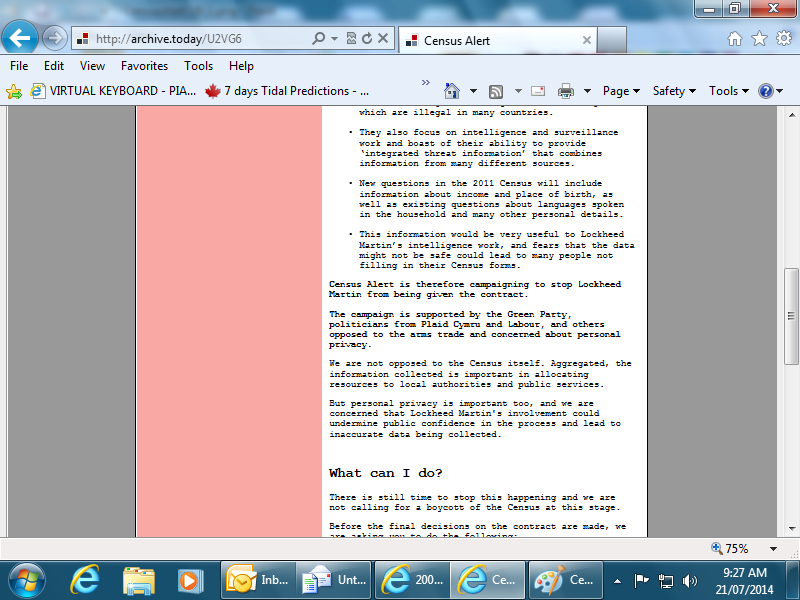
Screen Captures  (July 2014 – the domain name fees have not been paid, the site is not active at this time.)

CensusAlert UK 1


CensusAlert UK 2

CensusAlert UK 3

What’s the problem?

The process of running the 2011 Census will be contracted out by the Office of National Statistics to a private company.

One of the two contractors in the final round of selection is the arms company Lockheed Martin, 80% of whose business is with the US Department of Defense and other Federal Government agencies.

This might concern you because:

  • The Census rules mean that every household will be legally obliged to provide a wide range of personal information that will be handled by the chosen contractor.
  • Lockheed Martin produces missiles and land mines which are being used in Afghanistan and Iraq and which are illegal in many countries.
  • They also focus on intelligence and surveillance work and boast of their ability to provide ‘integrated threat information’ that combines information from many different sources.
  • New questions in the 2011 Census will include information about income and place of birth, as well as existing questions about languages spoken in the household and many other personal details.
  • This information would be very useful to Lockheed Martin’s intelligence work, and fears that the data might not be safe could lead to many people not filling in their Census forms.

Census Alert is therefore campaigning to stop Lockheed Martin from being given the contract.

The campaign is supported by the Green Party, politicians from Plaid Cymru, Labour and the Scottish National Party, and others opposed to the arms trade and concerned about personal privacy.

We are not opposed to the Census itself. Aggregated, the information collected is important in allocating resources to local authorities and public services.

But personal privacy is important too, and we are concerned that Lockheed Martin’s involvement could undermine public confidence in the process and lead to inaccurate data being collected.      . . . .

(Please go to the website for more information.  There is a page on this UK website:

Canada’s census and Lockheed Martin

Lockheed Martin were also involved in the 2006 Census in Canada, and a campaign calling for a boycott was organised by Vive le Canada and supported by progressive  …   etc.

= = = = = = = = = = = = = = = = = = = = == =  = = = = == = =

(3)  LOCKHEED MARTIN SELECTED FOR CONTRACTS ON UK CENSUS,  August 28,  2008

(Link no longer valid:  http://www.lockheedmartin.com/news/pressreleases/2008/0828_lmuk-2011-census.html)

Lockheed Martin Awarded £150M Contract to Support 2011 Census for England and Wales, and Northern Ireland

London, UK, August 28th, 2008 — Today, Lockheed Martin UK and its industry team were selected by the Office for National Statistics to support the 2011 Census for England, Wales and Northern Ireland.  The approximately £150M contract award comes after an extensive competition which required the Lockheed Martin UK-led team to demonstrate its ability to provide secure and accurate data capture and processing support services.

“We are proud to again support the Office for National Statistics in conducting its census,” said Ian Stopps, chief executive of Lockheed Martin UK.  “Together, with our industry team, we are committed to delivering a system that enables the government to efficiently and effectively perform the 2011 Census while ensuring that all information remains secure and confidential”

Lockheed Martin, who successfully provided the data capture elements of the 2001 UK Census, as well as previous censuses for Canada and the United States, has created a consortium of UK-based companies with proven experience. Team members are Broadcasting Support Services (bss), Cable & Wireless, Logica (UK) Ltd, Oracle Corporation UK, Polestar Group, Royal Mail, Steria Ltd, and UK Data Capture Ltd.

Working with the ONS and the Northern Ireland Statistics and Research Agency (NISRA) authorities, the team will design, install and support an innovative system using state-of-the-art character recognition and colour processing for paper census forms. The system will, for the first time, allow for census questionnaires to be completed via the Internet in England, Wales and Northern Ireland.

Lockheed Martin UK, a unit of Lockheed Martin Corporation, is a leader in systems integration working on major programmes spanning the aerospace, defence and civil sectors. Lockheed Martin UK works with more than 100 business partners and employs over 1,700 people at a dozen sites across the UK.

Headquartered in Bethesda, MD, Lockheed Martin is a global security company that employs about 140,000 people worldwide and is principally engaged in the research, design, development, manufacture, integration and sustainment of advanced technology systems, products and services. The corporation reported 2007 sales of $41.9 billion.

Media Contact:
UK: Chris Trippick; 02077982888; mobile: 07905356646; chris.trippick@lmco.com

For additional information, visit our websites:
http://www.lockheedmartin.co.uk
http://www.lockheedmartin.com

Apr 022007
 

They are offering one more chance for me to comply.  I will not be complying. 

From this point forward the stand I have taken is of benefit only if the Government proceeds against me and if there is lots of publicity and participation from the peace activists, in substantial numbers  –  to draw attention to “the unholy alliances” between Government and corporations like Lockheed-Martin, a major player and beneficiary in the American war machine.

No part of the Canadian census had to be out-sourced to Lockheed Martin, one of the most corrupt corporations on the planet. 

I stay in contact with others over the census boycott, people who didn’t fill out a census form.  I’ve sent the following to them. 

==========================

April 2, 2007 

Census – letter from Justice Dept hand-delivered tonight 

Hi,

I just want to register information, and connect with others. 

Tonight around 7:30 a middle-aged man rang my doorbell.  He said “Hi Sandra” as though he knew me and proffered an envelope.  Was apologetic saying he had to run.  I was struggling to recognize the friendly face.  He was wearing blue jeans and a jacket.  Balding.  Could have been a farmer, drove away in a rather nice, shiny-black, half-ton truck. 

The large envelope he handed me is from “Statistics Canada”.  Not sealed.

Inside is from “Department of Justice Canada”. 

The letter is dated March 19.  (NOTE:  hand-delivered April 2.) 

I have been given “one final opportunity to cooperate and avoid a court appearance.” 

“If you have not returned this questionnaire completed in full by March 31, 2007, your file will be sent to the Crown Attorney’s office for prosecution.” 

This has been hand-delivered to me,  April 2, around 7:30pm. 

I am disregarding the letter. 

I checked Vive le Canada web-site.  There’s nothing new posted in the census support group since my last one in October.  Maybe only a few people are receiving the letters from the Govt to enforce compliance. 

I know a farmer in PEI who didn’t fill in his census.  I’ll try to track him down.  Will also get back in contact with the Quaker group in Halifax who registered their position so well with the Government. 

I suspect that my best defence, if this goes to court, will be to show that I am being singled out.  It seems to me that if they prosecute me, they have to prosecute all the others who didn’t comply. 

Cheers! 

Sandra

Mar 222007
 

Thanks to Jim from Ontario: 

“An interesting and provocative lecture, being webcast this evening at 7:30 pm EDT, 5:30 pm CST.  Pre-broadcast video is streaming at the moment, so you can check the connection.  You can also participate real time in question period after the lecture.” 

Coincidentally I caught part of the interview with Darin Barney on CBC Radio and really wanted to hear more.  Now I can – his whole lecture! 

http://www.harthouselecture.ca/index.html  

First, Jim’s input.  Then a few words of my own:   

“Shelagh Rogers interviewed the lecturer, Darin Barney of McGill U, this morning on CBC radio. My provisional reaction (and the lecture may change my mind) is that I didn’t agree with a lot of what he said about the need for citizen review, approval and regulation of emerging technologies.  Where there are risks to health or nature I think oversight by government already exists or can be quickly brought into place, e.g. with recombinant DNA, nuclear power, GM foods.  A huge amount of discussion and debate also takes place in an open democratic society like ours, which politicians ignore at their peril.  I don’t see how his formalized approach would help.  I also don’t think Canadians’ concerns are really any different than those of Brits, Danes, Aussies or Japanese folks.  One country can go it alone setting standards for awhile, but ultimately has to influence then sign on to international standards.  Imagine if a Canadian citizens’ panel had decided in 1980 that the Internet would be more a threat than a positive influence and our government had forbid its deployment!  (North Korea did.) 

Listen in tonight and share your thoughts!”   (Jim)

========================= 

  My reaction was different from Jim’s, largely because of our work on GMO’s and what little I know about nanotechnology. 

To me, Darin Barney is making the point that in a democracy there will be bona fide involvement by citizens in decisions about –  if, and –  how new technologies will be introduced.  The process should ensure that the public interest is protected. 

If you use the example of the introduction of a new technology, bio-technology, as example: 

The Governments in Canada invested very heavily in biotechnology without any debate in Parliament, without the public having any clue that it was happening.  The deed was done before the public became aware.  The public interest was not even considered, only the interests of Monsanto. 

The introduction of new technologies needs to be done by the decision of an informed citizenry.  The role of Government is to regulate new technologies, to protect the environment and citizens, to be wise about what is good for the public and future public. 

Democracy is messy.  That the corporate-driven biotechnology agenda was imposed on Canadians, along with a refusal to label gene-altered food products, is based on the attitude “Big Government knows better than the citizens what is best for the citizens”.  It is an unsound and dangerous-to-democracy perspective.  You cannot claim to have a democracy if decisions are made this way.

Mar 082007
 

From the Supreme Court of Canada website:  (link no longer valid)

http://www.scc-csc.gc.ca/court-cour/ju/spe-dis/bm07-03-08-eng.asp

The Challenges We Face

Mr. President, distinguished guests, thank you for that welcome. I am delighted   to be here again to address the Empire Club.

More than a quarter century ago, a Canadian Justice Minister, Pierre    Elliott Trudeau, challenged Canadians to build “the just society”. In the   ensuing years, thousands of Canadians have worked to establish their visions   of a just society. The centrepiece of Prime Minister Trudeau’s vision   of the just society was the Charter of Rights and Freedoms, adopted   in 1982, and whose 25th anniversary we will celebrate on April 17,   2007. Whatever our political persuasion or our particular conception of justice,   there can be no doubt that Canadians today expect a just society. They expect   just laws and practices. And they expect justice in their courts.

Today, I would like to share with you my perspective on justice in our courts   and the challenges we face in assuring Canadian men, women and children a just   and efficacious justice process.

Let me begin by asserting that Canada has a strong and healthy justice system.   Indeed, our courts and justice system are looked to by many countries as exemplary.   We have well-appointed courtrooms, presided over by highly qualified judges.   Our judges are independent and deliver impartial justice, free of fear and favour.   The Canadian Judicial Council, which I head, recently issued an information   note on the judicial appointments process in which it affirmed these long-standing   principles on which our justice system is based. Canadians can have confidence   that judges are committed to rendering judgment in accordance with the law and   based on the evidence. Corruption and partisanship are non-issues. In all these   things, we are fortunate indeed.

Yet, like every other human institutional endeavour, justice is an ongoing   process. It is never done, never fully achieved. Each decade, each year, each   month, indeed each day, brings new challenges. Canadian society is changing   more rapidly than ever before. So is the technology by which we manage these   changes. Thus it should not come as a surprise that Canada’s justice system,   in 2007, faces challenges. Some represent familiar problems with which we have   yet to come to grips. Others arise from new developments, and require new answers.

In my comments today I will touch on four such challenges:

  • the challenge of access to justice,
  • the challenge of long trials,
  • the challenge of delays in the justice system, and
  • the challenge of dealing with deeply rooted, endemic social problems.
The Challenge of Access to Justice

The most advanced justice system in the world is a failure if it does not   provide justice to the people it is meant to serve. Access to justice is therefore   critical. Unfortunately, many Canadian men and women find themselves unable,   mainly for financial reasons, to access the Canadian justice system. Some of   them decide to become their own lawyers. Our courtrooms today are filled with   litigants who are not represented by counsel, trying to navigate the sometimes   complex demands of law and procedure. Others simply give up. Recently, the Chief   Justice of Ontario stated that access to justice is the most important issue   facing the legal system1.

The Canadian legal system is sometimes said to be open to two groups –   the wealthy and corporations at one end of the spectrum, and those charged with   serious crimes at the other. The first have access to the courts and justice   because they have deep pockets and can afford them. The second have access because,   by and large, and with some notable deficiencies, legal aid is available to   the poor who face serious charges that may lead to imprisonment. To the second   group should be added people involved in serious family problems, where the   welfare of children is at stake; in such cases the Supreme Court has ruled that   legal aid may be a constitutional requirement2.

It is obvious that these two groups leave out many Canadians. Hard hit are   average middle-class Canadians. They have some income. They may have a few assets,   perhaps a modest home. This makes them ineligible for legal aid. But at the   same time, they quite reasonably may be unwilling to put a second mortgage on   the house or gamble with their child’s college education or their retirement   savings to pursue justice in the courts. Their options are grim: use up the   family assets in litigation; become their own lawyers; or give up.

The result may be injustice. A person injured by the wrongful act of another   may decide not to pursue compensation. A parent seeking custody of or access   to the children of a broken relationship may decide he or she cannot afford   to carry on the struggle – sometimes to the detriment not only of the   parent but the children. When couples split up, assets that should go to the   care of the children are used up in litigation; the family’s financial   resources are dissipated. Such outcomes can only with great difficulty be called   “just”.

To add to this, unrepresented litigants – or self-represented litigants   as they are sometimes called – impose a burden on courts and work their   own special forms of injustice. Trials and motions in court are conducted on   the adversary system, under which each party presents its case and the judge   acts as impartial decider. An unrepresented litigant may not know how to present   his or her case. Putting the facts and the law before the court may be an insurmountable   hurdle. The trial judge may try to assist, but this raises the possibility that   the judge may be seen as “helping”, or partial to, one of the parties.   The proceedings adjourn or stretch out, adding to the public cost of running   the court. In some courts, more than 44 per cent of cases involve a self-represented   litigant3. Different, sometimes desperate, responses   to the phenomenon of the self-represented litigant have emerged. Self-help clinics   are set up. Legal services may be “unbundled”, allowing people to   hire lawyers for some of the work and do the rest themselves. The Associate   Chief Justice of the British Columbia Provincial Court is quoted as saying this   is “absurd”, not unlike allowing a medical patient to administer   their own anaesthetic4.

It is not only the unrepresented litigants who are prejudiced. Lawyers on   the other side may find the difficulty of their task greatly increased, driving   up the costs to their clients. Judges are stressed and burned out, putting further   pressures on the justice system. And so it goes.

The bar and the bench are attempting to improve the situation. Some modest   progress is being made. Lawyers are organizing themselves to give free, or pro   bono, service to needy clients. Clinics have been set up by governments,   NGOs and legal groups to help self-represented litigants. Rule changes to permit   contingency fees – the lawyer is paid out of the proceeds of the litigation,   if any – and class actions provide ways for people of modest means to   litigate some tort and consumer actions. Thought is being given to coverage   for legal services within specified limits as an endorsement to home insurance   policies. Justice groups are working to simplify procedures and thus reduce   costs or assist the unrepresented litigant.

All this is good. Yet much more needs to be done if access to justice is to   become a reality for ordinary Canadians.

The Challenge of Long Trials

A second challenge is the challenge of long trials, an increasingly urgent   problem both in civil and criminal litigation. Not too many years ago, it was   not uncommon for murder trials to be over in five to seven days. Now, they last   five to seven months. Some go on for years5.   The length of civil trials is also increasing. For example, in 1996, the average   length of a trial at the Vancouver Law Courts was 12.9 hours. Six years later,   the average length of a trial had doubled, to 25.7 hours6.   This trend is consistent with developments in other jurisdictions throughout   Canada.

There are a number of reasons why trials seem to have taken on a life of their   own. On the criminal side, the Canadian Charter of Rights and Freedoms   has had a significant impact on the criminal trial process. Charter   pre-trial motions regularly last two to three times longer than the trial itself7.   Changes in the law of evidence have also increased litigation and lengthened   trials8.

On the civil side, there are also a number of reasons why trials have become   longer. Although Canadian rules of procedure impose limits on examinations for   discovery, some argue that they are still too broad, allowing parties to canvass   issues that are not relevant and material to the issues in the litigation. This   results in longer, and more expensive discoveries, and a larger volume of evidence   being placed before the trier of fact at trial. The expanded use of expert witnesses   has also lengthened trials.

Efforts at reform are underway. On the criminal side, a recent report by the   Ontario Superior Court of Justice makes a number of recommendations to improve   the efficacy and effectiveness of judicial pre-trial conferences with a view   to improving the efficiency of criminal trials9.   The Ontario government recently launched a process to suggest reforms to the   province’s civil justice system10. A   similar review is underway in British Columbia11.

The Challenge of Delays in the Justice System

A third and related challenge is the problem of delays in the processing of   cases. Here again, the problem afflicts both criminal and civil cases. On the   criminal side, delays in proceedings may result in serious cases being stayed,   since the Charter guarantees a trial within a reasonable time. Delays   may also result in lengthy periods of incarceration for the accused person prior   to trial. Even where the accused is out on bail, the stress of the ongoing proceedings   and the upcoming, ever-deferred trial may be considerable. Witnesses are less   likely to be reliable when testifying to events that transpired many months,   or even years, before trial. Not only is there an erosion of the witnesses’   memories with the passage of time, but there is an increased risk that a witness   may not be available to testify through ordinary occurrences of sickness or   death. As the delay increases, swift, predictable justice, which is the most   powerful deterrent of crime, vanishes. The personal and social costs are incalculable.

On the civil side, different but similar problems arise. Whether the litigation   has to do with a business dispute or a family matter, people need prompt resolution   so they can get on with their lives. Often, they cannot wait for years for an   answer. When delay becomes too great, the courts are no longer an option. People   look for other alternatives. Or they simply give up on justice.

Courts have been promoting various forms of out-of-court mediation and arbitration   as a more effective way of achieving settlement and dealing with many civil   cases. This is good. But the fact is, some cases should go to court. They raise   legal issues that should be considered by the courts for the good of the litigants   and the development of the law.

I do not want to give the impression that all is bleak. Ten years ago, in   Ontario, civil appeals were taking two to three years from the date of perfection   to be heard. Criminal appeals were not much better. They were being heard one   and a half to two years from the date of perfection12.   Today, the time required for bringing appeals on for hearing has been greatly   reduced.

In a recent speech, Ontario Court of Appeal Justice Michael Moldaver noted   that the solution to delays in the justice system was not to hire more judges,   but for the court to take control of the process from the litigants and put   it back in the hands of the judges. This is what happened in Ontario. Within   a space of 18 months, the backlog was gone. Civil appeals in Ontario are now   being heard within nine to 12 months of perfection. Criminal appeals are being   heard within six to nine months.

The Challenge presented by Endemic Social Problems

The final justice challenge I wish to discuss is the challenge presented by   intractable, endemic social problems, including drug addiction and mental illness.

A few years ago, I found myself at a dinner at government house. Next to me   sat the chief of one of Toronto’s downtown precincts. I asked him what   his biggest problem was. I thought he would say the Charter and “all   those judges who pronounce on rights”. But he surprised me. “Mental   illness”, was his reply. He then told me a sad story, one I have heard   throughout the country in the years since. Every night, his jails would fill   up with minor offenders or persons who had created a nuisance – not because   they are criminals, but because they are mentally ill. They would be kept overnight   or for a few days, only to be released – the cycle inevitably to repeat   itself.

Such people are not true criminals, not real wrong-doers in the traditional   sense of those words. They become involved with the law because they are mentally   ill, addicted or both. Today, a growing awareness of the extent and nature of   mental illness and addiction is helping sensitize the public and those involved   in the justice system. This sensitization and knowledge is leading to new, more   appropriate responses to the problem.

One response has been the development of specialized courts – such as   mental health courts and drug courts. As Brian Lennox, Chief Justice of the   Ontario Court of Justice, said recently at the opening of the Mental Health   Court in Ottawa:

The Ottawa Mental Health Court is an example of a progressive movement within     criminal justice systems in North America and elsewhere in the world to create     “problem-solving courts”. These courts, with collaborative interdisciplinary     teams of professionals and community agencies, attempt to identify and to     deal with some of the underlying factors contributing to criminal activity,     which have often not been very well-addressed by the conventional criminal     justice process. The goal is to satisfy the traditional criminal law function     of protection of the public by addressing in individual cases the real rather     than the apparent causes that lead to conflict with the law.

Mental health courts have opened in Ontario, New Brunswick and Newfoundland13.   Many other jurisdictions, including British Columbia, Manitoba, Nunavut and   Yukon, are in various stages of developing these courts. These courts can do   much to alleviate the problems.

Other problem-solving courts within the Ontario Court of Justice include drug   treatment courts and Gladue courts, the latter dealing with aboriginal   offenders. Such courts are also being used in other Canadian jurisdictions.

This is just the beginning. I could go on. The point is this. In a variety   of ways, throughout Canada we are adapting our criminal law court procedures   to better meet the realities of endemic social problems and better serve the   public.

Conclusion

I have shared with you four challenges faced by Canada’s justice system   in 2007 – challenges close to my heart, and that of justice workers, including   judges, throughout Canada. I have also described the efforts which are being   made to alleviate the problems and ultimately, with luck, perhaps solve them.

Let me close on this note. Nothing is more important than justice and the   just society. It is essential to flourishing of men, women and children and   to maintaining social stability and security. You need only open your newspaper   to the international section to read about countries where the rule of law does   not prevail, where the justice system is failing or non-existent.

In this country, we realize that without justice, we have no rights, no peace,   no prosperity. We realize that, once lost, justice is difficult to reinstate.   We in Canada are the inheritors of a good justice system, one that is the envy   of the world. Let us face our challenges squarely and thus ensure that our justice   system remains strong and effective.


Notes

  1. Tracey Tyler, “The dark     side of justice”, Toronto Star, March 3, 2007.
  2. New Brunswick (Minister of Health     and Community Services) v. G. (J.), [1999] 3 S.C.R. 46.
  3. See André Gallant, “The     Tax Court’s Informal Procedure and Self-Represented Litigants: Problems     and Solutions” (2005) 53 Canadian Tax Journal 2. In Anne-Marie Langan,     “Threatening the Balance of the Scales of Justice: Unrepresented Litigants     in the Family Courts of Ontario” (2005) 30 Queen’s L.J. 825,     the author cites data compiled by the Ontario Ministry of the Attorney General,     which show that in 2003, 43.2 percent of applicants in the Family Court Division     of the Ontario Court of Justice were not represented by counsel when they     first filed with the court. The average percentage of unrepresented litigants     in Ontario family courts between 1998 and 2003 was 46 percent.
  4. Tracey Tyler, “The dark     side of justice”, Toronto Star, March 3, 2007.
  5. Hon. Justice Michael Moldaver, “Long     Criminal Trials: Masters of a System They are Meant to Serve” (2005),     32 C.R. (6th) 316.
  6. Supreme Court of British Columbia,     Annual Report 2005 (Vancouver, B.C.: Supreme Court of British Columbia,     2005).
  7. Ibid.
  8. The changes include the expanded     scope of the principled exception to the hearsay rule, increased use of previous     disreputable conduct evidence, third party record applications, and applications     to determine the admissibility of previous sexual conduct of the complainant.
  9. Superior Court of Justice, “New     Approaches to Criminal Trials: Report of the Chief Justice’s Advisory Committee    on Criminal Trials in the Superior Court of Justice” (May 2006),    on-line:     Superior      Court of Justice.
  10. Ministry of the Attorney General,     News Release, “McGuinty Government Launches Civil Justice Reform”     (June 28, 2006).
  11. B.C. Justice Review Task Force,     “Effective and Affordable Civil Justice: Report of the Civil Justice    Reform Working Group to the Justice Review Task Force” (November 2006),    on-line: B.C.      Justice Review Task Force (PDF format, 808 kb).
  12. The Hon. Justice Michael Moldaver,     “The State of the Criminal Justice System in 2006, An Appellate Judge’s     Perspective” (Remarks to the Justice Summit 2006, November 15, 2006).
  13. “Court for Mentally Ill to     Open” Kitchener-Waterloo Record (June 15, 2005), on-line: Canadian      Mental Health Association.
Feb 282007
 

Hi!

A community is made up of the people who live and work in it.  In times gone by, it was largely self-contained.

I recall in my community how deviant behavior was accommodated by people taking it upon themselves to find ways to neutralize the behavior of the deviant, in a caring way.  It was a creative process that required a few people to work out a solution.  It didn’t necessarily involve calling in the police.

Our network is a community – communities are no longer tied to location.  As you know, our networked community includes people from Europe.

The disempowerment of people and communities has been a theme in our work.  … we work to RE-empower ourselves!  Empowerment (becoming healthy) comes from working together to solve the problems that hold us back.

Weyerhaeuser (forest products) is a part of our community.  Its behavior has a substantial impact on the people in our community, our health.

As I see it, I am a responsible, mature adult.  Deviant behavior that is detrimental to the interests of the community needs to be addressed.  AT THE VERY LEAST I can let the person know that his/her conduct is doing harm  – – we expect better.

It is particularly important that I act when the harm is obvious, and the Government isn’t doing anything about it.  And no amount of lobbying causes the situation to be addressed.

Don Mazankowski is one of two Canadians on the Board of Directors of Weyerhaeuser. Some people will remember Don as a Member-of Parliament.

I telephoned Don to ensure that if I sent an email to the Company, addressed to the Board, that he would receive it.

CONTENTS

(1)  COMMENTARY

(2)  LETTER TO HENRIK SYSE, CENTRAL BANK OF NORWAY & TO CANADA PENSION PLAN INVESTMENT BOARD,  COPIED TO GOVERNMENT OF ONTARIO, DEPT OF NATURAL RESOURCES & to FOREST STEWARDSHIP COUNCIL

(3)  LETTER SENT TO BOARD OF DIRECTORS OF WEYERHAEUSER

(4)  PEOPLE WHO ARE BEHIND THE WORD “WEYERHAEUSER”

==============

I invite you to copy and paste from the material below, if you have investments in CPP, mutual and/or pension funds.  If your mutual or pension money is invested in Weyerhaeuser, ask that it be disinvested.  Or send an email to Weyerhaeuser, or forward this email to friends and relatives.

You’ll find some email addresses below.

————————–

(1)  COMMENTARY

Many thanks to Cliff Wallace from the Alberta Wilderness Assoc (AWA) for standards by which forest companies become members of the Forest Stewardship Council.  I phoned FSC, didn’t get a live person, and so included them by way of cc.

BACKGROUND FOR NEWCOMERS:

Norway has come to our attention a few times:

From our work on genetically-modified organisms – Norway has established a secure underground cold storage vault in the far north to safeguard a supply of seeds (non-gmo!).

The German documentary film-maker, Bertram Verhaag’s “Life Running Out of Control” regarding gmo’s, has segments from Norway (sound practices) and from Canada (not-so-sound!!).  We worked with Bertram; his documentaries (“Life..” and “Blue-Eyed, Brown-Eyed”) have been shown on SCN.

We have followed Norway’s work on ethical investing (e.g. they sold off Wal-Mart stocks).

On Feb 22, 2007 we circulated “Norway withdraws support from controversial World Bank fund”, because it forces privatization of water on developing countries.

And I should confess to a family connection: my Mother is an Onarheim (Norwegian Canadian by way of the U.S.).  As a student back in the early 1970’s, I worked at Akergruppen in Oslo (ship-building company, taken over by Fred Olsen Lines).  I stayed with Onar Onarheim (now deceased) who was Director.  I, of course, have fond memories of Norway.  The Norwegians in Alberta hold a camp every summer not far from Red Deer.  I have attended, a great experience. … In so many ways we are from a place that is larger than our countries of citizenship.

Picking up from there …

=====================

(2)  LETTER TO HENRIK SYSE, NORGES BANK AND TO CANADA PENSION PLAN INVESTMENT BOARD, COPIED TO
GOVERNMENT OF ONTARIO, DEPT OF NATURAL RESOURCES & to FOREST STEWARDSHIP COUNCIL

February 28, 2007

TO:  Henrik Syse,  Norges Bank (central bank of Norway)

CC:  Babak Abbaszadeh,  Canada Pension Plan Investment Board

CC:  Government of Ontario, Department of Natural Resources (list at bottom)


Dear Henrik,

The work you are doing in Norway is of great value to people around the globe.  You are a leader.  Corporations must meet ethical standards if public pension money is invested in them.  We hold your actions up to our Governments as the standard we expect of (Canada, in my case).  My heartfelt thanks to you, to your colleagues, and to Norges Bank.

I wish to draw attention to the actions of Weyerhaeuser (forestry).  They do not meet ethical standards.

An assessment of the corporation should consider their ACTIONS versus the RHETORIC of Weyerhaeuser and the Government of Ontario.

Residents of Grassy Narrows (Ontario) put forward their story at a public meeting last evening.  It included photographs of a devastated landscape, the results of clear-cut logging.  Humans and animals in the area also suffer the effects of mercury poisoning.  Weyerhaeuser is logging on lands that belong to other people, without permission.

It is clear:  the fine talk of stewardship and responsible logging practices are simply not true. The web-site  www.freegrassy.org has some of the visual images.  The one that worked best for me is at :http://freegrassy.org/multi_media/video/ – scroll down to “As Long as the River Flows” and click on “Share the preview online at YouTube”.

If you have investments in Weyerhaeuser, I think you will want to consider the REAL EXPERIENCE of the people and the land at Grassy Narrows.

My Canada Pension Plan money is invested in Weyerhaeuser.  I object very strongly and hereby request the Canada Pension Plan Investment Board to disinvest from Weyerhaeuser. (as at march 31, 2006, $19 million dollars invested.)

http://www.cppib.ca/files/PDF/Non_Canadian_Equity_Holdings.pdf

The boreal forest in Canada is extensive and critical to putting the brakes on climate change.  The actions of Weyerhaeuser and the Government of Ontario show no respect for current residents, let alone the future of our children.  The situation has been brought to their attention continuously since 2002 and there has been no action.

There are two Canadians, Don Mazankowski and Richard Haskayne on the Board of Directors of the American Company, Weyerhaeuser.  I have sent the letter below to them and to the entire Board of Directors.  But as they say, “Money talks”.  Citizen action since 2002 has so far met with no response.

(I am amazed by the dedication to peaceful protest by the residents of Grassy Narrows.  I am not sure that I could hold my cool so well:  the devastation of the land and its people, the failure of the people on the Board of Directors of Weyerhaeuser and the Government of Ontario, make my blood boil, if I may speak truthfully.)


Yours sincerely,

Sandra Finley

Saskatoon, Saskatchewan, Canada

(on the western prairies)

————–

cc: Babak Abbaszadeh is with the Canada Pension Plan Investment Board (Stakeholder Relations).

The CPPIB is familiar with Henrik Syse, the philosopher who guides ethical investing at the central bank in Norway (Norges Bank).   babak  AT  cppib.ca

cc:  Government of Ontario, Minister of Natural Resources, Minister Responsible for Aboriginal Affairs, David Ramsay (appointed by Premier Dalton McGuinty in June 2005). david.ramsay  AT  ontario.ca

cc:  Government of Ontario, Deputy Minister of Natural Resources, Gail Beggs. gail.beggs  AT  ontario.ca

cc:  Government of Ontario, MINISTER’S COUNCIL ON FOREST SECTOR COMPETITIVENESS, Secretary/Executive Director Tim Millard, former Deputy Minister of Labour and of the Ministry of the Solicitor General and Correctional Services, and past president of the Ontario Forest Industries Association  (conflict-of-interest?).

(Link no longer valid:  http://www.mnr.gov.on.ca/MNR/csb/news/2005/jun13bg_05.html )    tim.millard  AT  ontario.ca

cc:  Forest Stewardship Council, Canada  info  AT  fsccanada.org

=================

(3)  LETTER SENT TO BOARD OF DIRECTORS OF WEYERHAEUSER

I INTRODUCE YOU TO  – – no! not WEYERHAEUSER.  That is an artificial construct.  I introduce you to the PEOPLE (the Board of Directors):

February 28, 2007

Sent by email from web-page:  (Link no longer valid)  http://www.weyerhaeuser.com/aboutus/contactus/byemail2.asp?CategoryName=Archives

PLEASE SUBMIT THIS TO:

WEYERHAEUSER BOARD OF DIRECTORS

Steve Rogel, Richard Haskayne, Don Mazankowski, Nicole Piasecki, Martha Ingram, John Kieckhefer, Arnie Langbo, Chuck Williamson, Richard Sinkfield, Mike Steuert, Jim Sullivan, and Kim Williams  (biographies below)

Hard copy sent to Canadians on Board:

  • Don Mazankoski, Sherwood Park, Alberta
  • Richard Haskayne, Calgary, AB

Dear All,

RE:  forestry practices of Weyerhaeuser, ethical investing

I am prompted by the situation at Grassy Narrows, but my remarks apply generally.

I am hoping that the two Canadians on the Board of Directors, Don Mazankowski and Richard Haskayne, will clearly present the view of Canadians to you.

Canada Pension Plan money belongs to Canadians.  Many of us challenge investment in unethical companies.  The Norwegians have a large investment fund – royalties from off-shore oil and gas.  I am asking both the CPPIB and Norges Bank to disinvest from Weyerhaeuser.

It is not “socially responsible” to

  • clear cut forests in Canada (or anywhere else)
  • use monoculture tree planting as a replacement for “forest”
  • cause the degradation of water supplies through your forestry practices
  • cut forests that belong to other people
  • contribute to mercury poisoning, when you would not do that to your own families, and especially when climate change and water issues must be addressed by all people, around the globe.

That “the Government allows it” is not an excuse for unethical behaviour.

That “we are responsible to the shareholders” is not an excuse, either.

And please don’t feed me untruths.  Your practices are well documented in pictures.

http://freegrassy.org/multi_media/video/
– scroll down to “As Long as the River Flows” and click on “Share the preview online at YouTube”.

I invite you to consider the long-term consequences of your actions:

  • deforestation is a contribution to concentrations of greenhouse gases.
  • you contribute to the break-down of law and order.  Surely that is not difficult to understand.  When citizens see that corporations (you) are not regulated when you should be, that you are above the law, respect for the rule of law is undermined.  When the society is not ruled by law (good government), people take the law into their own hands.  What other recourse is there?  It becomes an eye-for-an-eye, a tree-for-a-tree.  That is NOT where we want to go.

The need for me to address you directly is a consequence of your behavior in forestry, and of the failure of the Government to perform its regulatory job.  More and more people will deal directly with you, unless there is change.  At least, that seems to me to be the common sense of the situation.

Why should I sit upon my hands and do nothing when we are urgently in need of a change-in-direction in Canada?  Clear-cutting, monoculture here … examples of what is sustainable in other jurisdictions (Switzerland for example).  It is not only the tropical forests that play an essential role in climate change;  the boreal forests of Canada are critical. And still this goes on.  At some point, I say “enough”.)

A private citizen could not get away with what you do.  The only reason that you, the Board of Directors, are not in jail is because you hide behind an artificial construct called Weyerhaeuser.

I will speak frankly:  a huge number of Canadians see the Americans as war-mongers, bullies in the world.  Through your actions (Steve, Richard, Don, Nicole, Martha, John, Arnie, Chuck, Richard, Mike, Jim, and Kim), and even though two of you are Canadians, you contribute to bad feelings between nations. Your actions reinforce the negative stereo-type of “Americans”.

Greed is associated.
I am not likely to notice that Steve does good work with the Boy Scouts.  My sense is that you are seen as part of the problem, not part of the solution to climate change, water quality and justice.  More precisely:  that is how I view you.

Respectability is like religion.  Going to church on Sunday doesn’t make you a spiritual being.

Money doesn’t make you respectable, or a person of influence.  It’s all in your behavior.

I recommend that you take immediate action regarding Grassy Narrows.

Yours truly,

Sandra Finley

(contact info)

===========================

(4)  PEOPLE WHO ARE BEHIND THE WORD “WEYERHAEUSER”

Steve Rogel, Dick Haskayne, Don Mazankowski, Nicole Piasecki, Martha Ingram, John Kieckhefer, Arnie Langbo, Chuck Williamson, Dick Sinkfield, Mike Steuert, Jim Sullivan, and Kim Williams.

Weyerhaeuser in Canada   (Link no longer valid)   http://www.weyerhaeuser.com/aboutus/whereweoperate/wyincanada.asp

BOARD OF DIRECTORS  (Link no longer valid) http://www.weyerhaeuser.com/aboutus/leadership/seniormanagement.asp#refreshTop

Steven R. Rogel, CEO

Steven R. Rogel was elected Chairman, President and Chief Executive Officer of Weyerhaeuser Company on April 20, 1999. Prior to assuming the title of chairman, Rogel served as president and chief executive officer and a member of the board of directors since December 1, 1997.

In 1966, he began his career with St. Regis Paper Company, where he worked until 1970. From 1970 to 1972, he was assistant manager at St. Anne-Nackawic Pulp and Paper in Nackawic, N.B., Canada. He joined Willamette in 1972 as technical director at the company’s operations in Albany, Ore. He was named president and chief executive officer of Willamette in 1995, and served in that position until joining Weyerhaeuser Company in December 1997. Rogel received his Bachelor of Science degree in chemical engineering in 1965 from the University of Washington in Seattle. He completed the executive education programs at Dartmouth College and the Massachusetts Institute of Technology in 1982 and 1989, respectively. He serves on various boards, including the American Forest & Paper Association and the World Forestry Center. He is a director of the Kroger Company, Union Pacific Corporation, Vice President of Administration for the Western Region Boy Scouts of America and co-chair of the Wood Promotion Network.

Directors—Terms to Expire in 2009

Richard F. Haskayne, 71, a director of the company since 2000, is chairman of TransCanada Corporation (gas transmission and power generation) and was chairman of Fording Inc. (coal and industrial minerals) from 2001 to 2003.

He was chairman of NOVA Corporation from 1991 to 1998 until the company merged with TransCanada Pipelines. He was chairman of the board of MacMillan Bloedel Limited from 1996 to 1999 and is also a director of Encana Corporation. He was chairman, president and chief executive officer of Interhome Energy Inc., the parent company of Interprovincial Pipe Line and Home Oil from 1986 to 1991. In 1997, he was appointed an officer of the Order of Canada. In addition, he is director emeritus of the Canadian Imperial Bank of Commerce and board of governors chair emeritus of the board of the University of Calgary (after serving as chair from 1990 to 1996).

Donald F. Mazankowski, 70, a director of the company since 1997, is a business consultant. He was a Member of Parliament, Government of Canada, from 1968 to 1993, served as Deputy Prime Minister from 1986 to 1993 and as Minister of Finance from 1991 to 1993. He also is a director of the Power Group of Companies; Shaw Communications, Inc.; Great West Life Assurance, Investors Group; Yellow Pages Group; Canadian Oilsands Trust and Atco Ltd.

He is a past member of the board of governors of the University of Alberta and is past chairman of the Institute of Health Economics and of the Canadian Genetic Diseases Network.

Nicole W. Piasecki, 43, a director of the company since June, 2003, is executive vice president of Business Strategy & Marketing for Boeing Commercial Airplanes, The Boeing Company. She was vice president of Commercial Airplanes Sales, Leasing Companies from 2000 until January 2003; the Boeing Commercial Airplanes sales director for the Americas from 1997 to 2000; and served in various management positions in sales, marketing, and business strategy for the Commercial Aircraft Group from 1991 when she joined The Boeing Company as a customer engineer on the 777 airplane program until 1997. She is also a director of Coal Valley Company; YWCA; World Trade Center Seattle and is a fellow of the British American Project.

Directors—Terms to Expire in 2008

Martha R. Ingram, 70, a director of the company since 1995, has been chairman of Ingram Industries, Inc. (book distribution, inland barging and insurance), since 1995 and a member of its board since 1981. She was its director of public affairs from 1979 to 1995. She is also a director of Ingram Micro, Inc.; and AmSouth Bancorporation. In addition, she serves on the board of Vassar College, and is chairman of the board of trust of Vanderbilt University. She also serves as chairman of the board of the Nashville Symphony Association, is on the board of the Nashville Opera, the Nashville Ballet and the Tennessee Repertory Theatre and is former chairman of the board of the Tennessee Performing Arts Center. Mrs. Ingram was also chairman of the 1996 Tennessee Bicentennial Commission.

John I. Kieckhefer, 61, a director of the company since 1990, has been president of Kieckhefer Associates, Inc. (investment and trust management) since 1989, and was senior vice president prior to that time. He has been engaged in commercial cattle operations since 1967 and is a trustee of J.W. Kieckhefer Foundation, an Arizona charitable trust.

Arnold G. Langbo, 68, a director of the company since 1999, was chairman of Kellogg Company (cereal products) from 1992 until his retirement in 2000. He joined Kellogg Canada Inc. in 1956 and was elected president, chief operating officer, and a director of Kellogg Company in 1990. He served as chief executive officer of Kellogg Company from 1992 to 1999. He is also a director of Johnson & Johnson and Whirlpool Corporation and serves on the board of the International Youth Foundation.

Charles R. Williamson, 58, a director of the company since October 2004, was the executive vice president of Chevron Texaco Corporation (international oil company) from August, 2005 until his retirement on December 1, 2005. He was chairman and chief executive officer of Unocal Corporation (oil and natural gas) until its acquisition by Chevron Texaco Corporation in 2005. He served as Unocal Corporation’s executive vice president, International Energy Operations from 1999 to 2000; group vice president, Asia Operations from 1998 to 1999; group vice president, International Operations from 1996 to 1997; and held numerous management jobs including positions in the United Kingdom, Thailand and the Netherlands since joining Unocal in 1977. He was a director of Unocal Corporation and former Chairman of the US-ASEAN Business Council.

Directors—Terms to Expire in 2007

Steven R. Rogel, 63, a director of the company since 1997, has been chairman of the board since 1999. He has been the Company’s president and chief executive officer since 1997. Prior to joining the Company, he served as the president and chief executive officer of Willamette Industries, Inc. from 1995 to 1997 and as its president and chief operating officer from 1991 to 1995. He is a director of the Kroger Company and Union Pacific Corporation, and serves on the National Executive Board Boy Scouts of America. He is also former Chairman of the American Forest & Paper Association, and the National Council for Air and Stream Improvement, Inc.

Richard H. Sinkfield, 63, a director of the company since 1993, is a senior partner in the law firm of Rogers & Hardin in Atlanta, Georgia, and has been a partner in the firm since 1976. He was a director of United Auto Group, Inc. (automobile retailer) from 1993 to 1999 and its executive vice president and chief administrative officer from 1997 to 1999. He also is a director of Central Parking Corporation. He is a former director of the Metropolitan Atlanta Community Foundation, Inc. and the Atlanta College of Art. He is a trustee of Vanderbilt University, a member of the executive board of the Atlanta Area Council of the Boy Scouts of America and was a member of the board of governors of the State Bar of Georgia from 1990 to 1998.

D. Michael Steuert, 57, is senior vice president and chief financial officer for Fluor Corporation where he is responsible for the company’s global financial processes. Prior to joining Fluor in 2001, Steuert served as senior vice president and chief financial officer at Litton Industries Inc.  He also held financial management positions at Gencorp Inc. and TRW Inc. Steuert earned both bachelors and masters degrees from Carnegie Mellon University and has attended post graduate training at Harvard University and the University of Pennsylvania Wharton School of Business.

James N. Sullivan, 68, a director of the company since 1998, is the retired vice chairman of the board of Chevron Texaco Corporation (international oil company) where he was a director from 1988 to 2000. He joined Chevron Texaco in 1961, was elected a vice president in 1983 and served as its vice chairman from 1989 to 2000.

Kim Williams, 51, was appointed a director to fill a vacancy effective Oct. 1, 2006. She recently retired from Wellington Management where she had served as a senior vice president and partner since 1995. In her 26 years in the investment management business, Williams established strong credentials as a financial analyst with more than 20 years experience covering industries including paper and forest products, publishing, metal and mining, and home improvement. During her career, Institutional Investor Magazine repeatedly recognized Williams as a “Best of the Buy Side” analyst.

Williams began her career as an investment analyst with the Imperial Chemical Industries Pension Fund in London, England in 1979. She also worked at Loomis, Sayles and Co., Inc. in Boston before joining Wellington in 1986.

Williams holds a masters in economics from the University of London.

Feb 222007
 

We’ve been following Norway’s “walk the talk”:

Norway’s withdrawl from the World Bank fund is another example of the international ethical leadership provided by this country of fewer than 5 million people.

Developing countries and water activists from around the world have fought the coercive nature of the World Bank’s policies.  Developing countries receive aid for securing water supplies, but only if they agree to participation (privatization) by the international water corporations – e.g. Bechtel, Suez, Vivendi.  Maud Barlow, the Council of Canadians, is among the international leaders who has fought shoulder-to-shoulder with people in, for example, Cochabamba Bolivia, where Bechtel was driven out.

To my knowledge, Norway is the first country to say, “The World Bank is wrong.  We are withdrawing our financial support.”  What an action of support and encouragement this is for “doing what is right”!

QUESTION:  who of you knows, which Department of the Government of Canada decides Canadian contributions to this World Bank fund?

=============================

NORWAY WITHDRAWS SUPPORT FROM WORLD BANK FUND, WATER PRIVATIZATION

PRESS RELEASE  22. February 2007

Norway has decided to pull out of a controversial World Bank fund that actively promotes water privatisation in developing countries. Norway has contributed $2,85 million to the Public Private Infrastructure Advisory Facility (PPIAF) since 1999.

During a meeting with the Norwegian Ministry of Foreign Affairs yesterday, representatives of the Norwegian NGO, the Association of International Water Studies (FIVAS) and the British advocacy group, World Development Movement (WDM), heard that Norway’s contributions to the fund would cease on the 30 June 2007.

WDM and FIVAS have published a new report entitled “Down the Drain: How aid for water sector reform could be better spent” that investigates the activities of PPIAF and shows how the fund actively promotes water privatisation by the use of consultants. This is despite the fact the strategy of water privatisation is widely acknowledged to have failed, particularly for the poor.

The report also criticises the fund’s consensus building activities which involve persuading sceptics and opponents in developing countries to accept the benefits of water privatisation. The authors consider this interference in recipient countries’ ability to conduct a free and democratic debate on the issues.

Torbjørn Urfjell, the political adviser for the Ministerof Development, Erik Solheim, said during the meeting that the Ministry of Foreign Affairs no longer viewed the fund as a means to solve the problem of access to water for the poor. The decision can also be seen as following the intentions of the Government’s Action Plan for Environment in Development Cooperation that wishes to see water as a common good, said Urfjell.

“This is good news,” said Andrew Preston, director of FIVAS. “We’re not talking about a large amount of money in development terms, but it’s nonetheless an important and correct decision. We hope this will send a signal to other donor countries, and not least the World Bank itself, that there are better ways of using aid funds.”

The report Down the Drain recommends alternative ways of increasing access to water for the poor. The report suggests financial support to strengthen the public sector through increased cooperation between public water operators.
For more information, contact:

Feb 142007
 

Wow!  It’s time to party!  Let’s sing and dance in cyber space!

Many people in our network and others across Canada and beyond joined in the effort to stop the registration of roundup-resistant (herbicide-tolerant) alfalfa in the U.S.

The American group, the Center for Food Safety, took on the court battle.

Many thanks to Lucy Sharratt, coordinator of CBAN (Canadian Biotechnology Action Network, Collaborative Campaigning for Food Sovereignty and Environmental Justice) and the ETC Group for their relentless work.

This is exciting!

================

From: CBAN Coordinator-Lucy Sharratt <coordinator  AT  cban.ca>

Subject: [gene-allies] US Alfalfa suit won!

http://www.nytimes.com/2007/02/14/business/14crop.html

U.S. Agency Violated Law in Seed Case, Judge Rules

By ANDREW POLLACK

February 14, 2007


A federal judge ruled yesterday that the Agriculture Department violated the law by failing to adequately assess possible environmental impacts before approving Monsanto’s genetically engineered alfalfa.

Judge Charles R. Breyer of Federal District Court in San Francisco said the agency had been “cavalier” in deciding that a full environmental impact statement was not needed because the potential environmental and economic effects of the crop were not significant.

Plaintiffs in the case – some alfalfa seed companies and environmental and farm advocacy groups – said they would push to stop the sales and planting of the alfalfa, which is resistant to Monsanto’s Roundup herbicide.

Joseph Mendelson, legal director of the Center for Food Safety, a Washington advocacy group that organized the lawsuit, said the decision by itself could block commercial sales of genetically engineered alfalfa seeds but that the plaintiffs would ask for an injunction to make sure.

Judge Breyer asked the parties to meet and propose remedies to him by Feb. 26.

Christopher R. Horner, a spokesman for Monsanto, said the company had not seen the decision but thought it would not affect its business.

Monsanto was not named in the suit, which was filed against the Agriculture Department.

Calls to several spokesmen for the Agriculture Department were not returned. A recording in the department’s communications office said the government closed early yesterday because of expected bad weather in Washington.

A federal judge in Washington said last week that the Agriculture Department had not done adequate assessments before approving field trials of genetically engineered grass. And last August a federal judge in Hawaii, in a case involving field trials of crops engineered to produce pharmaceuticals, ruled that the Agriculture Department had not adequately assessed the possible impact on endangered species.

Mr. Mendelson of the Center for Food Safety said yesterday’s decision could set a precedent that would require the Agriculture Department to do full impact statements for other biotech crops before they are approved.

The Roundup Ready alfalfa was deregulated by the Agriculture Department in June 2005, meaning it could be grown outside of field trials. It was the first approval in years of a new genetically engineered crop.

Because alfalfa is the fourth most widely planted crop in the United States, the action presented a big opportunity for Monsanto.

The Agriculture Department had first done an environmental assessment, which concluded that a longer and more detailed environmental impact statement was not needed. This was in part, the agency said, because the implanted gene conferring herbicide resistance was harmless to people and livestock.

But Judge Breyer, in his 20-page opinion, said that the agency had not adequately considered the possibility that the gene could be transferred by pollen to organic or conventional alfalfa, hurting sales of organic farmers or exports to countries like Japan that did not want the genetically engineered variety.

“An action which potentially eliminates or at least greatly reduces the availability of a particular plant – here, nonengineered alfalfa – has a significant effect on the human environment,” he wrote.

The judge also said that the Agriculture Department had too easily dismissed the possibility that planting Roundup-resistant alfalfa would lead to wider use of Roundup, which in turn would contribute to the development of weeds resistant to the popular herbicide. That is particularly a risk, he said, because many other crops like soybeans and corn are also resistant to Roundup, which is known generically as glyphosate.

“One would expect that some federal agency is considering whether there is some risk to engineering all of America’s crops to include the gene that confers resistance to glyphosate,” he wrote.

– – – – – – – – –

Lucy Sharratt, Coordinator

Canadian Biotechnology Action Network (CBAN) Collaborative Campaigning for Food Sovereignty and Environmental Justice

Ottawa, Ontario, Canada