Scroll down to VIDEO – – listen to the first part.
Australia is a member of “FVEY“, a U.S. – U.K. – Canada – Australia – New Zealand coalition on surveillance, “integration” of military, and so on. For more info, enter “FVEY” in the search button at top right of this blog page.
I am concerned because FVEY countries enact the same/similar legislation, at the behest of the U.S.
I will be interested to know whether others are of similar view: it will become increasingly difficult for local organizations to work with international on-line communities like 350.org, Beyond War, and the many others.
If the word “socialist” triggers negative stereotypes for you, a short report on the new “foreign Interference” laws, from the BBC, without critical comment, is at:
(I don’t agree with all the views of SEP, but then, I seldom agree with all the views of anyone!)
SEP (Australia) holds Sydney meeting against new “foreign interference” laws
By our reporters
On Sunday, the Socialist Equality Party held a successful meeting against Australia’s new “foreign interference” laws in Bankstown, a working-class suburb in south-west Sydney. The event was part of a national series, with meetings to be held in Melbourne and Newcastle next Sunday, and in Brisbane on July 28.
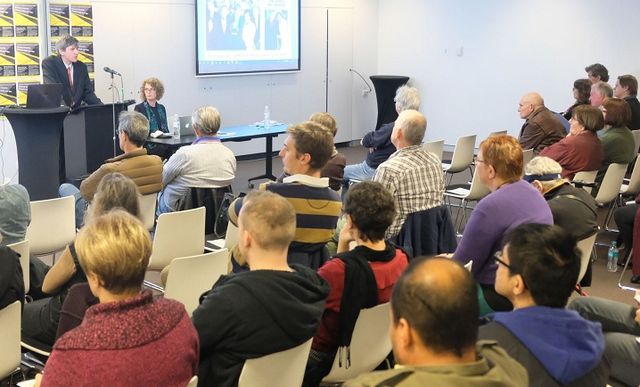
The Sydney meeting was the first public event held by an Australian political party against the anti-democratic legislation since it was rushed through parliament late last month. It was attended by a cross-sections of students, young people, retirees, and workers, including teachers, construction employees and clerical staff.
The meeting was streamed live on Facebook, attracting viewers throughout the country, and internationally, including in the United States, Canada, Sri Lanka, India, Kenya and elsewhere.
VIDEO
After the “live streaming” announcement, Linda Tenenbaum starts talking. Click on the sound button at bottom right of the video, to get audio.
Skip past the introduction; the content begins at about 1.5 minutes, with words “Exactly 4 weeks ago . . .” – – re Assange. Tenenbaum moves quickly to the Foreign Interference Laws. Stay with her into the second part of the Laws (FITS). There’s the bite.
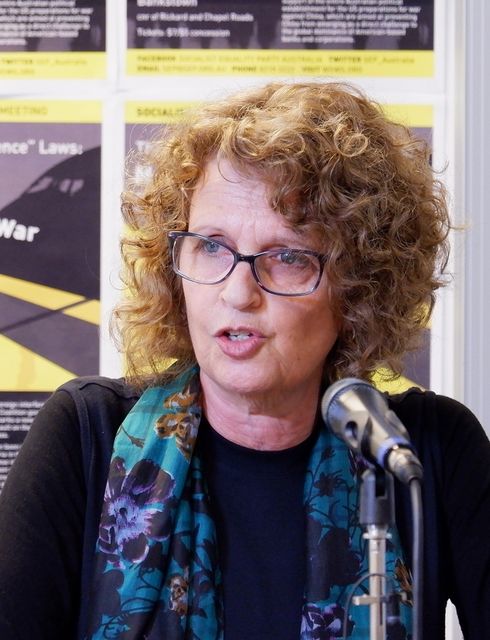
In opening the meeting, Linda Tenenbaum, a longstanding SEP leader, reviewed the significance of the June SEP rally in Sydney, which demanded freedom for Julian Assange. She noted that the speakers at the demonstration had warned that the persecution of the WikiLeaks editor was a preparation for the suppression of mass opposition to war, austerity and authoritarianism.
Linda Tenenbaum
The passage of the foreign interference laws, “confirms our warning,” Tenenbaum said. “In what represents nothing less than a move towards authoritarianism and the state repression of dissent, the Coalition Liberal-National government and the Labor opposition rammed the 150-page legislation through both houses of parliament, in just three days.”
Tenenbaum reviewed the contents of the laws. She stated that they could be deployed to criminalise anti-war activities and organisations, to persecute political organisations with international affiliations and to suppress whistleblowers and journalists who expose government crimes.
Tenenbaum noted that many of the key terms in the laws were not defined, giving the government and the courts broad scope for politically-motivated prosecutions.
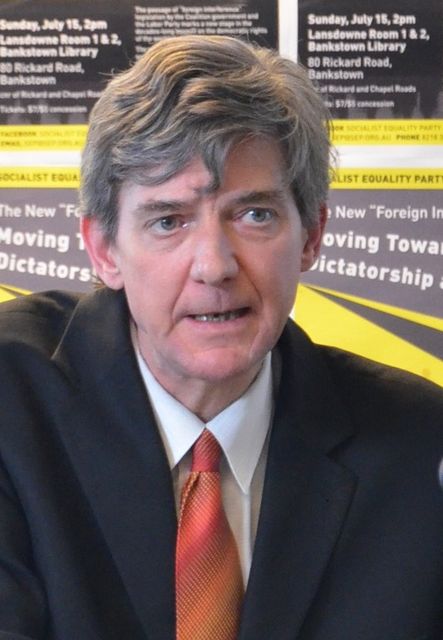
SEP national-secretary and leading WSWS writer James Cogan was the main speaker. He delivered an extensive report, placing the laws in the context of Australia’s integration into the US-led war drive in the Asia-Pacific region and internationally.
James Cogan addressing the Sydney meeting
Cogan warned that the legislation was, “intended to create the legal means for the mass repression of opposition in Australia to the country’s involvement in a military conflict with China.” He reviewed the role of Washington in agitating for the passage of the laws, and stated that they were intended to be a “model for similar legislation in the US, New Zealand,” and elsewhere.
Cogan said that successive US administrations had made clear they would brook no opposition to Australian involvement in US-led conflicts, including the plans for war with China. He displayed a map of US military installations across the country, and commented: “Australia is so integrated with the US war machine that the American military takes it for granted that the Australian military will fight alongside them in any conflict.”
Cogan warned that the anti-China campaign waged by the Australian political and media establishment, and the legislation, recalled repressive measures taken during World War I and II.
The speaker reviewed the growth of social inequality, and stated that “in desperation and fear,” the ruling class was using xenophobic and anti-Chinese rhetoric in an attempt to “divert the working class from linking its social struggles with the fight to build an international anti-war movement.”
The reports were followed by a lively question and answer period.
One attendee asked if there was a relationship between the ongoing purge of federal parliamentarians eligible for dual citizenship, and the passage of the “foreign interference” laws.
James Cogan
Cogan explained that the ouster of MPs with dual citizenship was being conducted on the basis of reactionary constitutional provisions, which prohibit parliamentarians from holding an “allegiance to a foreign power.” He noted that, like the anti-China witch-hunt, this was aimed at cultivating a “nationalist mood,” amid the preparations for war, in which “loyalty to the Australian state,” was demanded of all.
Two audience members asked what could be done to oppose the laws.
In response, Cogan stated that it was necessary to “break the conspiracy of silence surrounding the legislation,” that had been maintained by the official parliamentary parties and the media. The anti-democratic content of the laws had to be “exposed, critiqued” and made known to workers and young people across the country, he stated.
Cogan stated that the working class could not allow the gains of “centuries of struggle against despotism, and decades of struggle to build-up democratic rights” to be “swept aside by a cabal of Labor and Coalition hacks in the parliament.”
“The most serious answer that anyone can make to the assault on democratic rights,” Cogan said, “is to understand that it is the product of decaying capitalism, and to join our party and take up the fight to build the international socialist movement, against war, austerity and authoritarianism.
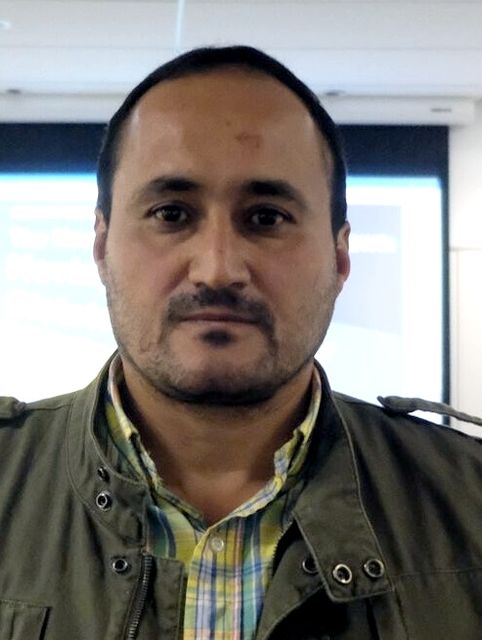
Ehab
WSWS reporters interviewed members of the audience at the conclusion of the meeting. Ehab, a worker originally from Egypt, said, “What has happened in Egypt looks like it is happening in Australia. The foreign interference laws and other anti-freedom laws are similar to what the Egyptian government has imposed for years. Anti-freedom laws are being put in place by governments all over the world.”
Ehab drew a parallel with the raft of anti-terror laws passed in Australia, and the state persecution of Muslim workers. “As a Muslim, when I return to the country, I am always subjected to a search. I thought it would end after a couple of times and they realised that I was a good guy.
“They were not doing it to me just because I was Muslim. They are using that as a catalyst to take away the rights of the entire population. They always come up with an excuse, whether it is to stop Muslim terrorism, or to prevent foreign interference, but what they are really doing is stripping us of our freedoms.”
Mick, a crane operator from western Sydney, said: “I knew very little about the foreign influence laws until I met you guys and definitely want to find out more. What I do know is that they are no good for people in Australia because they undermine freedom of speech.
Mick
“The main thing I learnt from today’s meeting is that the Australian government is in bed with the American government on every political issue. They just follow along, but we don’t have any say. I don’t believe we should blindly follow another nation, especially the US, which has made war on false pretences in Iraq and Afghanistan and produced a disaster for those people.
“The new laws are very dangerous for someone like Julian Assange and would be used against him if he came back to Australia. Assange has tried to open people’s eyes, not just in this country but all around the world. The fact that the media is not writing anything about the dangers that he faces is wrong.
“Assange has committed his life to telling people the truth about world politics and what’s really going on. He has to be supported. And it isn’t just about him. What’s going to happen to people like John Pilger and other honest journalists if the persecution of Assange isn’t stopped?
“Once these foreign influence laws are implemented they will be used to silence people like John Pilger and others. And from what I understand it isn’t just journalists that will be affected, but will be used to stop people protesting against war and other government policies. This is heading towards dictatorship.”
Although he denied it was aimed specifically at China, the move has added to diplomatic tensions with Beijing in recent months.
The wide-ranging laws, approved in the Senate on Thursday, target foreign interference in politics and other domestic affairs, as well as espionage.
Among key provisions, they will require lobbyists for foreign governments to identify themselves on a public register.
In December, Mr Turnbull said the crackdown followed warnings by intelligence agencies that were “necessarily classified”.
“Foreign powers are making unprecedented and increasingly sophisticated attempts to influence the political process, both here and abroad,” he said at the time.
He later acknowledged “disturbing reports about Chinese influence”, an assertion that has been strongly denied by Beijing.
Last week China’s ambassador to Australia, Cheng Jingye, reiterated his warning that a “Cold War mentality” was undermining relations.
What are the new laws?
The government has described the laws as the most significant counter-espionage reforms in Australia since the 1970s.
They were approved following months of review by a parliamentary national security committee.
The laws criminalise covert, deceptive or threatening actions that are intended to interfere with democratic processes or provide intelligence to overseas governments.
They are designed to include actions that may have fallen short of previous definitions of espionage.
Media caption Is China trying to influence Australian politics?
Industrial espionage – the theft of trade secrets – is among new criminal offences, while people who leak classified information will face tougher penalties.
The government also plans to ban foreign political donations through a separate bill later this year.
You may have guessed: I am making plans now, to attend the following.
Please help spread the word. And let your MP know your position (not necessarily the same as mine!). Thanks! Sandra
– – – – – – – – – – – – – – –
CORRECTION: I did not write the notice below. It is wrong in the statement “By July 22nd, the Trudeau government will decide . . .”(the buy-out of the Kinder Morgan). As I understand, July 22nd was the date of a Kinder Morgan shareholders’ meeting at which a decision would be made to accept (or not) the deal to purchase.
– – – – – – – – – – – – – – –
We have less than 2 weeks to stop Trudeau’s Big Oil buy out.
By July 22nd, the Trudeau government will decide whether or not to finalize the multi billion dollar deal to buy out Kinder Morgan’s Trans Mountain pipeline with our tax dollars. Before they do, let’s show them that resistance here on the Salish Coast is here to stay.
WHAT: Protect the Inlet Flotilla: By Land and By Sea WHERE: Whey-Ah-Whichen (Cates Park), North Vancouver
WHEN: 10:00 am – 4:00 pm on Saturday July 14th
RSVP if you will be there to protect the land, water and climate from Kinder Morgan.
We know that when we rise up, we win. Thanks to Indigenous led resistance, Kinder Morgan’s made it clear that its ready to walk away from the Trans Mountain pipeline. Let’s show Trudeau that he’d be wise to walk too.
Thanks to people power, Trudeau’s own caucus is torn on this issue. After historic resistance on the BC Coast and in over a hundred communities across the country opposing the pipeline buy out, the NDP forced a vote in Parliament. They voted on whether to support real climate leadership and investment in renewable energy, or to “spend billions of dollars on increasingly obsolete fossil fuel infrastructure.” A few Liberal MPs voted in support of the motion — showing the cracks in Trudeau’s inner circle caused by our movement.
PS – Did you hear about the People’s Town Halls on the Kinder Morgan pipeline featuring screenings of the new documentary “Directly Affected”? Find one near you or sign up to host one.
The driver behind this video is a popular, well-known German comedian, I believe.
In my mind, the video is an interesting and creative tactic to counter the drift toward fascism.
One complaint?: the language of the young girl near the end is offensive.
Or, a recommendation?: Stop the video, don’t listen to the rest, when the young girl takes centre stage.
Or, how about this?: figure out WHY the shock was used. It’s obviously smart people who made the video. Maybe? it goes like this: the makers took the obscenities used by those they oppose, and put them into the mouth of a “sweet young thing” associated with Deutschland (Germany). The crudity of those they oppose is thereby amplified a hundred fold. I think it’s effective, IF you can stomach it long enough to figure it out. Then next time, stop the video before the end!
To remind myself how long-standing and KNOWN the problem of U.S. interference is, I added some background to the recent news “Ecuador judge orders ex-president Correa be jailed”.
In my view, the best life insurance for former president Rafael Correa is the sharing of information – – people have to know what’s going on.
RECENTLY, (2018) (find the full text further down, under “RECENTLY”):
July 3: Ecuadorean judge orders that ex-President Rafael Correa be jailed
July 6: Ecuador: 10 Detained As Media Ignores Massive Anti-Gov’t Protest
January 21: Ecuador’s Correa ‘Afraid for Julian Assange’s Safety’ /“It will only take pressure from the United States to” withdraw protection for Assange said Correa.
(I have some fixing to do on the listing and numbering of the Content of this posting.)
Ironic: (#3 above – Correa afraid for Assange’s safety) Correa should be afraid for himself (the intention is now for him to be jailed).
For 10 years Correa was a defender of the interests of the Ecuadorean people; and he granted Julian Assange asylum in the Ecuadorean Embassy, London. Correa’s successor is Lenin Moreno. Correa eventually realized the danger for his family under Moreno’s presidency, and moved to Belgium in time to avoid arrest in Ecuador.
Ecuador’s Ailment: Ecuador suffers from an abundance of natural resources that The Corporations want. It always kills me – – if you want to see how much at risk a nation is for U.S. Interference, you have only to go to the CIA website:
Definition: This entry lists a country’s mineral, petroleum, hydropower, and other resources of commercial importance, such as rare earth elements (REEs). In general, products appear only if they make a significant contribution to the economy (INSERT: doesn’t say for whose economy), or are likely to do so in the future.
(INSERT: hydropower means “water”, and also, there is an abundance of minerals in Ecuador – – mining company interests. “Petroleum” interests are always synonymous with the poisoning and destruction of healthy water supplies. In Ecuador’s case, rain forest destruction is also a source of local resistance.)
Ecuador is an oil-producing nation, a member of OPEC.
Former president of Ecuador for 10 years (2007 – 2017), Rafael Correa stood up to the U.S. and Corporate Interests, in defense of the interests of his people.
Correa granted asylum to Julian Assange in the Ecuadorean Embassy in London, in 2012.
In fear for safety, Correa moved his family to Belgium (his wife’s original home).
So now the smear campaign against Correa begins IN EARNEST.
The recent news is not surprising: attempts to have Correa arrested (an Interpol warrant) and returned to Ecuador for trial. They will eventually get Assange, too – – UNLESS – – unless, we can help the Ecuadorian protesters counteract the Media Black-Out of the Massive Anti-Gov’t Protests in Ecuador.
= = = = = = = = =
Washington Moves Against Rafael Correa
First Washington went after Julian Assange for exposing US war crimes, and now Rafael Correa for granting Assange asylum in the Ecuadoran embassy.
From the Foreign Policy Journal, by Paul Craig Roberts, July 5, 2018
As President of Ecuador, Rafael Correa was a Godsend for the Ecuadorian people, for Latin American independence, and for WikiLeaks’ Julian Assange. By serving justice and truth instead of Washington, Correa earned Washington’s hatred and determination to destroy him.
Correa was succeeded as president by Lenin Moreno, whom Correa mistakenly believed to be an ally, but who has every appearance of being a Washington asset.
The first thing that Moreno did was to make a deal with Washington, block Correa from being able to again stand for the presidency and turn on Julian Assange.
Moreno wants to revoke the asylum granted to Assange and has prevented Assange from continuing his journalistic activity from the Ecuadorian embassy in London. In other words, Moreno has conspired with Washington and the UK to effectively imprison Assange in the embassy.
Now Moreno has taken another step that highlights his character as a blackguard. Correa, realizing that he and his family were in danger, moved to Belgium. An Ecuadorian court has now ordered the Belgians to detain Correa and extradite him to Ecuador on a fabricated kidnapping charge.
Correa thinks that Belgium will not comply with an absurd charge for which no evidence is presented and that the charge is intended to smear his name.
If I were Correa, I would not be so sure. Look at the ease with which Washington was able to use its vassals—Sweden and the UK—to effectively nullify the political asylum that Ecuador gave Assange.
Belgium is also Washington’s vassal and will experience threats and bribes—whatever it takes—to deliver Correa into Moreno’s hands, which is to say into Washington’s hands.
= = = = = = = = =
Excerpt, Wikipedia:
Correa won the presidency in the 2006 general election on a platform criticizing the established political elites. Taking office in January 2007, he sought to move away from Ecuador’s neoliberal economic model by reducing the influence of the World Bank and International Monetary Fund.
– – – – – – – – – – – – –
Excerpt, research paper below, Ecuador After Ten Years of President Correa: New Paper Examines Key Indicators, Reforms, and Policy Changes
The paper notes that these results (INSERT: benefits for Ecuadorean people) were not driven by a “commodities boom,” but from deliberate policy choices and reforms that the Correa government enacted, including ending central bank independence, defaulting on illegitimate debt, taxing capital leaving the country, countercyclical fiscal policy, and ― in response to the most recent oil price crash ― tariffs implemented under the WTO’s provision for emergency balance of payments safeguards.
“Ecuador’s experience over the last ten years indicates that a relatively small, lower-middle income developing country is less restricted in its policy choices by ‘globalization’ than is commonly believed,” Weisbrot said.
– – – – – – – – – – – – –
Cont., from Wikipedia:
He (Correa) declared Ecuador’s national debt illegitimate and announced that the country would default on over $3 billion worth of bonds; he pledged to fight creditors in international courts and succeeded in reducing the price of outstanding bonds by more than 60%.[1] He oversaw the introduction of a new constitution, being re-elected in 2009 and again 2013 general election. During Correa’s presidency, he was part of the wider Latin American pink tide, a turn toward leftist governments in the region, allying himself with Hugo Chávez‘s Venezuela and brought Ecuador into the Bolivarian Alliance for the Americas in June 2009.[2] Using its own form of 21st century socialism, Correa’s administration increased government spending, reducing poverty, raising the minimum wage and increasing the standard of living in Ecuador.[2][3][4] By the end of Correa’s tenure, reliance on oil, public overspending, and 2016 earthquakes (more than 650 deaths and damage estimated at the equivalent of about 3% of GDP) caused Ecuador’s economy to enter a recession, resulting in government spending being slashed.[2][3][4][5]On 3 July 2018, a judge in Ecuador ordered the arrest of Correa after he failed to appear in court during a trial surrounding the kidnapping of a political opponent. Correa, who lived in Belgium at the time, denied the allegations regarding the kidnapping.[6]
= = = = = = = = = = = = = =
RECENTLY,
WORLD NEWS JULY 3, 2018
Alexandra Valencia
QUITO (Reuters) – An Ecuadorean judge on Tuesday ordered that ex-President Rafael Correa be jailed as part of a case involving the kidnapping of a lawmaker, setting up a showdown with the Belgium-based leftist politician who vowed to appeal and defy the orders.
In 2012, former opposition lawmaker Fernando Balda was briefly kidnapped in neighboring Colombia, where he had fled after being sentenced to two years in prison for slander against Correa.
Balda accused Correa of having orchestrated the kidnapping, which the Colombian police broke up after a few hours.
Correa, who governed the Andean country for a decade, has always said he had nothing to do with the incident and has accused his successor Lenin Moreno of seeking to smear his administration for political gain.
The state prosecutor’s office in June requested that Correa be linked to the proceedings as the “author” of the incident.
Judge Daniella Camacho accepted that request and ordered Correa, who is living in Belgium, where his wife is from, to present himself in Ecuadorean courts every two weeks.
Instead, Correa on Monday presented himself to the Ecuadorean consulate in Belgium, which the judge on Tuesday termed a violation of her orders.
“Judge Daniella Camacho receives the prosecutor’s request and orders preventive prison for ex-president Rafael C. for his alleged participation in the crime of illicit association and kidnapping,” the Ecuadorean prosecutor’s office said on Twitter.
“A request will be submitted to Interpol for his capture, with the aim of extraditing him.”
Correa’s lawyer Caupolican Ochoa said the decision was a result of political pressures from Moreno, who was once an ally of Correa but turned on his mentor after being elected last year.
“This decision is arbitrary, it is a lie, it is defamatory. I do not believe they are seeking justice but rather revenge,” Ochoa told journalists at the end of the hearing, adding he would appeal.
Right after the decision, Correa tweeted that any attempt to jail him would fail.
“I’m well. Do not worry,” Correa tweeted. “They will seek to humiliate us and make us suffer a tough time, but a monstrosity like this will NEVER prosper in a country like Belgium with rule of law.”
Additional reporting by José Llangarí; writing by Alexandra Ulmer; editing by Chris Reese and Richard Chang
Ecuador: 10 Detained As Media Ignores Massive Anti-Gov’t Protest
Protesters reject neoliberal reforms and show their support for Rafael Correa.
Published 6 July 2018
Photo: @PaolaPabonC
Protesters rejected the “political persecution” against former president Rafael Correa, and a series of economic reforms they say benefit economic elites.
Ecuadorean police detained ten people during Thursday’s “Indígnate Ecuador” (which translates to Be Outraged Ecuador) march against a series of neoliberal economic reforms and political persecution, most notably against former president Rafael Correa.
Those detained were charged with causing a public disorder. Via Twitter, the police said that three of those arrested also had criminal records for robbery and homicide, among others offenses.
Through social media, civil society organizations and citizens condemned the police for obstructing the peaceful protest and arresting at least five people before the rally began for handing out posters that invited others to march.
Foro de los Comunes, an organization of academics and activists, tweeted Thursday “Today | Five detained by 15 policemen in five patrol cars for pasting posters inviting people to march. The government of ‘tenderness’ and the ‘outstretched hand.’ #IndígnateEcuador.”
One incident of violence documented by TeleSUR’s reporting team occurred when a group of 30 protesters attempted to bypass a police blockade that kept them from reaching the Carondelet, Ecuador’s presidential palace. The event took place as thousands more, who were protesting against a series of reforms made by Lenin Moreno’s government continued to walk peacefully to Domingo square, where they gathered to hear speeches by political leaders.
Ecuadorean media outlets have been accused of underreporting or mischaracterizing the number of protesters or the cause of the protest by observers; they have also been accused of exaggerating the incidents of violence that occurred.
Carlos Perez, a member of Quito’s city council, said on Twitter: “Do these newspapers close their edition at noon, they don’t have reporters in Quito or are they deliberately hiding what happened yesterday afternoon? What bothers me the most is @el_telegrafo a public outlet that should be an example of an independent and plural press.”
El Telegrafo, a state-owned Spanish-language daily newspaper based in Guayaquil, claimed there were only 1,000 protesters in Quito and both El Telegrafo and El Comercio, a privately owned newspaper based in Quito, stated that the march was motivated solely by the recent order for preventive detention of Correa. Critics claim, and a review of the reporting confirms both failed to report that the protesters were also against the government’s policy of debt forgiveness for the business sector, the Productive Development Law, and austerity measures that have affected Campesinos, and the cut the budget of the Ministry of Social and Economic Inclusion.
“First, First First is the Worker. Later, later the money of the bourgeois,” citizens chanted as the also rejected a series of tax breaks given to foreign investors.
Media outlets also failed to cover the placards and chants, which highlighted the press’ role in the campaign of persecution against Correa.
One of the signs carried yesterday reads “Press. You will not deceive us again, TODAY you occupy power with political hate to quench your thirst for revenge.”
= = = = = = = = = = = = = = =
3. News > Latin America
January 21, 2018
Ecuador’s Correa ‘Afraid for Julian Assange’s Safety’
“It will only take pressure from the United States to” withdraw protection for Assange said Correa.
Former Ecuadorean president Rafael Correa has warned that WikiLeaks founder Julian Assange’s days are numbered at the Ecuadorean Embassy in London.
Correa, who gave Assange asylum back in 2012, said that he’s “afraid for Julian Assange’s safety” due to the new government´s actions with regards to his case. He said that he believes President Lenin Moreno is likely “take away the support” previously afforded to the anti-secrecy activist.
“It will only take pressure from the United States to” withdraw protection for Assange and “surely it’s already being done, and maybe they await the results of the Feb. 4 (referendum) to make a decision,” said Correa, in an article published by AFP.
When asked does he have evidence to support his claim, Correa said it’s clear that Moreno “has no convictions, it’s clear that he has yielded to the usual powerbrokers” and will “soon enough yield regarding the question of Assange.” The 54-year old economist added that the ambassador for the United States was shamelessly interfering in Ecuador’s internal affairs, something “hadn’t occurred during ten years” of his government.
Earlier this week Correa officially left the ruling PAIS Alliance, the leftist political movement he founded in 2006 and which he first rose to political prominence.
Having referred to Moreno as a “traitor,” someone who has called for an “unconstitutional” referendum that could spell an end to “democracy,” Correa went on to say that “they can rob us of Alianza Pais, but never our will and convictions. Despite the pain, this only strengthens us.” More than two dozen other leaders and lawmakers have also resigned from the party, including Mauricio Proaño, Liliana Duran, and Esteban Melo.
The departing faction intends to start a new party called Citizens’ Revolution, the phrase Correa often uses to describe his socialist movement aimed at reducing the nation’s inequality.
= = = = = = = = = = = = = = =
Feb 2017
Ecuador After Ten Years of President Correa: New Paper Examines Key Indicators, Reforms, and Policy Changes
Contact: Dan Beeton, 202-239-1460
Washington, DC — A new report from the Center for Economic and Policy Research (CEPR) looks at key economic and social indicators, as well as policy, institutional, and regulatory changes in Ecuador in the decade since President Rafael Correa took office. The paper also looks at how the government dealt with the 2008–2009 world financial crisis and recession, and then a second oil price collapse beginning in 2014.
“The reforms and macroeconomic policy changes over the past decade, some of which were quite innovative, seem to have allowed for significant economic and social progress ― despite two major external economic shocks that triggered recessions in Ecuador,” said CEPR Co-Director and economist Mark Weisbrot, a coauthor of the paper.
Among the highlights, the paper finds:
Annual per capita GDP growth during the past decade (2006–2016) was 1.5 percent, as compared to 0.6 percent over the prior 26 years.
The poverty rate declined by 38 percent, and extreme poverty by 47 percent ― a reduction many times larger than that of the previous decade. This resulted from economic growth and employment, and from government programs that helped the poor, such as the cash transfer program Bono de Desarollo Humano, which more than doubled in size as a percent of GDP.
Inequality fell substantially, as measured by the Gini coefficient (from 0.55 to 0.47), or by the ratio of the top 10 percent to the bottom 10 percent of the income distribution (from 36 to 25, as of 2012).
The government doubled social spending, as a percentage of GDP, from 4.3 percent in 2006 to 8.6 percent in 2016. This included large increases in spending on education, health, and urban development and housing.
There were significant gains in education enrollment at various levels, as spending on higher education increased from 0.7 to 2.1 percent of GDP. This is the highest level of government spending on higher education in Latin America, and higher than the average of the OECD countries.
Government expenditure on health services doubled as a percentage of GDP from 2006 to 2016.
Public investment increased from 4 percent of GDP in 2006 to 14.8 percent in 2013, before falling to about 10 percent of GDP in 2016.
The paper notes that these results were not driven by a “commodities boom,” but from deliberate policy choices and reforms that the Correa government enacted, including ending central bank independence, defaulting on illegitimate debt, taxing capital leaving the country, countercyclical fiscal policy, and ― in response to the most recent oil price crash ― tariffs implemented under the WTO’s provision for emergency balance of payments safeguards.
“Ecuador’s experience over the last ten years indicates that a relatively small, lower-middle income developing country is less restricted in its policy choices by ‘globalization’ than is commonly believed,” Weisbrot said.
INSERT: Present day Ecuador. Rafael Correa, “a very different type of politician”, had emerged. Reminds Perkins of a former client, Jaime Roldos, who became President of Ecuador in 1979. From P. 152 “Roldos struck me as a man who walked the path blazed by Torrijos. (President of Panama, also a “client” of Perkins.) “Both stood up to the world’s strongest superpower. . . . Like Torrijos, Roldos was not a Communist but instead stood for the right of his country to determine its own destiny. And as they had with Torrijos, pundits predicted that big business and Washington would never tolerate Roldos as president – – that if elected he would meet a fate similar to that of Guatemala’s Arbenz or Chile’s Allende.
It seemed to me that the two men together might spearhead a new movement in Latin American politics and that this movement might form the foundation of changes that could affect every nation on the planet. These men were not Castros or Gadhafis. They were not associated with Russia or China or, as in Allende’s case, the international Socialist movement. They were popular, intelligent, charismatic leaders who were pragmatic rather than dogmatic. They were nationalistic but not anti-American. If corporatocracy was built by three sectorss – – major corporations, international banks, and colluding governments – – Roldos and Torrijos held out the possibility of removing the element of government collusion.
INSERT: Less than two years after his inauguration as president of Ecuador, Roldos “died in a fiery airplane crash.” Omar Torrijos (president, Panama) later “dropped from the sky in a gigantic fireball”. Both men assassinated in 1981. Roldos at the end of May, Torrijos less than three months later, with almost no reporting in the U.S.
Now, here was Correa, a candidate who openly invoked the memory of Jaime Roldos. . . . Correa said that he has been approached by EHMs and was very aware of the threat posed by jackals. . . .
In 1968, Texaco had only just discovered petroleum in Ecuador’s Amazon. Today, oil accounts for roughly half of the country’s export earnings. A trans-Andean pipeline, built shortly after my first visit, has since leaked more than half a million barrels of oil into the fragile rain forest – more than twice the amount spilled by the Exon Valdez. A $1.3 billion, three-hundred-mile pipeline constructed by an EHM-organized consortium had promised to make Ecuador one of the world’s top ten suppliers of oil to the United \States. Vast areas of rain forest had fallen, macaws and jaguars had all but vanished, three Ecuadorian indigenous cultures had been driven to the verge of collapse, and pristine rivers had been transformed into flaming cesspools.
INSERT: There was a fight back by indigenous nations. 2003 – American lawyers filed a lawsuit representing more than 30,000 Ecuadorians, …
P. 231 . . . a $1 billion lawsuit against Chevron Texaco asserting “that between 1971 and 1992 the oil giant dumped into open holes and rivers more than four million gallons per day of toxic wastewater contaminated with oil, heavy metals, and carcinogens, and that the company left behind nearly 350 uncovered waste pits that continue to kill both people and animals.” . . .
(A cement wall in the jungle) … This is the Agoyan hydroelectric project, which fuels the industries that make a handful of Ecuadorian families wealthy.
… Because of the way such projects were financed, by the time Correa decided to run for president, Ecuador was devoting a large share of its national budget to paying off its debts. The International Monetary Fund had assured Ecuador that the only way to end this cycle was by selling the vast sea of petroleum beneath its rain forests to the oil companies.
. . . Correa won with nearly 60% of the vote. . . . took office in 2007
. . . Correa refused to pay many of Ecuador’s debts, proclaiming that they had been signed by CIA-sponsored military dictators who had been bribed by EHMs (a fact I (i.e. Perkins) knew only too well was true). He closed the United States’ largest military base in Latin America, withdrew support for the CIA’s war on rebels in neighboring Columbia, ordered Ecuador’s central bank to divert to domestic funds that had been invested in the U.S., oversaw the rewriting of the constitution to make his country the first in the world to codify the inalienable rights of nature (a threat to the bottom lines of big business), and joined ALBA, an alternative to Washington’s plan to increase US hegemony through its Free Trade Area of the Americas.
But the most courageous of Correa’s actions was his renegotiation of oil contracts. He insisted that the companies could no longer base Ecuador’s share of oil revenues on “profits” – – an
P. 232: all-too-common arrangement between big oil and economically developing countries, which historically has cheated these countries through creative accounting. Instead, the oil would belong to Ecuador, and the companies could only collect a fee for each barrel they produced.
The EHMs were dispatched. They offered the president and his cronies bribes – – both legal and illegal – – if he’d just back off. He refused.
Then, Honduran president Manuel Zelaya fell to a jackal coup.
That coup had a huge impact on all of Latin America – and especially on President Correa.
INSERT: You will have to read the story of Zelaya in Honduras yourself! The role of the “School of the Americas” (School of the Assassins”) is discussed. And the misrepresentations of what happened, as written in mainstream American media.
“No matter how many toys we amass we leave them behind when we die, just as we leave a broken environment, an economy that only benefits the richest, and a legacy of . . .
This story plus the determination arising from the Auditor General’s report on the Phoenix payroll system to DO SOMETHING! – like actually firing and prosecuting – – raises my hopes.
We are blessed by some well-placed, very good people. Thank goodness!
Whistle-blowers seem suddenly to be the valuable people that they are, recognized and supported for their courage and dedication to the public good.
Please google “Global News ex Wall Street advice Vancouver”. Next week I’ll see if I can copy the article, or at least supply a URL.
Last week, rallies in support of Julian Assange were held around the world. We participated in two #AssangeUnity events seeking to #FreeAssange
This is the beginning of a new phase of the campaign to stop the persecution of Julian Assange and allow him to leave the Ecuadorian Embassy in London without the threat of being arrested in the UK or facing prosecution by the United States.
… I WILL FINISH THIS POSTING LATER. Please go to the URL at top
It’s great! And holy cow! There’s Coco, singing her song with one of Karla Mundy’s choirs. I sang with Karla’s Island Soul Choir a few years ago, and then, surprise! 3 years ago, there’s Karla (an exceptional musician and teacher), at a music camp I attend in the summer. Listen to the song, The River. . . . water . . . passion.
– – – – – – – –
I told you we’re working on serious local water issues. (Bowser Sewage Treatment, with liquid effluent planned to pipe out into the Salish Sea. There is anger over the idea, over who is making the decisions, and how (not by citizens).
On top of that we had cholera, and have had annual bouts of norovirus in the Sea, which became known because the organisms were carried in the water to herring eggs and oysters that we (people) then ate. As far away as Ontario, that we know of. The BC Centre for Disease Control said, yes, from sewage that enters the water. The Dept of Fisheries and Oceans said, yes, from sewage.
I went to Vancouver with others from here, to try and be heard. On Burnaby Mountain, the Kinder Morgan Pipeline. People are angry, but ever so nice, and clear-headed.
Lou is a 90-year-old neighbour of mine, an American. She drove home for herself, the significance of the uprisings:
Sandra, tell your friend from the newspaper that I did google Kalamazoo River…!! what a mess… The Gulf of Mexico is not cleaned up either…. nor Prince William Sound…. It only takes one spill…..
Lou sent this, excellent, Jun 09, 2017. A new video released by the National Wildlife …
Aug 2018: The link is VALID, it works. The information is important. I can’t get it to show without a line drawn through it.
A new video released by the National Wildlife Federation highlights ongoing cleanup and monitoring efforts, as well as the long-term effects, of the 2010 rupture of Enbridge (U.S) Inc.’s Line 6B oil pipeline, which spilled between 840,000 and 1.1 million gallons of oil.
“We’re now at nearly seven years after the spill,” says Dr. Kenneth Kornheiser, acting president of the Kalamazoo River Watershed Council, “so far they have gotten about, oh, three miles (out of 35) at which they say they have approved the ‘no further action required’ report.”
“This is not something you’re going to be done with in a week or two,” says Paul Makoski, director of environmental health for Calhoun County, “You better plan on months and years and such because there’s a lot of ripples.”
“The cruel irony is we knew this pipeline had defects right in that section where it ruptured over Talmage Creek. We knew.” says former Congressman Mark Schauer, who represented the area at the time. “We also know where Line 5 runs under the Straits of Mackinac.”
The video is the second in a series of videos and infographics . . .
Scroll down to the Youtube. The music sets cords inside me vibrating. You may find the same.
That song is being sung and listened to in different languages, all over the world. I noticed one flash-mob of it. Not the professionals singing on-stage and recorded. But people on the street. Upon closer inspection, google throws up numerous flash mobs of “Do you hear the people sing?” many of them in the U.S., including in front of the White House.
That was before I happened on Coco Love Alcorn’s The River. I was groovin’ on the water – – – hmm, WHAT ELSE has this young woman written and performed?
If I untangled that thread in my life, I might start back when the Canadian Arctic Territory of Nunavut came into being on my birthday, in 1999. I had just finished a short contract teaching accounting to Inuit adults in Chesterfield Inlet on Hudson Bay (because of an interest in community development).
While I was in the North, there came the report of the 10,000 year old artifacts that had lain buried deep within glaciers that were “the land”. The artifacts weren’t dug out of the glacier. Climate warming in the Arctic had melted the glacier down, like blowing away layers of sediment that hide something dropped 10,000 years ago. The surfacing of those 10,000 year-old artifacts started the alarm bells ringing in my head; they haven’t stopped. They were ringing in other heads, long before mine.
– – – – – – – – – – – – – –
I was trying to figure out: is there something that would make the Kinder Morgan Trans Mountain pipeline as “in your backyard” to people who are inland, as to people on the Coast?
Thanks to Elaine – – she happened to send the 2018 Saskatchewan Provincial Auditor’s Report.
I conclude: it is not intended that the tax-payers of Saskatchewan, alone, will shoulder the potentially $4 billion cleanup costs of 30,000 abandoned oil wells in that one province.
You can get angry about that. But when I start tugging to disentangle that thread of my life, I go straight to corruption. After decades of many people trying, I do not know how we are going to stop the pillagers, except through what is happening in BC.
SO, this posting is the pinnacle when I put on my Prairie hat. If it doesn’t help get SOME of the tar sands and Kinder Morgan prairie supporters to throw in with BC citizens, I leave it to others.
The Pinnacle Posting has a FEW EXAMPLES of other cleanup bills for poorly regulated industries, that have been discreetly subsidized, that have paid next to no royalties, whose “officials” live exorbitantly thinking or believing they are special, whose money and lobbying have corrupted our governance structures, all the while sending their money to offshore tax havens. In the name of “shareholders”.
It is allowed. We allow it.
Here’s one not mentioned. You are paying for it, too. (I went to Yellowknife from University to find a job and see the North. I didn’t know anyone. I ended up having a grand time. I roomed with a gifted Slavey Indian woman, Gina Blondin, and her husband Duncan Pryde. Yesterday, I emailed Gina’s grand-daughter:
The two women I knew best in Yellowknife were your Grandmother Gina Blondin, and her friend Minerva Darling (later, Minerva Gossen). Both were my age. Both died from cancer at a young age. I have wondered whether their cancers were a product of the arsenic and other poisoning from the Giant Gold Mine.
As you know, your Great Grandparents moved their family to Yellowknife from their somewhat-remote home, to access education for the children. Your Great Grandfather worked for a time at the Mine, I don’t know how long. (INSERT: The Great Grandfather Blondin lives on in the memory of the NWT, a natural leader. A cousin of Gina’s, Ethyl Blondin, is also well-known. She was a “first” in the House of Commons, a Liberal MP.)
An article published this month:
This gold mine was once so dangerous that it killed a toddler who ate snow two kilometres away. Canada’s second-largest environmental liability is inside Yellowknife city limits — and intrinsically tied to the city’s history and future. The federal government has now inherited the billion-dollar cleanup effort that could span a century.
There are enough examples, without even getting to the uranium and nuclear cleanups – – guess what! – – another Ponzi scheme. Someone’s going to be left holding the bag on that one, too.
(I was introduced to Coco through her song The River. The posted version is a gospel rendition of it.)
Black is the colour of the blood we let from stone and earth
Red is the colour of the blood we spill to claim it’s worth
Grey is the colour of the haze spun daze (days) we’re living in
Green is the colour of the fuel for the fire my hope runs thin
We need a world wide revolution
Restitution
Retribution
Resolution
We need a world wide revolution
With preservation
No hesitation
From any nation
Black is the colour of the good rich soil we sew with greed
Red is the colour of the ink we use to buy for free
Grey is the colour of the manifest destiny
Green is the colour of the old growth shade i long to see
We need a world wide revolution
Restitution
Retribution
Resolution
We need a world wide revolution
With preservation
No hesitation
From any nation

 Linda Tenenbaum
 James Cogan addressing the Sydney meeting
 James Cogan
 Ehab
Ehab Mick
Mick

.jpg)