Sandra Finley

Mar 012018
 
Mar 012018
 

In 10 years, the government has never fined anyone for breaking a law about reporting clinical trials. A new effort is trying to push things along.

https://psmag.com/economics/schools-and-companies-who-fail-to-report-clinical-trials

Francie Diep
rawpixel-com-550991-unsplash

(Photo: rawpixel/Unsplash)

Every day, the numbers tick upward. It began with $70,000 last Monday. That Wednesday, it was $170,000. Today, it’s $624,726. That’s how much the United States government could levy in fines against scientists who run clinical trials and recently failed to comply with a law that says they must make their results public, according to an independent team of researchers based in the United Kingdom. But U.S. government agencies have never penalized anyone for breaking that rule, which was intended to make it easier for doctors and regulators to spot when drugs don’t work or have dangerous side effects. The U.S. government’s inaction is why the U.K. team created their own website intended to shame the universities, pharmaceutical companies, and government institutes that ignore the law.

“Public accountability is a vitally important tool in public policy, and in improving standards. Public accountability is the reason why many states and countries require restaurants to publish their ‘hygiene ratings’ on the front door,” Ben Goldacre, a physician and health-data researcher at the University of Oxford and the website’s lead creator, writes in an email. In addition to embarrassing institutions who are late in posting their results to ClinicalTrials.gov as required, Goldacre hopes charities and other groups that fund trials will look at the site—called TrialTracker—and put pressure on the teams they support. Lastly, an open-data advocacy group that Goldacre founded, AllTrials, will be sending the U.S. Food and Drug Administration a weekly list of late reporters. “We also hope our public tool will help encourage the FDA to enforce the law,” he writes.

“What’s nice about this tracker is that it allows responsible individuals within an institution to monitor what’s happening,” says Joe Ross, a professor of medicine at Yale University who was not involved in making the site. A vocal supporter of data sharing, Ross says that, when he has visited universities to give talks, sometimes officials don’t even know how many clinical trials their faculty are running at the moment. Imperial College London apparently learned about one overdue trial through a BBC reporter writing a story about Goldacre’s work.

Making the results of clinical trials public as soon as possible is vital to ensuring that America’s drug supply is safe and effective, proponents say. In fact, the data-reporting law grew out of a specific safety controversy: In 2004, New York State’s attorney general filed a lawsuit against the drug company GlaxoSmithKline, alleging that the company had hidden data showing that an antidepressant it made, Paxil, increased the risk of suicidal thoughts and even attempts in children and teens. GlaxoSmithKline eventually settled out of court, but the case led Congress to pass data-reporting rules in the hope of bringing safety problems like Paxil’s to light sooner. (STAT News traces this history in a 2015 investigation.)

In fact, certain clinical trials—that is, studies of experimental drugs and devices conducted on human volunteers—have technically had to report their results since 2008. The country’s first clinical-trial data-reporting rules were written into the FDA’s Amendments Act of 2007. And experts have long known that researchers flout the law without consequence. In 2015, STAT found that most universities, companies, and even government scientists fail to post results on ClinicalTrials.gov for more than half of their trials. Between 2008 and STAT’s 2015 story, the feds could have collected $25 billion in fines, STAT reporter Charles Piller calculated. To date, they have collected $0.

Goldacre’s TrialTracker fingers more recent offenders than STAT did, and also offers clinical-trial leaders a more generous benefit of the doubt. The way the FDA’s Amendments Act was written left many questions about who exactly the law applied to, Goldacre says. So the government wrote a Final Rule in 2016, with clearer details, to apply to clinical trials that wrapped up after the rule went into effect on January 18th, 2017.* Goldacre and his team used the Final Rule to write an algorithm that combs trials that are registered to ClinicalTrials.gov for ones that should fall under the law.

“Our methods are rigorous, and conservative, and very clearly documented in our paper,” Goldacre writes. That paper has been posted online, but hasn’t yet been peer reviewed.

So, is TrialsTracker an accurate accounting of who’s on the hook for reporting their results? Pacific Standard asked the agencies that would know best. The National Institutes of Health—which runs ClinicalTrials.gov—offered a statement that said its spokespeople are “unable to comment on the accuracy of the data being made available by AllTrials,” while Lauren Smith Dyer, a spokeswoman for the FDA, writes in an email: “The FDA has not yet had opportunity to fully review the tracker being provided by AllTrials; however, it is often not possible to determine which parties may be noncompliant based solely on the information in the record that is publicly posted on ClinicalTrials.gov.” Goldacre is aware that ClinicalTrials.gov doesn’t publicly post some information that would allow outsiders to know for sure whether a clinical trial falls under the reporting law, so he and his team devised a workaround for TrialsTracker.**

As for whether the FDA plans to enforce its 2007 Amendments Act and Final Rule, Smith Dyer didn’t answer directly. She confirmed that the government has never fined anyone under the data-reporting law. She noted they must alert institutions first and give them a chance to post their late data. And she wrote that, in April of 2017, the agency issued guidance to inspectors, saying they need to “collect certain information related to compliance with ClinicalTrials.gov.”

Feb 272018
 
With many thanks to Terry H.   And to the people at the World Mercury Project.  A good article.

By the World Mercury Project Team

URL

 worldmercuryproject.org/news/twin-epidemics-among-our-teens/?utm_source=mailchimp

It has never been easy to be an adolescent, but by the look of things, twenty-first century teenagers may be having a harder time than ever. One contributing factor—the one that public health agencies and the media seem most willing to discuss—is a ballooning epidemic of mental health problems in teens. Meanwhile, an equally grim developmental disability crisis has been unfolding for years, affecting at least one in six American children and teens but receiving little attention.

Officialdom’s subtle sidelining of developmental disorders in favor of a focus on mental health is somewhat baffling, given that researchers frequently use the terms “neuropsychiatric” and “neurodevelopmental” interchangeably. This is particularly the case when they refer to diagnoses such as attention-deficit/hyperactivity disorder (ADHD) and other behavioral disorders. In fact, one of the most credible national surveys cited as evidence of the teenage mental health crisis (called the NCS-A and published in the Journal of the American Academy of Child & Adolescent Psychiatry in 2010) defines three behavior disorders (ADHD, conduct disorders and oppositional defiant disorders) as “mental disorders.”

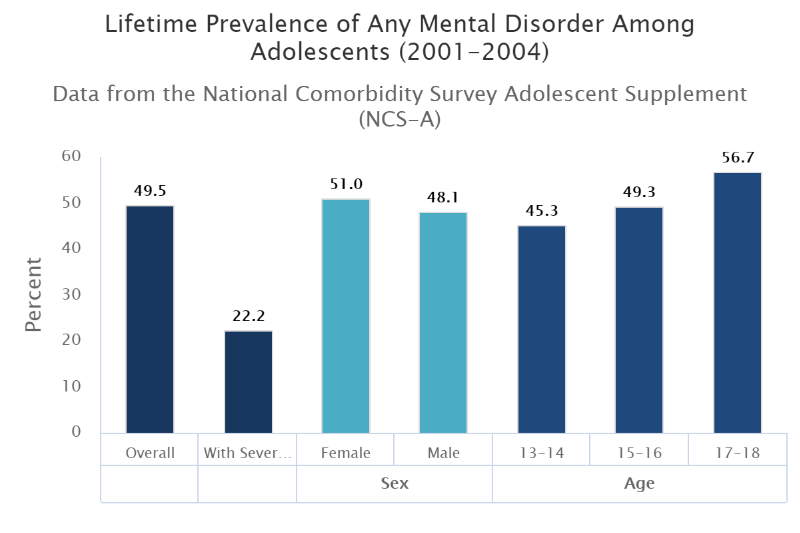
…half (49.5%) of U.S. teens ages 13-18 suffered from at least one mental disorder…

The NCS-A was conducted with over 10,000 teens from 2001-2004. The survey found that half (49.5%) of U.S. teens ages 13-18 suffered from at least one mental disorder (see chart), including one in five with behavior disorders and three in ten with anxiety disorders. The age of onset for the disorders often preceded adolescence by many years (for example, half of affected adolescents developed their anxiety disorders at age 6). Additionally, the impairments were often severe, ranging from 22.2% to 27.6% of teens, which is striking given that the survey measured “higher thresholds of impairment that required endorsement of ‘a lot’ or ‘extreme’ impairment in daily activities, or ‘severe or very severe’ distress.” Acknowledging that its own mental health surveillance data have significant limitations, the Centers for Disease Control and Prevention (CDC) praised the NCS-A because of its unique focus on childhood mental disorders and its inclusion of disorders not measured in other studies.


What are the likely culprits?

Regardless of specific terminology, one burning question arises: why do children and teens currently have such high levels of mental and neurologic dysfunction? Although the pro-Pharma health care system in the U.S. makes it socially taboo to say so, vaccines and other pharmaceutical products are some of the most likely culprits. As has been discussed in other World Mercury Project articles about children’s health, this supposition is backed by sound science.

For example, two epidemiological studies from 2017 are suggestive of temporal associations between vaccines and subsequent pediatric disorders:

  • Researchers from the Yale Child Study Center published a retrospective case-control study in Frontiers in Psychiatry that considered whether prior vaccination in a national sample of privately insured children and adolescents (ages 6-15) was associated with increased incidence of seven neuropsychiatric disorders. For the time period from January 2002 through December 2007, the Yale researchers found that children with four diagnosed disorders—anorexia nervosa (AN), anxiety disorder, tic disorder and obsessive-compulsive disorder (OCD)—were more likely than matched controls to have received a flu shot in the preceding 12 months. There were also associations between prior receipt of several other vaccines (hepatitis A, meningococcal and Td) and some of the neuropsychiatric diagnoses.
  • A prospective case-control study published in Brain Injury used the Vaccine Safety Datalink database to zero in on the relationship between thimerosal-containing vaccines given in the first six months of life (for children born between 1991 and 2000) and the long-term risk of diagnosis with “disturbance of emotions specific to childhood and adolescence,” a diagnostic category abbreviated as ED. The results showed a significant relationship between vaccine-related mercury exposure and the subsequent risk of an ED diagnosis, with a notable dose-response effect. As a side comment, the authors note that occupational health specialists have recognized depression and other psychological disturbances as symptoms of mercury poisoning for decades.

Other recent research observes that exposure to neurotoxic and excitotoxic vaccine ingredients (such as thimerosal, aluminum adjuvants and monosodium glutamate) can lead to changes in the brain, adversely affecting the long-range connectivity that makes it possible to pay attention and engage in big-picture thinking. This abnormal connectivity is a key feature not only of ADHD but of leading neurodevelopmental conditions such as autism spectrum disorder (ASD) and tic disorders.

The pharmaceutical connection

A TIME article on the “startling” rise in teen depression laments the fact that there has not been “a corresponding increase in mental health treatment for adolescents and young adults.” This prospect of a vast untapped market for greater pharmaceutical sales may offer one clue as to why many powerful organizations are focusing on the mental health aspects of teenagers’ wider health crisis.

However, other evidence indicates that some pharmaceutical products (in addition to vaccines) may be contributing to mental health problems. A Psychology Todayreport notes that “aggressive marketing by drug companies…has transformed mild depression and even sadness into a disease of ‘serotonin deficiency.’” At the same time, there has been growing awareness of “the potential for certain prescription medications to increase the risk of psychiatric symptoms and suicidality.” Classes of medications that come with black box warnings mandated by the U.S. Food and Drug Administration (FDA) include some of the very drugs used to address both psychiatric and neurological conditions, such as antidepressants and antiepileptics. In 2009, the FDA added warnings for the class of drugs known as leukotriene inhibitors (LTIs), which clinicians recommend for the control of allergies and asthma. Although sales of LTIs abruptly dropped as soon as the warnings appeared, the cautions did not manage to save an 18-year-old asthmatic who recently committed suicide after taking an LTI.

The CDC tells us that “mental disorders among children are an important public health issue because of their prevalence, early onset, and impact on the child, family, and community.” When an adolescent is too incapacitated by a mental or neurological disorder to pursue his or her education or a career, the whole country loses. Young people’s brains and emotions get plenty of a workout just by engaging in the process of growing up. Piling on more brain-scrambling pharmaceutical products to treat conditions that are often iatrogenic to begin with is probably not what most teenagers need.


In Part Two, World Mercury Project will look at some of the factors currently being offered as explanations for the epidemics of mental and neurological disorders in adolescents.


Feb 272018
 

2018-02-27  Live-streaming tomorrow, Jury reform in Canada, Prof Kent Roach, Wednesday Feb 28, 1pm CST

Thanks to Jim Pulfer for the alert.

2018-02-23 CORRECTION, Vaccines: It is Legislated – – vaccines are NOT mandatory anywhere in Canada.

Geez!  I hate to put out incorrect information.  Many thanks to Angela B and Janet M for setting me straight.

2016-04-12 Retired judge Marie Corbett reflects on feeling ‘powerless over crime’, CBC The Current interview

This 2016 interview was re-broadcast in January 2018.  Marie Corbett’s book:  January: A Woman Judge’s Season of Disillusion

2018-02-20 The secret to happiness? Ask this Yale professor (and the 1,200 students taking her class), CBC The Current

There is HOPE!  To see this happening in a prestigious university adds weight.   It reminded me of:

2009-11-04 EXTRAORDINARY, JK Rowling, Address to Harvard U.

2018-02-23 Uranium industry slumps, nuclear power dead in the water (?)

I added the question mark because of 2 developments that are important but not mentioned, IMHO!

2018-02-24 Julian Assange: Ecuador says latest talks on release failed

Feb 272018
 

Former judge Marie Corbett quit her job as a judge because the death of her close friend made her realize how powerless she felt sitting on the bench.

http://www.cbc.ca/radio/thecurrent/the-current-for-april-12-2016-1.3531544/retired-judge-marie-corbett-reflects-on-feeling-powerless-over-crime-1.3531577

Former judge Marie Corbett quit her job as a judge because the death of her close friend made her realize how powerless she felt sitting on the bench.

Listen 23:50

Read story transcript 

“You don’t stop caring when you’re a judge but you’re circumscribed by your role.” – Former judge Marie Corbett

For all the power they wield in the justice system, we don’t often hear frank talk from judges, in part because they seldom step down from their prestigious posts.

Marie Corbett Quoteboard

Ontario Superior Court Judge Marie Corbett was 55 years old when she stepped down from being a judge. Corbett retired early after a death of a close friend made her realize how powerless she felt sitting on the bench. Known for her judicial acumen and her activism, she could no longer do something that had little impact.

Video: Marie Corbett accepts Women of Distinction award from YWCA

Marie Corbett opens up about the reality of standing in judgment of others, and the life she left behind in her book, January: A Woman Judge’s Season of Disillusion. 

“It does stay with you. The trauma, the sorrow, the tragedy experienced by people is shocking.”  – Former judge Marie Corbett

This segment was produced by The Current’s Liz Hoath.

Feb 272018
 

A new course at Yale aims to give students the tools they need to build happy lives.

http://www.cbc.ca/radio/thecurrent/the-current-for-february-20-2018-1.4542333/the-secret-to-happiness-ask-this-yale-professor-and-the-1-200-students-taking-her-class-1.4542341

Listen 22:28

Read Story Transcript

What’s the secret of happiness? Hard work.

But a little help from a Yale professor — and roughly 1,200 eager classmates — probably doesn’t hurt.

Laurie Santos teaches Psychology and the Good Life course at Yale, a class designed to teach students how to be happy. She said that much of the anxiety she sees comes from being focused on things that don’t lead to happiness.

“The hope is that teaching students the right way to spend their time, and the right things to worry about, and the right things to focus on might actually shift things around,” she said.

It could help students “overcome not just the kind of garden-variety depression and anxiety, but maybe even the bigger things too.”

But it’s not an overnight fix, she warned, students needs to put in the hard work it takes to be happy.

The course is so popular it has to be held in a room normally used for stadium-style concerts, attracting more than a quarter of the college’s entire undergraduate student body.

It’s not hard to see why. According to a 2016 survey, 90 per cent of Canadians in post-secondary education say they felt overwhelmed by their workload. More than half felt overwhelmed by their academics.

The course has all the usual Ivy-League requirements, she said, such as midterms, quizzes, research projects and a final paper on happiness research.

“We also have a different set of requirements that we jokingly refer to as their rewirements, and that’s because they’re there to rewire students habits.”

These are practical tasks — five a week — such as meditation or a random act of kindness.

“They sound a little cheesy but they’re based on real scientific work,” she said.

Laurie Santos’ three tips for happiness

89723937 Laurie Santos Yale Good Life

Laurie Santos said that often the things we think we need to be happy have the opposite effect. (Getty Images)

Take time for yourself: really focus on time affluence

“Often we wind up working too hard to get access to salary and money, and compromise our time but it turns out that because salaries aren’t making us as happy as we think, that might not be the best strategy out there.”

Take time to be mindful and grateful

“A short five to 10 minutes everyday where you meditate — or just sit down and write five things that you’re grateful for — those things don’t take a lot of time but can have really serious impacts on subjective well-being.”

Think about doing nice things for others

It turns out that the reason that money doesn’t have an impact on our happiness is because we often keep it for ourselves, Santos said.

“People who give money away, [or] donate to charity, volunteer their time — those are the folks that tend to be happier. And so the more nice things you can do for others, the more you’ll inadvertently end up increasing your happiness.”

“If you put in that intentional effort to do these kinds of practices, you’re just going to increase your subjective well-being.”

“That’s the goal of the rewirements: putting these habits into place that will lead to healthier outcomes down the line.”

Students keep track of these assignments on a mobile app, which allows them to build up a picture of their progress.

What makes us happy?

There are a lot of misconceptions about what makes us happy, Santos told The Current’s Anna Maria Tremonti. The science suggests that the things we chase — higher salaries, good grades — actually increase anxiety and reduce well-being.

To underline this point early in the course, Santos joked that everyone would get a D, which caused a kerfuffle not just among students, but parents and other staff members.

“I think it just shows we have a lot more work to do to convince people that even though your mind is telling you these goals are good, they might not be increasing happiness in the way you think.”

The course has caught people’s attention beyond the campus, Santos said. She gets emails from adults in all walks of life who want to adopt these techniques.

She also sees students sharing techniques online, with friends and younger siblings.

Yale has even made the course available online, bringing it to a global audience.

“I think a lot of the stresses we’re seeing on campuses are just a tiny microcosm of the sort of stresses we see all over the world, in our adult lives.”

Hardest course at Yale

“I’ve joked with the students that this is the hardest class at Yale,” Santos said.

“The research shows that you can’t just hear about these findings and automatically become happy.”

You have to put the work in, she added, which is the tough message.

“The positive psychologist Sonja Lyubomirsky is famous for saying that becoming happier takes intentional daily effort.

“She likens it to learning to play the violin or learning an elite sport. You have to put the practice in.”

Listen to the full conversation at the top of this page, where you can also share this article across email, Facebook, Twitter and other platforms.


This segment was produced by The Current’s Karin Marley and Liz Hoath. 


Feb 272018
 

See below for the link to the live-streaming.   And thanks to Jim for notice.  The poster link for the event is at bottom.

– – – – – – – – – – – – – – – –

Professor Roach responded.

My note to him:

I think there is an element of human behaviour that goes unaddressed in the debate.

I inputted to CBC Sunday Edition, following their discussion of jury reform.

You might be interested:

http://sandrafinley.ca/?p=20434 

Professor Roach, reply:

I agree there are many reasons why Indigenous people would not want to be on the jury or indeed even respond to the jury summons- I will address this in my talk.

– – – – – – – — –

LINK TO LIVE-STREAMING:

https://usask.cloud.panopto.eu/Panopto/Pages/Viewer.aspx?id=6c65a8c9-0260-4969-9895-a88e010d908f

It will start at 1pm CST.

Thanks,

Katie Riley

Events Coordinator

College of Law, University of Saskatchewan

Phone (306) 966-5658

– – – – — – – – – – — – – – –

From: Jim Pulfer
Sent: February 27, 2018 7:52 AM

Prof Roach will be speaking on jury reform this coming Wednesday (Feb 28) at 1pm (local) in the Aikins Lecture Theatre, Law Building, U of S.

In the light of the Stanley trial, he’s going to be discussing jury reform. To my mind, this is about as important as it gets – for all of us. If you can’t get to hear it, I’ll try to get a manuscript (or pdf file) of his paper for limited circulation.

All the very best,

Jim

http://www.law.usask.ca/documents/events/Roach-lecture-poster.pdf

Feb 252018
 

NOTE:   this does not mention “small nuclear reactors” that the industry is working hard on.  Nor does it mention the role in Canada of the Chinese, with their appetite for nuclear.   I will post information about those aspects of the nuke industry soon.   The data in this article is interesting, but overly optimistic IMHO! /S


Jim Green, Australia, 23 Feb 2018  

www.onlineopinion.com.au/view.asp?article=19587&page=0

As with other commodity markets, the uranium market is a curious beast at the best of times ‒ keen to spot a bargain, investors get more and more excited the further the uranium price and company stock prices fall. They’ve had plenty to get excited about in recent years.

These days, the market exhibits multiple levels of weirdness, all stemming from the growing acknowledgment that nuclear power and the uranium industry face a bleak future.

The uranium market has a “subdued outlook” and Cameco’s uranium is now “more valuable in the ground” according to Warwick Grigor from Far East Capital, because the cost of production is higher than the prices currently being offered. Cameco CEO Tim Gitzel agrees, saying in January 2018 that at current prices “our supply is better left in the ground.” So uranium industry executives and market analysts are finally coming around to rallying cry of the anti-uranium movement: Leave it in the ground!

We’ve also had the odd situation over the past year of nuclear lobbyists arguing repeatedly that the nuclear power industry is in “crisis” and wondering what if anything can be salvaged from “the ashes of today’s dying industry“. Usually such claims come from the anti-nuclear movement ‒ sometimes more in hope that expectation.

And we’ve had the odd situation of industry bodies (such as the US Nuclear Energy Institute) and supporters (such as former US energy secretary Ernest Moniz) openly acknowledging the connections between nuclear power and weapons ‒ connections they have strenuously denied for decades.

Such arguments are now being used in an effort to secure preferential treatment for uranium mining companies in the US. Ur-Energy and Energy Fuels have lodged a petition with the Department of Commerce seeking a mandated requirement for US power utilities purchase a minimum 25% of their requirements from US mines. Uranium is “the backbone of the U.S. nuclear deterrent and fuels ships and submarines in the U.S. Navy”, the companies state.

The arguments might appeal to President Trump and they would dovetail neatly with his silly conspiracy theory about Hillary Clinton threatening national security by allowing the sale of a uranium mining company with US interests to Russia’s Rosatom. But the arguments don’t appear to enjoy any support from the US nuclear weapons complex and they certainly don’t enjoy any support from power utilities. According to market analysts FNArena, the petition lodged by Ur-Energy and Energy Fuels “brought the uranium market to a screaming halt” and US power utilities warned that a quota would force the early shutdown of some nuclear plants.

Another miserable year for the uranium industry

Nuclear power has been stagnant for the past 20 years. Although power reactors account for an overwhelming majority of uranium demand, uranium production ‒ and prices ‒ have been up and down and all over the place.

Uranium mine production increased by 50% from 2007 to 2016. The increase was driven, initially at least, by expectations of the nuclear renaissance that didn’t eventuate. Mine production plus secondary sources (e.g. stockpiles and ex-military material) have consistently exceeded demand ‒ 2017 was the eleventh consecutive year of surplus according to the CEO of uranium company Bannerman Resources.

Stockpiles (inventories) have grown steadily over the past decade to reach enormous levels ‒ enough to keep the entire global reactor fleet operating for around eight years. Supply from mines and secondary sources in recent years has exceeded demand by about 18%.

Those dynamics have put downward pressure on prices. After six years of steady decline, uranium prices were flat in 2017. The spot price as of 1 December 2017 was less than one-third of the pre-Fukushima price and the long-term contract price less than half the pre-Fukushima price.

Uranium Prices (US$ / pound uranium oxide)

  1 June 2007 1 Dec. 2008 1 Feb. 2011 1 Dec. 2011 1 Dec. 2014 1 Dec. 2017
Spot price 136 52.50 69.63 51.88 35.50 22.32
Long-term

contract price

95 70 71.50 62 49.50 30.67
Notes Peak bubble Bubble bursts Pre-Fukushima Decline 2011-16   Flat

Source: Cameco

Countless would-be uranium mining companies have given up, some trying their luck in other areas such as property development or growing dope. Some mines have closed, others have been put into care-and-maintenance, and others have reduced output. But supply has continued to exceed demand ‒ and to exert downward pressure on prices.

Very few mines could operate at a profit at current prices. Some mines are profitable because earlier contracts stipulated higher prices, while many mines are operating at a loss. Many companies have been loathe to close operating mines, or to put them into care-and-maintenance, even if the only other option is operating at a loss. They have been playing chicken, hoping that other companies and mines will fold first and that the resultant loss of production will drive up prices. “We have to recognise that we over-produce, and we are responsible for this fall in the price,” said Areva executive Jacques Peythieu in April 2017.

Current prices would need to more than double to encourage new mines ‒ a long-term contract price of about US$70–$80 is typically cited as being required to encourage the development of new mines.

The patterns outlined above were repeated in 2017. It was another miserable year for the uranium industry. A great year for those of us living in uranium producing countries who don’t want to see new mines open and who look forward to the closure of existing mines. And a great year for the nuclear power industry ‒ in the narrow sense that the plentiful availability of cheap uranium allows the industry to focus on other problems.

Cut-backs announced

The patterns that have prevailed over the past five years or so might be changed by decisions taken by Cameco and Kazatomprom (Kazakhstan) in late 2017 to significantly reduce production. Canada closed McArthur River in Canada in January and plans to keep it closed for around 10 months ‒ it had been producing more uranium than any other mine in the world. Kazakhstan has been producing almost 40% of world supply in recent years and plans to reduce production by 20% from 2018‒2020.

Previous cut-backs in Canada and Kazakhstan have had little or no effect, and so far the late-2017 announcements have only resulted in a small, short-lived upswing in uranium prices. But the cut-backs are significant and their impact might yet be felt.

A late-2017 report by Cantor Fitzgerald equity research argued that the decisions by Cameco and Kazatomprom could result in a “step change” for uranium prices. But Warwick Grigor from Far East Capital was downbeat about Cameco’s announcement. “I don’t see this as a turnaround for the uranium price; at best they will stay where they are, but it doesn’t signal a boom in price,” he said in November 2017.

BHP marketing vice-president Vicky Binns said in December 2017 that uranium markets would remain oversupplied for close to a decade, with downward pressure remaining on uranium prices despite Cameco’s production cuts. She said that demand for uranium could outstrip supply by the late 2020s but that could change if developed nations close their nuclear reactors earlier than expected, or if renewables take a larger than expected market share.

Equally downbeat comments have been made by other industry insiders and analysts in recent years. Former Paladin Energy chief executive John Borshoff said in 2013 that the uranium industry “is definitely in crisis” and “is showing all the symptoms of a mid-term paralysis”. Former World Nuclear Association executive Steve Kidd in May 2014 predicted “a long period of relatively low prices”. Nick Carter from Ux Consulting said in April 2016 that he did not see a supply deficit in the market until “the late 2020s”.

Perhaps a uranium price increase is on the way but it will do little to salvage Australia’s uranium industry. Apart from BHP’s Olympic Dam mine in SA, the only other operating uranium mine in Australia is Beverley Four Mile in SA. At Ranger in the NT, mining has ceased, stockpiles of ore are being processed, and ERA is planning a $500 million project to decommission and rehabilitate the mine site.

Meanwhile, Mirarr Traditional Owners in the NT and their many supporters are celebrating the 20th anniversary of the mass movement that defeated the plan to mine the Jabiluka uranium deposit. South Australians are celebrating the successful campaign to stop the state being turned into the world’s high-level nuclear waste dump. The Aboriginal-led Australian Nuclear Free Alliance recently celebrated 20 years of ‘radioactive resistance’.

And with the cost of a single power reactor climbing to as much as $20 billion, proposals to introduce nuclear power to Australia seem more and more quixotic and are now largely limited to the far right ‒ in particular, Australians Conservatives’ luminary Senator Cory Bernardi and the Minerals Council of Australia.

Even Dr Ziggy Switkowski ‒ who used to be nuclear power’s head cheerleader in Australia and was appointed to lead the Howard government’s review of nuclear power ‒ recently said that “the window for gigawatt-scale nuclear has closed”. He said nuclear power is no longer cheaper than renewables and the levelised cost of electricity is rapidly diverging in favour of renewables.

Dr Jim Green is the national nuclear campaigner with Friends of the Earth Australia and editor of the Nuclear Monitor newsletter produced by the World Information Service on Energy and the Nuclear Information & Resource Service.

Feb 252018
 

Ecuador says the country’s latest efforts to negotiate the departure of WikiLeaks founder Julian Assange from its London embassy have failed.

Foreign minister Maria Fernanda Espinosa said the UK was unwilling to take part in talks about his release.

A UK Foreign Office spokesman said Mr Assange should “leave the embassy to face justice”.

Mr Assange, 46, has been staying at the country’s London embassy since 2012 where he was granted political asylum.

Last week, the arrest warrant against him was upheld meaning as soon as he leaves the embassy he will be detained.

Ecuador’s foreign minister said: “On the issue of mediation, I have to say very honestly that it has not been successful because two parties are needed to mediate. Ecuador is willing, but not necessarily the other party”.

She said her country would “continue looking for mechanisms” to end the stalemate.

But a spokesman from the UK Foreign Office said: “Ecuador knows that the way to resolve this issue is for Julian Assange to leave the embassy to face justice”

Last December, Mr Assange was granted Ecuadorean citizenship in a move which the country hoped could give him immunity in the UK.

But the UK does not recognise Mr Assange as a diplomatic agent and continues to insist he should “face justice”.

There is no extradition treaty between the UK and Ecuador so he cannot be arrested inside the embassy.

Mr Assange breached bail conditions when he sought refuge at the Ecuadorean embassy six years ago.

He faced questioning over sexual assault allegations in Sweden, which have since been dropped.

Previously, Mr Assange has justified his decision to break bail conditions arguing if he faced the Swedish authorities he would be extradited to the US over the publication of classified documents.

Feb 232018
 

Exemptions


MANY thanks to Angela B and Janet M for setting me straight.  What a disservice I’ve done, assuming that “mandatory vaccinations” means “mandatory by law”.   I learned that lesson before – – from StatsCan and the Census!  Sheesh!   I should have known.   It’s the Orwellian thing.  Words no longer mean what they mean:

From: Angela B
Sent: February 23, 2018

Sandra, vaccines are not mandatory in Ontario, as you write in your blog.

Janet, can you confirm?

= = = = = = = = = = = = = =

From: Janet
Sent: February 23, 2018

oops, i didn’t notice Sandra had said that

good catch!

no, vaccines are NOT mandatory, anywhere in Cda

any family can get an exemption


the school system in Ont. is acting as tho’ they’re mandatory

with the bullying they’re doing


but no,

not mandatory!


Best info is VCC, this page

https://vaccinechoicecanada.com/exemptions/