Sandra Finley

Mar 312016
 

 Since the FBI vs Apple court case in California,  FBI in other jurisdictions, criminal investigations, have aired the need for access to iPhones.   For those stories, please use an internet search.

 FBI drops its case against Apple after getting into that iPhone

http://www.wired.com/2016/03/fbi-drops-case-apple-finding-way-iphone/

by Kim Zetter

After more than a month of a heated standoff between the Justice Department and Apple over access to an iPhone belonging to one of the alleged San Bernardino shooters, the government announced today that an alternative method for breaking into the phone has worked.

In a motion filed with the court Monday afternoon, the Justice Department has asked a California court to vacate its previous order commanding Apple to create a software tool to help authorities break into the phone.

“The government has asked a United States Magistrate Judge in Riverside, California to vacate her order compelling Apple to assist the FBI in unlocking the iPhone,” United States Attorney Eileen M. Decker said in a statement. “Our decision to conclude the litigation was based solely on the fact that, with the recent assistance of a third party, we are now able to unlock that iPhone without compromising any information on the phone…. Although this step in the investigation is now complete, we will continue to explore every lead, and seek any appropriate legal process, to ensure our investigation collects all of the evidence related to this terrorist attack.”

Last week, a day before a scheduled court hearing to discuss the case, the Justice Department pulled a surprise move and asked the court to delay the hearing after learning of a possible method it could use to get into the phone without Apple’s help. The government had insisted repeatedly to Magistrate Judge Sheri Pym that it could not get into the phone without Apple’s help, so the sudden turnaround surprised reporters and others who had gathered in Riverside, California for the hearing.

Since that announcement, the security community has speculated about what possible method the feds could be using. Last week, FBI Director James Comey told reporters at a news conference that a method called NAND mirroring, that some in the security community insisted was the best option the FBI had for getting into the phone, did not in fact work. Comey didn’t elaborate.

The government’s announcement today leaves that question unanswered. Apple told reporters last week that if the feds did find a way into the phone, it would seek discovery to learn the method that was used in order to confirm that the feds did indeed get into the device and didn’t just claim it did to save face and withdraw from the case. But Apple may never be able to get an answer to that question if the government classified the method.

Also left unanswered is whether the phone actually contained any data useful to the government’s investigation that it had not already obtained through the iCloud backups of the phone.

Apple did not yet respond to a call for comment. We’ll update this story when they do.

Last month a federal court ordered Apple to create a software tool that would bypass security mechanisms in Apple’s software so that the government could perform what’s known as a bruteforce password attack to guess the password on the phone.

Starting with versions of its operating system released in 2014 and later, Apple uses two factors to secure and decrypt data on the phone–the password the user chooses and a unique 256-bit AES secret key that’s embedded in the phone when it’s manufactured. The user’s password gets “tangled” with the secret key to create a passcode key that both secures and unlocks data on the device. When the user enters the correct password, the phone performs a calculation that combines these two codes, and if the result is the correct passcode, the device and data are unlocked.

To prevent someone from brute-forcing the password, the device has a user-enabled function that limits the number of guesses someone can try before the passcode key gets erased. Although the data remains on the device, it cannot be decrypted and therefore becomes permanently inaccessible. This happens after 10 failed guesses if a user has enabled the iPhone’s auto-erase feature

In addition to the auto-erase function, there’s another protection against brute force attacks: time delays. Each time a password is entered on the phone, it takes about 80 milliseconds for the system to process that password and determine if it’s correct. This helps prevent someone from quickly entering a new password to try again, because they can only guess a password every 80 milliseconds. Instead of being able to try hundreds or thousands of password guesses per second, the feds would only be able to try eight or nine per second.

The FBI wanted Apple to create a version of its software that eliminated these two protections.

Mar 262016


https://www.socialeurope.eu/2016/03/how-political-elites-have-failed-to-ensure-social-justice-across-generations/

Social Europe

by Joseph Stiglitz on 17 March 2016 @JosephEStiglitz

Joseph Stiglitz

Joseph Stiglitz (CC Raimond Spekking)

Something interesting has emerged in voting patterns on both sides of the Atlantic: Young people are voting in ways that are markedly different from their elders. A great divide appears to have opened up, based not so much on income, education, or gender as on the voters’ generation.

There are good reasons for this divide. The lives of both old and young, as they are now lived, are different. Their pasts are different, and so are their prospects.

The Cold War, for example, was over even before some were born and while others were still children. Words like socialism do not convey the meaning they once did. If socialism means creating a society where shared concerns are not given short shrift – where people care about other people and the environment in which they live – so be it. Yes, there may have been failed experiments under that rubric a quarter- or half-century ago; but today’s experiments bear no resemblance to those of the past. So the failure of those past experiments says nothing about the new ones.

Older upper-middle-class Americans and Europeans have had a good life. When they entered the labor force, well-compensated jobs were waiting for them. The question they asked was what they wanted to do, not how long they would have to live with their parents before they got a job that enabled them to move out.

That generation expected to have job security, to marry young, to buy a house – perhaps a summer house, too – and finally retire with reasonable security. Overall, they expected to be better off than their parents.

While today’s older generation encountered bumps along the way, for the most part, their expectations were met. They may have made more on capital gains on their homes than from working. They almost surely found that strange, but they willingly accepted the gift of our speculative markets, and often gave themselves credit for buying in the right place at the right time.

Today, the expectations of young people, wherever they are in the income distribution, are the opposite. They face job insecurity throughout their lives. On average, many college graduates will search for months before they find a job – often only after having taken one or two unpaid internships. And they count themselves lucky, because they know that their poorer counterparts, some of whom did better in school, cannot afford to spend a year or two without income, and do not have the connections to get an internship in the first place.

Today’s young university graduates are burdened with debt – the poorer they are, the more they owe. So they do not ask what job they would like; they simply ask what job will enable them to pay their college loans, which often will burden them for 20 years or more. Likewise, buying a home is a distant dream.

These struggles mean that young people are not thinking much about retirement. If they did, they would only be frightened by how much they will need to accumulate to live a decent life (beyond bare social security), given the likely persistence of rock-bottom interest rates.

In short, today’s young people view the world through the lens of intergenerational fairness. The children of the upper middle class may do well in the end, because they will inherit wealth from their parents. While they may not like this kind of dependence, they dislike even more the alternative: a “fresh start” in which the cards are stacked against their attainment of anything approaching what was once viewed as a basic middle-class lifestyle.

These inequities cannot easily be explained away. It isn’t as if these young people didn’t work hard: these hardships affect those who spent long hours studying, excelled in school, and did everything “right”. The sense of social injustice – that the economic game is rigged – is enhanced as they see the  bankers who brought on the financial crisis, the cause of the economy’s  continuing malaise , walk away with mega-bonuses, with almost no one being held accountable for their wrongdoing. Massive fraud was committed, but somehow, no one actually perpetrated it. Political elites promised that “reforms” would bring unprecedented prosperity. And they did, but only for the top 1%. Everyone else, including the young, got unprecedented insecurity.

These three realities – social injustice on an unprecedented scale, massive inequities, and a loss of trust in elites – define our political moment, and rightly so.

More of the same is not an answer. That is why the center-left and center-right parties in Europe are losing. America is in a strange position: while the Republican presidential candidates  compete on demagoguery, with ill-thought-through proposals that would make matters worse, both of the Democratic candidates are proposing changes which – if they could only get them through Congress – would make a real difference.

Were the reforms put forward by Hillary Clinton or Bernie Sanders adopted, the financial system’s ability to prey on those already leading a precarious life would be curbed. And both have proposals for deep reforms that would change how America finances higher education.

But more needs to be done to make home ownership possible not just for those with parents who can give them a down payment, and to make retirement security possible, given the vagaries of the stock market and the near-zero-interest world we have entered. Most important, the young will not find a smooth path into the job market unless the economy is performing much better. The  “official” unemployment rate in the United States, at 4.9%, masks much higher levels of disguised unemployment, which, at the very least, are holding down wages.

But we won’t be able to fix the problem if we don’t recognize it. Our young do. They perceive the absence of intergenerational justice, and they are right to be angry.

© Project Syndicate

About Joseph Stiglitz

Joseph Stiglitz is University Professor at Columbia University and a Nobel laureate in Economics.


Mar 222016
 

Hello Michelle (CBC Radio The Almanac),


You asked:  what is the context for the bombings in Brussels?


The Context is an accumulation of   “last month”s   and   “last year”s   that extends back in time.

Context has been created by  people of the Middle East AND by Westerners.


Human beings do not like it when their children are killed.  They do not like it when their homes, water supplies, schools, hospitals, museums and other infrastructure are destroyed.  They do not like it when their democratically-elected leaders are overthrown or murdered – – their heroes, the ones who dared to defend against exploitation by foreigners, the Leaders who insist that their people shall not live in poverty while their resource riches go into the pockets of the already-rich elites.


Destruction of one group of people by another becomes the stories that are passed from one generation to the next.   The inter-generational transference amongst the “victors” is a story that arouses some emotion.   Sympathy, yes.  But not outrage.


It is very different for the aggrieved.  The one thing that matters is that their sons were killed, their daughters were raped and their homes destroyed.   The cause is not the crux.  (Nelson Mandela’s great contribution was in understanding that “truth and reconciliation” are essential if the hatred and killing are to stop.)


Failure to recognize the ways in which WE have contributed to the Context of the bombings in Brussels, that there are two sides to the coin, ensures that solutions to the violence will be elusive.


Westerners stereotype people from the Middle East;  it may be assumed that people from the Middle East stereotype Westerners.   It is the way human brains work.


“Westerners”, in particular in the last half-century Americans, have a long and terrible history in countries whose resources are coveted.   Oil in the Middle East.  If a head-of-state refuses to be bought off, to cooperate with what the Americans want, the promise of wealth to others is used to overthrow the head-of-state.  Democratically-elected, good leaders are replaced by dictators.  Wealth is controlled by a minority;  poverty is the rule for the population.   . . .   But there are consequences of the exploitation, eventually.


Americans travelling abroad used to put Canadian flags on their jackets or backpacks.   They knew they, Americans, were generally disliked abroad.  Most were at a loss to understand how that could be.


You could point to recent history, the bombing of Iraq in 2003, an illegal war that left Iraq in shambles, many killed and many who became refugees.  The bombings of Libya.  Or, the dropping of bombs from drones on Middle Eastern countries, with many civilian deaths, the “collateral damage”.   Watch videos of interviews of the people who live in zones of drone attacks.   They are terrorized.   Who inflicts the terror on them?  . . .  Westerners.   But if it’s us,  we don’t use the word “terrorist”.

Many innocent people were rounded up and taken to American prisons (Abu Ghraib, Bagram, Guantanamo . . . ) where they were tortured.   If you think that isn’t the highest form of being terrorized, I ask you what is?   The family and friends of those terrorized by torture certainly hear the stories of what happened at the hands of   . . .  the Westerners.    But if it’s us doing the deed,  we don’t use the word “terrorist”.

All that does NOT explain why the hatred or dislike of Americans (“Westerners”) was there way back in the 1960s and 1970s when I was with a school group,  youth-hostelling in Europe.   I was puzzled by the dislike of Americans, and thankful to be Canadian.   Now I understand:   I, like the American kids, had been effectively propagandized in the fortress of North America so I didn’t know what many foreigners knew/know.

The CONTEXT for the bombings in Brussels includes what many of us have never been told, the story of THEIR side of the coin, one that extends back in time.

A few examples:

  • 1951   Mohammad Mossadegh was the democratically-elected prime minister of Iran.  He wanted to control his country’s oil resources to benefit the people of Iran, not only the foreign corporations.  It is no secret that Washington dispatched the CIA to engineer the overthrow of Mossadegh.


  • 1961.  Patrice Lumumba was a Congolese independence leader and the first democratically-elected prime minister of the Congo.   I became acquainted with his story through “The Poisonwood Bible” by Barbara Kingsolver (Oprah’s reading list).  There are large, American-owned copper mines in the Congo.   Short story:  Lumumba was executed.  He was the hero of his people, one who wanted his people to benefit from the resource revenues going to foreign corporations.  The foreigners exploited the Congolese workers, their land and resources.    From Wikipedia:  Declassified documents revealed that the CIA had plotted to assassinate Lumumba. These documents indicate that the Congolese leaders who killed Lumumba, including Mobutu Sese Seko and Joseph Kasa-Vubu, received money and weapons directly from the CIA.[45][59]


  • The (American) United Fruit Company owned vast tracts of land in various Central American countries (think pineapple).  They also “owned” people in high places in the U.S.  Efforts by local leaders in Central America to raise their people out of poverty by taking back what was theirs, meant they became a target of American wrath.

Reformer Jacobo Arbenz, was elected president of Guatemala in the early fifties.  The United Fruit Co mounted a campaign in the U.S., character assassination of Arbenz, painted him as part of a Russian communist plot.  In 1954 the CIA orchestrated a coup.  American pilots bombed the capital city.  Arbenz was gone, replaced by a right-wing dictator.


  • Che Guevera was a huge threat.   The CIA was involved in his death in Bolivia, 1967


  • 1973, the CIA overthrew Chile’s democratically-elected president, Salvador Allende.   Pinochet was the replacement.


The list goes on.  Those are but a few examples from a few of the aggrieved countries.


Eventually such deeds came back to haunt.   You reap what you sow,  you don’t escape.   The idea that you are superior or impervious are proven wrong.   Unfortunately for “us”,  stereotyping puts us all in the same basket with the perpetrators.   But then, maybe we played a role by being ignorant or silent or too busy to see?


That’s the Context.   The role of  “Westerners” in the creation of the Context exists and needs to be recognized.  Truth, not propaganda, is required to deal effectively with  “Terrorism”.

We Westerners have terrorized them.   Give me a break.  Why do we NOT expect to eventually be terrorized by them?

Justin Trudeau was right to stop Canadian bombing of people.   Bombing is a sure-fired way to heighten the hate.   And does nothing to address the Context that has fertilized the Brussels bombings.


/Sandra Finley

CLOSELY RELATED:    2016-07-08 Rulers cannot rule unless we agree to let them rule.  There are simply too many of us.   Democracy overtaken by Corporatocracy = coup d’état. Citizens fight to regain democracy = Revolution (insurgency) . Corporatocracy fights to hold on = counter insurgency.

Mar 212016
 

Matthew asked whether Lockheed Martin has a role in the 2016 Census.

Short answer:   Yes  – the clincher:  Canada has obligations because of its partnerships with other nations on censuses, and Lockheed Martin is part of that collaboration.   Lockheed Martin’s role is in “steerage”.

Search on words “Lockheed Martin” on StatsCan website.

There are expense claims that help document collaboration on censuses.  Several countries are involved.   That I knew from information given by StatsCan witness Anil Arora,  at my trial (2008).

The additional piece of evidence to be inferred from the expense claims (2009, 2010) is that Lockheed Martin is definitely a part of the collaboration  (probably always has been).

The evidence by StatsCan witness Anil Arora at my trial was that the countries are striving for compatibility,  i.e. the data bases on citizens in various countries, through their census operations, will be compatible.   In the words of Canada-U.S. agreement on “Defence”,  the goal is “inter-operability” (compatibility is required if you want inter-operability).   Loss of sovereignty (the Lockheed Martin – NSA link) is merely collateral damage I suppose.

I would call the collaborative censuses among specified nations a component of international surveillance, under the “steerage” of Lockheed Martin (using the wording of the Travel Expense Claims).

The Important Considerations:

  1.  Collaboration among specified nations on censuses, with Lockheed Martin steerage

    It is VERY IMPORTANT to know about Five Eyes.   2014-09-26  Journalists and whistleblowers will go to jail under new national security laws,  Australia,  The Guardian. (Includes info on Five Eyes (FVEY)    (Australia is one of the collaborating countries.)

    With or without that background,  take a look at the APPENDED Travel Expenses by the Assistant Chief Statistician (Canada).

    Lockheed Martin is a participant in the Collaborations among countries on censuses (U.S., U.K., Canada, Australia, New Zealand, the “Five Eyes” at least).

    What do you make of its role in the census meetings – – “Lockheed Martin Senior Management Steering Committee“?

    ONE of the Travel Claims from Canada’s Asst Chief Statistician, for example, reads:

. . .   Participate at the 2010 Meeting of the International Census Forum and Lockheed Martin Senior Management Steering Committee Meeting

2.    What actions arise out of the information?

 If you find the idea of surveillance repugnant  (American Corporate Empire with means and values infiltrated into Canada),  you will find ways to contribute to the resistance.   Never underestimate the value of simply “spreading the word” so more people are empowered – – they know what’s going  on and can decide how to respond to the Census in May and on-going StatsCan surveys.

We have been in contact in the past with  some U.K.ers who were fighting Lockheed Martin’s involvement in their censuses.   And contributed to debate on the American side when their Census Bureau contracted 100,000 workers to go building-to-building in the U.S. to enter GPS coordinates on census records.

It is important to see this for what it is – – success turns on resistance in more than just Canada.  You come to understand the need to contact people you know and organizations in the 5 Eyes countries.

Even if only half of us communicate with some of our contacts,  it will make a difference.


The Red Herring Considerations:

1.  What has StatsCan announced to the Canadian public?

 As far as I am aware, StatsCan has NOT made a statement to the public to say that Lockheed Martin’s involvement with StatsCan has ended.

Audrey Tobias, Janet Churnin, and Eve Stegenga were three who refused to cooperate with the 2011 census because of out-sourcing to Lockheed Martin Corp.  They were prosecuted.  Audrey’s trial was in October 2013, Toronto, followed by Janet’s.   Eve’s trial was in July 2014, Powell River BC.

At Audrey’s trial the StatsCan witness, under oath testified that “Lockheed Martin was out”  – – StatsCan had listened to the continuing outrage of Canadians and taken corrective action.   Lockheed Martin was no longer involved at StatsCan.

Given the significance of the issue:

  • 2011 Census non-compliance rate of 11%,  a more than five-fold increase over the 2006 Census.  The numbers for 2011 were provided under oath by the StatsCan witness (Yves Beland, then head of Census Operations) at the Tobias trial.    The non-compliance rate for 2006 was 2%, according to StatsCan reports to the media, at the time. )
  • the prosecutions:   so even though StatsCan testified that “Lockheed Martin is out”,  and the reason for the non-compliance was Lockheed Martin, they prosecuted regardless.  Bad enough their arrogance – – Audrey Tobias was 89-years-old and Janet Churnin was 79 years old.   Eve Stegenga is a self-employed yoga instructor who could ill afford the time and lost revenue required for research, preparation, numerous court appearances, and a pile of stress.   (Years later the decision still puzzles me.  It is as though insiders in StatsCan and the Justice Dept, in a position where they had to select people for prosecution, deliberately chose people who had the potention to ultimately embarrass StatsCan, drawing more attention to what was going on.   Or maybe they simply underestimated the power of women, even elderly ones.)

IF a decision had been made to end Lockheed Martin’s participation at StatsCan, surely it was StatsCan’s duty to report that to the Canadian public.

I double-checked the StatsCan website – – maybe there was an announcement I missed?  A search on “Lockheed” shows “0 results”.   But if you search “All” records, there are “4 results” two of which (appended) are Expense claims from Peter Morrison related to meetings with Lockheed Martin in 2010 and 2009 about the Census.

Given that a search on the StatsCan website yields only the Travel Expenses Claims,  and other searches,  I say with some confidence that StatsCan has not made a statement to the public.  (I should be able to find a Press Release, for example.)   (See below – – StatsCan CREDIBILITY GAP)

HOWEVER

2.    One “BUT”, leads to another “BUT”

The transcript for the Audrey Tobias trial contains a statement that Lockheed is out.

If true, it would represent a huge victory for Canadians against the Military-Industrial complex.

BUT,  as evidenced by the expense claims of Peter Morrison (scroll down)  StatsCan is enmeshed in collaborative censuses (U.S., U.K., Australia, New Zealand, Canada  AND Lockheed Martin).  You have to be realistic in assessing the evidence given by Yves Beland (StatsCan) at the Tobias Trial.

THE TOBIAS TRANSCRIPT, LOCKHEED MARTIN IS “OUT”

See    2014-07-17 Transcript, Tobias trial establishes Lockheed Martin is OUT

The testimony of the StatsCan witness Yves Beland, Director of Census Operations Division, tells

a.    StatsCan was getting resistance to Lockheed Martin’s involvement from the beginning (2004) during the development period.

b.    StatsCan reacted by “scaling back” substantially on the Lockheed contract for the 2006 Census.

c.    StatsCan cut again, down to $20 million contract for Lockheed for the 2011 Census.

d.    Resistance continued   and so

e.    Lockheed will be completely out of it by the next census (2016).

The only source I know for “Lockheed Martin is “out””  is this transcript of the Tobias trial which ONLY A HANDFUL OF PEOPLE have seen.

So, from the transcript of the testimony by Yves Beland, StatsCan had made a decision before the Tobias trial (Oct 2013)   IN SPITE OF WHICH   StatsCan and the Justice Dept proceeded with the prosecutions of Audrey Tobias, Janet Churnin and Eve Stegenga all of whom were on trial because they objected to Lockheed’s involvement in the 2011 Census.

The administration of Justice is brought into disrepute.

3.   StatsCan’s record on truthfulness

       You have to address the StatsCan CREDIBILITY GAP in arriving at any conclusions about

Lockheed Martin’s current (2016) involvement in the  StatsCan Data Base on Canadians.

        You also have to be very careful about word-smithing by StatsCan, as noted in the posting about Lockheed Martin is “out”.

StatsCan CREDIBILITY GAP

•   Edward Snowden and Glenn Greenwald did a good job of explaining that under the auspices of the NSA, backdoor entry to data bases is established if American “security” forces cannot obtain legal front door access.  Lockheed Martin is a contractor to the NSA. Both entities are surveillance specialists; both see themselves as being outside the rule of law.  The data base at StatsCan will contain the on-going collection of data through censuses AND surveys. Your name is on your file (established during the cross-examination of the StatsCan witness at my trial).  All in all, EVEN IF Lockheed Martin is “out”, a backdoor entry to the data base will be in place.

[The interest of the Americans in obtaining access to information on ALL Canadians is known through mainstream media report, Ottawa Citizen 2008.    The means?   Well, we have the “President of the Americas for Lockheed Martin” quoted in Maclean’s Magazine Sept 2006.  Lockheed’s position at StatsCan was in place by then.  Ron Covais was speaking in general when he said, The Ministers have told us, Tell us what you want, we’ll see that you get it.  This was how things were to work because as he said, they (corporates) knew they couldn’t get what they wanted through normal democratic channels; they would get it this way, working through the bureaucracy and agencies of Government.  I won’t repeat here how Lockheed Martin works,  nor what collaboration with them means.]

•   StatsCan claims that the Statistics Act gives them authority to take away citizens’ Charter Right to Privacy of Personal Information.  Most people know that Rights provided under Constitutional Law cannot be taken away by a regular act of Parliament.  Under Constitutional Law, in order for the Government to take away a Charter Right it has to meet the criteria set out in the Oakes Test.  As far as I know,  StatsCan / the Justice Dept has not applied to the Courts to see if they can meet the criteria, so the Charter Right stands. StatsCan’s assertions to citizens that the Statistics Act gives them authority to take away Charter Rights is bogus.

•   StatsCan proceeded with prosecution of 3 women AFTER the claimed decision (Lockheed Martin is “out”) was made – why would they do that if Lockheed Martin was indeed “out”?  The reason for dissent by all 3 women was Lockheed Martin’s involvement.

•   StatsCan continues to tell citizens “it is the Law”, you have to fill in (for example) the National Household Survey (formerly known as the long-form Census) when the Statistics Act says that participation in surveys is NOT mandatory (the sanctions for census non-compliance do not apply).   StatsCan uses a serious lie to intimidate and coerce citizens into providing information protected by the Charter Right.

•   According to the actual numbers provided by Yves Beland, StatsCan Director of Census Operations, at the Audrey Tobias trial, the non-compliance rate for the 2011 Census is 11%, not the 2% figure they supply to the media.   (StatsCan insists that 13 million out of 14.6 million is 98% compliance. It is 89% compliance. Do the math.)

= = = = =  = = = = = = = = = = = = = = = = = = =

So there we are, Matthew.  Is Lockheed Martin part of the 2016 Census?   I would say yes.  StatsCan has never made a statement to the public to say that the StatsCan contracts with Lockheed Martin have ended.   StatsCan’s credibility provides no basis for believing what they say.  So you have to figure it out.

To me, the CLINCHER is this:  Lockheed Martin is a component of the 5 Eyes partnership which commits Canada to collaboration and conformity with other nations in Census operations.

If people do not understand that this is about surveillance, they need to  read  (related to Bill C-51)   2014-09-26  Journalists and whistleblowers will go to jail under new national security laws, Australia, The Guardian. (Includes info on Five Eyes (FVEY)

= = = = =  = = = = = = = = = = = = = = = = = = =

APPENDED

EXCERPTS

 (In case the links to the Expense Claims on the StatsCan website become invalid,  screen captures of four of the Claims are pasted onto one word document, see bottom of this posting.)

From  http://www.statcan.gc.ca/eng/about/expense/petermorrison/2010

Morrison, Peter, Assistant Chief Statistician

Travel expenses – 2010

Date Purpose Cost
January 28, 2010 ARCHIVED – Lockheed Martin Steering Committee Meeting $909.88
September 22, 2010 ARCHIVED – Corporate Business Architecture presentation to Regional Offices $1,523.32
October 11, 2010 ARCHIVED – Participate at the 2010 Meeting of the International Census Forum and Lockheed Martin Senior Management Steering Committee Meeting $2,062.94
October 21, 2010 ARCHIVED – Corporate Business Architecture presentation to Central Regional Office and visit to Regional Census Centre $1,128.14


From  http://www.statcan.gc.ca/eng/about/expense/petermorrison/2009

Morrison, Peter, Assistant Chief Statistician

Travel expenses – 2009

Date Purpose Cost
June 17, 2009 ARCHIVED – To visit the Regional Offices in Vancouver and Edmonton $1,478.68
June 22, 2009 ARCHIVED – To attend the Steering Committee Meeting with Lockheed Martin and visit the United States Data Processing Centre (DPC) site $1,262.61
August 10, 2009 ARCHIVED – EX interviews $684.78
September 7, 2009 ARCHIVED – International Census Forum 2009 $4,369.27


SCREEN CAPTURES:

StatsCan Expenses Claims Lockheed Martin 2009-2010


Mar 212016
 

http://www.theguardian.com/environment/true-north/2016/mar/20/by-rejecting-1-billion-for-a-pipeline-a-first-nation-has-put-justin-trudeaus-climate-plan-on-trial


By rejecting $1bn for a pipeline, a First Nation has put Trudeau’s climate plan on trial

Canada´s Lax Kw´alaams show us how we can be saved: by loving the natural world and local living economies more than mere money and profit

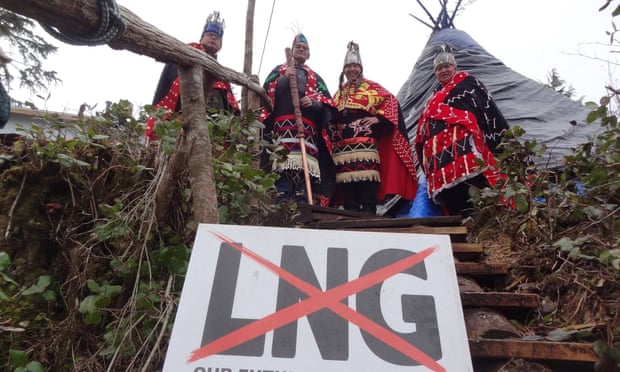
 Indigenous leaders gather on Lelu island where the Lax Kw’alaams First Nation has set up camp to protest the construction of the Petronas LNG terminal.

Indigenous leaders gather on Lelu island where the Lax Kw’alaams First Nation has set up camp to protest the construction of the Petronas LNG terminal.

Photograph: SkeenaWatershed Coalition

Last modified on Monday 21 March 2016 03.05 GMT


Everything has a price. Everyone can be bought. We assume this principle is endemic to modern life – and that accepting it is most obvious to the impoverished. Except all over the world, people are defying it for a greater cause. That courage may be even more contagious.


It has been in full supply in north-west Canada, where an oil giant is aiming to construct one of country´s biggest fossil fuel developments: a pipeline to ship liquified natural gas (LNG) out of British Colombia. To export it overseas via tankers, Malaysian-owned Petronas must first win approval for a multi-billion dollar terminal on the coast.


That happens to be at the mouth of Canada´s second-largest salmon river, on the traditional territory of the Lax Kw´alaams First Nation. One of the world´s longest un-dammed rivers, the Skeena abounds in the fish relied on by surrounding wildlife – and by First Nations and an entire regional economy.


Last year, following our modern principle, Petronas offered the First Nation an offer they imagined couldn´t be refused: in exchange for their support, a whopping $1.15 billion in cash.

But put to a vote, the Lax Kw´alaams resoundingly said “no” – every single community member.


When Petronas made the offer, Lax Kw´alaams hereditary chief Yahaan says he believed the community – poor and with few employment prospects – might vote yes.


“Opportunities like that don´t come to your door every day,” he says. “But I give my people credit for taking that bold step. They showed their love and their passion for the land and water. No amount of money can compare to the richness of the river and what it gives us.”


They knew something even a billion dollars couldn´t persuade them to ignore: that you couldn´t pick a worse place to transform into an industrial landscape. The proposed site for the LNG plant is smack in the middle of a unique estuary, a coastal Mecca for fish: where every year hundreds of millions of young salmon, having travelled down the river after birth, feed and nurture as part of their journey to adulthood.


When the British Columbia government gave Petronas a green-light anyway – ignoring the unanimous `no´ vote and the legal duty to consult all impacted First Nations – Yahaan and community members sprung into action. In the summer of 2015 they set up camp on Lelu island, right in the path of Petronas at the mouth of the river. Monitoring the area on boats, they peacefully turned away workers from sensitive sites. Advertisement


The camp, still up today, is a defence not just of wild salmon and aboriginal rights. Like many such outposts manned by Indigenous peoples across Canada, it is a defence of an entire worldview. On one side stands a government – wedded to an extractivist mentality – that is bent on carving up the province with tens of thousands of fracking wells. It promises an extravagant illusion of 100,000 jobs, which in truth amount to just a few thousand that will vanish as this resource boom, like all others, goes bust. And as Indigenous peoples´ rights have become more powerful, the government and its corporate partners have responded the way they know how: hiking the sums by which to buy them off.


On the other side, the salmon protectors, feeding tens of thousands and supporting a commercial and recreational economy crucial to British Columbians. Promoting an abundance of life instead of threatening to extinguish it. Taking care with the land so that it can take care of people. Getting by on what the earth can continually restore rather than depleting forever what lies beneath.


This is an Indigenous outlook, but one ever more people share. It is in sync with the knowledge that our energy sources must work not against natural cycles but with them – harnessing the power of the sun, water and wind. This can provide jobs in far greater numbers than fossil fuels. And this is the kind of economy we need more of: regenerating naturally, creating enduring local benefits, existing in balance with the natural world. It is, in other words, everything a dirty energy economy is not.


The most dangerous imbalance of all that would be generated by this industrial project, Yahaan says, has only deepened the community´s opposition: its contribution to climate change. Far from clean, emissions from an LNG industry would shatter the provincial government´s emission targets. The Petronas plant and its associated fracking alone could become the country´s largest carbon polluter. Advertisement


All this means that the courageous resistance of this First Nation has put Prime Minister Justin Trudeau´s climate plan on trial. The new Liberal government – which will have final say on the project – has raised enormous expectations. And raised those of First Nations: as Trudeau has said repeatedly, “governments grant permits, but only communities grant permission.” But as he has mouthed these words, he has pledged to build pipelines and fulfill ex-Prime Minister Stephen Harper´s dream of getting fossil fuels to overseas markets.

Trudeau can build LNG up, or bring down emissions: he cannot do both. Will it be on the shores of this beautiful, irreplaceable corner of the world that Trudeau´s contradiction flounders?


The signs so far are mixed. The federal government has said they´ll give the same tax breaks to the LNG industry that Harper was prepared to. On Friday they approved a smaller but controversial LNG project in southern British Columbia. And yet the federal government is clearly feeling the heat of opposition: after tens of thousands of public comments criticizing the Petronas project, a decision that was to come down March 22 has been delayed for three months.


The British Columbia government´s response to date has been worse. “I´m not sure what science the forces of no bring together up there except that it´s not really about the science,”

Premier Christy Clark declared. “It´s not really about the fish. It´s just about trying to say no.

It´s about fear of change. It´s about a fear of the future.”


It must have been a complete fluke for the “forces of no” that the results of a study assessing the project were published in Science, one of the world´s premier academic journals.  Its conclusion? The LNG plant could lead to the collapse of BC´s wild salmon run.


It must be another coincidence that the government´s own scientific studies showed, already 40 years ago, that any development in this region could “completely destroy” the river´s complex ecosystem.


And still yet another coincidence that the government´s current studies continue to point out the problems with an LNG industry:  its emissions, in a worse case scenario, “would be comparable to those from Alberta´s oilsands.”


The provincial government´s denigration has a different purpose: laying the grounds to marginalize and criminalize its Indigenous opposition.  Yahaan says the RCMP who escorted Petronas workers regularly threatened community members patrolling in boats. “They said they were watching us from land, air, and water. A police sergeant told me, `we could have ripped anyone out of those boats, but we didn´t want to make it seem like we were protecting the corporations.´”


In the face of this, support for the Lax Kw´alaams has only been growing.  In January, several neighbouring Indigenous nations, locals non-native groups and opposition politicians signed onto the Lelu Declaration, a powerful call from the First Nation to protect the area from industrial development and hold it in trust for generations to come.


Their stance is a challenge not just to Trudeau.  It is a challenge to all those who choose to side with the extractive economy that offers security in the short-run but guarantees peril in the long-term.  Last year, I sat in a meeting where activists from around the country debated how to propel us to the next economy.  After a labour unionist pleaded for caution when it came to risking the jobs of the oil industry, an Indigenous leader named Arthur Manuel stood up. “Look at the example of Lax Kw´alaams,” he said. “We, the poorest communities in Canada, turn down money all the time.”  If this First Nation can find the courage to risk another way, what excuse do the rest of us have?


These Indigenous “forces of no,” derided by Christy Clark, ignored by Justin Trudeau, have taken to calling themselves by another name: the Forces of Know.  They hold a few things certain, but one could not be more fundamental. It is that their approach, anchored in ancient knowledge and arched toward a habitable future, is how the world can be saved: by loving the natural world and living economies more than mere money and profit.


To follow Martin on twitter: @Martin_Lukacs

Mar 202016
 

On Sun, Mar 19, 2017 at 10:02 PM, Sandra Finley wrote:

Subject: re Zimmerman – – Ashu Solo driving her off facebook and out of Saskatoon

In case it can to helpful:,  re  Ashu Solo driving Tonia Zimmerman off social media.  And eventually out of Saskatoon.

The first quotes are from emails I have posted.   The remaining quotes are from emails that are on my computer, not posted.

. . .   I just read the following in its entirety.   It is a wretched story.   WHAT DO YOU THINK?   . . .  I am thinking that the Judge who decides the Motion to Strike should see it.   It should go in my Affidavit??   And be submitted DEPENDING ON the lawyer’s advice re Affidavit?

/Sandra

= = = = = = = = = = = = = = = = =

o    December 5, 2013

o

12/5, 3:14pm

Tonia Zimmerman

Hi Sandra,

Sorry to seem like a broken record, but the harassment from Mr. Solo hasn’t stopped.  He threatened to create more websites defaming me, unless I acquiesced.  I am attaching proof of these interactions.  Out of sheer fear, I deleted my twitter account, and also this Facebook account (which I have reopened to write you).

– – – – – – – – – – – – – – –

December 9, 2013   (Zimmerman was trying to find solutions)

Is there a way one could wrest control of the Official Facebook and Twitter pages from him?  Perhaps by starting new ones?    (“him” is Ashu Solo)

– – – – – – – – – – – – – – –

December 27, 2013    Ashu Solo came to the Saskatoon Airport at 6:00 AM, when I was in line with my daughter to check-in for a flight.  He had called people in Saskatoon with my surname, beginning around 5:00am, to find the time of my departure.  A WestJet attendant had been watching Ashu Solo’s verbal attacks on me.  She stepped in and called Security.

At the time, Ashu Solo’s allegations (attacks) seemed crazy.  Later, I realized they weren’t crazy.   Ashu Solo was desperate to know whether Tonia Zimmerman had given me the email thread between himself (Ashu Solo) and radio talk show host John Gormley.   The email thread is damning of Ashu Solo.   On December 27th, the time of the attack, I had not seen the email thread.  Tonia Zimmerman gave it to me later.

You can see by the date and time of the following:  After attacking me at the Airport, Ashu Solo immediately renewed his attacks on Tonia Zimmerman.  I knew nothing;  he had to “get to” Tonia Zimmerman, to stop her from ever giving the email thread to me.

The following is the second and final time that Zimmerman took down her Facebook and Twitter accounts because of harassment by Ashu Solo.   (The first time was December 5th – see above.)  Ashu Solo had just ramped up what he had been doing to her since December 2012.

“Patricia” is Professor Patricia Farnese, U of S Law School.

  • December 27, 2013

12/27, 7:13am

Tonia Zimmerman

Hi Patricia.  The blogs about my character have started up again.  I’m deleting my Facebook and twitter accounts.  You can still get a hold of me at (phone number removed)   .  This is just getting to be too much.    (Link no longer valid)  https://sites.google.com/site/toniazimmermansaskatoon/   (This blog still has a remnant)    http://toniazimmerman.wordpress.com/

(The first listed blog is invalid by now.  The second URL still has remnants of what had been there.  Ashu Solo put up the blogs.  He usurped the name “Tonia Zimmerman” and attacked Zimmerman’s employability.)

– – – – – – – – – – – – – – –

January 7, 2014.  Tonia Zimmerman wrote to Sandra Finley:

Given the levels of harassment, and especially since it has been in person in your case (only because Mr Solo doesn’t yet know where my apartment is) . . .

– – – – – – – – – – – – – – –

January 10, 2014.  Tonia Zimmerman:

I guess I’m just a bit war-weary, Sandra.  I do think we’ll beat him in the end, and the Greens will be a better group for it.  But this experience with him has cost me a lot.  I miss seeing and hearing about my friends on Facebook.  I tire of thinking so often about this madman that has turned my life upside-down, but at times I’m almost consumed with it, because that means I get my life back.

I wonder how calm and collected people like Larry or Vic would be if it were they that had their photos spread all over the internet simply for opposing a wannabe tyrant.  Memories of the most vulnerable and fragile times (my struggles with depression) brought vividly up, in an attempt to get people not to hire me.

Day after day, these sites remain up, and it’s really affecting me.   I have reported the sites, and received e-mails explaining until there is legal precedent proving the blog’s inaccuracies (!) wordpress will not remove them.  All of which makes me wonder why I am even bothering playing by the rules (ie, not posting the TRUE info we have on Solo), when Solo plays only down and dirty?

– – – – – – – – – – – – – – –

ASHU SOLO kept on hammering Tonia Zimmer.   Tis example reinforces Gerald Hawkes’ experience,  Ashu’s use of manufactured news websites that take over a person’s name when an on-line search is done on the name.    See January 25 below – – Ashu Solo lists half a dozen “news” items he has manufactured and posted on-line about Tonia Zimmerman.

But prior to that,  Tonia Zimmerman, recorded this about “Sponsored Content” and sent screen captures:

January 21, 2014

From: Tonia Zimmerman  Sent: January 21, 2014 2:25 PM   To: Sandra Finley

Subject: RE: Attack mode stealth 2.2?  SCREEN CAPTURES TONIA> AND CROCELS “For Hire”

Hello Sandra,

. . . .    Please find the captures attached.

Tonia

PS–did you notice on the first crocels article, that in the tags at the bottom, it clearly states “Sponsored Content”.  I think that must mean AShu is PAYING to have these stories planted about me.  Which strongly discredits crocels–news for hire!

SCREEN CAPTURE:

Screen Capture of one of Ashu Solo's "news" articles about Tonia Zimmerman

Screen Capture of one of Ashu Solo’s “news” articles about Tonia Zimmerman

– – – – – – –  – – – – – – – – – –  – – – –

January 25, 2014

—–Original Message—–

From: Ashu M. G. Solo [mailto:amgsolo@mavericktechnologies.us]

Sent: Saturday, January 25, 2014 8:31 PM

To: Larry Waldinger; votelau@gmail.com; John Murney; Vicki Strelioff; ‘Mark Bigland-Pritchard / Low Energy Design Ltd’; Kaitlyn Harvey


Subject: Articles & Sites on Harassment of Ashu M. G. Solo


“Tonia Zimmerman engaged in cyberbullying and cyberstalking of civil rights activist” on Crocels News http://www.crocels.info/news/5086/tonia-zimmerman-saskatoon-troll/

Posting was taken down on or about April 29, 2017:

  • Link last checked:
  • HTTP code: 404
  • Response time: 0.612 seconds
  • Final URL: http://www.crocels.info/news/5086/tonia-zimmerman-saskatoon-troll/
  • Redirect count: 0
  • Instance count: 14
  • This link has failed 3 times.
    This link has been broken for 2 days.


“Saskatoon cyberbully Tonia Zimmerman strikes again against civil rights activist” on Crocels News http://www.crocels.info/news/5172/tonia-zimmerman-trolling-civil-rights-activist/

This article was taken down on or about April 27, 2017:

  • Link last checked: May 1, 2017
  • HTTP code: 404
  • Response time:142 seconds
  • Final URL: http://www.crocels.info/news/5172/tonia-zimmerman-trolling-civil-rights-acti
  • Redirect count: 0
  • Instance count: 3
  • This link has failed 4 times. This link has been broken for 4 days.


Criminal Complaint against Tonia Zimmerman for Criminal False Messages, Criminal Harassment, and Criminal Defamatory Libel by Ashu M. G. Solo http://tonia-zimmerman-criminal.blogspot.ca/

Civil Claim against Tonia Zimmerman for Defamatory Libel by Ashu M. G. Solo http://tonia-zimmerman-civil.blogspot.ca/

Tonia Zimmerman in Encyclopedia of Trollers:   (As of 2017-04-11,  the 2 links are invalid)

http://www.trollingacademy.org/online-safety-sociability/2338/tonia-zimmerman/

This trolling research lab maintains an online encyclopedia of trollers and has added Zimmerman to it.

“Tonia Zimmerman engages in cyberhickery against civil rights activist”

http://www.trollingacademy.org/online-safety-sociability/2362/tonia-zimmerman-engages-in-cyberhickery-against-civil-rights-activist/

This is an article on a trolling research lab Web site.

– – – – – – – – – – –  – – – – –  – – – –

February 4, 2014.  Tonia Zimmerman to Sandra Finley:

I am 28.  . . .

I appreciate your kindness and for defending me.

I think I’m going to have to take a more decided step back from this whole affair.  While I am no longer as afraid for my person (though there are more (As at April 11, 2017.  Trolling Academy   This link has been broken for 22 days websites bearing my face, all threatening my financial ruin), I have been left quite adrift from much of this.  I suppose you could call it disillusionment (or maybe it’s just old fashioned depression) . . .

I’m sorry this message is such a downer.  I’m just not in a terribly bright place right now.  Maybe tomorrow will be better.

– – – – – – – – – – – – – – –

Feb 13, 2014.    Tonia Zimmerman went completely incommunicado, vis-à-vis myself (Sandra Finley).    She had spoken in December 2013 about returning to her home province of Alberta because of the impact of Ashu Solo on her life.  (I have an email in which she states that Ashu Solo began his assaults on her in December 2012.)  In the short time I knew her,  she rallied her courage to continue the fight.  She had tried hard for more than a year.  She was fearful lest Ashu discover where she lived, or her phone number.   He robbed her of her Right to Free Speech.   He was relentless in his attacks.  In the end, it was too much, it was hard to see where the remedy would come from.

It is now March 2017 – – THREE YEARS later.   I feel as though we are getting closer to putting an end to the antics of Ashu Solo.   However, the TIME, the FINANCIAL COSTS, the wear and tear, the OPPORTUNITY COSTS,  the number of people adversely affected, the costs of the time for Police Departments, for the Justice System. for the Saskatoon Health Authority (in the case of a woman Ashu Solo tried to get fired from her job), the fact that we are not yet at the end – –  all this combines to tell me that Tonia Zimmerman’s decision to leave Saskatoon to escape Ashu Solo was indeed a sound decision.

Just as I can tell you some of what Ashu Solo did to Tonia Zimmerman, myself and other people,  Tonia Zimmerman told about Ashu Solo’s attacks on other people from her circles.  She supported her statements with screen captures from facebook.

Gerald Hawke can tell you his experience of Ashu Solo’s attacks on another circle of people.

– – – – – – – – – – – – – – –

REMINDER:   there are copies of some of the material Ashu Solo posted about Tonia Zimmerman at  http://sandrafinley.ca/?p=11416.  

And the Ashu Solo file on my computer has the note from Tonia:   Ashu Solo used LinkedIn against her.  She could not get onto LinkedIn without having an account.  But she did not want to reveal to Ashu Solo her place of actual employment.  So she stated a place at which she had minimal connection.   Ashu phoned that office and was told that Tonia Zimmerman did not work there.   The mis-statement of where she worked saved her from attacks by Ashu Solo through her actual place of employment, but opened her up to his accusations that she falsified her work experience.

– – – – – –  – – – – – – – – – –

From: James Hunter Sent: March 18, 2017 1:44 PM To: Sandra Finley

Subject: Hi

. . .    I talked with an officer at the police station yesterday also.

I told him I had a concern about what Solo may do when he is served with the application and affidavits.  He said he could not tell me anything except that he was in their system.

I told him a bit about the harassment and asked if I had these women at the police station all with a sworn affidavit it would be difficult for the police to keep doing nothing.  He agreed.

I also asked if the police could confirm what Solo said in his request for particulars.

“After the Plaintiff made a criminal complaint against Jane Doe “Tonia Zimmerman” for false information and defamatory libel, the Saskatoon Police Service found that “Tonia Zimmerman” is a fake name used by someone with a fake profile.”

He could not help.   When I told the officer that it looked like Zimmerman could not stand the harassment and left Saskatoon.  “Your kidding”, he responded.

I wish there was sworn information or affidavits taken when it happened as I could submit them.

I told Lois I would let her know when the application is served as he will know where the information in my affidavit came from and she will need to watch for him.  The officer told me to tell her to call if Ashu Solo did anything.

What do you think about my submitting the letter (my affidavit) from your Vancouver lawyer to Solo’s lawyer re how to file a Statement of Claim?  I have a hard time getting my head around that and that he charged you for doing it.

Spring is in the air.

James


Mar 202016
 

Interview, Alberto Manguel by Michael Enright on the Sunday Edition, March 20, 2016

http://www.cbc.ca/radio/popup/audio/listen.html?autoPlay=true&clipIds=&mediaIds=2685567527&contentarea=radio&subsection1=radio1&subsection2=currentaffairs&subsection3=the_sunday_edition&contenttype=audio&title=2016/03/20/1.3497648-alberto-manguels-unquenchable-curiosity-&contentid=1.3497648

At  9:30

Q:  Have you ever met anyone who says or who seems to be not curious about anything?

A:   Of course.   Again our society blunts curiosity,  our education systems  try to smother the curiosity that is natural in children because society needs those children to become obedient citizens and also consumer.   The definition of consumer might be someone who is not curious but who accepts the temptation of the banal.   And of course, we all know people like that.


At 15:20

…  So let’s say through our actions we construct the consequences of our actions.

So there are no cruel punishments unless we are cruel to ourselves.    And all our actions derive from love, from excess of love, for instance excess of love of money  from not enough love, not enough love for our neighbours who we envy    And this vision of a loving and loved universe is, I think unique to Dante and extraordinarily powerful.

– – – – – – – – – – – – – – – – –

http://www.cbc.ca/radio/thesundayedition/the-past-is-not-the-present-do-food-animals-have-rights-alberto-manguel-s-curious-mind-the-great-hunger-1.3497315/alberto-manguel-s-unquenchable-curiosity-1.3497648

One of the first questions a child asks is “why?” According to the writer Alberto Manguel, it is the most important question they will ever ask. It opens numberless possibilities to children, as it does to all of us. And the act of asking questions, he says, is far more important than getting answers.

The curious mind is one which is always asking “Why this and why that?” and revels in where this takes it. Manguel’s curious mind was cultivated early. He began reading from a very young age and his friends were found in the pages of books  in part because his family led a somewhat peripatetic life. 

Alberto Manguel is renowned as a prolific writer and reader; indeed, he’s a dedicated champion of serious reading. His own library contains more than 35,000 books, and he’s just been appointed chief librarian of the National Library of Argentina.

His latest passion is an examination of the perils and promise of curiosity. In fact, his latest book is called Curiosity. Each chapter poses an essential human question. “Why Do Things Happen?” “What Are We Doing Here?”  “Why Are We Different?” 

Mar 192016
 

Subject: re Zimmerman – – Ashu Solo driving her off facebook and out of Saskatoon


In case it can to helpful:,  re  Ashu Solo driving Tonia Zimmerman off social media.  And eventually out of Saskatoon.


The first quotes are from emails I have posted.   The remaining quotes are from emails that are on my computer, not posted.


. . .   I just read the following in its entirety.   It is a wretched story.   WHAT DO YOU THINK?   . . .  I am thinking that the Judge who decides the Motion to Strike should see it.   It should go in my Affidavit??   And be submitted DEPENDING ON the lawyer’s advice re Affidavit.


/Sandra


    • December 5, 2013
    •  Tonia ZimmermanSorry to seem like a broken record, but the harassment from Mr. Solo hasn’t stopped.  He threatened to create more websites defaming me, unless I acquiesced.  I am attaching proof of these interactions.  Out of sheer fear, I deleted my twitter account, and also this Facebook account (which I have reopened to write you).
    • Hi Sandra,
    • 12/5, 3:14pm

– – – – – – – – – – – – – – –


December 9, 2013   (Zimmerman was trying to find solutions)


Is there a way one could wrest control of the Official Facebook and Twitter pages from him?  Perhaps by starting new ones?    (“him” is Ashu Solo)


– – – – – – – – – – – – – – –


The following is the second and final time that Zimmerman took down her Facebook and Twitter accounts because of harassment by Ashu Solo.  “Patricia” is Professor Patricia Farnese, Law School.


          • December 27, 2013
          • 12/27, 7:13am
          • Tonia Zimmerman

Hi Patricia.  The blogs about my character have started up again.  I’m deleting my Facebook and twitter accounts.  You can still get a hold of me at (phone number removed)   .  This is just getting to be too much.  https://sites.google.com/site/toniazimmermansaskatoon/    http://toniazimmerman.wordpress.com/

(The first listed blog is invalid by now.  The second URL still has remnants of what had been there.  Ashu Solo put up the blogs.  He attacked Zimmerman’s employability.)


– – – – – – – – – – – – – – –


January 7, 2014  (After Ashu Solo came to the Airport at 6:00 AM when I was in line-up, with my daughter, to check-in for a flight.)


Given the levels of harassment, and especially since it has been in person in your case (only because Mr Solo doesn’t yet know where my apartment is) . . .


– – – – – – – – – – – – – – –


January 10, 2014


I guess I’m just a bit war-weary, Sandra.  I do think we’ll beat him in the end, and the Greens will be a better group for it.  But this experience with him has cost me a lot.  I miss seeing and hearing about my friends on Facebook.  I tire of thinking so often about this madman that has turned my life upside-down, but at times I’m almost consumed with it, because that means I get my life back.  I wonder how calm and collected people like Larry or Vic would be if it were they that had their photos spread all over the internet simply for opposing a wannabe tyrant.  Memories of the most vulnerable and fragile times (my struggles with depression) brought vividly up, in an attempt to get people not to hire me.  Day after day, these sites remain up, and it’s really affecting me.   I have reported the sites, and received e-mails explaining until there is legal precedent proving the blog’s inaccuracies (!) wordpress will not remove them.  All of which makes me wonder why I am even bothering playing by the rules (ie, not posting the TRUE info we have on Solo), when Solo plays only down and dirty?


– – – – – – – – – – – – – – –


February 4, 2014


I am 28.  . . .


I appreciate your kindness and for defending me.  I think I’m going to have to take a more decided step back from this whole affair.  While I am no longer as afraid for my person (though there are more websites bearing my face, all threatening my financial ruin), I have been left quite adrift from much of this.  I suppose you could call it disillusionment (or maybe it’s just old fashioned depression) . . .


I’m sorry this message is such a downer.  I’m just not in a terribly bright place right now.  Maybe tomorrow will be better.


– – – – – – – – – – – – – – –


ASHU SOLO kept on hammering Tonia Zimmer.   Just one example  (which reinforces Gerald Hawkes’ experience,  Ashu’s use of manufactured news websites that take over a person’s name when an on-line search is done on the name:

—–Original Message—–

From: Ashu M. G. Solo [mailto:amgsolo@mavericktechnologies.us]

Sent: Saturday, January 25, 2014 8:31 PM

To: Larry Waldinger; votelau@gmail.com; John Murney; Vicki Strelioff; ‘Mark Bigland-Pritchard / Low Energy Design Ltd’; Kaitlyn Harvey


Subject: Articles & Sites on Harassment of Ashu M. G. Solo

(INSERT, May 3, 2017:   Two  Crocels postings have come down in last 4 days:

  1.  “Tonia Zimmerman engaged in cyberbullying and cyberstalking of civil rights activist” on Crocels News

http://www.crocels.info/news/5086/tonia-zimmerman-saskatoon-troll/

Posting was taken down on or about April 29, 2017:

  • Link last checked: May 1, 2017
  • HTTP code: 404
  • Response time: 0.612 seconds
  • Final URL: http://www.crocels.info/news/5086/tonia-zimmerman-saskatoon-troll/
  • Redirect count: 0
  • Instance count: 14
  • This link has failed 3 times. This link has been broken for 2 days.

= = = = = = = = = = =

2.  “Saskatoon cyberbully Tonia Zimmerman strikes again against civil rights activist” on Crocels News

http://www.crocels.info/news/5172/tonia-zimmerman-trolling-civil-rights-activist/

This article was taken down on or about April 27, 2017:

= = = = = = = = = = =  == = =

(#1 above)    “Tonia Zimmerman engaged in cyberbullying and cyberstalking of civil rights activist” on Crocels News http://www.crocels.info/news/5086/tonia-zimmerman-saskatoon-troll/


(#2 above)  “Saskatoon cyberbully Tonia Zimmerman strikes again against civil rights activist” on Crocels News http://www.crocels.info/news/5172/tonia-zimmerman-trolling-civil-rights-activist/


Criminal Complaint against Tonia Zimmerman for Criminal False Messages, Criminal Harassment, and Criminal Defamatory Libel by Ashu M. G. Solo http://tonia-zimmerman-criminal.blogspot.ca/


Civil Claim against Tonia Zimmerman for Defamatory Libel by Ashu M. G. Solo http://tonia-zimmerman-civil.blogspot.ca/


Tonia Zimmerman in Encyclopedia of Trollers:

(Link no longer valid)  http://www.trollingacademy.org/online-safety-sociability/2338/tonia-zimmerman/

This trolling research lab maintains an online encyclopedia of trollers and has added Zimmerman to it.


“Tonia Zimmerman engages in cyberhickery against civil rights activist”

(Link no longer valid)  http://www.trollingacademy.org/online-safety-sociability/2362/tonia-zimmerman-engages-in-cyberhickery-against-civil-rights-activist/

This is an article on a trolling research lab Web site.


– – – – – – – – – – –  – – – – –  – – – –


Feb 13, 2014.    Tonia Zimmerman went completely incommunicado, vis-à-vis myself (Sandra Finley).    She had spoken in December 2013 about returning to her home province of Alberta because of the impact of Ashu Solo on her life.  (I have an email in which she states that Ashu Solo began his assault on her in December 2012.)  In the short time I knew her,  she rallied her courage to continue the fight.  She had tried hard for more than a year.  She was fearful lest Ashu discover where she lived, or her phone number.   He robbed her of her Right to Free Speech.   In the end, it was too much;  Ashu Solo forced her to leave Saskatoon.

Just as I can tell you stories of what Ashu did to Tonia Zimmerman,  Vicki, and so on;  Tonia told stories of Ashu’s attacks on other young women, supported by screen captures from facebook and her commentary.

/Sandra

Mar 172016
 

I haven’t had time to read this.  But the topic is of interest!

Subject: Canadian defamation law is noncompliant with international law

http://ocla.ca/our-work/reports/canadian-defamation-law-is-noncompliant-with-international-law/


The most important legal instrument to supress expression in Canada is the common law of defamation, which acts both directly and by creating chill. Using this instrument, any corporation or individual with sufficient financial means to pursue a defamation lawsuit can intimidate and silence any publisher, writer, media outlet, social-media commentator, blogger, vlogger, or public speaker. [1]

= = = = = = = = = = = =  == =


Canadian defamation law is noncompliant with international law

Prepared for the OCLA by volunteer Denis G. Rancourt, PhD

1 February 2016

PDF version

SUMMARY: Defamation law in Canada is contrary to international law, in both design and practice. Under international law, the right to hold an opinion is absolute, and the right of freedom of expression can be restricted “for respect of the rights or reputations of others” solely using written laws that must conform to the “strict tests of necessity and proportionality”. With Canadian civil defamation law, the state has unfettered discretion from an unwritten common law that provides presumed falsity, presumed malice, unlimited presumed damages, and broad gag orders enforceable by jail, using a subjective judicial test for “defamation” without requiring any evidence of actual damage to reputation. Also, Canada’s practice of its defamation law materially aggravates the noncompliance with the International Covenant on Civil and Political Rights (eleven impugned rules and practices are described). A final section broadly examines the underlying social and historic reasons for having developed an oppressive defamation law, followed by recommendations.

1. The most important legal instrument to supress expression in Canada is the common law of defamation, which acts both directly and by creating chill. Using this instrument, any corporation or individual with sufficient financial means to pursue a defamation lawsuit can intimidate and silence any publisher, writer, media outlet, social-media commentator, blogger, vlogger, or public speaker. [1]

2. This article is divided in four parts. First, I prove that the Canadian common law of defamation is in violation of international law, and is therefore unconstitutional. Second, I show that the practice in the application of this defamation law aggravates the noncompliance. Third, I explore how and why this situation occurred, from a social and historic perspective. Finally, I make recommendations for a statute for civil defamation, which would be compliant with the International Covenant on Civil and Political Rights.

Part 1: Demonstration that Canadian defamation law is noncompliant with international law

3. In 1995, the Supreme Court of Canada judged that the common law of defamation is consistent with the Canadian constitution (with the Canadian Charter of Rights and Freedoms). [2] This judgement has been criticized by legal scholars. [3]

4. Therefore, in post-Charter Canada, when a defendant is sued for defamation: damages, falsity, and malice of defamation (intent) are presumed. The plaintiff need not prove actual damage to reputation, or the defendant’s intent to damage reputation, or that the words complained of are false.

5. The test for liability is not based on evidence but merely on subjective judicial discretion: [4]

A defamatory statement is one which has a tendency to injure the reputation of the person to whom it refers; which tends, that is to say, to lower him in the estimation of right‑thinking members of society generally and in particular to cause him to be regarded with feelings of hatred, contempt, ridicule, fear, dislike, or disesteem.

6. Once defamation is thus determined, the defendant then has the onus to establish one of the common-law-prescribed defences, such as the so-called “fair comment” defence for the case of an expressed opinion. [5] The threshold for the defendant to establish the “fair comment” defence for an expressed opinion is onerous. [6]

7. Furthermore, the Supreme Court of Canada has judged that there should not be a cap placed on damages for defamation, [7] which holds for the four types of defamation damages that are allowed in the common law:

(a) general damages (presumed),

(b) aggravated damages (based on evidence of the defendant’s behaviour beyond the expression complained of),

(c) actual damages (based on evidence of actual harm to reputation), [8] and

(d) punitive damage (based on evidence of egregious malice).

8. In addition, the Canadian common law of defamation allows a practice wherein, following a defamation judgement, a judge can make a broad permanent gag order (permanent injunction), beyond the expression complained of, on the sufficient basis of a defendant’s inability to pay ordered costs and damages, [9] enforceable by imprisonment. [10]

9. Therefore, Canada enforces an unwritten (common law) defamation law that is contrary to the internationally recognized principle of “necessity and proportionality” regarding state suppression of expression (see below). Canada enforces a defamation law that — by its very design, non-transparent nature (unwritten, non-statutory), and application — is non-compliant with Article 19 of the International Covenant on Civil and Political Rights (“Covenant”):

Article 19

1. Everyone shall have the right to hold opinions without interference.

2. Everyone shall have the right to freedom of expression; this right shall include freedom to seek, receive and impart information and ideas of all kinds, regardless of frontiers, either orally, in writing or in print, in the form of art, or through any other media of his choice.

3. The exercise of the rights provided for in paragraph 2 of this article carries with it special duties and responsibilities. It may therefore be subject to certain restrictions, but these shall only be such as are provided by law and are necessary:

(a) For respect of the rights or reputations of others;

(b) For the protection of national security or of public order (ordre public), or of public health or morals. [Emphasis added]

10. “General comments” are provisions that are added to international law, following landmark decisions, which direct and bind the interpretation of the Covenant. The directives in General comment No. 34 are clear in regard to the meaning of Article 19: [11]

22. Paragraph 3 lays down specific conditions and it is only subject to these conditions that restrictions may be imposed: the restrictions must be “provided by law”; they may only be imposed for one of the grounds set out in subparagraphs (a) and (b) of paragraph 3; and they must conform to the strict tests of necessity and proportionality. Restrictions are not allowed on grounds not specified in paragraph 3, even if such grounds would justify restrictions to other rights protected in the Covenant. Restrictions must be applied only for those purposes for which they were prescribed and must be directly related to the specific need on which they are predicated. [Emphasis added]

11. Here, “provided by law” means: [12]

25. For the purposes of paragraph 3, a norm, to be characterized as a “law”, must be formulated with sufficient precision to enable an individual to regulate his or her conduct accordingly and it must be made accessible to the public. A law may not confer unfettered discretion for the restriction of freedom of expression on those charged with its execution. Laws must provide sufficient guidance to those charged with their execution to enable them to ascertain what sorts of expression are properly restricted and what sorts are not. [Footnotes removed]

12. The complexity and subtleties of the common law of defamation are antithetical to Canada’s obligation to provide a defamation statute that is in conformity with the Covenant requirement of clarity, not to mention the “unfettered discretion” that is associated with unlimited presumed damages, presumed falsity, a subjective test for “defamation”, and broad gag orders enforceable by jail.

13. “Necessity”, here, means that it must be demonstrably necessary to apply the state-enforced penalty (published correction, apology, damages, costs, gag order, imprisonment) in order to achieve the goal of “respect of the … reputations of others”. The strict requirement of necessity is meaningless unless the state imposes an onus on the defamation plaintiff to establish both: evidence-based actual damage to reputation, and necessity of the nature and degree of the desired penalty.

14. “Proportionality”, here, means that the penalties cannot be in excess (in nature and degree) of what is needed to achieve reparation and prevention of any demonstrated actual damage to reputation; otherwise the principle is made meaningless by a subjective judicial determination of both “defamation” and “reputation”.

15. In Canada, a person who is permanently paralyzed from the neck down or who suffers any such massive debilitating effects due to flagrant medical negligence has his/her “non-pecuniary losses” damages for “pain and suffering” or “loss of enjoyment of life” capped at $100,000.00, adjusted for inflation since 1978 (the “Andrews cap”). [13], [14], [15] The same cap holds for non-pecuniary losses in all bodily or physical personal injury cases, such as involving loss of limbs, brain damage, etc. [16] Recently, relying on its 1995 ruling for absence of a cap in defamation damages, the Supreme Court clarified (so to speak) that the Andrews cap does not apply to non-pecuniary damages stemming from “material” injury, such as theft of copyright. [17]

16. The Andrews cap also applies to egregious cases of wrongful criminal convictions, although the Supreme Court has recently opened the door to a re-examination of non-pecuniary damages in such cases: [18]

… But when it rendered its decision, the Court of Appeal did not have the benefit of this Court’s judgment in Cinar, which confirmed that the limit is inapplicable to damages for non-pecuniary loss that do not stem from bodily injury …

17. In contrast, in a defamation case there is no cap on the amount of awards for unproven damage to “reputation” at large, even when there is no evidence for actual damage to reputation. Following orders for large costs and damages, the court can then permanently and broadly gag the defendant, on the sufficient basis of inability to pay the costs and damages, and enforce the gag with imprisonment.

18. There was a missed opportunity for the Supreme Court to inject rationality into the question of damages in defamation when it expressed a strong dissenting view in 1988: [19]

In sum, in view of the arbitrary nature of the compensation awarded for non‑pecuniary loss, the risk that it may have a punitive aspect, the temporary nature of the loss suffered, the compensatory effect of the judgment obtained and the moderation displayed by Quebec courts, I think that aside from truly exceptional cases it will not be necessary to award an amount greater than $50,000 (now $100,000) to compensate in full for the non‑pecuniary loss resulting from an attack on reputation. […]

19. The Supreme Court has never revisited that dissenting opinion. On the contrary, the Supreme Court has insisted on turning logic on its head by implementing the Andrews cap in all cases involving physical or bodily injury (not admitting —unless proven at the time of the trial — that additional actual harm can result directly from the original said physical or bodily injury, such as medical depression and complex aggravating medical conditions), and by applying the Andrews cap to cases of wrongful criminal convictions (again, not admitting that prolonged imprisonment can cause severe medical conditions and general loss of health long after the trial for wrongful conviction has ended), while prescribing that general damages in defamation should have no cap, where damages are presumed, where the test for “defamation” is subjective, and where actual damage to “reputation” need not be established with evidence.

20. These features of the Canadian jurisprudence of damages make it clear that the Canadian common law of defamation is at least incompatible with, if not contrary to, the Covenant principles of necessity and proportionality. This is in stark contrast to Canada’s Covenant obligation to enact laws that implement necessity and proportionality in protecting freedom of expression (regarding all aspects, not solely damages). The said obligation is long overdue.

21. Canada’s problem of noncompliance with Article 19 of the Covenant is not solely in civil defamation law. Canada’s Criminal Code contains provisions against “blasphemous libel” (s. 296) and “defamatory libel” (ss. 297 to 317), which are squarely contrary to international law, [20] and opposite to all the relevant joint statements of international rapporteurs on human rights. [21], [22], [23] In particular, the said provisions prescribe imprisonment, whereas international law expressly disallows imprisonment as a penalty for any type of defamation, whether characterized as “criminal” or not. [24]

22. Canada has an obligation to remove all such laws from its criminal code, [25] an obligation that it appears to be disregarding.

23. Even the “hate propaganda” (s. 318) provision of the Criminal Code, which should be designed to prevent war and genocide, without violating the right of freedom of expression, does not mention the ultimate crime of war of aggression, and is further noncompliant with the Covenant because it does not impose a necessity onus on the state to establish a “direct and immediate connection” to actual “discrimination, hostility, or violence”. [26] As such, the said provision describes a “crime of expression”, which is subjectively judged by the state, without any objectively defined and justified threshold, while failing to comply with the Covenant requirement imposed by Article 20(1) regarding outlawing war propaganda.

24. Further, the “public incitement of hatred” (s. 319) provision of the Criminal Code is at least as problematic, and clearly in noncompliance with the Covenant. [27] In this author’s opinion, to be compliant a statutory scheme for a crime of “inciting hatred” must have both: (1) an onus on the state to prove intent to incite hatred, and (2) an onus on the state to prove causation of actual harm (discrimination, hostility, or violence) to one or more actual victim(s). We should reject “victimless crimes of expression, especially those “perpetrated” merely through public internet diffusion from a personal website or blog or social media account, and in the absence of any actual (not perceived) power relationship. Canada should not enforce “crimes” that consist in publicly publishing words arbitrarily judged to induce hypothetical emotional responses.” [28]

25. But the Supreme Court of Canada goes in the opposite direction. It goes so far as to find that there is no constitutional right to the defence of truth against prosecutions of “hate speech”, whether the prosecutions arise in a criminal code or in a human rights code. [29], [30] This is truly remarkable considering that one is dealing with a category of offenses, in Canada, in which the state does not require proof or any evidence of actual harm to one or more persons (there is no victim that testifies), and in which intent is presumed. It is simply baffling to read the contortions that are in these rulings. [31] This author does not know of any case where true statements can be considered the pith of “advocacy of national, racial or religious hatred that constitutes incitement to discrimination, hostility or violence”. [32]

26. Thus, Canada is a well-armed nation for broadly and arbitrarily supressing individual expression, and it does not shy away from jail sentences to achieve its goal of controlling speech.

27. These statutory realities (and the coming “anti-terrorist” legislations) are inconsistent with continuous Supreme Court pronouncements that “the [Canadian Charter of Rights and Freedoms] should be presumed to provide at least as great a level of protection as is found in the international human rights documents that Canada has ratified.” [33] Given the said pronouncements, we must conclude that Canadian common law of defamation is unconstitutional, not to mention the expression provisions of the Criminal Code.

Part 2: How defamation law has developed and is applied in Canada

28. Ever since the defamation trial of Socrates, [34] many public figures and jurists have tried to explained the concept of free expression in a free society: [35]

“Give me the liberty to know, to utter, and to argue freely according to conscience, above all liberties.”—-John Milton, Areopagitica: A Speech for the Liberty of Unlicens’d Printing, to the Parliament of England (published November 23, 1644).

“Every man has a right to utter what he thinks truth, and every other man has a right to knock him down for it.”—-Samuel Johnson, as quoted in James Boswell’s The Life of Samuel Johnson, Vol. 1 (1791), p. 335.

“Strange it is that men should admit the validity of the arguments for free speech but object to their being “pushed to an extreme”, not seeing that unless the reasons are good for an extreme case, they are not good for any case.”—-John Stuart Mill, On Liberty (1859) Ch. 2, Mill (1985). On Liberty. Penguin. pp. p. 108.

“Without free speech no search for Truth is possible; without free speech no discovery of Truth is useful; without free speech progress is checked, and the nations no longer march forward towards the nobler life which the future holds for man. Better a thousandfold abuse of free speech than denial of free speech. The abuse dies in a day; the denial slays the life of the people and entombs the hope of the race.”—-Charles Bradlaugh, Speech at Hall of Science c.1880 quoted in An Autobiography of Annie Besant; reported in Edmund Fuller, Thesaurus of Quotations (1941), p. 398; reported as unverified in Respectfully Quoted: A Dictionary of Quotations (1989).

“The censor is always quick to justify his function in terms that are protective of society. But the First Amendment, written in terms that are absolute, deprives the States of any power to pass on the value, the propriety, or the morality of a particular expression.”—-William O. Douglas, Associate Justice of the Supreme Court of the United States (Memoirs v. Massachusetts, 1966).

“Censorship reflects a society’s lack of confidence in itself. It is a hallmark of an authoritarian regime. Long ago those who wrote our First Amendment charted a different course. They believed a society can be truly strong only when it is truly free. In the realm of expression they put their faith, for better or for worse, in the enlightened choice of the people, free from the interference of a policeman’s intrusive thumb or a judge’s heavy hand. So it is that the Constitution protects coarse expression as well as refined, and vulgarity no less than elegance.”—-Potter Stewart, in dissenting opinion in Ginzburg et al v. United States (1965), also quoted in Censorship Landmarks (1969) by Edward De Grazia, p. 492

“What is freedom of expression? Without the freedom to offend, it ceases to exist.”—-Salman Rushdie, In Good Faith (1990), p. 6.

“As a young constitutional lawyer, I was put to the first amendment test when I was called on to defend racists and neo-Nazis. I really had no choice. Surely now we know that none of us do. Free speech is unequivocal, unpolitical, and indivisible.”—-Eleanor Holmes Norton, “Support for Free Speech”, Congressional Record, Volume 141, Number 71 (Tuesday, May 2, 1995), United States House of Representatives, Page H4448.

“Free speech is the bedrock of liberty and a free society. And yes, it includes the right to blaspheme and offend.”—-Ayaan Hirsi Ali (2010). Nomad: From Islam to America. Knopf Canada. p. 215. ISBN 0307398501.

“Free speech is not speech you agree with, uttered by someone you admire. It’s speech that you find stupid, selfish, dangerous, uninformed or threatening, spoken and sponsored by someone you despise, fear or ridicule. Free speech is unpopular, contentious and sometimes ugly. It reflects a tolerance for differences. If everyone agreed on all things, we wouldn’t need it.”—-Robert J. Samuelson (April 6, 2014). “In politics, money is speech”. Washington Post. Retrieved on April 7, 2014.

29. This is part of the social environment that has moved Supreme Court of Canada judges to utter similar sentiment on some occasions:

Among the most fundamental rights possessed by Canadians is freedom of expression. It makes possible our liberty, our creativity and our democracy. It does this by protecting not only “good” and popular expression, but also unpopular or even offensive expression. The right to freedom of expression rests on the conviction that the best route to truth, individual flourishing and peaceful coexistence in a heterogeneous society in which people hold divergent and conflicting beliefs lies in the free flow of ideas and images. If we do not like an idea or an image, we are free to argue against it or simply turn away. But, absent some constitutionally adequate justification, we cannot forbid a person from expressing it. [36] [Emphasis added]

This Court attaches great weight to freedom of expression. Since the Charter came into force, it has on many occasions stressed the societal importance of freedom of expression and the special place it occupies in Canadian constitutional law. Very recently, in the highly sensitive context of an examination of the provisions of the Criminal Code relating to child pornography, McLachlin C.J. recalled the fundamental importance of freedom of expression to the life of every individual as well as to Canadian democracy. It protects not only accepted opinions but also those that are challenging and sometimes disturbing. [37] [Emphasis added] [Reference excluded]

In the absence of demonstrated malice on his part (which the trial judge concluded was not a dominant motive), his expression of opinion, however exaggerated, was protected by the law. We live in a free country where people have as much right to express outrageous and ridiculous opinions as moderate ones. I would therefore allow the appeal. [38] [Emphasis added]

30. Lofty statements made in particular cases notwithstanding, in the actual war against words that are defamation lawsuits in Canada, the social statuses of the litigants and their lawyers, and the cultural correctness of the expression, have far more weight with the court than any otherwise enunciated legal principle. Modern research is starting to elucidate such social-hierarchical rules in the practice of law, [39] which have always been apparent to those being managed by the legal system. [40], [41]

31. A good example that demonstrates the degree to which cultural correctness bias, from the prevailing societal attitudes, and societal status of the litigants largely determine defamation case outcomes and appeals is seen by comparing two landmark Supreme Court of Canada judgements:

(a) In Hill v. Church of Scientology the plaintiff was a rising and prominent Crown attorney and the critique was about his apparent conduct in a highly contentious matter, whereas the defendant was the Church of Scientology, which has a negative societal reputation of being a hierarchical sect, [42] it was criminally accused in Toronto in the relevant period. An extraordinarily large award of damages was made (the largest ever in Canada) and the Supreme Court made several determinations that materially weakened freedom of expression protections in Canada (and see above). [43]

(b) In WIC Radio v. Simpson the plaintiff was an outspoken anti-gay-rights activist in the public school arena and the defendant was a radio show host who had, on air, compared her to Hitler and said that she would want to kill all gays, without there existing any evidence linking her to Nazis or remotely suggesting that she was violent and would exterminate gays if she could. The Supreme Court ruled fair comment protection, broadened the fair comment defence, and made a seminal dissenting view that judges should provide higher thresholds in finding that opinions expressed in public debates could be defamatory. [44]

32. The impact of cultural correctness bias on the practice of defamation law is also apparent in the conduct of civil liberty associations. Major civil liberty associations in Canada, when intervening in court to defend the principle of freedom of expression, will — in a case involving a controversial defendant whose views conflict with the prevailing culture — insist on stating on the record that the association repudiates the defendant’s views. In other words, these associations are primarily trying to safeguard a sufficient measure of free speech to defend societally sanctioned victims, rather than defending the human right itself of free expression. Agreeing or not agreeing with a defendant’s views is not relevant to defending the principle of freedom of expression, and expressly not agreeing harms both the defendant’s case and the principle. At best, the said conduct is intended to extract favourable consideration by exploiting the court’s cultural correctness bias sensitivity.

33. Overall, the mechanism by which the common law of defamation is shaped, to limit and degrade any given recognition of an actual right to free expression, is succinctly explained by the US political activist and feminist Voltairine de Cleyre: [45]

Make no laws whatever concerning speech, and speech will be free; so soon as you make a declaration on paper that speech shall be free, you will have a hundred lawyers proving that “freedom does not mean abuse, nor liberty license”; and they will define and define freedom out of existence.

34. As a result, we have the “reputation” of the common law of defamation, which is not a possession or even a character trait but instead is what one believes about how one is perceived by others, at large. “Harm” to reputation is a distant and indefinable mosaic of unknown individual perceptions, opinions and judgements. “Damage” to reputation can be quantified [46] but instead it is simply presumed, thus guaranteeing a legal cause of action. [47]

35. By design, therefore, defamation law serves the interests of those powerful enough to use the courts to oppress critics against the subjective measure of how one is imagined to be perceived, using state-provided coercive means, without any objective and evidence-based determination of extent to which the said oppression or coercion is necessary, effective or unjustly harmful in itself.

36. It goes very far. The Supreme Court of Canada, in the context of defamation lawsuits, has effectively given “reputation” the legal status of a constitutionally protected right, to be “balanced” against the statutory constitutional right of freedom of expression: [48]

[107] The other value to be balanced in a defamation action is the protection of the reputation of the individual. Although much has very properly been said and written about the importance of freedom of expression, little has been written of the importance of reputation. Yet, to most people, their good reputation is to be cherished above all. A good reputation is closely related to the innate worthiness and dignity of the individual. It is an attribute that must, just as much as freedom of expression, be protected by society’s laws. In order to undertake the balancing required by this case, something must be said about the value of reputation.

[108] Democracy has always recognized and cherished the fundamental importance of an individual. That importance must, in turn, be based upon the good repute of a person. It is that good repute which enhances an individual’s sense of worth and value. False allegations can so very quickly and completely destroy a good reputation. A reputation tarnished by libel can seldom regain its former lustre. A democratic society, therefore, has an interest in ensuring that its members can enjoy and protect their good reputation so long as it is merited.

37. Thus, there is no onus on the plaintiff beyond convincing the judge that he/she was “defamed” (to the eye of the hypothetical observer), the constitutional “right of freedom of expression” has no special status, and the interests of the two sides must simply be “balanced”, within the accepted framework where both damage and malice of defamation (intent to harm) are presumed. That is the state of Canada’s constitutional protection of freedom of expression, and it is contrary to international law.

38. As such, when applied to opinions or non-factual comments, Canadian defamation law is in-essence the state enabling influential parties to suppress blasphemy, insult, ridicule, gossip, criticism, and so on — any expression that the judge subjectively considers diminishes the “reputation” of the complainant. After judgement, the Canadian court can make a broad gag order (permanent injunction) against the defendant, which is enforceable by imprisonment. [49]

39. Defamation law is also inherently hypocritical. On the one hand its jurists and scholars proclaim that its purpose is to protect reputation, and that reputation is a vital human attribute to be cherished by many above all else, while on the other hand a defamation lawsuit is a state-sanctioned ruthless defamation of the defendant, in which state power proclaims guilt regarding unacceptable behaviour and hands down a punishment intended to demonstrate guilt, accompanied by jail if the message is not clear enough.

40. In the real world, defamation is truly harmful to the person being defamed when the defamers have actual power over the defamed, such as in an employer-employee or teacher-student or leader-member or corporate-takeover or warring-nations context. However, virtually always in these contexts, the defamatory attacks are done covertly within power circles, and are often additionally covered using legal instruments related to “privilege” or “confidentiality” or “security”. Defamation in the absence of a power relationship is mere trading in impressions, whereas defamation made by power is projected by that power and acted upon. However, there is nothing in the common law of defamation that takes actual power into account. Society’s social hierarchy of dominance, which is an overriding and defining feature of any primate society, [50] is abstracted away to leave solely harmed “reputations” at large, which exist in the hypothetical mind of a hypothetical reasonable observer. Thus, defamation law is used at the court’s whim. Defamation actions of employees against employers, of subjects against their bosses, are rare, are rarely allowed and virtually never succeed. [51]

41. In practice, it is even worse than the record of case law shows. Leaving aside the entrenched systemic judicial culture that allows self-represented litigants to be bullied and disregarded in the courts, [52], [53] the practice of a defamation action has many procedural features that should be of great concern, as follows:

I. Pre-trial litigation is oppressive. The pre-trial litigation (demand for particulars, discovery examinations, refusals motions, motions to force the conditions of mandatory mediation, mandatory mediation, cross-examinations on affidavits submitted in motions, motions for additional examinations and re-examinations, motions to strike out pleadings, motions for interim injunctions, motions to amend pleadings, motion to strike out a jury notice, motion to impose the format of court transcripts, motion to force case management, motion for summary judgement, motion for trial of an issue, pre-trial hearings, and so on, where each motion is essentially a mini-trial) can be as arduous and costly as a plaintiff can or wants to make it, where (in Ontario) the winning side’s costs are payable by the loser at each step. If the loser cannot pay the costs, then he can be barred from bringing his own motions. The litigation can last many years and can be all-consuming.

II. No protection against asymmetry of means. Limited provincial strategic lawsuit against public participation (“SLAPP”) laws notwithstanding, [54] there is no general provision to correct for asymmetry of means when a corporation or otherwise wealthy plaintiff sues an ordinary citizen, in what can be years of litigation. Thus, the purely oppressive, intimidating and coercive nature of asymmetric litigation removes any freedom of speech protection that one has on paper.

III. No protection against lawsuits by covert proxies. There is no statutory limit on non-parties to fund a plaintiff’s legal costs, and there is no obligation for a plaintiff to disclose non-party funding. In fact, funding arrangements are considered privileged and cannot easily be discovered. The common law of maintenance and champerty is a weak protection against funding abuse and puts a heavy onus on the party complaining about covert funding to prove legal impropriety. Even government and public institutions can fund private defamation lawsuits of their employees or of any person, and do, not to mention political lobby groups. Thus, without transparency and without limit, there is a systemic condonation of defamation lawsuits by covert proxy.

IV. Disproportionate breadth of liability. The common law of defamation allows the plaintiff to sue everyone or anyone that is involved in a publication that is alleged to be defamatory, including: the author of the words, the printer, the publisher, the book store, the delivery man, the web site, the software provider for the web venue, the server hosting the web site, the service provider, the host of an on-line forum, the social media user that did not block or delete a comment, and so on. Even a search engine can be sued for the display of search results, or a bulletin board for the display of automatic listings. The plaintiff can select targets from all these possibilities. Thus, defamation law attacks publication venues by forcing them to monitor and censor, which can be resource intensive, thereby closing down discussion forums. The chill effect on book publishers and specialized forum providers, in particular, is significant. If the publication involves speaking to a crowd with a voice amplification device, then, in principle, the provider of the amplification system and the venue can be sued. Thus, the reach of defamation actions goes far beyond the originating communicator, to any knowing or unknowing “enabler”, which is a disproportionate measure if ever there was one.

V. Effectively no time-limitation barring of litigation. There is no time limitation for a defamation action against re-publication of the same words or pamphlet or book or blogpost alleged to be defamatory. In the Canadian common law, every re-publication is considered a fresh event. This could include a new printing of a book made decades after the original printing, even if no defamation action had been made against the first printing. It could include a newspaper that puts its paper archive on the internet, and so on. With internet material, the plaintiff can argue that the words complained of are continuously being published as long as they are on the internet: he need only show one new viewing of the material.

VI. No equality of arms, by design. At trial, damages, intent and falsity are presumed, and there is no regulatory or statutory limit on character assassination of the defendant. The in-court motion and trial hearings are a legally protected venue where defamation of the defendant is, in practice, given free reign. That defamation can be published, based on the open court principle, and is not actionable. In contrast, the common law foresees that the entire in-court conduct of the defence is evidence to show malice towards awarding aggravated damages. Even advancing the defence of truth, if it fails, is evidence of malice for awarding aggravated damages, which are routinely thus awarded. In practice, the presumption of malice of defamation (intent) is extended to a presumption of malice of defence. The absence of a retraction or of an apology is also weighed negatively in awarding damages. By design, there is no equality of arms (equal access to justice) in a defamation lawsuit in Canada.

VII. Insufficient protection against judge’s prejudicial questions to the jury. In the charge to the jury (final instructions to the jury, prior to its deliberation), it is part of the practice to submit questions to the jury about meanings of the words complained of. Judges have allowed such questions to include several proposed defamatory meanings for each of the phrases or statements complained of in a given publication (the set of proposed defamatory meanings can be different for the different phrases or statements). The jury must answer if each of the said phrases or statements has each of the proposed defamatory meanings. If the jury answers “yes” for any one of the proposed defamatory meanings, then the publication is deemed to have been proven to be defamatory. [55], [56] By this artifice, the plaintiff can bring an array of defamatory meanings and, if accepted by the judge, the jury is forced to consider each one, which unduly guides the jury’s thinking. The original words are multiplied into a spectrum of defamatory meanings and shades. The defendant does not have a right to impose that the jury be left to decide for itself whether the words, in their context, carry defamatory sting (“general verdict”). A jury’s general verdict determination of whether there is defamatory sting, without being questioned as to specific defamatory meanings, is an allowed possibility but it is not a defendant’s right. Purely from a mathematical perspective, not to mention the psychological impact on perception, this multiplying of and elaboration of potential defamatory meanings necessarily skews the determination of whether there is defamatory sting, yet it has been allowed by the courts. [57]

VIII. Jury is directed away from considering the right of freedom of expression. In the charge to the jury, the judge typically constrains himself to the determinations prescribed by the common law of defamation, and is thus required to explain the test for liability in defamation, and the tests for applicable and pleaded defences, but he is not required to describe the constitutional right of freedom of expression — the fundamental human right that is always attacked in a defamation lawsuit. Despite the Supreme Court’s lofty statements about “balancing” reputation and the constitutional right of freedom of expression, the trial judge need never explain or describe or name the constitutional right that is in play. As a result, the jury is guided to a technical determination without being invited to ponder the societal and Charter value of freedom of expression. Typically, if the defendant attempts to bring the law of freedom of expression, then the judge instructs the jury to disregard any legal argument made by the litigants, and that he is the only authority on the legal framework.

IX. Judge can opine on quantum of damages, prior to jury’s determination of liability. In the charge to the jury, judges have been allowed in common law to express their opinions in characterizing the amount of non-pecuniary (and unproven) damages that would be warranted if a determination of liability for defamation is made, or to give “guidance” as to recommended ranges of damages.

X. Financial barrier to bringing the appeal. After trial, if the defendant wishes to appeal, as a condition for bringing the appeal, the defendant must, under the rules of procedure, secure a transcript of the trial. [58] The costs of producing the transcript, which the defendant must assume, can typically be in the tens of thousands of dollars, and must be paid prior to securing the transcripts.

XI. Financial barrier to having the appeal heard. After trial, if the defendant duly brings an appeal, the plaintiff can make a motion to stay the appeal on a basis of security for costs. This means that if the plaintiff can convince the court that the defendant would not be able to or would not pay the plaintiff’s costs on appeal, in the event that the defendant loses the appeal, then the appeal can be dismissed. [59], [60]

Part 3: Social and historic perspective

42. From this author’s perspective, the evolution of defamation law reflects an unending and primordial struggle between the need of the individual to have influence in society and the drive of society’s dominance hierarchy [61] to maintain and increase its power. If individuals are allowed to interact truthfully and vehemently within and between social classes then they will form strong bonds and sentiments, and will develop, pit, parse and share experiential knowledge, all of which will make them unmanageable. The grip of hierarchical dominance is maintained by suppression of individual influence, and this is achieved by many strategies including the suppression of free expression. [62]

43. In pivotal historic periods, such as after the US war of independence, and after the Second World War, establishment forces enact strong freedom legislation in order to prevent recurrence of abuse of power. This is then followed by an erosion of freedom that accompanies gradual rising centralization and hierarchical control (monopolies, globalization, centralization, etc.). Both statutes and the case law follow these meta-trends, and the courts always represent the interests of centralized power, from which the judiciary is ordained. The statutes themselves represent a “balance of the period” between significant freedom and safeguards for the newly enacted power structure. In addition, there is an effort to ground and consolidate the statutes by establishing underlying moral principles, such as a right to life, a protection against torture, and a prohibition of genocide.

44. In this regard, the “societal value of reputation” is a call to discipline and to preservation of undemocratic power, whereas freedom of expression is a call to shake it up and interact in order to find meaning and influence by testing boundaries. Reputation is the force behind subservience to authority. Expression is the force of change and of resistance against unjustified control. Claims of hurt feelings and irreparable personal integrity, from expressed opinions or in an absence of proven actual damage, should carry no weight in the constant class struggle between reputation and free expression, which is a central business in democratic societies.

45. Thus, defamation law is an incarnation of the eternal battle between Enlightenment and systemic oppression of the individual. And modern defamation law is largely a failed manifestation of and deviation from what Foucault called Kant’s “contract of rational despotism with free reason”: [63], [64], [65]

“And Kant, in conclusion, proposes to Frederick II, in scarcely veiled terms, a sort of contract — what might be called the contract of rational despotism with free reason: the public and free use of autonomous reason will be the best guarantee of obedience, on condition, however, that the political principle that must be obeyed itself be in conformity with universal reason.”

46. An illustration of the said eternal battle, is that every time a new communication technology has emerged (printing press, radio and television, and now the internet), which gives new outreach potential to an underclass, the judiciary and its associated service intellectuals have gone nuts “fixing” defamation law. [66]

47. One aspect, in particular, of the Covenant illustrates how the ill-conceived task of negotiating the struggle between freedom and hierarchical control leads to incongruence. On the one hand, the Covenant prescribes that the right to hold an opinion is absolute, [67] while, on the other hand, the Covenant allows written defamation laws (that follow the strict requirements of necessity and proportionality) “[f]or respect of the rights or reputations of others”. [68] What is the meaning of an absolute right to hold an opinion if one does not have an absolute right to express the opinion, with the obvious understanding that an opinion, by definition, is distinct from an order or directive, and cannot be true or false?

48. Why would a gag law be needed “for respect of the … reputations of others”? Instead, a sound principle that is consistent with an absolute right to hold an opinion would be to presume that those closest (in influence) to the person will make their judgement of the person from direct knowledge rather than from expressed third-party opinions, and that those that form judgement on the basis of hearsay opinion are distant and irrelevant.

49. The inconsistencies in defamation law itself are manifold worst, as should be amply evident from the instant article. One recent plea for reform of the US common law of defamation, which is already more rational than the Canadian variety, cited many sources in calling it: [69]

… an area of law that has been called “odd,”(ref) “senseless,”(ref) and “utterly confusing,”(ref) a “hodgepodge,”(ref) an “historical accident,”(ref) and a “rustic relic [] of ancient asininity”(ref) “for which no court and no writer has had a kind word for upwards of a century and a half.”(ref) “Neither judicial nor academic fatigue can long serve to avoid coming to grips with … the chaos that is the modern American law of defamation.”

50. To those jurists who react by claiming that society would collapse without defamation law, I would answer along the following lines. A merchant’s reputation is determined by the quality of his wares and services, and is thus robustly protected against opinions expressed by competitors and their clients. Allowing widespread defamation in advertisement has not caused a collapse of commerce, and consumers have adapted their judgments to suit their needs and desires. Likewise, allowing widespread defamation in the political discourse of representative politics has not caused a meltdown of democracy, and has not been the cause of systemic loss of democracy. The same is true among individuals in modern society. If defamation on the internet were such a poisonous substance, then surely modern civilization would have extinguished itself by mass suicide and gang wars by now. I would add that the iconic teen suicide is caused by deep societal problems, leading to bullying, isolation, and low self-esteem, not by insults and defamation. Freedom of expression is needed to solve those very societal problems, at the root. If the world allowed adults free expression, free expression would be practiced in all spheres, and teens would be more resilient. More expression is the answer, not suppression of expression.

51. Socrates has already answered the jurists. Defamation kills the gadfly and thereby kills society. The mule simply becomes stupid and lethargic. Democracy becomes a parody. And we become run and overrun by idiots who suffer from not having their self-images regularly challenged by stinging defamatory comments.

Part 4: Recommendations

52. Canada should develop a written and comprehensive defamation law that recognizes both freedom of expression as a fundamental human right, and the aggravated damages from defamers (employers, leaders, hierarchical superiors, etc.) who have structural power over plaintiffs, having the following characteristics:

(a) The presumptions of falsity, malice, and damages should be abolished.

(b) The plaintiff should have an onus to prove actual damage to reputation, falsity in the case of a statement of fact, and actual malice (intent to inflict actual damage) or consequential negligence.

(c) Damages should be limited to reparations for actual (pecuniary) damage to reputation, caused by the words spoken or published

(d) Other remedies should include publishing corrections, and providing an equivalent venue for response.

(e) There should be a complete bar against government and corporate plaintiffs, and a disclosure rule regarding third-party funding of the litigants.

(f) Forum and medium providers should be excluded from any liability.

(g) There should be a time-limitation bar, irrespective of re-publishing.

(h) Conduct of the defence should be separate from the cause of action, and unusable in proving the charge.

(i) The purpose of the statute should include protections against asymmetry of means, protection against social correctness bias, protections against using secrecy from privilege (including more probing discovery and transparency rules) to cover defamation attacks by defendants who have structural power over plaintiffs, and should take into account aggravating circumstances from structural power relations between the litigants.

(j) There should be no systemic barriers to access, to litigation and to appeal, for a litigant defending his/her right of freedom of expression.

53. There should not be civil liability for a person’s emotional or stress response to words. Such liability is disproportionate. Actual damage to reputation already covers all the circumstances where the words caused an effect on the plaintiff, through the responses of persons that change their relation to the plaintiff. Evidence of actual damage to reputation includes: loss of employment, not being promoted, loss of career development, loss of work assignments, loss of clients or contracts, loss of income, loss of memberships to clubs and groups, loss of friends, being barred from social circles, loss of social, public and business opportunities, loss of relationships, loss of access to public participation, and so on, to the full extent that these carry pecuniary consequences.

54. Put another way, being “mean” with words that do not project structural (hierarchical) power should not be punishable in itself. Being “mean” and emotional responses including stress are intrinsic to human interactions. Suppressing these elements suppresses the individual’s influence in society, and produces a managerial dystopia rather than a healthy society of constantly colliding views and interests. Human motivation and perception are moulded by emotional responses, which alone can cause re-examination of self-image and identity. It is, at best, an irrational and unjustified project of social engineering to attempt to erase hurt feelings and stress reactions to words, by suppressing the speaker.


[1] See OCLA’s January 2014 position statement “OCLA position paper on Bill 83: The tort of defamation must be abolished in Ontario” <http://ocla.ca/our-work/reports/report-bill-83/>

[2] Hill v. Church of Scientology of Toronto, [1995] 2 SCR 1130, 1995 CanLII 59 (SCC), <http://canlii.ca/t/1frgn>: para. 141, and see paras. 83 to 140; para. 208, and see paras. 205 to 207.

[3] Bayer proposes that the plaintiff should, contrary to the common law of defamation, be required to prove that the words complained of are false, did indeed cause damage to reputation, and that the defendant acted with actual malice or negligence: Carolin Anne Bayer, Re-thinking the common law of defamation: Striking a new balance between freedom of expression and the protection of the individual’s reputation, thesis, Master of Laws, University of British Columbia, 2001, <https://open.library.ubc.ca/cIRcle/collections/ubctheses/831/items/-1.0077572>. See also: Hilary Young, “But names don’t necessarily hurt me: Considering the effect of disparaging statements on reputation”, Queen’s Law Journal, 37:1, 2011, <http://www.queensu.ca/lawjournal/sites/-webpublish.queensu.ca.qljwww/files/files/issues/pastissues/Volume37a/1-Young.pdf>.

[4] WIC Radio Ltd. v. Simpson, [2008] 2 SCR 420, 2008 SCC 40 (CanLII), <http://canlii.ca/t/1z46d>, para. 67, and see paras. 68 to 80 (dissenting analysis).

[5] Ibid., para. 1

[6] Ibid., para. 1

[7] Hill v. Church of Scientology of Toronto, [1995] 2 SCR 1130, 1995 CanLII 59 (SCC), <http://canlii.ca/t/1frgn>: para. 168, and see paras. 167 to 203.

[8] Evidence of actual damage to reputation includes: loss of employment, not being promoted, loss of career development, loss of work assignments, loss of clients or contracts, loss of income, loss of memberships to clubs and groups, loss of friends, being barred from social circles, loss of social, public and business opportunities, loss of relationships, loss of access to public participation, and so on.

[9] St. Lewis v. Rancourt, 2015 ONCA 513 (CanLII), <http://canlii.ca/t/gjxxd>, see paras. 13 and 14

[10] Gee Nam John et al. v. Byung Kyu Lee et al., 2009 BCSC 1157 (CanLII), <http://canlii.ca/t/259r4>, see paras. 23 to 25

[11] General comment No. 34, International Covenant on Civil and Political Rights, Human Rights Committee, 102nd

session, CCPR/C/GC/34, <http://www2.ohchr.org/english/bodies/hrc/docs/gc34.pdf>, para. 22

[12] Ibid., para. 25

[13] “Non-pecuniary damages” are damages from emotional reactions and stress, which are not quantified or are not quantifiable, and which do not correspond to an objectively determined loss of income or anything having marketable monetary value.

[14] Andrews v. Grand & Toy Alberta Ltd., [1978] 2 SCR 229, 1978 CanLII 1 (SCC), <http://canlii.ca/t/1mkb5>

[15] Ter Neuzen v. Korn, [1995] 3 SCR 674, 1995 CanLII 72 (SCC), http://canlii.ca/t/1frhk, para. 104, and see dissenting view.

[16] Cinar Corporation v. Robinson, [2013] 3 SCR 1168, 2013 SCC 73 (CanLII), <http://canlii.ca/t/g2fgx>, paras. 95 to 103

[17] Ibid.

[18] Hinse v. Canada (Attorney General), [2015] 2 SCR 621, 2015 SCC 35 (CanLII), <http://canlii.ca/t/gjl6n>, at para. 146

[19] Snyder v. Montreal Gazette Ltd., [1988] 1 SCR 494, 1988 CanLII 66 (SCC), <http://canlii.ca/t/1ftfp>, at para. 39

[20] General comment No. 34, International Covenant on Civil and Political Rights, Human Rights Committee, 102nd

session, CCPR/C/GC/34, <http://www2.ohchr.org/english/bodies/hrc/docs/gc34.pdf>, paras. 47 to 49

[21] JOINT DECLARATION: Current Challenges to Media Freedom, by the UN Special Rapporteur on Freedom of Opinion and Expression, the OSCE Representative on Freedom of the Media and the OAS Special Rapporteur on Freedom of Expression, 30 November 2000, <http://www.osce.org/fom/40190>

[22] JOINT DECLARATION, by the UN Special Rapporteur on Freedom of Opinion and Expression, the OSCE Representative on Freedom of the Media and the OAS Special Rapporteur on Freedom of Expression, 10 December 2002, <http://www.osce.org/fom/39838>

[23] JOINT DECLARATION ON DEFAMATION OF RELIGIONS, AND ANTI-TERRORISM AND ANTI-EXTREMISM LEGISLATION, by the UN Special Rapporteur on Freedom of Opinion and Expression, the OSCE Representative on Freedom of the Media, the OAS Special Rapporteur on Freedom of Expression and the ACHPR (African Commission on Human and Peoples’ Rights) Special Rapporteur on Freedom of Expression and Access to Information, 10 December 2008, <http://www.osce.org/fom/35639>

[24] General comment No. 34, International Covenant on Civil and Political Rights, Human Rights Committee, 102nd

session, CCPR/C/GC/34, <http://www2.ohchr.org/english/bodies/hrc/docs/gc34.pdf>, paras. 47

[25] General comment No. 31, The Nature of the General Legal Obligation Imposed on States Parties to the Covenant, International Covenant on Civil and Political Rights, Human Rights Committee, 80th session, CCPR/C/21/Rev.1/Add. 13, 26 May 2004, <http://www.refworld.org/cgi-bin/texis/vtx/rwmain?docid=478b26ae2>, para. 13

[26] See Article 20 of the Covenant; and see General comment No. 34, International Covenant on Civil and Political Rights, Human Rights Committee, 102nd session, CCPR/C/GC/34, paras. 35 and 50 to 52

[27] 13 January 2016 letter of the Ontario Civil Liberties Association regarding “Unconstitutionality of s. 319(2) of the

Criminal Code  (R. v. Topham , Court File No. 25166, Quesnel Registry)”

<http://ocla.ca/wp-content/uploads/2016/01/2016-01-13-Letter-OCLA-re-R-v-Topham.pdf>

[28] Ontario Civil Liberties Association letter to Justice Butler, “Re: Unconstitutionality of s. 319(2) of the Criminal Code (R. v. Topham, Court File No. 25166, Quesnel Registry)”, 13 January 2016, <http://ocla.ca/wp-content/uploads/2016/01/2016-01-13-Letter-OCLA-re-R-v-Topham.pdf>

[29] R. v. Keegstra, [1990] 3 SCR 697, 1990 CanLII 24 (SCC), <http://canlii.ca/t/1fsr1>, p. 781

[30] Saskatchewan (Human Rights Commission) v. Whatcott, [2013] 1 SCR 467, 2013 SCC 11 (CanLII), <http://canlii.ca/t/fw8x4>, paras. 137 and 138

[31] Ibid., paras. 137 to 143

[32] At Article 20(2) of the Covenant. The French is clearer: “Article 20 : 1. Toute propagande en faveur de la guerre est interdite par la loi. 2. Tout appel à la haine nationale, raciale ou religieuse qui constitue une incitation à la discrimination, à l’hostilité ou à la violence est interdit par la loi.” Article 20 delimitates all such “hate speech” laws allowed and required by the Covenant.

[33] Saskatchewan Federation of Labour v. Saskatchewan, 2015 SCC 4 (CanLII), <http://canlii.ca/t/gg40r>, at para. 64

[34] “The Apology (Greek: Ἀπολογία Σωκράτους; Apologia Sokratous, Latinized as Apologia Socratis) is Plato’s version of the speech given by Socrates as he defended himself in 399 BC against the charges of “corrupting the young, and by not believing in the gods in whom the city believes, but in other daimonia that are novel”.”—Wikipedia (accessed on 26 January 2016).

[36] R. v. Sharpe, [2001] 1 SCR 45, 2001 SCC 2 (CanLII), <http://canlii.ca/t/523f>, para. 21

[37] R. v. Guignard, [2002] 1 SCR 472, 2002 SCC 14 (CanLII), <http://canlii.ca/t/51vd>, para. 19

[38] WIC Radio Ltd. v. Simpson, [2008] 2 SCR 420, 2008 SCC 40 (CanLII), <http://canlii.ca/t/1z46d>, at para. 4

[39] D.M. Katz et al., “Reproduction of Hierarchy? A Social Network Analysis of the American Law Professoriate”, Journal of Legal Education, Vol. 61, No. 1, August 2011, p. 1-28.

[40] In 1869, Mikhail Bakunin put it this way: “But these natural laws must be distinguished from the authoritarian, arbitrary, political, religious, criminal, and civil laws that the privileged classes have established over the course of history, always for the sole purpose of exploiting the labor of the working masses and muzzling their freedom—laws which have, under the pretext of a fictitious morality, always been the source of the lowest immorality.” The Basic Bakunin, Writings 1869-1871, translated and edited by Robert M. Cutler, Prometheus Books, NY, 1992, p. 121

[41] J. Macfarlane, “National Self-Represented Litigants Project – Final Report”, May 2013. <https://representingyourselfcanada.files.wordpress.com/2014/05/nsrlp-srl-research-study-final-report.pdf>

[42] R. Behar, “The Thriving Cult of Greed and Power: Ruined lives. Lost fortunes. Federal crimes. Scientology poses as a religion but is really a ruthless global scam — and aiming for the mainstream”, Time, 6 May 1991

[43] Hill v. Church of Scientology of Toronto, [1995] 2 SCR 1130, 1995 CanLII 59 (SCC), <http://canlii.ca/t/1frgn>

[44] WIC Radio Ltd. v. Simpson, [2008] 2 SCR 420, 2008 SCC 40 (CanLII), <http://canlii.ca/t/1z46d>

[45] In: Selected Works of Voltairine de Cleyre, published posthumously by Mother Earth in 1914, in the essay “Anarchism & American Traditions”; which is a position that is in accord with the First Amendment (1791) of the US constitution: “Congress shall make no law … abridging the freedom of speech”.

[46] As noted above, evidence of actual damage to reputation includes: loss of employment, not being promoted, loss of career development, loss of work assignments, loss of clients or contracts, loss of income, loss of memberships to clubs and groups, loss of friends, being barred from social circles, loss of social, public and business opportunities, loss of relationships, loss of access to public participation, and so on; such that pecuniary value can be ascribed in determining “actual” damage if there is a proven causal link.

[47] In the province of Quebec, the legality of the cause of action in defamation is different on paper than in English Canada. In Quebec, “[t]he basis for an action in defamation in Quebec is found in art. 1457 C.C.Q. [Code Civil du Québec], which lays down the general rules that apply to questions of civil liability.  Thus, in an action in defamation, the plaintiff must establish, on a balance of probabilities, the existence of injury, of a wrongful act, and of a causal connection, as in the case of any other action in civil, delictual or quasi‑delictual liability.” [Emphasis added] Prud’homme v. Prud’homme, [2002] 4 SCR 663, 2002 SCC 85 (CanLII), <http://canlii.ca/t/1g2w3>, at para. 32. However, this statutory basis for correcting the common-law features that are noncompliant with the Covenant has not been used, and has instead been corrupted by: (1) an ad hoc adoption of a definition of “injury” that assimilates the common-law subjective and non-evidence-based definition of “defamation” (i.e., the so-called “objective standard” based on an imaginary member of the public, the “ordinary” or “reasonable” person), (2) an ad hoc determination of “intent” that also relies solely on the common law test for defamation, while (3) not imposing any evidentiary burden to establish a causal connection. Thus, the Quebec law has been effectively reduced to the common law for defamation. Ibid., paras. 32 to 37; and Bou Malhab v. Diffusion Métromédia CMR inc., [2011] 1 SCR 214, 2011 SCC 9 (CanLII), <http://canlii.ca/t/2frk1>, paras. 22 to 41

[48] Hill v. Church of Scientology of Toronto, [1995] 2 SCR 1130, 1995 CanLII 59 (SCC), <http://canlii.ca/t/1frgn>, paras. 107 and 108

[49] Gee Nam John et al. v. Byung Kyu Lee et al., 2009 BCSC 1157 (CanLII), <http://canlii.ca/t/259r4>, at paras. 23 to 25

[50] R.M. Sapolsky, “The Influence of Social Hierarchy on Primate Health (Review)”, Science, 29 Apr 2005: Vol. 308, Issue 5722, pp. 648-652, DOI: 10.1126/science.1106477

[51] See the remarkable case of a fired and defamed cabinet minister who tried to sue the Prime Minister of Canada and officers. The Prime Minister, through his senior officer Mr. V. Raymond Novak, Principle Secretary, wrote to the RCMP (national police) to suggest that a criminal investigation be made of, at the time, Member of Parliament, Minister, and member of the caucus of the Conservative Party of Canada, Helena Guergis. The letter alleged: an existence of evidence relevant to fraud, extortion, and prostitution, that the writer and the PMO did not have first-hand knowledge of the said evidence, that a named third party (private investigator Derrick Snowdy) was available to provide the said evidence, and that the PMO had not communicated directly with Mr. Snowdy. The RCMP found no evidence worthy of acting upon, did not even question Guergis, and closed the case. Guergis sued for defamation. Judge Hackland of the trial court decided that a decision of a Prime Minister to dismiss a Minister, remove a party candidate, and so on, is a decision for which the Prime Minister is not answerable to the courts. It is a political decision, the merits of which cannot be questioned by the courts. Therefore, the learned trial judge argued, the court has no jurisdiction to examine the circumstances or reasons for the decisions and the case should not be heard — the pleadings must be struck. This machination was upheld on appeal: Guergis v. Novak et al, 2012 ONSC 4579 (CanLII), <http://canlii.ca/t/fsg9t>; and Guergis v. Novak, 2013 ONCA 449 (CanLII), <http://canlii.ca/t/fzgjl> (Part of the claim survived.)

[52] D. Rancourt, “Rogue Courts in Canada Trample Self-Represented Litigants”, Dissident Voice, 29 September 2014, <http://dissidentvoice.org/2014/09/rogue-courts-in-canada-trample-self-represented-litigants/>

[53] J. Macfarlane, “National Self-Represented Litigants Project – Final Report”, May 2013. <https://representingyourselfcanada.files.wordpress.com/2014/05/nsrlp-srl-research-study-final-report.pdf>

[54] See OCLA’s January 2014 position statement “OCLA position paper on Bill 83: The tort of defamation must be abolished in Ontario” <http://ocla.ca/our-work/reports/report-bill-83/>

[55] In an early case, the trial judge directed the jury to answer whether the words “There are no rooms for you.” imputed “unchastity”, as the sole proposed meaning: Saunders v. Randolph Hotel Company, Limited and Pidutti., 1945 CanLII 65 (ON CA), <http://canlii.ca/t/g1gzf>

[56] In a recent egregious example, the trial judge put 33 ordinary meanings and 12 innuendo meanings about 8 statements complained of, from two blogposts, to the jury: see book of questions for the jury, Tab E1a, pages 17 to 39, application book, Application for Leave to Appeal to the Supreme Court of Canada, dated 28 September 2015, Court File No. 36653, Rancourt v. St. Lewis, <https://archive.org/details/PostFULLAPPLICATIONLTAAllWSigsOCR>

[57] Ibid.

[58] Rules of Civil Procedure (Ontario), Rule 61.09 <https://www.ontario.ca/laws/regulation/900194>

[59] Rules of Civil Procedure (Ontario), Rule 61.06 <https://www.ontario.ca/laws/regulation/900194>

[60] Astley v. Verdun, 2015 ONCA 225 (CanLII), <http://canlii.ca/t/gh0hc>, paras. 5 and 6

[61] R.M. Sapolsky, “The Influence of Social Hierarchy on Primate Health (Review)”, Science, 29 Apr 2005: Vol. 308, Issue 5722, pp. 648-652, DOI: 10.1126/science.1106477

[62] D. Rancourt, Hierarchy and Free Expression in the Fight Against Racism, Stairway Press, 2013. <http://www.stairwaypress.com/bookstore/hierarchy-and-free-expression-in-the-fight-against-racism/>

[63] The said “contract” is the rational basis for limited freedom in modern societies that institute forms of democratic representation (the so-called “free and democratic” societies of Western jurisprudence).

[64] I. Kant, “What is Enlightenment?” (essay, original in German), 1784. <http://www.columbia.edu/acis/ets/CCREAD/etscc/kant.html>

[65] M. Foucault, “What is Enlightenment?” (essay, original in French), 1984. (In The Foucault Reader, edited by Paul Rabinow, pp. 32-50. New York: Pantheon Books, 1984. Original Publication: Qu’est-ce que les Lumières ?) <http://foucault.info/documents/whatisenlightenment/foucault.whatisenlightenment.en.html>

[66] The plethora of exaggerated claims of near-infinite harm from internet postings is noteworthy. Plaintiffs’ counsels in defamation cases have been repeatedly arguing that internet publications are more damaging to reputation than conventional publications, without any basis in social science studies, without expert evidence, in legal circumstances where damage to reputation is presumed, and without considering the known counter arguments of “link rot”, information overload, the ease of responding in the same venue, the inherent low reputation and recognized unreliability of both blogs and general internet information, and so on. And judges have been happy to go along.

[67] Covenant, Article 19, para. 1; and General comment No. 34, International Covenant on Civil and Political Rights, Human Rights Committee, 102nd session, CCPR/C/GC/34, paras. 5, 9, and 10

[68] Covenant, at Article 19, para. 3.

[69] J.C. Sipe, “”Old Stinking, Old Nasty, Old Itchy Old Toad”*: Defamation Law, Warts and All (A Call for Reform)”, Indiana Law Review, 2008, vol. 41:137, pages 137-160.


Mar 152016
 

This essay is adapted from Thom Hartmann’s review of “They Thought They Were Free” by Milton Mayer.

An important contribution.

It is lengthy,  you may want to skim the first part.   Janet writes:

After introducing himself by reference to his German roots, Hartmann says:

“I include all this personal and historical/reference information with this review of Milton Mayer’s book in hopes of establishing enough credibility in your mind to make a simple statement:   It could happen here, too.”   . . .  


===========================

http://www.alternet.org/tea-party-and-right/what-will-trump-presidency-look-rise-nazis-pretty-good-guide?akid=14061.131597.QavQIb&rd=1&src=newsletter1052558&t=16


What Will a Trump Presidency Look Like? The Rise of the Nazis Is a Pretty Good Guide

Milton Mayer’s book presents an upsettingly familiar formula to fascism and explains how It could happen here, too.

By Thom Hartmann / AlterNet

March 14, 2016


After watching the rise of Donald Trump and the inevitable protests against his hateful rhetoric, many of us can’t help but recall the warnings we’ve read and heard from those who knew from personal experience what such an authoritarian could do to a great nation.

They Thought They Were Free: The Germans 1933-’45 is an intensely personal book for me. Although I was born after Hitler was five years dead, the horrible dance between fascism and democracy has fascinated me since childhood. Through a series of odd coincidences, my adult life has been heavily intertwined with those of both Hitler’s Nazis and their victims.

I’ve had several close friends who lost family members in the Holocaust. I’ve spent a lot of time in Israel, sobbed at Yad Vashem, and my wife Louise and I played a role when two of our closest friends, Hal and Shelley Cohen, started Orr Shalom, which is now one of the largest Jewish (and non-Jewish) programs for abused children in Israel. Before I learned English I was speaking Yiddish, learned from our Holocaust-survivor neighbors in Detroit who cared for me when my parents worked, and today I can recite Hebrew prayers and speak German with accents and inflections more characteristic of a first than a second language.

On the other side of the coin, I think back to the days I spent with an old and dear friend, Armin Lehmann, who is no longer alive to witness the rise of Donald Trump and speak out. At the age of 16, Armin was the Hitler Youth courier who handed to Adolf Hitler the papers that caused Hitler to commit suicide two days later. Armin was there when the suicide happened. He was there when Joseph and Magda Goebbels poisoned their six children and then committed suicide. He watched it all. If you see the movie Downfall, you’ll see a teenage actor depicting my friend Armin.

Armin and I first met in 1984 when we were paired up by a marketing/training company to lecture in Amsterdam (and later, many other cities) to teach advertising, marketing and communications for American Express and KLM. I had no idea he had been Hitler’s last courier, or that he would later write a book titled In Hitler’s Bunker: A Boy Soldier’s Eyewitness Account of the Fuhrer’s Last Days. We were friends for 15 years before he told me of his experiences. Throughout those years, I knew him only as a tireless campaigner for peace, and until his death, the man behind a peace-themed website.

Armin’s revelation about his past came when an old friend and I set out to write a book about the religion — the cult — of the Nazis. Scott Berg and I traveled across Europe, interviewing people. We snuck into and photographed the altar in an old castle where Hitler initiated his inner circle, near an SS cemetery where every week fresh-cut flowers appear and the tombstones are regularly polished to a high gloss. We infiltrated a meeting of aging SS members, complete with black candles and wreaths hung from the ceiling, near Wewelsburg, a city in Germany that Hitler intended to turn into his Vatican for his Thousand Years of Peace.

On our way into the meeting, we passed a house decorated with ancient ruins and human skulls. When discovered, we fled, fearing for our lives. (Scott and I ended up not finishing the book after several unsettling and threatening experiences. I decided it would be less dangerous and more productive to write a book about the Kennedy assassination.)

Years before that (1978), I’d met a former Nazi who so impressed me with his commitment to peace and his deep spirituality (much learned from his Hasidic mentor, a Polish Jew who survived the Holocaust) that I wrote a book about him, titled The Prophet’s Way. (It’s also available in German.) In the years I lived in Germany (1986–’87), I met at least two dozen elderly Germans who hated Hitler, who still loved Hitler, and every shade in between.

I include all this personal and historical/reference information with this review of Milton Mayer’s book in hopes of establishing enough credibility in your mind to make a simple statement: It could happen here, too.

This was also Mayer’s great fear and great fascination, after he got to know real Nazis. An American Jew of German ancestry and a brilliant reporter, Mayer went to Germany seven years after Hitler’s fall and befriended 10 “ordinary guy” Nazis. His book is, in large part, his story of that experience. Intertwined through it, written in 1955, are repeated overt and subtle warnings to future generations of Americans: us, today.

Mayer opens the book by noting that he was prepared to hate the Nazis he would meet. But he discovered they were just as human as the rest of us:

I liked them. I couldn’t help it. Again and again, as I sat or walked with one or another of my ten [Nazi] friends, I was overcome by the same sensation that had got in the way of my newspaper reporting in Chicago years before [in the 1930s]. I liked Al Capone. I liked the way he treated his mother. He treated her better than I treated mine.


He wrote about how if he were to die that night, at least he could look back on some good he had done. But his Nazi friends would never be able to die in peace, knowing the evil they had participated in, if even by acts of omission, could never be wiped clean. And he dreaded that Americans would feel the same for the acts we might one day commit as a nation:

Now I see a little better how Nazism overcame Germany — not by attack from without or by subversion from within, but with a whoop and a holler. It was what most Germans wanted — or, under pressure of combined reality and illusion, came to want. They wanted it; they got it; and they liked it.

I came home a little bit afraid for my country, afraid of what it might want, and get, and like, under combined pressure of reality and illusion. I felt — and feel — that it was not German Man that I met, but Man. He happened to be in Germany under certain conditions. He might be here under certain conditions. He might, under certain conditions, be I.

If I — and my countrymen — ever succumbed to that concatenation of conditions, no Constitution, no laws, no police, and certainly no army would be able to protect us from harm.


Among Mayer’s stories are some of the most telling aspects of how the Nazis came to take over Germany (and much of Europe). Mayer told how one of his friends said:

To live in this process is absolutely not to be able to notice it — please try to believe me — unless one has a much greater degree of political awareness, acuity, than most of us had ever had occasion to develop.

Each step was so small, so inconsequential, so well explained, or on occasion, “regretted,” that, unless one were detached from the whole process from the beginning, unless one understood what the whole thing was in principle, what all these “little measures” that no “patriotic German” could resent must some day lead to, one no more saw it developing from day to day than a farmer in his field sees the corn growing. One day it is over his head.


In this conversation, Mayer’s friend suggests he wasn’t making an excuse for not resisting the rise of the fascists, simply pointing out an indisputable reality. This, he suggests, is how fascism takes over a nation:

“Pastor Niemoller spoke for the thousands and thousands of men like me when he spoke (too modestly of himself) and said that, when the Nazis attacked the Communists, he was a little uneasy, but, after all, he was not a Communist, and so he did nothing: and then they attacked the Socialists, and he was a little uneasier, but, still, he was not a Socialist, and he did nothing; and then the schools, the press, the Jews, and so on, and he was always uneasier, but still he did nothing. And then they attacked the Church, and he was a Churchman, and he did something — but then it was too late.”

“Yes,” I said.

 “You see,” my colleague went on, “one doesn’t see exactly where or how to move. Believe me, this is true. Each act, each occasion, is worse than the last, but only a little worse. You wait for the next and the next. You wait for the one great shocking occasion, thinking that others, when such a shock comes, will join with you in resisting somehow. You don’t want to act, or even to talk, alone; you don’t want to ‘go out of your way to make trouble.’ Why not? — Well, you are not in the habit of doing it. And it is not just fear, fear of standing alone, that restrains you; it is also genuine uncertainty.

“Uncertainty is a very important factor, and, instead of decreasing as time goes on, it grows. Outside, in the streets, in the general community, everyone is happy. One hears no protest, and certainly sees none. You know, in France or Italy there will be slogans against the government painted on walls and fences; in Germany, outside the great cities, perhaps, there is not even this. In the university community, in your own community, you speak privately to your colleagues, some of whom certainly feel as you do; but what do they say? They say, ‘It’s not so bad’ or ‘You’re seeing things’ or ‘You’re an alarmist.’

 “And you are an alarmist. You are saying that this must lead to this, and you can’t prove it. These are the beginnings, yes; but how do you know for sure when you don’t know the end, and how do you know, or even surmise, the end? On the one hand, your enemies, the law, the regime, the Party, intimidate you. On the other, your colleagues pooh-pooh you as pessimistic or even neurotic. …

“But the one great shocking occasion, when tens or hundreds or thousands will join with you, never comes. That’s the difficulty. If the last and worst act of the whole regime had come immediately after the first and the smallest, thousands, yes, millions would have been sufficiently shocked — if, let us say, the gassing of the Jews in ’43 had come immediately after the ‘German Firm’ stickers on the windows of non-Jewish shops in ’33. But of course this isn’t the way it happens. In between come all the hundreds of little steps, some of them imperceptible, each of them preparing you not to be shocked by the next. Step C is not so much worse than Step B, and, if you did not make a stand at Step B, why should you at Step C? And so on to Step D.

“And one day, too late, your principles, if you were ever sensible of them, all rush in upon you.

 “The burden of self-deception has grown too heavy, and some minor incident, in my case my little boy, hardly more than a baby, saying ‘Jew swine,’ collapses it all at once, and you see that everything, everything, has changed and changed completely under your nose. The world you live in — your nation, your people — is not the world you were in at all. The forms are all there, all untouched, all reassuring, the houses, the shops, the jobs, the mealtimes, the visits, the concerts, the cinema, the holidays.

But the spirit, which you never noticed because you made the lifelong mistake of identifying it with the forms, is changed. Now you live in a world of hate and fear, and the people who hate and fear do not even know it themselves; when everyone is transformed, no one is transformed. Now you live in a system which rules without responsibility even to God.


Mayer’s friend pointed out the terrible challenge faced then by average Germans, and today by people across the world, as governments are taken over by authoritarian, corporatist, fascist regimes.

“How is this to be avoided, among ordinary men, even highly educated ordinary men?” Mayer’s friend asked rhetorically. And without the benefit of a previous and recent and well-remembered fascistic regime to refer to, he had to candidly answer: “Frankly, I do not know.”

This was the great problem that Mayer’s Nazis and so many in their day faced.

As Mayer’s Nazi friend noted:

I do not see, even now [how we could have stopped it]. Many, many times since it all happened I have pondered that pair of great maxims, Principiis obsta and Finem respice — “Resist the beginnings” and “Consider the end.” But one must foresee the end in order to resist, or even see, the beginnings. One must foresee the end clearly and certainly and how is this to be done, by ordinary men or even by extraordinary men?”


And here we are.

Hundreds of hours a day of right-wing programming pour out of television and radio stations nationwide, and conservative extremists (and their politician puppets) are the most common guests and experts on network news and weekend political TV shows. It was a set-up that was perfect for a fascist like Trump, and he is not the first one to employ this formula to rise in power.

As you can see, the formula is indeed simple. Identify real problems within a society, such as crime, poverty and unemployment. Invent a conspiracy about who is responsible for these problems. Say it is led by a specific group (Muslims, immigrants, liberals), and hyperinflate a few anecdotes to make that conspiracy seem vast and powerful.

Say they are trying to destroy the nation by weakening its defenses and corrupting its morals, thus causing the economic pains felt by the average person. Rally the people behind you in self-defense to restore military strength and moral clarity, and to empower great wealth and corporations to “create jobs again.” Or you can boil it all down simply by promising to make the country “great again.”

As Leo Strauss, the mentor of the neoconservatives currently controlling much of Washington, pointed out, it’s not even necessary that the so-called enemies of the nation really be enemies. The myth of national victimhood, when wrapped in the language of morality, will elevate a politician to power just as surely as true national victimhood.

It was the formula Hitler used, and as Trump has proven, it still works today. It is, in fact, the most consistently reliable way for demagogues to gain power. It works because it’s gradual but relentless, and progressively absorbs — and then intimidates or co-opts — both government and the media.


Thus, Donald Trump dominates the media, wall-to-wall, and even if he goes away from our political infotainment world any day soon, the genie is out of the bottle.

Even many of the so-called liberal news networks perpetuate those extremist views by failing to denounce the hateful smears against Muslims and African Americans and Mexicans and women. Former MSNBC producer Jeff Cohen told me (and wrote in his book Cable News Confidential) that he was ordered by the network always to have at least two conservatives on the Donahue show whenever one liberal appeared, “and three conservatives to Michael Moore.”

It seems like not much has changed on that network, perhaps because it’s profitable (as Les Moonves revealed about CBS last week), or perhaps it’s because, like the average Germans of the 1930s, they do not want to stand up to an authoritarian fascist all on their own.

In 2005, Attorney General Gonzales called the Geneva Conventions “quaint” (as Trump suggests now); Secretary of Defense Rumsfeld stood accused of ordering torture (Trump wants more!); Bush and Cheney knowingly lied to us and the world in order to lead an election-year preemptive war (Trump suggests a few more wars); and Congress reauthorized the original PATRIOT Act which, itself, had been passed in 2001 without Congress reading it, eerily like the German Parliament passed the Enabling Acts after the Reichstag was burned.

Despite all of the warnings, we have not stood together as a people and reversed this slide into authoritarianism.

So how do we counter it? As Mayer so movingly narrated, the experience of 20th-century Europe demonstrates that those abusing power must be confronted with equally vigorous power.

In the 1930s, Germans who believed in republican democracy were overwhelmed before they realized how completely their civil liberties and national institutions had been seized. We must not allow it to happen in our nation. Read They Thought They Were Free and awaken as many as you can.


Thom Hartmann is an author and nationally syndicated daily talk show host. His newest book is “The Crash of 2016: The Plot to Destroy America — and What We Can Do to Stop It.”