Sandra Finley

Sep 252015
 

I was so surprised to see the treasure of information sent by Sandy.

So it wasn’t just the Nazis who used census data to round up “enemies” in their midst.   The Americans did the same ( but not to quite the same end!).    Hmm . . . and what about Canada?  How did we find the Japanese in our midst?

You might just scroll down to    U.S. Census was used to round up hundreds of thousands of patriotic American citizens at gunpoint

– – – – – – – – – – – – – – – – – – – – – – – – – – – – – –

Elections don’t address elephant-in-room issues.

Voice support for Justin Trudeau’s intention to dump the F-35 stealth bomber contracts (Lockheed Martin, bankrupting and corrupting).   War as a failed strategy.

Speak up when, in ignorance,  someone hits on Harper,  advocating for the return of the “mandatory long form census” (detailed files on citizens).   Hit on Harper any legitimate way you like, but not on the long form census!

– – – – – – – – – – – – – – – – – – – – – – – – – – – – – – –

Why didn’t I synthesize this?  (I read the book about how census data was used in Nazi Europe , and should have put 2+ 2 together.)

  • The Nazis used Census Data to round up Jews and others.  The goal was extermination.

. . . .    Duh . . .

  • The Americans used Census Data to round up Japanese and others.

This happened in the lifetime of my parents, not in the misty past.

  • Hmmm – –  Canada used Census Data to round up its Japanese??   (according to Brian, see the Comments below, the answer is “no”.


BACKGROUND:  Census machinery, “Hollerith machines” and punch cards, were developed and implemented in the late 1800’s through the U.S. Census Bureau.   IBM later bought up and transported the technology, first to Germany and then to other European countries.

IBM perfected the collection and tabulation of data on citizens for the Nazis in the 1930’s.

Of course the American Census Bureau would benefit!  – – IBM supplied their Hollerith machines, punch cards, and processes,  too.

In the present day,  IBM is a sub-contractor to Lockheed Martin in the census contracts with Canada, U.S., U.K., and I believe Australia and New Zealand (the “5 Eyes”) .  At least those countries if not more.

– – – – – – – – – – – – – – – –  – – – – – – – – – – – – – – –

IMPORTANTLY RELATED:

I post this in the aftermath of  Advocating for detailed files on citizens.   I am appalled that Maclean’s Magazine would effectively advocate in support of the Government’s continued development of detailed files on citizens through StatsCan surveys and censuses.

The situation is exacerbated by the fact that Lockheed Martin (American surveillance and aggression) is absolutely central to the covert merging of Canada, the U.S. and Mexico.   The integration has been and continues step-by-step, brick by brick.  It is carried out by heads-of-state working with corporate heads under names such as the  Security and Prosperity Partnership (SPP) that changed names to circumvent public scrutiny and outrage.

The integration of Canadian and U.S. military is pretty well a done deal.

The integration of our economies proceeds apace through trade and investment deals in which corporations come first.

A corporate-run state is a fascist, police state necessarily.

1.  2011-05-02  WikiLeaks Exposes North American Integration Plot.    Not just Wilileaks.  The posting contains the link to CNN Youtube Lou Dobbs documenting the same.

2.  2008-12-11    SWAT team raids Ohio Food Co-op, Jackie Stowers.  Government “fronts”.    Skip the details.   Drop-your-jaw.   I did not believe this report, did not believe that this would happen in the U.S. to people who ran a food co-op.   So I tracked down Jackie Stowers.  We talked several times over the course of the family’s ordeals.   The point here:  remember what you know, not only about violence in America, but about the imported violence, for example through the terrible and outrageously expensive military tactics at the G20 summit in Canada.

– – – – – – – – – – – – – – – –  – – – – – – – – – – – – – – –

And now to  U.S. Census was used to round up hundreds of thousands of patriotic American citizens at gunpoint

Backup copy.  The collection of information – below –  done by John Gilmore  is too valuable to risk losing.

Don’t get me wrong.  The CENSUS, in a right form, has its place.

HOWEVER, the people who advocate for a mandatory “long form” census  – – the collection of detailed information on citizens – – are championing a key tool of a police state.   Add the following to the enabling role of censuses in Nazi Europe.     (Related:  Advocating for detailed files on citizens)

Many thanks to Sandy for sending this link.


– – – – – – – – – – – – – – – – – – – – – – – – – – – – – – – – – – – – – – – – – – – – – –

http://www.toad.com/gnu/census.html
Don’t Trust the Census.

Don’t Trust the Census. [Though Paul Krugman thinks this is a right-wing site, it’s actually a site that doesn’t have any wings. I’m a libertarian: a believer in personal liberty. Krugman seems to think he can divide people between liberals and conservatives (and that those labels somehow are a code for Republicans and Democrats). I am neither a leftist nor a rightist; I think of myself as an uppist, in three dimensions. I’m not on their one-dimensional line.

I oppose the census because the U.S. census was used within my parents’ lifetime to round up hundreds of thousands of patriotic American citizens at gunpoint and put them in prison camps for years. Maybe you think it couldn’t happen again? You would’ve told me just a minute ago that you couldn’t even think of a time when 100,000 innocent Americans had been forced from their homes and held as prisoners for years by the U.S. government out of racism. Our country is not full of angels, unfortunately, and our government does extreme things sometimes; things that we regret later.

When we collect detailed profiles of every citizen, we make the excesses of the next extremist spasm more excessive. —John Gilmore,  September 30, 2011] When the US Government rounded up Japanese-Americans in 1942, they used the supposedly private census data to tell the soldiers how many Japanese lived on each block. The Census Bureau handed out the data needed to put them into prison camps or otherwise be harassed. Reams of information came from the “strictly confidential” census. In 1943, a direct tabulation of “Every Japanese person living in Washington, DC”, including name, address, sex, age, marital status, citizenship, profession, and employer, all taken directly from individual census records, was provided to the Secret Service. Throughout the war, individuals “of interest” to the FBI and Secret Service were looked up, and their private information was released for purposes of government harassment.

Don’t participate in the census, don’t work for it, don’t fill it out, and feed it false data whenever you can. There is no effective law against doing so; the maximum penalty was $100 (Congress recently raised it to $5000), no jail, and it is VERY rarely enforced. The Constitution authorizes them to count heads every ten years, not to ask how many bathrooms you have and what racial group your ancestors are from.

The Department of Homeland Security asked the Census Bureau in 2003 for details about where Arab populations live in the United States, receiving detailed information about any town where more than 1000 people from Arabic-speaking countries are living. They also got a multi-hundred-page breakdown by Zip codes of every person who self-identified on the census as Egyptian, Iraqi, Jordanian, Lebanese, Moroccan, Palestinian, Syrian, Arab/Arabic, or “Other Arab”. The Electronic Privacy Information Center discovered this via the Freedom of Information Act and posted the results. EPIC also offers an overview of census privacy.

YOUR ethnic, religious, recreational, or occupational group might well be the next target of state-sponsored terror tactics. I’m talking about the US Government here, though of course the same information is available to both private organizations such as the KKK and the Hollywood MPAA anti-piracy enforcers, as well as to other governments. DON’T help idiotic extremists lock you up, smash your windows, terrorize your kids, sue you for having MP3s, burn crosses on your lawn, deport you for having parents from the wrong country, or draft you because you have a relatively rare skill. You can’t predict what innocent trait of yours will inflame extremists next year or in the next fifty years. The best defense is to TELL THE CENSUS TAKERS NOTHING.

Previous abuses of census information

A series of academic papers by William Seltzer and Margo Anderson document Census Bureau efforts to both provide confidentiality, and violate it, over the last century. Their paper “Census Confidentiality under the Second War Powers Act (1942-1947)”, prepared for the Annual Meeting of the Population Association of America, March 30, 2007, New York, New York, documents actual examples of the Census Bureau revealing both personal and business records during the war hysteria of World War II. In 1943, the Census Bureau looked up and revealed every Japanese citizen or alien in Washington, DC to the Secret Service. It’s no longer conjecture; here’s the listing in black and white from the National Archives:
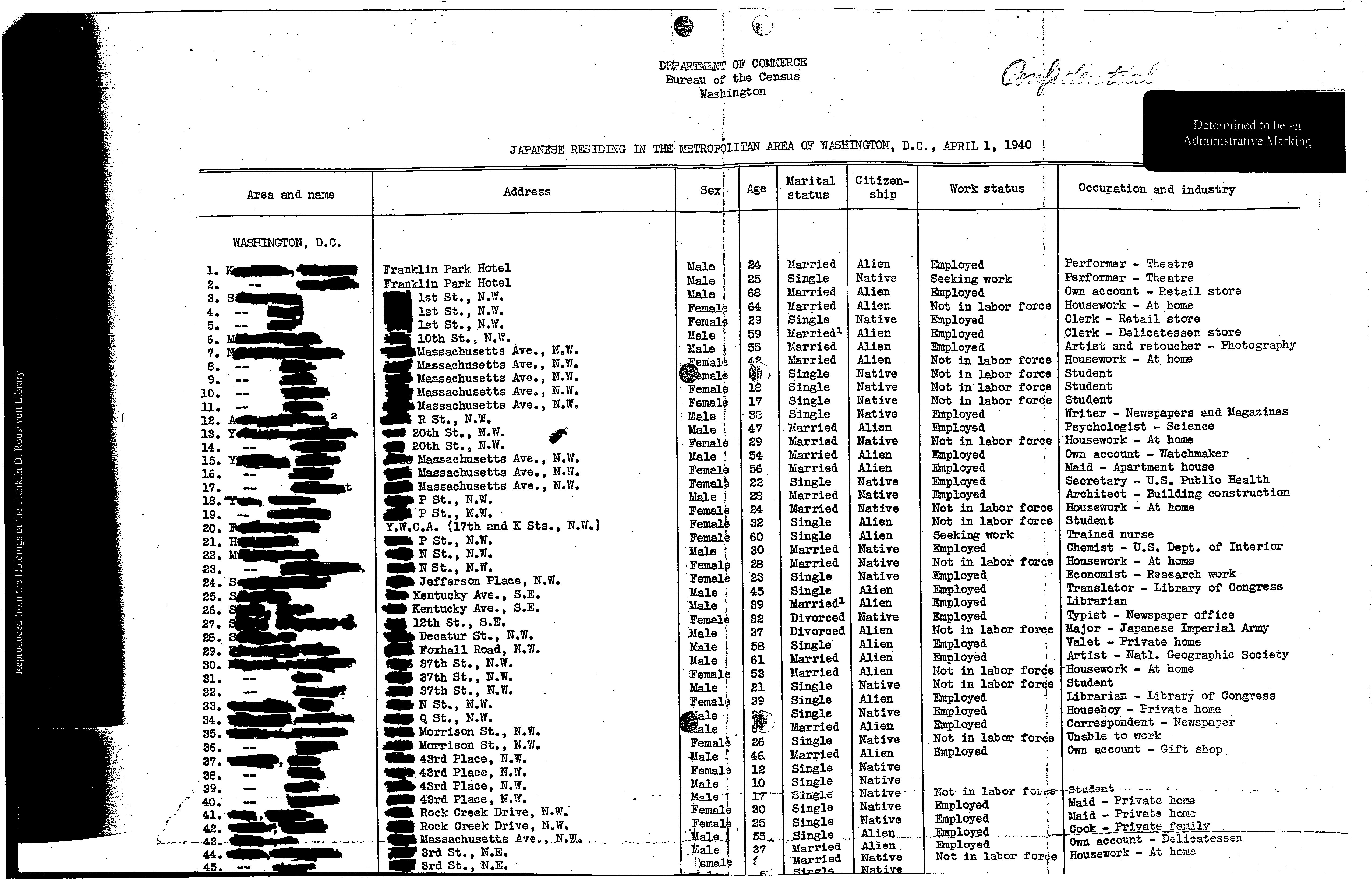
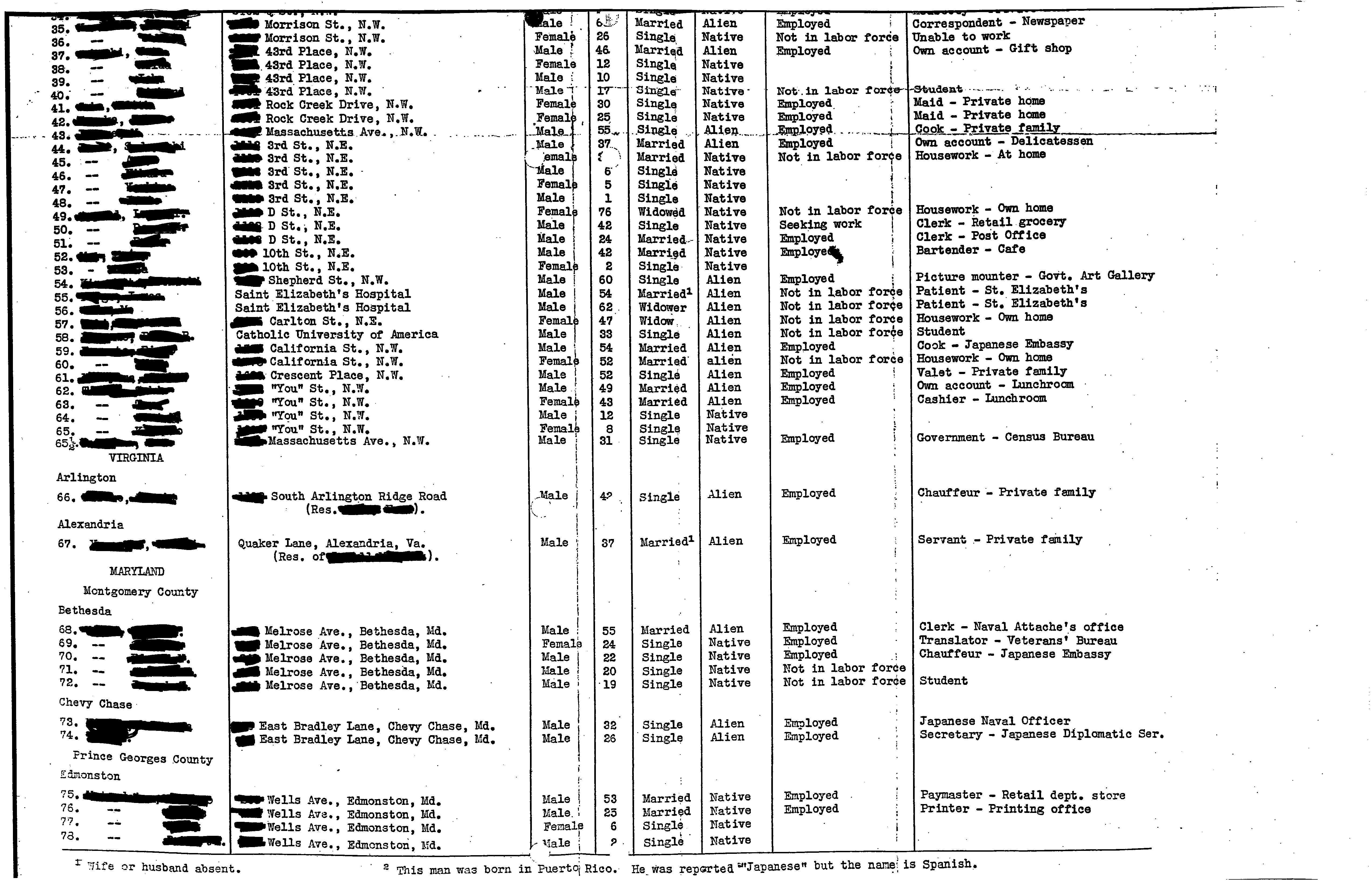
(The researchers blacked out the name and house number of each person when republishing this document in 2007. The original 1943 document revealed all the names and addresses.)

The authors believe that law enforcement lookups of such information were relatively routine during the war — and that the FBI and other agencies tried to continue their access to this personal census information after the war, even after their legal authorization for access had lapsed. Read the paper, and their other papers, for the details.

News coverage about the Japanese-American Census roundup includes Scientific American’s 2007 story “Confirmed: The U.S. Census Bureau Gave Up Names of Japanese-Americans in WW II”, and USA Today’s March 30, 2007 “Papers show Census role in WWII camps”. Both include an apology from the 2000 Director of the Census, who didn’t even know it had happened; some researchers had to dig it out of Commerce Dept. records because all memory of these releases had been scrubbed from the Census Bureau records.

This wasn’t some fanciful injury to these peoples’ privacy. This was rounding up not thousands, not tens of thousands, but more than a hundred thousand completely innocent Americans and forcing them into prison camps for years. Men, women, and children. Rounded up like cattle. The only difference between this and what the Germans did to the Jews was the lack of gas chambers. And it was those foolish people who trusted the Census Bureau’s “oh sure we’ll keep it very confidential” assurances that ultimately put them in the camps. Don’t you believe it! We just had a spasm of national paranoia from 2001-2010, this time about Muslims, and poof, census data about Muslims got somehow released to our local Gestapo (the Department of Homeland Security). Who’s next?

A more general reference is an editorial in the Wall Street Journal of 8/8/89, page A10, “Honesty May Not Be Your Best Census Policy”, by James Bovard. I found a definitive copy in the SF Public Library on microfilm; your library probably has it. It documents a couple of violations.

The most obvious is that census data was used to round up the Japanese-Americans in 1942. “The Census Bureau provided the Army with a list of exactly how many Japanese-Americans lived in given neighborhoods, making it easy to round them up for internment during World War II. Census Bureau spokesman Ray Bancroft insists that this was not a breach of confidentiality because the bureau did not give out the names or exact addresses of Japanese-Americans. This is like someone claiming he bears no responsibility for setting loose on your block a wolf that just happened to gnaw on your leg — simply because he didn’t set the wolf free at your doorstep and tell the wolf to bite you personally.” And it turns out he was wrong, the Census Bureau did actually hand out names and exact addresses, for example in the document shown above.

Other cases occurred in Montgomery County, MD; Pullman, Wash; Long Island Regional Planning Commission; and Urbana, IL; where census data released on a ‘block’ basis is used to check compliance with local building codes and zoning laws. A block can have as few as 6 houses; the average is 14. This clearly lets these governments pinpoint where to send their inspectors to charge people with violations.

The IRS tried to use computer matching of census data and private mailing lists to track down people wno don’t file income taxes, in 1983.

All of the above is from the article. The maximum penalties are from the Census Act itself, I think it’s Title 13 of the US Code. You can find it in any law library or government depository library (e.g. your city library or large university library). If you look in the “US Code Annotated” books then you’ll find the court cases about the Census Act listed too.

General Sherman’s march was powered by Southern census data

The Civil War provides a much earlier example. According to Erik Larson’s book “The Naked Consumer”, (Penguin 1992) ISBN 0-8050-1755-0, on pp. 33-34:

	 Census officials began treating the collected information as confidential, although no law required them to do so. The custom didn't keep the Union Army from turning census data into a weapon,
     however, thereby providing one of the earliest proofs of the second and third laws of data dynamics: that information produced for one purpose will be used for other purposes and eventually will cause
     harm to those who supplied the Information.

	 In 1864 Union General William Tecumseh Sherman concocted an audacious plan--a full-force march from Atlanta to the sea, which Civil War historian Bruce Catton called "the strangest, most fateful campaign of the entire war." Sherman set out not to engage another army; but to destroy the Confederate economy and to convey the message that the United States, in Sherman's words, "has the right, and also the physical power, to penetrate to every part of the national domain, and that we will do it ... that we will remove and destroy every obstacle--if need be, take every life, every acre of land, every particle of property, everything that to us seems proper." With the help of the census office--it was not yet called a bureau--he made a pretty fair try at fulfilling that promise.

	 He planned a fast, lean march. Doing so meant he would not be able to maintain conventional lines of supply; in those days before helicopter gunships and Harrier jets, an army was only as good as its ability to protect the roads, rivers, and railroads down which it had already traveled. Sherman would have to live off the countryside to a degree no Union or Confederate army had done before.

	 From the start of the war, Census Superintendent Joseph C. G. Kennedy had been earnestly providing the war effort with maps and census information on southern population and industry but had sparked only limited interest. Sherman, however, saw in Kennedy's annotated maps the key to his campaign.

	 In practical effect Kennedy had provided Sherman with a kind of Mobil guide for the plunder of the Confederate countryside, using data produced in more settled times by the very people Sherman encountered along his route. He gave his troops explicit orders to forage, a practice that until then was technically against the law. The army's mission included destroying mills, cotton supplies, railroads, anything of economic or military value. An Illinois sergeant wrote that his colleagues seemed "to take savage delight in destroying everything that could by any possibility be made use of by their enemies."

	 After the campaign, Sherman dropped Kennedy a thank-you note:
     "The closing scene of our recent war demonstrated the, value of these statistical tables and facts, for there is a reasonable probability that, without them, I would not have undertaken what was done and what seemed a puzzle to the wisest and most experienced soldiers of the world."

How to handle public meetings about the census

(Written by me in 1990, with annotation in 2007.)

I just got back from a Census rah-rah meeting sponsored by two local Congresswomen. (Barbara Boxer and Nancy Pelosi, I think. How times have failed to change in the intervening 17 years.) They had a bunch of folks from the Census Bureau plus people from the local Complete Count Committee. The Complete Count Committee represents local communities trying to get a good count, e.g. the homeless, blacks, arabs, Latinos, asians, etc. The Committee had little good to say about the Census Bureau, a litany of broken promises and no support. The homeless won’t be counted well because sending in middleclass people scares them, and few homeless are willing to submit to an FBI check so they can work for the Census Bureau for a few weeks. Latino enumerators are required to pass an English literacy exam because the enumerator classes and administration forms are in English, even though the census forms themselves are available in Spanish. Census bureau outreach to schools has been botched by sending one lesson-plan packet to each school principal, none to teachers. Etc.

They tried to railroad the question-answer period so if you go to such a meeting, watch out for that. There were a bunch of people who were waiting to ask or comment when they said they would take two more questions. I interrupted them and called them on it, saying that they were more interested in telling us what to do than in listening to our questions and comments, and they said the meeting was advertised to end at noon. They then spent the next ten minutes blathering, thanking everyone for coming and etc. They didn’t get away with it because they were cornered in the hall by about 40 people (most of the audience) and had to listen and respond for another 25 minutes.

I found that my first question, “Didn’t the census bureau supply the Army with the locations of all the Japanese-Americans in 1942 so that they could be taken off to concentration camps?” provoked quite a stir in the audience. The Census Bureau’s answer didn’t quiet the stir. I asked it in response to their speech about the utter “confidentiality” of the information. However, this alerted them that I was a troublemaker and thereafter, a Congresswoman interrupted whenever it looked like the moderator was going to call on me. Moral: Bring a few people and don’t sit together!

My second question I squeezed in at the end after they tried to squelch further discussion. It was “If someone decides not to answer the census, what is the maximum penalty? Can they be sent to jail?” The first phrase is critical, the whole meeting had not even mentioned that someone could “decide not to answer”, they talked about “undercounts” and “outreach efforts” and “refugees from repressive governments who we need to convince about our government”. Unfortunately the Census Bureau rep lied in his answer, saying $1000. The Census Act specifies a penalty of $100.

I spoke with the Census rep afterward, and he surprised me by saying that his parents and siblings were taken to the internment camps (he is Japanese- American). But he still doesn’t see anything wrong with the census. He said that the data the Army used was available to everyone — not noticing that the mere collection of the data makes its abuse, as well as its use, inevitable. He seemed to be slightly moved by my charging him with making it easier for the next round-up, say of Central Americans or drug users. (The data they supplied was how many Japanese lived in each block in the country. The average block contains 14 houses. If the data says 5 Japanese live on this block, they just have to search until they find the household (two parents, three kids) and then they can go on to the next block, skipping completely the ones with no Japanese. In short, it made the repression a lot easier to administer. Their defense is that they didn’t give out names and addresses — just which block each Japanese-American lived in. However — in 2007, research has determined that the census bureau DID reveal specific addresses of Japanese people to the agencies of state oppression, so that those people could be harassed by the federal government. See images above.)

They have a publicity machine cranking up for the rest of the month so there will probably be plenty of opportunities for Libertarians to speak out on this issue. I encourage every Libertarian candidate for office to take a stand now, while the Census is “newsworthy”. You might call local radio station personalities and see if they will do a show about the Census (with you in the studio!). The morning commuter shows might be a good place, and the late night national and regional talk shows.

A good starting point for research is the Wall Street Journal, 8/8/89, page A10, editorial by James Bovard of the Competitive Enterprise Institute. This one page (reproduced below) will give you more points than you’re likely to be able to bring up in a meeting or talk show.

Consequences of Census Resistance

From: Lee King
Subject: Re: Consequences of census resistance
Date: 9 Mar 90 22:22:30

Since the census bureau only filed against one person in 1960 and one in 1970 (and later dropped the charges, according to the mailout from the Committee for Census Privacy), I don’t intend to answer non-count questions, either. If they try to prosecute thousands of us it will cost them more than what it’s worth (I hope).

* Origin: Liberty Houston (713) 785-4763 (Opus 1:106/1776)

Date: Mon, 09 Apr 90 12:50:19 -0700 I read a summary of the case that indicated $100/question but I haven’t read the actual case. At any rate I don’t think it set a national precedent, or was applied against more than one person. It wasn’t a Supreme Court case, just a local Federal district court case.

In 1960 two people were prosecuted for resisting the Census.
In 1970 one person.
In 1980 we don’t have figures but it wasn’t masses of people. They don’t like to give it publicity. I went to a meeting with two Congresswomen and the local Census honchos, and they were quite careful to even avoid mentioning the possibility that people might DECIDE to not answer the census. They kept talking about undercounts and such, but implying it was all due to mistakes or ‘missing some people’ rather than those people DECIDING not to be part of the sham.

Date: Fri, 16 Mar 90 16:52:36 -0800

One court case held the $100 to be per question, not per form. I don’t recall which district it was binding in, and didn’t look up the case itself, so I don’t know if it was used to charge somebody $800 for not answering all 8 questions, or $100 for not answering one of the questions though they answered the rest, or what. The US Code Annotated (look in the index under the Census Act) has the reference to the case, which you can then look up in the cases from that district. It doesn’t set a national precedent because it wasn’t a Supreme Court case.

Libertarian Party position on the 1990 census

The platform says (in the Protection of Privacy plank):

So long as the National Census and all federal, state, and other government agencies’ complilations of data on an individual continue to exist, they should be conducted only with the consent of the persons from whom the data is sought.

Here’s a press release from some Libertarian congressional candidates:

FOR IMMEDIATE RELEASE CONTACT: June Genis (415) 851-5224
or (415) 723-4422
Congressional Candidate Protests Census Penalties

Redwood City –June Genis, who is opposing Tom Lantos in the 11th Congressional District on the Libertarian ticket, has indicated that she will not fully comply with the 1990 census as a protest against the current criminal penalties for non-compliance. Genis says that while she is “proud to stand up and be counted” that she will answer only the head-count questions and leave all others unanswered.

“Many of the questions asked on the census are harmless and I expect most people, including myself, would probably not mind answering them for anyone. But other questions are very invasive of personal privacy and I do not believe that anyone should be subjected to hundreds of dollars in fines for failing to answer them or for giving incorrect answers”. She also noted that the sixth of the population which will be required to complete the long forms are being asked to invest several hours of unpaid labor on behalf of the government which will then turn around and sell the results to private companies. “Why should any Americans be forced to become market research subjects against their will and without compensation?”

Genis also noted that despite the vigorous, and likely expensive, advertising campaign to convince us of the confidential nature of census responses, it was census data that helped to round up Japanese Americans for the Word War II internment camps. “No, the Census Bureau did not tell the internment team that Mr. Yamaguchi lives at 123 Main Street, but they did supply the information that exactly five Japanese Americans live on the 100 block of Main Street which made it very easy for them to know where to go and how many bodies they should be able to collect on each street.”

Pointing out that although the Constitution empowers Congress to conduct a census for the purpose of apportioning representation, there is nothing there which empowers them to demand answers to any questions they chose to ask. “Yet”, says Genis, “they have taken the position that it would perfectly all right for them to compel you to enumerate what weapons you own or what illicit substances you consume and pretend that this would not be a violation of your constitution rights just because they won’t divulge any individual answers. We have already heard proposals to create concentration camps for drug users and to seize all privately owned semi-automatic weapons. There is simply no way to tell how the answers that people supply today might be used against them in the future”.

One person’s approach to the American Housing Survey

Date: Mon, 26 Mar 90 22:12:31 EST
From: alang@trashbin.MV.COM (Alan Groupe)

As we are now starting to receive our 1990 census forms, I thought some of you might like to know about the experience I had this time last year with a similar survey from the census bureau, called the American Housing Survey.

In April of 1989, Nancy Butter rang my doorbell and asked me to answer several questions about my house, my neighbors, my neighborhood, etc., under the guise of something called the American Housing Survey. I told her I was not interesting in participating and after a moderate length discussion on how important this was and how I would be throwing off all the statistics, she left me a 6 page brochure describing the survey and told me that I would be receiving a letter from the Regional Director, an Arthur G. Dukakis.

[As it turns out, Arthur IS related to Michael — he’s a cousin, I think.]

I received the following letter, dated April 17:

Dear Mr. Groupe:

We recently visited you and asked that you participate in the American Housing Survey. The U.S. Bureau of the Census is conducting this sur- vey in many metropolitan areas for the Department of Housing and Urban Development. This survey is conducted under the authority of Title 12, Section 1701Z-1 and 2g of the United States Code.

You indicated to the interviewer who visited you that you did not wish to participate in this survey. This survey is so important that we hope that a further explanation will cause you to reconsider your decision.

The primary purpose of the American Housing Survey is to provide cur- rent information on the size and composition of housing in your area. We ask questions about the housing people live in, the age of the buildings, the presence of selected facilities in your home, and the adequacy of neighborhood services.

In a society as complex as our, it is necessary that our nation’s decision makers be as well informed as possible in order to make the decisions that affect the lives of us all. The job of the U.S. Bureau of the Census is to be provide [sic] our national and local government leaders, as well as our business leaders, with statistical information on various aspects of our society.

Any information provided for this survey is confidential, by law, under Title 13, Section 9a, United States Code. No information which would identify an individual will be released. Your answers will be used only to prepare statistical summaries. Our interviewers and our office staff have been sworn to confidentiality and I can assure you that the record of the U.S. Bureau of the Census is unblemished. You will, by participating make a valuable contribution to the knowledge of the nation’s housing. In the future, when you see or hear housing statistics, you will know that you helped in the preparation of these figures. I trust that we can rely on you to help.

Our representatives will call on you again within the next few days.

Sincerely,
Arthur G. Dukakis
Regional Director

I responded with the following letter:

Dear Mr. Dukakis,

Recently, one of your field interviewers visited me and requested that I donate my time — I presume that I’m paying her for hers — to participate in the American Housing Survey. She then handed me a fact sheet so that I might know what this survey is about.

According to the fact sheet, this information will be used to assist the federal government in establishing a national housing policy. Since it is my fervent belief that the only proper housing policy would have no role for government, and since I do not believe that this is the type of policy the American Housing Survey is intended to engender, I could not in good conscience comply with your request.

You then sent me a letter asking me to reconsider, based on all the nice, wonderful things government does with all the information it collects. In your letter you stated, “In a society as complex as ours, it is necessary that our nation’s decision makers be as well informed as possible in order to make the decisions that affect the lives of us all.”

I couldn’t disagree with you more. In a society as complex as ours, it is necessary that our nation’s decision makers STOP MAKING SO MANY DECISIONS that affect the lives of us all.

In closing your letter to me you indicated that once again you would be sending an interviewer to talk to me. It angers me greatly that you are: 1) collecting data for an inappropriate purpose; 2) asking me to donate substantial amounts of my time to assist you (I remember the virtual novel your department asked me to fill out in 1980); 3) spending MY hard-earned money to do so; and 4) ignoring my wishes by sending out a second interviewer after I believe I made it clear that I did not wish to participate.

Maybe when the government learns that it is not entitled to the services of its citizens, people like me would be more willing to cooperate. But until such time, I wouldn’t hold my breath.

Sincerely,

Alan Groupe

I didn’t hear anything more from them.

— Alan Groupe | Data: (603) 672-9662
2 Great Brook Road | Cserve: 73607,2241
Milford, NH 03055 | uucp: decvax!ubbs-nh!trashbin!alang
(603) 672-9155 | alang@trashbin.mv.com

A Japanese-American view of the census

Date: Thu, 26 Apr 90 14:58:40 PDT
From: Ed Hall <edhall%ives@rand.org>

Well, I believe I read it in Pacific Citizen, the weekly newspaper of the Japanese American Citizen’s League. My wife probably threw out the edition I was thinking of–it would have been in mid-March. Needless to say, the issue does come up. More recently, the JACL joined with other Asian-American groups in a strong effort to get Asian-Americans to be counted. (This edition we still have: April 6, front page).

Your assertion is quite correct, though, if you change the word “block” to “tract.” But, then, anyone can obtain such information. You can even get tract data on CD-ROM these days.

The history of the wartime internment is chock full of reasons not to trust government agencies, Congress, the President, or even the Supreme Court. Read Michi Weglyn’s “Years Of Infamy” for a hard-hitting, well-documented history. The “Justice” department comes out looking particularly bad; it fought against justice for interned Japanese-Americans well into the ’60s. There is absolutely no mention of the Census Bureau, though. Various intelligence agencies had been spying on the Japanese-American community for almost a decade before the war. They already knew where they were. What’s worse, they already knew that the chance of any problems with that community were slim-to-none.

My mother-in-law spent the war in a camp in Arkansas; my father-in-law fled with his family to central Utah, where he spent the war until he was old enough to enlist. They were both originally from the San Jose area. Unlike some Nisei, they’ve talked about their experiences with their children–and with their children-in-law. This sort of thing isn’t a forgotten issue with us.

I see no reason to slander one of the few government organizations which *wasn’t* involved.

-Ed

Wall St. Journal article: Honesty may not be your best census policy

HONESTY MAY NOT BE YOUR BEST CENSUS POLICY
By James Bouvard
Wall St Journal 8-Aug-89

Next year, the Census Bureau will conduct the nation’s 21st decennial census. Ironically, while the bureau collect masses of information partly to justify expanding various welfare programs, many poor people will be victimized by the answers. While many liberal groups are worried about how the census will count the homeless, no one is paying attention to how the census could create new homeless.

The census forms next year will ask up to 59 compulsory questions per household, depending upon whether it receives a long or short form. They will include up to 26 questions on housing — type of building, approximate number of units in the building, monthly rent or mortgage payments, whether solar energy is used, etc. Anyone who refuses to answer any question can be fined $100.

Each household will receive an official notice with its census form next March: “Although your answers are required, the law guarantees privacy … The only people allowed to see your answers to the census are Census Bureau employees. No one else — no person, government agency, police officer, judge, welfare agency — can see them. It’s the law.” Federal law states that “in no case shall [census] information be used to the detriment of any respondent or other persons to whom such information relates.”

Yet, people have been evicted for giving honest census answers. Though the Census Bureau does not release data on each household, it does release information on each block — and a block can have as few as six houses on it. The average block contains 14 houses.

According to the General Accounting Office, one of the most frequent ways city governments use census information is to detect illegal two-family dwellings. An American Planning Association survey reported that housing code enforcement was a key benefit of census data for local governments.

For instance, Montgomery County, MD, and Pullman, Washington, use census data on the nubmer of housing units in a structure to check compliance with zoning regulations. The Long Island Planning Board uses census “block counts … to estimate the extent of illegal two-family home conversions,” according to a June 27, 1986 board letter. Such “illegal” two-family dwellings are pervasive on Long Island, according to Anthony Downs of the Brookings Institution. Such crackdowns are especially unfortunate because, as George Sternlieb of Rutgers University notes “The biggest source of good-size rental apartments in America is the illegal conversion of single-family houses.”

Census data help housing inspectors zero in on violators. Bruce Stoffel of the Community Services Department of the City of Urbana, Illinois, declared in an Aug 24, 1987 letter to the Census Bureau that he “routinely used census data to analyze the developmental stage of neighborhoods to determine the most appropriate public intervention strategies (e.g., code enforcement).

Obviously, the people most likely to live in overcrowded situations are poor people, especially immigrants, who often cluster in the same neighborhood. Housing codes have long been used as a means to “keep out undesirables” and to exclude waves of newcomers. William Tucker, author of the forthcoming “The Excluded Americans” notes: “code enforcement has always been a very counterproductive way of trying to help the poor. It usually sacrifices the adequate in favor of the ideal.

The Census Bureau denies responsibility for the eviction of poor people because the bureau does not release the precise names and addresses of housing code violators. It makes a similar argument about events that occurred in 1942, when the Census Bureau provided the Army with a list of exactly how many Japanese-Americans lived in given neighborhoods, making it easy to round them up for internment during World War II.

Census Bureau spokesman Ray Bancroft insists that this was not a breach of confidentiality because the Bureau did not give out the names or exact addresses of Japanese-Americans. This is like someone claiming he bears no responsibility for setting loose on your block a wolf that just happens to gnaw on your leg — simply because he didn’t set the wolf free at your doorstep and tell the wolf to bite you personally.

The IRS in 1983 attempted (largely unsuccessfully) to combine census data with private mailing lists in order to track down people who don’t file income taxes. As computer technology advances, the ability of the IRS to “abuse” census data will increase. As David Burnham, author of the forthcoming “The IRS: A Law Unto Itself”, says: “The IRS will try it again. As marketing lists become more complete and accurate, the IRS will become more able to combine them with census information to track people down.”

Information on race and home ownership is used to discover allocations of housing units that are discriminatory under the Civil Rights Act of 1984. Oxnard Park, California, uses census data to discover areas where landlords illegally discriminate against families with children. Information on occupations is used by corporations and government attorneys to construct affirmative-action quotas for different industries. Information on “place of birth” is used by the Civil Rights Commission as a baseline for determining discrimination by national origin. Even though the census is especially inaccurate with regard to minorities, (who often prefer not to be counted), census data are increasingly being used to construct proofs of prejudice and discrimination.

But the more intrusive government becomes, the less information it will get. The Census Bureau is expecting a sharp decline in the percentage of households that voluntarily mail back their census forms — from 83% in 1980 to 78% in 1990.

A lower response rate will sharply increase the costs of doing the census. The cost per capita of the census has increased from $121 in 1970 to $1040 in 1990 — a cost spiral that almost makes the Pentagon look good. (The total census cost next year is expected to weigh in at $2.6 billion). [sic — actual per cap cost is $2600*10^6 / 250*10^6 = $10.40 — looks like the decimal points got lost].

While most information-intensive industries utilize computers to sharply lower their costs of operation, the Census Bureau has repeatedly botched its operations and squandered millions. The bureau will need to recruit 300,000 census takers next year to go around and knock on doors. But, unless the nation has a major recession between now and then, the efforts to recruit temporary help could be a big failure, and the entire census effort could run aground. Recruitment is already running into difficulty in many areas.

The more information the government collects on people, the more control the government will have over people. When there are hundreds of thousands of pages of federal, state and local rules and regulations, almost every citizen must be guilty of something. And will millions of government employees in this nation, there are too many people with an incentive to abuse government information to fill their quotas of citations, arrests and investigations.

Mr. Bovard, a 1980 census taker, is an associate policy analyst for the Competetive Enterprise Institute.

What happens if you don’t answer

Subject: Census Compliance
Date: Wed Mar 28 09:34:55 1990
From: Bob Alexander

| On the bright side, the census official said that compliance in 1980 was
| ~83% (they send out people to homes to collect the other 17%. He did
| not say what the compliance was after that.)
According to the WSJ, if you refuse to answer they will fill the form out themselves by asking your neighbors.

 = = = = = = = = = = = = = = = = = =

RELATED POSTINGS:


Sept 20:  Advocating for detailed files on citizens  (Response to Maclean’s Magazine)


Nov 5.  Mandatory long form census, to Minister Navdeep Bains (Innovation, Science & Development)  Minister Responsible for the Census


Nov 6.   To Prime Minister J Trudeau, Census Long Form & Charter Right to Privacy


Nov 7.  My reply to “What’s your take?”


Nov 9.  Request to defend Charter Right (Privacy of Personal Information) – to Ministers Justice, Democratic Institutions & Privacy Commissioner    Includes reply and response.


Jan 9.  2016-01-09 To Parliamentary Secretary for Justice, Sean Casey, re Mandatory Census Long Form and Charter Right to Privacy of Personal Information


2015.    Prime Minister Justin Trudeau’s commitment to the Charter of Rights and Freedoms: 1. Letter of Mandate to Attorney General & 2. Quotes from Trudeau’s book, “Common Ground” 
 
2015.    1940′s “U.S. Census was used to round up hundreds of thousands of patriotic American citizens at gunpoint”.   

gnu@toad.com, gnu@eff.org, my PGP key
Last updated Fri Sep 30 01:56:57 PDT 2011


Sep 202015
 

Here is the link to the article,  followed by letter I sent in response.   So I won’t have a heart attack!

Vanishing Canada: Why we’re all losers in Ottawa’s war on data”, Maclean’s Magazine. By     September 18, 2015


– – – – – – – – – – – – – – – – – – – –  – – – – – – – – – – – – – – – – – – – – – – – – – – –

UPDATE:   Sandy sent in  1940′s “U.S. Census was used to round up hundreds of thousands of patriotic American citizens at gunpoint”.  An excellent and eye-opening compendium.

Let me add this background for newcomers:

Census machinery, “Hollerith machines” and punch cards, were developed and implemented in the late 1800’s through the U.S. Census Bureau  and later transported by IBM, first to Germany and then to other European countries.   IBM perfected the collection and tabulation of data on citizens for the Nazis in the 1930’s.   Of course the American Census Bureau would benefit – – IBM supplied their Hollerith machines and punch cards, too.

The Nazis used the Census Data to round up Jews and others.

The Americans used the Census Data to round up Japanese and others.  In the lifetime of my parents, not in the misty past.

(Note: In present day Canada,  IBM is a sub-contractor to Lockheed Martin in the census contracts.  True in Canada, U.S., U.K., and I believe Australia and New Zealand (the “5 Eyes”).


– – – – – – – – – – – – – – – – – – – –  – – – – – – – – – – – – – – – – – – – – – – – – – – –

SENT BY EXPEDITED MAIL TO MACLEAN’S MAGAZINE with a hand-written cover letter

Currently, Citizens can choose whether or not to tell the Government (the Statistics Dept)  whether they are Muslim, Jew, Mexican, First Nation, Polack, Nigger, Slant-Eye, Freak, Gay, Bum Boy, Dwarf, whether they see visions, hallucinate  – – –  or whatever other target we WASP heterosexuals may use for the venting of our venom.

But, the Government should build detailed files on citizens. That’s the argument in Maclean’s Magazine, if the journalist understands what she is advocating for (a mandatory census long form).

If Harper cannot build a police state for us (Bill C-51 just one example), we will do it for ourselves.  Maclean’s Magazine, other media and influential people are determined to help us.

We will boot Harper out and elect people who will impose mandatory detailed files on citizens, IN SPITE OF the record of the Stasi in East Germany (detailed personal information on 6 million citizens),   We know that every sophisticated police state current and historical uses detailed files on citizens.   We want the same for ourselves.     Well thank you but I decline.

LOOK:

Nazi Europe.  NOT JUST in Germany.   Mechanized files on citizens were KEY.

Opaque subsidiaries of IBM working with Governments started doing “long form censuses”  WAY BEFORE World War Two.

The Nazis could not have targeted specific populations in Germany and other countries without the files and the collaborators.  (Ref:  “IBM and the Holocaust” by NY Times author Edwin Black.)  It’s why we have an enshrined Right to privacy of personal information.   . . .  what is so hard to understand about that?

THE EXTENT IN EUROPE of the build-up of personal files in the lead-up to the exterminations appears below as yet more evidence, if that will help.

I can have no patience with this ignorance by which we seem determined to enslave ourselves.   People who ADVOCATE for the collection of detailed data on citizens that is happening at StatsCan are badly misinformed.

God, Allah and All Saints help us.

Sandra

Government/Corporate capability for surveillance today far outweighs what could be done pre-World War Two.  And far outweighs what has already been done through the U.S. military and NSA, with contracts to Lockheed Martin that also has its tentacles in the data base at StatsCan.

The following is an EXCERPT,  the dates for the beginning of the files on citizens in Europe.  It began innocently enough as censuses.  By the time of World War Two, for example, people of Jewish ancestry could be identified down to eighth-bloods.

http://www-03.ibm.com/ibm/history/documents/pdf/emea.pdf

The following document has been adapted from an IBM Intranet resource developed by Grace Scotte, a senior information broker in the organization at IBM’s EMEA headquarters in Paris, France. 

Some Key Dates in IBM’s Operations in Europe, the Middle East and Africa

(EMEA)  (The year in which the IBM census operations began in each country)

          1910   Germany

          1914   France

          1920   The Netherlands

          1927   Italy, Switzerland

          1928   Austria, Sweden

          1935   Norway

          1936   Belgium, Finland, Hungary

          1937   Greece

          1938   Portugal, Turkey

NOTE:  In the envelope to Maclean’s I included a copy of my  First attempt  to explain the dangers in their article.   If you are new to this issue you may want to look at it, yet another equally troubling perspective.

 = = = = = = = = = = = = = = = = = =

RELATED POSTINGS:


Sept 20:  Advocating for detailed files on citizens  (Response to Maclean’s Magazine)


Nov 5.  Mandatory long form census, to Minister Navdeep Bains (Innovation, Science & Development)  Minister Responsible for the Census


Nov 6.   To Prime Minister J Trudeau, Census Long Form & Charter Right to Privacy


Nov 7.  My reply to “What’s your take?”


Nov 9.  Request to defend Charter Right (Privacy of Personal Information) – to Ministers Justice, Democratic Institutions & Privacy Commissioner    Includes reply and response.


Jan 9.  2016-01-09 To Parliamentary Secretary for Justice, Sean Casey, re Mandatory Census Long Form and Charter Right to Privacy of Personal Information


2015.    Prime Minister Justin Trudeau’s commitment to the Charter of Rights and Freedoms: 1. Letter of Mandate to Attorney General & 2. Quotes from Trudeau’s book, “Common Ground”  


2015.    1940′s “U.S. Census was used to round up hundreds of thousands of patriotic American citizens at gunpoint”.   
Sep 192015
 

Part of the Maclean’s Magazine article Vanishing Canada: Why we’re all losers in Ottawa’s war on data is dangerous.

Please see my next attempt to make the danger clear:    Advocating for detailed files on citizens .  Below is my first attempt.

THE ARTICLE:

http://www.macleans.ca/news/canada/vanishing-canada-why-were-all-losers-in-ottawas-war-on-data/#comments

by    September 18, 2015

MY RESPONSE  (Sept 19):  
I applaud Anne Kingston for valid points.  I must strongly challenge her and some others on another point.  Have the lessons of history been forgotten?  Are Canadians ignorant of important details of the last decade?
Work at Statistics Canada was out-sourced to Lockheed Martin Corp of the American military beginning in 2003.   Its website lists “surveillance” as a specialty.  Lockheed Martin’s website discloses that it does work for the NSA.  Edward Snowden provided the information to show that the American “security” forces get back-door entrance to important data bases, if they can’t get front-door (i.e. legal) access.  It does not matter which country.
The historic lesson is that states with detailed files on citizens are police states.  “IBM and the Holocaust” by Edwin Black is  a powerful documentation of the enabling role played by mechanized data (census) files on citizens in Nazi Europe.  You are wrong if you think that names are not on the data files at StatsCan. There is an urgent reason why Canadians have a Charter Right to Privacy of Personal Information.  – –  I can only think that a citizen would seriously advocate for “supply your personal information, and if not you will be prosecuted” as I and others have been,  if you are unaware of what we’ve gotten ourselves into with integration of the U.S. and Canadian military.
StatsCan demands very detailed personal information.  Even the lengthy National Household Survey is conducted under threat of prosecution, although there is a strong case to say that surveys are voluntary under the law.
But further, Canadians have to decide whether to cooperate with giving our money to Lockheed Martin Corp.   They were the number one contract interrogator at overseas U.S. prisons like Abu Ghraib and Bagram.   Torture – illegal.  They produce illegal weapons.  They break U.S. Arms Export rules meant to keep weapons out of the wrong hands.  They are very corrupting of democratic processes.  And they are a large part of the reason that American tax-payers are burdened with debt of more than $18 Trillion dollars (wars).   Canadians should be careful what they wish for.  It is a travesty that Lockheed Martin Corp got anywhere near the data base at StatsCan.  
That is still no reason why one should advocate for the tools of a police state (detailed files on citizens) in Canada.   I find it very troubling that anyone would do so.
Sep 172015
 

I am especially upset when it is children who are affected by the deceits.   Upset (angry!) is the wrong word.   I am fueled to continue.

I  commented on the appended article in the Guardian,

and contacted the parties who have worked so tirelessly in the public interest, to thank them.


http://www.theguardian.com/science/2015/sep/16/seroxat-study-harmful-effects-young-people?CMP=EMCNEWEML6619I2#comment-59709849 

My Comment:

Moonbean says “Thanks to everyone for their courage . . .” (in fighting for integrity in science). Yes!   Many thanks to David Healy in this instance.

I googled “Martin Keller, Brown University”, (lead author of the fraudulent study that benefitted GlaxoSmithKline) and found Alison Bass.   She documents that Keller left Brown University by Sept 2012.   https://www.madinamerica.com/2012/09/martin-keller-principal-investigator-of-controversial-paxil-study-is-retired-from-brown-university/

I see where journalist Alison Bass has been a persistent force in exposing the corruption.  Citizens have to know the names of the fraudsters; it’s the only way to hold them to account.

Pierre Boudoir comments “Isn’t this fraudulent and criminal behaviour? We can expect people to go to jail, right?”

Keller and GSK may not have put a bullet in anyone; their crime is worse and affects many more people. The only ones who will see that they are brought to justice are citizens.   The strength of the Comments on this article say to me that we have the capability, we have only to exercise it.

Propaganda (advertising, spin doctors) is a serious threat in today’s world.   Most of the large Universities (“scientists”, collaborators) play a significant role in “conditioning” students for corporate and Government purposes.   The public interest is lost.

It definitely takes courageous people within our institutions to stand up to the betrayal, and, journalists ready to go the extra mile.  It also takes active and vocal citizens to mobilize and bring the weight of our numbers to bear.

– – – – – – – – – – – – – – – – – – – – – – – – – – – – – – – – – – – – – – – – – – – – – – – –

APPENDED, FROM THE GUARDIAN

http://www.theguardian.com/science/2015/sep/16/seroxat-study-harmful-effects-young-people?CMP=EMCNEWEML6619I2#comment-59709849 

Health editor

Seroxat (Paxil) study under-reported harmful effects on young people, say scientists
Experts who re-analysed data say study is still referred to in medical literature and needs to be retracted

Seroxat pills Paroxetine is sold as Seroxat in the UK and Paxil in the US. Photograph: Jack Sullivan/Alamy

An influential study which claimed that an antidepressant drug was safe for children and adolescents failed to report the true numbers of young people who thought of killing themselves while on it, re-analysis of the trial has found

Study 329, into the effects of GlaxoSmithKline’s drug paroxetine on under-18s, was published in 2001 and later found to be flawed. In 2003, the UK drug regulator instructed doctors not to prescribe paroxetine – sold as Seroxat in the UK and Paxil in the US – to adolescents.

But experts who have obtained the original data say the study is still referred to in the medical literature and needs to be retracted.

In their re-analysis of the trial, published in the British Medical Journal, they say the beneficial effects of paroxetine on young people were far less and the harmful effects far greater than the study suggested.

Out of 275 children and adolescents in the trial, 11 taking the drug and one in the group given a placebo developed suicidal or self-harming behaviour. The original publication of the study reported five on the drug and one on placebo. There were no reports of suicidality on a second drug, imipramine, which was also tested in study 329.

David Healy, professor of psychiatry at Bangor University in Wales, said it was hard to see how so many suicidal children could have been overlooked. “We think if you were to go in and look at this data, anyone without training will find there are at least of the order of 12 children becoming suicidal on this drug out of about 93 [who were given it],” he said.

“This is a very high rate of kids going on to become suicidal. It doesn’t take expertise to find this. It takes extraordinary expertise to avoid finding it.”

In an article published with the re-analysis, Peter Doshi, associate editor of the BMJ, said the new paper “has reignited calls for retraction of the original study, putting additional pressure on academic and professional institutions to publicly address the many allegations of wrongdoing.”

He said few trials had been as controversial as study 329, whose lead author was Martin Keller from Brown University. In 2002, the year after its publication, the US Food and Drug Administration said it should be considered a failed trial because the depressed adolescents taking the drug did no better than those on placebo.

In that same year, more than two million prescriptions for paroxetine were written for adolescents and children in the United States, on the back of an advertising campaign which claimed the trial had shown “remarkable efficacy and safety”. GSK was fined $3bn in 2012 for fraudulently promoting the drug.

“It is often said that science self-corrects. But for those who have been calling for a retraction of the Keller paper for many years, the system has failed,” Doshi writes. “None of the paper’s 22 mostly academic university authors, nor the journal’s editors, nor the academic and professional institutions they belong to, have intervened to correct the record. The paper remains without so much as an erratum, and none of its authors – many of whom are educators and prominent members of their respective professional societies – have been disciplined.”

The BMJ authors, led by Prof Jon Jureidini at the University of Adelaide, wrote to GSK in 2013 asking whether the company intended to re-analyse the data itself. They say GSK declined.

However, GSK did co-operate with the re-analysis by agreeing to post 77,000 pages of de-identified case reports from the adolescents in the trial on a website.

The BMJ paper is the first re-analysis of a drug study under a new initiative called Riat (Restoring Invisible and Abandoned Trials). Dr Fiona Godlee, BMJ editor-in-chief, said publication of the reanalysed data from study 329 “sets the record straight” and “shows the extent to which drug regulation is failing us”. She said it also showed that the public and clinicians did not have the unbiased information they needed to make informed decisions.

She called for independent clinical trials rather than trials funded and managed by industry, as well as legislation “to ensure that the results of all clinical trials are made fully available and the individual patient data are available for legitimate independent third-party scrutiny.”

GSK stressed its commitment to transparency and its help for the researchers who re-analysed study 329. “Importantly, the findings from this team’s analysis appear to be in line with the longstanding view that there is an increased risk of suicidality in paediatric and adolescent patients given antidepressants like paroxetine,” it said.

“This is widely known and clear warnings have been in place on the product label for more than a decade. As such we don’t believe this reanalysis affects patient safety.”


Sep 172015
 

Colette Derworiz, Calgary Herald,

From an earlier report:

University of Alberta scientist David Schindler holding a white fish with a tumour growth in the center. Deformed and unheathly fish collected from the Athabasca watershed, downstream from the oil sands industrial development were on display during a news conference at the University of Alberta. Researchers raised alarm bells and request the federal government make funds available for a long-term fish monitoring program.

As the federal election enters its final month, one of Canada’s most influential environmental scientists says it’s time to start focusing on water.

The campaign, which started six weeks ago, has lacked much debate on climate change — including its impact on water.

“I see these very imminent problems and here we have our so-called leadership candidates running about harping on each other’s scandals and who can do better with the economy,” said David Schindler, a retired University of Alberta ecologist. “We are going to forget all about the economy when we run out of water.

“To a scientist who spent his lifetime studying this, what we see is as obvious as a bunch of boys walking by with big leather gloves and bats. There’s going to be a ball game. It’s just a question of when and where, but it’s going to be soon.”

His comments come after high temperatures and low rainfall across Western Canada caused the worst drought in more than a decade this summer, leading to large wildfires, water restrictions and a province-wide agricultural disaster in Alberta.

Schindler will speak at In Deep: A Conversation About Water — a one-day symposium on Oct. 3 that will bring together internationally renowned experts at the Banff Centre in Banff.

The symposium, organized by the Whyte Museum, will have both global perspectives and specific concerns about the Rocky Mountains and the Columbia River Basin.

“The morning will try to give a broad sweep of the water situation globally right down to the local,” said Henry Vaux Jr., a retired professor of resource economics at the University of California and chairman of the Rosenberg International Forum on Water Policy. “In the afternoon, the focus is on the Columbia River Treaty.”

The United States has suggested it’s ready to start talks with Canada on the renewal of the pact, a 51-year old treaty that created dams for electricity and flood mitigation in the Pacific Northwest.

Vaux, the symposium’s moderator, said the treaty is often debated but the speakers will work to educate attendees on what’s at stake for both the U.S. and Canada.

“The treaty, it looks almost certain it will be up for renegotiation in the next two years,” he said, noting one side or the other will have to ask for it. “There are stakes in terms of water supply and potential of reallocation of the water supply.

“That has implications for power production in Canada and agriculture in the United States and it also has some implications for fisheries.”

Schindler will speak more generally about Western Canada’s freshwaters in a changing climate, including the decline of the Bow River flows, glacial melt and the effect on fisheries — all issues he suggested could be addressed by politicians.

“The first thing we ought to do is pressure our federal and provincial politicians for some regulations on everything from population development to water use. We are still the world’s most profligate water users,” he said. “Second, we need those climate regulations now … if we don’t get on top of this in the next 10 years, we are going to see incredible suffering.”

Schindler added that water needs to be connected to the economy.

“I haven’t yet heard one mention about the billions of dollars that are going to be paid out to farmers for the agricultural disaster happening in Alberta and parts of B.C. this summer,” he said. “That happens every few years, and yet it’s scarcely mentioned as part of the economy.

“It’s like someone who only ever looks at their income, but not their expenses.”

cderworiz   AT   calgaryherald.com

twitter.com/cderworiz


Sep 122015
 

Essay — From the September 2015 issue
The Neoliberal Arts
How college sold its soul to the market
Download Pdf
Read Online
( 2 of 8 )


This is education in the age of neoliberalism. Call it Reaganism or Thatcherism, economism or market fundamentalism, neoliberalism is an ideology that reduces all values to money values. The worth of a thing is the price of the thing. The worth of a person is the wealth of the person. Neoliberalism tells you that you are valuable exclusively in terms of your activity in the marketplace — in Wordsworth’s phrase, your getting and spending.

The purpose of education in a neoliberal age is to produce producers. I published a book last year that said that, by and large, elite American universities no longer provide their students with a real education, one that addresses them as complete human beings rather than as future specialists — that enables them, as I put it, to build a self or (following Keats) to become a soul. Of all the responses the book aroused, the most dismaying was this: that so many individuals associated with those institutions said not, “Of course we provide our students with a real education,” but rather, “What is this ‘real education’ nonsense, anyway?”

A representative example came from Steven Pinker, the Harvard psychologist:

Perhaps I am emblematic of everything that is wrong with elite American education, but I have no idea how to get my students to build a self or become a soul. It isn’t taught in graduate school, and in the hundreds of faculty appointments and promotions I have participated in, we’ve never evaluated a candidate on how well he or she could accomplish it.

Pinker is correct. He is emblematic of everything that is wrong with elite American education. David Brooks, responding to both Pinker and myself, laid out the matter very clearly. College, he noted, has three potential purposes: the commercial (preparing to start a career), the cognitive (learning stuff, or better, learning how to think), and the moral (the purpose that is so mysterious to Pinker and his ilk). “Moral,” here, does not mean learning right from wrong. It means developing the ability to make autonomous choices — to determine your own beliefs, independent of parents, peers, and society. To live confidently, courageously, and hopefully.

00028__JulieCockburn-Harpers-1509-630. -1

Only the commercial purpose now survives as a recognized value. Even the cognitive purpose, which one would think should be the center of a college education, is tolerated only insofar as it contributes to the commercial. Everybody knows that the percentage of students majoring in English has plummeted since the 1960s. But the percentage majoring in the physical sciences — physics, chemistry, geology, astronomy, and so forth — has fallen even more, by some 60 percent. As of 2013, only 1.5 percent of students graduated with a degree in one of those subjects, and only 1.1 percent in math. At most colleges, the lion’s share of undergraduates majors in vocational fields: business, communications, education, health. But even at elite institutions, the most popular majors are the practical, or, as Brooks might say, the commercial ones: economics, biology, engineering, and computer science.

It is not the humanities per se that are under attack. It is learning: learning for its own sake, curiosity for its own sake, ideas for their own sake. It is the liberal arts, but understood in their true meaning, as all of those fields in which knowledge is pursued as an end in itself, the sciences and social sciences included. History, sociology, and political-science majors endure the same kind of ritual hazing (“Oh, so you decided to go for the big bucks”) as do people who major in French or philosophy. Governor Rick Scott of Florida has singled out anthropology majors as something that his state does not need more of. Everybody talks about the STEM fields — science, technology, engineering, and math — but no one’s really interested in science, and no one’s really interested in math: interested in funding them, interested in having their kids or their constituents pursue careers in them. That leaves technology and engineering, which means (since the second is a subset of the first) it leaves technology.

Sep 092015
 

http://www.cbc.ca/news/business/kpmg-offshore-sham-deceived-tax-authorities-cra-alleges-1.3209838

By Harvey Cashore, Dave Seglins and Frederic Zalac, CBC News

A wealthy Victoria, B.C., family paid virtually no tax over a span of eight years – and even obtained federal and provincial tax credits – while being involved in an offshore tax “sham” developed by one of the country’s most respected accounting firms, the Canada Revenue Agency alleges.

The Canada Revenue Agency (CRA) believes there may be many more like them.

Court documents obtained by CBC News and Ici Radio-Canada show that in 2000, Peter Cooper and his two adult sons, Marshall and Richard, signed up for a KPMG tax product in the Isle of Man that targeted “high net worth” Canadian residents, promising they would pay “no tax” on their investments.

In 2013, the CRA obtained a judicial order demanding KPMG hand over the names of all the wealthy clients who set up shell companies in the Isle of Man, a small, self-governing territory in the Irish Sea between England and Ireland.

KPMG Canada is fighting that decision in federal court.

Documents show that between 2002 and 2010, the Cooper family paid little or no tax, despite receiving nearly $6 million from an offshore company. KPMG lawyers claim any money the Coopers received were “gifts” and therefore non-taxable.


If you have any more information on this story, please e-mail investigations@cbc.ca or contact Harvey Cashore at 416-526-4704.


The CRA alleges that the KPMG tax structure was in reality a “sham” that intended to deceive the taxman – and that both the Coopers and KPMG knew that $26 million hidden in offshore accounts actually belonged to the Coopers.

“The parties to the structure willfully presented its transactions as being different from what they knew them to be,” the Revenue Agency said in tax court filings in Vancouver.

The CRA also alleges that the Coopers received federal and provincial tax credits during the years they were not declaring the income from the Isle of Man. In 2009, for example, Richard Cooper claimed the full home renovation tax credit on a home in Victoria.

The CRA has slapped the Cooper family with an order to repay millions in unpaid taxes and penalties in a “grossly negligent” scheme the CRA says was set up to “avoid detection” by tax authorities.

‘I’m being drawn into this’


Marshall Cooper

B.C. resident Marshall Cooper said he was unaware of Canadian tax laws when he emigrated from South Africa in the mid-1990s. (Facebook)

When reached at his home in Victoria, Marshall Cooper said he was unaware of Canadian tax laws when he emigrated from South Africa in the mid-1990s.


“I went to the best people in the country. I’m being drawn into this, and I don’t think I should have been in the first place,” he says.

Cooper referred inquiries to KPMG, which is also representing the Coopers in their appeal in tax court.

KPMG declined to speak to CBC News about the allegations.

“Professional standards and obligations preclude us from disclosing, responding to, or discussing any matters that involve clients,” Kira Froese, KPMG Canada’s director of communications, wrote in an e-mail. “It is inappropriate for us to comment on matters that may be before the courts.”

KPMG Canada, which is both a tax and auditing firm, is perhaps best known for helping the federal government crack down on public misspending. Yet in the Coopers’ court case, it is alleged the accounting giant’s Offshore Company Structure intentionally deceived the federal government. The structure “is a sham and was intended to deceive the Minister,” the CRA alleges in court documents.

‘For internal use only’

Documents filed in court by the CRA also shed light on a secret internal KPMG marketing campaign that had escaped the scrutiny of tax collectors for more than a decade.


Isle of Man

Court documents obtained by CBC News show that in 2000, a wealthy B.C. family signed up for a KPMG tax product in the Isle of Man, pictured, that targeted “high net worth” Canadian residents, promising they would pay “no tax” on their investments. (CBC)


As far back as 1999, a “product alert” was sent to all KPMG tax practitioners across the country and strictly marked “for internal use only – not for distribution or circulation outside the firm.”


The memo outlined a plan that would “target” wealthy Canadian residents worth at least $10 million. It offered them “confidentiality,” protection from creditors and the ability to receive money “free of tax.”

In return, KPMG would take a 15 per cent cut of the taxes dodged. Successful KPMG sales agents and accountants were referred to as product “champions.”

Dennis Howlett, the executive director of Canadians for Tax Fairness, wants to know exactly how much KPMG Canada and its sales agents profited from the offshore scheme.

“They were given the incentive that they could collect 15 per cent of the taxes avoided,” he said. “We’re talking about millions of dollars here.”

KPMG did not respond to specific CBC queries about how many multi-millionaires invested in their “Offshore Company Structure” nor how much money the accounting firm made in sales and commissions.

Marshall Cooper told CBC News he believes there are many more like him. “It’s huge – huge,” Cooper said, speculating the CRA may find many more KPMG OCS clients.

Millions in undeclared ‘gifts’

According to CRA documents filed in court, Marshall Cooper lived in a posh home in Victoria but paid only $3,049 in total taxes between 2002 and 2011.

He even received tax credits worth $5,420, the CRA alleges.

Government auditors discovered the family invested in excess of $26 million back in 2002 and 2003 with help from KPMG. The money was handed to an offshore company called “Ogral” set up in the Isle of Man, but registered in other people’s names.

The CRA alleges the Coopers first “purported to gift their wealth” to the offshore company.  However, for years they received millions in non-taxable “gifts” back from Ogral that the CRA alleges were never reported on tax returns.

In their court filings, the Coopers insisted they obtained “substantial professional advice” when KPMG helped to set up the company in the Isle of Man. In their defence, the Coopers also say they consulted the law firm Fraser Milner Casgrain (now Dentons) before proceeding.

In the Cooper case, one CRA court pleading notes KPMG collected $300,000 in fees from the family between 2002 and 2008 based on the amount saved through the tax shelter.

KPMG lawyer Mark Meredith is representing the Cooper family in tax court. In a recent CRA court filing, however, the tax agency names Meredith, as well as now-retired KPMG tax partner Barrie Philp, as being the very ones who “developed the idea of an offshore company structure.”

Dalhousie tax professor Geoffrey Loomer says that if the allegations against KPMG hold up in court, the case may have implications for the entire accounting industry.

“It seems to me it’s bad from the point of view of the advisors involved, but it’s also just, you know, an instance of a larger problem where you have high-wealth, high-income taxpayers arguably not paying their fair share,” Loomer says.

“So it just means that more of the tax burden is borne by the middle class.”

Sep 032015
 

RE  John Pilger’s  documentary, The War You Don’t See   https://vimeo.com/67739294.  

Journalists, administrators speak frankly of their personal shame for reporting the propaganda spewed out by the Government spin doctors (propaganda) for the Iraq War.     (At the URL  scroll down through the white space,  there’s a white bar,  click on the left end of it.)

It takes courage to expose yourself in this fashion,  recorded for all to see and hear.  The film is well worth your time.

(I happen coincidentally to be reading Ronald Wright’s What is America? (2008), a myth-busting book about the history of the violence of the U.S.)


BLESS JOHN PILGER  for being a journalist who so effectively calls his fellow journalists to account.   Democracy otherwise drowns in seas of propaganda, a real and imposing threat to us today.   How many are aware?

ASIDE:   Earlier postings related to Pilger


BIG DEAL IF I APPLAUD PILGER.    (The War You Don’t See . . . EXTENDED)  

What can I do to help John Pilger / his worthy work fighting propaganda ?   . . .   hmmm   . . .   the Universities have become instruments for propaganda.

I was taken aback by Julie Cafley’s recent analysis in the Globe and Mail of the problems at the universities.  The elephant in the ivory towers is corporate influence which she does not even mention.  That is a very serious omission.   It is the vehicle by which the Universities become and are the propagandists.   So I wrote

Reply to Globe&Mail, “Universities need a new model of governance” by Julie Cafley

But why would Cafley be obtuse to the problem?   . . .  what is this organization for which she is a Vice-President,  Canada’s Public Policy Forum?

http://www.ppforum.ca/      Aaaaah!    Take a look.   Explains everything.   These guys PROMOTE corporate inclusion.    


I am no John Pilger.   But I can help out.   I left a message on Julie Cafley’s voice mail.  613-238-7858 Ext: 229.   She did not reply.   I need to email her:    julie.cafley@ppforum.ca

I think we have to directly challenge – – well, we actually have to stop – –  these people who so blithely sell-out our democracy.    Corporatized universities are in the propaganda business.    Propaganda is necessary to fascism.

John Pilger understands that.   Most of us understand that.   Why doesn’t a PhD know that?


– – – – – – – – – – – –  – – – – – – – – – – – – – – – – – – – – – – – – – – – – – –

RELATED:

2012-05-21    Heist of the century: university corruption and the financial crisis. Extract from “Inside Job”.

2004-11-02   “The Insider”, “The Corporation”, & J K Galbraith’s “The Economics of Innocent Fraud”  


Sep 022015
 

Universities need a new model of governance,

Globe&Mail, by Julie Cafley

Text and URL to access the on-line Comments is appended.

MY RESPONSE: 

Cafley does not mention the large problem of corporate infiltration of educational institutions.  Fortunately, many of the Comments do.

Will the professor steadfastly serve the public interest in unbiased research and teaching when a corporate entity is the funder?  “Knowledge” for corporate purposes is known as advertising.  In the common vernacular it is “propaganda”.   Example:  Monsanto provided millions of dollars for the Agriculture College at the U of S and has continued to fund research.  Will students learn anything other than GMO agriculture?  The Govt (both under the NDP and the Sask Party (Conservative)) supports the industry financially.  Now there is, in addition to the Ag College, The Global Institute for Food Security (GIFS) at the U.  It is a marketing vehicle for the industry.  The lobbying machine for the chemical-biotech corporations is CropLife Canada.  Lorne Hepworth was a Cabinet Minister in the Conservative Govt of Grant Devine.   When the Conservatives were ousted he became the Head of CropLife, for decades.  He now sits on the Board of GIFS at the University.   There are many lawyers at the U of S.   Yet none of them will disallow a clear conflict-of-interest in the little fiefdom.

The list of transgressions is long.   Dalhousie University taking money from Lockheed Martin Corporation under terms that give the corporation large influence in the teaching and research.

An insidious corporatization of the universities is through The Minerva Initiative.  It’s American.  In Canada we have the “U15” which appears to be taking Canadian universities along a similar path.

http://minerva.dtic.mil/overview.html  http://minerva.dtic.mil/overview.html

“The Minerva Initiative is a Department of Defense (DoD)-sponsored, university-based social science research initiative launched by the Secretary of Defense in 2008 focusing on areas of strategic importance to U.S. national security policy.

“The goal of the Minerva Initiative is to improve DoD’s basic understanding of the social, cultural, behavioral, and political forces that shape regions of the world of strategic importance to the U.S.  The research program will:

•   Leverage and focus the resources of the Nation’s top universities. …  “

The takeover of our knowledge base is not limited to the “hard” sciences.  It is a cancer that extends into many aspects of education.

I am particularly concerned about that which is absolutely essential for a functioning democracy,  learning that citizens have trusted our educational institutions to deliver.  Corporatized “education” turns out “yes people”, “consumers” without the skills and understanding to participate meaningfully in their (withering) democracy.


= = = = = = = = = = = = = = =

(http://www.theglobeandmail.com/globe-debate/universities-need-a-new-model-of-governance/article26024030/).

Universities need a new model of governance
Sep 022015
 

http://www.ppforum.ca/news-room/how-ubc-lost-president

By Simona Chiose and Frances Bula

August 27, 2015 — An unusual group had assembled at the Point Grey campus residence of Arvind Gupta, the president of the University of British Columbia. The gathering was made up of professors and associate deans from the Vancouver and Okanagan campuses, from science to arts and humanities. For a few hours last March, they had the president’s undivided attention.

Dr. Gupta’s spring session on the leafy UBC grounds was atypical in that it did not include administrators, staff and students who generally advise a university president.

“The argument that he made was that he was looking for advice that was [different] … from what he would normally get from his other vice-presidents and administrators,” said John Klironomos, a biology professor and the associate dean of research at the Irving K. Barber School of Arts and Sciences. “We sat there and brainstormed and agreed on many things and we had interesting debates. He mostly listened.”

But while Dr. Gupta was spending time with professors – and he invited administrators to the next session – behind the scenes there were smouldering fires. The president had let go several high-ranking executives in the administration; he’d also had disagreements with the board of governors over how much he needed to consult on key decisions.

On July 31, five months after the faculty brainstorming, Dr. Gupta resigned – only one year into what was supposed to be a five-year term. When the departure became public a week later, the campus erupted into rumours and recriminations that threaten to damage the reputation of one of Canada’s globally ranked universities. In the resulting row, faculty demanded to know more about why the president left, but the event has remained shrouded in mystery, protected by nondisclosure agreements that have silenced Dr. Gupta, the university and its board of governors. 

The Globe and Mail has talked to more than two dozen sources, including university administrators – deans, vice-presidents and the former provost – as well as faculty members. Most requested anonymity because they feared harming their careers. Several argued that Dr. Gupta focused too much on building links with professors and didn’t communicate with senior administrators. The university had taken a risk in hiring an innovator, but fatally underestimated his lack of administrative experience, they said. While Dr. Gupta is a computer science professor at UBC, his reputation largely rested on his building of Mitacs, a non-profit powerhouse that had broken down walls between academia and industry. The announcement of his hiring cited his “courage to chart a bold course.”

“The argument [in hiring Dr. Gupta] would have been that we have somebody who is an established researcher, who is an established fundraiser and has good connections to the outside, but he’s from UBC.… It’s an exceptional case because he had no experience as a dean or vice-president,” said Ross Paul, a former university president and the author of Leadership Under Fire: The Challenging Role of the Canadian University President.

The prevailing sentiment on campus now is one of regret. “From the inside, it’s been a tough year,” said one senior administrator. “I would have hoped that had Arvind stayed on, the university would have pulled together and made it work.”

The candidate

Across the country, governments and parents are anxious about the state of higher education in a challenging economy. They are asking for reassurance that the Ivory Tower is not just a place of abstract learning, but one that opens doors to well-paying jobs or helps students become entrepreneurs who can create their own employment.

When Stephen Toope resigned after seven years at the helm of UBC, he left a university facing those pressures head-on: The B.C. government had announced last year that it would tie 25 per cent of public funds to the labour-market outcomes of graduates.

Dr. Gupta seemed like the right man for the times. In his 14-year stint as CEO and scientific director of Mitacs, he had helped link up thousands of graduate students and researchers with internships in industry. In 2013, Ottawa rewarded the group with $35-million over several years.

The future UBC president was well connected to the federal government in other ways as well: In 2011, he served as a member of the Jenkins panel on innovation, which recommended closer collaboration between the National Research Council, universities and business.

“We are in a province where everything seems to be oriented toward LNG and pipelines,” one administrator said. “If what you think you need is better representation in government and in the private sector, Arvind [was] a pretty interesting choice.”

Many in the UBC administration were far more skeptical, describing the hire as a “flyer.” For them, running Mitacs, with its 2014 budget of approximately $100-million compared to UBC’s $2-billion, was not nearly enough preparation.

The first year

The departure of a president so soon in a mandate is unusual, but not unprecedented. In 2010, Concordia fired former French lit professor and experienced administrator Judith Woodsworth halfway through her term. As at UBC, it was Concordia professors who first demanded to know why.

Even before the March meeting, Dr. Gupta had begun building support with professors. He brokered a compromise with the faculty association around how the university could use faculty-created course materials. He protected academic programs from cuts to the university’s budget and argued for closer community connections for researchers.

“As faculty we are skeptical of business, but he was bringing us along,” one science professor said.

But to those who watched him make the rounds, the president looked exhausted. “He probably heard 10,000 opinions on what the university should do,” said one senior administrator. “Symbolically, it was interesting; practically, it was not that helpful.”

Dr. Gupta apparently didn’t treat administrators with the same care. Instead, firings were done in a brusque manner, without sufficient recognition of the contributions of those who left, sources said. The senior ranks began to fear for their jobs.

“Arvind was alienating people one at a time,” is how one administrator described the environment.

There was also resentment of new hires. Political strategist David Hurford, who had worked with former Liberal minister Allan Rock and former Vancouver mayor Sam Sullivan, joined as executive director of the president’s office. Mr. Hurford was known for promoting his political masters aggressively and doing whatever it took behind the scenes to help them drive through their agendas. He continued that approach in the president’s office.

“We have to have [the president] in the news, we have to have a photo op every week,” said one source of how the office was run. (Mr. Hurford left UBC after Dr. Gupta.)

Although things were rocky, by late winter a consensus was forming that these were merely the growing pains of a first year. Then, in April, the president asked David Farrar to step down from his job as provost and take on a new post as a presidential adviser. Dr. Farrar’s departure was a turning point.

“After David Farrar was moved out of the provost’s office, the tone shifted,” one person familiar with the situation said.

In the eight years he had been provost, Dr. Farrar had recruited and groomed some of the university’s top administrators. He also led the school’s successful aboriginal education strategy, which culminated in UBC being the only university that suspended classes this June, when the Truth and Reconciliation Commission released its findings.

It was one of his proudest accomplishments, Dr. Farrar said in an e-mail answer to a series of questions from The Globe.

He never applied for the job of president and has no plans to do so in the upcoming round, he added. “He was an extraordinary team player,” said one administrator of Dr. Farrar.

The deans of many faculties felt adrift after the departure. They e-mailed the president, requesting a meeting. A copy of that note made its way to the chair of the board, John Montalbano.Some deans had already informally talked to members of the board of governors over what they saw as lack of communication from the president’s office. But the goal was never to force the president to step down. Mr. Montalbano would not say how many issues had been raised with him. 

“Anything anecdotal would not be something the board would consider seriously,” he said.

He added that the board offered the president all the help it could muster, from inside and outside the university. Mr. Montalbano declined to say whether Dr. Gupta made use of that help. “I can’t speak for Arvind.…The board made it abundantly clear at any point that Arvind had all the resources available to him to succeed, to allow him to succeed.”

Former administrators and faculty at UBC have said relations between the board and the president could get heated. A former administrator who attended an in-camera board meeting last spring described it as “really ugly.” The chair’s concern, the administrator said, was that Dr. Gupta was making announcements about changes and directions that Mr. Montalbano believed should have been cleared with the board.

Mr. Montalbano rejects that claim: The board and the president had a “cordial” relationship, he said.

On the other hand, a colleague of Dr. Gupta’s said the former president had to deal with an inordinate level of interference by the board chair.

Exactly what happened in the last few weeks is unclear. According to Dr. Gupta’s contract, a performance-review process was to start in June. No such formal review ever took place, according to Mr. Montalbano.

The next president

On Sept. 1, the university will begin the process of closing this chapter in its 100-year history. Martha Piper, who already served as president from 1997 to 2006, will take over as interim leader while a new presidential search begins.

The ramifications are lingering: On Tuesday, Mr. Montalbano temporarily stepped down as chair of the board of governors while the university investigates allegations that he and others infringed on the academic freedom of a business professor who blogged about Dr. Gupta’s resignation.

Many on campus are angered by the entire episode.

“Given the price tag of the search, [the resignation] seemed to have come out of nowhere. You’re way over a million dollars in terms of this search,” said Joey Hansen, president of the university’s staff union. Mr. Hansen says as many as 5 per cent of the university’s workers could be laid off by the end of the year due to budget cuts.

Increasingly, research has found, Canadian university presidents today are less experienced and last a shorter time in the job than a prior generation.

“A lot of change-making is happening … once they’ve gained the trust of stakeholders, once they’ve built those relationships,” said Julie Cafley, who wrote her dissertation on Canadian university presidents and is a vice-president at the Ottawa-based Public Policy Forum. “It’s a shame for our system that we are not able to hire well, to transition well, to retain well and really be more supportive of this complex leadership role.”

Editor’s note: The article originally appeared in The Globe and Mail.