The pestilence of corporate totalitarianism is spreading rapidly over the earth.
This interview is a joint project of Truthdig and The Nation magazine.
A tiny tip of the vast subterranean network of governmental and intelligence agencies from around the world dedicated to destroying WikiLeaks and arresting its founder, Julian Assange, appears outside the red-brick building on Hans Crescent Street that houses the Ecuadorean Embassy. Assange, the world’s best-known political refugee, has been in the embassy since he was offered sanctuary there last June. British police in black Kevlar vests are perched night and day on the steps leading up to the building, and others wait in the lobby directly in front of the embassy door. An officer stands on the corner of a side street facing the iconic department store Harrods, half a block away on Brompton Road. Another officer peers out the window of a neighboring building a few feet from Assange’s bedroom at the back of the embassy. Police sit round-the-clock in a communications van topped with an array of antennas that presumably captures all electronic forms of communication from Assange’s ground-floor suite.
The Metropolitan Police Service (MPS), or Scotland Yard, said the estimated cost of surrounding the Ecuadorean Embassy from June 19, 2012, when Assange entered the building, until Jan. 31, 2013, is the equivalent of $4.5 million.
Britain has rejected an Ecuadorean request that Assange be granted safe passage to an airport. He is in limbo. It is, he said, like living in a “space station.”
“The status quo, for them, is a loss,” Assange said of the U.S.-led campaign against him as we sat in his small workroom, cluttered with cables and computer equipment. He had a full head of gray hair and gray stubble on his face and was wearing a traditional white embroidered Ecuadorean shirt. “The Pentagon threatened WikiLeaks and me personally, threatened us before the whole world, demanded that we destroy everything we had published, demanded we cease ‘soliciting’ new information from U.S. government whistle-blowers, demanded, in other words, the total annihilation of a publisher. It stated that if we did not self-destruct in this way that we would be ‘compelled’ to do so.”
“But they have failed,” he went on. “They set the rules about what a win was. They lost in every battle they defined. Their loss is total. We’ve won the big stuff. The loss of face is hard to overstate. The Pentagon reissued its threats on Sept. 28 last year. This time we laughed. Threats inflate quickly. Now the Pentagon, the White House and the State Department intend to show the world what vindictive losers they are through the persecution of Bradley Manning, myself and the organization more generally.”
Assange, Manning and WikiLeaks, by making public in 2010 half a million internal documents from the Pentagon and the State Department, along with the 2007 video of U.S. helicopter pilots nonchalantly gunning down Iraqi civilians, including children, and two Reuters journalists, effectively exposed the empire’s hypocrisy, indiscriminate violence and its use of torture, lies, bribery and crude tactics of intimidation. WikiLeaks shone a spotlight into the inner workings of empire—the most important role of a press—and for this it has become empire’s prey. Those around the globe with the computer skills to search out the secrets of empire are now those whom empire fears most. If we lose this battle, if these rebels are defeated, it means the dark night of corporate totalitarianism. If we win, if the corporate state is unmasked, it can be destroyed.
U.S. government officials quoted in Australian diplomatic cables obtained by The Saturday Age described the campaign against Assange and WikiLeaks as “unprecedented both in its scale and nature.” The scope of the operation has also been gleaned from statements made during Manning’s pretrial hearing. The U.S. Department of Justice will apparently pay the contractor ManTech of Fairfax, Va., more than $2 million this year alone for a computer system that, from the tender, appears designed to handle the prosecution documents. The government line item refers only to “WikiLeaks Software and Hardware Maintenance.”
The lead government prosecutor in the Manning case, Maj. Ashden Fein, has told the court that the FBI file that deals with the leak of government documents through WikiLeaks has “42,135 pages or 3,475 documents.” This does not include a huge volume of material accumulated by a grand jury investigation. Manning, Fein has said, represents only 8,741 pages or 636 different documents in that classified FBI file.
There are no divisions among government departments or the two major political parties over what should be Assange’s fate. “I think we should be clear here. WikiLeaks and people that disseminate information to people like this are criminals, first and foremost,” then-press secretary Robert Gibbs, speaking for the Obama administration, said during a 2010 press briefing.
Sen. Dianne Feinstein, a Democrat, and then-Sen. Christopher S. Bond, a Republican, said in a joint letter to the U.S. attorney general calling for Assange’s prosecution: “If Mr. Assange and his possible accomplices cannot be charged under the Espionage Act (or any other applicable statute), please know that we stand ready and willing to support your efforts to ‘close those gaps’ in the law, as you also mentioned. …”
Republican Candice S. Miller, a U.S. representative from Michigan, said in the House: “It is time that the Obama administration treats WikiLeaks for what it is—a terrorist organization, whose continued operation threatens our security. Shut it down. Shut it down. It is time to shut down this terrorist, this terrorist Web site, WikiLeaks. Shut it down, Attorney General [Eric] Holder.”
At least a dozen American governmental agencies, including the Pentagon, the FBI, the Army’s Criminal Investigative Department, the Department of Justice, the Office of the Director of National Intelligence, and the Diplomatic Security Service, are assigned to the WikiLeaks case, while the CIA and the Office of the Director of National Intelligence are assigned to track down WikiLeaks’ supposed breaches of security. The global assault—which saw Australia threaten to revoke Assange’s passport—is part of the terrifying metamorphosis of the “war on terror” into a wider war on civil liberties. It has become a hunt not for actual terrorists but a hunt for all those with the ability to expose the mounting crimes of the power elite.
The dragnet has swept up any person or organization that fits the profile of those with the technical skills and inclination to burrow into the archives of power and disseminate it to the public. It no longer matters if they have committed a crime. The group Anonymous, which has mounted cyberattacks on government agencies at the local and federal levels, saw Barrett Brown—a journalist associated with Anonymous and who specializes in military and intelligence contractors—arrested along with Jeremy Hammond, a political activist alleged to have provided WikiLeaks with 5.5 million emails between the security firm Strategic Forecasting (Stratfor) and its clients. Brown and Hammond were apparently seized because of allegations made by an informant named Hector Xavier Monsegur—known as Sabu—who appears to have attempted to entrap WikiLeaks while under FBI supervision.
To entrap and spy on activists, Washington has used an array of informants, including Adrian Lamo, who sold Bradley Manning out to the U.S. government.
WikiLeaks collaborators or supporters are routinely stopped—often at international airports—and attempts are made to recruit them as informants. Jérémie Zimmerman, Smári McCarthy, Jacob Appelbaum, David House and one of Assange’s lawyers, Jennifer Robinson, all have been approached or interrogated. The tactics are often heavy-handed. McCarthy, an Icelander and WikiLeaks activist, was detained and extensively questioned when he entered the United States. Soon afterward, three men who identified themselves as being from the FBI approached McCarthy in Washington. The men attempted to recruit him as an informant and gave him instructions on how to spy on WikiLeaks.
On Aug. 24, 2011, six FBI agents and two prosecutors landed in Iceland on a private jet. The team told the Icelandic government that it had discovered a plan by Anonymous to hack into Icelandic government computers. But it was soon clear the team had come with a very different agenda. The Americans spent the next few days, in flagrant violation of Icelandic sovereignty, interrogating Sigurdur Thordarson, a young WikiLeaks activist, in various Reykjavik hotel rooms. Thordarson, after the U.S. team was discovered by the Icelandic Ministry of the Interior and expelled from the country, was taken to Washington, D.C., for four days of further interrogation. Thordarson appears to have decided to cooperate with the FBI. It was reported in the Icelandic press that he went to Denmark in 2012 and sold the FBI stolen WikiLeaks computer hard drives for about $5,000.
There have been secret search orders for information from Internet service providers, including Twitter, Google and Sonic, as well as seizure of information about Assange and WikiLeaks from the company Dynadot, a domain name registrar and Web host.
Assange’s suitcase and computer were stolen on a flight from Sweden to Germany on Sept. 27, 2010. His bankcards were blocked. WikiLeaks’ Moneybookers primary donation account was shut down after being placed on a blacklist in Australia and a “watch list” in the United States. Financial service companies including Visa, MasterCard, PayPal, Bank of America, Western Union and American Express, following denunciations of WikiLeaks by the U.S. government, blacklisted the organization. Last month the Supreme Court of Iceland found the blacklisting to be unlawful and ordered it lifted in Iceland by May 8. There have been frequent massive denial-of-service attacks on WikiLeak’s infrastructure.
And there is a well-orchestrated campaign of character assassination against Assange, including mischaracterizations of the sexual misconduct case brought against him by Swedish police. Assange has not formally been charged with a crime. The two women involved have not accused him of rape.
Bradley Manning’s heroism extends to his steadfast refusal, despite what appears to be tremendous pressure, to implicate Assange in espionage. If Manning alleges that Assange had instructed him on how to ferret out classified documents, the U.S. might try to charge Assange with espionage.
Assange sought asylum in the Ecuadorean Embassy after exhausting his fight to avoid extradition from the United Kingdom to Sweden. He and his lawyers say that an extradition to Sweden would mean an extradition to the U.S. If Sweden refused to comply with U.S demands for Assange, kidnapping, or “extraordinary rendition,” would remain an option for Washington.
Kidnapping was given legal cover by a 1989 memorandum issued by the Justice Department stating that “the FBI may use its statutory authority to investigate and arrest individuals for violating United States law, even if the FBI’s actions contravene customary international law” and that an “arrest that is inconsistent with international or foreign law does not violate the Fourth Amendment.” This is a stunning example of the security and surveillance state’s Orwellian doublespeak. The persecution of Assange and WikiLeaks and the practice of extraordinary rendition embody the shredding of the Fourth Amendment, which was designed to protect us from unreasonable searches and seizures and requires any warrant to be judicially sanctioned and supported by probable cause.
Two Swedes and a Briton were seized by the United States last August somewhere in Africa—it is assumed to have been in Somalia—and held in one of our black sites. They suddenly reappeared—with the Briton stripped of his citizenship—in a Brooklyn courtroom in December facing terrorism charges. Sweden, rather than object to the extradition of its two citizens, dropped the Swedish charges against the prisoners to permit the rendition to occur. The prisoners, The Washington Post reported, were secretly indicted by a federal grand jury two months after being taken.
The persistence of WikiLeaks, despite the onslaught, has been remarkable. In 2012 it released some of the 5.5 million documents sent from or to the private security firm Stratfor. The documents, known as “the Global Intelligence Files,” included an email dated Jan. 26, 2011, from Fred Burton, a Stratfor vice president, who wrote: “Text Not for Pub. We [the U.S. government] have a sealed indictment on Assange. Pls protect.”
WikiLeaks’ most recent foray into full disclosure includes the Kissinger files, or the WikiLeaks Public Library of U.S. Diplomacy. The files, which have built into them a remarkable search engine, provide access to 1.7 million diplomatic communications, once confidential but now in the public record, that were sent between 1973 and 1976. Henry Kissinger, secretary of state from September 1973 to January 1977, authored many of the 205,901 cables that deal with his activities.
In the files it appears that the late Indian Prime Minister Rajiv Gandhi may have been hired by the Swedish group Saab-Scania to help sell its Viggen fighter jet to India while his mother, Indira Gandhi, was prime minister.
In 1975 Kissinger during a conversation with the U.S. ambassador to Turkey and two Turkish and Cypriot diplomats assured his hosts that he could work around an official arms embargo then in effect. He is quoted in the documents as saying: “Before the Freedom of Information Act, I used to say at meetings, ‘The illegal we do immediately; the unconstitutional takes a little longer.’ [laughter] But since the Freedom of Information Act, I’m afraid to say things like that.”
The documents, along with detailing collaborations with the military dictatorships in Spain and Greece, show that Washington created a torture exemption to allow the military government in Brazil to receive U.S. aid.
The documents were obtained from the National Archives and Record Administration and took a year to be prepared in an accessible digital format. “It is essentially what Aaron Swartz was doing, making available documents that until now were hard to access or only obtainable through an intermediary,” Assange said in the interview.
Swartz was the Internet activist arrested in January 2011 for downloading more than 5 million academic articles from JSTOR, an online clearinghouse for scholarly journals. Swartz was charged by federal prosecutors with two counts of wire fraud and 11 violations of the Computer Fraud and Abuse Act. The charges carried the threat of $1 million in fines and 35 years in prison. Swartz committed suicide last Jan. 11.
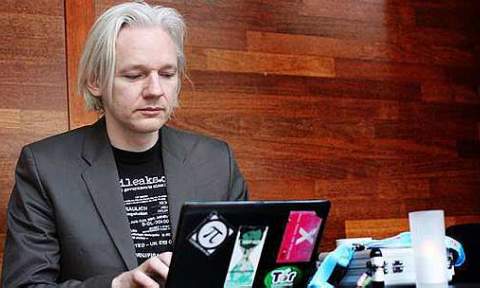
Assange, 41, works through most of the night and sleeps into the late afternoon. Even though he uses an ultraviolet light device, he was pale, not surprising for someone who has not been out in sunlight for nearly a year. He rarely gives interviews. A treadmill was tilted up against a wall of his quarters; he said he sets it up and tries to run three to five miles on it every day. He has visits from a personal trainer, with whom he practices calisthenics and boxing. He is lanky at 6 feet 2 inches tall and exudes a raw, nervous energy. He leaps, sometimes disconcertingly, from topic to topic, idea to idea, his words rushing to keep up with his cascading thoughts. He works with a small staff and has a steady stream of visitors, including celebrities such as Lady Gaga. When the Ecuadorean Ambassador Ana Alban Mora and Bianca Jagger showed up late one afternoon, Assange pulled down glasses and poured everyone whiskey from a stock of liquor he keeps in a cabinet. His visitors chatted at a small round table, seated in leatherette chairs. Jagger wanted to know how to protect her website from hackers. Assange told her to “make a lot of backup copies.”
It is from this room that Assange and his supporters have mounted an election campaign for a seat in Australia’s upper house of Parliament. Public surveys from the state of Victoria, where Assange is a candidate, indicate he has a good chance of winning.
Assange communicates with his global network of associates and supporters up to 17 hours a day through numerous cellphones and a collection of laptop computers. He encrypts his communications and religiously shreds anything put down on paper. The frequent movements of the police cordon outside his window make sleep difficult. And he misses his son, whom he raised as a single father. He may also have a daughter, but he does not speak publicly about his children, refusing to disclose their ages or where they live. His family, he said, has received death threats. He has not seen his children since his legal troubles started. The emotional cost is as heavy as the physical one.
Assange said he sees WikiLeaks’ primary role as giving a voice to the victims of U.S. wars and proxy wars by using leaked documents to tell their stories. The release of the Afghan and Iraq War Logs, he said, disclosed the extent of civilian death and suffering, and the plethora of lies told by the Pentagon and the state to conceal the human toll. The logs, Assange said, also unmasked the bankruptcy of the traditional press and its obsequious service as war propagandists.
“There were 90,000 records in the Afghan War Logs,” Assange said. “We had to look at different angles in the material to add up the number of civilians who have been killed. We studied the records. We ranked events different ways. I wondered if we could find out the largest number of civilians killed in a single event. It turned out that this occurred during Operation Medusa, led by Canadian forces in September 2006. The U.S.-backed local government was quite corrupt. The Taliban was, in effect, the political opposition and had a lot of support. The locals rose up against the government. Most of the young men in the area, from a political perspective, were Taliban. There was a government crackdown that encountered strong resistance. ISAF [the NATO-led International Security Assistance Force] carried out a big sweep. It went house to house. Then an American soldier was killed. They called in an AC-130 gunship. This is a C-130 cargo plane refitted with cannons on the side. It circled overhead and rained down shells. The War Logs say 181 ‘enemy’ were killed. The logs also say there were no wounded or captured. It was a significant massacre. This event, the day when the largest number of people were killed in Afghanistan, has never been properly investigated by the old media.”
Operation Medusa, which occurred 20 miles west of Kandahar, took the lives of four Canadian soldiers and involved some 2,000 NATO and Afghan troops. It was one of the largest military operations by the ISAF in the Kandahar region.
Assange searched for accounts of reporters who were on the scene. What he discovered appalled him. He watched an embedded Canadian reporter, Graeme Smith of the Toronto Globe and Mail, use these words on a Canadian military website to describe his experiences during Operation Medusa:
In September 2006 I had one of the most intense experiences of my life. I was on the front lines of something called Operation Medusa. It was a big Canadian offensive against the Taliban who were massed outside of Kandahar City. The Taliban were digging trenches and intimidating locals, and the Canadians decided to sweep in there in big numbers and force them out. And I was travelling with a platoon that called themselves the “Nomads”. These were guys who had been sent all over, you know, sort of, a 50,000 square kilometer box out to the very edges of Kandahar City, and so they were moving around all the time; they were never sleeping in the same place twice and they’d even made up these little patches for their uniforms that said “Nomads” on them. The Nomads took me in and they sort of made me one of them. I spent what was originally supposed to be just a two or three day embed with them, stretched out into two weeks. I didn’t have a change of underwear. I didn’t have a change of shirt. I remember showering in my clothes, washing first the clothes on my body, then stripping the clothes off and washing my body, and that was just using a bucket as a shower. It was an intense experience. I slept in my flak jacket a lot of nights. We were under fire together, you know, we had RPGs whistling in. One time I was standing around behind a troop carrier and we were just sort of relaxing—we were in a down moment—and I think some guys had coffee out and were standing around and I heard a loud clap beside my right ear. It was like someone had sort of snuck up behind me and sort of played a prank by clapping beside my ear. I turned around to say hey that’s not really funny, that’s kind of loud, and all of the soldiers were lying on the ground because they know what to do when an incoming sniper round comes in, and I didn’t because [laughs] it was my first time under fire. So I threw myself to the ground as well. They had sort of made me one of them and so they gave me a little “Nomads” patch that I attached to my flak jacket and you know as a journalist you try to avoid drinking the Kool-Aid, but I did feel a sense of belonging with those guys.
“The physical demeanor of this man, the way he describes life in the great outdoors, led me to understand that here was someone who had never boxed, been mountain climbing, played rugby, been involved in any of these classically masculine activities,” Assange said. “Now, for the first time, he feels like a man. He has gone to battle. It was one of many examples of the failure by the embedded reporters to report the truth. They were part of the team.”
Assange is correct. The press of a nation at war, in every conflict I covered, is an enthusiastic part of the machine, cheerleaders for slaughter and tireless mythmakers for war and the military. The few renegades within the press who refuse to wave the flag and slavishly lionize the troops, who will not endow them with a host of virtues including heroism, patriotism and courage, find themselves pariahs in newsrooms and viciously attacked—like Assange and Manning—by the state.
As a reporter at The New York Times, I was among those expected to prod sources inside the organs of power to provide information, including top-secret information. The Pentagon Papers, released to the Times in 1971, and the Times’ Pulitzer-winning 2005 exposure of the warrantless wiretapping of U.S. citizens by the National Security Council used “top secret” documents—a classification more restricted than the lower-level “secret” designation of the documents released by WikiLeaks. But as the traditional press atrophies with dizzying speed—effectively emasculated by Barack Obama’s use of the Espionage Act half a dozen times since 2009 to target whistle-blowers like Thomas Drake—it is left to the renegades, people like Assange and Manning, to break down walls and inform the public.
The cables that WikiLeaks released, as disturbing as they were, invariably put a pro-unit or pro-U.S. spin on events. The reality in war is usually much worse. Those counted as dead enemy combatants are often civilians. Military units write their own after-action reports and therefore attempt to justify or hide their behavior. Despite the heated rhetoric of the state, no one has provided evidence that anything released by WikiLeaks cost lives. Then-Secretary of Defense Robert Gates in a 2010 letter to Sen. Carl Levin conceded this point. He wrote Levin: “The initial assessment in no way discounts the risk to national security. However, the review to date has not revealed any sensitive intelligence sources and methods compromised by the disclosure.”
The New York Times, The Guardian, El Pais, Le Monde and Der Spiegel giddily printed redacted copies of some of the WikiLeaks files and then promptly threw Assange and Manning to the sharks. It was not only morally repugnant, but also stunningly shortsighted. Do these news organizations believe that if the state shuts down organizations such as WikiLeaks and imprisons Manning and Assange, traditional news outlets will be left alone? Can’t they connect the dots between the prosecutions of government whistle-blowers under the Espionage Act, warrantless wiretapping, monitoring of communications and the persecution of Manning and Assange? Don’t they worry that when the state finishes with Manning, Assange and WikiLeaks, these atrophied news outlets will be next? Haven’t they realized that this is a war by a global corporate elite not against an organization or an individual but against the freedom of the press and democracy?
And yet Assange is surprisingly hopeful—at least for the short and medium term. He believes that the system cannot protect itself completely from those who chip away at its digital walls.
“The national security state can try to reduce our activity,” he said. “It can close the neck a little tighter. But there are three forces working against it. The first is the massive surveillance required to protect its communication, including the nature of its cryptology. In the military everyone now has an ID card with a little chip on it so you know who is logged into what. A system this vast is prone to deterioration and breakdown. Secondly, there is widespread knowledge not only of how to leak, but how to leak and not be caught, how to even avoid suspicion that you are leaking. The military and intelligence systems collect a vast amount of information and move it around quickly. This means you can also get it out quickly. There will always be people within the system that have an agenda to defy authority. Yes, there are general deterrents, such as when the DOJ [Department of Justice] prosecutes and indicts someone. They can discourage people from engaging in this behavior. But the opposite is also true. When that behavior is successful it is an example. It encourages others. This is why they want to eliminate all who provide this encouragement.”
“The medium-term perspective is very good,” he said. “The education of young people takes place on the Internet. You cannot hire anyone who is skilled in any field without them having been educated on the Internet. The military, the CIA, the FBI, all have no choice but to hire from a pool of people that have been educated on the Internet. This means they are hiring our moles in vast numbers. And this means that these organizations will see their capacity to control information diminish as more and more people with our values are hired.”
The long term, however, may not be as sanguine. Assange recently completed a book with three co-authors—Jacob Appelbaum, Andy Müller-Maguhn and Jérémie Zimmermann—called “Cypherpunks: Freedom and the Future of the Internet.” It warns that we are “galloping into a new transnational dystopia.” The Internet has become not only a tool to educate, they write, but the mechanism to cement into place a “Postmodern Surveillance Dystopia” that is supranational and dominated by global corporate power. This new system of global control will “merge global humanity into one giant grid of mass surveillance and mass control.” It is only through encryption that we can protect ourselves, they argue, and only by breaking through the digital walls of secrecy erected by the power elite can we blunt state secrecy. “The internet, our greatest tool of emancipation,” Assange writes, “has been transformed into the most dangerous facilitator of totalitarianism we have ever seen.”
The U.S., according to one of Assange’s lawyers, Michael Ratner, appears poised to seize Assange the moment he steps out of the embassy. Washington does not want to become a party in two competing extradition requests to Britain. But Washington, with a sealed grand jury indictment prepared against Assange, can take him once the Swedish imbroglio is resolved, or can take him should Britain make a decision not to extradite. Neil MacBride, who has been mentioned as a potential head of the FBI, is U.S. attorney for the eastern district of Virginia, which led the grand jury investigation, and he appears to have completed his work.
Assange said, “The grand jury was very active in late 2011, pulling in witnesses, forcing them to testify, pulling in documents. It’s been much less active during 2012 and 2013. The DOJ appears ready to proceed with the prosecution proper immediately following the Manning trial.”
Assange spoke repeatedly about Manning, with evident concern. He sees in the young Army private a reflection of his own situation, as well as the draconian consequences of refusing to cooperate with the security and surveillance state.
Manning’s 12-week military trial is scheduled to begin in June. The prosecution is calling 141 witnesses, including an anonymous Navy SEAL who was part of the raid that killed Osama bin Laden. Assange called the Navy SEAL the “star diva” of the state’s “12-week Broadway musical.” Manning is as bereft of establishment support as Assange.
“The old media attempted to remove his alleged heroic qualities,” Assange said of Manning. “An act of heroism requires that you make a conscious act. It is not an unreasoned expression of madness or sexual frustration. It requires making a choice—a choice that others can follow. If you do something solely because you are a mad homosexual there is no choice. No one can choose to be a mad homosexual. So they stripped him, or attempted to strip him, of all his refinements.”
“His alleged actions are a rare event,” Assange went on. “And why does a rare event happen? What do we know about him? What do we know about Bradley Manning? We know that he won three science fairs. We know the guy is bright. We know that he was interested in politics early on. We know he’s very articulate and outspoken. We know he didn’t like lies. … We know he was skilled at his job of being an intelligence analyst. If the media was looking for an explanation they could point to this combination of his abilities and motivations. They could point to his talents and virtues. They should not point to him being gay, or from a broken home, except perhaps in passing. Ten percent of the U.S. military is gay. Well over 50 percent are from broken homes. Take those two factors together. That gets you down to, say, 5 percent—5 percent on the outside. There are 5 million people with active security clearances, so now you’re down to 250,000 people. You still have to get from 250,000 to one. You can only explain Bradley Manning by his virtues. Virtues others can learn from.”
I walked for a long time down Sloane Street after leaving the embassy. The red double-decker buses and the automobiles inched along the thoroughfare. I passed boutiques with window displays devoted to Prada, Giorgio Armani and Gucci. I was jostled by shoppers with bags stuffed full of high-end purchases. They, these consumers, seemed blissfully unaware of the tragedy unfolding a few blocks away. “In this respect, our townsfolk were like everybody else, wrapped up in themselves; in other words, they were humanists: they disbelieved in pestilences,” Albert Camus wrote in “The Plague.” “A pestilence isn’t a thing made to man’s measure; therefore we tell ourselves that pestilence is a mere bogy of the mind, a bad dream that will pass away. But it doesn’t always pass away and, from one bad dream to another, it is men who pass away, and the humanists first of all, because they have taken no precautions.”
I stopped in front of the four white columns that led into the brick-turreted Cadogan Hotel. The hotel is where Oscar Wilde was arrested in Room 118 on April 6, 1895, before being charged with “committing acts of gross indecency with other male persons.” John Betjeman imagined the shock of that arrest, which ruined Wilde’s life, in his poem “The Arrest of Oscar Wilde at the Cadogan Hotel.” Here’s a fragment:
A thump, and a murmur of voices—
(“Oh why must they make such a din?”)
As the door of the bedroom swung open
And TWO PLAIN CLOTHES POLICEMEN came in:
“Mr. Woilde, we ’ave come for tew take yew
Where felons and criminals dwell:
We must ask yew tew leave with us quoietly
For this is the Cadogan Hotel.”
The world has been turned upside down. The pestilence of corporate totalitarianism is spreading rapidly over the earth. The criminals have seized power. It is not, in the end, simply Assange or Manning they want. It is all who dare to defy the official narrative, to expose the big lie of the global corporate state. The persecution of Assange and Manning is the harbinger of what is to come, the rise of a bitter world where criminals in Brooks Brothers suits and gangsters in beribboned military uniforms—propped up by a vast internal and external security apparatus, a compliant press and a morally bankrupt political elite—monitor and crush those who dissent. Writers, artists, actors, journalists, scientists, intellectuals and workers will be forced to obey or thrown into bondage. I fear for Julian Assange. I fear for Bradley Manning. I fear for us all.


