In 2018, Helena Norberg-Hodge sat down with Wendell Berry for a far-reaching discussion. The two are giants of the local economy movement. Berry is a poet and activist, an author of over forty books—including The Unsettling of America and Home Economics—and a lifelong advocate for ecological health, the beauty of rural life, and small-scale farming. He is a recipient of the National Humanities Medal. Norberg-Hodge founded Local Futures, which works to renew ecological, social, and spiritual well-being by promoting a systemic shift toward economic localization. She also produced the film The Economics of Happiness and wrote the book Ancient Futures: Learning from Ladakh. She was honored with the Right Livelihood Award (or “Alternative Nobel Prize”) for her groundbreaking work in Ladakh.
Berry and Norberg-Hodge touch on human nature, technology, experiential knowledge, agriculture policy, happiness, wildness, and local food systems. These are topics on which both have commented widely over the years, but they have taken on a new urgency as of late. The urban/rural divide and colonization of people; mechanization and our globalized economy; democracy and our ties to the earth—these intersections seem as relevant as ever, yet are barely acknowledged by political leaders and thus barely covered by the media. Through their discussion, Berry and Norberg-Hodge offer a critique of our economic system and show how the caretaking of the natural world and local communities are one and the same.
HNH: Your words of wisdom are especially valuable today, when so many people are feeling desperate and depressed. Many are giving up on humankind. They say things like, “Human beings are just ignorant, stupid, and greedy, and we deserve to extinguish ourselves.”
WB: That seems to me to be a cheap way out. I think that there’s some merit to be found among us, and some merit to be found in our history. There’s a lot of bad in it, no question about that, but the interesting thing is to try to solve the problem, not escape it.
HNH: It’s also important to realize that the real problem is not human nature, but what I think of as an inhuman system. One of the biggest problems we’re facing is that the system has become so big that we can’t see what we’re doing and what we’re contributing to. Our economic system is of such an inhuman scale that it has become like a giant machine—a global juggernaut that’s pushing us all into fear and a terrible sense of scarcity.
WB: What one has to say to begin with is that, as humans, we are limited in intelligence and we really have no reliable foresight. So none of us will come up with answers to the whole great problem. What we can do is judge our behavior, our history, and our present situation by a better standard than “efficiency” or “profit,” or those measures that we’re still using to determine economic decisions. The standard that I always come back to is the health of the world, which is the same as our own personal health. We can’t distinguish our health from the health of everything else. And we know enough from the ecologists now to know that health is a very complex and un-understandable complexity of relationships that makes the world whole.
HNH: Rather than those economic measures you referred to, the goal needs to be human and ecological well-being. And when people are more dependent on the living community around them—both the human and the nonhuman—then it becomes obvious that their well-being is connected to the well-being of the other.
WB: It seems to me that it all depends upon our ability to accept limits. And the present economic system doesn’t even acknowledge limits. It is “develop[ing] resources”—which is to say, turning resources into riches (which is to say, money)—which leads almost inevitably to destruction. Money is an abstraction. Goods are particular, and always available within limits— natural limits, and the rightful limits of our consumption.
It’s also important to realize that the real problem is not human nature, but what I think of as an inhuman system.
HNH: And in order for us to see those limits, we need a more human-scale, localized economy.
WB: It would mean even more if we said a community economy, and we meant by economy the original sense of “household management” or “housekeeping.” That would imply taking the best possible care of the life supports of, first, the household economy, then the neighborhood economy, then the community economy. And we can go on from there on the principle of community, if we take it in the sense of “what we all have in common,” and an obligation to take care of all of it. But it will only be manageable locally, and within limits—the limits, among other things, of our own intelligence and our own capacity to act responsibly.
HNH: What I’ve seen in ancient traditional cultures is that even the language reminded people that their experiential knowledge was really the only reliable knowledge. One of the great tragedies has been this shift toward trusting secondhand knowledge more than we trust experiential knowledge, and in fact denigrating experiential knowledge as anecdotal and worthless. And of course, this has been reinforced by numerical, and very reductionist, modern science.
WB: I think what you’re applying there is simply the fundamental rule of all the human disciplines. And that rule is that you have to know what you’re talking about. You have to come with evidence. And this applies across the board, from the court of law to the laboratory of the scientist.
HNH: But of course now we have science and knowledge for profit, which can lead to very shoddy proof. The impact of these new discoveries has the potential to affect all life on Earth—for instance, genetic manipulation.
WB: The issue there again, it seems to me, is the acceptance of a limit. Science that accepts limits would do no harm to an ecosystem or a human body. This is very different from the kind of science that too frequently turns out to be product development, without control of its application. The nuclear scientists who developed the atomic bomb are a very good example. But so are chemists who develop toxic substances for a limited use that they have in mind, but then turn it loose on the market and into the world. So you develop a chemical to control weeds in crops, and you ask only the question of whether or not the weeds are controlled; you don’t ask what happens when it runs off into the rivers.
HNH: This is why there has to be the precautionary principle, as Rachel Carson reminded us. But the only entities really capable of enforcing the precautionary principle are governments—and trade treaties and the globalizing economy have given giant multinational companies more and more power over governments. We’ve seen these last thirty years the enormous damage that this power shift created. And then with the financial breakdown in 2008, it was so clear that we needed regulation; but it didn’t happen.
WB: The global economy is almost by definition not subject to regulation. And this simply means that corporations can pursue economic advantage without limit, wherever in the world those advantages are to be found. And as I’ve thought of it in the last several years, it has seemed to me that we’ve had a global economy for about five hundred years—ever since the time of Columbus. And this allowed us to think that if we don’t have some necessity of life here, we can get it from somewhere else. This is the most damaging idea that we’ve ever had. It’s still with us, still current, and it still excuses local plunder and theft and enslavement. It’s an extreme fantasy or unreality, the idea that if we don’t have it here, we can get it somewhere else—if we use it up here, we can get it somewhere else. It’s the stuff of fantasy.
HNH: What’s very frightening is that from the centers of power in the corporate world there’s a recognition that globalization is not working, and that a shift from global to local is needed—but what they’re talking about is the opposite of what you and I talk about. It’s about giant multinationals using robots to make washing machines in America instead of producing them in China.
WB: This makes all the world a colony.
HNH: Yes.
WB: I’m a rural American, and moreover a Kentuckian. I live in a state that has been a colony all my life, and probably ever since the Civil War, at least. We’re a coal-producing state. Some of our counties are the richest in the world in their natural endowment, and the result of that is that they now have land that is virtually destroyed and some of the poorest people. This is the result of a limitless economy. And the only recourse that we have is to try to understand what we have here that’s worth our keeping, and then to discover ways to keep it — and that is to say that we have to have recourse to this movement toward local economies. We should fulfill our needs and export the surplus. We should never export the necessities of our own lives.
HNH: You also mentioned what might be called a “movement” toward local economies. Are you a bit resistant to using that notion, of a movement?
WB: The word “movement”? Yes, I wrote an essay once called “In Distrust of Movements.” My quarrel with “movements,” and the reason I use it in quotation marks, so to speak, is that they tend to be specialized. For example, there’s a movement now about climate change, and it has become extremely specialized, while the actual solution to a problem like that is to have an economy that takes care of everything—an inclusive economy, not just an economy of moneymaking. And so I’m always a little anxious about movements. They turn into fads, in a way, and then they peter out because they’re too specialized.
HNH: Exactly. And it’s so frightening that the climate movement has become specialized to the point of being destructive, particularly when you have talk of market-based “solutions” like carbon trading and carbon offsets. So my plea is for what I call “big-picture activism,” to support a shift from global to local. When we see the multiple benefits of localizing, it becomes clear that it’s not about specialization: it’s about adaptation to diversity. I often say that localism is “the -ism that could end all -isms,” because it has to entail this adaptation to diversity. This is the opposite of a movement that wants to impose a standard solution or a standard anything. Any kind of monoculture is deadly.
WB: That’s right. Localism would cease to be an -ism just as soon as the local people went to work locally. One of the things that’s wrong with these great movements is that they’re not telling people to go home and go to work in good ways to improve things. They’re movements to bring pressure on political leaders. And to that extent it’s something of a distraction from the real problems, which are all local.

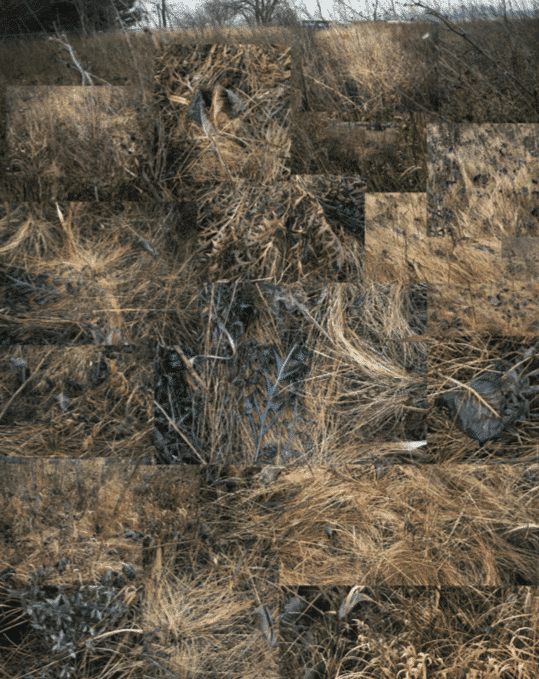
Terry Evans, Another Indiana Prairie, January 2018, 38 x 48 inches
HNH: Here is a point where you and I might differ, because I believe that we need both “resistance” and “renewal” simultaneously. What I mean by “resistance” is, first of all, linking together locally to resist the advances of the top-down global monoculture in all its destructive forms. But it also means linking up with other groups around the country, and even around the world, to push for a kind of democracy where people have a choice. So, in that sense, I do believe that at the same time that we start the work at home, we can also raise our voices to have a unified call to come back home.
WB: You’re really asking me, Helena, whether in addition to my insistence on the importance of the local context and local work, I believe in policy changes. And the answer is, of course I do. And I have done a good bit of that work. Wes Jackson and his people at the Land Institute produced a farm policy called the 50-Year Farm Bill, and what that proposes, essentially, is to convert our agriculture from an 80 percent dependence on annual crops and a 20 percent dependence on perennials to the opposite—an 80 percent dependence on perennials and a 20 percent dependence on annuals. And that change, which would be a policy change, would cure a lot of problems, including to a considerable extent the problem of global warming. That’s a policy, and it’s general, to the extent that it would be a policy that would be in force nationally. However, if it was done rightly, it would have to be applied in different ways in different places. And that would call for a high degree of local knowledge and local intelligence.
HNH: And this knowledge grows out of close relationships to the land, which have been maintained over generations. The deep connections indigenous peoples have with the earth and with others in their communities have come about through daily economic interactions—weaving a fabric of interdependence from which the individual cannot be separated. This generates a deep love for land, for community, and for oneself. And these are the connections that have come under attack from a technoeconomic system that is founded on distance and robotization. Already now, robots are looking after old people, robots are acting as surrogate children . . .
WB: If you love somebody, you need to have ways to enact your love. And that would be in caretaking for the children and the old people. The putting-on of hands. That’s the only way we can do it. We can’t enact our love by hiring a robot to do it. And the same goes for the world. If we let machinery, whether it’s a robot or not, intervene to too great an extent between us and the farmland or the forestland that we’re using, we begin to destroy it. We begin to destroy what economists would call the “resource.” And finally, this has a very practical economic effect. One effect, of course, is disease.
HNH: Exactly. And now the next step is to move into a world of not just robots but 3D printing, driverless cars (which, again, of course are robots). . . . It’s very frightening that people are so locked into the man-made world. And they would tell us, Wendell, that we’re not being realistic. For them, the real world is this commercial, man-made world, which they believe can become utopia.
WB: It’s a strange utopia that depends on people being absolutely passive. And this again, it seems to me, has to do with addiction. Addiction is manifested by much more than dependence on a drug. Our children are dying from drug addiction here in rural America, in my little corner of it. But while the addiction to drugs is receiving some attention, young people are also addicted to computers—it is exactly an addiction, and nobody is concerned about that. Again, that addiction removes the person physically from the life of the world. So it does seem to me to be deathly, suicidal, and absolutely ruinous.
HNH: Did you know that there are also, in some places, clinics where they take screen-addicted youth? I don’t know if they have them in America, but they have them in South Korea.
WB: That’s very profitable of course, and that means that this really helps economic growth. If you can make money by selling an addictive device and then make money by curing people of their addiction—that’s a great business plan.
HNH: Just like lots of cancer and chemotherapy are nicely adding to GDP.
WB: Yes, that’s right. It all depends on unhappiness, sickness, ill health, and the rest of it. Ugliness.
HNH: But isn’t it remarkable that so few environmentalists are joining us to just laugh at the notion of GDP? Once it’s understood that GDP increases with breakdown, it seems we all should be linking hands to demand a fundamental shift in the economy.
WB: One of the roots of the problem is the focus of environmentalists. The conservation movement, for one hundred years, has, at least in this country, focused on wilderness preservation—places of spectacular rocks and waterfalls—at the expense of what I would call the “economic landscapes” of farming, forestry, and mining. The politicians have kept the environmental movement quiet by designating wilderness areas. And in the meantime, they’ve let corporations run completely out of control, and extraordinarily destructively, in the economic landscapes, without any acknowledgement at all that the natural world is out there just the same as it is in the parks.
HNH: At the same time, what I find so inspiring is that, in the localization movement, communities around the world are rebuilding truly healthy economies by diversifying. Those are like little diamonds in the landscape, aren’t they, of beauty and joy.
WB: Those are the examples we need to study and look to. And always that localization depends on a revival of the neighborhood principle. People can only do this if they help each other, and accounts come in my mail of how farmers, for instance, have scaled back, diversified, and increased the number of people who are employed on the land. This, it seems to me, is the incontrovertible answer to these people who say, “We need to give up on human nature and, as a favor to Nature, commit suicide.”
HNH: Another important point is that small, diversified farms always produce more per unit of land, water, and energy than large monocultures. So we have to turn this lie around that there are too many people now to localize, too many people to have small farms. It’s exactly the opposite.
WB: Small farms make economic sense. They also produce more happiness, more beauty, more health—those things that aren’t so quantifiable.
HNH: . . . And more thriving opportunities for wildness within the farm. To change subjects a bit, what do you say when people ask you as an American what you think about Donald Trump and the people who voted for Trump?
WB: Well, there’s far too much generalization now about rural America. Conservatives and corporations have had their eye on rural America all along. And they’ve been turning it into money as fast as they can, which is to say destroying the land and the people. The liberals and the Democrats have discovered rural America now — a place about as foreign to them as it was to Columbus. They don’t know anything about it, and they’ve been condemning it out of hand as if everybody out here in rural America is a racist, sexist, backward, ignorant person. And this isn’t true. The problem is that rural America has been a colony, certainly throughout my lifetime. I don’t think anybody’s paid attention to rural America since about 1945 or ’50. Certainly not since 1952, when Eisenhower’s Secretary of Agriculture said to the farmers: “Get big or get out.” They’ve just abandoned rural America to corporations and technologies. And now, if they would only look out here and try to learn what’s here and the really terrible predicament we’re in, they might be able to construct a policy platform that would be meaningful and would give people a real choice. People voted for Trump not because they liked him but because they saw no hope. They didn’t feel that they could count on the other side. A minister friend of mine wrote me to say that the Trump voters’ grandfathers were priced out of farming. Their parents experienced a generation of union-supported good wages. And they—the grandchildren—don’t have anything to depend on or look forward to. And that’s a bad situation for people to be in, and to expect an enlightened choice from people in that kind of trouble may be asking too much.
HNH: Especially when there is no enlightened offer.
WB: If there was an enlightened alternative, the scene would be different. But I don’t think any presidential candidate has a clue about the existence of rural America, much less the problems that it has.
HNH: Genuine local economies connected to the land have been systematically destroyed in the name of progress and efficiency, and we are now at a point where more than half of the global population has been urbanized. But we do have an opportunity to say in a loud voice, “Let’s push the pause button on this juggernaut that’s pulling people away from real livelihoods, and then start a journey back to the land.” Not everyone has to live on the land, but we need cities that have a relationship with the land around them and that have some breathing space within them so that we regain that contact with nature and with the real source of our livelihoods — with the real economy.
WB: We need people on the land who are capable of acting as a sort of lobby—to defend it, but also to use it well. The terrible humanitarian problems we’re witnessing worldwide have come about because a depreciation of the humanity of great swaths of people has been necessary to their exploitation, to their use as colonies. If you’re going to steal from somebody, you need to convince
yourself that they’re inferior, and then you have to convince them that they’re inferior. I’ve heard too many farmers in meetings who start to speak by saying, “I’m just a farmer and I don’t know much.” They’ve been told that, and it’s false, and it’s a tragedy.
HNH: This is so frightening because throughout the world, in places like China, India, and most of Africa, farmers are being told that rural life and they themselves are backward and primitive, and that if they want to be respected they’ve got to move into the city. And by the millions, they’re pouring into the cities, whether in their own country or in another country, where they’re trying to get a job—but the jobs are not available. And the results include angry reactions that in many cases translate into local ethnic friction, and then into an anger and hatred against the West; even into terrorism. These deepening ideological divides and today’s antagonistic left/right political theater serve to divide us and distract us from the bigger picture of an economic system that is threatening what we all care about: healthy communities and a healthy world.
I’ve heard too many farmers saying, “I’m just a farmer and I don’t know much.” They’ve been told that, and it’s false, and it’s a tragedy.
WB: I think you and I are seeing things from a kind of agrarianism. This has nothing to do with the left and the right. This simply says that the land—the given world—is of ultimate value, and that the caretaking of it is a matter of paramount importance. To argue from those two points puts you outside the current political dialogue. We just have to accept that. But there are more and more people who do understand that. The county governments and city governments are coming to understand that. I don’t think, in America, state governments and the national government can understand it at all. But my county judge would understand our conversation perfectly. The governor of the state would think we were speaking a foreign language.
HNH: Isn’t that so interesting? It’s a pattern that is quite logical, because at the level of the local council the leaders are responding to the realities on the ground: what people need and what the land needs. But when you go up to that higher level, they’re off in their own utopian make-believe world of numbers and statistics. Nevertheless, as you say, there is a waking up—I see awareness trickling upward, and it’s very encouraging—particularly when we know how pressured people have been, and how suppressed. Media, government, funding—it’s not been there to support this agrarian movement and this new farmers’ movement.
WB: But as it trickles up, we just have to make sure that it trickles up from things that actually work: from real knowledge down here at the bottom.
HNH: What we do in our organization [Local Futures] is to encourage people to really understand this global technoeconomic monoculture so that they can be much more strategic as they start these projects. On a policy level, we campaign for a shift in direction to support diversified local and regional economies and for the development of technologies and infrastructure,
which could be useful for those smaller systems. There’s still such a scope, isn’t there, for genuinely appropriate technologies?
WB: Value-adding industries to the products of the land don’t have to be as big as an airplane factory. We now have a very good small slaughter facility, here in our county, again. And this opens up lots of opportunities. My daughter is trying to set up a beef co-op here to market for the farmers—in their interests. And it would be then processed here. Otherwise, it goes out of the community without adding much to the benefit of the community. If our trees leave this community, as raw logs or rough lumber, the community doesn’t benefit much.
HNH: Also, in industrial society the system has driven up the price of human labor and artificially lowered the price of energy and technology, and through that encouraged every single enterprise to use more energy and technology—supporting a system based on speculation in which countries routinely import and export the same products—while throwing more people on the rubbish heap. And if that could be shifted, we would have a completely different economy; we would have a completely different world. The local food movement is demonstrating what can happen when you shorten distances: you encourage a shift from monoculture to diversification on the land; you reduce the energy consumption, the packaging, the refrigeration, and the waste; you provide healthier food at a reasonable price; and you have healthier, more prosperous farming communities.
WB: I was born into a way of farming that used solar energy. And I haven’t forgotten it. We had these solar converters called mules, and human beings, and that’s the way we got the work done.
HNH: Wendell, remind me again how old you are . . .
WB: Well, sometimes, Helena, I think I’m only about twenty. But I’m eighty-four.
HNH: Well, you sound like twenty, and I know you’re strong and healthy like twenty.
WB: I’m not as strong and durable as I used to be by a long way, I can tell you that. I’m perfectly natural.
HNH: Perfectly natural. O
Read more by Wendell Berry.









Comments
Mr. Wendell Berry, Ms. Norberg-Hodge, well said, and important to hear. My work has been to try to tell as many people as possible that we are under the influence of a deadly, infectious Disease, this disease is called “GREED and the LUST for POWER.” Until, and if, a cure can be found, do what we will, nothing will ever change. It will be business as usual, until the last drop of oil is pumped out, the last cubic meter of gas, the last ounces of gold and copper mined, the last fish in the sea netted, and the last dollar removed from the poor man/woman’s pocket, Greed will continue until in the end it will consume its self, but by then the planet will be a dead, barren rock floating lifelessly around the sun.. During the children’s climate march this Friday, one child held a sign that said: “Soon, all we will have left to eat will be the rich!”I can only hope that these wonderful, brave children keep the pressure on our so-called leaders. I am also calling for a World Wide cleanup, to be paid for by all the major polluters. I am a 73 year newbie on computers, and have a lot to learn, I got it as I went deaf and this is a nice way to communicate. We live very simply, 35 years without a T.V., no microwave oven, washer dryer, water heater,(Wood stove is water heated) humanure outhouse, land line phone, even use a rotary dial during power failures,it is also handy for getting right to a human at Gov’t and business offices as they cannot play the Press 1, Press 2, press 3 and hold forever…..We don’t farm any more, but we did for years raise goats, sheep, chickens, turkeys, geese and ducks, We miss the animals. Well, I have had my say, any comments appreciated…..Orion magazine-I have been a supporter for years now, because I love your work. We also subscribe to Acres Mag.
THANK YOU FOR THIS EXTREMELY IMPORTANT, INFORMATIVE INTERVIEW BETWEEN TWO PEOPLE WHO ACTUALLY BRING ANSWERS TO SOME OF THESE SUPPOSEDLY UNSOLVABLE QUESTIONS.
Nail on the head! There are examples in Sri Lanka of systems that have survived over the centuries — forest gardens — that have 161 food crops, there is no “hidden hunger” (missing nutrients), and the farmers have been able to adjust to climate change. These gardens are based upon a continual care of the land for more than a thousand years. Then here in SW Virginia, we’re creating agendas at the grassroots and then asking the agencies, politicians, experts at the land grant universities, etc., how they can assist in meeting what is required to move the agendas along. We start with our experts, the farmers, the distributors, and the buyers. There is a demand for grass fed beef? We’re on it and we do a forage management study. If we “bank our grass,” fence part of it off in July, then with as little snow as we’re receiving, cattle graze year round. With the dried hay, farmers purchase corn gluten to supplement the dried hay. The gluten is 24% protein and 70% energy. The banked grass? Twenty-four percent protein and 70% energy. Reduce labor, reduce haying, reduce herd size, and increase profits. Wendell and Helen are right, there are answers on the ground. It’s step by step, we must think in terms of symbiosis. Hi Wendell and Helena!
What a fertile, holistic discussion! Thank you. I have boundless admiration for each person’s work. Wendell’s The Unsettling of America inspired me in the 1980s to pursue and report on alternative economies and small, sustainable industries. The book version of the PBS documentary Affluenza – of which I am a co-author, was partly fueled by Wendell’s ideas about the true economy which lies beneath the so-called bottom line.
Helena’s work in Ladakh was a testimonial to the tsunami-effect that occurs when media sensationalize the “goods” life. Tradition, craft and place-specific knowledge are swept away in favor of addictive symbols like cell phones and cigarettes. I used her Ancient Futures documentary in a few college courses I taught, with a great, empathetic response from students.
For twenty-two years, I’ve lived in a 27-household, cooperative neighborhood in Golden, Colorado (based on the Danish model of Cohousing). I wholeheartedly agree with the themes of localism discussed in the article. Our neighborhood shares common land and its maintenance; and importantly, an interest in each other’s well-being. I’m the neighborhood fruit and vegetable grower and I gratefully harvest far more than produce. The community, the garden, and my ability to meet needs within walking distance makes localism a vivid reality for me. I believe that a workable, durable economy can best be created by a more careful look at human needs.
Living sustainably is the opposite of sacrifice if the sense of mission, the attention to health, and the space for creativity delivers more human energy and less stress than the mainstream lifestyle sometimes called a “Dream.” If meaningful work and worthwhile pastimes make you happy, who needs all the consumer garbage? (Really, does all that stuff symbolize success or failure?) I think a person can either choose passions or addictions as stepping stones. If the overall goal is connection – with other people and with nature – passions like cooking, playing music, or hiking in wild areas can get you there; but addictions to junk food, shopping, or the web will usually leave you feeling like a hunk of leftover meat loaf.
I’ve several used books of Wendell Berry from our local library sales and he has vision of and like those early and great conservationist John Muir and Walden. Your Orion Magazine featured on Living On Earth on NPR is now a new avenue for “rural living fight back” against stupid and selfish profit/productivity freaksand corporations. The new Frankenstein of our Digital Evolutionary time.
I grew up on a small fruit/vegetable farm and saw my Grandfather and Father change to the trades when blacksmithing and horsepower was surpassed by gasoline cars, cement, and particle board lumber changed the trades.
I experienced hiring a typist for my college papers to typing my own social work notes on providing services to the disabled for over 20 years after teaching Industrial Arts and drafting houses and machine parts with a T square and using a slide rule for computations in algebra and geometry.
Reading the thoughts of these two great economic thinkers Helena Norberg-Hodge gives me hope as did Barack Obama and Michelle. Being civil and thoughtful is a skill that must be emphasized so that creativity and effort for community rather than privilege and domination.
Thanks for being on the radio( my soul listening media) and still free and available to educate while I work around the home and field/forest that occupy my retirement years now.
I love most of what they both said, but one thing seems to be missing, one critical thing. Capitalism is a system of exploitation based mainly on the land exploit. Land is our habitat as humans, and shelter and a place to live are basic needs. Capitalism makes the land too expensive for most people. It end up being the main driver of wage slavery. I am a carpenter to the very rich in Berkshire County, Massachusetts, for instance, and i work all the time in toxic and dangerous environments and my body has been harmed forever by this full time work (sometimes 60 hours a week, even) and yet even at this rate of hard unsustainable work, i cannot afford to buy a small bit of land in this very place where i work for the super rich. Please see Michael Perelman’s book “The Invention of Capitalism” for many sources from the formation time of capitalism about this particular critical relationship between land and the exploitation of the not-rich for labor by the rich. It’s critical to understand this to see the totality of the problem and the dispossession from the land of the majority of people by capitalism. We have here in Berkshire County some of the “Giants of Finance” who come and buy up hundreds of acres and put most of it in “conservation” which actually means it’s locked up virtually forever and people like me cannot afford land and get priced out of the market and end up dying landless. It’s a real tragedy and hurts the land and the people so these rich people can have “glorious estates” in the Berkshires, ego-spreads with orangeries and servants like the aristocracy of old, and yet the very people working to build these pleasuredromes paid by the ill-gotten gains from shell games on Wall Street cannot afford to have a few acres and a homestead with gardens and chickens and a woodshop.
Sage, I think you put your finger on a very key point, and I’m in the same position as you are, though a white collar worker in the NYC area. But at the same time I’m grateful for those conservation areas that have been preserved (especially on Long Island) because they are the closest thing to wilderness I get to enjoy. I don’t think those preserved lands are the problem. Surely we would want both – swaths of parks and preserved areas for everyone’s enjoyment, PLUS the ability for all to own a bit of land or home.
There is ample evidence that it is already too late to prevent near-term extinction of most life on earth. There is also ample evidence that global humanity is pursuing environmental degradation with increasing intensity. Localization has zero chance of saving us, so we need another reason to pursue it. I am pursuing it because it makes economic sense and is simply the morally right and rational approach. Thank you both for making that so crystal clear. Localization is what I want to be doing when the lights go out, and they will go out very soon.
Excellent rapport between these two giants of the cause for wellness! Yeah, those of us awakened see the cause as the unnamed, i.e., neoliberal capitalism. The solution in a word is to “drawback”. Of course, throughout all of this desecration of the natural world, one must look at rapid urbanization as a cause within, or as already stated, the unquestioned, unregulated economic paradigm. It cannot be humanized.
Yup, The Universe spent 13.75 billion years just to create consumers. hahaha
The issue with the science telling us we are done or it’s all over for life, is that in order for science to study anything, it must separate the ditty from its component parts. That’s the reductionism. ‘Cept, life does not work that way. It’s all interrelated, all intertwined and it’s all *SACRED*!