Sandra Finley

May 292017
 

Banksters: Index

CIB  (Canada Infrastructure Bank)

Canadians should know these names.  Our peril if we don’t:

  • Bank of America Merrill Lynch
  • BlackRock
  • Larry Fink
  • Infrastructure Minister Amarjeet Sohi.

Beyond Banksters, Joyce Nelson,

Chapter 3:  A 21st Century Trojan Horse,  Page 25:

The Advisors   … Ottawa Citizen’s Jason Fekete reported: “. . . (Ottawa) has recruited a Canadian investment banker working at Bank of America Merrill Lynch in the U.S. to help design the CIB and advise Infrastructure Minister Amarjeet Sohi on the (CIB) project.”  . . .  Merrill Lynch and the Bank of America (which merged in 2008) were both involved in the massive Wall Street mishandling of asset-backed securities and investments that led to the 2008 Great Recession and the bank bailouts – – which shook the world’s financial stability, with repercussions that have continued ever since.

It’s been reported that “backdoor bailouts” for Merrill Lynch and Bk of America reached “a combined $11.5 billion” in taxpayer monies.  Those “backdoor bailouts” were only a fraction of the money given to those two banks during the aftermath of the Wall Street crash.  The Rolling Stone’s Matt Taibbi, in a scathing 2012 article, says that

(P. 26)  Bank of America received at least $45 billion from taxpayers, even though it “has systematically ripped off almost everyone with whom it has a significant business relationship, cheating investors, insurers, depositors, homeowners, shareholders, pensioners and taxpayers.

So why would the Trudeau government choose someone from Bank of America Merrill Lynch to advise them on setting up a CIB?

One possible answer comes if we look at the single biggest shareholder in Bank of America – a little known company called BlackRock.

BlackRock . . . world’s biggest investor . . . more than $4 trillion in assets under management, and another $15 trillion that it manages . . . for investors worldwide.

So influential is BlackRock that, according to The Economist, the company advised governments in the U.S., Greece and Britain on what to do with toxic assets from crashing banks, with co-founder, chair and CEO Larry Fink becoming a Washington insider.

These governments sought Fink’s advice, despite the fact that (as Fortune reported in 2008) BlackRock’s Larry Fink “was an early and vigorous promoter of the same mortgage-backed securities” responsible for the crisis.  “Now his firm is making millions cleaning up these toxic assets,” Fortune reported.

Besides being Bank of America’s biggest shareholder, BlackRock owns part of Merrill Lynch and in 2009 BlackRock snapped up Barclays’ asset-management business, thereby boosting the assets under its control well into the trillions.  . . .

That’s enough to introduce the Trojan Horse – – there’s more (in Beyond Banksters)!

May 292017
 

http://www.newindianexpress.com/world/2017/may/20/wikileaks-founder-julian-assange-claims-victory-after-sweden-drops-rape-probe-1606831–1.html

LONDON:

Julian Assange claimed victory Friday after Swedish prosecutors dropped a seven-year rape allegation against the WikiLeaks founder, but insisted the “proper war” over his future was only just beginning.

Assange gave a clenched fist salute as he stepped into the daylight on the balcony of Ecuador’s London embassy, where he has been holed up since 2012.

But the 45-year-old Australian said the road was “far from over” and declined to reveal whether he would leave the embassy after five years cooped up inside.

British police would arrest him immediately for breaching earlier bail conditions if he left the embassy, while US authorities have warned they regard WikiLeaks as a “hostile intelligence service”.

“Today is an important victory,” Assange told reporters and a small band of supporters crowded around the tiny balcony, after emerging wearing a black shirt and jacket.

“But it by no means erases seven years of detention without charge. In prison, under house arrest and almost five years here in this embassy without sunlight.

“That is not something that I can forgive. It is not something that I can forget.”

– Uncertain future –

Earlier in Stockholm, Marianne Ny, Sweden’s director of public prosecutions, said the rape investigation had been dropped because there was “no reason to believe that the decision to surrender him to Sweden can be executed in the foreseeable future”.

“It is no longer proportionate to maintain the arrest of Julian Assange in his absence,” she said.

Despite the probe in Sweden being dropped, Assange would still face arrest if he set foot outside the embassy, a flat located just behind the plush Harrods emporium.

Assange jumped British bail by entering the embassy and claiming asylum, saying he feared he would eventually be extradited to the United States.

US justice authorities have never confirmed that they have Assange under investigation or are seeking his extradition.

But US Attorney General Jeff Sessions said last month that “we will seek to put some people in jail”, when asked if arresting Assange was a “priority” for Washington.

US prosecutors have been drafting a memo that looks at charges against Assange and WikiLeaks members that possibly include conspiracy, theft of government property and violations of the Espionage Act, according to The Washington Post.

US President Donald Trump’s administration has put heat on WikiLeaks after it embarrassed the Central Intelligence Agency in March by releasing files and computer code from the spy agency’s top-secret hacking operations.

“While today was an important victory and an important vindication, the road is far from over. The war, the proper war is just commencing,” Assange said.

He said his lawyers were in touch with the British authorities and hoped to begin a dialogue about the “best way forward”.

And the former computer hacker said that despite the “extremely threatening remarks” emanating from Washington, he was “always ready to engage with the Department of Justice”.

The department said Friday it had no comment “at this point” on Assange.

Asked if London would now support a request to extradite Assange to the United States, British Prime Minister Theresa May said: “We look at extradition requests on a case-by-case basis.”

Assange’s Swedish lawyer, Per Samuelsson, said his client plans to move to Ecuador because “it’s the only nation where he is safe”. 

– Decision a ‘scandal’ –

In Sweden, Assange’s accuser was left stunned by the prosecutors’ decision.

“It is a scandal that a suspected rapist can escape justice and thereby avoid the courts,” her lawyer, Elisabeth Fritz, told AFP in an email.

My client is shocked and no decision to (end the case) can make her change (her mind) that Assange exposed her to rape,” she said.

The accusation against Assange dates from August 2010 when the alleged victim, who says she met him at a WikiLeaks conference in Stockholm a few days earlier, filed a complaint.

= = = = = = = = = = = = = = = = = =

The Guardian coverage of same:

Swedish prosecutors drop Julian Assange rape investigation  (after 7 years).

https://www.theguardian.com/media/2017/may/19/swedish-prosecutors-drop-julian-assange-investigation

May 282017
 

Banksters: Index

Beyond Banksters

Insert, Chapter 2, Page 19, heading The Debt Trap

* Perkins is a whistleblower, his 2004 book was read by more than a million people.  In 2016, the updated book was published in paperback under title, New Confessions of an EHM, with added Part V:  2004 to Today.  The book is good companion to Banksters.

Excerpts from Part V of New Confessions, see: http://sandrafinley.ca/?p=18978

– – – – – – – – – – – – – – – –

Insert, Chapter 4, Page 39

* Focusing Capital,  2nd para,  re “The Chair of Morneau’s Advisory Council on Economic Growth is Dominic Barton” (appointed by Finance Minister Morneau):

CBC Radio, The Sunday Edition, April 23, 2017.  Barton was interviewed.  (URL see: http://sandrafinley.ca/?p=18968).   I’d never heard of the guy, but was alarmed by what he was saying. Serendipity! That evening I started reading Beyond Banksters!

– – – – – – – – – – – – – – – –

Insert, Opposite Chapter 1,  Page 9

* UPDATE: Bank of Canada Lawsuit     May 4, 2017

Decision on the application for leave to appeal.

http://www.scc-csc.ca/case-dossier/info/dock-regi-eng.aspx?cas=37431

The application for leave to appeal from the judgment of the Federal Court of Appeal, Number A-76-16, 2016 FCA 312, dated December 7, 2016, is dismissed with costs.

– – – – – – – – – – – – – – – –

May 9: Watch for updates on the Bank of Canada battle. Get Beyond Banksters circulating, and conversations going.

COMER has a Call for Renaissance of the Bank of Canada http://www.comer.org/projects/index.htm.

– – – – – – – – – – – – – – – –

In Banksters, Joyce Nelson tells about other citizens in other countries and their publicly-owned banks. Central banks lend at near-zero interest to Govts in their country, as the BoC used to do.

Canadians to purchase $180 billion of infrastructure over 12 years.  $180 with 9 zeroes. http://www.infrastructure.gc.ca/plan/about-invest-apropos-eng.html

Experience of the “new bridge” over Halifax Harbor, opened in 1970:

Foreign currency loans financed the bridge. Currency fluctuations caused the debt to balloon. In 1994 the debt was $100 million with annual interest payments of $11 million.

At its peak, the Bridge Commission’s debt amounted to nearly $125,000,000, nearly triple the total cost of construction for BOTH harbor bridges of about $42,000,000.

Between Beyond Banksters and New Confessions of on EHM, it is clear: the Canada Infrastructure Bank (CIB) will make debt slaves of Canadians, as has been done in developing countries for decades through “big projects” financed by bankster debt. Citizens can’t earn enough to get ahead of servicing the debt. The Mackay Bridge over Halifax Harbor is an example that doesn’t need repeating.

Some will remember when one third of every tax dollar we paid went to servicing public debt. I don’t know what today’s proportion is. Interest and servicing costs will be increasing. We will be paying for infrastructure many times over. But only if we agree to do that. Get active, get talking. If your Province borrows money, in the public interest, they should borrow from the Bank of Canada. If the Federal Govt borrows money on our behalf, they should be borrowing from the BoC. I don’t agree to get fleeced.

Joyce discusses: the ramifications of the clauses for the financial sector (the banksters) in the trade treaties Canada is signing on for. Read it (and gulp).

“Jerry” bought  a copy of Banksters for every MP and Senator.  The P.O. accepted the books under mail sent to MP’s for free.    UPDATE:  the books were never delivered; they simply disappeared.    Call your MP, Senator.   Confirm that they received their copy.

Please, re citizens in ridings Toronto Centre (Bill Morneau) and University Rosedale in Toronto (Chrystia Freeland) get copies of Banksters to them. Or, have conversations with them. Thanks!

May 282017
 

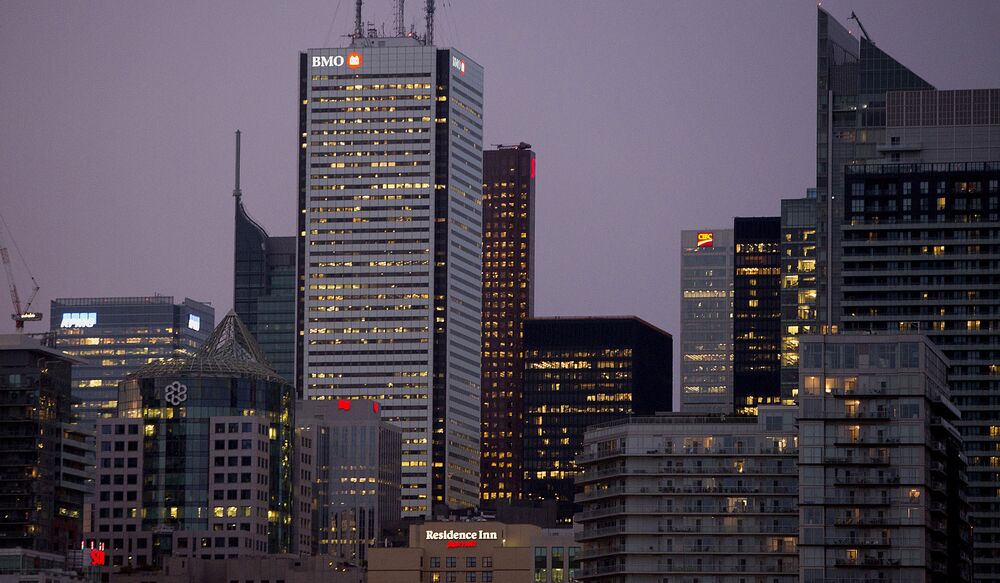
The Bank of Montreal (BMO) building, center, stands in the financial district of Toronto.

Photographer: Brent Lewin/Bloomberg

Lender is looking to securitize uninsured prime mortgages  

Deal follows new rules that limit government insurance

by  Allison McNeely

Bank of Montreal is bundling uninsured residential mortgages into bonds in what could be the start of a new debt market for Canadian banks as the government scales back its support for home loans.

The Toronto-based lender is planning to sell debt backed by nearly C$2 billion ($1.5 billion) of prime uninsured mortgages through a trust. That’s a novel development in a country where big banks have historically packaged government-insured mortgages into bonds. Much of the securities will be purchased and retained by the bank, according to Moody’s Investors Service. 

If the Bank of Montreal deal is successful, other Canadian banks may follow its lead, providing banks with more financing to keep making mortgages,

said Marc Goldfried, chief investment officer at Canoe Financial LP. The net result may be that housing prices in Canada keep rising. 

“Right now the banks don’t have any other way to fund it, so there’s probably some form of internal limit on this kind of mortgage financing they’ll do,” Goldfried said by phone from Toronto.

A spokesman for BMO wrote in an email that “The transaction provides a cost-effective structure to optimize a portion of our mortgage business. We regularly look at different alternatives to meet our funding and capital objectives and this program continues that.”

Possible Headwinds

But the Bank of Montreal deal may find headwinds, said Paul Gardner, partner and portfolio manager at Avenue Investment Management Inc. Canada last year tightened access to the federal insurance to help tamp down rapid home price growth in areas like Toronto and Vancouver. The federal government or Ontario could craft more legislation to cool the housing market, Gardner said.  

Residential mortgages, my God, it’s the last thing you want to invest in right now,” Gardner said by phone from Toronto. “When the capital markets are flush with cash, it makes sense that they would try at least to issue this stuff.” 

Gardner said has not looked at these particular securities.

Ontario’s finance minister is considering a foreign-buyers tax like the one that helped cool home prices in Vancouver. Canadian finance minister Bill Morneau, Ontario finance minister Charles Sousa, and Mayor John Tory are meeting in Toronto Tuesday to discuss the housing market in the Greater Toronto Area.

Homes have grown less affordable in Canada as housing prices have increased far faster than wages. Existing home prices rose 18.6 percent in the 12 months ended in March, while wages grew just 1.1 percent, the slowest rate since the 1990s. In Toronto, affordability reached its worst level since 1990 at the end of 2016, according to a report from Royal Bank of Canada.

A First 

Canadian banks have used covered bond programs and asset-backed commercial paper programs to securitize mortgages that do not carry government insurance, but have yet to issue term residential mortgage-backed securities unless they were through a government-sponsored program.

The Bank of Montreal bond is backed by C$1.96 billion of prime residential mortgages, more than half of which are in Ontario and Quebec, according to a Moody’s pre-sale report. Around 95 percent of the securities in the transaction will be rated Aaa. The lowest rated portion will be B2, and there is a non-rated portion as well, the bond grader said. BMO intends to purchase and hold the top three tranches of the debt, equal to about 98 percent of the principal, according to the report.

The bank will offer to renew the mortgage loans at the end of their term if the borrower is not in default, and if the borrowers satisfies the bank’s underwriting criteria at the time, which mitigates some of the risk of borrowers not being able to refinance. Canadian mortgage loans generally have a five-year term, and borrowers pay down their principal at a 25-to-30-year pace meaning they usually have to refinance a significant portion of their loan every five years.

“This is a really unique deal in the Canadian market,” Richard Hunt, an analyst at Moody’s Investors Service who rated the deal, said in an interview. “Given the pent-up demand that we think is out there on the part of banks and non-banks to have a vehicle to fund their residential mortgages, to have an RMBS market, we think this could be a significant transaction.”


May 262017
 

MANY THANKS for sharing this strategy with others  – –  to Jake  – –  who writes:

I am not sure if you remember our original correspondence from several years back but I will take a short moment to refresh your memory.

Our organization, North American Intertribal Missions, (NAIM) has for almost thirty years now provided ancillary services to and for Native American Children who are rendered to the custody of any entity outside of their tribal affiliations.  I personally am half NatAm (both parents were half) and affiliated with three tribes.

The ‘successes’ we have had are as a result of using the existing law(s) most often in a manner that they were not originally intended to be used; but we were successful in most cases by that method.

Recently, we have had several cases of children who we had found foster care for who were subject to the “Indian Child Welfare Act” and the “Indian Health Care Act” and the organization known as the “Indian Health Care Service” “IHCS” and its many avenues of services which most often need the same approach as listed above to be used to their fullest potential and benefit; and this brings me to a point that I felt MAY be of some service to you and your own program on the Forced Vaccination Resistance.

To sum it up WE took the existing laws that govern “Physician Liability” and  we think; USED THEM TO MAKE OUR POINT ON THE MATTER OF CHOICE……. AND IT IS SIMPLY THIS:

Because here in our headquarter state of Texas, Vaccinations CAN ONLY BE ADMINISTERED BY/AT THE ORDERS/PRESCRIPTION OF A DOCTOR–or— PHYSICIAN WHO IS LICENSED TO PRESCRIBE THOSE DRUGS………

We crafted several very short, differently worded documents that essentially “request” that the “Doctor who is prescribing the vaccination that may or may not be required by law (most often for children) ASSUME FULL  RESPONSIBILITY FOR THE RESULTS OF THE VACCINATIONS PRESCRIBED—-WHETHER THEY BE SUCCESSFUL OR RESULT IN ADVERSE REACTIONS.

Of the FOUR cases that we have been involved with; NONE of the Doctors were willing to accept the ultimate responsibility whether it resulted in ‘success’ or ANY adverse reactions.

In each case the parent, had the document to show to the ‘demander’ (most often a school or other similar organization) that their “demand” was impossible to accomplish without the participation of the licensed Physician who is the ONLY professional that has the authority to ‘prescribe’ the vaccination; and was NOT willing to accept “personal professional responsibility”—-for prescribing something was being demanded by law. (*)

It stopped there (well for now) and we hope that the same concept can be expanded upon by others.

The irony is that the institutions that are demanding the vaccinations have no way to overcome the fact to the most simple of the counter arguments that we have used which is:

“If everyone else but a few, volunteer to be vaccinated, then THEY are the ones who will have nothing to worry about if that contagion becomes epidemic; while those who refuse the vaccinations are ‘willingly taking the risk’ and will not by law be able hold anyone else liable.

This approach MAY need some refinement ,and I am aware that you are in Canada with many differing laws, but the same approach with refinements may very well be the answer.

  • EVERY Lawyer we have revealed this to has said almost the same thing “Damn, that is SMART”……..”they’ll have some major difficulties getting that past the insurance companies that cover the liabilities for those Doctors.”

It may just be worth it to you and ‘yours’ to try the same approach with your own tailored method.

The Pharmaceutical  corporations are as dependent upon the Insurance industry as the medical field; and that being the case we think we found a way to cause them to be concerned about their “concerns” e.g. MONEY……..(it does make the world go round doesn’t it?) and when you can “grab them by the ——money bags; you get their attention”……..

Let me know what you think.

May 262017
 

ASIDE:    Here are young people – –    It seems to me  They understand that if CORRUPTION isn’t factored in,  we  can forget about getting rid of the TYRANTS.

https://voices.transparency.org/10-quotes-about-corruption-and-transparency-to-inspire-you-cd107d594148

– – – – – – – – – –

UPDATE:

Below is a 2017 posting.   I was despairing that the Trudeau Liberals had brought Larry Summers and McKinsey Co. (Dominic Barton)  up from the USA to help guide Canadian economic policy.    Corruption was already Canada’s #1 Ailment.

Summers spoke at UBC as recently as this year (2025).

You may have seen:   Summers is on  “the Epstein List”   and getting dumped (resigning?) fast from corporate Boards.

I looked him up on Wikipedia:   there is a comprehensive biography which includes the Epstein connection.


= = = = = = = = = = = = = = =

EMAIL THREAD, edited for brevity

SENT:   May 24,  (2017, I think)

TO:  Janet

Thanks for the Larry Summers re Chrystia Freeland (Cdn Minister of Foreign Affairs) connection.

Sources:  I found Summers listed as one of Freeland’s  “friends in high places”.  He is a booted-out (controversial) President of Harvard,  she a graduate of Harvard (Summers was her supervising economics prof).   Details below – – Summers’ role with the Wall Street robber barons.

New York Times supplies the student – professor relationship,  http://www.nytimes.com/2008/12/07/us/politics/07summers.html

Chrystia Freeland, a former student (of Summers) who had become editor at the Financial Times, asked him to write a monthly column that became such an attraction that the paper soon promoted it with his picture atop the front page. . . .

Freeland was a journalist and has interviewed Summers a few times since 2007-08  (I had a quick look at only one video of interview – – the little I saw would have been conducive to “friendly relationship” – – no hard questions regarding Summers’ role, as a civil servant under Obama, in protecting Wall Street over Main Street.  And the millions he made from the Wall Street barons.

Maybe she didn’t know (excerpt from below):  Upon being nominated Treasury Secretary by President Clinton in 1999, Summers listed assets of about $900,000 and debts, including a mortgage, of $500,000.[57]   By the time he returned in 2009 to serve in the Obama administration, he reported a net worth between $17 million and $39 million.[57] He is a former member of the Steering Committee of the Bilderberg Group.[59]


There are  Larry Summers – Dominic Barton connections, too (below).  (Barton, head of McKinsey Co. based in London UK, appointed by Finance Minister Bill Morneau, to head up the Advisory Committee on Economic Growth to the Federal Govt.

My view on Summers remains the same, after doing a second review of the documentation:

he didn’t have an epiphany.   He’s part of the “Inclusive Capitalism Initiative“.    It’s not about change – – it’s about propaganda, after 2007-08 and the continuing excesses.

They are “re-branding” capitalism,  because of growing anti-capitalism.

There are links below to Summers’ role in deregulation of the U.S.  banking and derivatives market.  He was advising the u.s.  President.   Later – – don’t put caps on pay for executives who received Government bail-out money.  What a joke – – Summers was simultaneously making millions from the crooks:  Goldman Sachs, JPMorgan Chase, Citigroup, Merrill Lynch and Lehman Brothers.

Larry Summers is corrupt (I don’t know what else you call such profound conflict-of-interest).  He provided bad advice to the U.S. Government that was of huge benefit to the crooks on Wall Street and in high places in the U.S..  He manifests the problem with “Wall Street” and the outrages leading up to and following 2007-08.  He enriched himself by being a courtier.  He is slippery.  Get him out of Canadian affairs.

Everyday Canadians know the old adage, “You judge a person by the company he keeps”.

Morneau appointed Dominic Barton to head up the Advisory Committee on Economic Growth.   Freeland is the rah-rah for Summers and for Trade deals that hand over control of the Canadian banking, investment, and financial industries to the international cartels.

To me, you don’t have to be too bright to have figured out on your own:  Once a nation parts with control of its currency and credit, it matters not who makes that nation’s laws  (quoted from a former Canadian prime minister in the COMER material submitted to court – – see below). 

Morneau and Freeland have the potential to take down their cabinet colleagues, the good along with the bad (damn the fact that elected representatives are also tied to a political party!).

Thank goodness for Beyond Banksters and the appetite with which Canadians are devouring it.

Remind ourselves to look abroad:  with corruption of governance comes poverty

Larry Summers and Dominic Barton, Bill Morneau, Chrystia Freeland  are a corrupting force when married to the Government.  Summers makes that clear.  They are in very serious conflicts-of-interest.  They represent the interests of the millionaires and billionaires, unabashedly.  But you have to cut through the snake oil to see it.

You have only to observe, you don’t need a book to explain it.  But there IS a great little book on the topic!  In the past, I’ve posted re Jane Jacobs’  Systems of Survival:  A Dialogue on the Moral Foundations of Commerce and Politics.  

And  Ha! ha!   In every copy of Banksters that I sent out, I inscribed,  Oh!  Canada!  We stand on guard for thieves!

MENTAL PUZZLE – SUMMERS

Summers was brought in to help the Liberals develop economic strategy, in advance of the 2015 Federal Election.   Mental puzzle:  figure out WHY they would employ someone like Summers.  (It’s not hard to see that the people who Prime Minister J. Trudeau (the Liberal Party) surrounds himself with, especially in the Power Portfolios that involve economic matters,  will be their downfall – –  OR their salvation.)

The ANSWER (why would they even touch someone like Summers?), I think, is along these lines:   Pre-election, the Liberal Party was driven by “How do we beat the Conservatives?”.   They believed that their weak spot was economic policy.  Then comes fear – – the Conservatives were seen to be able to beat them on that issue.   (OR,  the Big-Business-Old-Boys in the Liberal Party run to the same tune as the Big-Business-Old-Boys in the Conservative Party – – and both embrace charlatans like Summers – – basically pimps for “Wall Street”.  Larry Summers and Dominic Barton chicanery delivers!   Re-branding – – “Inclusive Capitalism”.

THEY DON’T MENTION THE OTHER SIDE OF THE DEAL:  “the deal” for Canadians – –   we give away Canada, final nail in the coffin.   No longer a sovereign nation (to the extent we haven’t already reached that status).   No question left.    Once a nation parts with control of its currency and credit, it matters not who makes that nation’s laws.

The Liberals addressed the wrong question to the wrong people.   We were driven by the same question:  “How do we get rid of Harper?”.   Now we have to fight “the Old Boys”.   Hard.  They’ve globalized.    But we globalized, too.   And there’s way more of us than them.

But back to the evidence on Summers:

Scroll down, down – – see excerpts from FOUR EARLIER POSTINGS RE SUMMERS.

In 2009 John McMurtry alerted us to Summers’ role at Harvard.   (To this day, Summers rides on the “credentialing” that comes with having been a President of Harvard University (and other “prestigious” positions).  The fact that he got the boot from Harvard, and WHY he got the boot are trivialized – – it was just a backlash by feminists, his statements taken out of context, etc.   The fraud committed by his friend in the Economics Dept is not mentioned.  The fraud was such that the Government of the USA brought charges against Harvard University.  The settlement involved Harvard paying a fine of $26 million.

The apologists for Summers might tire?

  • I don’t know exactly how you apologize for first, his role in the de-regulation of the banking and investment industries, of derivatives – –  which contributed to the 2007-08 meltdown in which millions of Americans lost their homes – – then his role in “don’t put a cap on the remuneration paid to the Management” of the Corporations that received HUGE bail-outs, paid by the citizens on Main Street   – – while he receives millions from the same corporations.   You apologize for that whopper.  Then
  • A few years later,  you find yourself again making up fantasies about Summers – – this time over his departure from the position of President of Harvard.
  • What next?
  • Or, does it matter to an apologist – – as long as you’re riding the same wave as Summers?   And you think you’re money, as long as you’re rubbing shoulders with money.  – –  If the re-branding doesn’t work, if  the forces against “capitalism” in its current incarnation, are successful,  well then, the conflicts-of-interest, the corruption are threatened.  In-my-interest might be replaced by in-the-public-interest.  None of them want to be knocked off the wave.  . . .   Question is:  do we have the intelligence to see through the spin of the “new” “Inclusive Capitalism”?

Back to John McMurtry’s paper (2009)

(Sales pitches metamorphize reality into miracles of more value added in the market, and money sequences leave ever more money in the hands of money managers. This magical thinking is, of course, the very opposite of the search for truth. But the mind has become totalitarian.  . . . (more below))

– – I had forgotten the Summers name.  In 2012 it re-surfaced when his role in the Corruption on Wall Street, the 2007-08 meltdown and failure to prosecute the perpetrators came up in the movie, Inside Job.   . . .  THIS is the guy advising Canadians on Economic Policy?   Ya gotta be kidding.

Larry Summers and Dominic Barton (McKinsey Co.) are closely connected.

You may have read what Barton counsels business leaders – – what they have to do.   If they don’t “reform” capitalism they’re going to lose their grip on things.   Deny, deny, deny  is not going to work any longer.  Barton is seen as a guru because he’s calling things the way they are.   They have to do (the “remedy” for addressing all the anti-capitalism) —   “inclusive capitalism”.   (The Pope condemned the “exclusion” that the existing economic system engenders.)

A conference in London aimed at addressing some of capitalism’s shortfalls has been organised by the “Inclusive Capitalism Initiative” (ICI), convened by a senior member of one of the world’s leading financial-capitalist dynasties, Lady Lynn Forester de Rothschild.    http://www.dw.com/en/inclusive-capitalism-the-big-new-thing/a-17665826

Dominic Barton is a co-founder of the ICI.

This other report names some of the “Big Business” participants:

2014-06-03   ICI (“inclusive capitalism initiative) Christine Lagarde, Mark Carney wouldn’t take a pay cut, so why talk up inequality?   Financial Post

Google, Unilever, GlaxoSmithKline, Dow Chemical and Prudential PLC

Note:  I think many people overlook the role of the Insurance Industry – – they are a significant part of the global cartel that is actively engaged in taking over financial infrastructure of countries.   So yes,  it is not a surprise to see Prudential among the ICI participants.

(Wikipedia:  Prudential plc is a British multinational life insurance and financial services company headquartered in London, United Kingdom. . . .  It owns Jackson National Life Insurance Company, which is one of the largest life insurance providers in the United States, and M&G Investments, a Europe-focused asset manager.[6]  . . . Products:  Life insurance, Investment management,  Consumer finance (loans).   It’s revenue (2016):  71.84 billion pounds (not dollars).   https://en.wikipedia.org/wiki/Prudential_plc

I was alarmed at how much Canada appears to be a target of “the banksters”.   Rothschild (organizer, promoter of ICI), Barton (co-founder), Summers – –   ICI.   Now we have:

  • Barton heading up the Advisory Committee on Economic Growth to the Fed’l Govt
  • Summers consulting with the Advisory Committee
  • You wrote re Summers … he became an advisor to the Trudeau economic polices i.e.  spend our way out of recession a sort of Keynesian approach.   Here’s a source,  Liberals heart Larry Summers , by Konrad Yakabuski, The Globe and Mail, Apr. 09, 2015:

    Will the Liberals live to rue their love-in with Larry Summers? 

    The former U.S. treasury secretary (under Bill Clinton) and top White House economic adviser (under Barack Obama) has become the go-to guru as Justin Trudeau’s Liberals look to craft a crackerjack election platform that can undo the seeming Tory advantage on the economy. 

    Mr. Summers, who was the keynote speaker at the Liberal Party convention in 2014, was back in Canada this week to offer his theories about why economies in the West have been growing so slowly and what he thinks they need to do about it.  He dubbed his talk: The Fierce Urgency of Fixing Economic Inequality Worldwide . . . . “

    So Summers sounds good.   Maybe he believes his own rhetoric.  That does not matter.  What they are actually DOING does matter.   Whether they, or I, am merely poor misled dupes is not the issue.   If there are fundamental flaws, they need to be known.

    Summers rides on his “credentials”.   But they are hollow:

    Why Women are Poor at Science, by Harvard President,  the Guardian, Jan 18. 2005.      (Warning:  this link will take you off my blog and the “back arrow” doesn’t bring you back.   I have to try and copy the article onto my blog; the technology to prevent copying is more and more pervasive.)

    Why Larry Summers lost the presidency of Harvard    (blogger argues that it wasn’t so much Summers’ problems with women and Afro-Americans, but the scandal under which Harvard was required to pay $26.5 million to the U.S. government).  There are links in the article to more information.

    Summers’ service to the Wall Street Crooks,  excerpt from Wikipedia:

    On October 19, 2006, Summers was hired as a part-time managing director of the New York-based hedge fund D. E. Shaw & Co. for which he received $5 million in salary and other compensation over a 16-month period.[55] At the same time Summers earned $2.8 million in speaking fees from major financial institutions,[56][57] including Goldman Sachs, JPMorgan Chase, Citigroup, Merrill Lynch and Lehman Brothers.[58] Upon being nominated Treasury Secretary by President Clinton in 1999, Summers listed assets of about $900,000 and debts, including a mortgage, of $500,000.[57] By the time he returned in 2009 to serve in the Obama administration, he reported a net worth between $17 million and $39 million.[57] He is a former member of the Steering Committee of the Bilderberg Group.[59]

    . . .   According to the Wall Street Journal, Summers called Senator Chris Dodd (D-CT) asking him to remove caps on executive pay at firms that have received stimulus money, including Citigroup.[69]

    . . .   On April 3, 2009 Summers came under renewed criticism after it was disclosed that he was paid millions of dollars the previous year by companies which he now has influence over as a public servant. He earned $5 million from the hedge fund D. E. Shaw, and collected $2.7 million in speaking fees from Wall Street companies that received government bailout money.[70]

    . . .   Summers hailed the Gramm–Leach–Bliley Act in 1999, which lifted more than six decades of restrictions against banks offering commercial banking, insurance, and investment services (by repealing key provisions in the 1933 Glass–Steagall Act): “Today Congress voted to update the rules that have governed financial services since the Great Depression and replace them with a system for the 21st century,” Summers said.[26] “This historic legislation will better enable American companies to compete in the new economy.”[26] Many critics, including President Barack Obama, have suggested the 2007 subprime mortgage financial crisis was caused by the partial repeal of the 1933 Glass–Steagall Act.[27] Indeed, as a member of President Clinton’s Working Group on Financial Markets, Summers, along with U.S. Securities and Exchange Commission (SEC) Chairman Arthur Levitt, Fed Chairman Greenspan, and Secretary Rubin, torpedoed an effort to regulate the derivatives that many blame for bringing the financial market down in Fall 2008.[28]

I haven’t made time to go through the COMER website (the lawsuit to enforce Canadian law – –  the Bank of Canada, a publicly-owned central bank whose mandate is to lend to Governments at minimal interest rates).    Just this one posting – – very worthwhile.

2013-12-10   COMER, on our behalf. Read the “Relevant Quotations”.  “Once a nation parts with control of its currency and credit, it matters not who makes that nation’s laws. . . .”

CPPIB (Canada Pension Plan Investment Board)  http://www.cppib.com/en/.

Public pensions are a big part of the “remedy”.   Think how much money is in them.  They’re taking them over.  It’s part of the game plan:

Social Security” is the American version of the CPP.   Beyond Banksters, Chapter 13,  Hillary, Larry & Dominic:  More Looting Opportunities  lays it out.  What they’re doing to the U.S. (Social Security), they’re doing to Canada (CPP and other pension plans).

Pension plans going bankrupt.  Last fall I talked with a member of the Atlantic middle coastal area of the U.S. Teamsters Union, retired guy.  He became involved in the Union Administration to help combat  corruption in the organization, ended up being there many years.   Fall-out from the corruption on Wall Street (the 2007-08 collapse and bail-out of the big banks responsible)  – – the Union Pension Plan, supposed to support workers through their retirement, is good for another 6 years.   That’s all.   And,  there had been Government money put in a fund to guard against pension plan failure,  but it too, is caput.   Drained, gone.   While the banksters laugh their way, scot-free, millions in bonuses, bailed out by the Government, not even prosecutions.

(CPP Board of Directors:  http://www.cppib.com/en/who-we-are/governance-overview/board-directors/)

To me, their agenda is:  Put a new face on capitalism.  “Re-brand” it.

BUT things get worse for citizens – – the Canada Infrastructure Bank (CIB) is an important case-in-point.

How do we finance $180 billion in infrastructure spending?

  • First, generate some cash – – do that by selling off public assets  (at a fraction of what they’re worth.   The buzz word for it is “asset recycling”.   Of course, the only assets that get “recycled” (privatized) are the profitable ones.)
  • Then you do “partnerships” on other infrastructure.  Which means the Government has zero ability to regulate.
  • And then you Borrow, Big Time.   Debt servitude.   Canada does not have the population base to pay enough taxes to get ahead of the interest and servicing charges.   We have one tenth of the population of the U.S.    But that’s part of the “junk economics” of the day – – economic theories with no base in reality.

Trade deals – – publicly owned central banks are outlawed.   We are at the mercy of the international financial boys.   Whose money gets off-shored.  They don’t pay taxes.    They siphon off what we pay for debt servicing.

Yesterday’s CBC News  (credited to CP):  http://www.cbc.ca/news/politics/trudeau-morneau-business-spending-1.4128295

(Barton) was reluctant to share some of the council’s possible recommendations for job skills or for business investment, since it’s still early in the process.

Re Summers:   The group has already had a 90-minute session on the subject with Larry Summers, a one-time U.S. treasury secretary and former president of Harvard University.   . . . .

(Barton)  said the council hopes to build on existing research, including work conducted by the Conference Board of Canada, the C.D. Howe Institute and tax-policy expert Jack Mintz.   . . . .

In an interview Tuesday, Mintz said Canada should consider changes in two areas if it hopes to promote more business investment: regulation and taxes.   . . . .

. . .  (C.D. Howe)  paper, which recommended policy measures to promote business investment: liberalized trade, less-intrusive regulations, cheaper electricity and lower taxes.

Vipers.

/Sandra

THE FOUR EARLIER POSTINGS RE SUMMERS – –  follow Janet’s email.

= = = = = = =  = = = = = = = = =

From: Janet    Sent: May 23, 2017        To: sandra Finley

Subject:  RE: Larry Summers: Trump’s budget is simply ludicrous

Hi Sandra

Yes I hestiated to post anything by him – other than that he has turned coat a bit now – for whateer reason he is now in a different camp- He has been posting about and defined the persitent slump which some see as the persistent economic future as – the age of secular stagnation. I find it interesting that he finally started to see the folly of globalization about two years ago- when he became an advisor to the Trudeau economic polices i.e spend our way out of recession a sort of Keynsian approach.  He was also Chrystia Freeland’s PhD thesis advisor at Harvard.

I wouldn’t be quite so cynical about him – he’s not been a politico so  much as an advisor and university head- who once was indeed the nemisis of the anti-globalization movement- the one who said – let’s ship polution to Africa becaue it could be diluted there since they don’t have the same degree of pollution or somethng like that.

However in the antiTrump campaign I think it is news that someone of his ilk now widely accepted as a journalist trying to use his economic knowedge to ferret a way through the crisis – even if it’s not the path you or I forsee as necessary. At least he’s much more liberal than he used to be and people do learn and change their perspective.

take care,

= = = = = = = = = = = = = = = = = =

FOUR EARLIER POSTINGS RE SUMMERS

From:                       Sandra Finley

To:                            Janet

Subject:                     RE: Larry Summers: Trump’s budget is simply ludicrous

Date sent:                  Tue, 23 May 2017

Hi Janet,

I assume this is the same Larry Summers as has been Chief Economist at the World Bank, etc etc etc  ??

I checked.   Yes, the same:

The Washington Post article is By Lawrence H. Summers

Lawrence Henry “Larry” Summers (born November 30, 1954) is an American economist, former . .


I copied the excerpts that are on my blog about him.

So what?    Summers is  now outside the ranks of power and wants to de-throne Trump, so that he can get back in?   (Not that I’m a Trump fan,  but this piece by Summers  has, as context,  Summers “contributions” to the financial barons over a long period of time.  Did he have an epiphany?)

The last excerpt, by John McMurtry  in f/u to an interview by the G&M of Summers is enlightening.

I’ve highlighted each time that Summers’ name appears – – you don’t have to read entirety.   Enjoy the summer, instead!

Cheers,

  1. http://sandrafinley.ca/?p=17484   2016-08-25   Revisiting the lessons of the Battle of Seattle and its aftermath,   by Walden Bello.

Then by engaging in the defensive anti-regulatory war that they had mastered in Congress over decades, the banks were able, in 2009 and 2010, to gut the Dodd–Frank Wall Street Reform and Consumer Protection Act of three key items that were seen as necessary for genuine reform: downsizing the banks; institutionally separating commercial from investment banking; and banning most derivatives and effectively regulating the so-called “shadow banking system” that had brought on the crisis. 

They did this by using what Cornelia Woll termed finance capital’s “structural power”.  One dimension of this power was the US$344 million the industry spent lobbying the U.S. Congress in the first nine months of 2009, when legislators were taking up financial reform. Senator Chris Dodd, the chairman of the Senate Banking Committee, alone received US$2.8 million in contributions from Wall Street in 2007–2008. But perhaps equally powerful as Wall Street’s entrenched congressional lobby were powerful voices in the new Obama Administration who were sympathetic to the bankers, notably Treasury Secretary Tim Geithner and Council of Economic Advisors’ head Larry Summers , both of whom had served as close associates of Robert Rubin, who had successive incarnations as co-chairman of Goldman Sachs, Bill Clinton’s Treasury chief, and chairman and senior counsellor of Citigroup.

  1. http://sandrafinley.ca/?p=15208 2012-05-21    Heist of the century: university corruption and the financial crisis.   Extract from “Inside Job”.

Yet we should not be surprised. Over the past couple of decades medical professionals have amply demonstrated the influence money can have in a supposedly objective, scientific field. In general, medical schools and journals have responded well, adopting disclosure requirements. The economics discipline, business schools, law schools and political science schools have reacted very differently.

Over the past 30 years, significant portions of American academia have deteriorated into “pay to play” activities. These days, if you see a famous economics professor testify in Congress, or write an article, there is a good chance he or she is being paid by someone with a big stake in what’s being debated. Most of the time, these professors do not disclose these conflicts of interest, and most of the time their universities look the other way.

Half a dozen consulting firms, several speakers’ bureaus and various industry lobbying groups maintain large networks of academics for hire for the purpose of advocating industry interests in policy and regulatory debates. The principal industries involved are energy, telecommunications, healthcare, agribusiness – and, most definitely, financial services.

Some examples. Glenn Hubbard became dean of Columbia Business School in 2004, shortly after leaving the George W Bush administration. Much of his academic work has been focused on tax policy. A fair summary is that he has never seen a tax he would like. In November 2004 Hubbard co-authored an astonishing article, jointly with William C Dudley, then chief economist at Goldman Sachs. The article, How Capital Markets Enhance Economic Performance and Facilitate Job Creation, warrants quotation. Remember, this is November 2004, with the bubble well under way: “The capital markets have helped make the housing market less volatile … ‘Credit crunches’ of the sort that periodically shut off the supply of funds to home buyers … are a thing of the past.

Hubbard refused to say whether he was paid to write the article. He also refused to provide me with his most recent government financial disclosure form, which we could not obtain otherwise because the White House had destroyed it. Hubbard was paid $100,000 (£63,000) to testify for the criminal defence of two Bear Stearns hedge fund managers prosecuted in connection with the bubble, who were acquitted. Last year, Hubbard became a senior economic adviser to Mitt Romney’s presidential campaign.

Larry Summers has held almost every important government position in economics. Treasury secretary under President Clinton, in 2009 he became director of the National Economic Council in the Obama administration. Although sensible about many issues, Summers has made a succession of well-documented mistakes and compromises. And his views on the financial sector would be hard to distinguish from those of, say, [Goldman Sachs chief] Lloyd Blankfein or [JP Morgan boss] Jamie Dimon.

Most of our information about Summers comes from his mandatory government disclosure form. Summers ’ 2009 disclosure form stated his net worth to be $17m-$39m. His total earnings in the year prior to joining the government were almost $8m. Goldman Sachs paid him $135,000 for one speech.

Summers is a compromised man who owes most of his fortune and much of his political success to the financial services industry, and who was involved in some of the most disastrous economic policy decisions of the past half century. In the Obama administration, Summers opposed strong measures to sanction bankers or curtail their income.

Harvard still does not require Summers to disclose his financial-sector involvements. Both Harvard and Summers declined my requests for information.

The problem of academic corruption is now so deeply entrenched that these disciplines, and leading universities, are severely compromised, and anyone considering bucking the trend would rationally be very scared. Consider this situation: you’re a PhD student, or a junior faculty member, considering doing some research on, say, compensation structures on risk-taking in financial services, or the potential impact of public disclosure requirements on the market for credit default swaps. The president of your university is … Larry Summers .

The chairman of your department is …Glenn Hubbard. Or you’re at MIT, and you want to examine the decline in corporate tax payments. The president of MIT is Susan Hockfield, on the board of GE, a company that has managed to avoid paying hardly any corporate taxes for several years.

How much do these forces actually affect academic research and policymaking? The available evidence suggests that the effect is large.

Academic commentary on the financial crisis by economists has been remarkably muted. There are, to be sure, some notable exceptions. But for the most part, the silence has been deafening. How can an entire industry come to be structured such that employees are encouraged to loot and destroy their own firms? Why did deregulation and economic theory fail so spectacularly?

The release of the film Inside Job clearly touched a nerve with regard to these questions. I was contacted by a large number of students and faculty, and there has been a great deal of debate. Departments including the Columbia Business School have adopted disclosure requirements for the first time. But most universities still have no such requirements, and few if any have any limitations on the existence of conflicts of interest. The same is true of most academic publications. Newspaper reporters are strictly prohibited from accepting money from any industry or organisation they write about.

Not so in academia.

There has been one significant positive development. Earlier this year, the American Economics Association adopted a disclosure requirement for the seven journals it publishes. But most institutions continue to oppose further disclosure and, when I was making my film, refused even to discuss the subject.

This is an edited extract from Inside Job: the Financiers Who Pulled Off the Heist of the Century by Charles Ferguson, published by Oneworld at £12.99. Order a copy for £10.39 with free UK p&p here or call 0330 333 6846. Charles Ferguson will appear at the Edinburgh international book festival on Sunday 12 August.

  1.   http://sandrafinley.ca/?p=15102    2015-06-25   International Philanthropy Conference in Greece – Richard Heinberg’s talk on Sustainability, Growth Limits and role of Philanthropy

The “standard run” scenario from the Limits to Growth scenario series showed a peak and decline in world industrial output during the first half of this century, or right about now; indeed, many economists are today noting a slowing of growth worldwide (this is especially clear for the older industrialized countries—Europe, the United States, and Japan; however, it may also be the case even for the Asian tigers, principally China, which posted such dramatic expansion during the past two decades).  Economist Larry Summers, former Chief Economist of the World Bank, discusses the current deceleration in terms of secular stagnation, attributing its cause to demographic or financial factors, including too much debt.  However, it is hard to disregard the coincidence of the 43-year-old scenario study and the emerging reality.  Ecological and biophysical economists have identified causal factors linking energy resource depletion and accumulating environmental impacts with the economic slowdown, reducing the likelihood that the coincidence is merely one of chance.

Many of us who have been part of the growth limits discussion have arrived at a common view of the situation that can be summarized as follows: Economic growth may not be entirely over, but its limits are indeed within view. However, societies have become systemically dependent on economic expansion to provide jobs, returns on investments, and government tax revenues. Policymakers have made no plans to respond to the end of growth because the economists whom they listen to refuse to acknowledge that environmental limits to growth exist. This puts us in a bind. Policymakers, including central bankers, seem to have no choice but to tromp on the accelerator of monetary policy to achieve growth at any and all cost, even as physical scientists warn that further expansion will imperil both the environment and the economy.

– – – – – –

  1. http://sandrafinley.ca/?p=13504   2009-04-07  The University Wars: The Corporate Administration versus the Vocation of Learning,  John McMurtry

Financialization of the Academy: The Totalitarian Drift

To get a sense of the academy’s increasing submergence in corporate-market values, consider the words of the past Harvard President, Larry Summers, now chief economic adviser to the Obama administration. He was interviewed by the Globe and Mail in glowing admiration after a lecture to University of Toronto. (May 24, 2003). “The essential truth”, he declared, is that all “basic value” – including “literacy” – is “linked to market growth”.

We may formalize the equation of the paradigm corporate president as follows: More/less money-value sales = more/less market growth = more/less “basic values” for the world. No substantiation of the given equations is deemed necessary. No explanation of contra-indicative evidence is conceived. Yet mind-staggering implications follow that are not seen. Whatever is without a market price is, therefore, without any value – the world’s biodiversity of species, for example. Life itself is of no value except as it sells for a market price. So too research and knowledge. If they are not marketable, they do not exist. The truth is what sells.

An unseen onto-ethic rules here. As with soaps, so with universities. Sales pitches metamorphize reality into miracles of more value added in the market, and money sequences leave ever more money in the hands of money managers. This magical thinking is, of course, the very opposite of the search for truth. But the mind has become totalitarian. Recently, the New York Times gave much page and blog space to Stanley Fish, an academic servant to money and power as Allan Bloom and Leo Strauss before him. Fish’s tirade against academics following “the inner light” – his words – required, he concluded, the use of coercive force against them. Professors need to be reduced to a master-servant relationship with “their employer” as all other employees: that is, with university CEO’s and designates who hire and fire by unilateral control of purse-strings with no ultimate accountability to academic standards.5 Fish’s prancings for the boss in the New York Times are a sign of things to come.

= = = = = = = = = = = = = = = = = = = = = =

From: Janet E   Sent: May 23, 2017

Subject: Larry Summers : Trump’s budget is simply ludicrous

He begins:

Details of President Trump’s first budget have now been released. Much can and will be said about the dire social consequences of what is in it and the ludicrously optimistic economic assumptions it embodies.  My observation is that there appears to be a logical error of the kind that would justify failing a student in an introductory economics course….

and concludes:

The president’s personal failings are now not just center stage but whole stage.  They should not blind us to the manifest failures of his economic team.  Whether it is Secretary Mnuchin’s absurd claims about tax cuts not favoring the rich, Secretary Ross’s claim that the small squib of a deal negotiated last week with China was the greatest trade result with China in history, NEC Director Cohn’s ludicrous estimate of the costs of Dodd-Frank, or today’s budget, the Trump administration has not yet made a significant economic pronouncement that meets a minimal standard of competence and honesty.   -Larry Summers, WP

THE TEXT OF SUMMERS’ PERSPECTIVE

https://www.washingtonpost.com/news/wonk/wp/2017/05/23/larry-summers-trumps-budget-is-simply-ludicrous/?utm_term=.fa3b82b305d0

Wonkblog Perspective

Larry Summers: Trump’s budget is simply ludicrous

By Lawrence H. Summers May 23 at 5:00 AM

Play Video 2:08

Trump’s new budget proposal: What’s in and what’s out

The Trump administration is expected to introduce its 2018 budget proposal on May 23, which will likely include major cuts to programs for low-income Americans. (Video: Jenny Starrs/Photo: Jabin Botsford/The Washington Post)

Details of President Trump’s first budget have now been released. Much can and will be said about the dire social consequences of what is in it and the ludicrously optimistic economic assumptions it embodies.  My observation is that there appears to be a logical error of the kind that would justify failing a student in an introductory economics course.

Apparently, the budget forecasts that U.S. economic growth will rise to 3.0 percent because of the administration’s policies — largely its tax cuts and perhaps also its regulatory policies.  Fair enough if you believe in tooth fairies and ludicrous supply-side economics.

[Graphic: What Trump’s budget cuts from the social safety net]

Wonkbook newsletter

Your daily policy cheat sheet from Wonkblog.

Then the administration asserts that it will propose revenue neutral tax cuts with the revenue neutrality coming in part because the tax cuts stimulate growth! This is an elementary double count.  You can’t use the growth benefits of tax cuts once to justify an optimistic baseline and then again to claim that the tax cuts do not cost revenue. At least you cannot do so in a world of logic.

The Trump team prides itself on its business background.  This error is akin to buying a company assuming that you can make investments that will raise profits, but then, in calculating the increased profits, counting the higher revenue while failing to account for the fact that the investments would actually cost some money to make. The revenue generated by the investments might exceed their cost (though the same is almost never true of tax cuts), but that doesn’t change the fact that the investment has a cost that must be included in the accounting.

This is a mistake no serious business person would make. It appears to be the most egregious accounting error in a presidential budget in the nearly 40 years I have been tracking them.

Who knew what when? I have no doubt that there are civil servants in Office of Management and Budget, the Treasury and the Council of Economics who do know better than this mistake. Were they cowed, ignored or shut out?   How could the secretary of the treasury, the director of OMB and the director of the National Economic Council allow such an elementary error? I hope the press will ferret all this out.

The president’s personal failings are now not just center stage but whole stage.  They should not blind us to the manifest failures of his economic team.  Whether it is Secretary Mnuchin’s absurd claims about tax cuts not favoring the rich, Secretary Ross’s claim that the small squib of a deal negotiated last week with China was the greatest trade result with China in history, NEC Director Cohn’s ludicrous estimate of the costs of Dodd-Frank, or today’s budget, the Trump administration has not yet made a significant economic pronouncement that meets a minimal standard of competence and honesty.

May 262017
 

Banksters: Index

With many thanks to Leo who has written provocative letters-to-editor for as long as I’ve known him.   Years ago I asked Leo if he’d run in the next election for the Green Party.   His reply, “Sandra, do you know how old I am?”.   – – No.   He had a big laugh.  He was well into his eighties!   He is now well into his nineties.

Email thread:

= = = = = = = = =

On Mon, May 22, 2017, Leo Kurtenbach wrote:

To the Editor,

Water, water everywhere,–and not a drop to drink!–At least not here in Canada.

We have been told that on our planet Earth, there are about 663 million people who do not have safe water to drink.

Harrods is the world’s largest department store. It is owned by the Qatar Investment Authority, with parent offices in London, England.

Harrods will be marketing bottled water with the brand name “Limited Edition Bottled Water.” The price per bottle will be about $100 dollars!

However, it is obvious that $1OO bottled water will not be available for poor people.

Apparently, this “special” drinking water is melted into water from Arctic ice.  — We are also told that the glaciers are already melting at an accelerating rate, due to climate change, along with extravagant consumerism.

Water is the most important of all liquids needed to maintain the life and growth of all plants and animals, including human beings.– Using water for the sole purpose of creating profits, borders on an inhuman action, and should be viewed as an act of extortion.

However, there are instances where water can legally be used, but in the process may no longer be safe drinking water. Therefore, it is necessary that our governments maintain and enforce laws that clean drinking water cannot be used in the processing of commercial interests.  The export of Canada’s clean drinking water, if it is available, should  be allowed only when it is deemed to be necessary to maintain the lives of human beings.

Leo Kurtenbach,   Saskatoon.

– – – – – – – – – – – – – – –    REPLY

From: Gordon Kurtenbach

Subject: Re: Water,water everywhere

Water is a good issue.

  • First, oddly enough, while we charge money for it, it literally falls from the sky.
  • Second, it self evident that those who use water for processing should have to return equal amounts of clean water back to environment.
  • Finally, to get us out of our water pollution debt, we need for it to be “return equal amounts + 1% more”.    This will eventually get the human race back to using water in a sustainable and ethical way.
May 252017
 

Banksters: Index

Cover Letter,  a copy of Beyond Banksters sent.

= = = = = = = = = =  = =

City of Calgary  (Example)


Dear Mayor Naheed Nenshi,

I expect you will be attending the FCM Convention, June 1 to 4.   Perhaps you will have time to pick out high points from enclosed book before the Conference starts.

(FCM = Federation of Canadian Municipalities.)

Large numbers of Canadians are (choose your adjective) re $180 billion in Infrastructure spending over 12 years, and the methods proposed for FINANCING the purchases.

How do we obtain $180 billion?

  • Sell off public assets to generate some cash (sell the profitable ones, for far less than they’re worth)
  • Form “partnerships” to build some of the infrastructure (when you do that, the Government completely relinquishes its ability to regulate)
  • Use debt for the remainder, financed/directed by the international banking cartel (we’ll be paying high interest rates, with “servicing charges on top of that)
  • While remembering HOW MANY people we have to spread the costs over. (And the fact that many corporations and wealthy people use offshore tax havens; while the CRA twiddles its thumbs and hums and haws.) Note that the amount of money we are talking about is large in the U.S. with its ten times more people than Canada.
  • It is a recipe for creating a continuous flow of money into the hands of the wealthy. Canadians will never be able to pay enough taxes to get ahead of the debt, with carrying charges on top.
  • To me personally, the Canada Infrastructure Bank (CIB) has to be torpedoed.   We already have an Infrastructure Bank and it’s called the Bank of Canada.   THE EXISTING LAW mandates it to lend money at very low interest, to governments in Canada. The author of Beyond Banksters, Joyce Nelson, has done a fine job of documenting how, in Orwellian fashion, its duty under the Law has been usurped.

“Beyond Banksters” offers an ALTERNATIVE.   We do not have to be stupid dupes.

“Jerry” purchased 445 copies of Banksters.   Every MP and Senator has received a copy.

I purchased 55 copies.   A number are going to the FCM Conference:   Mayor Teunis Westbroek (Qualicum Beach) has his own and offered to take a copy for FCM CEO Brock Carlton.

Mayor Mike Savage (Hfx), Mayor Charlie Clark (Saskatoon), Mayor Josie Osborne (Tofino), and others. National Chief Perry Bellegarde, Grand Chief Stewart Phillip have received. . . . Copies are being read and passed on.

The book is selling quickly. I believe that Margaret Atwood has received a copy. Grass roots.  (Insert:  Author Ronald Wright has his own copy.)

I will be appreciative of whatever conversations you are able to generate.

Best wishes,

Sandra Finley

(contact info)

May 252017
 

Banksters: Index

COMER — Committee on Monetary and Economic Reform  EST. 1986

There are powerful statements in this Report,  especially under ‘The Citizens” and “Relevant Quotations“,  as well as other, important, empowering information.   I am extremely grateful to the members of COMER.

http://www.comer.org/content/Appeal2.htm  

Report of an Appeal of an August 2013 Interim Order
in the Lawsuit Respecting the Bank of Canada

Comments by Connie Fogal aided by Ann Emmett, the Statement of Claim,
and Rocco Galati’s August 2013 report

The Court

On December 10, 2013, Bill Krehm, Ann Emmett and COMER were in court again defending the right of Canadians to the use of our Bank of Canada in the interest of Canada and Canadians, not private banks and bankers.

The December 10, 2013, court appearance involved argument by their lawyer Rocco Galati appealing against the order August 9, 2013, of Prothonotary Aalto (a Justice of the Federal Court) who struck COMER’s claim against the Bank of Canada and Minister of Finance.

Using our own tax dollars against us the Government of Canada had brought forward the motion to strike the case, i.e., knock it out of court, dismiss the case. Prothonotary Aalto did so because he said it was not “justiciable.”

On December 10, 2013, Rocco Galati presented the defence of our right to continue the case including the points he set out in his August 2013 report. He pointed out the legal errors in the August order that struck our case:

  • that justiciability is a doctrine that is normally and properly invoked where the Court essentially does not have the expertise, or is incapable, at the end of the day, to come to a judicial determination of the issue because it is beyond the scope of what a Court does;
  • that in this case invoking the doctrine of justiciability lacks logic, is devoid of cogency, and is reverse circular reasoning. To do so is contrary to the avalanche of jurisprudence;
  • that Prothonotary Aalto’s decision that the claim was not justiciable because the case deals with “policy-ridden” socio-economic issues ignores the fact that this case would not be the first time the Courts, including the Supreme Court of Canada, dealt with policy-ridden socio-economic issue(s) which contravene statute and the Constitution;
  • that on a motion to strike, the Court is not allowed, according to the Supreme Court of Canada, to come to any (final) conclusions with respect to the merits of the case, including interpreting any statutory provisions in issue;
  • that Prothonotary Aalto’s decision ignores the clear Supreme Court of Canada’s jurisprudence that statutory interpretation, particularly in the face of a constitutional challenge, should be determined by the trial judge, after evidence in a trial, not by a motions judge on a motion to strike, just based on the pleadings;
  • that the Court’s decision rests on a flawed statutory interpretation of the word “may” in section 18 of the Bank of Canada Act which interpretation is one of the crux issues in dispute and which interpretation jurisprudence does not allow him to make;
  • that the Federal Court decision is devoid of any logic, but for its absurd reverse circular reasoning, because, by deciding these substantive issue(s), which the Court did not have the jurisdiction to do on a motion to strike, proved that the issue(s) are justiciable. But the Court, in essence, ruled that the issue(s) are not justiciable because if he were the trial judge, he would decide them against the plaintiffs…which is not his function on a motion to strike.

The government lawyer argued in defence of Prothonotary Aalto’s decision.

The judge at the December 10, 2013, appeal reserved his decision. It is likely that whoever loses this round will appeal again to the next court level on this issue of whether we have a right to proceed.


The Citizens

The court was once again overflowing with ordinary citizens, including members of COMER, university students, and members of the Occupy Movement. The room was too small to hold everyone. At first the court staff refused to arrange for a change of rooms between judges to better accommodate the crowd. The staff administration was demanding on threat of security action that those without seats in this too small room leave. There was verbal resistance. A few went out, but returned once one small woman stood up adamantly urging all present to stay put until a proper room was provided. We did, and it worked. Lo and behold, it was possible after all to move the judges to accommodate us in the larger room.

Ann Emmett called it invigorating drama bringing us together in an extraordinary way creating a sense of community amongst this gathering of citizens. Even so, there was still insufficient room for all of us. Those still without seats remained in the foyer even though they could not hear the proceedings. In this way they were still with us, a part of the proceedings.

Ann opined that the day ended on a high note of conviviality with picture taking and lunch together.

We were a varied group from 100-year-old Bill Krehm and 90-year-old Paul Hellyer, (among other long term monetary reformers), through those of middle age, down to youths including a 19-year-old student, Patrick Cryon. We came from all across Canada.

Ann has been working hard teaching, holding discussions, communicating, including with young people and the Occupy Movement. She said, “The rapport and respect between the many young people and the older generations at this hearing was impressive. The youth expressed their admiration, gratitude and appreciation that their elders were still fighting a good fight setting a great example. A sense of hope pervaded the atmosphere. They were aware the case might fail, but that the cause was just, and this had to be done. Success would come in some way. There was real hope for the future in the air.”

She continued, “For their part, the long term monetary reformers were encouraged by the commitment and articulateness of the youth who are working hard to inform themselves and understand the issue. It was encouraging to see that the young are so willing and able to take up the struggle. It is happening!!!!!”

Ann felt that, “Whatever the outcome of this December 10, 2013, hearing, there was a feeling among the audience that we came away winners, stronger together and more committed than ever, inspired and determined to carry on.”

Relevant Quotations

“If you will not fight what is right when you can easily win without bloodshed; if you will not fight when your victory will be sure and not too costly; you may come to the moment when you will have to fight with all the odds against you and only a precarious chance of survival. There may even be a worse case. You may have to fight when there is no hope of victory, because it is better to perish than live as slaves.” – Sir Winston Churchill, The Gathering Storm

“Banking was conceived in iniquity and was born in sin. The bankers own the earth. Take it away from them, but leave them the power to create money, and with the flick of the pen they will create enough money to buy it back again. However, take that power away from them and all the great fortunes like mine will disappear, and they ought to disappear, for this would be a happier and better world to live in. But if you wish to remain the slaves of Bankers, and pay the cost of your own slavery, let them continue to create money.” – Sir Josiah Stamp, a director of the Bank of England, 1920s

“When a government is dependent upon bankers for money, they and not the leaders of the government control the situation, since the hand that gives is above the hand that takes.… Money has no motherland; financiers are without patriotism and without decency; their sole object is gain.” – Napoleon Bonaparte, Emperor of France, 1815

“Once a nation parts with control of its currency and credit, it matters not who makes that nation’s laws. Usury, once in control, will wreck any nation. Until the control of currency and credit is restored to government and recognized as its most conspicuous and sacred responsibility, all talk of the sovereignty of Parliament and of democracy is idle and futile.” – Mackenzie King, Canada’s 10th Prime Minister, 1938

“Give me control of the nation’s money and I care not who makes the laws.” – Mayer Amshel Bauer Rothschild

“The powers of financial capitalism had another far-reaching aim, nothing less than to create a world system of financial control in private hands able to dominate the political system of each country and the economy of the world as a whole. This system was to be controlled in a feudalistic fashion by the central banks of the world acting in concert, by secret agreements arrived at in frequent meetings and conferences. The apex of the systems was to be the Bank for International Settlements in Basel, Switzerland, a private bank owned and controlled by the world’s central banks which were themselves private corporations. Each central bank…sought to dominate its government by its ability to control Treasury loans, to manipulate foreign exchanges, to influence the level of economic activity of the country, and to influence cooperative politicians by subsequent economic rewards in the business world.” – Carroll Quigley, Historian, Tragedy and Hope, p. 324

“The very idea of a government that can create money for itself allowing private banks to create money that the government then borrows and pays interest on is so preposterous that it staggers the imagination.” – William F. Hixson, It’s Your Money

The Betrayal of Canadians

Our governments have given over their powers to private banks. The citizen’s lawsuit challenges this transfer of use and power. No Canadian political party sitting in our government acknowledges the legitimacy of this lawsuit let alone joins us in it, choosing instead complicity in this treason. Some say they are just ignorant. On the other hand, Rosemary Brown said, “Silence can be golden. But sometimes, it’s just plain yellow.” (Rosemary Brown was the first black woman member of a provincial legislature, in BC.)

This lawsuit is one kind of step for citizens to gain back our power. Our government is taking every possible step it can using our own tax dollar to fight us every inch of the way. They are acting to keep us “slaves of the bankers,” and making us “pay the cost of our (own) slavery.”

In 1938, the Bank of Canada was nationalized. It is empowered to regulate credit and currency in the best interest of the economic life of Canada. Until 1974 it did that as government obtained from the Bank of Canada some of the money it needed (25 to 50%) to run the country at low or no interest rates rather than borrowing all from private banks at much higher rates of interest.

The government used the Bank of Canada to help finance WW2, build the Trans-Canada Highway and the St. Lawrence Seaway, finance social programs like the Canada Pension plan, Medicare – all without undue debt or inflation.

The Bank of Canada is the only “public” central bank created by statute and accountable to the legislative and executive branches to be found in any of the G-8 nations. All other central banks are “private” banks and are not directly created nor governed by legislation nor directly accountable nor reportable to the legislative or executive branches of the governments of the nations in which they operate.

In the 70s, Canada joined the Basel Committee of G-10 countries at the Bank for International Settlements, ceased its use of the Bank of Canada for Canadians except for about 5% of its needs, and instead now borrows from private banks at compound interest. Instead of today being able to operate at an estimated surplus of $C13 billion, Canadians have paid over one trillion Canadian dollars in interest on the national debt to private bankers which debt is used to justify the demolition of services to citizens.

Post 1974 our government added s18(m) to the Bank of Canada Act. That action is a core challenge in the lawsuit. That s18 (m) is the facilitating mechanism that hands over our Bank of Canada to the Bank of International Settlements providing for the use and operation of our Bank of Canada for the benefit of foreign financial institutions rather than our citizens. That section reads:

(m) “open accounts in a central bank in any other country or in the Bank for International Settlements, accept deposits from central banks in other countries, the Bank for International Settlements, the International Monetary Fund, the International Bank for reconstruction and Development and any other official international financial organization, act as agent or mandatory, or depository or correspondent for any of those banks or organizations, and pay interest on any of those deposits;

That section throws us to the lions of the international finance world who are currently destabilizing nations everywhere with crippling austerity demands. We are on their “hit” list and our governments and Parliament are complicit in that betrayal. One can explain it in the Quigley terms of their being “cooperative politicians (expecting) subsequent economic rewards in the business world.”

Declarations Sought

This current lawsuit respecting the Bank of Canada seeks many declarations including that:

  • the Minister of Finance, and the government of Canada are required to request, and the Bank of Canada is statutorily required, when necessary, to make interest free loans, on the terms set out under s. 18 (i) and (j) of the Bank of Canada Act, RSC, 1985, c B-2 for the purposes of “human capital” expenditures and/or municipal/provincial/federal “human capital” and/or infrastructures expenditures (i.e., support of education and health, utilities, roads, bridges);
  • the “Government of Canada,” the Minister of Finance, and Her Majesty the Queen in Right of Canada, with the Bank of Canada:(A) have abdicated their statutory and constitutional duties with respect to s. 18 (i) and (j) of the Bank of Canada Act to make loans or advances to the Government of Canada or the government of a province in readily marketable securities issued or guaranteed by Canada or any province, and further,

    (B) the refusal to request and make (interest free) loans under s. 18 (i) and (j) of the Bank of Canada Act has resulted in negative and destructive impact on Canadians by the disintegration of Canada’s economy, its financial institutions, increase in public debt, decrease in social services, as well as widening the gap between rich and poor with a continuing disappearance of the middle class.

  • the Parliament of Canada has unconstitutionally abdicated its duty and function as mandated under the Constitution Act, 1867, and the Constitution Act, 1982. in: allowing the Governor of the Bank of Canada to hold secret the nature and content of his meetings with other central bankers, in not exercising the authority and duty contained in 18 (i) and (j) of the Act, and in enacting s 18 (m) of the Bank of Canada Act.
  • that s. 18 (m) of the Bank of Canada Act and its administration and operation is unconstitutional and of no force and effect as Parliament and the government have abdicated their constitutional duties and handed them over to international private entities, whose interests and directives are placed above the interests of Canadians, and the primacy of the Constitution of Canada and constitutional imperatives.
  • that the defendants’(officials) are wittingly and/or unwittingly, in varying degrees, knowledge, and intent, engaged in a conspiracy, along with the Bank for International Settlements, the Financial Stability Board, and International Monetary Fund to render impotent the Bank of Canada Act, as well as Canadian sovereignty over financial, monetary, and socio-economic policy, and in fact by pass the sovereign rule of Canada, through its Parliament, by means of banking and financial systems…causing injury to Canadians.…

Other Facts to be Established as Findings of Facts in the Lawsuit

  • The current Bank of Canada Act continues to reflect a public statutory duty and responsibility, as borne out by the preamble to the Act.
  • Now, policies such as interest rates and others set by the Bank of Canada are made in consultation with but mostly at the direction of the Financial Stability Board which is an international body of central bankers that monitors and makes recommendations about the global financial system. The Board includes all major G-20 major economies, financial Stability forum members (FSB), and the European Commission. The FSB is based in Basel, Switzerland.
  • The current FSB consists of the major national financial authorities such as Finance Ministers, central bankers, and international financial bodies.
  • The BIS formulates policies and dictates to central banks, including the Bank of Canada.
  • Canada, through its Bank of Canada, became a member of an expanded BIS in 1974.
  • Between 1934 to 1974 the Bank of Canada and Canada were completely independent from international private interests with respect to statutory duties under the Bank of Canada Act, as well as monetary and financial policies reflected in the preamble to the Act, and as it flowed through its economic and social policies.
  • Since 1974 there has been a gradual but sure slide into the reality that the Bank of Canada and Canada’s monetary and financial policy are dictated by private foreign bank and financial interests, contrary to the Act.
  • The BIS is not accountable to any government. It holds secret annual meetings the deliberations and discussions of which are not available to Parliament, the executive nor the Canadian public, notwithstanding that the Bank of Canada policies now directly emanate from and are directed by these meetings.
  • On or about 1974, after Canada’s entry into the expanded BIS, an agreement or directive was reached that the central banks (including our Bank of Canada despite its being the only publicly created and accountable to Parliament central bank) would not be used to create or lend interest free money (contrary to s. 18 (i) and (j) of the Act and the original purpose for its creation) but that governments must obtain borrowed money from and through the BIS (FSF, FSB and IMF).
  • Over the years since 1974 Canadian Ministers of Finance have had requests to make interest free loans from the Bank of Canada to the Provinces and to municipalities to fund infrastructure and other social needs which the Ministers have consistently refused to do citing unjustified excuses about inflation and deficits and debt, but never the truth about the deal with the BIS.
  • It has long been established that investment in human capital such as education and health is the most productive investment and expenditure a government can make.
  • The BIS, FSF, FSB and IMF were all created with the cognizant intent of keeping poorer nations “in their place,” which has now expanded to all nations in that these financial institutions succeed in overriding governments and constitutional orders in countries such as Canada over which they assert financial control.

Iceland

The citizens of Iceland have defied the power of the global bankers, refused to be caught in the impoverishing demands of the global elite for austerity measures, have jailed bankers guilty of theft of the commons, removed the politicians who would have betrayed them, and are creating a way to govern themselves and control their own money.

Canadians

The Canadians participating in this lawsuit are carrying the torch for Canada. You can too. Your presence at the next court appearance will help, as can your dollars. Send a donation, payable to “COMER lawsuit,” to 83 Oakwood Avenue, Toronto ON, Canada, M6H 2V9.

This is “the only game in our town.” See you in Court!

(UPDATE:   May 4, 2017  – – the Supreme Court dismissed the Application for Leave to Appeal the lower court decision, with costs.   Joyce Nelson’s book “Beyond Banksters” came out.  There is a large effort underway to get the book and awareness into many hands.)

COMER (the Committee on Monetary and Economic Reform)

May 252017
 

Banksters: Index

From   DW:  Made for Minds   

DW  is  Deutsche Welle.  German international broadcaster  (Welle is “wave” or “wavelength” in English)


http://www.dw.com/en/inclusive-capitalism-the-big-new-thing/a-17665826

Author   Jasper Sky

Blockupy Protest Demonstration ECB Kapitalismus Frankfurt

The global financial crisis that began in 2007-2008 has led to wide-ranging criticism of the world’s current finance-driven capitalism. A conference in London aimed at addressing some of capitalism’s shortfalls has been organised by the “Inclusive Capitalism Initiative” (ICI), convened by a senior member of one of the world’s leading financial-capitalist dynasties, Lady Lynn Forester de Rothschild.

ICI’s aim is to adjust the workings of the capitalist system  so that it works well for more people.

(INSERT:   “Inclusive Capitalism” versus Pope Francis blasts ‘economy of exclusion’.)  

Not incidentally, this is seen as necessary in order to restore trust in capitalism, and so head off possible threats to its continuing dominance as a social and economic model.

ICI’s web page says: “At its core, Inclusive Capitalism is concerned with fixing the elevator of the economist Larry Katz’s famous analogy, portraying the American economy as an apartment block in which the penthouses have increased in size, the middle apartments are more and more squeezed, the basement is flooded, but what gets people down the most is that the elevator is broken.”

(There’s a good one-minute video – – go to the URL at the top.)
Anti-capitalism protests in London and Frankfurt

 Activists from the anti-capitalism “Occupy” movement held anti-capitalist protests in many cities including London and Frankfurt on Saturday.

Luminaries gather to talk about the future of capitalism

Lady de Rothschild assembled a cast of senior dignitaries to participate in Tuesday’s discussions at Mansion House. The starting keynote speech was given by HRH Prince Charles. He was followed at the mic by IMF head Christine Lagarde. Former US President Bill Clinton, former US Treasury Secretary Larry Summers, and Bank of England chief Mark Carney were also scheduled to give plenary speeches. All the speakers were introduced with gushing praise, as is customary at conferences featuring high-level dignitaries.

One of the presentations was given by Michael Sommer, who this month retired from posts as President, German Confederation of Trade Unions (DGB), and President, International Trade Union Confederation (ITUC). Sommer discussed the German economic model – how labor, management and capital can work together to increase the benefits of capitalism. 

It was claimed that institutional investors and business leaders assembled at the meeting represented companies that together control about 30 percent of the world’s  total stock of financial wealth   under professional management.  Lady de Rothschild suggested that the amount of influence in the room was sufficient to change the capitalist game, if those assembled could come together behind a common approach – but cautioned that developing a more inclusive capitalism would be a journey that takes time. 

A long-term project 

Several speakers, including Prince Charles, likewise expressed the hope that the conference would kick off a longer-term process of deliberations aimed at renewing capitalism toward inclusivity of social and environmental concerns. 

Lady de Rothschild has high ambitions for “inclusive capitalism”. She aims to help found a movement, not merely host a conference or two. The ICI project was originally launched in 2011 by the Henry Jackson Society, a neoconservative think-tank launched in Cambridge in 2005 and now based in London, before being spun off into its own non-profit organization. 

In May 2012, The Task Force published a “founding blueprint” document, which suggested that the business community could focus its efforts on three pathways to ensure that everyone – all stakeholders, not just shareholders – derive benefits from capitalism.

The three areas identified were “Education For Employment”, “Nurturing Start-Ups and SMEs” (mentoring of small businesses and improving access to credit), and “Reforming Management and Governance for the Long Term” (replacing today’s corporate and investor focus on short-term financial performance with a longer-term view).

This founding document for the Inclusive Capitalism Initiative was co-authored by a task force of British and American business leaders and senior policy makers, co-chaired by Dominic Barton, Global Managing Director, McKinsey & Company, and Lady de Rothschild, CEO, E.L. Rothschild.

The tone of ICI seems rather noblesse-oblige. Time will tell whether the “Inclusive Capitalism Initiative” bears any fruits other than more of the sort of conferences at which extremely wealthy people arrive at in private jets to spend a pleasant few hours together and reassure each other that they’re doing their best for society.