http://www.bloomberg.com/news/2013-02-22/flawed-f-35-fighter-too-big-to-kill-as-lockheed-hooks-45-states.html
(Note: I captured the text below because links sometimes become invalid.)
By Kathleen Miller, Tony Capaccio & Danielle Ivory
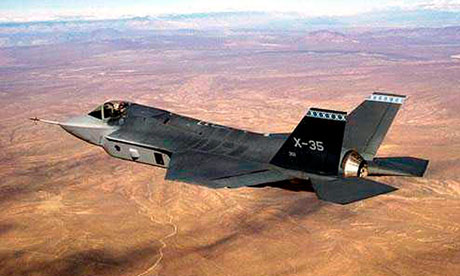
The Pentagon envisioned the F-35 Joint Strike Fighter as an affordable, state-of-the-art stealth jet serving three military branches and U.S. allies.
Instead, the Lockheed Martin Corp. (LMT) aircraft has been plagued by a costly redesign, bulkhead cracks, too much weight, and delays to essential software that have helped put it seven years behind schedule and 70 percent over its initial cost estimate. At almost $400 billion, it’s the most expensive weapons system in U.S. history.
It is also the defense project too big to kill. The F-35 funnels business to a global network of contractors that includes Northrop Grumman Corp. (NOC) and Kongsberg Gruppen ASA of Norway. It counts 1,300 suppliers in 45 states supporting 133,000 jobs — and more in nine other countries, according to Lockheed. The F-35 is an example of how large weapons programs can plow ahead amid questions about their strategic necessity and their failure to arrive on time and on budget.
“It’s got a lot of political protection,” said Winslow Wheeler, a director at the Project on Government Oversight’s Center for Defense Information in Washington. “In that environment, very, very few members of Congress are willing to say this is an unaffordable dog and we need to get rid of it.”
The Pentagon said today it suspended all F-35 flights after a routine engine inspection of a test aircraft revealed a crack on a turbine blade. The jet is also facing scrutiny as the March 1 deadline to avert automatic U.S. budget cuts approaches. The across-the-board reductions would take as much as $45 billion this year from defense programs, including the F-35.
Greatest Exposure
Among the contractors, Lockheed has the greatest exposure to the F-35, said Richard Aboulafia, a military analyst with Fairfax, Virginia-based Teal Group. The program made up 13 percent of the company’s $46.5 billion in revenue in 2011, according to a regulatory filing.
“Unlike much of their subcontractor base, they have no commercial market” to protect against hits to the F-35, Aboulafia said in a phone interview.
United Technologies Corp. (UTX), which supplies the engine, has more diversity than Lockheed, he said. Northrop, another key F-35 contractor, has a hedge because it builds 40 percent of Boeing Co. (BA)’s F/A-18E/F jet, which benefits if the F-35 gets cut, Aboulafia said.
About 5 percent of Northrop’s $26.5 billion in new contract awards in 2012 were tied to the F-35, according to a Securities and Exchange Commission filing.
Supersonic Jet
The supersonic F-35 was intended to transform military aviation. Three versions for the Air Force, Navy and Marine Corps would be built off a common assembly line, permitting faster production, reduced costs and compatibility among allied air forces.
About a quarter of the aircraft would be purchased by other countries. Norway, Canada, the U.K., Australia, Turkey, Italy, the Netherlands, Denmark and the U.S. agreed in 2006 to cooperatively produce and sustain the F-35 jet. Israel and Japan later signed on to purchase jets and take part in their development.
Export Fighter
The F-35 will probably become the dominant export fighter for the U.S. aerospace industry, Gordon Adams, who served as the senior White House official for national security and foreign policy budgets under President Bill Clinton, said in a phone interview.
“This is the last U.S. export fighter standing, and that has saved this program,” said Adams, now a foreign-policy professor at American University in Washington. “There is a huge economic element to the F-35.”
Members of Congress are hesitant to make deep cuts to the project in part because it generates work in their states, Wheeler said. The F-35 supports 41,000 jobs in Texas alone, the most of any state, according to Lockheed’s website. The company assembles the fighter in Fort Worth.
Even Senator John McCain, who has been a critic of the fighter, toned down his rhetoric to welcome a squadron of the Marine Corps’ F-35B short-takeoff-and-vertical-landing jets to his home state of Arizona in November.
‘Right Direction’
McCain said he was encouraged the program was “moving in the right direction” after years of setbacks. The jet “may be the greatest combat aircraft in the history of the world,” he said at a ceremony at Marine Corps Air Station Yuma.
The Republican senator had described the F-35’s ballooning costs and delays as “disgraceful,” “outrageous” and a “tragedy.”
Brian Rogers, a spokesman for McCain, said the senator didn’t request that the planes be located at the base and “continues to be seriously concerned about potential cost- growth and schedule-slips in the program.” Still, Rogers said in an e-mail that McCain “is a staunch advocate of the unmatched training resources and decades-long community support that Arizona provides this vital mission.”
The co-chairmen of President Barack Obama’s deficit- reduction panel, former White House Chief of Staff Erskine Bowles and former Senator Alan Simpson, recommended in 2010 that Air Force and Navy purchases be reduced. They also suggested the Pentagon cancel the Marines’ F-35, the most complex of the three models.
‘Acquisition Malpractice’
That aircraft is “worth killing, particularly given its technical problems,” said Barry Blechman, co-founder of the Stimson Center, a nonprofit public-policy institute in Washington. The Marines’ AV-8B Harrier is “quite capable for now,” he said.
Blechman questioned the need for all F-35 models, saying they provide marginal improvement over existing F-16 jets “but nothing compared with the amount the Pentagon is planning to invest.” The Air Force is buying its version to replace F-16s. The F-35 will also replace the Air Force A-10 ground attack aircraft and older Navy F-18s.
The program’s woes have been blamed partly on how it was conceived — with the notion that small numbers of aircraft could be produced during development and testing.
“Putting the F-35 into production years before the first flight test was acquisition malpractice,” Frank Kendall, then acting acquisition undersecretary, said in February 2012. He is now undersecretary for acquisition.
‘Exceeding Expectations’
Thomas Burbage, Lockheed’s general manager for the F-35, said the program has made “very significant strides over the last three years.” Structural and flight tests have improved, and the Bethesda, Maryland-based company delivered 30 aircraft last year compared with 13 in 2011, he said.
Lockheed intends to deliver 36 to the Defense Department this year, said Laura Siebert, a spokeswoman.
“The jet has flown to every corner of the envelope and it’s meeting or exceeding expectations in performance,” Siebert said in an e-mail. “With any test program of this size and complexity, normal discoveries will be made.”
Even so, the F-35 remains in development, and tests that would allow the plane to go into full production aren’t scheduled to be completed until 2019, seven years later than planned, Pentagon data shows.
On Probation
The total cost of the U.S. military’s 2,443 aircraft is now estimated at $395.7 billion, up from $233 billion in 2001 in current dollars, according to a Pentagon report.
“In between those two numbers is, of course, 12 years and an awful lot of learning,” said Michael Sullivan of the Government Accountability Office.
“They began the program before they understood the requirements,” Sullivan, director of acquisition management, said in a phone interview. “They failed to do a lot of systems engineering early. They didn’t understand their technologies.”
The program’s life-cycle cost, which includes development and 55 years of support, is projected to top $1.5 trillion, according to the latest Pentagon estimates.
Former Defense Secretary Robert Gates instilled some discipline in 2010 when he fired the Pentagon’s F-35 program manager and withheld from Lockheed $614 million in fees. Gates put the Marines’ version on “probation” in 2011 because of glitches in the jet’s propulsion system. His successor, Leon Panetta, released it from probation a year later. Both secretaries postponed jet orders in their budgets, citing the need for more testing.
Sticker Shock
Overseas, the Pentagon’s partners are balancing concerns about the F-35’s cost with the amount of work sent to their companies.
Allies have agreed to purchase 721 fighters, yet the soaring price is painful for nations with shrinking defense budgets. The estimated cost of each plane has about doubled to $137 million since 2001, according to a GAO report last year.
All the original nations “remain important partners on the program, and five of the eight have placed initial orders,” Lockheed’s Burbage said. Italy, Canada and Denmark, however, have scaled back their planned purchases.
Italy announced last year it would reduce its initial goal of buying 131 jets to 90.
The F-35 has emerged as a campaign issue in the race to replace Italian Prime Minister Mario Monti after a center-left candidate, whose coalition leads in all opinion polls, said the next administration should continue to cut planned F-35 orders.
Canada Reconsiders
Canada had dropped to 65 planes from 80. In December, it said it was reconsidering its commitment to purchase any of the jets after a consultant said the price to buy and maintain them might reach about $45 billion.
The F-35 program isn’t so easy to exit, though. A Lockheed spokesman raised the possibility that Canada would lose its F-35-related business — and jobs — if it didn’t buy planes.
“If Canada did pull out of the program, all remaining aspects, including industrial participation, connected to the program would most likely be reviewed,” Michael Rein wrote in a Dec. 17 e-mail to Bloomberg Government.
Japan, which will increase its defense budget for the first time in 11 years, isn’t likely to change its plan to buy 42 planes, said Chiaki Akimoto, a military expert with the Royal United Services Institute in Japan. It may even order hundreds more F-35 jets when it starts retiring its fleets of F-2 and F-15 planes, he said.
‘Backbone’ Aircraft
The partners’ commitments should make the U.S. wary of making deep cuts to the F-35 program, said Dov Zakheim, a former defense comptroller who served under President George W. Bush.
“This program was advertised as a major collaborative program with a lot of allies,” Zakheim said in a phone interview. “It was sold to our allies as such. What do we do now — pull the rug out from under them at the same time we’re complaining they aren’t spending enough on defense?”
The new fighter is the “backbone of our tactical aircraft plans,” Deputy Defense Secretary Ashton Carter said in an interview. “The issue with F-35 is not whether it will work. The real question that we have been wrestling with now as we pass through the development phase is how to reduce costs.”
The Pentagon may have provided some protection to the F-35 by awarding Lockheed $4.87 billion in contracts related to the program on Dec. 28, just days before the first deadline to avert automatic cuts. The reductions were delayed for two months in a last-minute deal. If they kick in, defense officials have warned that as many as four of the requested 29 aircraft wouldn’t get funded this year.
Eliminating the entire program is unlikely, said Adams, the professor.
“It is always hardest to kill a program when it is already in production and the services have decided it is truly important to finish it,” he said. “Crib death is easier, when it’s in R&D.”
(This is the last of a four-part Bloomberg series examining Pentagon weapons spending. Part One reported on the mismatch between anticipated wars and the hardware bought to fight them. Part Two showed how members of Congress, regardless of party, protect even unwanted programs to save hometown jobs. Part Three reported on a troubled Navy ship.)
To contact the reporters on this story: Kathleen Miller in Washington at kmiller01@bloomberg.net; Tony Capaccio in Washington at acapaccio@bloomberg.net; Danielle Ivory in Washington at divory@bloomberg.net
To contact the editors responsible for this story: Stephanie Stoughton at sstoughton@bloomberg.net; John Walcott at jwalcott9@bloomberg.net
2 Responses to “2013-03-13 University Senators question legality of Susan Milburn’s position on U of S Board of Governors”
RE YOUR QUESTION:
have either you, Mary Jean Hande or anyone else lodged a formal complaint with anyone about this?
MY REPLY:
We initially decided against taking it to the University Secretary which would be our channel for lodging complaint. The reasons for so doing:
– The University Secretary is secretary for Senate meetings. We have raised the issue of Susan Milburn’s position on the Board at Senate meeting.
There are serious issues, not taken seriously. As I understand things, the Senate used to accept most everything that came from the University Administration; it was a very expensive rubber-stamp.
The Administration has perhaps found it difficult to adjust to a situation where new Senators ask questions and put forward motions.
Their response has been, for example, when we objected to the conflicts-of-interest that the former Chair of the Board (Nancy Hopkins) was in ($2 million worth of Cameco shares, sitting on the Cameco Board since 1992, Cameco having a 30% investment in Bruce Power (nuclear), chairing the Bd of Gov of the University, making decisions related to the Canadian Centre for Nuclear Innovation at the U of S, we got nowhere. McKinnon (then-President)’s response was: Nancy Hopkins is this fine person, giving to the community, how dare you question her position on the Board! Both he and Hopkins are lawyers by training. They would not address the issue of conflict-of-interest, not even when the University Conflict-of-Interest statement was provided. Rhetoric without substance.
Another example of the difficulty: for the time I’ve been on the Senate (3 years) we have tried to put forward motions for the Senate Meetings (the University Act explicitly states that Senators can put forward motions). The motions have been worked on, in one case taken to the Secretary for input, we worked to establish a working relationship, and still it is difficult to get motions onto the Agenda through normal channels (submitting the motion in advance, for inclusion in the agenda package). Can’t get past the gate-keepers.
– The Bd of Gov is just as closed-shop. Long before I went on Senate, I submitted a well-argued document to the Board and asked to be allowed to make a related, brief presentation to them. They would not allow it because their meetings were closed. A few years later, long after a change in procedures – presentations could be made to the Board, I submitted a different matter. They rejected it on the basis (never mentioned in the past), that no, it did not have anything to do with the financial management of the U, and so they would not consider the submission. A narrow interpretation could conclude that it did not affect the U financially.
– To my way of understanding the role of Senator at the U, especially the elected Senators (who are a minority, 25% roughly), it is like other elected bodies in a democracy – – our role is to ask the questions, to keep the administrators accountable, and responsible.
Also, in a democracy you have to have conversation – – the public has to have some idea of what is going on in order to know whether the money is well-spent, and how well the educational institution is serving the population. The University is making it very difficult to converse, unless it’s a one-way conversation in which they write the script. Now, this Milburn situation places them outside the rule-of-law.
– I would add that Milburn’s position has been considered by more than one lawyer; the case is deemed by them to be valid. We also checked to see if the Legislation had been changed – it hasn’t. Milburn will be 3 to 4 years on the Board, beyond what she is allowed by law (she got a temporary extension past her July 1, 2012 expiry date, but was to have been replaced in 2013. The University Press Release says she’s on the Board until 2016.).
– This final point was not a factor in the decision to issue the media release, but it is a concern of mine. As I wrote to one lawyer:
First – I am not interested in denouncing Milburn. Maybe she is good on the Board. Maybe she is not – – she has been on the Board for 6 years, going on 7.
It can be reasonably argued that the spending during that time was way out-of-line. A $44.5 million deficit in the operating budget ALONE. And other very serious financial matters. Costs that were easily projected into the future.
Yes, the Provincial Govt did not come through with the money, but it was not good management to spend the money before it was in the bank, when it was subject to politics.
Also, the Board during her time did not protect the autonomy of the U. It was willing to take $30 or $47 million from the Prov Govt ear-marked for the CCNI (Cdn Centre for Nuclear Innovation), and now it is receiving $50 million from the Province ear-marked for the Global Institute for Food Security (a corporate biotech/chemical entity – – the announcement of it completely bypassed the people on Campus who have been working on the question of public interest Food Security for years now.).
Bees in my bonnet: autonomy requires that the U receives the money and be able to allocate as it sees fit. The U cannot be held to account on many different fronts, if it does not protect its autonomy.
There it is, more than you want!!
Best wishes, Sandra
RE: YOUR SUGGESTION ” if we acceded to Milburn . . . “: (This is from a different person than the preceding question.)
What I think I can say somewhat factually, but admittedly knowing very little:
– The University Bd of Gov provided less-than-stellar over-sight to the U Admin. They would not be in the financial mess they are now in, but for the terribly inflated over-building. It is the responsibility of the Board to keep the Admin in line on financial matters.
– The Board has served corporatist values well.
– It seems to me they were part of a small, overlapping cabal. Use the Lockheed example: McKinnon & Hopkins both on the S’toon Airport Authority, Lockhheed Martin setting up for drone training at the new school set up at the Airport, Lockheed then coming onto campus (don’t know whether that has been successful). Lockheed being a prime player in the SPP (North American integration), Board member Sutherland with connections to that. A few years ago I circulated the newspaper piece about university presidents (12 at that time) that are now drawn in. Eisenhower identified the “(military)-industrial-congressional complex”. We now have the “(military)-industrial-government-UNIVERSITY complex”.
– Milburn would know that she is not legitimately on the Board. But she is willing to go along with that. I don’t know what the intrigues are, but it’s more important to her that she become Chair of the Board than that she play by the rules. That’s not a very good sign.
– Personally, I am opposed to accommodation for Milburn. She’s been on the Board for more than 6 years, a not-very-stellar 6 years. Enough. (There is wisdom in limiting people’s time served in positions where their influence builds with time.)
– Right now, a significant battle whether with the Govt, or with the University, is to try to establish the rule of law. If they want Milburn on the Board, it should be by legitimate procedure. If we capitulate, we are effectively abandoning the rule of law.
Sandra