Sandra Finley

Mar 152013
 

There is excellent (troubling) background documentation to the following action in 2013-02-28  MAY:  Tightening the grip: muzzling of scientists ramps up

= = = = = = = = = = = = = = = = = = =

http://thetyee.ca/Blogs/TheHook/2013/03/15/government_muzzling/

Enviro Law Clinic asks for investigation of government ‘muzzling’ of scientists

By Crawford Kilian


The Environmental Law Clinic at the University of Victoria has published its request to the Information Commissioner of Canada, asking for an investigation of the muzzling of federal scientists, including a report detailing numerous cases in which either researchers were silenced or their findings were kept from the media.

In its letter of transmittal to Information Commissioner Suzanne Legault, the ELC wrote:

    We request that you initiate an investigation under s. 30(1)(f) of the Access to Information Act into the systematic efforts by the Government of Canada to obstruct the right of the media – and through them, the Canadian public — to timely access to government scientists. We ask you to take this step because of the deeply troubling findings in the attached report, Muzzling Civil Servants: A Threat to Democracy. 

The letter summarizes a number of cases involving scientists in Fisheries and Oceans, Natural Resources, the Canadian Food Inspection Agency, the Department of National Defence, and Environment Canada who were kept from speaking with media, or whose findings had to be filtered through media-relations officials before being released to reporters — often long after their deadlines had passed.

The report itself, after documenting these cases, divides them into “direct muzzling” and “indirect muzzling” — delaying answers to media queries until the deadline has passed and comments from scientists don’t matter. It also criticizes “content control and intimidation,” in which the media receive more information if their “tone” is expected to be positive, or interviews include media-relations staff who act as “minders” for the scientists. The report then concludes:

    The policy changes that have been implemented by the federal government of Canada under the leadership of Prime Minister Harper have dramatically affected the way government information is disseminated in Canada. The Obama administration has also made changes to Communications policies in the United States; however, these changes have been in the opposite direction. Many departmental communications policies now require all media inquiries to be routed through Communications departments. These departments dictate whether or not media inquiries will be responded to and also control all other aspects of the release of government information to the public.

    Federal civil servants in Canada, and in particular scientists, are being muzzled by the federal government. Muzzling occurs directly or indirectly; civil servants who are not permitted to speak with the media, or who are not permitted to speak with the media in a time frame that is compatible with the fast-paced media environment, are effectively being muzzled. The federal government is also manipulating the release of government information by selectively permitting or disallowing responses to media inquiries, using communications employees to craft “approved lines” or provide scripted answers to civil servants, and through subtle means of intimidation when allowing civil servants to respond directly to media inquiries, such as requiring all interviews to be recorded or for a communications employee to be present at the time of the interview.

    Canada was once recognized internationally as a country that encouraged its scientists to speak freely and openly to the public. However, the federal government is taking steps in the wrong direction and has drawn international criticism in recent years. Even more alarming is the fact that the federal government has ignored all such criticism and seems intent on continuing down this path. Access to government information is a vital part of a healthy democracy. As Nature journal once put it: “The way forward is clear: it is time for the Canadian government to set its scientists free.”


Crawford Kilian is a contributing editor of The Tyee.

Mar 112013
 

http://www.organicconsumers.org/articles/article_27170.cfm

by Will Allen

After three years of trying to get a law passed by the Vermont legislature to require mandatory labeling of genetically modified organisms (GMOs), Vermonters are once again up against a governor who continues to run scared from threats of a lawsuit by Monsanto and its gene giant allies. Vermonters are beginning to wonder: What’s the governor really afraid of?


Governor Peter Shumlin has repeatedly expressed reluctance to stand up to Monsanto. His excuse? That a previous state labeling law, requiring the labeling of rBGH, a synthetic bovine growth hormone used to increase milk production in cows, was struck down by a federal appeals court. The state simply can’t afford another lawsuit, Shumlin says. But the facts and circumstances surrounding the new proposed GMO labeling law are very different from the 1994 rBGH labeling law, according to the Vermont Right to Know Coalition which has worked closely with the Vermont Law School on the 2013 version of the bill. So what’s the hold-up?


Vermont passed a labeling law in 1994, requiring that all milk produced with the aid of rBGH must be labeled as such, either on the bottle or on the shelf. rBGH, also referred to as rBST, is manufactured by Monsanto. The state’s attorney general defended the 1994 law on the basis of “consumer’s curiosity” about what is in their milk products, rather than on the basis of a compelling state interest. The state failed to raise any potential health risks with rBGH, or even to dispute the U.S. Food and Drug Administration’s (FDA) notion that there is no difference between milk from rBGH-treated cows and milk from animals not treated with the hormone. As a result, the U.S. Court of Appeals for the Second Circuit struck down Vermont’s labeling law.


Ohio took a different approach on rBGH labeling. Lawmakers there proposed a law stating that milk producers had the right to label their products “rBGH-free.” In 2010, the U.S. Court of Appeals for the Sixth Circuit upheld the law, ruling that the state could not ban “rBGH-free” labels. The Court determined that “rBGH-free” is not a misleading label because there are, in fact, compositional differences in milk from treated and untreated animals. The Ohio ruling contradicted the FDA’s claim of “no significant differences.”


Vermont is following Ohio’s lead with its latest proposed GMO labeling law. Consumer Union’s senior scientist, Michael Hansen, points out that “…there is a compelling state interest in labeling of genetically engineered foods and that is due to the potential human health and environmental impacts of genetically engineered foods.” He also argues that in the language of Codex Alimentarius, the international body regulating food and chemicals used on food, labeling serves “as a risk management measure to deal with the scientific uncertainty” associated with genetically engineered foods, and there most certainly is significant scientific uncertainty about the potential health impacts of Genetically Engineered foods.


In spite of the changes in case law since 1996, Vermont’s Governor Shumlin still hides behind the fear that if the federal court struck down Vermont’s labeling law once, they will do it again. He also expresses fear that specialty food producers will suffer economic loss because they will be forced to change their genetically modified ingredients, or label them.


The governor doesn’t stop there in his efforts to duck and dodge the issue. He recently argued that the labeling law should be a national law; that if Vermont loses the inevitable lawsuit, it will set a negative precedent for the national GMO labeling movement; and, most disconcertingly of all, that the FDA, after “extensive studies,” has determined that there is no difference between GMO products and non-GMO products. This, despite the fact that the FDA has relied on the biotech industry’s studies, not its own, for health safety testing of GMOs.


Shumlin’s fears are dubious and weak. Surely by now the governor knows that no progress is being made at the national level. The health and security of our food supply do not seem to be a government priority. Why would a popular governor, believed by some to be eyeing a national office, think that our comatose federal government is going to fix this when the FDA has failed consumers on the issue of GMOs for nearly two decades?


As for a loss in Vermont setting a negative precedent? The governor has only to look at what happened after Proposition 37, the GMO labeling initiative in California, failed in November, to realize that another loss, though unlikely, would only strengthen consumers’ resolve. Since Prop 37 failed, more than 30 states have launched their own GMO labeling law campaigns. Vermont, Connecticut, and Washington already have bills making their way through their respective houses and senates. That doesn’t look like a “negative precedent.” It looks more like Monsanto threw down the gauntlet, and the public is responding aggressively.That this otherwise progressive governor does not know at this late date that the FDA has never done any human, animal or environmental health and safety studies on GMO food, milk or seed is embarrassing. All the existing U.S. studies concerning health, safety and the environment were done by the corporations producing and selling the products. These corporations – Monsanto, Dow, Syngenta, DuPont, Bayer and a few others – have outright refused to let independent researchers in the U.S. buy their seed for health, safety and environmental research studies. The corporations cite patent law in the U.S. to prevent qualified university researchers from conducting tests with GMO seeds.


Fortunately, researchers outside the U.S. are not as restrained by U.S. patent law in their research efforts, although researching genetically modified crops anywhere where problems are found can be – and has been – a career-ending move for some. In spite of Monsanto’s aggressive bullying of researchers, numerous studies have emerged recently which illustrate that there are serious health and safety concerns with GMO foods and animal feed. This is why 61 countries label GMO foods, including China, Russia, and South Africa. If China, where companies added melamine to watered-down baby formulas to fool the inspectors about the protein content, can label genetically modified foods, why can’t Vermont?


It’s time for Governor Shumlin to stop hiding behind a new contrived fear every week and do what 90% of Vermonters want. We want to know if genetically modified ingredients are in our food. Do your homework, catch up on the case law that has changed, and the health and safety research that has been done in the 19 years since the rBGH law was passed. Vermont’s Right to Know coalition has implored you to meet with our lawyers and scientists, and you have still not done so. Please take us up on this offer. We guarantee it will change your perspective. Vermont and national consumers have shown they will not be intimidated by Big Biotech, and have donated the necessary funds to fight Monsanto and their allies in several state legislatures.


More than 400 Vermonters turned out for a hearing on last year’s bill. More than 100 testified in favor of the bill. No one testified against it. Vermonters were waving their checkbooks and $20-bills at the agricultural committee members vowing that they would support the state in any lawsuit. Please stop letting Monsanto bully the state of Vermont. Stop protecting Monsanto’s ability to deceive consumers.

Mar 062013
 

Don’t miss appended quotes from Audre Lord.

= = = = = = = = = = = = = = = = =

RE SALLY ARMSTRONG

I highly recommend click & listen:   http://www.cbc.ca/player/Radio/ID/2340427936/

Thanks to Janet for sending the link;  she writes:

Holy shit!   (if I may be so bold)

I have written & just recently — about the power of conversation CONVERSATION

You can read it here if U wish    http://janetsplanet.ca/?p=11295

but never mind

Instead, listen to this podcast of Sally Armstrong talking about her experiences in the world

(INSERT:  Janet’s posting is worth your while, too.)

OMG — “silence is violence” — what a quote, what an insight!

http://www.cbc.ca/player/Radio/ID/2340427936/

= = = = = = = = = = = = = =

QUOTES FROM AUDRE LORDE:

source:  http://www.goodreads.com/author/quotes/18486.Audre_Lorde

“Your silence will not protect you.”  ―    Audre Lorde,    Sister Outsider: Essays and Speeches

“If I didn’t define myself for myself, I would be crunched into other people’s fantasies for me and eaten alive.”  ―    Audre Lorde

“When I dare to be powerful, to use my strength in the service of my vision, then it becomes less and less important whether I am afraid.”  ―    Audre Lorde

“I have come to believe over and over again that what is most important to me must be spoken, made verbal and shared, even at the risk of having it bruised or misunderstood.”  ―    Audre Lorde

“I was going to die, sooner or later, whether or not I had even spoken myself. My silences had not protected me. Your silences will not protect you…. What are the words you do not yet have? What are the tyrannies you swallow day by day and attempt to make your own, until you will sicken and die of them, still in silence? We have been socialized to respect fear more than our own need for language.”

I began to ask each time: “What’s the worst that could happen to me if I tell this truth?” Unlike women in other countries, our breaking silence is unlikely to have us jailed, “disappeared” or run off the road at night. Our speaking out will irritate some people, get us called bitchy or hypersensitive and disrupt some dinner parties. And then our speaking out will permit other women to speak, until laws are changed and lives are saved and the world is altered forever.

Next time, ask: What’s the worst that will happen? Then push yourself a little further than you dare. Once you start to speak, people will yell at you. They will interrupt you, put you down and suggest it’s personal. And the world won’t end.

And the speaking will get easier and easier. And you will find you have fallen in love with your own vision, which you may never have realized you had. And you will lose some friends and lovers, and realize you don’t miss them. And new ones will find you and cherish you. And you will still flirt and paint your nails, dress up and party, because, as I think Emma Goldman said, “If I can’t dance, I don’t want to be part of your revolution.” And at last you’ll know with surpassing certainty that only one thing is more frightening than speaking your truth. And that is not speaking.”  ―    Audre Lorde

“It is not our differences that divide us. It is our inability to recognize, accept, and celebrate those differences.”  ―    Audre Lorde,    Our Dead Behind Us: Poems

“and when we speak we are afraid our words will not be heard nor welcomed but when we are silent we are still afraid So it is better to speak remembering we were never meant to survive”  ―    Audre Lorde,    The Black Unicorn: Poems

“The master’s tools will never dismantle the master’s house”  ―    Audre Lorde

“Guilt is not a response to anger; it is a response to one’s own actions or lack of action. If it leads to change then it can be useful, since it is then no longer guilt but the beginning of knowledge. Yet all too often, guilt is just another name for impotence, for defensiveness destructive of communication; it becomes a device to protect ignorance and the continuation of things the way they are, the ultimate protection for changelessness.”  ―    Audre Lorde

“A Litany for Survival

For those of us who live at the shoreline standing upon the constant edges of decision crucial and alone for those of us who cannot indulge the passing dreams of choice who love in doorways coming and going in the hours between dawns looking inward and outward at once before and after seeking a now that can breed futures like bread in our children’s mouths so their dreams will not reflect the death of ours:

For those of us who were imprinted with fear like a faint line in the center of our foreheads learning to be afraid with our mother’s milk for by this weapon this illusion of some safety to be found the heavy-footed hoped to silence us For all of us this instant and this triumph We were never meant to survive.

And when the sun rises we are afraid it might not remain when the sun sets we are afraid it might not rise in the morning when our stomachs are full we are afraid of indigestion when our stomachs are empty we are afraid we may never eat again when we are loved we are afraid love will vanish when we are alone we are afraid love will never return and when we speak we are afraid our words will not be heard nor welcomed but when we are silent we are still afraid So it is better to speak remembering we were never meant to survive.”  ―    Audre Lorde,    The Black Unicorn: Poems

“I am my best work – a series of road maps, reports, recipes, doodles, and prayers from the front lines.”  ―    Audre Lorde

“I have a duty to speak the truth as I see it and share not just my triumphs, not just the things that felt good, but the pain, the intense, often unmitigated pain. It is important to share how I know survival is survival and not just a walk throught the rain.”  ―    Audre Lorde

“Our feelings are our most genuine paths to knowledge.”  ―    Audre Lorde

“But the true feminist deals out of a lesbian consciousness whether or not she ever sleeps with women.”  ―    Audre Lorde

“Revolution is not a one time event. ”  ―    Audre Lorde

“I am not free while any woman is unfree, even when her shackles are very different from my own.”  ―    Audre Lorde

“Pain is important: how we evade it, how we succumb to it, how we deal with it, how we transcend it.”  ―    Audre Lorde

“I find I am constantly being encouraged to pluck out some one aspect of myself and present this as the meaningful whole, eclipsing or denying the other parts of self.”  ―    Audre Lorde,    Sister Outsider: Essays and Speeches

“The erotic is a measure between the beginnings of our sense of self and the chaos of our strongest feelings. ”  ―    Audre Lorde

“We have been raised to fear the yes within ourselves, our deepest cravings.”  ―    Audre Lorde

“Some women wait for themselves around the next corner and call the empty spot peace but the opposite of living is only not living and the stars do not care.”  ―    Audre Lorde

“Unless one lives and loves in the trenches, it is difficult to remember that the war against dehumanization is ceaseless.”  ―    Audre Lorde

“If you come as softly

As wind within the trees

You may hear what I hear

See what sorrow sees.


If you come as lightly

As threading dew

I will take you gladly

Nor ask more of you.

You may sit beside me

Silent as a breath

Only those who stay dead

Shall remember death.

And if you come

I will be silent

Nor speak harsh words to you.

I will not ask you why, now.

Or how, or what you do.

We shall sit here, softly

Beneath two different years

And the rich earth between us

Shall drink our tears.”  ―    Audre Lorde

“My silences had not protected me. Your silence will not protect you. But for every real word spoken, for every attempt I had ever made to speak those truths for which I am still seeking, I had made contact with other women while we examined the words to fit a world in which we all believed, bridging our differences.”  ―    Audre Lorde,    The Cancer Journals

“Without community, there is no liberation.”  ―    Audre Lorde

“I want to live the rest of my life, however long or short, with as much sweetness as I can decently manage, loving all the people I love, and doing as much as I can of the work I still have to do. I am going to write fire until it comes out of my ears, my eyes, my noseholes–everywhere. Until it’s every breath I breathe. I’m going to go out like a fucking meteor!”  ―    Audre Lorde

“I am deliberate and afraid of nothing.”  ―    Audre Lorde

“Sometimes we are blessed with being able to choose the time, and the arena, and the manner of our revolution, but more usually we must do battle where we are standing.”  ―    Audre Lorde,    Sister Outsider: Essays and Speeches

“Those of us who stand outside the circle of this society’s definition of acceptable women; those of us who have been forged in the crucibles of difference – those of us who are poor, who are lesbians, who are black, who are older – know that survival is not an academic skill…For the master’s tools will not dismantle the master’s house. They will never allow us to bring about genuine change.”  ―    Audre Lorde

“Poetry is the way we help give name to the nameless so it can be thought.”  ―    Audre Lorde


Mar 052013
 

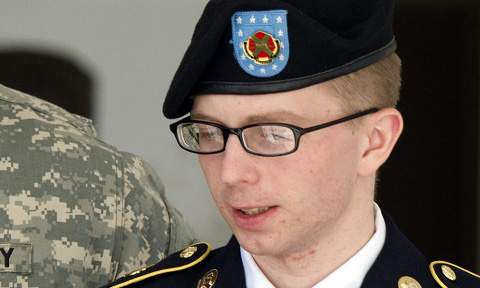
All the world should read the report below and then weep for the U.S.A.   My heart aches for the goodness of this young man, Bradley Manning.


ADD:

Why share the information on Bradley Manning?

Because the Press is deliberately not telling his story:

  1. The article 2012-10-17 Media seek court-martial files in WikiLeaks case,  by Associated Press (AP), is about the trial of Bradley Manning, not about Julian Assange and Wikileaks.   AP does not mention the name “Bradley Manning”. He is referred to only as “an Army private”.
  2. 2012-09-30 The Globe & Mail doctored the video of Julian Assange’s address to the United Nations, changing his message.   ACTUALLY, the video was doctored by AP;  the G&M posted it to the G&M website.

   EXCERPT from the posting:

Anybody who listened to the video of Julian Assange’s address to the United Nations would know that it’s about failing democracy in the U.S.

The Globe & Mail  AP  edited the video to create:   “Assange accuses Obama of exploiting Arab Spring.” 

I placed markers in the 2012-09-26 Transcript; you can see

  • what was said in the video, and
  • what they edited it down to,  without ANY acknowledgement that the video was substantially changed.

  The Globe & Mail (AP) deleted – – – all mention of Sgt Bradley Manning,  for example.

Frankly speaking, it makes me nauseous to see the dishonesty and distortion.

= = = = = = = = = = = = = = = = = = =


BY:  Kevin Zeese,  an attorney who serves on the steering committee of the Bradley Manning Support Network. He also serves a co-director of It’s Our Economy. His twitter is @KBZeese.


As I sat in court last Thursday at Fort Meade, watching Bradley Manning take responsibility as the Wikileaks whistleblower, two things struck me: (1) his thorough intelligence fueled by intellectual curiosity and (2) his empathy for other people when so many in war had lost their humanity.


This was the second time I had heard Manning testify. The first was his testimony about the abusive pre-trial incarceration he suffered for one year while being held in a cage in Kuwait and in solitary confinement in the Quantico Brig.  I’ve now seen him testify for a total of 15 hours.


His testimony leads me to wonder: what would have happened to Bradley Manning if we had a decent educational system that included affordable, preferably free, college education so that young people weren’t driven to the military for economic reasons? What could Bradley Manning have given the country if he had been able to pursue his interests and natural talents? Would Manning have joined the military if the country was honest about how the US Empire operates around the world?


But, that was not to be.  The country failed Bradley Manning.


I hope we do not fail him again.


Article image

Manning made it clear last Thursday that he leaked the documents to Wikileaks because he saw serious problems in US foreign policy. Problems which are as serious as they can be: war crimes, criminal behavior at the highest levels up to Secretary of State Clinton, unethical behavior and bullying of other nations.


Manning’s sole purpose was to “spark a domestic debate on the role of the military and our foreign policy in general.”* He hoped the debate “might cause society to reevaluate the need or even the desire to engage in counterterrorism and counterinsurgency operations that ignore the complex dynamics of the people living in the effected environment every day.”


Regarding the collateral murder video which showed civilians, including two Reuters journalists being massacred, he said “I hoped that the public would be as alarmed as me about the conduct of the aerial weapons team crew members. I wanted the American public to know that not everyone in Iraq and Afghanistan are targets that needed to be neutralized, but rather people who were struggling to live in the pressure cooker environment of what we call asymmetric warfare.”


When discussing the State Department cables Manning saw that the US was not behaving the way the “de facto leader of the free world” should act as the cables “documented backdoor deals and seemingly criminal activity.” Again, he hoped for a change in policy as the “cables were a prime example of a need for a more open diplomacy” that would avoid conflict and save lives.


In some of these statements you get a hint of Manning’s empathy for fellow human beings. The incident that really showed it was his comments on David Frankel’s book “The Good Soldier,” where Frankel describes a seriously injured Iraqi civilian on the ground at the end of the Collateral Murder video. He lifts two fingers toward the soldier, a well-known sign of friendship, as he asks for help. The US soldier responds lifting his middle finger as the Iraqi died. Manning puts himself in the place of the Iraqi thinking his final act was an act of friendship only to be returned by a crude obscenity of unfriendliness. Manning acknowledges that this “burdens me emotionally.”


Manning was clear that he was solely responsible for his actions saying “The decisions that I made to send documents and information to the WLO [Wikileaks Organization] and website were my own decisions, and I take full responsibility for my actions.”  He described his conversations with an anonymous person at Wikileaks but made it quite clear there was no espionage conspiracy between Manning and Julian Assange.  His statement made it much more difficult for the US to prosecute Assange under the Espionage Act.


There is no question that Manning will spend years in jail.  The ten charges he pled guilty to last week each carry two years for a total potential of 20 years incarceration. The government has announced it will still prosecute the espionage and aiding the enemy charges which could lead to a life sentence. This is an abuse of government power.  They may be able to prove their case, but that does not mean he is truly guilty of those crimes, if convicted it will be another example of laws written to favor the prosecution; another example of injustice in today’s United States.


Judge Denise Lind has beautiful judicial decorum in court and shows she is on top of the details of the proceedings and the law.  She is an impressive judicial figure but so far when there have been disputes between Manning and the government she has tended to split the difference, always giving a little more to the government. She has served in the Judge Advocate General’s Corps for 25 years, four as a judge.  She is a product of a system that does not blow the whistle, does not go outside the chain of command and views following orders as a way of life. She will do what she thinks is just when she considers Manning’s case, but I doubt it will seem like justice to those of us who support Manning.


How can we avoid failing Bradley Manning? Ongoing support through the Bradley Manning Support Network continues to be essential but more than that, we need to do what we can to disseminate the information he leaked and work to create a national debate on a foreign policy that is seriously off-track.


This will be a long term effort, and as we pursue that work, we should never forget the young man who put his life and liberty on the line to give the world a glimpse of US foreign policy, a person who was failed by a country that talks about its concern for the young but does not do enough for them. Now, it is our job to pick up the materials Bradley has provided and work to create the better world we urgently need and he sought in his own patriotic way.


* All quotations are taken from the transcript of Manning’s testimony prepared by Alexa O’Brien as the court has not released his written statement to the public.

Mar 052013
 

Please go to the link to see the videos:   http://www.collateralmurder.com/


Collateral Murder
Overview

Update: On July 6, 2010, Private Bradley Manning, a 22 year old intelligence analyst with the United States Army in Baghdad, was charged with disclosing this video (after allegedly speaking to an unfaithful journalist). The whistleblower behind the Pentagon Papers, Daniel Ellsberg, has called Mr. Manning a ‘hero’. He is currently imprisoned in Kuwait. The Apache crew and those behind the cover up depicted in the video have yet to be charged. To assist Private Manning, please see bradleymanning.org.

5th April 2010 10:44 EST WikiLeaks has released a classified US military video depicting the indiscriminate slaying of over a dozen people in the Iraqi suburb of New Baghdad — including two Reuters news staff.

Reuters has been trying to obtain the video through the Freedom of Information Act, without success since the time of the attack. The video, shot from an Apache helicopter gun-sight, clearly shows the unprovoked slaying of a wounded Reuters employee and his rescuers. Two young children involved in the rescue were also seriously wounded.

(Please go to the link to see the videos.)

Short version

Full version

WikiLeaks’ Collateral Murder: U.S. Soldier Ethan McCord’s Eyewitness Story

The military did not reveal how the Reuters staff were killed, and stated that they did not know how the children were injured.

After demands by Reuters, the incident was investigated and the U.S. military concluded that the actions of the soldiers were in accordance with the law of armed conflict and its own “Rules of Engagement”.

Consequently, WikiLeaks has released the classified Rules of Engagement for 2006, 2007 and 2008, revealing these rules before, during, and after the killings.

WikiLeaks has released both the original 38 minutes video and a shorter version with an initial analysis. Subtitles have been added to both versions from the radio transmissions.

WikiLeaks obtained this video as well as supporting documents from a number of military whistleblowers. WikiLeaks goes to great lengths to verify the authenticity of the information it receives. We have analyzed the information about this incident from a variety of source material. We have spoken to witnesses and journalists directly involved in the incident.

WikiLeaks wants to ensure that all the leaked information it receives gets the attention it deserves. In this particular case, some of the people killed were journalists that were simply doing their jobs: putting their lives at risk in order to report on war. Iraq is a very dangerous place for journalists: from 2003- 2009, 139 journalists were killed while doing their work.


Mar 052013
 

University of Saskatchewan

Creative Commons License This site is licensed under a Creative Commons License.

Susan Milburn elected chair of U of S board

Saskatoon – The University of Saskatchewan (U of S) Board of Governors today elected Susan Milburn to serve as its chair until June 30, 2016.

Milburn, vice-president of Raymond James Ltd. in Saskatoon, was elected to the board in July 2006 as a representative of the U of S Senate, has chaired the audit committee and has served as vice-chair of the board. She has also been a member of the board’s finance and investment, and governance and executive committees.

“We are in the midst of what I think can be fairly termed interesting and challenging times when it comes to governance at the University of Saskatchewan,” said Milburn.

“As a member of the U15 and one of Canada’s leading research institutions, we must continue to move our university forward while at the same time deal with the financial realities of the post-secondary education sector. I very much appreciate the confidence my board colleagues have shown in my ability to take a lead role in these efforts.” Milburn earned a Bachelor of Commerce degree from the        U of S in 1978 and an MBA in 1980. She is a past president of the U of S Alumni Association and is well known for her extensive community and corporate involvement in Saskatoon, including having served on the boards of two Saskatchewan crown corporations.

At the March 5 meeting, the board also elected Greg Smith to serve as vice-chair. Also a commerce graduate of the U of S, Smith is a partner in the chartered accounting firm Stark & Marsh in Swift Current. Smith was appointed to the U of S board in 2007, chairs the finance and investment committee, and serves on the audit and governance and executive committees.
-30-

For more information, contact: Patty Martin, Director, Strategic Communications, University of Saskatchewan (306) 966 6919 patty.martin  AT  usask.ca

Mar 042013
 

It’s wonderful to see these initiatives around climate change.

Important information included.


I can’t say that one is more important than the other two.

(Note  for Saskatoon area residents:  good news!  a dynamic group is organizing to mobilize support for climate change action.)

CONTENTS

  1. FILM:  GREEDY LYING BASTARDS
  2. WE’RE NOT DROWNING, WE’RE FIGHTING (ISLAND NATIONS)
  3. CHASING ICE – SHORTISH VIDEO FROM BOULDER CITY, COLO, COUNCIL MEETING

= = = = = = =  = = = = = = = = = =

1.      FILM:  GREEDY LYING BASTARDS

FOR IMMEDIATE RELEASE 

From: One Earth Productions

Date: February 5, 2013

GREEDY LYING BASTARDS TO OPEN

NATIONALLY ON MARCH 8, 2013


Markets include New York, Los Angeles, Chicago, Philadelphia, Boston, Washington DC, San Francisco, HoustonDetroit, Seattle, Tampa Miami, Denver, Phoenix and San Diego

Los Angeles – One Earth Productions announced today that the feature documentary GREEDY LYING BASTARDS will open nationally on March 8, 2013 in the top twenty markets.


Produced and directed by Craig Rosebraugh, with Daryl Hannah serving as executive producer, GREEDY LYING BASTARDS investigates the reason behind stalled efforts to tackle climate change despite consensus in the scientific community that it is not only a reality but also a growing problem that is placing the world on the brink of disaster. Two-time Emmy-Award winner Patrick Gambuti, Jr. co-wrote and edited the film and Michael Brook composed the original score.


Rosebraugh documents the impact of an industry that has continually put profits before people, waged a campaign of lies designed to thwart measures to combat climate change, and used its clout to minimize laws and regulations – ultimately undermining the political process in the U.S. and abroad. The film takes aim at two companies, Koch Industries and ExxonMobil, charging them with being the main financial drivers of the climate change denial campaign worldwide.


“Concerned about the future of the planet and our ability to exist on it, I wanted to undertake a project that would uncover the hidden agenda of the oil industry and provide answers as to why as a nation we fail to implement clean energy policies and take effective action on important problems such as climate change”, says Rosebraugh. “This is particularly crucial following the warmest year on record in the United States, one in which the country experienced record drought, wildfires and Hurricane Sandy.”


Director/Producer Craig Rosebraugh, founder of One Earth Productions, is a writer, filmmaker and activist in the United States advocating for political and social justice, human rights, and environmental and animal protection. GREEDY LYING BASTARDS was an official selection of the United Nations Film Festival, Costa Rica Documentary Film Festival, Bahamas International Film Festival and winner for feature documentary at the Burbank Film Festival and Ecofilm Award at the Boston Film Festival.


OFFICIAL WEBSITE: http://greedylyingbastards.com/

CONTACT:

Shelby Kimlick MPRM Communications skimlick AT  mprm.com, 323 933 3399

John Murphy Murphy PR jmurphy  AT  murphypr.com, 212 414 0408

 = = = = = = = = = = = = = = = = = =


2.   WE’RE NOT DROWNING, WE’RE FIGHTING (ISLAND NATIONS) 

(Related:  the courageous story of “The Island President” (Maldives, one of the “Island Nations”) is in posting  Climate Warming: The Island President. James Hansen)


Malo ni!

My name is Mikaele Maiava. I’m writing from the Pacific Island archipelago of Tokelau to ask you to join with us in action as we take on the fossil fuel industry.

Last October, Tokelau turned off the last of its diesel generators. In their place, we switched on our solar plants, making Tokelau the first country in the world to become 100% renewably-powered.

I woke up before sunrise that day, excited about the history Tokelau was making. My whole village made its way to the site of over 100 solar panels — we could see the many hours of hard labor that had gone into this project. As we counted down to the switch, I could feel future generations smiling at us and thanking us. Our children’s future suddenly looked brighter because we had the vision (and perseverance) necessary to get off fossil fuels and switch to 100% renewable energy.

You might wonder why we bothered. Aren’t we doomed to lose our islands from sea-level rise? I don’t blame you for thinking that if you did. So often the global media victimises the Pacific Islands and portrays us as helplessly succumbing to climate change and rising seas. But the global media know nothing of who we really are, or how it feels to live on these paradise islands we call home. They don’t know that as Pacific Islanders, we are warriors, and that the land we live on is part of us.

We know that the longer the fossil fuel industry gets its way, the worse climate change will be, and the more sea-level rise will threaten our islands. But giving up on our home is not an option. We are not drowning.
We are fighting.

That’s why on March 2nd, Pacific Islanders across 15 diverse nations will be mobilising at prominent locations to perform our unique war challenges, songs, and dances. We’ll be laying down a challenge to the fossil fuel industry. It is their coal and oil and gas vs. our future. They cannot both coexist. And it is our future that has to win.

In this moment, and in the years to come, we need you to walk beside us. Because we live far away from the mines and power plants that threaten our future, we need the world’s solidarity. Click here to stand with us during this weekend of Pacific Warrior climate action!

We want to show the world that people from countries and cultures everywhere are standing with us — the Pacific Warriors — in the fight against climate change.

Fakafetai lahi,
Thank you,
Mikaele Maiava

350.org is building a global movement to solve the climate crisis. Connect with us on Facebook and Twitter, and sign up for email alerts. You can help power our work by getting involved locally, sharing your story, and donating here.

= = = = = = = = = = = = = = = = = = = = =


3.      CHASING ICE – SHORTISH VIDEO FROM BOULDER CITY, COLO, COUNCIL MEETING

Click on:   http://vimeo.com/50079869   

Science Tuesday – Chasing Ice

This video segment was taken from the September 18, 2012 Boulder, Colorado City Council Meeting and features Agenda Item 1C, a presentation by James Balog on the subject of disappearing glaciers and ice.

Please send it out to all so that we can feel enough power together to start tackling this problem.
Thanks,  Dianne

Mar 032013
 

The framework within which disease is typically discussed, is useful as an analogy for discussion of which corporate interests are most problematic in the assault on the public interest (“the commons”).


I frequently remind myself that with disease, “the causes” do not follow a one-cause, one-disease relationship. Which is how they are usually referenced.  We put cancer into the cancer society and with oncologists.  We put Parkinsons Disease into the Parkinsons Disease Foundation and with a P.D. specialist or neurologist.


But things that make a difference in the incidence of one dis-ease affect the incidence of other health problems, too.  Chemicals that are “teratagens” (cause developmental problems in the fetus) may also be carcinogenic. When talking about one, e.g. Multiple Sclerosis, asthma, cancer, autism, inverted female/male birth ratios, etc., I try to always say “yes, but remember” we are really talking about NOT this one disease or developmental problem.


We truly understate the problem if we allow the one-disease, one-cause model to stand, if we put each disease in its own separate box.  Which is what we do.


And so it is with “corporate interests”.  They are hugely interconnected.

Which means that when we go after the chemical companies as cause, we simultaneously weaken the pharmaceutical company that owns the chemical company.


If we are able to stop the killing way of war, we will strike a blow to the chemical companies.  The chemical companies are huge beneficiaries of war.

Chemical weapons.  Agent Orange = 2,4D mixed with 2,4,5T (the latter now banned).  Aerial spraying of chemicals is routine in the “war on drugs”.

The public purse pays for the chemicals.  And the health problems they create.  And the pharmaceuticals used to treat the health problems.  And we do not then have money to address causes – most drug addicts have been abused as children.  It is well-known and documented.


The chemical companies started out “on the land” by supplying farm chemicals.  They then weaseled their way in on the ground floor of food production:  GMO crops designed so that the company’s chemicals can be sprayed on them and they’ll survive.  The bioteched seeds are patented so that the chemical/biotech companies take control of seed stocks, the basis of the human food supply.  The Government will not change patent legislation to prohibit the patenting of life forms, our common heritage — in spite of clear statements of need in two Supreme Court decisions (onco-mouse and Monsanto vs Schmeiser).


Chemicals come from the “petro-chemical industry”.  When we speak of the poisoning of the water supply as from Sarnia down river to Windsor-Detroit and into the Great Lakes, we are again talking of the same corporations.

The Tar Sands is the petro-chemical industry.

And now with the Tar Sands we are seeing the cross-over into the petro-chemical industry of the nuclear industry.


As with disease, it is useful to remember that the problem is under-stated if we think of “the chemical companies”, for example, in a straight line relationship to industrial use.  Or of Big Pharma only in terms of pills.

Or either only in relation to disease.  They have also poisoned democratic governance and science.  The public record is full of examples.


If the battle is between the public interest and the corporate interest, we gain ground when any small group of us takes on one of the tentacles of this beast.  There are way more than ten thousand such groups of us, as documented in Blessed Unrest.  Hallelujah!


RELATED:   2008-03-19  Do you have some fight left in you?!  Non-violent resistance.  Killing wars OR Wars that don’t kill.  Corporatization/Fascism.  The Illusion that we fight different battles.  

Mar 022013
 

By Andrew Coyne, Postmedia News,  February 26, 2013


So many of the well-known ills of our politics have their roots in the way we count the votes, writes Andrew Coyne.


Since the idea of an electoral reform pact was first broached — not by me, but by Elizabeth May of the Green Party, by Nathan Cullen of the NDP, and latterly by Joyce Murray in the Liberal leadership race — reaction has split into two camps. Among each party’s members, the notion of a one-time alliance formed around the need to fix our broken electoral system plainly excites some interest: it propelled Cullen’s long-shot campaign for party leader into contention, as it may be doing for Murray’s. Yet it is dismissed by much of the respective party establishments, as it would seem by most of the punditocracy.


The critics’ objections, in the main, are four. 1. It would be difficult to do. 2. It is unnecessary: the opposition parties will one day defeat the Conservatives, without such a pact. 3. The public would never go for it: not a coalition, or not one with such a narrow focus. 4. If they did win, it is unclear how such a coalition would govern.


The first is undoubtedly true. There are, indeed, any number of reasons why this probably won’t happen. What’s being discussed is whether it should. Suffice it to say that if the party leaders think it should, it will. None of the many questions the critics raise — how would the parties agree on a single candidate? who sets the rules? in which ridings? etc. — are insurmountable, in themselves. All that is required is the will.


Of course, whether that will exists, or is likely to, is heavily dependent on the second point. So long as each side thinks it can win without co-operating, they won’t. And yes, at some point, the Conservatives will be defeated. The question is by whom, or what — and when.


If defeating the Conservatives were all, the parties could arguably afford to wait each other out — though the longer they wait, the more time the Conservatives will have to adjust the rules to their advantage. But if electoral reform is the objective, the wait-and-see option looks less tenable.


This is the paradox at the heart of the issue. Whatever the parties may say they believe in, unless it is also in their self-interest it won’t happen. My argument is that we are currently witnessing just such an exceptional alignment of the planets: not only do all three opposition parties now favour reform of some kind, but, in an inversion of the norm, they are unlikely to win power without it.


The first-past-the-post system presents a formidable obstacle, as is well known, given the (apparently enduring) division of the “progressive” vote between the three (four, in Quebec) parties. And while it is easy to say they should just form a coalition or even merge, not every such arrangement is as likely to succeed. There is a reason why the three parties exist as separate entities: because there are real differences between them. The more permanent any proposed coalition was, and the more ambitious its ideological reach, the more it would bleed votes, especially to the right.


On the other hand, a coalition that confined itself to the objective of fixing the electoral system would be less likely to put off centrist voters. Having reformed the system, moreover, they would find vote-splitting was no longer an issue: their majority in the popular vote would now translate into a majority of the seats.


But would the voters go for it — objection three? The talking points write themselves: while the Tories were focused on bread-and-butter issues, the opposition would offer a motley alliance united only by an abstraction like electoral reform. And if no one thinks ahead — if everyone concedes the argument in advance — then of course that is how it would play out.


If you never make the case for electoral reform, then yes, it will remain an abstraction in the public mind. But if you believe it is necessary, presumably it is because of the real-world problems of the current system. So many of the well-known ills of our politics — the phoney majorities, the exaggerated regional divisions, the lack of competition for so many seats, the obsession with a narrow slice of swing voters, the lack of serious debate, the sheer partisan nastiness — have their roots in the way we count the votes.


How could they not? That is what decides who gets into power, and how. As such, it rewards a certain kind of political behaviour, and not others — the sort of behaviour that results in falling turnout, declining interest in Parliament, and a general sense among many voters that they are not represented by our politics. You want better bread-and-butter policies? You have to fix our politics. And one part of fixing politics is to fix the system. The opposition has two years to make that case. If they believe in it, they will.


All very well, but — objection four — how would it work in practice? Single issue elections are not unknown to our politics: 1988 was one. Neither are coalitions, with all of the last-minute haggling over cabinet seats and the like these entail. If it would allay the critics’ fears, the parties could agree upon a short program of government, in addition to the central objective of electoral reform. No doubt other issues would arise in the interim, but there’s nothing new in that.


Of course, if you don’t think electoral reform is needed, none of this will make sense to you. But then that is your real objection.


© Copyright (c) Postmedia News