Protected: DRAFT 2018-09 Elections, Municipal: Hand-out
Uncategorized
Enter your password to view comments.
Aug 302018

Return to INDEX, Salish Sea
OCTOBER 20TH MUNICIPAL ELECTIONS:
(Might be slightly different in different communities?)
Candidates have until Friday, Sept 14th to file their papers (open for nominations Sept 4).
Town /City/RDN staff update an on-line list of candidates, as candidates file their papers.
The information, for one town, for example: https://www.qualicumbeach.com/running-for-office
Regional Board
The Regional District is governed by an elected Board of 19 Directors. There are eight members on the Board representing the City of Nanaimo, two members representing the City of Parksville, one member each for the Town of Qualicum Beach and the District of Lantzville, and one for each of the RDN’s seven Electoral Areas. The RDN Board has two standing committees – The Electoral Area Services Committee and The Committee of the Whole. The Board and its Standing Committees meet regularly to govern the affairs of the District and to establish local bylaws and public policy. Board members also direct a variety of additional committees for key services throughout the region.
Elections to the RDN Board occur every four years during province-wide local government elections.
Bill Veenhof, Electoral Area H Director, is the RDN Board Chair, and Ian Thorpe, City of Nanaimo Councillor, is the Vice Chair.
| The 2014 – 2018 Board of Directors | ||
| Bill Veenhof Board Chair Director, Electoral Area H Shaw Hill, Deep Bay, Bowser |
265 Jimmy Rd Qualicum Beach, BC V9K 2A2 Phone: 250-797-6313 bill.veenhof@shaw.ca |
|
| Ian Thorpe Vice Chair City of Nanaimo |
c/o City of Nanaimo 455 Wallace Street Nanaimo, BC V9S 5J6 Phone: 250-713-9135 ian.thorpe@nanaimo.ca |
|
| Alec McPherson Director, Electoral Area A South Wellington, Cassidy, Cedar |
2768 Nicola Road Nanaimo, BC V9X 1N4 Residence: 250-722-9472 alecmcpherson@shaw.ca |
|
| Howard Houle Director, Electoral Area B Gabriola & Surrounding Islands |
1070 North Road Gabriola Island, BC VOR 1X3 Residence: 250-247-8250 Contact Me |
|
| Maureen Young Director, Electoral Area C Extension, East Wellington, Pleasant Valley |
2335 Godfrey Road Nanaimo, BC V9X 1E7 Residence: 250-754-5896 Fax: 250-714-1135 maureen_young@shaw.ca |
|
| Bob Rogers Director, Electoral Area E Nanoose |
1578 Arbutus Lane Nanoose Bay, BC V9P 9B5 Phone: 250-468-9986 bobrogers4areaE@telus.net |
|
| Julian Fell Director, Electoral Area F Coombs, Hilliers, Errington |
1555 Wells Place (Box 222) Errington, BC V0R 1V0 Residence: 250-248-4296 fjfell.at.rdn@gmail.com |
|
| Joe Stanhope Director, Electoral Area G Dashwood, Englishman River, French Creek |
1025 West Island Highway Parksville, BC V9P 2E1 Residence: 250-248-6401 Fax: 250-248-6403 jstanhope@shaw.ca |
|
| Bill McKay City of Nanaimo Mayor’s Office |
City of Nanaimo Mayor’s Office 455 Wallace Street Nanaimo, BC V9R 5J6 Phone: 250-668-5969 bill.mckay@nanaimo.ca |
|
| Bill Bestwick City of Nanaimo |
c/o City of Nanaimo 455 Wallace Street Nanaimo, BC V9S 5J6 bill.bestwick@nanaimo.ca |
|
| Jerry Hong City of Nanaimo |
c/o City of Nanamo 455 Wallace Street Nanaimo, BC V9S 5J6 Phone: 250-713-9143 jerry.hong@nanaimo.ca |
|
| Jim Kipp City of Nanaimo |
c/o City of Nanamo 455 Wallace Street Nanaimo, BC V9S 5J6 Phone: 250-753-5212 jim.kipp@nanaimo.ca |
|
| Gordon Fuller City of Nanaimo |
c/o City of Nanaimo 455 Wallace Street Nanaimo, BC V9S 5J6 Phone: 250-713-3551 gordon.fuller@nanaimo.ca |
|
| Bill Yoachim City of Nanaimo |
c/o City of Nanaimo 455 Wallace Street Nanaimo, BC V9S 5J6 Phone: 250-713-3593 bill.yoachim@nanaimo.ca |
|
| Diane Brennan City of Nanaimo |
c/o City of Nanaimo 455 Wallace Street Nanaimo, BC V9S 5J6 Phone: 250-713-6996 diane.brennan@nanaimo.ca |
|
| Marc Lefebvre City of Parksville |
c/o City of Parksville 100 E. Jensen Avenue (Box 1390) Parksville, BC V9P 2H3 Phone: 250-954-4661 mayor@parksville.ca |
|
| Kirk Oates City of Parksville |
c/o City of Parksville 100 E. Jensen Avenue (Box 1390) Parksville, BC V9P 2H3 Phone: 250-802-2059 CouncillorOates@parksville.ca |
|
| Bob Colclough District of Lantzville |
c/o District of Lantzville 7192 Lantzville Rd (Box 100) Lantzville, BC V0R 2H0 Phone: 250-390-4006 councillor.colclough@lantzville.ca |
|
| Teunis Westbroek Town of Qualicum Beach |
c/o Town of Qualicum Beach 201-660 Primrose St. (Box 130) Qualicum Beach, BC V9K 1S7 Phone: 250-752-6921 mayor@qualicumbeach.com |
|
The RDN Board has two standing committees – The Electoral Area Services Committee and The Committee of the Whole. The Board and its Standing Committees meet regularly to govern the affairs of the District and to establish local bylaws and public policy.
To view the next Agenda of the Regional District Board or one of its Standing Committees [ Click Here ]
To read the Board’s Strategic Plan, and to view other planning documents developed by the Board [ Click Here ]
Return to INDEX, Salish Sea
The Sept 24th “Salish Sea” Book Event will draw from roughly the top three quarters of the Regional District of Nanaimo (RDN).
The RDN goes from Deep Bay – Bowser to south of Nanaimo, including Gabriola Island.
Communities, Mid-Island, potential attendees:
https://www.rdn.bc.ca/regional-board gives you an idea of the communities, and is a gateway to other info.
Angelique Chrisafis in Paris
Emmanuel Macron’s climate commitment to “make this planet great again” has come under attack after his environment minister dramatically quit, saying the French president was not doing enough to meet environmental goals.
Nicolas Hulot, a celebrity environmentalist and former TV presenter, announced on a radio breakfast show that he was leaving the government over “an accumulation of disappointments” with its measures to tackle climate change, defend biodiversity and address other environmental threats.
Hulot’s departure is a major blow to Macron and calls into question the president’s credibility on the environment. Though he did not make environmental issues a major part of his election manifesto last year, he subsequently attempted to push them to the forefront as a symbol of progressive politics and to counter Donald Trump’s decision to take the US out of the Paris climate accord.
Macron has lost a minister. Has he lost credibility on the environment too?
Hulot, who was one of the most popular ministers in government, told French radio the “mini steps” taken by France and other nations to slow global warming and avert a collapse of biodiversity were inadequate. “I don’t want to create the illusion that we’re facing up to it,” he said. “I can’t lie to myself any more.”
Emmanuel Macron responded by claiming that his government had “done more than any other on this subject”, saying people must be patient. “It’s a fight that isn’t won from one day to the next,” Macron said.
Hulot announced his departure after the government said it would relax hunting laws, a measure aimed at boosting Macron’s appeal in rural areas, but seen by environmentalists as caving in to the powerful hunting lobby.
Under the changes, hunting licences would be cheaper and more species could be shot, sparking outrage among campaigners for the protection of birds. Hulot said lobbies had too much power over the French government.
Hulot’s differences with the government had been exposed in recent months. He had been disappointed when the government backtracked on a target to reduce reliance on nuclear power to 50% of the country’s energy mix by 2025.
He had also sought a legal ban on the controversial weedkiller glyphosate but was overruled by the agriculture ministry, which preferred negotiating directly with farmers and industry.
The government was taken by surprise by Hulot’s announcement live on radio. Macron, who was beginning a visit to Denmark, was not informed beforehand.
The Elysée, asked about Hulot’s concern over the influence of lobbyists, said the government listened to people but made decisions in the general interest.
The departure of Hulot, seen as a major figure on the left, threatens to upset Macron’s delicate political balancing act, trying to style himself as a centrist who can appeal to both left and right in France.
He has lost support on the left in recent weeks and his approval ratings have dipped as he struggles to shake off the label “president of the rich”. Over the summer, he faced the first major political scandal of his presidency when a senior security aide was filmed violently assaulting a young man and woman at the edge of a Paris demonstration.
“The most basic of courtesies would have been to warn the president of the republic and the prime minister,” government spokesman Benjamin Griveaux told the BFM news channel after Hulot quit.
Richard Ferrand, the head of the parliamentary group of Macron’s party, La République En Marche, said politicians and the government had worked hard with Hulot to meet climate challenges. “We’ll keep going with the same determination,” he added.
Hulot was formerly the star presenter of the hit environmental TV programme Ushuaïa and had turned down offers to enter government by previous French presidents.
In February, he denied a magazine report of a historic allegation of sexual assault made against him by a woman in the 1990s.
After the anti-nuclear Hulot quit, shares in French state power company EDF rose more than 2% in early trading. Hulot had repeatedly said EDF must close up to a third of its 58 reactors to reduce the share of nuclear energy.
Candidates, Municipal Election, List of
NOTE: the following link is valid, even if it shows as invalid.
Coastal zone management framework proposal for the Salish Sea, Howard Stewart
Communities, Mid-Island, a list of
Contact Info & DISTRIBUTION LIST for Salish Sea (not public)
Elections, Municipal, October 20, 2018, General
Building sea-side, sea-level housing when sea levels are rising. Who is going to pay, in the end?
Letters-to-Editor
Media
Newspaper, Radio, Facebook, Other, List
PSA (Public Service Announcement)
Organizations, People with particular interest, to contact, List
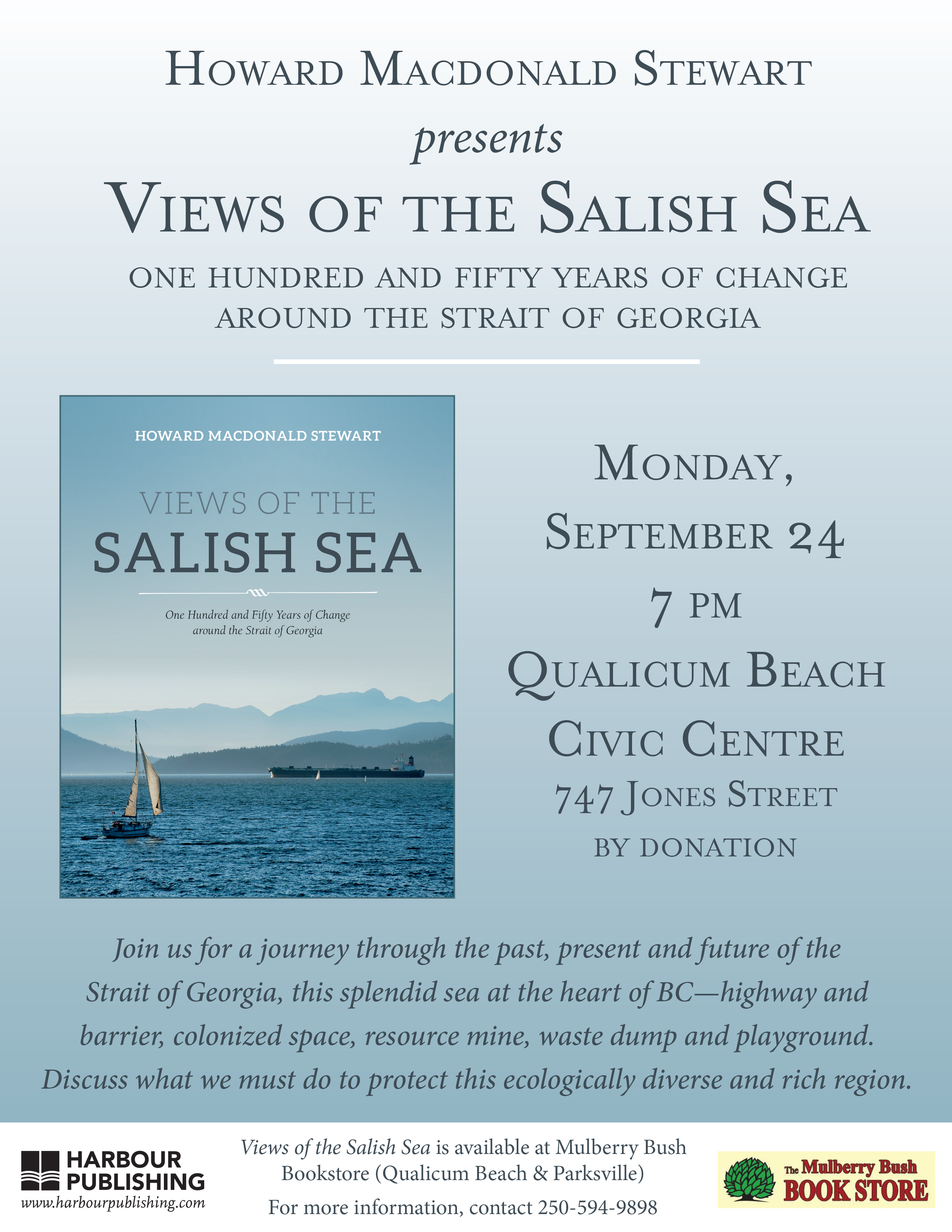
Poster for Sept 24, 2018 Book Event in Qualicum Beach with author Howard Stewart, “A View of the Salish Sea”
Related postings as at Aug 30, 2018, List of
Revenues and Expenses, Treasurer, , Cash box
Venue (Civic Centre, Tanya, 250-752-1992. See Revenues & Expenses for cost)
Return to INDEX, Salish Sea
MOST RECENT FIRST
SALISH SEA
KINDER MORGAN TRANS MOUNTAIN PIPELINE, OIL SPILLS
EXPANDED PIPELINE FOR EXPANDED PRODUCTION IN TAR SANDS (CLIMATE CHANGE)
SEWAGE, CHOLERA & NOROVIRUS
PLASTICS & MICROFIBRES
Special reference to:
There are gaps in the postings. Little on plastics and microfibres. Some material is in submissions to Government, not evident from the title.
2018-08-30 VICTORY: We’ve defeated Trans Mountain, from EcoJustice (EcoJustice are the lawyers on the case.)
2018-08-30 Federal Court of Appeal overturned the Kinder Morgan TransMountain pipeline approval!
Presentation in Courtenay, Sept 13, 2018
2018-07-10 How would you spend $4.5 billion?
2018-06-18 For Your Selection, June 18, 2018
2018-06-05 What a joke! We bought a crappy pipeline with taxpayer’s money, Common Ground.
2018-06-01 Every Canadian Unknowingly Gives $100 a Year to Big Oil, Study Reveals, Motherboard
“Les Miz”, a powerful call. “Do you hear the people sing?” – singing the song of angry men . . .
2018-05-01 David Orchard. The Kinger Morgan kowtow. Vancouver Sun.
2018-04-29 Re pipeline, the Spill Regulations, my input to public consultations
2018-04-27 Maybe this can be of assistance re the pipeline?
2018-04-20 HSBC to stop financing most new coal plants, oil sands, arctic drilling, Reuters
2018-04-10 re Cholera and Norovirus in Georgia Strait, BC. Local resident writes . . .
2018-04-09 2 B.C. oyster farms closed after norovirus outbreak, CBC
2018-03-22 This is Trudeau’s worst nightmare
2018-02-27 Canada’s largest integrated energy company has filed an application for a massive new oilsands project defying expectations of slowing growth in the oilsands, Financial Post (In the context of the KinderMorgan Pipeline)
2018-02-05 The constitutional complexity of pipelines: It’s as clear as bitumen, Jason MacLean, Globe and Mail I was curious about the assertions that jurisdiction over the Kinder Morgan pipeline resides solely with the Federal Govt; that BC has zero jurisdiction?
2017-10-26 Revealed: oil giants pay billions less tax in Canada than abroad, The Guardian
2017-09-12 The proposed Bowser Sewage Treatment Plant, submission to the BC Government
2017-09-12 One developer drops out of Bowser sewer deal, Parksville Qualicum News
2017-08-23 Bowser Sewage Treatment Plant
Financial analysis says it’s a bad deal – – but CPP is investing in it.
2006-10-11 re Acid rain in Northern Saskatchewan (Alberta tar sands)
2006-09-13 continued re Tar Sands and SO2 emissions, Sask lakes dying
*** 2006-09-12 Response from Govt to Saskatchewan Lakes dying from tarsands emissions?
2006-07-10 Wow. Peter Lougheed speaks out, Tar Sands; plus LA Times & Globe & Mail on pipeline
Return to INDEX, Salish Sea
Note from Howard:
I deliberately covered a lot of ground in the Blue Book because I wanted people to see the ‘big picture’ on our inland sea and connections between issues that are often considered in isolation from one another, even though the problems never can be solved in isolation.
Poster_Qualicum_8.5×11 (PDF file, not accepted on F/B)
JPEG file, can use on F/B
THE REPORT is at:
2018-07-13 “Estimates of exceedances of critical loads for acidifying deposition
in Alberta and Saskatchewan” (water and land, nitrogen and sulphur from oil sands)
COMMENT:
I conclude this is a good news story, taking place over 12 years!
Serendipity: In June 2006 I sat beside a water scientist who told me that the lakes in northern Saskatchewan were dying from acidification – – tar sands emissions. A top policy advisor in the Saskatchewan Watershed Authority confirmed – yes, that is the case.
I sent the information to you (“The Battles”), and to media. Our networks sprang into action, including the Council of Canadians and the Sierra Club of Canada. Elaine Hughes did some great work.
Others pitched in, Saskatchewan and Alberta, with public meetings, letters to Government officials and so on.
The Governments had to do something: News, October 10, 2006
EDMONTON (CP) – Alberta and Saskatchewan have begun trying to figure out how to deal with increased pollution drifting over the boundary between them from rapidly expanding oilsands projects.
Changes were made. It seems to have worked! The emissions appear to have been sufficiently arrested:
UPDATE (Good news!)
The exceedances are not huge, and perhaps society will smarten up and scrap the oil sands before any significant damage is done. (I asked Dave Schindler, internationally renowned water scientist, from the University of Alberta, retired but still working, for his interpretation of the Report. His full email appears below.)
– – – – – – – – – – – – –
ASIDE: Still sticks in my craw! – –
Stan Shewchuk, the water expert at the Saskatchewan Research Council who first told me about the acidification of northern Saskatchewan in 2006, retired. He had baseline data – – his research on the condition of the water in the lakes in northern Saskatchewan began in the early eighties. He said the water was “pristine” then.
In 2006, I took the acidification story to the media in Saskatchewan. The Government response was: research would have to be done, to establish baseline data!
Some time later, I tried to dig up access to Stan’s data and research, but was not successful.
Never mind! It appears that the steps taken were effective, so today “The exceedances are not huge“. And I congratulate all the people, inside and outside Government and media, who worked to contain the acidification. Details, and copies of letters sent are at:
2006-09-12 Water: Response from Govt to “Saskatchewan Lakes dying from tarsands emissions “
Conscientious people, 12 years ago, could see a disaster coming, and stopped it from happening. That’s a victory!
– – – – – – – – – –
The tar sands in northern Alberta extend across the border into Saskatchewan, where different geology would require different energy-intensive technology to bring the tar (oil) to the surface. The tar has to be heated so it will flow. The uranium/nuclear industry tried hard to make nuclear the energy of choice for the tar sands. But the economics of nuclear energy convinced citizens of both Saskatchewan and Alberta that nuclear energy would impoverish them, while a few people got richer.
The last half of “My letter to the Minister” tells some of the involvement at the U of Saskatchewan of the uranium/nuclear industry:
The University of Regina is home to the Petroleum Technology Research Centre (PTRC). They were heavily involved in research to find a way to flow the tar sands on the Sask side of the border which is in different geological formations, and further underground. A group organized and I accompanied a tour of 5 cities in Saskatchewan of a Panel discussion, because the public was hearing very little. Nor were they aware about the acidification in the north. For me, it was additional incentive to stop the building of a nuclear reactor, which would have met the energy demands of the oil corporations when “the lakes (were already) dying”.
Further background:
2010-01-26 Scripps Institute of Oceanography – – – Backgrounder Manitoba & Sask Joint Cabinet Meeting, Feb 2
(Aug 2018: Good news from Dave Schindler: The exceedances are not huge, and perhaps society will smarten up and scrap the oil sands before any significant damage is done.)
= = = = = = = =
WITH MANY THANKS TO DAVID SCHINDLER
From: David Schindler
Sent: August 27, 2018
To: Sandra Finley
Subject: Re: re (Recent) Estimates of exceedances of critical loads for acidifying deposition in Alberta and Saskatchewan
Hi Sandra,
This is a good paper. Aherne and Jeffries are very familiar with critical load calculations, and are co-authors on some of the widely accepted international work that goes back years. Kirk is an Alberta student, and I have co-authored work with her on mercury deposition in snow in the oil sands. She is an excellent young chemist.
Many of the small lakes in the northern Precambrian part of Sask. are very sensitive to acidification, because there are no calcareous rocks to buffer any incoming acids. The oil sands are a big source of both sulfur and nitrogen aerosols, the precursors of sulfuric and nitric acids. Nitrogen oxides are largely from the monster haul trucks.
Because these are aerosols and gases, they travel long distances and are slowly transformed to acids. In contrast, the emissions of calcium and other base cations that would neutralize acids are connected with larger, heavier particles in the emissions, which fall out of the atmosphere very close to the sources. This is a common scenario around mines of different sorts.
The exceedances are not huge, and perhaps society will smarten up and scrap the oil sands before any significant damage is done.
Best wishes,
Dave
– – – – – – – – –
On Mon, Aug 27, 2018, Sandra Finley wrote: (edited)
Hi Dave,
RE: Recent, Estimates of exceedances of critical loads for acidifying deposition in Alberta and Saskatchewan
. . . QUESTION: Have these scientists (Estimates of exceedances) confused “distance” with the quirks of geology? is the cause-and-effect relationship right?
The Abstract for Estimates of exceedances of critical loads for acidifying deposition in Alberta and Saskatchewan, is at http://sandrafinley.ca/?p=21672
I made “Comments” on it.
I am on thin ice because I am not a scientist.
As explained in the Comments, my association with exceedances of critical loads for acidifying deposition goes back to an FSIN Water Conference in 2006 – – I sat beside SRC scientist Stan Shewchuk who told me “the lakes in northern Saskatchewan are dying”. He’d been monitoring since the early eighties when they were pristine.
Serendipitously, the next day I met Murray Bryck from the Sask Watershed Authority who was in Saskatoon for a water conference (Sask Partners for blah, blah, blah). I asked Murray about what Stan had said. Murray’s reply was “oh yes, that’s right. We know it.” The conversation proceeded, I subsequently went to the media.
The CCME in its annual report mentioned that some areas of northern Sask were past critical load limits for acidification. I believe I have mentioned this to you in past correspondence.
I was expecting this 2018 report to have something further to what was known by 2006.
You will see in the Comments that I went down a rabbit hole, trying to determine what happened to the NWRI (National Water Research Institute). It no longer exists as far as I can tell, although one is led to it – – the links go to dead end. I wondered why, if this is about acidification in Saskatchewan, and the well-funded Hydrology Centre is at the U of S, why aren’t they joined in the research?
Back to the ABSTRACT:
Base cation deposition was shown to be sufficiently high in the region to have a neutralizing effect on acidifying deposition, and the use of the aircraft and precipitation observation-based corrections to base cation deposition resulted in reasonable agreement with snowpack data collected in the oil sands area. However, critical load exceedances calculated using both observations and observation-corrected deposition suggest that the neutralization effect is limited in spatial extent, decreasing rapidly with distance from emissions sources, due to the rapid deposition of emitted primary dust particles as a function of their size. We strongly recommend the use of observation-based correction of model-simulated deposition in estimating critical load exceedances, in future work.
(Don’t laugh too hard when I use scientific terms and information inappropriately! Sorry.)
(INSERT: through Dave Schindler’s input, I understand that the correct terminology where I have used ” sulfur dioxide and nitrous oxide” is “sulfur and nitrogen”)
the neutralization effect is limited in spatial extent, decreasing rapidly with distance from emissions sources, due to the rapid deposition of emitted primary dust particles as a function of their size.
To me, the scientists who put out this recent research are saying
The “dust particles” and “Fugitive dust particles”, the “acidifying deposition” are, as I understand, synonymous with sulfur dioxide and nitrous oxide emissions.
I thought to track down one of the scientists who participated in the Research, to speak with. But I could be all wrong in my interpretations.
I will be appreciative if an independent scientist might be able to respond to the question: have these scientists got the right cause-and-effect relationship?
= = = = = = = = = = = = = =
THE FOLLOWING IS FOR MY OWN PURPOSE. SUGGEST YOU SKIP IT! THE RABBIT HOLE I went down, trying to figure out what happened to Canada’s National Water Research Institute (the NWRI), with whom I dealt in past.
Who is involved in the creation of this new (July 2018) report on exceedances of critical loads for acidifying deposition? (Don’t get me wrong; I’m very happy they’re working on it! I have some history, going back to 2006.)
I notice scientists from the Canada Centre for Inland Waters, Environment and Climate Change Canada, Burlington, Canada.
In years past, it was the National Water Research Institute (NWRI) with two centres in all of Canada – – one in Burlington ON, the other in Saskatoon SK. The NWRI employed almost all of the water scientists in Canada – – more than 300. What happened to it?
I tried to find the “NWRI” on the web (Aug 2, 2018). I found http://www.css.ethz.ch/en/services/css-partners/partner.html/89060. You can tell by the URL that it is not a Government of Canada website.
HOWEVER, it says:
National Water Research Institute (NWRI), by Environment Canada
Main content
The Canadian National Water Research Institute (NWRI) is Canada’s government freshwater research facility. The Institute’s research focuses on water pollution and its impact.
TWO THINGS:
There’s a page titled NWRI at https://www.sdtc.ca/en/organizations/national-water-research-institute
You can see from the URL that it’s not a page on an NWRI website. It’s a page under “organizations” on SDTC website. SDTC is “funded by the Govt of Canada”.
Oh I see, https://www.sdtc.ca/en/apply/funds

IN THE ABSTRACT re “EXCEEDANCES”:
The citations in the abstract from the Canada Centre for Inland Waters (CCIW) are all from their centre in Burlington. The last time I visited the Saskatoon NWRI, they were under serious budget constraints.
The Hydrology Centre at the U of S worked with the NWRI Saskatoon centre (that is no more). https://www.usask.ca/hydrology/History.php
The Centre will coordinate graduate student training, outreach and research; provide shared laboratory and experimental research basin facilities to researchers from the College of Agriculture, Arts and Science, Engineering, and the National Water Research Institute on campus, and develop major funded programs addressing water and environmental change.
Hydrological research opportunities continue to improve at the University of Saskatchewan. The Canada Research Chairs program, . . .
CURIOUS:
The only citation in the Abstract that is Saskatchewan based (” . . . acidifying deposition in Alberta and Saskatchewan”) is:
Technical Resources Branch, Environment Protection Division, Saskatchewan Ministry of the Environment, Regina, Canada
– Regina is the centre of provincial government. Not known as a centre of science. I searched for this Technical Resources Branch (under 4. at http://www.saskatchewan.ca/government/government-structure/ministries/environment). Couldn’t find them.
Why isn’t the Hydrology Centre at the U of S involved in this research on the acidification of the north?

After a San Francisco jury proved Monsanto not invincible and ordered the chemical giant to pay $289 million to a school worker who argued he got terminal cancer after using its Roundup herbicide, Vietnam has also demanded compensation from the St. Louis-based company.
“The verdict serves as a legal precedent which refutes previous claims that the herbicides made by Monsanto and other chemical corporations in the US and provided for the US army in the war are harmless,” deputy foreign ministry spokesperson Nguyen Phuong Tra said Thursday. “Vietnam has suffered tremendous consequences from the war, especially with regard to the lasting and devastating effects of toxic chemicals, including Agent Orange.”
Around three million people in Vietnam were exposed to Agent Orange during a brutal chemical warfare campaign between 1961 and 1971, in which 12 million gallons of herbicide produced by Monsanto Corporation, among others, were dropped over the jungle to defoliate it. Because of such a high level of exposure to dioxin, a byproduct found in Agent Orange, millions of Vietnamese continue to suffer health conditions, often resulting in deformities which are passed through gene mutations to future generations.

Monsanto, which has never acknowledged its role in the devastation, argues that Agent Orange “was only produced for, and used by, the government,” noting that Monsanto was just one of nine wartime government contractors who manufactured the same toxin from 1965 to 1969.
READ MORE: Agent Orange victims in Air Force Reserve now eligible for compensation
Monsanto was acquired by German giant Bayer AG in June, in a merger deal valued at $66 billion. Following the cancer compensation verdict, shares in the pharmaceuticals company took an enormous hit. Luckily for US markets, though, since Bayer is now the sole owner of Monsanto, it is no longer traded on the New York Stock Exchange. Meanwhile, lawsuits against Monsanto surged from 5,200 to 8,000, requiring the new owner to engage in costly legal battles.
While the US Environmental Protection Agency (EPA) maintains that glyphosate (the active ingredient in Monsanto’s Roundup) is not carcinogenic, the European EPA labeled it a carcinogen in 1985, but reversed its position in 1991. The company itself maintains that no clear position on glyphosate exists in the scientific community, and that more research is needed. The World Health Organization’s cancer research agency classified glyphosate as “probably carcinogenic to humans” in 2015.
Meanwhile, Bayer announced that it will appeal the August 10 verdict that found Monsanto liable for cancer due to prolonged exposure to the company’s glyphosate-based product. “We believe it is wrong,” Werner Baumann, chief executive officer of Bayer AG, noted. The firm said its position on glyphosate is “supported by 800 studies and reviews done over many decades.”
“They conclude glyphosate can be used safely and does not cause cancer. Farmers and growers have been using glyphosate safely and effectively for more than 40 years,” it said.