Sandra Finley

Mar 182015
 

http://rabble.ca/columnists/2014/09/isis-their-barbarism…-and-ours

By Matthew Behrens

September 24, 2014

Image: Jared Rodriguez / t r u t h o u t/flickr

The incessant drumbeat of war, accompanied by the harsh propaganda of “barbarism” and “brutality” directed at individuals in Syria and Iraq, is as wearily familiar as that used to demonize the German “Hun” a century ago and dozens of other “enemies” in the interim. The PR industry, which is the landing pad for many politicos from the Conservatives to the NDP, is having a field day, from allegations that “Islamic militants” are murdering seniors in hospital rooms (perhaps an update of the Hill & Knowlton-created falsehood that Iraqis ripped babies from incubators after the 1991 invasion of Kuwait) to claims that a group with no air force, weapons of mass destruction, overseas military bases, aircraft carriers, and hundreds of billions in other war infrastructure presents the greatest threat known to our generation.

Needless to say, many of the actions of the group known as ISIS, ISIL, and IS (not to be confused with the folks hawking newspapers at lefty events) are reprehensible, from the targeting of specific groups based on their identity (i.e., Shia Muslims) to gross violations against women. And while members of this group should be condemned for their actions — which, combined with the major gains they have made over the summer, do raise significant questions about the future of the region — it is important to note that they are no different from the actions of NATO and its members whenever they go to war, with perhaps the difference that much of the “West’s” brutality is conducted from afar, whether 30,000 feet in the air or 10,000 miles away.

Afghan lives have no value

Indeed, as Amnesty International reported in August’s Left in the Dark: Failures of Accountability for Civilian Casualties Caused by International Military Operations in Afghanistan, thousands of Afghan civilians have been killed since 2001 by NATO forces in everything from bombing strikes to night raids, almost always without follow-up investigation and accountability. Richard Bennett, Amnesty’s Asia Pacific Director, said, “Evidence of possible war crimes and unlawful killings has seemingly been ignored.” That endless reign of terror was added to last week with yet another U.S. air strike that killed 14 civilians in the eastern part of the country, with Bennett concluding, “The lack of accountability for killings of civilians by U.S./NATO forces in Afghanistan sends a message that foreign troops have free rein to commit abuses in Afghanistan and that the lives of Afghan civilians have little or no value.”

Ordering atrocities from afar has long been standard operating procedure for western governments, including the torture by proxy that Canada’s intelligence agencies have engaged in with Egypt and Syria, and Barack Obama’s curt, callous comment, “We tortured some folks,” an attempt to soften the impact of a U.S. Senate report on complicity in torture due out soon. One source who has seen the report told the London Daily Telegraph in early September that the CIA took some detainees “to the point of death,” noting that the “waterboarding” euphemism was not simply dropping bits of H20 on a facecloth, but instead, “They were holding [detainees] under water until the point of death, with a doctor present to make sure they did not go too far. This was real torture.”

Such criminality is given the executive stamp of approval when Obama says he will not prosecute Bush or Clinton-era officials for such policies; similarly, no one in Canada has ever been charged, much less prosecuted, for high-level Canadian complicity in torture over the same time period. As reported here last month, Canada’s official policy is to trade information with torturers, in flagrant violation of all international legal norms.

Acknowledging such home-grown violence is important in contextualizing (though certainly not condoning) the actions of ISIS and related groups.

Meanwhile, in taking a page from the Hill & Knowlton playbook, among others, the boys from ISIS know the value of a gruesome video, which tends to dramatize and inspire fear far beyond their actual capacity to do damage to people halfway around the globe. And so the beheading videos have become a focus for incessant condemnation from countries like the U.S. (which regularly executes people via lethal injection) and Canada (which until 1962 murdered over 700 people by the equally brutal means of hanging, a slower version of beheading). Recent reports of young men playing soccer with severed heads are unfortunate reminders of the sickness of militarism and desensitization that comes with warrior societies, and are reminiscent of the soccer games U.S.-trained and Canadian-supported soldiers played with dead babies in El Salvador during the 1980s.

Obama’s long-distance beheadings

The beheading mania sheds a light both on what is patently and obviously barbaric (YouTube videos featuring heads coming off at the hand of a masked individual) and what is barbarism conducted from the comfort and safety of North American bunkers. The latter are located in places like New York and California, from which soldiers operating unmanned aerial drones are able to launch Hellfire missiles against schools, weddings, and other gatherings, especially those which include what Barack Obama views as “military-age males” who are likely up to no good, all of which are justified “unless there is explicit intelligence posthumously proving them innocent.” When the Hellfires explode, they create what they were named for: severed bodies, including heads, lie scattered about the towns and villages where thousands have been murdered from afar on Obama’s direct orders, emerging from his “Terror Tuesday” morning meetings, during which he approves his kill lists. Indeed, the Assassinator-in-Chief was quoted during one of these meetings as stating: “Turns out I’m really good at killing people. Didn’t know that was gonna be a strong suit of mine.”

The late Gloria Emerson is a former war correspondent whose elegy on the American invasion and war against Vietnam, Winners and Losers, is a deeply felt cri de coeur against a society that makes war and carries on as if no slaughters are committed with our tax dollars and in our name. Emerson noted in the 1970s a growing trend in which “our military technology is so advanced that we kill at a distance and insulate our consciences by the remoteness of the killing.”

So our barbarism is a few steps removed, but it remains no less stomach-churning. We don’t see the bloodied and dismembered victims on the ground after Canadian and U.S. bombers drop cluster bombs, “daisy cutters,” napalm, white phosphorous, and 1,000-pound bombs on villages with thatched huts, but our fellow citizens show up by the hundreds of thousands for annual war shows in which these same killing machines are flown above our heads to great applause and appreciation. We rightfully condemn anyone cheering on scimitar-based beheadings, yet think nothing of our neighbours clapping for a B-52 bomber back from the mass beheading of whole villages.

Targeting water, promoting disease

The barbarism that is ISIS has its roots in the barbarism that was Canadian and “coalition” war policy in the obliteration of Iraq in the 1991 “Gulf” war and subsequent sanctions, which claimed millions of lives in what some UN experts called a genocidal campaign against the Iraqi people. When Canadian CF-18s went on their bombing runs over Iraq in 1991, it was a particularly barbarous mission that consciously, deliberately, targeted Iraq’s civilian infrastructure and electricity supply, knowing this would eliminate the desert country’s ability to provide clean drinking water to its citizens. One January, 1991 U.S. military document, “Iraq Water Treatment Vulnerabilities,” noted that wiping out Iraq’s water purification systems “could lead to increased incidences, if not epidemics, of disease [cholera, hepatitis, and typhoid].”

Another related document, “Effects of Bombing on Disease Occurrence in Baghdad,” bluntly concluded: “Increased incidence of diseases will be attributable to degradation of normal preventive medicine, waste disposal, water purification/distribution, electricity, and decreased ability to control disease outbreaks. Any urban area in Iraq that has received infrastructure damage will have similar problems.” The document notes that “particularly children” will be adversely affected.

Of course, by 1996, some half million Iraqi children had been murdered by the slow and steady constriction imposed by the U.S., Canada and other nations, which then U.S. Ambassador to the UN (and seriously under-rated war criminal) Madeleine Albright told CBS’ 60 Minutes “was worth it.” (The slow destruction of whole peoples by poisoning their waters and then preventing the provision of proper purification systems is well known to Canada, where First Nations boil water alerts have gone on for decades. A report last week reminded us that almost 50 per cent of Ontario’s 133 First Nations communities continue to exist under boil water alerts lasting as long as 20 years.

Harper supports the Saudis who behead people

But the Harper government is not interested in solving decades-long water pollution problems, preferring to focus on ISIS beheadings. But it is a very selective view, for Canada blithely ignores Saudi Arabia for carrying out the same atrocities.

During August 2014, the Saudi government publicly executed almost one person a day, including at least eight beheadings for alleged apostasy, adultery, drug-offences, and “witchcraft.” The response of Harper and company to such a regime, which also refuses women the right to drive or do much of anything without the permission of male guardians, is to reward the beheading leader of the Middle East with two of the largest weapons contracts in Canadian history, totalling $14.8-billion. The contracts were brokered by the Canadian Commercial Corporation for General Dynamics Land Systems in London, Ontario, making Saudi Arabia the largest recipient of Canadian military products for perhaps a decade to come. Such Canadian-made armoured vehicles have been used to repress freedom demonstrations in neighbouring Bahrain and will no doubt be used to clamp down on any visible signs of dissent in the Saudi kingdom.

The deal for Saudi war materiel also conveniently ignores that country’s role in supporting ISIS and similar groups. As Patrick Cockburn writes in The London Review of Books, the Saudis, other Gulf monarchies and Turkey are literally the “foster parents” of ISIS, and without their financial support, the group could not have made the gains it did this past summer, taking over both a wide swath of northern Iraq and becoming the dominant opposition to the Assad regime in Syria. Will the possibility of an ISIS takeover of Syria turn Assad’s regime back into the “friend” of Canada, a role it so clearly played when, on behalf of CSIS and the RCMP, it tortured Canadians Abdullah Almalki, Maher Arar, Ahmad El Maati, and Muayyed Nureddin?

Questioning the roots of violence

As ISIS proves itself the latest wet dream of weapons manufacturers the world over (another crisis to spur arms sales!) and offers macho photo-ops for politicians of all stripes who “visit the front lines” of this “new war,” it does provide Canadians with many opportunities to question and act upon the roots of violence in our own society, from the despair and destruction wrought by our centuries of colonial domination of First Nations to the thousands of workers in London, Ontario who churn out military equipment for one of the globe’s worst human rights pariahs. Our distance from most of this becomes that insulating blanket Emerson wrote about; our willingness to do anything about it is a true reflection of our values.

Matthew Behrens is a freelance writer and social justice advocate who co-ordinates the Homes not Bombs non-violent direct action network. He has worked closely with the targets of Canadian and U.S. ‘national security’ profiling for many years.


Mar 172015
 

By Richard Norton-Taylor

http://gu.com/p/46yy3

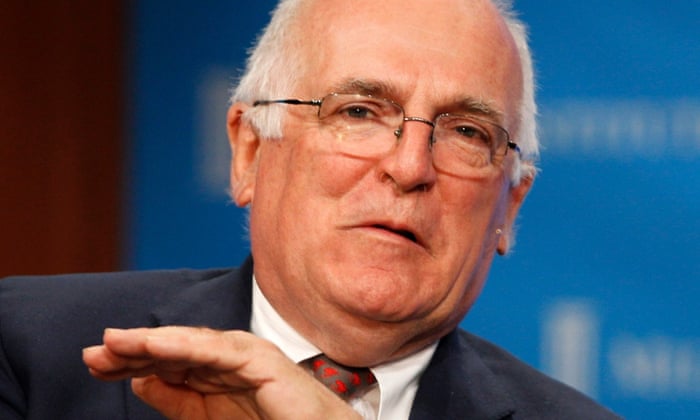
Sir Richard Dearlove, former chief of MI6, says the threat of terror requires social, cultural, and educational responses.Sir Richard Dearlove, former chief of MI6, says the threat of terror requires social, cultural, and educational responses. Photograph: Lucy Nicholson/Reuters

A former head of MI6 has said that an independent body, made up of “citizens’ groups” and other outsiders, should be set up to scrutinise Britain’s security and intelligence agencies.

Such a body, including non-government organisations (NGOs) and people who “really understood technology”, as he put it, could have authority and help to reassure the public, Sir Richard Dearlove told a security thinktank on Tuesday.

He made the case for a new scrutiny body – of a kind proposed by the Guardian – in the course of a speech in which he raised serious questions about the families of London schoolgirls who are believed to have joined the extreme Islamist group, Isis, in Syria.

He wondered if the families had discussions about the current disputes and divisions within Islam and the Sunni-Shia struggle. “If the answer is they had not, the family is certainly at fault,” Dearlove said.

But the potential threat to Britain from extreme jihadi groups such as Isis should be kept in proportion, he told a meeting of the Global Strategy Forum thinktank. In what he called a “plea for proportionality”, he urged the government to “proceed with great caution” before changing the law in an attempt to prevent the radicalisation of young Muslims.

The problem could be managed, Dearlove said. He described the Charlie Hebdo attacks in Paris as a “serious security failure by the French authorities”. The target was known and the threat was known, he said.

“The attack should have been stopped.” There should be “social, cultural, and educational responses” as well as a “national security response” to the terror threat, Dearlove said.

There was a risk that Mohammed Emwazi, known as Jihadi John, and the “Bethnal Green tearaways” – a reference to the three schoolgirls Shamima Begum, 15, Kadiza Sultana, 16, and Amira Abase, 15 – would attain iconic status. Isis, he warned, had become “the new gold standard for PR”.

The actions of Isis and other groups might be shocking, Dearlove said, but they did not pose a serious security threat to Britain. That might change, he added, if such groups were getting hold of nuclear material, an ambition al-Qaida once announced.

Dearlove’s proposal for a body to scrutinise GCHQ, MI6 and MI5 was an explicit and direct attack on the much criticised parliamentary Intelligence and Security Committee (ISC). A new scrutiny committee, should be “representative of different threads of opinion”, Dearlove, now Master of Pembroke College, Cambridge, said.

Such a body, including members of NGOs, could have “significant authority”. It was needed, partly because of what Dearlove called “the lack of trust in politicians”.

In a report prompted by the revelations of Edward Snowden, the former US National Security Agency contractor, the ISC said last week Britain’s laws governing the intelligence agencies and mass surveillance required a total overhaul to make them more transparent, comprehensible and up to date.

Potentially a much greater threat to Britain’s security than Islamist terror groups, Dearlove suggested, was a resurgent Russia. He said the west had “mishandled” Ukraine and there had been a tendency to treat Russia, after the fall of the Soviet Union, in a way Russians deeply resented.

Dearlove said that Russia had become “a dangereous neighbour” who had to be deterred. One way of doing that was to beef up European armed forces, he said.


Mar 172015
 

Bill C-51.   Secret Police / Anti-Terrorism

It’s about U.S. Surveillance,  U.S. “Homeland Security”, American hegemony.

(Hegemony is the political, economic, or military predominance or control of one state over others.)

That’s the Elephant in the Room.    Ya better put it on the table, folks!  Bad outcomes if we don’t.


We have followed the developments – –  American military intrusion into Canada – –  over the years.  I won’t repeat the list.   Edward Snowden and Glenn Greenwald have confirmed the legitimate basis for citizen action.

THREE MORE THINGS YOU SHOULD KNOW:

1.    Australia passed legislation six months ago that is similar to Bill C-51.   2014-09-26  Journalists and whistleblowers will go to jail under new national security laws, Australia, The Guardian

2.    Canada, Australia, the U.K., and N.Z. are in an “intelligence alliance” with the U.S.  (5 countries).  The acronymn is FVEY, hence the common name “Five Eyes”.  It is a successor to ECHELON, the espionage of the Cold War.   Info at   Journalists and whistleblowers will go to jail

To my thinking,  the distinction between Espionage and Surveillance has been erased.   I googled and found this article on that theme:  https://www.schneier.com/blog/archives/2014/05/espionage_vs_su.html

3.    The Minerva Initiative  (U.S.)

. . .   The goal of the Minerva Initiative is to improve DoD’s (Dept of Defence’s) basic understanding of the social, cultural, behavioral, and political forces that shape regions of the world of strategic importance to the U.S. The research program will:

Mar 172015
 

Legislation passed in Australia 6 months ago (Sept 2014) is (errily?!) like Bill C-51, the Anti-Terrorism or Secret Police legislation in Canada.

It is deliberate.

There is an intelligence alliance (excerpts below)

  • 5 members   (the U.S., U.K., Australia, Canada, N.Z.)
  • acronymn FVEY
  • hence the handle “Five Eyes”
  • …  which to this day remains the most extensive known espionage alliance in history.
  • older people may remember Echelon which basically became Five Eyes


The article about the legislation in Australia (Sept 2014 – journalists and whistleblowers will go to jail . . . ) follows the info on Five Eyes.


I wonder whether Australia told Harper (former Prime Minister, Canada),  hey!  the legislation is easy to pass!  

What Harper did not count on is Elizabeth May, Leader of the Green Party.   Elizabeth immediately understood the dangers in the legislation and went to work.   Seventeen days later the NDP saw the light and joined the opposition.  The Liberals plan to vote for the legislation and then change it later.   (?)


= = = = = = = = = = = = = = = = = = =

http://en.wikipedia.org/wiki/Five_Eyes 

The “Five Eyes”, often abbreviated as “FVEY“, refer to an intelligence alliance comprising Australia, Canada, New Zealand, the United Kingdom, and the United States. These countries are bound by the multilateral UKUSA Agreement, a treaty for joint cooperation in signals intelligence.[1][2][3]

The origins of the FVEY can be traced back to World War II, when the Atlantic Charter was issued by the Allies to lay out their goals for a post-war world. During the course of the Cold War, the ECHELON surveillance system was initially developed by the FVEY to monitor the communications of the former Soviet Union and the Eastern Bloc, although it allegedly was later used to monitor billions of private communications worldwide.[4][5]

In the late 1990s, the existence of ECHELON was disclosed to the public, triggering a major debate in the European Parliament and, to a lesser extent, the United States Congress. As part of efforts in the ongoing War on Terror since 2001, the FVEY further expanded their surveillance capabilities, with much emphasis placed on monitoring the World Wide Web. The former NSA contractor Edward Snowden described the Five Eyes as a “supra-national intelligence organisation that doesn’t answer to the known laws of its own countries”.[6] Documents leaked by Snowden in 2013 revealed that the FVEY have been spying on one another’s citizens and sharing the collected information with each other in order to circumvent restrictive domestic regulations on domestic spying.[7][8][9][10]

Despite the impact of Snowden’s disclosures, some experts in the intelligence community believe that no amount of global concern or outrage will affect the Five Eyes relationship, which to this day remains the most extensive known espionage alliance in history.[11][12]      …  MORE  >> http://en.wikipedia.org/wiki/Five_Eyes 

= = = = = = = = =  = =  = = = = = = = = =

http://en.wikipedia.org/wiki/UKUSA_Agreement

. . .   Due to its status as a secret treaty, its existence was not known to the Prime Minister of Australia until 1973,[14] and it was not disclosed to the public until 2005.[13] On 25 June 2010, for the first time in history, the full text of the agreement was publicly released by Britain and the United States, and can now be viewed online.[9][15] Shortly after its release, the seven-page UKUSA Agreement was recognized by Time magazine as one of the Cold War‘s most important documents, with immense historical significance.[13]

Currently, the global surveillance disclosure by Edward Snowden has shown that the intelligence-sharing activities between the First World allies of the Cold War are rapidly shifting into the digital realm of the Internet.[16][17][18]

SEE ALSO:    Elephant in the Room

SEE ALSO:   2016-03-18  Does Lockheed Martin Corp have a role in the 2016 Census?

= = = = = = = = = = = = = = = = = = = = = = = = =

Journalists and whistleblowers will go to jail under new national security laws,  Australia

http://www.theguardian.com/commentisfree/2014/sep/26/journalists-and-whistleblowers-will-go-to-jail-under-new-national-security-laws  


(There is a video clip at the URL)

There was no concerted campaign, no unified push by the media to stop this bill, which dramatically expands the powers of intelligence agencies while creating new offences for disclosing information about their operations

By Paul Farrell

Journalists will be jailed. It might take a year, or two, or even longer. But journalists and whistleblowers will face prison as a result of the first tranche of national security legislation that was passed in the Senate late on Thursday.

And they laughed as they did it. As the Coalition, Labor and the Palmer United party voted in favour of this bill, which dramatically expands the powers of intelligence agencies while creating new offences for disclosing information about the operations they will undertake with these new powers, there was a jovial air in the chamber.

It’s a bill that makes many broad changes to our intelligence gathering apparatus. It introduces a class of “special intelligence operation” for Australian Security Intelligence Organisation (Asio) missions where intelligence officers can gain immunity from using force or committing other offences.

Reporting of these operations, which could foreseeably lead to situations where a public disclosure would be in the public interest, could land journalists and whistleblowers in jail. And not just journalists, but any person who shares or republishes this material. In addition, harsher penalties are put in place for intelligence whistleblowers who take documents or records and disclose them, partly as a response to the disclosures made by NSA whistleblower Edward Snowden.

So how would these laws work? We have many examples of intelligence reporting that could be caught within the scope of such an offence. Say, for instance, the bugging of East Timorese leaders during their negotiations with Australians were to happen today. If it were declared a ‘special intelligence operation’ – a process which only involves approval from the attorney general – reporting of the fact this bugging occurred, the details around it, the nature of the surveillance, could be caught within the scope of this offence. The same could equally apply for reporting the Indonesian president’s phone was targeted by Australian intelligence agencies, if it were declared a special operation.

Among Asio’s other new powers is the ability to obtain massive warrants for effectively the whole of the internet. They also create new powers for Asio to conduct “optical surveillance” without a warrant. There are many other small expansions that lead to a general widening of the powers of our intelligence agencies.

These are serious changes and they warrant serious scrutiny. But the passage of the bill has been all too easy. After it was initially introduced into the Senate it was quickly referred to the parliamentary joint committee on intelligence and security. This committee is dominated by Coalition and Labor senators – the Greens senator Scott Ludlam and independent MP Andrew Wilkie lost their places after the last election.

The catch-all disclosure offence for special intelligence operations remained, with some minor suggestions for change. There was a recommendation to clarify that “recklessness” is the mental element required to commit the offence. A note was also suggested in the explanatory memorandum that the public prosecutor needed to consider the public interest before commencing a prosecution. This should be little comfort to any of us, when the options existed to have a real public interest defence, or simply not have the offence at all.

Earlier this week the Senate began debating the bill. The government’s amendments sailed through. Labor capitulated almost entirely on these enhanced powers – and, disappointingly, on the disclosure offence as well. Despite the shadow attorney general, Mark Dreyfus, initially saying the government would “need to make changes to remove that consequence” if journalists could face prosecution, the fact is the consequence still potentially exists.

Scott Ludlam fought hard to keep the debate going, and moved a series of amendments that would have protected journalists and whistleblowers, wind back some of the broad new computer warrant powers and increase oversight of Asio.

“I simply do not believe and cannot in good conscience vote, particularly in the climate that we’re in, for continued and relentless expansion of powers for these agencies at a time when the only person who the Australian government had established … to investigate whether the laws that we already have are necessary and proportionate has said in many cases they are not,” he said.

Ludlam spent considerable time questioning how the laws would work and whether they were appropriately crafted – what the limits of the computer warrant powers were, how the disclosure offences would apply – and he was accused of filibustering by the attorney general. Independent senator Nick Xenophon and Liberal Democratic senator David Leyonhjelm also raised many serious questions about the scope of the powers being granted.

But in the end the bill passed. Only the Greens, Leyonhjelm, John Madigan and Xenophon refused to support the amended laws.

Brandis, in a late night third-reading speech, said: “What we have achieved tonight is to ensure that those who protect us, particularly in a newly danger age, have the strong powers and capabilities that they need.”

Really, we can only blame ourselves. Could all journalists, collectively, have done more than throw together a handful of submissions? Most major news organisations in Australia raised concerns about the bill and the new offences. But there was no concerted campaign, no unified push to stop these disclosure offences succeeding. We’re now stuck with these laws, probably until someone is made an example of to spur journalists into action.

There is a small comfort in all of this and that is that the laws simply won’t work as a deterrent. They won’t discourage whistleblowers. And they won’t discourage fearless journalists from reporting on our intelligence agencies when it is in the public interest to do so. The disclosures by whistleblowers like Edward Snowden and Chelsea Manning – and the reporters who told these stories – have shown us that people are willing to take extraordinary actions, at great personal risk, when they believe it is necessary to do so.

It will just mean that some of them will go to jail.

Mar 102015
 

http://sputniknews.com/europe/20150310/1019315975.html

As he waits in limbo inside the Ecuadorian embassy in London, the Swedish Supreme Court has decided to accept an appeal hearing for Wikileaks founder Julian Assange. The decision comes after Assange issued a challenge to his arrest on February 25.

The Swedish Supreme Court is reportedly requesting the opinion of the Attorney General in regards to the arrest of Julian Assange.

Swedish law enforcement issued an arrest warrant for Assange in 2010 without filing criminal charges. This occurred soon after the release of 250,000 US diplomatic cables which were released through the Wikileak’s website.

The arrest warrant prevents Assange from leaving the embassy. British police have encircled the compound and would inevitably extradite Assange to Sweden if he were to step foot on UK soil. Assange refuses to hand himself over to Swedish authorities, fearing extradition to the United States.

As Justice for Assange points out, it is extremely unlikely for the Swedish government to issue an Interpol Red Notice and a European Arrest Warrant against a person whose whereabouts are known. This leads many to suspect that Swedish interest in Assange is primarily driven by US pressure.


The FBI is currently leading a criminal investigation against the Wikileaks founder for his role in publishing the documents obtained by former intelligence analyst Chelsea Manning. Manning was sentenced to 35 years imprisonment on charges of espionage.

Assange was given asylum by Ecuador since his home country of Australia may be coerced into extradition.

He also filed a petition with the United Nations in protest of his Arbitrary Detention.

Assange has repeatedly expressed that he doesn’t have much hope for a positive outcome in his case.

“I’m condemned to death,” Assange told Radio Television Suisse earlier this month.

Nevertheless, the Swedish Supreme Court will now have to decide whether the country will continue effectively imprisoning Assange in the Ecuadorian embassy in London without even filing criminal charges against him. Otherwise, his case will be dismissed after years of fruitless attempts to extradite the Wikileaks founder.


Mar 102015
 

Under Bill C-51, you risk becoming a “terrorist” with no due process, when your actions are based on the desire to help address long-standing injustices, to make life better for people.

In my view, efforts to stop young people from going to Syria will fail if their legitimate concerns are treated as a need to “re-program” their thinking.   Many of them are responding to a long history of injustices in the Middle East, the actions of “Westerners”.

Danish filmmaker Nagieb Khaja is determined to understand why young Western Muslim men are abandoning their countries and heading to fight in Syria. So he embedded himself with the group Jabhat al Nusra, an al-Qaeda ally in the Syrian civil war.

Nagieb Khaja’s film is an important contribution to the debate on Bill C-51.

It will help

  • formulate right responses to “terrorists`
  • combat the propaganda.

I am afraid that the programs to “educate“ young people so they don`t join the “terrorists“ will be a classic “blame the other guy” scenario.

We need, instead, to see and accept our share of the responsibility – – our contribution to the situation. Maybe then we can find solutions.

Try and UNDERSTAND WHY people go to Syria to join the combat – – the Western contribution to the serious injustices perpetrated over decades. In the name of oil and gas appropriation in the Middle East.

Nagieb Khaja, filmmaker, interviewed by Anna Maria Tremonti, CBC Radio, The Current.

  • The interview and Nagieb’s 25-minute film are especially important in combating the propaganda.

See:   http://www.cbc.ca/radio/thecurrent/the-current-for-march-10-2015-1.2988524/nagieb-khaja-s-quest-to-understand-western-jihadis-in-syria-1.2988578?fb_ref=Default

Mar 072015
 

http://www.theglobeandmail.com/news/politics/anti-terror-bill-powers-excessive-canadas-privacy-commissioner-says/article23325129/


NOTE:  if you are supportive of what the Privacy Commissioner says, you might take a minute – – go to the above URL and enter a simple, short message, that’s all it takes.   Daniel Therrien needs to be known and supported – – Harper will not like what he wrote.

UPDATE:  Daniel Therrien and Elizabeth May,  articulate and informed MP and Leader of the Green Party of Canada, are both being blocked from making presentations to the  Parliamentary Committee hearings that are part of the legislative process.


By Daniel Therrien


Daniel Therrien is Privacy Commissioner of Canada.

The debate over the federal government’s new antiterrorism bill is raising profound questions about the tension between privacy and security.

Most Canadians would agree that terrorism represents a growing threat and that we must respond with appropriate national security measures when new threats arise. But at what cost?

In my view, Bill C-51, in its current form, would fail to provide Canadians with what they want and expect: legislation that protects both their safety and their privacy. As proposed, it does not strike the right balance.

The scale of information-sharing between government departments and agencies proposed in this bill is unprecedented. The new powers that would be created are excessive and the privacy safeguards proposed are seriously deficient.

All Canadians – not just terrorism suspects – will be caught in this web. Bill C-51 opens the door to collecting, analyzing and potentially keeping forever the personal information of all Canadians in order to find the virtual needle in the haystack. To my mind, that goes too far.

This is really about big data, which relies on massive amounts of information that can be analyzed algorithmically to spot trends, predict behaviours and make connections. The implications for privacy are serious – especially when we are talking about the highly sensitive information Canadians entrust to their government.

The legislation would allow for Canadians’ personal information to be shared if it is deemed “relevant” to the detection of new security threats. That’s an extremely broad standard that suggests the bar has been set far too low.

In this way, the bill would provide 17 federal government agencies with almost limitless powers to monitor and profile ordinary Canadians, with a view to identifying security threats among them. The end result is that national security agencies would potentially be aware of all interactions all Canadians have with their government. That would include, for example, a person’s tax information and details about a person’s business and vacation travel.

While the potential to know virtually everything about everyone may well identify some new threats, the loss of privacy is clearly excessive. In a country governed by the rule of law, it should not be left for national security and other government agencies to determine the limits of their own powers.

We need to create clear and reasonable standards for what personal information may be collected, shared, used and kept. We also need to ensure appropriate oversight and review. Currently, 14 of the 17 agencies that will receive information under the proposed law are not subject to independent oversight.

Either a new review body should be created or the mandate of existing review bodies should be expanded. I would also recommend a system that includes a separate parliamentary review body.

Existing review bodies also need permission to share information with each other, which is not currently the case, and judicial recourse should be available to those who believe personal information has been collected, used, disclosed or retained improperly.

National security agencies have an important and difficult role to play in protecting us from terrorist threats – and I believe they strive to do their work in a way that respects human rights.

That being said, history has shown us that serious rights abuses can occur in the name of national security. A commission of inquiry, for example, confirmed that national security information-sharing led to the torture of Syrian Canadian Maher Arar, while revelations by U.S. whistleblower Edward Snowden have shown how pervasive government surveillance programs can become.

Bill C-51 requires significant changes. I have sent the parliamentary committee reviewing it a submission outlining my concerns along with a series of recommendations, and I would welcome the opportunity to speak with parliamentarians about my concerns in the near future.

I hope the government will listen to the concerns being raised – not just by me, but by many eminent Canadians – and that it amends Bill C-51 to ensure it respects our privacy rights.

= = = = = = = = = =  = = = = = =

I submitted “COMMENT” as follows.    Maybe I should have just made a short statement in support of the Privacy Commissioner?


1. Terrorism is the terrorizing and killing of CIVILIANS, not of soldiers. If we are at war with another country, the killing of their soldiers or ours, is not called terrorism.

The Government and media are irresponsible in the use of a word that they know hits the emotional button of fear.

2. When the label “terrorist” is applied, Government & Police immediately see themselves as OUTSIDE the Rule of Law. They believe they cannot be held accountable for the breaking of laws, a lesson from the Omar Khadr case.

The Rule of Law requires that people cannot be held indefinitely without charge, due process (a fair trial), and torture is definitely illegal.

Khadr was held 10 years without trial. He was tortured. The U.S. Senate Report on Torture (Dec 2014), and all the earlier documentation make denial impossible.

NO ONE has been held to account. Other countries got their citizens out of Guantanamo. They prob knew they might face prosecution if they did not. They, like Canada, are signatory to the Internat’l Law. Canada was the only western democracy that did not get citizens out of Guantanamo, a known place of torture.

The Harper Conservatives do not want the “anti-terrorism” machinery to be subject to oversight. No kidding!

3. March 14, a day of protest against C-51. You better be there!

4. It’s not hard to figure out why some young people join ISIS. Just ONE example. In 2010 many joined social media groups related to the Khadr case – they KNOW what was done to Khadr by “Westerners”. Truly depraved and highly illegal behaviour. Yes, “Westerners” are beasts. Torture AND unprovoked and illegal war on Iraq (2003).

Canadians are “Westerners”; Govt policy has rendered us indistinguishable from American military/CIA. A horrid history of deposing democratically-elected leaders, supporting foul regimes, the arming of anyone who wants to buy weapons. People understand “humanitarian” and “fighting for democracy” mean “appropriation of oil & gas rights”.

These young people are smart enough to figure out that when we drop bombs that are routinely killing women and children, maiming, turning homes and communities into piles of rubble, destroying the environment – these are what WE define as terrorist acts.

They are not so easily propagandized – – our Govt is not only doing “nice” Canadian kind of things.

If someone fires a bullet at a Canadian soldier on Canadian soil, as some kind of retribution for what has been done in the Middle East, why damn those terrorists! I think there are many who see through the double standard.

5. I think I might be capable of hate, if anyone did to my son what was done to Omar Khadr. It would be helpful if we were able to put ourselves into the shoes of people who we have helped terrorize.

It is as likely that many of the young who go to Syria to join ISIS are idealists, as they are terrorists. (“Freedom fighter” is probably a more accurate word than “terrorist”.)


Mar 072015
 

ExxonMobil is the operator of the Hibernia oil project off Newfoundland's east coast.

ExxonMobil is the operator of the Hibernia oil project off Newfoundland’s east coast.   CBC

NOTE:  the Atlantic Accord under which the R&D money was to go to the Province has been in place since 1985, for 25 years.  Would they not have known about it?

ALSO – there’s the list of other even more egregious awards made to corporations under NAFTA.   Now, if the other trade deals go through, we will be paying even more of these “awards”.

And they wonder why there is social unrest?!  I’d like to place some balls in a vice.

http://www.cbc.ca/news/canada/newfoundland-labrador/exxonmobil-s-nafta-win-over-oil-r-d-called-corporate-bullying-1.2984879

An international trade tribunal has ordered Ottawa to pay ExxonMobil and another oil company $17.3 million, following a complaint that the companies were required to spend money in Newfoundland and Labrador on research and development.


The oil companies fought the federal government in a trade challenge brought under the North American Free Trade Agreement (NAFTA).


The International Centre for Settlement of Investment Disputes made the decision through a recent tribunal, about three years after the two U.S. companies had successfully argued their NAFTA challenge, reported a trade dispute journal Investment Arbitration Reporter. The text of the decision has not yet been made public.


Under the terms of the Atlantic Accord, a federal-provincial agreement on oil development first negotiated in 1985, oil companies are required to support petroleum-focused research and development in Newfoundland and Labrador, as part of its local benefits package.

ExxonMobil is the operator of the Hibernia project, the first oilfield off eastern Newfoundland to go into production. Murphy Oil owns a minority stake in the project.


Scott Sinclair, a senior research fellow with the Canadian Centre of Policy Alternatives, thought little of the NAFTA challenge.


“I think it’s a story of corporate bullying,” he told CBC News.


“You have one of the most powerful and profitable corporations in the world, ExxonMobil, using NAFTA to defeat the purpose of a fairly modest and sensible regional economic development measure put in place by the Government of Newfoundland and Labrador.”


But veteran Toronto-based trade lawyer Lawrence Herman said the case sends a clear message.


“It means governments have to be very sensitive to the need to avoid giving benefits to local providers of goods and services in one way or another,” he said.

Unless the governments of Canada and Newfoundland and Labrador agree to change the R&D legislation, Ottawa could be on the hook for continued damages. The federal government is responsible because NAFTA is an agreement between sovereign nations.

Mar 052015
 

Submitted to CBC Radio, The Current, Anna Maria Tremonti, in response to a discussion re homeopathy, March 5:

http://www.cbc.ca/radio/thecurrent/the-current-for-march-5-2015-1.2982500/scientists-question-research-on-homeopathic-treatment-for-adhd-1.2982505


Is a clinical trial testing homeopathic treatment for ADHD a waste of time and money? (The Associated Press//Josh Reynolds)

RESPONSE: 

I wish to add a note of personal experience, which might be helpful.    It’s about the placebo effect and falls into the mind-body connection.


Words are important.   Choosing the word “placebo” to describe an effect places restrictions on the ability of research to get at the truth of what is happening.  Our allopathic medical vocabulary does not have a word for a particular phenomenon – – “placebo effect” is inaccurate and sometimes used to dismiss.   (I am happy to see that Heather Boon is trying to understand, rather than dismiss.)


The following is my experience and interpretation of it, to illustrate the point.


It is not about Attention Deficit specifically (the interview arose in that context). It is about the placebo effect in the context of homeopathy and medicine in general.   (As I understand it, the study by Dr. Boon is about trying to make sense of input from people whose experience is not explained by conventional medical wisdom.)


My experience:


After a weekend of the worst flu, or so I thought, on the Monday I was able to get out of bed.   The flu symptoms (fever, chills, aching bones) were replaced by a stabbing pain in my side, but I could get up and do things.   Late in the day on Wednesday I decided I had to go to the walk-in clinic because the pain was not going away or decreasing.   (I do not use Tylenol or other forms of pain-killers.)


The doctor took an x-ray.   At the point when he left the room to fetch it, the pain noticeably and abruptly came to an end.   There was a kind of finality to it; it was not going to return. The pain did not just lessen, it was over, abruptly.

I kind of freaked out, thinking “Oh My God, the pain was all in my head. It was psychosomatic. The doctor is going to come back and tell me that the x-ray shows nothing wrong.”

Hence, you may understand that I was very relieved when he came back with the x-ray and said, “You have a large volume of fluid on your lung.”   To me the diagnosis was: my mental health is fine!


I won’t go into the details of subsequent serious blunders in the medical profession whereby the first of two thoracenteses to remove fluid did not take place for another 5 days.


WHAT IS NOTABLE:   presumably it was the large amount of fluid that was causing the stabbing and relentless pain.   It stopped abruptly after the x-ray was taken.   I had taken no pain medication, nor had any other medical intervention.   Not once in the following days and months did the pain return.


MEDICAL INTERPRETATION:   I wish to make the point that if I had taken a pain-killer, the allopathic medical paradigm would say absolutely that the pain-killer stopped the pain.   Had I been given a placebo pain-killer, a scientific medical researcher would have said that I succumbed to the placebo effect.


To my understanding, as explained below, there is a third alternative, but it is excluded from consideration by our creative inability to generate possibilities. The exclusion is exacerbated by the fact that we don’t have a word in the scientific vocabulary to describe the particular phenomenon.


A BIT OF BACKGROUND:    I understand things thus:   a few years earlier I came to the conclusion that I have an inner being, so to speak.   I went through the rational process of trying to understand (a review of related experiences) the relationship between the conscious me and my sub-conscious self.   My conclusion was that my sub-conscious self has always been there and has always fought to try and protect the whole self.   I just had to learn to work with, and to trust the inner part of my being.


I made a conscious decision to always try to be attuned to information that might be coming from the inner self, to recognize that the direction provided will most likely be better informed than decisions I might make which are processed only by my conscious “rational faculty” (prefrontal lobe).


A side note: In time I think it likely that we will refer not to the “conscious and sub-conscious selves” but rather to the “ conscious and HYPO-conscious selves”.


One further point:   I understand my body as being a dynamic system.   All dynamic systems have feedback loops to inform whether the system is stable. If the feedback indicates that the system is getting out-of-balance, and if the response to the feedback is timely and actually addresses the CAUSE (as opposed to a SYMPTOM) of the disequilibrium, the system (in this case our body) can be returned to balance (health).   (“dis-ease” becomes “ease”)


SO WHAT HAPPENED IN THE CASE OF THE PAIN THAT STOPPED FOR NO APPARENT REASON?


The only explanation I can see is the mind-body connection.   The inner part of my being KNOWS that I will defer to it, if I can discern what it is telling me. I have never waivered from that, since I decided that that is the way “I” work.

The inner part of my being cannot just tap me on the shoulder and say, “Oh, by the way …”.   It cannot just leave me a note saying, “You need to get to a doctor. Things are kind of serious in here. We need outside help.”


The inner self has to find some way to convey information to the conscious part of the self.


You could think of it as a morse code, SOS.   I responded appropriately (eventually! – – it took from Monday to Wednesday to “get the message”).   My inner self knows that I am committed to working with it (her?!).   There was no further need for the pain and so it stopped.   I think that some people would describe this as the mind-body connection.


As it turned out, I was eventually diagnosed with tuberculosis. It was identified at an early stage, before becoming contagious.   I was able to work with the Director of Tuberculosis Control for Saskatchewan, an allopathic doctor, and a naturopathic doctor.

“I”, with assistance, overcame the tuberculosis without the use of conventional TB drugs.   (I believe, along with the Centre for Disease Control, that organisms quickly evolve to become resistant to drug protocols. The CDC uses the example of antibiotics.   Our current practice of trying to combat organisms with stronger and stronger drugs is irrational, from a number of perspectives.)


I tell you my story because it might also be an explanation for some of the people whose experience is that homeopathic care improved their condition.


(I know there is a difference between homeopathy and naturopathy)

I could say that the Naturopathic Doctor “cured” me. The question we focused on was: why did my immune system not fend off the TB organism? What was weakening it? After all, the figure most often used is that 30% of the population is walking around with the TB organism. People often don’t know they are carrying the TB organism because their immune system simply keeps it in check. So why wasn’t my immune system doing the same? What was weakening it?

To say that the Naturopathic Doctor cured me ignores the role of my inner being. It (she) devised an early warning alert. It is plausible that if the mind-body connection in my case had atrophied through non-use, the TB organism would have continued to multiply to the point where I had a contagious case. There would then have been no option but the drug protocol.   And the drugs would have been credited with curing me. “I” would have been disempowered instead of becoming more empowered.


I hope that this might in some way be helpful.


Best wishes,

Sandra Finley

Mar 032015
 

From: Sandra Finley

Hi Andy,

It is party, party time for Larry K and others:   The Nuke Waste Mgmt Organization is taking leave from Saskatchewan!    The Committee for Future Generations  won the battles at Pinehouse and English River.

NWMO announced today, they are pulling out of the last community, Creighton.  (Their reason for leaving is a cover-up.  They were beat by community opposition, once the information started flowing into the community.)

I wonder what the bill was for trying to establish the Deep Geological Repository in northern Sask?!


Anyhow – – the good news:

http://www.thereminder.ca/news/local-news/updated-nwmo-crosses-creighton-off-the-list-1.1779968

SAndra

= = = = = = = = = = = = =

Updated: NWMO crosses Creighton off the list

Jonathon Naylor / Flin Flon Reminder
March 3, 2015 03:06 PM
Updated: March 4, 2015 04:13 PM

Canada’s nuclear waste won’t be coming to Creighton.

The Nuclear Waste Management Organization (NWMO) announced Tuesday morning that the geology around the community cannot safely accommodate an underground waste repository.

“The studies show that there is limited potential to meet safety requirements of the project in the Creighton area,” Kathryn Shaver, vice-president of site selection for NWMO, wrote in a letter to the Town of Creighton.

“In light of these findings, the NWMO will now conclude studies in your community. Safety, security and protection of people and the environment are central to the siting process, and it is important that we are guided by these findings concerning geoscientific suitability.”

The decision stemmed from geological work NWMO carried out on land near Creighton last year.

NWMO announced that Schreiber, Ontario, has also been removed from consideration because of geological concerns.

Shaver thanked both communities.

“The NWMO is grateful for the opportunity to work and learn with the people of Creighton and Schreiber,” Shaver said in a news release. “These communities should be proud of all they’ve done to help advance this important national infrastructure project.”

For Creighton, the news caps a regional conversation that divided many residents.

Creighton never applied to host the repository, only to engaged in a years-long learning process around it.

The town joined that process in late 2010, several months after town councillors visited a NWMO information kiosk.

Council discussed the concept at length and ultimately toured a Pickering, Ontario, nuclear power facility where radioactive waste is currently stored on site.

Over the following four years, NWMO took part in a series of public presentations and community meetings designed to educate residents on what is known – and not known – about nuclear waste storage.

It will take several more years of technical, scientific and social study and assessments, and more engagement with interested regions, before NWMO confirms a repository site.

Still in the running are the Ontario communities of Blind River, Central Huron, Elliot Lake, Hornepayne, Huron-Kinloss, Ignace, Manitouwadge, South Bruce and White River.

The repository is not expected to be operational until 2035 at the earliest. The project carries an estimated price tag as high as $24 billion.

© Copyright 2015 Flin Flon Reminder