Sandra Finley

Nov 152011
 

Thanks to Janet:

Another Annie Leonard treasure (Annie of ‘The Story of Stuff’), & only 8 minutes long!

 Relevant to ALL the issues we’re all working on – $$$ for war, nukes, incinerators, education reforms, tar sands, green jobs, Occupy Wall St. – you name it!  

The Story of Broke.

It is in the US context, but the situation in Canada has many similarities.

http://www.nationofchange.org/story-broke-1320860582

The United States isn’t broke; we’re the richest country on the planet and a country in which the richest among us are doing exceptionally well. But the truth is, our economy is broken, producing more pollution, greenhouse gasses and garbage than any other country. In these and so many other ways, it just isn’t working. But rather than invest in something better, we continue to keep this ‘dinosaur economy’ on life support with hundreds of billions of dollars of our tax money. The Story of Broke calls for a shift in government spending toward investments in clean, green solutions—renewable energy, safer chemicals and materials, zero waste and more—that can deliver jobs AND a healthier environment. It’s time to rebuild the American Dream; but this time, let’s build it better.

Nov 112011
 

http://palmdesert.patch.com/articles/occupy-coachella-valley-protests-bush-visit

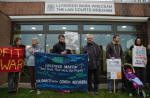
Approximately 25 people chanting and waving signs protest policies enacted by former President Bush during a visit to Palm Desert.
An Occupy Coachella Vallye protestor holds a sign reading “Citizens: Arrest Bush” during a visit by former President George W. Bush to Palm Desert. Friday, Nov 11, 2011.
Photos (6)

Photos

About two dozen members of Occupy Coachella Valley marched along sidewalks and in crosswalks in front of the JW Marriott in Palm Desert on
Friday morning.

The peaceful demonstration was a protest against former President George W. Bush, who spoke earlier in the morning to a private group at the hotel. 

“We’re protesting the presence of the top 1% and President Bush, who started the polices that have bankrupted this nation,” said a person
in a Guy Fawkes mask who called himself “Anonymous”, but was later found to be Jayel Aheram. 

“We’re protesting two budget busting wars, the fat bailouts and the Patriot Act and things of that nature. For the most part, the fact that he put this country into massive debt,” Aheram said.

With chants of “Bush lied, soldiers died,” and “Shame on Bush”, the group received honks and approving waves from a handful of vehicles passing in front the Marriott.  Only one person was seen making a negative gesture toward the group. 

The former President was speaking as part of an Ernst & Young Strategic Growth Forum, which was not open to the public.  Attendees, which Occupy Coachella Valley claims represent the 1% of people that control political power and wealth, paid $3,695 to register for the five-day event. 

= = = = = = == = = = = = = =

http://www.kpsplocal2.com/Content/Headlines/story/Former-President-George-W-Bush-In-The-Valley/BkVyCzxECUOqiXWGJ7hj3Q.cspx

Former President George W. Bush is visiting the Coachella Valley Friday.

He’s speaking at the 25th Annual Ernst & Young Entrepreneur of the Year Awards Ceremony. The event is being held at the JW Marriott Desert Springs Resort & Spa in Palm Desert.

The event is part of the annual Strategic Growth Forum, which takes place from November 9 through the 13, with the awards ceremony taking place on the final night, hosted by Jay Leno.

According to Ernst & Young’s website there will be more than 2,100 CEOs and senior executives from America’s top high-growth, market-leading companies at this year’s sold out Forum.

The event is private and closed to the public.

Protesters from the “Occupy Coachella Valley” movement will be demonstrating outside the hotel.

Copyright 2011 Desert Television LLC All rights reserved. This material may not be published, broadcast, rewritten, or redistributed.
Nov 112011
 

WATCH:  Sun TV attacks Ceasefire.ca!

http://www.ceasefire.ca/?p=9260

Defence lobby, Steven Staples

Right-wing TV host calls our letter to supporters “despicable”

http://www.sunnewsnetwork.ca/video/big-labour-v-military/1292517244001

Sun TV, also known as “Fox News North,” has turned its guns on the peace work of Ceasefire.ca and all of its 20,000 supporters – but especially Ceasefire.ca founder Steven Staples.

In a 9-minute rant, sometime nasty – and sometimes comical – Sun TV host and far-right commentator Brian Lilley attacks our latest letter to supporters, and calls it “despicable.”

It’s clear that our campaign to confront Harper’s military-funded pro-war lobby is worrying the corporations and the “old generals.”

It’s no surprise that Lockheed Martin, the maker of the F-35 and billions of dollars’ worth of other weapons sold to the Canadian military, is a major advertiser and supporter of Sun TV.

Watch the Sun TV video, above, for yourself.:   http://www.ceasefire.ca/?p=9260

Then read the letter that Sun TV calls “despicable,” and make a donation to help our defence campaign against these attacks from Sun TV.

Nov 082011
 

Further to (about “small” nuclear reactors): 

  • 2011-08-25   Minister Rob Norris (former U of S employee) – the Province going ahead with development of “Small nuclear reactors” (for the tar sands)
  • 2011-11-07   Words used to FRAME the nuclear propaganda in Saskatchewan:  “small”, “science”, “Nuclear medicine”, “university”

Subject:  Small Reactors

You might be interested in an article I wrote about our experience with the Slowpoke 10 which Atomic Energy of Canada attempted to market back in the 1990’s.  (A battle which we won and was also successfully fought subsequently at the U. of Sask).

It can be accessed on our grandfolkies web site.  Go to http://www.grandfolkies.com/nukeshaft.htm.  The link is on the upper left, called “Small Reactors? No Way!

Walt Robbins

= = = = = = = = = = = == = =  =

The Little Reactor That Couldn’t

Back in the late 1950’s, ideas for the use of small nuclear reactors for various purposes were in vogue. During that period, when I worked for the U.S. Atomic Energy Commission, I heard speculation over the possible use of atomic energy to run our autos, heat our houses, lift our rockets to the heavens.  Many of these ideas were so wild, they were quickly dropped.  However, some small reactors were designed and used for university research projects, medical and industrial isotope production and even nuclear submarine propulsion.

Small nuclear reactors can range in power output from less that one up to several hundred megawatts.

More recently, prospects for a so-called nuclear renaissance have revitalized speculation about the design and use of small reactors in Canada.  For example, in an interview with CBC News, in February, 2009, Premier Brad Wall said “… he hoped Saskatchewan could play a role developing small reactor technology.  He went on to say the provincial government might be able to devote some resources to research and development in that area.”

A report by Saskatchewan’s Uranium Development Partnership, (UDP) included an upbeat statement that “because they require little or no refueling and produce both heat and electricity, small reactors could eventually compete with small-scale diesel, oil and gas generation as a power alternative in remote sites.” The report went on to state that, “Saskatchewan has the opportunity to participate in this market by partnering with a commercial technology developer on a demonstration project.”

Ah, but–the history of small reactors in Canada includes some very expensive “lemons,” something that should give pause to anyone seriously contemplating getting into that kind of business.

As an example, one of those not so successful small reactor efforts was the SLOWPOKE 3, a brainchild of Atomic Energy of Canada, Ltd. (AECL).

The Slowpoke became an issue for me in 1986, when I was a spokesperson for the Concerned Citizens’ of Manitoba (CCM.), Canada, a nuclear waste watchdog group.  After years of our lobbying, the Manitoba provincial government was poised to pass a bill which would prohibit the burial or long-term storage of high level nuclear waste in the Province.

AECL officials were quite upset over the upcoming legislation, one of their concerns being that the bill contained a clause which prohibited the storage of high-level nuclear waste originating from outside the Province for more than seven days.  This, according to the AECL testimony, would result in its inability to store the waste from its new “Safe Low Power Kritical (sic) Experiment,” (a.k.a. SLOWPOKE) at its Whiteshell, Manitoba based nuclear research station.

The SLOWPOKE 3 was to be a small (10 Megawatt) heat and isotope producing nuclear reactor that AECL was actively marketing around the world, even though it was still in the early stages of untested design.  AECL maintained that the pending legislation would force it to set up waste storage facilities elsewhere at additional cost, and that Manitoba would lose “commercial benefits” from the SLOWPOKE 3 program.

It appeared that AECL planned to retrieve the waste from all the SLOWPOKE 3 reactors that it expected to sell in Canada, and abroad, and bring it to Manitoba for storage!  Nevertheless, the Manitoba legislation was enacted into law.

However, that did not stop AECL from promoting its mini-nuke.

I recalled reading an article in the Lac du Bonnet, Manitoba, Leader of June 15, 1982, headlined “Nuclear Furnaces Could Soon Be Heating Your House.”  It went on to describe the small, unattended, SLOWPOKE reactor which could heat a building and require refueling only once every five years.

“Safe Low Power Kritical Experiment!”  It was fascinating that AECL chose to use the word “Safe,” to describe its new “baby” reactor.  It left me with more apprehensions than I already had about its large power reactors, with the acronym, “CANDU,” which lacked that vital word “Safe.”  Would they now change CANDU to “SCANDU”?

Also, I wondered why the use of the word “experiment.”  After all, who wants to buy a radioactive “experiment” to heat their community centre or other buildings?

A demonstration 2-megawatt version of the SLOWPOKE 3 reactor began very low-power operation at AECL’s Pinawa, Manitoba, Whiteshell research station on July 15, 1987.  But well before that small demonstration model was up and running, the Crown Corporation was already actively marketing the non-existent 10 mw version in such places as China, Korea, Europe and Canada’s own Northwest Territory.

By January, 1988, AECL had signed a memorandum of agreement with Hungary for a potential SLOWPOKE 3 sale.

A May 29, 1986, Winnipeg Free Press article headlined “Radioactive Waste Repository for Manitoba Planned by Agency,” really caught our attention.  AECL’s idea was to remove spent fuel from each SLOWPOKE 3 reactor every five to eight years. The thirty or forty fuel bundles would be placed in concrete cylinders at its research facilities at Pinawa, Manitoba and Chalk River, Ontario.  Eventually, it was reported, the waste would go into the (still non-existent) permanent underground waste repository.   CCM took the position that the Province should not permit storage of SLOWPOKE 3 waste and that (it should) “. . . block the buildup of anything which tends to take us closer to a nuclear waste repository in Manitoba.”

CCM considered that if AECL started bringing its foreign customers’ SLOWPOKE 3 excrement back to Canada, it would be well on the road to the full-scale commercial international radioactive waste dump about which CCM had been warning the public for so many years.

According to the article, Provincial Environment Minister Gerard Lecuyer was surprised by this development and indicated that “. . his initial reaction was one of opposition.”

CCM’s interest in the SLOWPOKE 3 grew further as a result of another article in the Winnipeg Free Press on July 24, 1987, which reported AECL’s Metro Dmytriw as saying that the Corporation had received an initial inquiry about the purchase of one from an interested party in Manitoba.

According to that article, Dmytriw also suggested that a SLOWPOKE 3 nuclear reactor might be a replacement for Winnipeg’s aging central steam heating plant. The article pointed out that AECL had held no discussions with the city nor did city officials express any interest in the idea at the time.

Other groups had also been criticizing the SLOWPOKE 3.  The Montreal Gazette, May 22, 1986, reported Norm Rubin of Energy Probe in Toronto as saying . . .(the idea is) “crazy.” Rubin wondered how, in the event of an accident, a hospital or shopping mall could be evacuated, especially since the SLOWPOKE 3 would operate “unattended” for some periods of time.

The same Gazette article included similar concerns expressed by Gordon Edwards, President of the Montreal-based Canadian Coalition for Nuclear Responsibility.  Both Rubin and Edwards pointed to the unsolved nuclear waste problem as a good reason for not proceeding with the development and marketing of the SLOWPOKE 3 nuclear reactor.

Aside from the waste, safety, and economic questions surrounding the SLOWPOKE 3, CCM expressed concern over reactor security.  An unattended reactor operating in a small  community or a building in a large city could present unparalleled opportunities for anyone who might want to steal highlevel nuclear waste. (The design called for spent fuel rods to be stored within each reactor, until removed to some other location.)

Other possible acts might include sabotaging the untended reactors themselves, or pumping out the water (which becomes more radioactive as the reactor operates), into a municipal system.  Unforeseen and unanticipated damage and acts of terrorism are a real possibility when one considers the many unstable political situations around the world.

Even large power reactors have their security problems.  According to the October 2, 1987 Critical Mass Energy Project’s newsletter, Public Citizen, in the US, “Dozens of security breaches occurred at nuclear plant sites in 1986.  These include vandalism and sabotage directed at reactor operations; use of firearms on plant sites by unauthorized persons; and increasing drug use among nuclear workers.”  Also, some workers have been found, literally, asleep at the switch.

My personal involvement with the SLOWPOKE, became even more intense when my wife, Phyl, and I moved from Manitoba to Québec, in 1988.

We had just arrived at the home of friends in the town of Beebe, in the Eastern Townships of Québec.  It was March 15, 1988, and we were on a house hunting expedition.

Somewhat tired from the day’s journey, which included a six-hour long delayed flight from Winnipeg, and a long drive in a rented car through a heavy snow storm from Montréal, we looked forward to some relaxation and good conversation that evening.

Our friends, however, stood by quietly watching, as we stared incredulously at the March 14 edition of the Sherbrooke, Québec, Record, which was propped up on their dining table.

Plastered across the front page was a story about AECL’s plan to construct and operate a ten megawatt SLOWPOKE (“Safe Low Energy Critical Experiment”) nuclear reactor at the Centre hospitalier universitaire de Sherbrooke (CHUS), the large University Medical Centre located in Québec’s Eastern Townships.

I quickly scanned the story, which someone had leaked to the newspaper, revealing AECL’s plan to build the reactor for the stated purpose of heating the hospital.

AECL was to own and operate it, and the hospital would pay the heating bill.  Most importantly, the reactor, the first of its kind, was planned to serve as a demonstration based on the two megawatt version (which we knew was still nowhere near full power) at the Whiteshell Nuclear Research Establishment at Pinawa, Manitoba.

“I don’t believe this,” and “You’ve got to be kidding,” were but a few (printable!) comments made by the two of us, as we read the lead article.

Our activities in Manitoba were well known to some of the environmental and peace activists in the Townships area. We had made contact with them during the 1985 controversy over a possible U.S. nuclear waste dump in northern Vermont, very close to the Canadian border.

When some of them heard that we were moving into the area, we were asked to join them in dealing with the new-to-Sherbrooke SLOWPOKE 3 issue.

Thus, a short time after our arrival into what we had hoped would surely be a relaxed new start in retirement life, Phyl and I were involved in strategy meetings with peace and ecology groups, a meeting with AECL and hospital officials, news conferences and media interviews.

It was as if we had never left Winnipeg.

Since my concern about the so-called SLOWPOKE 3 reactor had already started to grow over the past several years in Winnipeg, it seemed somehow appropriate to be involved in this new controversy.

The more I learned about the new mini-nuke, the less I liked it: It would use highly-enriched uranium which must be imported from other countries.  It would create high-level radioactive waste, which would contain weapons usable plutonium. It would be marketed anywhere in the world.  It would operate unattended for periods of time, leaving it vulnerable to those with malicious intent.  Also, it would routinely emit radioactive gasses into the environment.

Yet, the plan now was to place such a machine in, of all places, a large teaching hospital, where, as is true of anything else designed by humans, accidents could, and did happen.

When Phyl and I finally moved from Winnipeg, we had put our belongings in storage as we continued to search for a house in the Eastern Townships.  As it turned out, we did not find a house we liked before we sold our place in Winnipeg.  So, we rented a furnished mobile home in a farming area near the town of Beebe.

We brought the essentials for living with us in our camper van which pulled our old 1960s’tent trailer from Winnipeg to the Townships.

However, I had packed one box of assorted files on nuclear waste issues in the tent trailer.  Now, I am not especially a mystic, but it turned out that one of those files was full of papers on the SLOWPOKE reactor!  It contained information which later proved to be very useful in shaping future events.

However, it now seemed as if our dream of “peace, quiet and contemplation” in the rolling hills of the Eastern Townships was not to be.  [Our histories showed that we were probably never cut out for that kind of a life anyway!]  For us, it would be the “Year of the SLOWPOKE.”

The minutes of a February 16, 1988 meeting between AECL and the CHUS Hospital Board of Directors include an AECL quote that “. . . an appropriate strategy produces very little public reaction.”

This time, however, AECL’s “appropriate strategy” obviously did not take into account that someone(s) high up within the hospital’s staff itself might have more than a few misgivings about the venture and would leak the information to the media.

The Townships Peace Group asked us to attend a May 2, 1988 meeting at the CHUS with hospital officials, AECL representatives, and persons concerned about the SLOWPOKE project.

We were already seated at the board room conference table when the AECL contingent arrived.  Several AECL officials present from the Pinawa, Manitoba, Whiteshell Nuclear Research Establishment (WNRE), were visibly shaken when they saw us there.  Of course, they did not know that we had very recently moved from Winnipeg to Québec.  “What are you doing here?” asked one of them.  “We live here.” I retorted.  I’ll never forget the astonished look on their faces.

The Robbins, former Concerned Citizens of Manitoba stalwarts, were probably the last two people they wanted to see that morning!

They were no doubt unhappy about the presence of others who also were at the meeting, including Gordon Edwards, well known nuclear critic from Montréal, and Max Krell, a local university professor, (and a very concerned nuclear physicist).

The hospital officials and AECL reminded me of a group of kids who had just got caught with their hands in the cookie jar.  I imagine that they all realized at that moment, that their “appropriate strategy” might have just gone down the tube!

Although good manners were observed throughout, it became quite obvious that the citizens’ representatives were not going to buy in on the proposal.

It did not take long for a coalition of peace and environmental groups and other concerned individuals to take shape in the Eastern Townships.  The group used the same initials used by the hospital, i.e., the “Coalition CHUS” (Continue Hydro, not Uranium for our Safety, or, in French, Continuer l’Hydro non l’Uranium pour notre Sécurité.)

After the initial flurry of organizational and media activity, Phyl and I settled into a relatively benign role of “behind the scenes” support to the mostly French speaking coalition.  But I had one more moment in the spotlight, which Phyl provided for me.

She had carefully reviewed the contents of the SLOWPOKE file that we had brought with us from Winnipeg, and had found an amazingly frank, and startling statement by John Hillborn, the inventor of the SLOWPOKE reactor, concerning the possibility of nuclear accidents.

In a June, 1981 paper he co-authored for the Second Annual Meeting of the Canadian Nuclear Society in Ottawa,(AECL document No. 7438), Hillborn said that, “It is now well known that people will accept frequent, small disasters more readily than rare catastrophes.”

Airplane crashes were used as an example.  The paper continued, “Although we may have to endure the legacy of Three Mile Island for many years, a decentralized system of small reactors which effectively eliminates the possibility of a single big accident may have a significant advantage in licensing, insuring, and gaining public acceptance.  Eventually the public may accept accidents to small reactors to the same extent that they accept fires, explosions, and airplane crashes, as long as the consequences are not obviously worse.  It would be unrealistic however, to expect many communities to welcome nuclear reactors within their boundaries until there are severe regional shortages of gas and electricity.”

On June 22, 1988, I read this statement, without comment, at the Coalition’s first press conference.  The media jumped on it.  The following day the quote was used in the lead editorial in the Sherbrooke Record.  Hilborn’s statement became one of the Coalition’s, and the media’s favorite items.  It was an excellent example of the fact that one of our most powerful weapons against AECL was its own prose.

I was not alone in finding Hilborn’s statement to be a chilling one, with its assessment of public reaction to “small” nuclear catastrophes.  The 1980s witnessed bitter and protracted conflict and public concern over radioactive spills from discarded medical equipment in scrap yards, radioactive soil in housing developments, radioactive materials dropping from space
satellites, and missing quantities of plutonium.

The fact that there is no safe level of radiation was understood by the public.  Increasingly, evidence points to negative health effects from the most negligible levels of radiation. And the public has become aware of the consequences from nuclear radiation in whatever forms and amounts.  Even the negative side of natural radiation has become more evident.  There is nothing to suggest that the public will, in Hilborn’s terms, easily accept “small” nuclear disasters.

Coalition CHUS continued to raise questions about the safety of the reactor.

An exchange of correspondence between an official of Canada’s Atomic Energy Control Board (AECB) and myself, revealed that the so-called “nuclear regulators” had no(!) safety information on the reactor.  Their October 5, 1988 letter to me stated that “It is likely that the 10-mw reactor will be significantly different from the (2-mw) SDR.”   The letter also noted
that “At this time the AECB does not have any detailed design information on the proposed 10-mw installation.”

Not only was the 10-megawatt SLOWPOKE 3 an “experiment” in the true sense of the word, even its supposed prototype 2-mw version, at the WNRE, was still in its embryonic stages.  AECB had reviewed that reactor and requested that AECL take a number of significant steps to improve its safety.

As the SLOWPOKE issue developed and the Coalition CHUS quickly grew during the Summer and Autumn of 1988, Phyl and I continued to provide it with advice, moral support, and assistance in developing letters and fact sheets.  I was absolutely astounded at the energy and the effectiveness of the anti-SLOWPOKE coalition.  Something was happening all the time. Meetings, mailings, radio and TV coverage, debates, button and t-shirts sales — just about every legitimate, democratic, non-violent form of protest and expression was taking place.

By October, 1988, the movement had acquired a life of its own.  There were so many media events, activities, and speakers’ appearances going on that it was difficult just to keep track of them all.

As Coalition CHUS rapidly expanded, Phyl and I continued work in our behind the scenes role to supply information and ideas.  For example, in one of her fact sheets Phyl included information about AECL’s own stated policy of excluding pregnant women and small children from tours and open houses at the WNRE, which contained the 2 megawatt “prototype” of the SLOWPOKE.

Pregnant women and small children visit the CHUS medical centre every day for medical treatment.  Would not a ten megawatt reactor at the hospital provide at least equal, if not greater risk?  The point was not lost on the nurses at the hospital.  Their union passed a unanimous resolution opposing the reactor, declaring it a public health risk.

By November, 1988, coalition support was estimated at twenty-five thousand, with almost ten organizations a week joining our forces.  Much of the opposition came from the hospital staff itself.  Politicians were falling over themselves to come onside.

The handwriting on the wall was writ large and clear.  On December 20, 1988, we received the best Christmas present of all:  the hospital Board of Directors announced its withdrawal from the SLOWPOKE project, a decision taken in spite of AECL’s initial offer to absorb the five-to-seven milliondollar capital cost.  Coalition CHUS had done its work well.

AECL folded its tents and left Sherbrooke.  It had lost another round in its struggle to market its mini-nuke.

AECL’s public relations and sales forces had again failed to convince any community that they had invented the perfect nuclear heating machine; one which they promoted as being inherently safe, and which would operate in the midst of a populated area without negative consequences, for at long as 30 years — – even though the design of the reactor had not yet been finalized or approved!

Undaunted, the federal Crown Corporation continued to seek a location for a full-scale demonstration SLOWPOKE 3 to enhance the reactor’s credibility in the eyes of potential foreign customers.  But no one was buying.  After two more failed attempts (one at a G.E. plant in Peterborough, Ontario, and another lengthy one at the University of Saskatchewan), the marketing project stalled.

A few years later, the two megawatt “prototype” at WNRE (which had never operated at full strength.  By November 1991, and forty-five million dollars later, the entire SLOWPOKE 3 project was consigned to oblivion.

In a 2007 article on “ Nuclear Smoke and Mirrors,” Jim Harding, a retired University of Regina, professor of environmental and justice studies commented on some of the Canadian reactor designs.

He wrote that “… the list of botched AECL designs is lengthy.  There was the Organic Cooled Reactor in Manitoba, which was an expensive dead end.  There was the Candu Boiling Light Water Reactor in Québec, which (without even including design costs) was a $126 million disaster.  Then there was the Slowpoke Energy System, for which design work cost $45 million, which didn’t work properly.  Next came the Candu-3, for which design work cost $75 million, which no one wanted.  And the Candu-9, with design costs still secret, which was a no-go in South Korea.  More recently AECL built the Maple Reactor at Chalk River, which threatens to become another technological and financial fiasco since the Canadian Nuclear Safety
Commission (CNSC) is refusing to even license it for operation”.

The moral of this story is that there is no such thing as an inherently safe nuclear reactor.  Those who contemplate going down that road should carefully assess the lessons from the past.  If they do so, they might very well choose other, more preferable alternatives.

Walt Robbins

Nov 072011
 

NEWS ARTICLES TELL THE STORY

It’s pretty exciting! 

The list of news articles  shows growing awareness of the use of the University for back-door promotion of the nuclear industry.  Fukishima  has further lowered the level of public support for nuclear.   When citizens realize that the “small” reactors are for tar sands expansion with its connection to climate change,  support plummets yet again.

The list shows great effort by numbers of people for the “heave-ho” that will shift us off this suicidal path onto a new sustainable one. 

In 2009 most Saskatchewanians thought the job was done (public consultations said “No” to nuclear).   But the articles show there are no intentions to stop the nuclear agenda, it will be accomplished through the University.  

The ousting of the corporate interest at the University of Saskatchewan will set the wheel rolling to take-back all of our Canadian Universities.  It is part of the OCCUPY movement – stop the corporatization of the public space.

Premier Brad Wall is a chief proponent of the nuclear industry.  He is “co-spearhead of the largest on the planet Canada-U.S. Western Energy Corridor” which includes nuclear energy. 

But this list of news reports focuses on the role of Minister Rob Norris in the use of the University as the vehicle for by-passing the public wish.

 The list shows:

–        the extent to which Rob Norris, former employee of the University become cabinet Minister, is a point-man for the Government in the triangle that includes the University (Peter MacKinnon) and the Nuclear Industry (Nancy Hopkins).

–        April 21, Government announced $30 million to the University for the nuclear industry (the Canadian Centre for Nuclear Innovation – CCNI).  The University is supposed to be autonomous and able to make its own decisions on how to spend tax-payer money.

–        On August 25th Norris announced the deal with Hitachi/GE for ‘small’ reactors that are also part of the CCNI mandate.

–         On Sept 2nd  MacKinnon announced “Rob Norris is the finest minister responsible for post-secondary education that I have been privileged to work with in my (13) years as (president) – .”  

–        October,  MacKinnon approved Norris’ use of the endorsement in election brochure. 

–        November 7th  is election.

–        The news articles provide background and show the growing dissension

= = = = = = =

  1. 2011-10-31   YouTube, Brad Wall on Nuclear
  2. 2011-03-14   NUKE:  Saskatchewan moves ahead with nuclear agenda despite crisis in Japan, Rob Norris Minister tells (Canadian Press) 
  3. 2011-03-15  YouTube, Rob Norris on Fukishima, CBC   (The CBC interviewer doesn’t let Norris get away with “framing”. The framing is explained in   2011-11-07   Words used to FRAME the nuclear propaganda in Saskatchewan: “small”, “science”, “Nuclear medicine”, “university”.
  4. 2011-04-21   Tax-payers give $30 million (or $47?) to Nuke at U of S, Nancy Hopkins Chairs U Board of Governors, is on Cameco Board, has $1.8 million in Cameco shares, Chairs Search for next President + 
  5. 2011-08-16   Revolution Canadian style? U of S Senators challenge conflicts-of-interest at the University while The Walkers challenge the Government’s corporate interests. 
  6. 2011-08-17   Senators want board chair to step aside, Star Phoenix 
  7. 2011-08-25   Minister Rob Norris (former U of S employee) – the Province going ahead with development of “Small nuclear reactors” (for the tar sands) 
  8. 2011-08-26   On Campus News:  Momentum builds for nuclear centre
  9. 2011-08-31   Elected U of S senators take on Board chair (U of S),  The Sheaf
  10. 2011-09-14   University Council approves nuclear innovation centre, On Campus News
  11. 2011-10-06  NUKE:  Chiefs undermined  (Government – University – Industry).  Emil Bell on hunger strike. (Star Phoenix, Kashap)
  12. 2011-10-11    U of S senators want more public input.  Occupy Saskatoon starts at the University.  (Star Phoenix) 
  13. 2011-10-15   My response to Letter from Lawyer, University threatening legal action against me.
  14. 2011-10-15   YouTube, Mary Jean Hande:  Senate Meeting at University of Saskatchewan addresses conflict of interest of Ms. Nancy Hopkins 
  15. 2011-10-17   NUKE / University:  Visions clash at animated U of S senate meeting 
  16. 2011-10-19   The 99% march in Occupy Saskatoon, The Sheaf, U of S  (Corporate University) 
  17. 2011-10-28   U of S: president MacKinnon endorsement of SaskParty candidate a conflict, Professor charges. 
  18. 2011-10-28   Jeremy Rifkin on nuclear – a must hear.  PLUS connect the players and the information. 
  19. 2011-11-02   Offensive move, Letter-to-Editor, Star Phoenix (U of S, President MacKinnon endorsement of SaskParty candidate Rob Norris and vice versa)
  20. 2011-11-03   Letter to Board of Governors from U of S Senators,  re President MacKinnon’s endorsement of SaskParty candidate Rob Norris, Saskatoon-Greystone.  The letter requests that the President be censured and the Chair of the Board of Governors (Nancy Hopkins) be asked to permanently stand-down from the Search Committee for the next president of the University. 
  21. 2011-11-03   Nuclear companies infiltrate universities 
  22. 2011-11-04   University, “Questionable Move”, Letter-to-editor, Star Phoenix, Pulfer regarding MacKinnon’s endorsement of SaskParty candidate, Norris
  23. 2011-11-04    Green Party opposes nuclear “research” funding (excellent statement)
  24. 2011-11-05    Admit mistake, Letter-to-editor, Star Phoenix,  Sharma (re U of S President MacKinnon’s endorsement of SaskParty’s Rob Norris), Star Phoenix
Nov 072011
 

Think of the introduction of genetically-modified organisms.  Not a word of public debate about the desirability, the public funding, or the use of the University as the vehicle for introduction.   Now think of the introduction of nuclear reactors needed for tar sands expansion.  

The by-pass mechanisms have been spelt out, e.g. in Maclean’s Magazine, http://sandrafinley.ca/?p=116  2006-09-13 Maclean’s Magazine interview, President of the Americas for Lockheed Martin Ron Covais, Meet NAFTA 2.0.

See Radioactive Trinity:  A Study of the Partnerships and Collaborations of Government, Industry and the University of Saskatchewan,  http://ussword.blogspot.com/p/infographic.html.

(SPP = Security and Prosperity Partnership with the U.S.;  SPI = SP Initiative; NAU = North American Union).   

The University has been taken over, is a vehicle for the SPP/NAU/corporate agenda  Flagrantly.  And dangerously.  Especially in terms of climate change (University is the vehicle for introducing “small” nuclear reactors for tar sands expansion.)  Not many people understand the critical role of Saskatchewan and within that, of the University, in the larger SPP/NAU game plan.  

The U of S Senators emailed the Board of Governors of the University requesting censure of the president and a permanent stand-down of Nancy Hopkins from the Selection Committee for the next president of the U.  Hopkins is Chair of the Board of Governors, on the Cameco Board,  and had a couple of million dollars worth of Cameco shares as at the end of 2009.  Meanwhile the Government is funneling a minimum of $30 million to the University, ear-marked for nuke,  the Govt signed the $10 million deal for the “small” nuclear reactors with Hitachi / GE.  

The Canadian Centre for Nuclear Innovation (CCNI) is established at the U of S.   The “small” reactors will be ushered in through the U.  The CCNI is a vehicle for pushing the public money through to serve industry.   The CCNI Board is industry and industry-friendly.  The reporting lines are directly to the Board of Governors, bypassing all the normal processes for accountability.  The CCNI does not do research.  It only pays out the money, nothing to stop the money from going to industry scientists.  On top of that, a couple years back Saskatchewan signed a deal with the Idaho National Laboratory (nuke).  As did Alberta, not long before Sask.

It is to the advantage of Cameco (owns 30% of Bruce Power which is sitting on a pile of 40,000 tonnes of high-level radioactive waste) and to the advantage of Nancy Hopkins’ financial interests that scientists whose research is related to water become eunuchs or are driven out.  The poisoning of water by the uranium mines and/or through deep geological disposal of radioactive waste is contrary to their entrenched financial interests. 

 The SPP is represented on the Board of Governors of the University (David Sutherland is on the CCCE (Canadian Council of Chief Executives) and on the SPI);  the Premier is a darling (“co-spearhead”) of the plans for movement of tar sands south into the States, sending the money for nuke to the University (for cooking the tar sands);  the president of the U is a member of the Family Compact.

Nov 072011
 

UNDERSTAND THE  MANIPULATION OF PERCEPTION   TO GET NUCLEAR PAST THE (SASKATCHEWAN) PUBLIC. 

The main issues are NUCLEAR REACTORS,  EXORBITANT COSTS, and RADIOACTIVE WASTE. 

The politicians and promoters “frame” it otherwise, to divert attention.

  • “Small” subtly plants the idea that the reactors are not exorbitantly expensive.   (The reactors ARE expensive; they are VERY LARGE, especially in relation to actual electricity needs in Saskatchewan.)
  • “Small” – The Saskatchewan Research Council (SRC) at the U of S has had a “small” reactor for a long time, the “slow-poke” reactor.   It is under-utilized.  Scientists are begged to develop projects that will use the slow-poke.   It is less costly to run this “small” reactor than it is to shut it down.  So they just keep it in operation.  
  • It doesn’t matter how “small” it is.  You can’t shut down a reactor with a flip of the switch, as the Japanese painfully know.  And you have a pile of radioactive waste on your hands that takes decades of cooling.  Shut down the reactor? – – How?  what are you going to do with it?  How are you going to FINANCE the cost of dealing with it?  Better that you keep it going, then retire or move, and let someone else figure it out.  Hand off the responsibility.
  •  “Research” sounds benign.  – – But “small” reactors have already been developed.  Hyperion applied in the U.S. for licensing of its “small” reactor a few years ago.  The Saskatchewan Government gave $10 million to help Hitachi/GE bring its small reactor on-line.   It’s for tar sands expansion.
  • The reactors are for Motherhood, in this case “Nuclear medicine”. . .  it must be good.   The truth is that a miniscule amount of the uranium mined is used for medical purposes.
  • Associating the University (integrity, educated influential people)  with the nuclear agenda is part of the framing.

 It is important to understand the use of “FRAMING”, a tool of the skilled manipulator / propagandist / perception manager.

We create meaning through the main part of what we hear and see, but also from those elements that surround it.  For example, a gun in a museum cabinet has a different meaning to a gun being pointed at you by a nervous burglar. 

By changing the surroundings, the meaning of the main topic can be changed.  People are usually focused on the main topic, which enables the frame to be used as a subtle form of persuasion.  The persuasiveness of the argument can easily be affected – – more by the frame – – than the core point.

The Government and University try to frame the nuclear issue in terms of

  • “small”
  • medical isotopes
  • nuclear medicine
  • “science”

whenever they can get away with it. 

Go to item #3 at   2011-11-07   (List of news articles)   The CBC interviewer of Minister Rob Norris does a terrific job of refusing to let Norris get away with his “framing” of the argument. 

 Another example of framing comes from University President MacKinnon:  when we Senators say that Nancy Hopkins is in a serious conflict-of-interest, he says “She’s an enormously sophisticated governance person and has terrific judgment,”  AND MacKinnon gets quoted!   

It is EXTREMELY frustrating when media persons allow interviewees to get away with “framing” (not answering the question). 

The U of S Senators (I’m one) who are challenging the corporatization of the University have been the subject of framing.  We are “shooting from the side-lines”, “rogue Senators”, etc.  Do not address the issues we raise.  I expect it will become worse.  There are very large financial interests in tar sands expansion, for which the “small” reactors are necessary.

The ground work’s in place:  

  • Thank-you Mary Jean!  (short YouTube, see http://sandrafinley.ca/?p=3627  ).  She had the courage to tell University Senate (a gathering of Deans, the President, Chancellor, and senior people) that the Board of Governors has to deal with the conflicts-of-interest of the nuclear industry at the University.  
  • The grass roots Green Party put a candidate on every ballot for the Provincial Election, to collect the vote against nuclear.   (Full disclosure:  I am a former leader and candidate.  For the Nov 2011 election I was the Business Manager for 16 candidates.)
  • Now we need the Jedi Knights – you! – – to talk to everyone you know.  People need to understand the predicament. 

Nov 062011
 

LIMA — Peru’s Congress announced Friday it overwhelmingly approved a 10-year moratorium on imports of genetically modified organisms in order to safeguard the country’s biodiversity.

The measure bars GMOs — including seeds, livestock, and fish — from being imported for cultivation or to be raised locally.

Exceptions include the use of GMO products for research purposes in a closed environment, but those will be closely monitored, the legislature’s official news service said.

The bill, approved late Thursday, now goes to President Ollanta Humala to be signed into law. Humala, who has been in power since late July, has repeatedly said he opposes GM programs.

According to the Agriculture Ministry, Peru is one of the world’s leading exporters of organic food, including coffee and cocoa, with $3 billion a year in revenues and 40,000 certified producers.

Congress approved a similar 10-year moratorium in June, but outgoing president Alan Garcia, who was seen as being favorable to GM, did not ratify the ban.

There was friction over GM in the previous government’s ministries of agriculture and environment.

The head of Peru’s Consumer Agency, Jaime Delgado, said the moratorium is long enough to learn from scientific studies that will emerge on the effects of GMO products.

The country’s leading group representing farmers and ranchers, the National Agrarian Convention, said that by this measure Peru “defends its biodiversity, its agriculture, its gastronomy and its health.”