Goal: To fund the legal costs of forcing the University of Saskatchewan’s senior administration to comply with the recommendations of Saskatchewan’s Information and Privacy Commissioner and the public’s right to know.
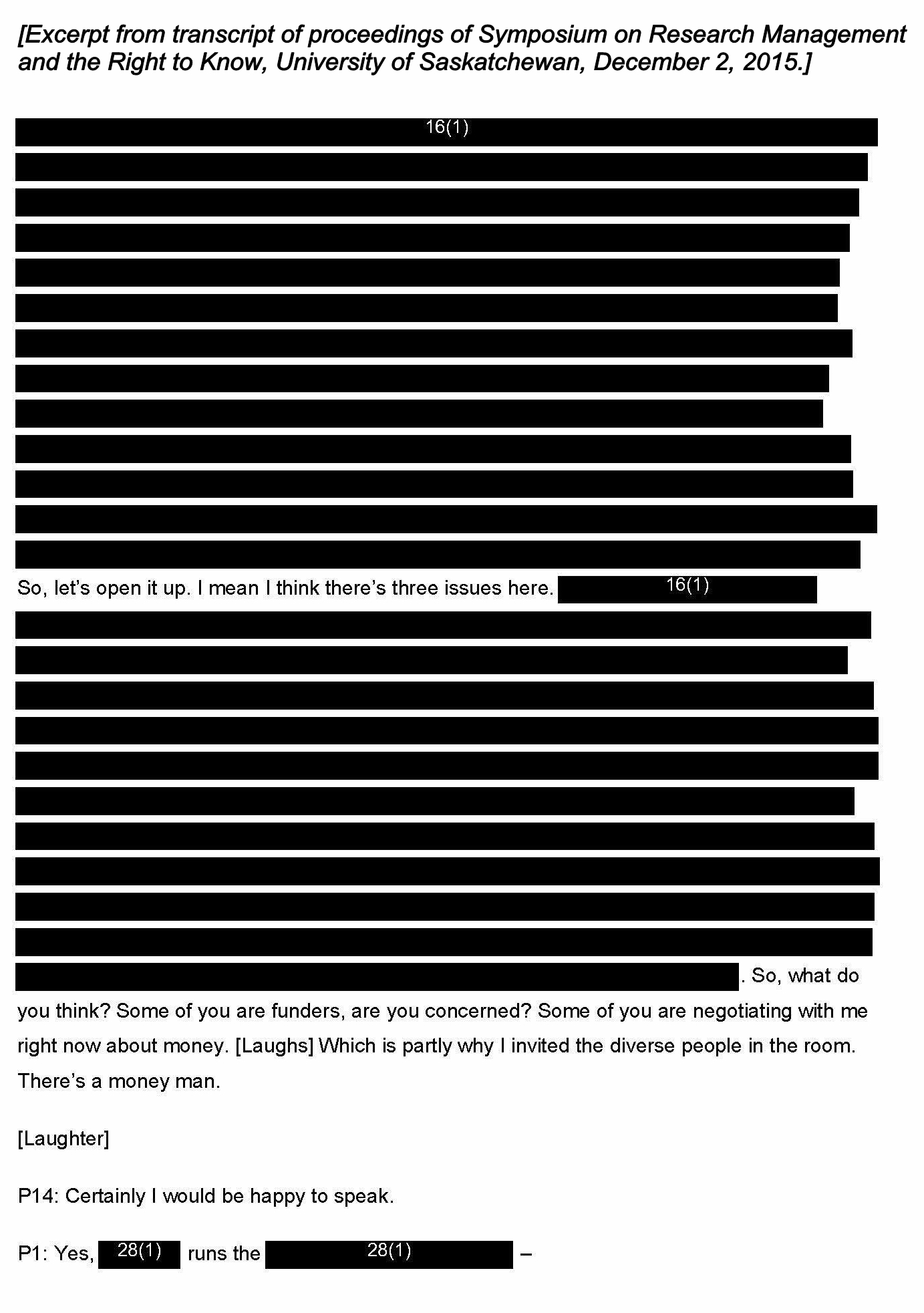
Saskatoon, Sask. – Notice of Appeal against the University of Saskatchewan was filed today in Court of Queen’s Bench. Retired archivist D’Arcy Hande, the applicant, is asking the Court to enforce recent recommendations by Saskatchewan’s Information and Privacy Commissionerthat the University lift most of its redactions in the transcript of proceedings of a closed symposium involving university and agriculture industry representatives, held on campus December 2, 2015.
The symposium, entitled Research Management and the Right to Know (referring to the US organization “Right to Know,” which has brought to light several instances of undue influence on research by industry partners) was by invitation only. The 20 attendees included members of the University of Saskatchewan administration, faculty from this and other universities, research funders, communications personnel and representatives from industry.
“I strongly believe that the University, a publicly funded institution, needs to demonstrate that its research and scholarship is in fact serving the broadest public interest,” said Hande. “The redactions to this document imply that the University wants to avoid scrutiny of its affiliations with controversial industry partners like Monsanto/Bayer.”
Emails previously obtained through FOI indicate that UofS Professor Peter Phillips, assisted by Monsanto Canada’s “social sciences lead” Camille Ryan, organized the symposium in order to develop strategies for managing the intense media scrutiny of collaborations between university researchers and the agricultural chemical industry. A critical news report about Phillips’ associations with Monsanto had appeared in the Saskatoon StarPhoenix just weeks before, and it had both Phillips and Ryan very concerned.
Hande submitted an Access to Information request to the University in August 2017, asking for a copy of the Symposium’s proceedings. In November the University provided a 42-page transcript, but it also blacked out 85% of its contents, claiming to protect third parties and academic freedom. Names and affiliations of non-UofS participants and almost all of the discussion at the meeting had been redacted.
Hande asked Saskatchewan’s Information and Privacy Commissioner Ron Kruzeniski to review the University’s actions. In Kruzeniski’s opinion, delivered on June 5, 2018, the University had not applied the Local Authority Freedom of Information and Protection of Privacy Act appropriately. He therefore recommended that they lift most of the redactions to make the transcript more publicly accessible. The University refused to comply, which has impelled Mr. Hande to begin legal proceedings.
GIFS, the Global Institute for Food Security, at the University of Saskatchewan.
It is NOT about global food security. It is a re-framing of agriculture.
WHY is re-framing necessary?
an international movement made the name “Monsanto” the red flag in front of a raging bull, the public. Awareness of the industry and its tactics through Monsanto is a problem for ALL the collaborators in Corporate Agriculture.
So the Communications Specialists re-frame it – – It’s about food and feeding the world, don’t ya know! See APPENDED: I made a bullet list, What it’s really about.
If you want to understand what’s going on, I think you have to have some
ESSENTIAL BACKGROUND.
GIFS board chair Lorne Hepworth went straight from 20 years of being chief lobbyist for the chemical-biotech (agriculture) industry, to the not-Global Institute for Food Security at the U of S. Significant, expanded, background on Hepworth, see
When launched in 2012, the goal of the Global Institute for Food Security was to translate research into food. (Tory Gillis/CBC)
The University of Saskatchewan’s $100-million Global Institute for Food Security (GIFS) is operating under a cloud of suspicion, fear and open conflict, according to a series of interviews and internal documents obtained by CBC News.
File photo of Maurice Moloney, CEO of the Global Institute for Food Security. (Rosalie Woloski/CBC)
One report from an external consultant warns the host of problems could lead to “complete disintegration” of the institute.
Much of the criticism revolves around CEO Maurice Moloney, recruited to the post in 2014 after overseeing top research institutes in Canada, the United Kingdom and Australia. But most say the problems run far deeper.
“It’s absolutely bizarre. This is a horror story,” said Tim Sharbel, a world-leading expert in seed biology, one of four “research leads” of GIFS teams, and one of Moloney’s harshest critics.
The institute attracts top scientists and grant money to the university. It’s a significant contributor to Saskatchewan’s economy and its researchers are working hard to decrease world hunger.
Neither Moloney, GIFS board chair Lorne Hepworth, U of S President Peter Stoicheff nor U of S vice-president of research Karen Chad returned CBC News interview requests.
A U of S official said in an email that many reforms are underway, including the creation of a task force, but critics say little has changed.
‘Key relationships have deteriorated,’ says report
The institute was conceived over lunch in 2011 by former Premier Brad Wall, former U of S President Peter MacKinnon and then-Potash Corp CEO Bill Doyle, Doyle has said.
It was launched soon after with a $15 million contribution from the provincial government and $35 million from PotashCorp (now Nutrien). It has since grown into a $100 million operation.
Premier Brad Wall (left) helped launch a Global Institute for Food Security. He stands beside former U of S president Ilene Busch-Vishniac (middle) and former PotashCorp CEO Bill Doyle. (CBC)
But tensions have been escalating for the past two years, say critics.
Last September, GIFS research staff sent a letter to U of S administration unanimously demanding action. They said team members are fleeing GIFS or being forced out because of Moloney and the toxic environment.
In the letter, obtained by CBC News, staff said there’s been interference with their research funds. Requests for lab time and materials have been rejected without explanation. Confidential data has been leaked to competitors. Rumours have been spread to pit staff against each other.
“There is a general feeling that any pretext can be used to justify actions that seem unconscionable,” states the letter.
The authors said they were suffering from exhaustion, panic attacks and depression. They didn’t want to apply for long-term research grants or move their families to Saskatoon because of the uncertainty, according to the letter.
The Global Institute for Food Security is located at the University of Saskatchewan in Saskatoon. (CBC)
Shortly after staff sent the letter, GIFS leadership commissioned McGill University professor Dirk Schlimm to produce a report on the situation. Completed in December, it said the institute has the potential to answer key questions about how to feed the world’s rapidly expanding population.
“Food security is a massive global problem and GIFS is at the forefront of solving it through advanced, ground-breaking research,” states the eight-page report.
It also stated Moloney did a “superb” job expanding the institute’s scope and was a “visionary” fundraiser and ambassador.
He feels he can do whatever he wants.– Tim Sharbel
However, the report also confirmed the complaints made in the letter and by individual team members. Moloney is seen by many as an “absentee manager” with “little or no reporting back on his activities,” the report states.
When he is present, some staff said Moloney has a “micromanaging leadership style” and controls information between staff and the board, according to the report.
There’s a deep conflict over whether to run GIFS like a “top-down” corporation or a research institute respecting academic freedom, states the report.
And no one knows who’s ultimately in charge, the report says. Some staff think it’s U of S vice-president of research, others say it’s the institute’s CEO, while others say it’s the scientists who produce the results, the Schlimm report says.
“…key relationships have deteriorated with the consequence of a high degree of dysfunction,” states the report. “If left unaddressed, the current situation could lead to complete disintegration.”
Moloney to step down in November but may work on ‘super-cluster’ project
Several months after the report was issued, staff interviewed say they were relieved to hear Moloney was leaving.
That relief turned to anger when they learned the changes won’t take place until the end of November. They’re also afraid Moloney may not actually leave.
In his farewell post in May on the GIFS website, Moloney said the goals he set out to achieve with the institute “have been realized” and he “will assist with succession planning and identification of the next CEO for GIFS.”
Tim Sharbel is the research chair in seed biology at the Global Institute for Food Security. (Submitted by Tim Sharbel)
He said he hopes to continue working on the university’s prestigious $200-million “protein super-cluster” project, which is closely tied to GIFS.
“He feels he can do whatever he wants,” Sharbel said.
Sharbel, like the other team leaders, was recruited and promised multi-million dollar budgets for equipment, labs and staff.
Sharbel said those promises were not kept. He said Moloney then told him salaries and other expenses would be deducted from his budget. He and another team leader would also be charged $20,000 per month for lab rental. When Sharbel protested, he said Moloney withheld research funds. The report detailed these and other disputes.
Fellow team leader and renowned digital agriculture specialist Dave Schneider called Moloney brilliant, but said in his opinion “prevailing standards of scientific ethics and due process” have been repeatedly ignored in Scharbel’s case and others.
Schneider said an institute’s CEO is not supposed to have any control over scientists’ research funding. No such safeguards existed at GIFS, he said.
Schneider said staff had little recourse because Moloney was given “unilateral” power.
“It is what it is. That’s how the system was designed,” Schneider said.
No official harassment complaints, says U of S
A U of S communications officer emailed a response to CBC News questions.
They say the decision for Moloney to step down was “mutual,” but declined to say whether he’ll receive any form of payment.
They said the university received no harassment complaints under the “Discrimination and Harassment Prevention Policy” and would act swiftly if there was one.
They’ve been “engaging consultants and advisors in conflict resolution, leadership coaching, and mentoring.” A task force has been created, with former interim provost Ernie Barber serving as an advisor, stated the email.
INSERT by me:
Ernie Barber is a former dean of Agriculture, and former Acting Dean of Engineering, a vigorous defender of the status quo at the University.
Most interviewed were skeptical a solution can be found.
U of S Faculty Association grievance officer Patricia Farnese has worked with Sharbel and others to press their case to U of S administrators. She said a lot of powerful people created the current situation and won’t easily change.
“You can draw your own conclusions as to whether this was taken seriously or not,” she said. “I do know that it’s been frustrating for our members.”
= = = = = = = = =
APPENDED
I used to get so frustrated: WHY do we have to spend so much time, energy and money – – literally years – – to stop the introduction of GM Wheat? NObody wants it – – not farmers, not consumers.
What it’s really about
concentrated corporate control of seeds;
genetically-engineered plants, insects, animals;
the majority of GM seeds (“food” to feed the world) are seeds engineered to be resistant to many and various chemicals, so this is also about chemical sales;
propaganda and myth-building by the industry, the university, and Governments;
stupidity – – use one example – – as organisms evolve to be resistant to the bT toxin engineered into a plant to kill insects, scientists look for other “solutions”, like GM insects. They don’t look to correct, for example, the role of monoculture.
people dispossessed of their land;
serious chemical pollution of water and land enabled by
archaic, dangerously-flawed nonsense that passes as “economics”, served up by our “knowledge” institutions;
disease and developmental problems caused by chemicals that are KNOWN TO BE carcinogenic, teratogenic, a hormone disruptor, a neuro toxin, an allergen.
neonic chemicals that are KNOWN TO kill bees, other pollinators, song birds;
manipulated science, including “science” that does not get done because it has the potential to affect corporate bottom lines;
a sham of a regulatory system. In Canada that is the PMRA (Pest Management Regulatory Agency in Health Canada) and the CFIA (Canadian Food Inspection Agency in Agriculture Canada).
Canadian Government officials actively trying to negotiate Trade Deals that entrench the interests of the GM industry, in spite of the “no” by citizens around the world.
corruption of Governments and in universities
an international movement that made the name “Monsanto” the red flag in front of a raging bull, the public. “Monsanto” was an excellent symbol under which to create awareness of what this is all about. That awareness is a problem for ALL the collaborators. The Global Institute for Food Security is a response; the industry has to re-brand itself, re-frame the discourse.
Bayer CropScience bought up Monsanto. So now, the name “Monsanto” is dead; but the awareness is not. “Bayer CropScience” becomes the red flag.
(INSERT, Sandra: Re “Could it (rogue GMO wheat) happen again? – – There have already been rogue GMO flax and rogue GMO rice. The information is in these postings:
What does “regulated or registered by the Government” mean? The perpetrators of the rogue GMO flax are known, no one was ever held to account. Farmers, not a Government regulatory agency, working through the courts held Bayer to account over the “rogue” GM rice.
I looked for an update on what’s happening in the realm of genetically-modified insects, and found “4 GM Insects You May Not Know About“, May, 2016:
GM Mosquitoes
GM diamondback (cabbage) moths
GM pink bollworm moths (cotton), and
GM honey bees “in the works”.
The author, in relation to cabbage and cotton crops says: As some pests have become increasingly resistant to the toxins in GM crops over the last couple of years, Oxitec’s mission is to “pair” these insects with their GM crops. AND
Oxitec developed these moths because pests such as the pink bollworm moth are becoming increasingly resistant to the Bt toxin, used in genetically modified cotton and corn.
The thinking behind the idea of GM bees appears to be to create a species that can withstand the “colony collapses”. If neonic chemicals are related to the deaths of honey bees, then I suppose the next thinking will be to develop GM songbirds and hummingbirds and wasps and . . . you know, all those beings that neonics are killing, with extended exposure.
BACK TO The mysterious case of Alberta’s rogue GMO wheat . . .
Prairie farmers breathed a collective sigh of relief last week, when Japan — Canada’s second-largest buyer of wheat — lifted a month-long import ban imposed in the aftermath of the discovery of a few stalks of genetically modified wheat growing in a ditch in southern Alberta.
But with the origins of the rogue wheat still a mystery, activists say the Canadian government should put a halt to all field testing of GM wheat or risk such an incident happening again.
“It’s a concern that the government was unable to identify the cause of this contamination,” said Lucy Sharratt, coordinator of the Canadian Biotechnology Action Network. “We think that in the case of genetically modified crops — where there is a serious risk of economic harm if contamination occurs — that there needs to be a ban on field testing those crops.”
Extensive testing by the Canadian Food Inspection Agency confirmed the wheat plants found in Alberta — which contained a gene that made them resistant to the herbicide Roundup — matched a strain of genetically modified wheat produced by the American agricultural biotech giant Monsanto. However, Monsanto had not conducted field trials of that strain of wheat since the early 2000s and even then, the trials took place approximately 300 km away from the southern Alberta road allowance where the unusual wheat sample turned up.
While the CFIA concluded there is no evidence this GM wheat is present anywhere other than the isolated spot where it was discovered, it has so far been unable to identify where the wheat came from or how it turned up in the ditch in question.
Genetic engineering is already commonplace in some agricultural crops — the vast majority of canola, sugar beets, corn and soybeans grown in Canada have been genetically modified to resist herbicides. However, genetically modified wheat has never been approved for commercial production by any country. Monsanto never did pursue commercialization for GM wheat seeds, in large part due to resistance from wheat-importing countries that were strongly opposed to the product.
However, experimental field trials of various strains of GM wheat continue to this day. Biotech companies have done field trials of genetically modified wheat most years since 1998, including 52 in Alberta in 2014. Most of the recent field trials have been done in Manitoba and Saskatchewan. In 2017, 54 field trials of genetically modified wheat — including 32 by Bayer Crop Science, which recently purchased Monsanto — were carried out in Saskatchewan and Manitoba.
Any company or research institution testing a genetically modified crop is expected to follow strict protocols to prevent any of the seeds or plants from “escaping” into the surrounding environment. But the system is not foolproof. The United States has reported three separate incidents of unauthorized GM wheat releases which occurred in Oregon in 2013, in Montana in 2014, and in Washington in 2016.
In 2009, traces of genetically modified flaxseed — another product that has not been approved for commercial production — were found in Canadian shipments to the European Union, at that time this country’s largest buyer of flax. The incident proved devastating to the flax industry, which spent years trying to eliminate all traces of contamination from the Canadian crop. To this day, the EU market for Canadian flax has not fully recovered.
“Despite the reassurances about protocols, etc., this stuff always seems to escape,” said Terry Boehm, who farms in Saskatchewan and chairs the National Farmers’ Union seed committee. “It’s a natural process. These things want to reproduce.”Boehm added for an individual farmer, the discovery of stray GM wheat plants growing within a regular crop would be a nightmare scenario.
“It would be disastrous, really,” he said. “One would have to go into all sorts of measures to root out those plants and do follow-up monitoring — all probably at the farmer’s expense.”
The Alberta Wheat Commission, which represents the province’s wheat farmers, said the recent incident is a reminder that genetically modified material potentially has the ability to resurface, even years later.
A farmer harvests wheat on June 6, 2013 in Okayama, Japan. Japan is Canada’s second-largest buyer of wheat. Buddhika Weerasinghe/Getty Images“It is a possibility, and we need to be vigilant and ensure all the proper protocols are in place when these research trials are being done,” said general manager Tom Steve.
While the AWC does not have a position on the merits of GM wheat, the organization is broadly supportive of agronomy research aimed at the development of new wheat varieties. The organization’s chair Kevin Bender, who farms in the Sylvan Lake area, said he believes GM wheat could reduce the amount of herbicide used in crop production and allow farmers to produce more wheat on less land. He pointed out that other GM crops have been in the food chain in Canada for 20 years and there has never been any evidence they are harmful to human health.
“I think it would be beneficial for all of us if we did have it (GM wheat),” Bender said. “But for whatever reason, it hasn’t been generally accepted yet. In every other aspect of our lives we embrace technology but when it comes to food production, we want to do it the way it was done 100 or 200 years ago. It just seems very backwards to me.”
Sylvain Charlebois, a professor of food distribution and dean of the faculty of management at Dalhousie University, said the anti-GM movement has actually quieted in recent years, as more time has passed without any scientific evidence of harmful health effects. But he said there are still many consumers, particularly outside North America, who are uncomfortable with the idea of “tampering with nature” through genetic engineering.
“I think producers need to accept that we’re in an era where perceptions are quite important,” Charlebois said. “The science is actually quite clear — there is little risk involved here for consumers. But that doesn’t necessarily mean that you’ll deal with rational, unbiased human beings on the other side of the world.”
The nuclear/uranium industry is a Ponzi scheme; the last man to buy in, gets creamed. Except that, that bill too, is funded by all tax-payers. Along with the multi-million dollar salaries, perks, and so on, for the “executives” – – the “1%” we help create and to whom we defer.
Canadians should be aware of a trick, increasingly used by Governments, to dodge the bullet on responsibility, while tax-payers continue to pay the bill:
Just before the last federal election, the Harper government turned over control of all federal nuclear holdings to a consortium of private, profit-oriented, multinational corporations. The staff of the government-owned Atomic Energy of Canada Limited (AECL) went from 3600 to 40. A new corporation, called Canadian Nuclear Laboratories (CNL) was created as a wholly-owned subsidiary of AECL, and then turned over completely to be owned and operated by the consortium, most of whose people are not Canadians.
In the last two years the hollowed-out shell of a company called AECL has been getting close to a billion dollars in annual allocations of Canadian taxpayers’ money, most of which goes directly to CNL and some of it into the profit statement of the consortium members. The Auditor General of Canada has estimated the “nuclear liability” associated with AECL’s radioactive waste management, site decontamination, and decommissioning of hundreds of radioactively contaminated buildings, at about seven billion dollars.
But it’s CNL that is in charge, and getting the lion’s share of the money, under the nominal “control” of AECL — whose main task seems to be to funnel money to CNL.
☢ The Nuclear Renaissance was a flop. Let’s (not) have another one – made in Canada By Dr. Gordon Edwards. If big reactors aren’t going to save the nuclear industry, what about SMR’s (small modular reactors)? What’s needed is lots of public money to fund the research. But they’re prohibitively expensive and will require an enormously large market to break even, meaning thousands or even tens of thousands of units being ordered. . . .
The short article below (“Cameco lays off . . . “) is followed by a REMINDER that the nuclear industry is attempting salvation by switching from the monolithic reactors to “small modular reactors”.
An IMPORTANT UPDATE, today (July 31, 2018), is in the reminder:
The CNSC has released a thirteen page “regulatory document” to guide proponents in applying for licenses for small modular reactors, with a September 28th deadline for public comment.
= = = = = = = = =
Cameco lays off hundreds of Saskatchewan employees, extends site shutdowns
CEO says uranium prices have continued to slide over past 7 years
INSERT by Sandra:
The price slide started in 2007 – – 11 straight years of going nowhere but down, according to my arithmetic:
No longer: Nancy Hopkins, Saskatoon corporate lawyer who had been on the Cameco Board since 1992, had Cameco shares and options worth $1,001,871 in 2008; valued at $1,843,273 in 2009.
The fight over reactors in the Peace River, AB – – successful – – preceded the fight in Saskatchewan.
The fight over a North Sask River reactor was in 2009 (successful). . . . Not good news for Cameco’s share value.
The Fukishima nuclear reactor disaster was 2 years later, in March 2011. Cameco shares fell, but had been falling. The high was in mid-June, 2007, $59.46 per share. The next high, mid-Feb 2011, $41.34. Down to $18.41 by the end of 2011; no recovery – – trading around $12.00 in mid-March, 2018. Today’s share value is down by 80% over its June 2007 high.
If Nancy did not unload her shares, the value of her portfolio investment in Cameco has plummeted. The same is true for other Executive members of Cameco. But investment in shares is only part of their Cameco money. . . .
NOTE – – the news article makes no mention of the huge battles in Canada, and in other countries, over WHERE and HOW the accumulated radioactive waste will be handled. The West to East success in Canada of opposition to the nuclear industry and a sampling of the corruption between the nuclear industry, the Government and the University, Saskatchewan – – see Does Environment Minister McKenna KNOW . . .
BACK TO the article:
Cameco announced Wednesday it would be extending its mine and mill shut-down, resulting in permanently laying off hundreds of employees. (Liam Richards/Canadian Press)
Uranium miner Cameco Corp. has permanently laid off hundreds of employees in Saskatchewan, with the company’s CEO laying the blame on a market that has become progressively worse since the Fukushima Daiichi nuclear disaster in 2011.
“The Japanese very quickly shut down 54 reactors, which was about 20 per cent of the world market. And so, that really had a huge effect,” said Tim Gitzel, noting over the course of the past seven years, uranium prices have slid from $75 US per pound to its current price of about $23 US per pound.
Only recently, companies including Cameco have been cutting back production to deal with a surplus of uranium sitting on the market, he said.
About 550 total employees from the Key Lake and McArthur River uranium mine sites have been terminated and another 150 were laid off from the corporate head office.
The layoffs are a result of the company indefinitely extending production suspensions at its McArthur River and Key Lake operations, according to Cameco.
The company said last November that the closures were expected to last 10 months, but Gitzel said the uranium market has not improved and has only worsened in that time.
= = = = = = = = = = = =
REMINDER, SMRs, SALVATION FOR THE INDUSTRY
Be careful with interpretation. This earlier article, Australia, announced nuclear power “dead in the water”.
The industry knows that the large reactors are no longer tolerated. They are moving ahead as fast as they can with “SMRs” (Small Modular Reactors), with little public awareness and discussion.
Sites with active or shut-down reactors are being targeted for SMRs, especially Chalk River. The former Licence Conditions Handbook for CRL (INSERT: Chalk River Laboratories) (attached) had extensive safety provisions for new facilities. All of these have now been deleted from the new LCH.
— Original message —
Subject: CNSC Releases Draft REG DOC-1.1.5, “Licence Application Guide: Small Modular Reactor Facilities” Comments Due September 28th
Date: Tuesday, 31/07/2018
The CNSC has released a thirteen page “regulatory document” to guide proponents in applying for licenses for small modular reactors, with a September 28th comment deadline. The preface summarizes purpose and intent as follows:
Regulatory document REGDOC-1.1.5: Licence Application Guide: Small Modular Reactor Facilities,
sets out requirements and guidance for submitting an application to the CNSC for the following types of
licences for a small modular reactor (SMR) facility in Canada: licence to prepare site, licence to construct,
and a licence to operate. REGDOC-1.1.5 also identifies considerations that the CNSC takes into account
when assessing the adequacy of submissions.
This document will be used by CNSC staff to assess licence applications for proposed SMRs, which also
include advanced reactors. If the Commission grants a licence, the safety and control measures described
in the licence application, along with the documents needed to support the application, will form part of
the licensing basis.
A graded approach, commensurate with risk, may be defined and used when applying the requirements
and guidance contained in this regulatory document. The use of a graded approach is not a relaxation of
requirements, but rather the application of requirements in a manner commensurate with the risks and
characteristics of a facility or activity.
The information in this document is consistent with modern national and international practices
addressing issues and elements that control and enhance nuclear safety. In particular, it establishes a
modern, risk-informed approach to the licensing of SMRs.
The 150 words outlining the waste management provisions is classic: generate the waste, send the waste somewhere else. And same “safety control areas” approach that already doesn’t work with existing nuclear facilities.
The deadline for comments is September 28th, 2018.
——– Forwarded Message ——–
Subject:
Public invited to comment on draft REGDOC-1.1.5, Licence Application Guide: Small Modular Reactor Facilities
REGDOC-1.1.5 is intended to be used in conjunction with consultations with CNSC staff, as well as within the context of other licence application guides. Licence applications for small modular reactors (SMRs) have to address both design and safety and control measures to support the safety case; REGDOC-1.1.5 will assist proponents in developing risk-informed proposals that take CNSC expectations into account. Along with the release of REGDOC-1.1.5 for public consultation, the CNSC is also posting the Stakeholder Workshop Report: Application of the Graded Approach in Regulating Small Modular Reactors, as a companion to the draft regulatory document. This report summarizes a workshop held with stakeholders on November 24, 2017 and provides specific examples of how the CNSC would apply the graded approach to SMRs. The public has until September 28, 2018 to provide comments.
The assertion “nuclear . . . will continue to play a key role in achieving the country’s low-carbon future.” struck me as incongruent. Why would a political party in Canada promote the nuclear industry? Canadian provinces, moving from the West eastward:
British Columbia‘s policy is no-nuclear. The Crown corporation, BC Hydro “reject(s) consideration of nuclear power in implementing B.C.’s clean energy strategy.”
Albertans fought down nuclear reactors on the Peace River (from 2007 until 2011 when Bruce Power completely bailed out of efforts to build reactors in Alberta).
Saskatchewanians fought down nuclear reactors planned for the North Saskatchewan River, 2009.
(WASTE: Saskatchewanians also fought down 3 separate attempts by the industry to build a deep geological repository for high level radioactive waste disposal in northern Saskatchewan.)
Manitobans gained their experience at Pinawawa (“Whiteshell”) in 1978. “No.”
(WASTE: The High Level Radioactive Waste Act was assented to in 1987. It is illegal to import radioactive waste into Manitoba.)
The citizens of Ontario have had enough experience to know the high cost of nuclear energy.
(WASTE: Mayors of Cities around the Great Lakes, on both the Canadian and American sides, banded together to stop the transport of radioactive waste through their water supply bound for disposal on the other side of the Atlantic. I don’t know the number of communities in Ontario that have said “No” to the disposal of radioactive waste anywhere in their vicinity. For fifty years the industry has been trying unsuccessfully to get rid of their waste. Meanwhile the old reactors in Ontario have to be dealt with, as they near end-of-life. What happens then?)
The Province of Quebec put an end to nuclear reactors.
(WASTE: The Quebec Legislature prohibited import of radioactive waste for storage in Quebec.)
Point LePreau has been a financial sinkhole for the people of New Brunswick.
What are the Liberals thinking?! . . . Nuclear energy is an important part of Canada’s current clean energy basket and will continue to play a key role in achieving the country’s low-carbon future? I have to laugh. It’s getting politically expensive to keep backing that which citizens have fought against. Except that . . . there’s a reason. Always is.
WHY are Canadians so opposed to nuclear energy? . . . It’s because the economics don’t make sense. Most Ontarians, Quebecers, and New Brunswickers, provinces that have had nuclear energy, understand that. And the rest of us learn from their experience. (UPDATE: a large issue in the Ontario Provincial Election, June 7, 2018, is the high cost of electricity in Ontario, which is to say, the high cost of nuclear.)
Citizens become the paupers.
The question then, is, who wins? Not in general terms, but SPECIFICALLY. That is the role of investigative journalists to discover – – there ARE beneficiaries. WHO are they? . . . follow the money. I will get to that after this comment:
When a population fights a reactor because it will enslave them to very expensive electricity, at the cost of investing in alternatives, and
then turns around to fight the transportation of (the industry’s estimate in 2009, more now) 20,000 truckloads of accumulated high level radioactive waste, you may, as I did, come to view the nuclear industry as a Ponzi scheme. Someone gets left holding the bag, at the end. “Someone” is the good old, not-yet-angry-enough citizen.
It’s pretty simple: a business needs a revenue stream to cover its costs. The industry has old reactors in Ontario; billions of dollars are being spent to extend their lives. Costs go onto electricity bills. The last “new” reactor began construction in July 1985, more than three decades ago.
No new reactors means no new revenue streams to replace the old ones.
BUT, simultaneously, the industry has (by its own estimates in 2009, more now) upwards of $24 billion for the cost of building a Repository for its accumulated waste. That estimate does not include the cost of transporting all the waste to the site. (Some years ago, the industry was required to start putting money into a fund to address those eventual costs. It has so far collected a small portion of the necessary money.)
There’s the Ponzi:
Without new reactors they don’t have a replacement revenue stream. So, dwindling cash in-flow. Large out-flows. How are they going to pay the cost of accumulated waste disposal, an estimated $30 billion dollars? I have no idea what their existing debt-loads are. There are contaminated sites to be cleaned up, at large expense. There isn’t one insurance company willing to sell insurance to them. A new reactor requires capital investment. But investors don’t line up when the potential for returns looks lousy.
No new reactors? . . . in a Ponzi, the last guy to buy in (Ontario?) ends up footing the bill. Most of the other provinces have said. “It’s not going to be us.”
UNLESS . . . unless the industry has access to the public purse to foot the bills, they’re hooped. Seems to me.
The Liberals appear to be gambling that they can use spin doctors and count on ignorant voters. I don’t think we are that gullible.
So WHY the big push, by the Trudeau Government, to commit Canada to nuclear reactors and to have other countries adopt them as a (false) answer to climate change? . . . follow the money.
When I read the words of Natural Resources Minister Jim Carr’s parliamentary secretary, we have ensured that nuclear energy will have its place, I went to Cameco’s website. (If you don’t know Cameco, see https://en.wikipedia.org/wiki/Cameco.)
QUESTION 2: Are you aware of former 4-term Liberal Cabinet Minister (under PM’s Martin & Chretien) Anne McLellan’s role on the Board of Cameco (nuclear industry)?
(Re DSU: Most of the deferred equity-based compensation paid to directors takes the form of deferred share units (DSUs)).
From https://www.cameco.com/about/board-of-directors/anne-mclellan (at end of Dec, 2016, McLellan held almost a million dollars worth of Cameco shares)
Securities Held
As of December 31, 2016
Year
Cameco Shares
DSUs
Total Shares & DSUs
Total value of Shares & DSUs
Meets share ownership targets
2016
100
38,253
38,353
$ 538,478
Yes (145%)
2015
100
33,413
33,513
$ 572,066
Yes
Change
––
4,840
4,840
$(33,588)
For share ownership compliance, Anne’s shares and DSUs held at December 31, 2016 are valued at $929,756.00
These people are in the 1%, having been given access to a public resource, once owned by a Crown Corporation. From 2013 to 2014 Key Executive Compensationrose by 43% (from $10 million to $15 million), at a time when their share value had been in uninterrupted decline since February, 2011. And just after the CRA – – –
Grant Isaac was into his fourth year with Cameco (Chief Financial Officer), Nancy Hopkins, corporate lawyer, her 21st year on the Board, when the CRA went after Cameco, over offshore shell companies:
The uranium producer estimates it has avoided declaring $4.9-billion in Canadian income, saving it $1.4-billion in taxes, over the last 10 years.
Citizens were pretty pissed. We pay taxes, they don’t. That’s not all. Intolerable conflicts-of-interest:
Nancy served as a Director on the Board of Governors of the University of Saskatchewan from 2005-2013, serving as the Chair of the Board in the last three years. Nancy also sat on the Board of Cameco Corporation (CCO on the TSX; CCJ on the NYSE) for 24 years, and, in that time, chaired the Compensation Committee, the Audit Committee, and the Governance Committee. (https://www.mcdougallgauley.com/people/nancy-hopkins/)
During Nancy’s time as Chair of the University Board of Governors, the Provincial Government of Brad Wall transferred (2011) between $30 and $47 million to the University EAR-MARKED for the nuclear industry. (http://www.cbc.ca/news/canada/saskatchewan/sask-spending-30m-on-nuclear-research-centre-1.987996). Nancy did not protect University autonomy by insisting that public funding of the University has to be “no strings attached”. Further:
Grant Isaac was Dean of the Edwards School of Business at the U of S. In July, 2009, Cameco Corp hired him; in 2011 he became Senior Vice-President and Chief Financial Officer. In January 2013, Grant was appointed by the Government to the Board of Governors of the University.
(I met with Grant when he was still Dean of the Business School, to understand whether what is taught in Economics classes is still the same as it was when I was a student there, (1967-71). Grossly deficient economic indicators, GDP, the ability of corporations to offload costs to the public to pay, etc.. The answer was “yes”. Grant put it this way: “If there was a way to change it, it would have been done by now.” So, no problem teaching junk to students. That was in 2008 when the faculty was still on strike (http://www.cupe1975.ca/index_archive_071106.html). Grant went to Cameco in summer 2009. Would he have been selected if he had been active in seeking changes to a flawed economic system that is taking the planet to the brink?
. . . progressive lawyering rests on the sound assumption that no fundamental social change – be it the eradication of racism, poverty, war, sexism, homophobia or other societal ills – can come about solely through legal reform. Only organized, politicized mass activism from below, aimed at constantly enhancing and enforcing that social change or revolutionizing the entire social and economic order can achieve and maintain such goals.
Go to the URL. The INTRODUCTION only, is copied below.
INTRODUCTION
Fostering activism has always been central to progressive lawyering theory.
Without exception, every approach to the progressive practice of law has contemplated some form of client activity or connection with other activism – be it mass movement and mobilization, militant protest, direct action, organization-building, civic participation or simply individual empowerment – as an essential ingredient.
For many progressive lawyers, in fact, client activism is the primary object of legal advocacy. It is both means and end, powering efforts at reform and fulfilling the promise of democracy – even revolutionary transformation. For these lawyers, the key question driving legal practice is not what will ensure legal victory, but what will motivate, support and further effective activism.
Only organized, politicized mass action from below, these lawyers hold – not law reform – produces fundamental, lasting social change.
Indeed, this unique objective distinguishes progressive lawyering from liberal-legalist practice, which focuses intently on legal reform, secured by expert litigators, policy analysts and lobbyists.
Yet legion though the literature is that has enshrined this bedrock commitment, progressive lawyers and theorists have paid insufficient attention to the full range of factors that define this unusual professional project.
At times, client activism is an unexamined given, warranting no more mention than as a perfunctory, even utilitarian, statement of purpose.
And when progressive scholars, practitioners, activists and other commentators do examine it, they tend to do so within the confines of formalist, apolitical and transhistorical legal and organizing method, imparting important – indeed, for those of us committed to this project, canonical – lessons,but remaining disappointingly impressionistic about their analyses of the attendant, extra-legal forces that shape their mercurial objective.
This should not be surprising. After all, client activism is not formally a province of traditional lawyering theory. Mainstream practice – individualist to begin with – contemplates a passive client reliant upon an attorney who acts, typically alone, on his or her behalf.
Indeed, it is only with the “lawyering” and “law and organizing” literature that client activism has cohered as a distinct focus of scholarly inquiry. But there are other reasons.
Although birthed by the social movements of the 1960s and early ’70s, progressive lawyering theory – the broad set of strategies and tactics progressive lawyers and their activist partners have developed to advance their cause – matured during a subsequent period of prolonged political conservatism that has been defined largely by the absence of sustained mass movements and the eclipse of the radical political ideologies and militant organizations that propelled them.
For the past three decades, neoconservative and neoliberal politics have reigned supreme. In this period, two divergent, but equally limited, theoretical currents emerged. On the one hand, under the banner of liberal public interest law, lawyers substituted their own advocacy and leadership (usually through litigation) for grassroots activist efforts. On the other hand, influenced by postmodernist, poststructural and identity-based social theories, many progressive lawyers turned inward, to ideological and parochial concerns, eschewing “meta” theories – the political economy and class analysis in particular – in favor of a narrower preoccupation with the local dimensions of political activism, the lawyer-client relationship and the lawyer’s professional role.
Despite key differences – the most important of which is the explicit centrality of client activism in the latter approach – both theoretical currents share common ground. First, notwithstanding progressive lawyering theorists’ commitment to fundamental social change and social movement-building, proponents of both camps either accept existing institutional arrangements (albeit critically) or are reluctant, unable or unwilling to articulate alternative normative visions.
Second, while scrutinizing legal practice, progressive theorists, like their liberal-legalist rivals, undertheorize the concomitant historical, social, economic and political forces at work and the state of client activism writ large.
And third, while committed to grassroots activity, progressive lawyering theorists rely presumptively – and often uncritically – on a similarly narrow band of approaches – “community organizing” and “mobilization,” rather than litigation and policy advocacy – as the primary and, at times, only models for political activism.
In short, progressive legal scholars have paid too much attention to lawyering (by which I mean professional role) and too little attention to carefully scrutinizing client activism – in particular its aims, contexts and methods.
The result: mechanical prescriptions that, at best, reinforce formalist (if pluralist) strategy and, at worst, miscalculate the lawyer’s role in promoting client activism and social change. In this Article, I argue that the aims, contexts and methods of client activism are paramount in progressive lawyering theory, and therefore precede and define the question of how progressives should lawyer.
Progressive lawyering scholarship – in the fields of poverty law, clinical practice, critical theory, public interest law, and law and society – is an invaluable resource for activists. Making full use of this literature, I suggest, requires precursory paradigms that:
clarify the ultimate political goals to which activism is and should be directed;
analyze the social conditions shaping and defining grassroots activity; and,
specify and systematize the myriad methods that can and should be used to further these ends.
Progressive lawyers engage in these analyses by necessity and know intuitively that there are no mechanical lawyering formulae to building, sustaining and growing client activism.
In critiquing prevailing theoretical formulations that relate to these considerations, I argue that progressive lawyers need to go beyond law, lawyering, community organizing, mobilization and social movement-building, and develop a framework for more finely analyzing political aims, contexts and activist methods.
In Part I, I summarize the various, at times conflicting, lawyering approaches to fostering activism.
In Part II, I trace the evolution of these approaches since “people’s” and “poverty” lawyers began addressing the question in the 1960s. Situating discussion of lawyering theory in historical context, my aim is to sketch an intellectual history of progressive lawyering and illustrate the decisive role of social, political and economic circumstances on theoretical development and emphases.
In Part III, I critique the theoretical limitations I have identified and argue that activists need to clarify their alternative normative visions, carefully analyze the overarching nature of ever-changing social conditions, and broaden, deepen and systematize their understanding of popular activism. Here, I join the efforts of other scholars to situate the development of progressive lawyering theory in historical context and move it in a broader, interdisciplinary direction, including taking such “macro” historical factors into account,” examining its political foundations and “pass[ing] through the door” of social movement and organizing literature.
I. LAWYER AS ACTIVIST: A BROAD, DEEP CANON
In contrast to liberal-legalist practice, progressive lawyering rests on the sound assumption that no fundamental social change – be it the eradication of racism, poverty, war, sexism, homophobia or other societal ills – can come about solely through legal reform. Only organized, politicized mass activism from below, aimed at constantly enhancing and enforcing that social change or revolutionizing the entire social and economic order can achieve and maintain such goals.
Nevertheless, in contrast to what Steve Bachmann has called the . . .
The article analyzes legal theory. This five minute youtube of Eduardo Capulong on changes to the curriculum for first year law students – – “enlivening” the experience – – is very practical:
Scroll down to VIDEO – – listen to the first part.
Australia is a member of “FVEY“, a U.S. – U.K. – Canada – Australia – New Zealand coalition on surveillance, “integration” of military, and so on. For more info, enter “FVEY” in the search button at top right of this blog page.
I am concerned because FVEY countries enact the same/similar legislation, at the behest of the U.S.
I will be interested to know whether others are of similar view: it will become increasingly difficult for local organizations to work with international on-line communities like 350.org, Beyond War, and the many others.
If the word “socialist” triggers negative stereotypes for you, a short report on the new “foreign Interference” laws, from the BBC, without critical comment, is at:
(I don’t agree with all the views of SEP, but then, I seldom agree with all the views of anyone!)
SEP (Australia) holds Sydney meeting against new “foreign interference” laws
By our reporters
On Sunday, the Socialist Equality Party held a successful meeting against Australia’s new “foreign interference” laws in Bankstown, a working-class suburb in south-west Sydney. The event was part of a national series, with meetings to be held in Melbourne and Newcastle next Sunday, and in Brisbane on July 28.
The Sydney meeting was the first public event held by an Australian political party against the anti-democratic legislation since it was rushed through parliament late last month. It was attended by a cross-sections of students, young people, retirees, and workers, including teachers, construction employees and clerical staff.
The meeting was streamed live on Facebook, attracting viewers throughout the country, and internationally, including in the United States, Canada, Sri Lanka, India, Kenya and elsewhere.
VIDEO
After the “live streaming” announcement, Linda Tenenbaum starts talking. Click on the sound button at bottom right of the video, to get audio.
Skip past the introduction; the content begins at about 1.5 minutes, with words “Exactly 4 weeks ago . . .” – – re Assange. Tenenbaum moves quickly to the Foreign Interference Laws. Stay with her into the second part of the Laws (FITS). There’s the bite.
In opening the meeting, Linda Tenenbaum, a longstanding SEP leader, reviewed the significance of the June SEP rally in Sydney, which demanded freedom for Julian Assange. She noted that the speakers at the demonstration had warned that the persecution of the WikiLeaks editor was a preparation for the suppression of mass opposition to war, austerity and authoritarianism.
Linda Tenenbaum
The passage of the foreign interference laws, “confirms our warning,” Tenenbaum said. “In what represents nothing less than a move towards authoritarianism and the state repression of dissent, the Coalition Liberal-National government and the Labor opposition rammed the 150-page legislation through both houses of parliament, in just three days.”
Tenenbaum reviewed the contents of the laws. She stated that they could be deployed to criminalise anti-war activities and organisations, to persecute political organisations with international affiliations and to suppress whistleblowers and journalists who expose government crimes.
Tenenbaum noted that many of the key terms in the laws were not defined, giving the government and the courts broad scope for politically-motivated prosecutions.
SEP national-secretary and leading WSWS writer James Cogan was the main speaker. He delivered an extensive report, placing the laws in the context of Australia’s integration into the US-led war drive in the Asia-Pacific region and internationally.
James Cogan addressing the Sydney meeting
Cogan warned that the legislation was, “intended to create the legal means for the mass repression of opposition in Australia to the country’s involvement in a military conflict with China.” He reviewed the role of Washington in agitating for the passage of the laws, and stated that they were intended to be a “model for similar legislation in the US, New Zealand,” and elsewhere.
Cogan said that successive US administrations had made clear they would brook no opposition to Australian involvement in US-led conflicts, including the plans for war with China. He displayed a map of US military installations across the country, and commented: “Australia is so integrated with the US war machine that the American military takes it for granted that the Australian military will fight alongside them in any conflict.”
Cogan warned that the anti-China campaign waged by the Australian political and media establishment, and the legislation, recalled repressive measures taken during World War I and II.
The speaker reviewed the growth of social inequality, and stated that “in desperation and fear,” the ruling class was using xenophobic and anti-Chinese rhetoric in an attempt to “divert the working class from linking its social struggles with the fight to build an international anti-war movement.”
The reports were followed by a lively question and answer period.
One attendee asked if there was a relationship between the ongoing purge of federal parliamentarians eligible for dual citizenship, and the passage of the “foreign interference” laws.
James Cogan
Cogan explained that the ouster of MPs with dual citizenship was being conducted on the basis of reactionary constitutional provisions, which prohibit parliamentarians from holding an “allegiance to a foreign power.” He noted that, like the anti-China witch-hunt, this was aimed at cultivating a “nationalist mood,” amid the preparations for war, in which “loyalty to the Australian state,” was demanded of all.
Two audience members asked what could be done to oppose the laws.
In response, Cogan stated that it was necessary to “break the conspiracy of silence surrounding the legislation,” that had been maintained by the official parliamentary parties and the media. The anti-democratic content of the laws had to be “exposed, critiqued” and made known to workers and young people across the country, he stated.
Cogan stated that the working class could not allow the gains of “centuries of struggle against despotism, and decades of struggle to build-up democratic rights” to be “swept aside by a cabal of Labor and Coalition hacks in the parliament.”
“The most serious answer that anyone can make to the assault on democratic rights,” Cogan said, “is to understand that it is the product of decaying capitalism, and to join our party and take up the fight to build the international socialist movement, against war, austerity and authoritarianism.
Ehab
WSWS reporters interviewed members of the audience at the conclusion of the meeting. Ehab, a worker originally from Egypt, said, “What has happened in Egypt looks like it is happening in Australia. The foreign interference laws and other anti-freedom laws are similar to what the Egyptian government has imposed for years. Anti-freedom laws are being put in place by governments all over the world.”
Ehab drew a parallel with the raft of anti-terror laws passed in Australia, and the state persecution of Muslim workers. “As a Muslim, when I return to the country, I am always subjected to a search. I thought it would end after a couple of times and they realised that I was a good guy.
“They were not doing it to me just because I was Muslim. They are using that as a catalyst to take away the rights of the entire population. They always come up with an excuse, whether it is to stop Muslim terrorism, or to prevent foreign interference, but what they are really doing is stripping us of our freedoms.”
Mick, a crane operator from western Sydney, said: “I knew very little about the foreign influence laws until I met you guys and definitely want to find out more. What I do know is that they are no good for people in Australia because they undermine freedom of speech.
Mick
“The main thing I learnt from today’s meeting is that the Australian government is in bed with the American government on every political issue. They just follow along, but we don’t have any say. I don’t believe we should blindly follow another nation, especially the US, which has made war on false pretences in Iraq and Afghanistan and produced a disaster for those people.
“The new laws are very dangerous for someone like Julian Assange and would be used against him if he came back to Australia. Assange has tried to open people’s eyes, not just in this country but all around the world. The fact that the media is not writing anything about the dangers that he faces is wrong.
“Assange has committed his life to telling people the truth about world politics and what’s really going on. He has to be supported. And it isn’t just about him. What’s going to happen to people like John Pilger and other honest journalists if the persecution of Assange isn’t stopped?
“Once these foreign influence laws are implemented they will be used to silence people like John Pilger and others. And from what I understand it isn’t just journalists that will be affected, but will be used to stop people protesting against war and other government policies. This is heading towards dictatorship.”
Although he denied it was aimed specifically at China, the move has added to diplomatic tensions with Beijing in recent months.
The wide-ranging laws, approved in the Senate on Thursday, target foreign interference in politics and other domestic affairs, as well as espionage.
Among key provisions, they will require lobbyists for foreign governments to identify themselves on a public register.
In December, Mr Turnbull said the crackdown followed warnings by intelligence agencies that were “necessarily classified”.
“Foreign powers are making unprecedented and increasingly sophisticated attempts to influence the political process, both here and abroad,” he said at the time.
He later acknowledged “disturbing reports about Chinese influence”, an assertion that has been strongly denied by Beijing.
Last week China’s ambassador to Australia, Cheng Jingye, reiterated his warning that a “Cold War mentality” was undermining relations.
What are the new laws?
The government has described the laws as the most significant counter-espionage reforms in Australia since the 1970s.
They were approved following months of review by a parliamentary national security committee.
The laws criminalise covert, deceptive or threatening actions that are intended to interfere with democratic processes or provide intelligence to overseas governments.
They are designed to include actions that may have fallen short of previous definitions of espionage.
Media caption Is China trying to influence Australian politics?
Industrial espionage – the theft of trade secrets – is among new criminal offences, while people who leak classified information will face tougher penalties.
The government also plans to ban foreign political donations through a separate bill later this year.
You may have guessed: I am making plans now, to attend the following.
Please help spread the word. And let your MP know your position (not necessarily the same as mine!). Thanks! Sandra
– – – – – – – – – – – – – – –
CORRECTION: I did not write the notice below. It is wrong in the statement “By July 22nd, the Trudeau government will decide . . .”(the buy-out of the Kinder Morgan). As I understand, July 22nd was the date of a Kinder Morgan shareholders’ meeting at which a decision would be made to accept (or not) the deal to purchase.
– – – – – – – – – – – – – – –
We have less than 2 weeks to stop Trudeau’s Big Oil buy out.
By July 22nd, the Trudeau government will decide whether or not to finalize the multi billion dollar deal to buy out Kinder Morgan’s Trans Mountain pipeline with our tax dollars. Before they do, let’s show them that resistance here on the Salish Coast is here to stay.
WHAT: Protect the Inlet Flotilla: By Land and By Sea WHERE: Whey-Ah-Whichen (Cates Park), North Vancouver
WHEN: 10:00 am – 4:00 pm on Saturday July 14th
RSVP if you will be there to protect the land, water and climate from Kinder Morgan.
We know that when we rise up, we win. Thanks to Indigenous led resistance, Kinder Morgan’s made it clear that its ready to walk away from the Trans Mountain pipeline. Let’s show Trudeau that he’d be wise to walk too.
Thanks to people power, Trudeau’s own caucus is torn on this issue. After historic resistance on the BC Coast and in over a hundred communities across the country opposing the pipeline buy out, the NDP forced a vote in Parliament. They voted on whether to support real climate leadership and investment in renewable energy, or to “spend billions of dollars on increasingly obsolete fossil fuel infrastructure.” A few Liberal MPs voted in support of the motion — showing the cracks in Trudeau’s inner circle caused by our movement.
PS – Did you hear about the People’s Town Halls on the Kinder Morgan pipeline featuring screenings of the new documentary “Directly Affected”? Find one near you or sign up to host one.
The driver behind this video is a popular, well-known German comedian, I believe.
In my mind, the video is an interesting and creative tactic to counter the drift toward fascism.
One complaint?: the language of the young girl near the end is offensive.
Or, a recommendation?: Stop the video, don’t listen to the rest, when the young girl takes centre stage.
Or, how about this?: figure out WHY the shock was used. It’s obviously smart people who made the video. Maybe? it goes like this: the makers took the obscenities used by those they oppose, and put them into the mouth of a “sweet young thing” associated with Deutschland (Germany). The crudity of those they oppose is thereby amplified a hundred fold. I think it’s effective, IF you can stomach it long enough to figure it out. Then next time, stop the video before the end!
To remind myself how long-standing and KNOWN the problem of U.S. interference is, I added some background to the recent news “Ecuador judge orders ex-president Correa be jailed”.
In my view, the best life insurance for former president Rafael Correa is the sharing of information – – people have to know what’s going on.
RECENTLY, (2018) (find the full text further down, under “RECENTLY”):
July 3: Ecuadorean judge orders that ex-President Rafael Correa be jailed
July 6: Ecuador: 10 Detained As Media Ignores Massive Anti-Gov’t Protest
January 21: Ecuador’s Correa ‘Afraid for Julian Assange’s Safety’ /“It will only take pressure from the United States to” withdraw protection for Assange said Correa.
(I have some fixing to do on the listing and numbering of the Content of this posting.)
Ironic: (#3 above – Correa afraid for Assange’s safety) Correa should be afraid for himself (the intention is now for him to be jailed).
For 10 years Correa was a defender of the interests of the Ecuadorean people; and he granted Julian Assange asylum in the Ecuadorean Embassy, London. Correa’s successor is Lenin Moreno. Correa eventually realized the danger for his family under Moreno’s presidency, and moved to Belgium in time to avoid arrest in Ecuador.
Ecuador’s Ailment: Ecuador suffers from an abundance of natural resources that The Corporations want. It always kills me – – if you want to see how much at risk a nation is for U.S. Interference, you have only to go to the CIA website:
Definition: This entry lists a country’s mineral, petroleum, hydropower, and other resources of commercial importance, such as rare earth elements (REEs). In general, products appear only if they make a significant contribution to the economy (INSERT: doesn’t say for whose economy), or are likely to do so in the future.
(INSERT: hydropower means “water”, and also, there is an abundance of minerals in Ecuador – – mining company interests. “Petroleum” interests are always synonymous with the poisoning and destruction of healthy water supplies. In Ecuador’s case, rain forest destruction is also a source of local resistance.)
Ecuador is an oil-producing nation, a member of OPEC.
Former president of Ecuador for 10 years (2007 – 2017), Rafael Correa stood up to the U.S. and Corporate Interests, in defense of the interests of his people.
Correa granted asylum to Julian Assange in the Ecuadorean Embassy in London, in 2012.
In fear for safety, Correa moved his family to Belgium (his wife’s original home).
So now the smear campaign against Correa begins IN EARNEST.
The recent news is not surprising: attempts to have Correa arrested (an Interpol warrant) and returned to Ecuador for trial. They will eventually get Assange, too – – UNLESS – – unless, we can help the Ecuadorian protesters counteract the Media Black-Out of the Massive Anti-Gov’t Protests in Ecuador.
= = = = = = = = =
Washington Moves Against Rafael Correa
First Washington went after Julian Assange for exposing US war crimes, and now Rafael Correa for granting Assange asylum in the Ecuadoran embassy.
From the Foreign Policy Journal, by Paul Craig Roberts, July 5, 2018
As President of Ecuador, Rafael Correa was a Godsend for the Ecuadorian people, for Latin American independence, and for WikiLeaks’ Julian Assange. By serving justice and truth instead of Washington, Correa earned Washington’s hatred and determination to destroy him.
Correa was succeeded as president by Lenin Moreno, whom Correa mistakenly believed to be an ally, but who has every appearance of being a Washington asset.
The first thing that Moreno did was to make a deal with Washington, block Correa from being able to again stand for the presidency and turn on Julian Assange.
Moreno wants to revoke the asylum granted to Assange and has prevented Assange from continuing his journalistic activity from the Ecuadorian embassy in London. In other words, Moreno has conspired with Washington and the UK to effectively imprison Assange in the embassy.
Now Moreno has taken another step that highlights his character as a blackguard. Correa, realizing that he and his family were in danger, moved to Belgium. An Ecuadorian court has now ordered the Belgians to detain Correa and extradite him to Ecuador on a fabricated kidnapping charge.
Correa thinks that Belgium will not comply with an absurd charge for which no evidence is presented and that the charge is intended to smear his name.
If I were Correa, I would not be so sure. Look at the ease with which Washington was able to use its vassals—Sweden and the UK—to effectively nullify the political asylum that Ecuador gave Assange.
Belgium is also Washington’s vassal and will experience threats and bribes—whatever it takes—to deliver Correa into Moreno’s hands, which is to say into Washington’s hands.
= = = = = = = = =
Excerpt, Wikipedia:
Correa won the presidency in the 2006 general election on a platform criticizing the established political elites. Taking office in January 2007, he sought to move away from Ecuador’s neoliberal economic model by reducing the influence of the World Bank and International Monetary Fund.
– – – – – – – – – – – – –
Excerpt, research paper below, Ecuador After Ten Years of President Correa: New Paper Examines Key Indicators, Reforms, and Policy Changes
The paper notes that these results (INSERT: benefits for Ecuadorean people) were not driven by a “commodities boom,” but from deliberate policy choices and reforms that the Correa government enacted, including ending central bank independence, defaulting on illegitimate debt, taxing capital leaving the country, countercyclical fiscal policy, and ― in response to the most recent oil price crash ― tariffs implemented under the WTO’s provision for emergency balance of payments safeguards.
“Ecuador’s experience over the last ten years indicates that a relatively small, lower-middle income developing country is less restricted in its policy choices by ‘globalization’ than is commonly believed,” Weisbrot said.
– – – – – – – – – – – – –
Cont., from Wikipedia:
He (Correa) declared Ecuador’s national debt illegitimate and announced that the country would default on over $3 billion worth of bonds; he pledged to fight creditors in international courts and succeeded in reducing the price of outstanding bonds by more than 60%.[1] He oversaw the introduction of a new constitution, being re-elected in 2009 and again 2013 general election. During Correa’s presidency, he was part of the wider Latin American pink tide, a turn toward leftist governments in the region, allying himself with Hugo Chávez‘s Venezuela and brought Ecuador into the Bolivarian Alliance for the Americas in June 2009.[2] Using its own form of 21st century socialism, Correa’s administration increased government spending, reducing poverty, raising the minimum wage and increasing the standard of living in Ecuador.[2][3][4] By the end of Correa’s tenure, reliance on oil, public overspending, and 2016 earthquakes (more than 650 deaths and damage estimated at the equivalent of about 3% of GDP) caused Ecuador’s economy to enter a recession, resulting in government spending being slashed.[2][3][4][5]On 3 July 2018, a judge in Ecuador ordered the arrest of Correa after he failed to appear in court during a trial surrounding the kidnapping of a political opponent. Correa, who lived in Belgium at the time, denied the allegations regarding the kidnapping.[6]
= = = = = = = = = = = = = =
RECENTLY,
WORLD NEWS JULY 3, 2018
Alexandra Valencia
QUITO (Reuters) – An Ecuadorean judge on Tuesday ordered that ex-President Rafael Correa be jailed as part of a case involving the kidnapping of a lawmaker, setting up a showdown with the Belgium-based leftist politician who vowed to appeal and defy the orders.
In 2012, former opposition lawmaker Fernando Balda was briefly kidnapped in neighboring Colombia, where he had fled after being sentenced to two years in prison for slander against Correa.
Balda accused Correa of having orchestrated the kidnapping, which the Colombian police broke up after a few hours.
Correa, who governed the Andean country for a decade, has always said he had nothing to do with the incident and has accused his successor Lenin Moreno of seeking to smear his administration for political gain.
The state prosecutor’s office in June requested that Correa be linked to the proceedings as the “author” of the incident.
Judge Daniella Camacho accepted that request and ordered Correa, who is living in Belgium, where his wife is from, to present himself in Ecuadorean courts every two weeks.
Instead, Correa on Monday presented himself to the Ecuadorean consulate in Belgium, which the judge on Tuesday termed a violation of her orders.
“Judge Daniella Camacho receives the prosecutor’s request and orders preventive prison for ex-president Rafael C. for his alleged participation in the crime of illicit association and kidnapping,” the Ecuadorean prosecutor’s office said on Twitter.
“A request will be submitted to Interpol for his capture, with the aim of extraditing him.”
Correa’s lawyer Caupolican Ochoa said the decision was a result of political pressures from Moreno, who was once an ally of Correa but turned on his mentor after being elected last year.
“This decision is arbitrary, it is a lie, it is defamatory. I do not believe they are seeking justice but rather revenge,” Ochoa told journalists at the end of the hearing, adding he would appeal.
Right after the decision, Correa tweeted that any attempt to jail him would fail.
“I’m well. Do not worry,” Correa tweeted. “They will seek to humiliate us and make us suffer a tough time, but a monstrosity like this will NEVER prosper in a country like Belgium with rule of law.”
Additional reporting by José Llangarí; writing by Alexandra Ulmer; editing by Chris Reese and Richard Chang
Ecuador: 10 Detained As Media Ignores Massive Anti-Gov’t Protest
Protesters reject neoliberal reforms and show their support for Rafael Correa.
Published 6 July 2018
Photo: @PaolaPabonC
Protesters rejected the “political persecution” against former president Rafael Correa, and a series of economic reforms they say benefit economic elites.
Ecuadorean police detained ten people during Thursday’s “Indígnate Ecuador” (which translates to Be Outraged Ecuador) march against a series of neoliberal economic reforms and political persecution, most notably against former president Rafael Correa.
Those detained were charged with causing a public disorder. Via Twitter, the police said that three of those arrested also had criminal records for robbery and homicide, among others offenses.
Through social media, civil society organizations and citizens condemned the police for obstructing the peaceful protest and arresting at least five people before the rally began for handing out posters that invited others to march.
Foro de los Comunes, an organization of academics and activists, tweeted Thursday “Today | Five detained by 15 policemen in five patrol cars for pasting posters inviting people to march. The government of ‘tenderness’ and the ‘outstretched hand.’ #IndígnateEcuador.”
One incident of violence documented by TeleSUR’s reporting team occurred when a group of 30 protesters attempted to bypass a police blockade that kept them from reaching the Carondelet, Ecuador’s presidential palace. The event took place as thousands more, who were protesting against a series of reforms made by Lenin Moreno’s government continued to walk peacefully to Domingo square, where they gathered to hear speeches by political leaders.
Ecuadorean media outlets have been accused of underreporting or mischaracterizing the number of protesters or the cause of the protest by observers; they have also been accused of exaggerating the incidents of violence that occurred.
Carlos Perez, a member of Quito’s city council, said on Twitter: “Do these newspapers close their edition at noon, they don’t have reporters in Quito or are they deliberately hiding what happened yesterday afternoon? What bothers me the most is @el_telegrafo a public outlet that should be an example of an independent and plural press.”
El Telegrafo, a state-owned Spanish-language daily newspaper based in Guayaquil, claimed there were only 1,000 protesters in Quito and both El Telegrafo and El Comercio, a privately owned newspaper based in Quito, stated that the march was motivated solely by the recent order for preventive detention of Correa. Critics claim, and a review of the reporting confirms both failed to report that the protesters were also against the government’s policy of debt forgiveness for the business sector, the Productive Development Law, and austerity measures that have affected Campesinos, and the cut the budget of the Ministry of Social and Economic Inclusion.
“First, First First is the Worker. Later, later the money of the bourgeois,” citizens chanted as the also rejected a series of tax breaks given to foreign investors.
Media outlets also failed to cover the placards and chants, which highlighted the press’ role in the campaign of persecution against Correa.
One of the signs carried yesterday reads “Press. You will not deceive us again, TODAY you occupy power with political hate to quench your thirst for revenge.”
= = = = = = = = = = = = = = =
3. News > Latin America
January 21, 2018
Ecuador’s Correa ‘Afraid for Julian Assange’s Safety’
“It will only take pressure from the United States to” withdraw protection for Assange said Correa.
Former Ecuadorean president Rafael Correa has warned that WikiLeaks founder Julian Assange’s days are numbered at the Ecuadorean Embassy in London.
Correa, who gave Assange asylum back in 2012, said that he’s “afraid for Julian Assange’s safety” due to the new government´s actions with regards to his case. He said that he believes President Lenin Moreno is likely “take away the support” previously afforded to the anti-secrecy activist.
“It will only take pressure from the United States to” withdraw protection for Assange and “surely it’s already being done, and maybe they await the results of the Feb. 4 (referendum) to make a decision,” said Correa, in an article published by AFP.
When asked does he have evidence to support his claim, Correa said it’s clear that Moreno “has no convictions, it’s clear that he has yielded to the usual powerbrokers” and will “soon enough yield regarding the question of Assange.” The 54-year old economist added that the ambassador for the United States was shamelessly interfering in Ecuador’s internal affairs, something “hadn’t occurred during ten years” of his government.
Earlier this week Correa officially left the ruling PAIS Alliance, the leftist political movement he founded in 2006 and which he first rose to political prominence.
Having referred to Moreno as a “traitor,” someone who has called for an “unconstitutional” referendum that could spell an end to “democracy,” Correa went on to say that “they can rob us of Alianza Pais, but never our will and convictions. Despite the pain, this only strengthens us.” More than two dozen other leaders and lawmakers have also resigned from the party, including Mauricio Proaño, Liliana Duran, and Esteban Melo.
The departing faction intends to start a new party called Citizens’ Revolution, the phrase Correa often uses to describe his socialist movement aimed at reducing the nation’s inequality.
= = = = = = = = = = = = = = =
Feb 2017
Ecuador After Ten Years of President Correa: New Paper Examines Key Indicators, Reforms, and Policy Changes
Contact: Dan Beeton, 202-239-1460
Washington, DC — A new report from the Center for Economic and Policy Research (CEPR) looks at key economic and social indicators, as well as policy, institutional, and regulatory changes in Ecuador in the decade since President Rafael Correa took office. The paper also looks at how the government dealt with the 2008–2009 world financial crisis and recession, and then a second oil price collapse beginning in 2014.
“The reforms and macroeconomic policy changes over the past decade, some of which were quite innovative, seem to have allowed for significant economic and social progress ― despite two major external economic shocks that triggered recessions in Ecuador,” said CEPR Co-Director and economist Mark Weisbrot, a coauthor of the paper.
Among the highlights, the paper finds:
Annual per capita GDP growth during the past decade (2006–2016) was 1.5 percent, as compared to 0.6 percent over the prior 26 years.
The poverty rate declined by 38 percent, and extreme poverty by 47 percent ― a reduction many times larger than that of the previous decade. This resulted from economic growth and employment, and from government programs that helped the poor, such as the cash transfer program Bono de Desarollo Humano, which more than doubled in size as a percent of GDP.
Inequality fell substantially, as measured by the Gini coefficient (from 0.55 to 0.47), or by the ratio of the top 10 percent to the bottom 10 percent of the income distribution (from 36 to 25, as of 2012).
The government doubled social spending, as a percentage of GDP, from 4.3 percent in 2006 to 8.6 percent in 2016. This included large increases in spending on education, health, and urban development and housing.
There were significant gains in education enrollment at various levels, as spending on higher education increased from 0.7 to 2.1 percent of GDP. This is the highest level of government spending on higher education in Latin America, and higher than the average of the OECD countries.
Government expenditure on health services doubled as a percentage of GDP from 2006 to 2016.
Public investment increased from 4 percent of GDP in 2006 to 14.8 percent in 2013, before falling to about 10 percent of GDP in 2016.
The paper notes that these results were not driven by a “commodities boom,” but from deliberate policy choices and reforms that the Correa government enacted, including ending central bank independence, defaulting on illegitimate debt, taxing capital leaving the country, countercyclical fiscal policy, and ― in response to the most recent oil price crash ― tariffs implemented under the WTO’s provision for emergency balance of payments safeguards.
“Ecuador’s experience over the last ten years indicates that a relatively small, lower-middle income developing country is less restricted in its policy choices by ‘globalization’ than is commonly believed,” Weisbrot said.
INSERT: Present day Ecuador. Rafael Correa, “a very different type of politician”, had emerged. Reminds Perkins of a former client, Jaime Roldos, who became President of Ecuador in 1979. From P. 152 “Roldos struck me as a man who walked the path blazed by Torrijos. (President of Panama, also a “client” of Perkins.) “Both stood up to the world’s strongest superpower. . . . Like Torrijos, Roldos was not a Communist but instead stood for the right of his country to determine its own destiny. And as they had with Torrijos, pundits predicted that big business and Washington would never tolerate Roldos as president – – that if elected he would meet a fate similar to that of Guatemala’s Arbenz or Chile’s Allende.
It seemed to me that the two men together might spearhead a new movement in Latin American politics and that this movement might form the foundation of changes that could affect every nation on the planet. These men were not Castros or Gadhafis. They were not associated with Russia or China or, as in Allende’s case, the international Socialist movement. They were popular, intelligent, charismatic leaders who were pragmatic rather than dogmatic. They were nationalistic but not anti-American. If corporatocracy was built by three sectorss – – major corporations, international banks, and colluding governments – – Roldos and Torrijos held out the possibility of removing the element of government collusion.
INSERT: Less than two years after his inauguration as president of Ecuador, Roldos “died in a fiery airplane crash.” Omar Torrijos (president, Panama) later “dropped from the sky in a gigantic fireball”. Both men assassinated in 1981. Roldos at the end of May, Torrijos less than three months later, with almost no reporting in the U.S.
Now, here was Correa, a candidate who openly invoked the memory of Jaime Roldos. . . . Correa said that he has been approached by EHMs and was very aware of the threat posed by jackals. . . .
In 1968, Texaco had only just discovered petroleum in Ecuador’s Amazon. Today, oil accounts for roughly half of the country’s export earnings. A trans-Andean pipeline, built shortly after my first visit, has since leaked more than half a million barrels of oil into the fragile rain forest – more than twice the amount spilled by the Exon Valdez. A $1.3 billion, three-hundred-mile pipeline constructed by an EHM-organized consortium had promised to make Ecuador one of the world’s top ten suppliers of oil to the United \States. Vast areas of rain forest had fallen, macaws and jaguars had all but vanished, three Ecuadorian indigenous cultures had been driven to the verge of collapse, and pristine rivers had been transformed into flaming cesspools.
INSERT: There was a fight back by indigenous nations. 2003 – American lawyers filed a lawsuit representing more than 30,000 Ecuadorians, …
P. 231 . . . a $1 billion lawsuit against Chevron Texaco asserting “that between 1971 and 1992 the oil giant dumped into open holes and rivers more than four million gallons per day of toxic wastewater contaminated with oil, heavy metals, and carcinogens, and that the company left behind nearly 350 uncovered waste pits that continue to kill both people and animals.” . . .
(A cement wall in the jungle) … This is the Agoyan hydroelectric project, which fuels the industries that make a handful of Ecuadorian families wealthy.
… Because of the way such projects were financed, by the time Correa decided to run for president, Ecuador was devoting a large share of its national budget to paying off its debts. The International Monetary Fund had assured Ecuador that the only way to end this cycle was by selling the vast sea of petroleum beneath its rain forests to the oil companies.
. . . Correa won with nearly 60% of the vote. . . . took office in 2007
. . . Correa refused to pay many of Ecuador’s debts, proclaiming that they had been signed by CIA-sponsored military dictators who had been bribed by EHMs (a fact I (i.e. Perkins) knew only too well was true). He closed the United States’ largest military base in Latin America, withdrew support for the CIA’s war on rebels in neighboring Columbia, ordered Ecuador’s central bank to divert to domestic funds that had been invested in the U.S., oversaw the rewriting of the constitution to make his country the first in the world to codify the inalienable rights of nature (a threat to the bottom lines of big business), and joined ALBA, an alternative to Washington’s plan to increase US hegemony through its Free Trade Area of the Americas.
But the most courageous of Correa’s actions was his renegotiation of oil contracts. He insisted that the companies could no longer base Ecuador’s share of oil revenues on “profits” – – an
P. 232: all-too-common arrangement between big oil and economically developing countries, which historically has cheated these countries through creative accounting. Instead, the oil would belong to Ecuador, and the companies could only collect a fee for each barrel they produced.
The EHMs were dispatched. They offered the president and his cronies bribes – – both legal and illegal – – if he’d just back off. He refused.
Then, Honduran president Manuel Zelaya fell to a jackal coup.
That coup had a huge impact on all of Latin America – and especially on President Correa.
INSERT: You will have to read the story of Zelaya in Honduras yourself! The role of the “School of the Americas” (School of the Assassins”) is discussed. And the misrepresentations of what happened, as written in mainstream American media.
“No matter how many toys we amass we leave them behind when we die, just as we leave a broken environment, an economy that only benefits the richest, and a legacy of . . .